10/02/2024 1
Job Analysis
10/02/2024 2
Job Analysis Is -
 The procedure of determining the duties
and skill requirements of a job and the kind
of person to be hired.
 The systematic process of collecting
information that identifies similarities and
differences in work
10/02/2024 3
Job Analysis Produces Information -
 Job Descriptions: summary reports that identify,
define and describe the job as it is actually
performed.
 Job Specification: summary reports that identify
and describe the specification of the employee.
 Job Evaluation: comparison of jobs within an
organization/jobs
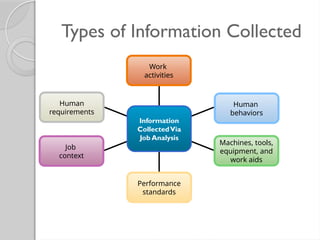
Types of Information Collected
Work
activities
Human
behaviors
Human
requirements
Job
context
Machines, tools,
equipment, and
work aids
Performance
standards
Information
CollectedVia
Job Analysis
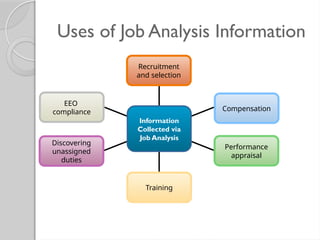
Uses of Job Analysis Information
Recruitment
and selection
Compensation
EEO
compliance
Discovering
unassigned
duties
Performance
appraisal
Training
Information
Collected via
Job Analysis
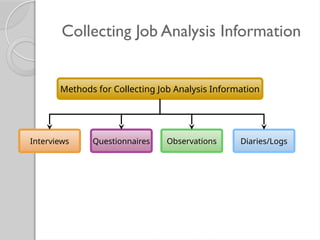
Collecting Job Analysis Information
Interviews Questionnaires Observations
Methods for Collecting Job Analysis Information
Diaries/Logs
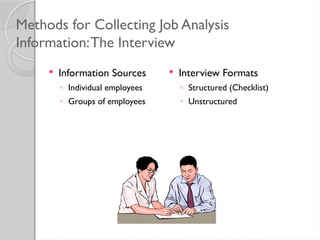
Methods for Collecting Job Analysis
Information:The Interview
 Information Sources
◦ Individual employees
◦ Groups of employees
 Interview Formats
◦ Structured (Checklist)
◦ Unstructured
Methods for Collecting Job Analysis
Information: Questionnaires
 Questionnaire Formats
◦ Structured checklists
◦ Open-ended questions
Methods for Collecting Job Analysis
Information: Observation
 Information Source
Observing and noting the physical activities of
employees as they go about their jobs by
managers.
Methods for Collecting Job Analysis
Information: Participant Diaries/Logs
 Information Source - Workers keep a
chronological diary or log of what they do and
the time spent on each activity
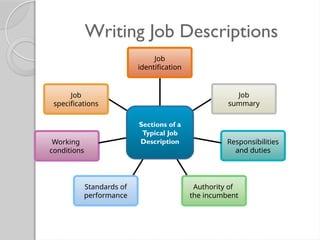
Writing Job Descriptions
Job
identification
Job
summary
Responsibilities
and duties
Authority of
the incumbent
Standards of
performance
Working
conditions
Job
specifications
Sections of a
Typical Job
Description
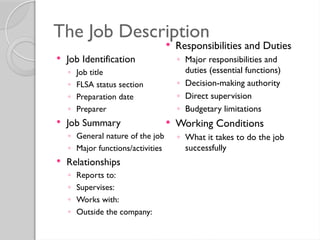
The Job Description
 Job Identification
◦ Job title
◦ FLSA status section
◦ Preparation date
◦ Preparer
 Job Summary
◦ General nature of the job
◦ Major functions/activities
 Relationships
◦ Reports to:
◦ Supervises:
◦ Works with:
◦ Outside the company:
 Responsibilities and Duties
◦ Major responsibilities and
duties (essential functions)
◦ Decision-making authority
◦ Direct supervision
◦ Budgetary limitations
 Working Conditions
◦ What it takes to do the job
successfully
10/02/2024 13
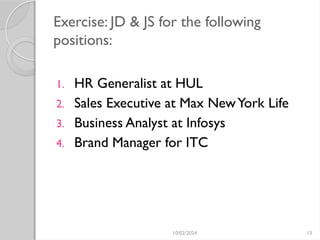
Exercise: JD & JS for the following
positions:
1. HR Generalist at HUL
2. Sales Executive at Max NewYork Life
3. Business Analyst at Infosys
4. Brand Manager for ITC

Lecture_3_Job_Analysis.pptx job descript

  • 1.
  • 2.
    10/02/2024 2 Job AnalysisIs -  The procedure of determining the duties and skill requirements of a job and the kind of person to be hired.  The systematic process of collecting information that identifies similarities and differences in work
  • 3.
    10/02/2024 3 Job AnalysisProduces Information -  Job Descriptions: summary reports that identify, define and describe the job as it is actually performed.  Job Specification: summary reports that identify and describe the specification of the employee.  Job Evaluation: comparison of jobs within an organization/jobs
  • 4.
    Types of InformationCollected Work activities Human behaviors Human requirements Job context Machines, tools, equipment, and work aids Performance standards Information CollectedVia Job Analysis
  • 5.
    Uses of JobAnalysis Information Recruitment and selection Compensation EEO compliance Discovering unassigned duties Performance appraisal Training Information Collected via Job Analysis
  • 6.
    Collecting Job AnalysisInformation Interviews Questionnaires Observations Methods for Collecting Job Analysis Information Diaries/Logs
  • 7.
    Methods for CollectingJob Analysis Information:The Interview  Information Sources ◦ Individual employees ◦ Groups of employees  Interview Formats ◦ Structured (Checklist) ◦ Unstructured
  • 8.
    Methods for CollectingJob Analysis Information: Questionnaires  Questionnaire Formats ◦ Structured checklists ◦ Open-ended questions
  • 9.
    Methods for CollectingJob Analysis Information: Observation  Information Source Observing and noting the physical activities of employees as they go about their jobs by managers.
  • 10.
    Methods for CollectingJob Analysis Information: Participant Diaries/Logs  Information Source - Workers keep a chronological diary or log of what they do and the time spent on each activity
  • 11.
    Writing Job Descriptions Job identification Job summary Responsibilities andduties Authority of the incumbent Standards of performance Working conditions Job specifications Sections of a Typical Job Description
  • 12.
    The Job Description Job Identification ◦ Job title ◦ FLSA status section ◦ Preparation date ◦ Preparer  Job Summary ◦ General nature of the job ◦ Major functions/activities  Relationships ◦ Reports to: ◦ Supervises: ◦ Works with: ◦ Outside the company:  Responsibilities and Duties ◦ Major responsibilities and duties (essential functions) ◦ Decision-making authority ◦ Direct supervision ◦ Budgetary limitations  Working Conditions ◦ What it takes to do the job successfully
  • 13.
    10/02/2024 13 Exercise: JD& JS for the following positions: 1. HR Generalist at HUL 2. Sales Executive at Max NewYork Life 3. Business Analyst at Infosys 4. Brand Manager for ITC

Editor's Notes

  • #4 Actual work activities of the job—how, why, and when the worker performs each activity. Human behaviors the job requires: communicating, deciding, and writing, lifting weights or walking long distances. Machines, tools, equipment, and work aids used on the job: tools used, materials processed, knowledge dealt with or applied, and services rendered. Standards of expected employee job performance: quantity and\or quality output levels that can be used to appraise employees. The organizational and social context in which the job exists: physical working conditions, work schedules, and incentives The job’s human requirements: job-related knowledge or skills (education, training, work experience) and required personal attributes (aptitudes, physical characteristics, personality, interests).
  • #5 Job analysis provides the information required for other organizational activities that depend on and also support the job. Job analysis provides required duties and desired human characteristics information needed to effectively Recruit and Select individuals for jobs. Compensation factors such as skill and education level, safety hazards, degree of responsibility, and so on are assessed by job analysis. Knowledge of specific duties and requisite skills of a job is required for proper Training of employees. Correctly conducting a Performance Appraisal requires knowledge of the job’s duties and standard. Job analysis is a method for Discovering Unassigned Duties that should become a formal part of a job. Job analysis is required to validate essential job functions and other HRM for Equal Employment Opportunity Compliance under the Uniform Guidelines on Employee Selection.
  • #6 There are various ways to collect information on a job’s duties, responsibilities, and activities. In practice, you could use any one of them, or combine several. The basic rule is to use those that best fit your purpose. Interviews, questionnaires, observations, and diaries/logs are the most popular methods for gathering realistic information about what job incumbents actually do. Managers use these methods for developing job descriptions and job specifications.
  • #7 Job analysis interviews range from completely unstructured interviews to highly structured ones containing hundreds of specific items to check off. Managers may conduct individual interviews with each employee, group interviews with groups of employees who have the same job, and/or supervisor interviews with one or more supervisors who know the job. Distortion of information is interviewing’s main problem—whether due to outright falsification, honest misunderstanding, or statements inflating the importance of their jobs by interviewees.
  • #8 Questionnaires can be structured or opened-ended. A questionnaire is a quick, efficient, and cost-effective way to obtain information from a large number of employees. However, developing the questionnaire and testing it to make sure the workers understand the questions can be time consuming. And as with interviews, employees may distort their answers, consciously or unconsciously.
  • #9 Direct observation is especially useful when jobs consist mainly of observable physical activities. Observation is usually not appropriate when the job entails a lot of mental activity or if the employee only occasionally engages in important activities. Reactivity—the worker’s changing what he or she normally does because you are watching—can also be a problem.
  • #10 Workers are asked to keep a record of what they do during the day by writing a diary/log. Employees record each of their activities (along with the time) in a log. This can produce a very complete picture of the job, especially when supplemented with subsequent interviews with the worker and the supervisor. The employee, of course, might try to exaggerate some activities and underplay others. However, the detailed, chronological nature of the log tends to mediate against this. Diaries/logs have gone high-tech. Some firms give employees pocket dictating machines and pagers. Then at random times during the day, they page the workers, who dictate what they are doing at that time. This approach can avoid one pitfall of the traditional diary/log method: relying on workers to remember what they did hours earlier when they complete their logs at the end of the day.
  • #11 There is no standard format for writing a job description. However, most descriptions contain sections that cover: 1. Job identification 2. Job summary 3. Responsibilities and duties 4. Authority of incumbent 5. Standards of performance 6. Working conditions 7. Job specifications
  • #12  A job description is a written statement of what the worker actually does, how he or she does it, and what the job’s working conditions are. You use this information to write a job specification; this lists the knowledge, abilities, and skills required to perform the job satisfactorily.