Communication In
Negotiation
Communication in Negotiation
Communication processes, both verbal
and nonverbal, are critical to
achieving negotiation goals and to
resolving conflicts.
What is Communicated
during Negotiation?
Offers, counteroffers, and motives
Information about alternatives
Information about outcomes
Communication about process
Communication in Negotiation:
Three Key Questions
Are negotiators consistent or adaptive?
Does it matter what is said early in the process?
Is more information always better?
How People Communicate
in Negotiation
Use of language operates at two levels:
Logical level (proposals, offers)
Pragmatic level (semantics, syntax, style)
Use of nonverbal communication
Making eye contact
Adjusting body position
Nonverbally encouraging or discouraging what
the other says
How People Communicate
in Negotiation
Selection of a communication channel
 Communication is experienced differently when it occurs
through different channels
 People negotiate through a variety of communication
media –
 Social bandwidth distinguishes one communication
channel from another.
How to Improve
Communication in Negotiation
Three main techniques:
1. The use of questions
2. Listening
3. Role reversal
How to Improve
Communication in Negotiation
Use of questions: two basic categories
Manageable questions
cause attention or prepare the other person’s
thinking for further questions:
“May I ask you a question?”
getting information
“How much will this cost?”
generating thoughts
“Do you have any suggestions for improving
this?”
6-8
How to Improve Communication in
Negotiation
Use of questions: two basic categories
Unmanageable questions
cause difficulty
“Where did you get that dumb idea?”
give information
“Didn’t you know we couldn’t afford this?”
 bring the discussion to a false conclusion
“Don’t you think we have talked about this
enough?”
6-9
How to Improve Communication in Negotiation
Listening: three major forms
1. Passive listening: Receiving the message
while providing no feedback to the sender
2. Acknowledgment: Receivers nod their heads,
maintain eye contact, or interject responses
3. Active listening: Receivers restate or
paraphrase the sender’s message in their own
language
6-10
How to Improve
Communication in Negotiation
 Role reversal
 Negotiators understand the other party’s positions
by actively arguing these positions until the other
party is convinced that he or she is understood
 Impact and success of the role-reversal technique
6-11
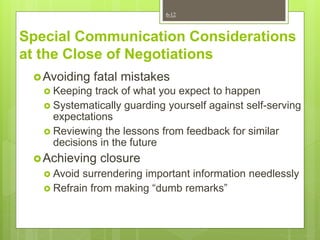
Special Communication Considerations
at the Close of Negotiations
Avoiding fatal mistakes
 Keeping track of what you expect to happen
 Systematically guarding yourself against self-serving
expectations
 Reviewing the lessons from feedback for similar
decisions in the future
Achieving closure
 Avoid surrendering important information needlessly
 Refrain from making “dumb remarks”
6-12

Communication in negotiation process.ppt

  • 1.
  • 2.
    Communication in Negotiation Communicationprocesses, both verbal and nonverbal, are critical to achieving negotiation goals and to resolving conflicts.
  • 3.
    What is Communicated duringNegotiation? Offers, counteroffers, and motives Information about alternatives Information about outcomes Communication about process
  • 4.
    Communication in Negotiation: ThreeKey Questions Are negotiators consistent or adaptive? Does it matter what is said early in the process? Is more information always better?
  • 5.
    How People Communicate inNegotiation Use of language operates at two levels: Logical level (proposals, offers) Pragmatic level (semantics, syntax, style) Use of nonverbal communication Making eye contact Adjusting body position Nonverbally encouraging or discouraging what the other says
  • 6.
    How People Communicate inNegotiation Selection of a communication channel  Communication is experienced differently when it occurs through different channels  People negotiate through a variety of communication media –  Social bandwidth distinguishes one communication channel from another.
  • 7.
    How to Improve Communicationin Negotiation Three main techniques: 1. The use of questions 2. Listening 3. Role reversal
  • 8.
    How to Improve Communicationin Negotiation Use of questions: two basic categories Manageable questions cause attention or prepare the other person’s thinking for further questions: “May I ask you a question?” getting information “How much will this cost?” generating thoughts “Do you have any suggestions for improving this?” 6-8
  • 9.
    How to ImproveCommunication in Negotiation Use of questions: two basic categories Unmanageable questions cause difficulty “Where did you get that dumb idea?” give information “Didn’t you know we couldn’t afford this?”  bring the discussion to a false conclusion “Don’t you think we have talked about this enough?” 6-9
  • 10.
    How to ImproveCommunication in Negotiation Listening: three major forms 1. Passive listening: Receiving the message while providing no feedback to the sender 2. Acknowledgment: Receivers nod their heads, maintain eye contact, or interject responses 3. Active listening: Receivers restate or paraphrase the sender’s message in their own language 6-10
  • 11.
    How to Improve Communicationin Negotiation  Role reversal  Negotiators understand the other party’s positions by actively arguing these positions until the other party is convinced that he or she is understood  Impact and success of the role-reversal technique 6-11
  • 12.
    Special Communication Considerations atthe Close of Negotiations Avoiding fatal mistakes  Keeping track of what you expect to happen  Systematically guarding yourself against self-serving expectations  Reviewing the lessons from feedback for similar decisions in the future Achieving closure  Avoid surrendering important information needlessly  Refrain from making “dumb remarks” 6-12