Philosophical
Views in Nursing
OBJECTIVES
• To understand the meaning of philosophy
and relay it to nursing profession
• To understand the philosophy behind nursing
practice and nursing education
• To explain the significance of philosophy of
nursing
• To determine the purposes of philosophy
• To elaborate the 2 approaches to philosophy
development
PHILOSOPHY
• Is defined as “love and pursuit of wisdom by
intellectual means and moral-discipline”.
• Is a science that comprises logic, ethics,
aesthetics, metaphysics, and the theory of
knowledge.
• Set of beliefs and values that guide the way
in which we operate in the world.
• Is a statement of beliefs that guide one’s
behavior and, in case, influence the practice
of nursing.
SIGNIFICANCE OF PHILOSOPHY
FOR NURSING
• To achieve intellectual enlightenment
• The individual is afforded an
opportunity to exercise both
understanding and value judgments
• Sciences benefit from philosophy
essentially because philosophy governs
their methods through logic and ethics
APPROACHES TO PHILOSOPHY
DEVELOPMENT
• Top-Down Approach = imposed by the
managerial system and is a reflection of
organizational beliefs, which are not
necessarily applicable to the nursing
care.
• Bottom-Up Approach = people will have
to use the philosophy who are involved
in writing it
PHILOSOPHY OF NURSING
EDUCATION
• Period of Intuitive Nursing / Medieval
Period (Primitive Era)
• Apprentice Nursing / Middle Ages
(1848)
• Period of Educated Nursing /
Nightingale Era (1900)
• Period of Contemporary Nursing / 20th
Century
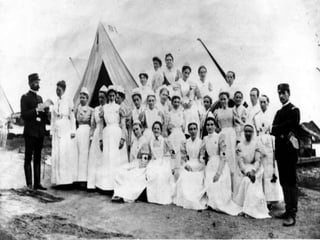
Period of Intuitive Nursing/Medieval
Period (Primitive Era)
Apprentice Nursing / Middle Ages
Famous Nursing Philosophers
Florence Nightingale
(1820 –1910)
“keeping the client warm,
maintaining a noise-free
environment, and
attending to the client’s
diet in terms of assessing
intake, timeliness of the
food and its effect on the
person”.
Famous Nursing Philosophers
• Mary Seacole
(1805 – 1881)
Jamaican healer or
'doctress' with expertise
in tending victims of
cholera and yellow fever
epidemics during
Crimean War
Famous Nursing Philosophers
• Hildegard Peplau
(1909–1999)
“There must be a nurse-
patient relationship and to
help clients fulfill their
needs, nurses must
assumes many roles;
stranger, teacher, resource
person, surrogate, leader
and counselor”.
Famous Nursing Philosophers
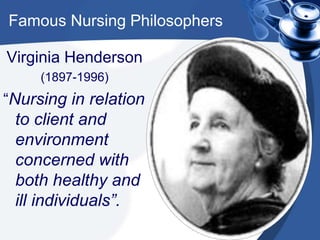
Virginia Henderson
(1897-1996)
“Nursing in relation
to client and
environment
concerned with
both healthy and
ill individuals”.
Famous Nursing Philosophers
Dorothy Johnson
(1905–1984)
• the science and
art of nursing
should focus on
the clients, not
on the disease
process itself
Famous Nursing Philosophers
Imogene King
(1923–2007)
“the nursing domain
involves human beings,
families, and
communities as a
framework within which
nurses make
transactions in multiple
environments with
health as a goal”.
Famous Nursing Philosophers
Martha Elizabeth
Rogers
(1914-1994)
• “Humans are dynamic
energy fields in
continuous exchange
with environmental
fields, both of which
are infinite”.
Famous Nursing Philosophers
Lydia Eloise Hall
(1906-1969)
“The patient is
composed of
overlapping parts;
person (core),
pathologic state and
treatment (cure) and
body (care)”.
Famous Nursing Philosophers
Dorothea Orem
(1914–2007),
“ not only when nursing is
needed but also how people
can be assisted through five
methods of helping: acting or
doing for, guiding, teaching,
supporting, and providing an
environment that promotes
the individual’s abilities to
meet current and future
demands”.
Famous Nursing Philosophers
Sister Callista Roy
(1914)
“the process and the
outcome whereby the
thinking and feeling
person uses conscious
awareness and choice
to create human and
environmental
integration”
Famous Nursing Philosophers
Betty Neuman
(1921-2006)
“Client as an open system
consisting of a basic
structure or central core of
energy resources
(physiologic, psychological,
sociocultural,
developmental, and
spiritual) surrounded by
two concentric boundaries
or rings referred to as lines
of resistance
Famous Nursing Philosophers
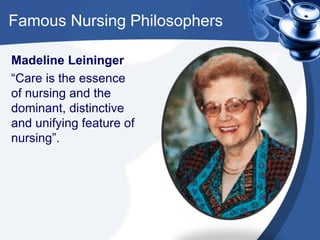
Madeline Leininger
“Care is the essence
of nursing and the
dominant, distinctive
and unifying feature of
nursing”.
Famous Nursing Philosophers
Rose Marie Risso
Parse
“Client, not the nurse is
the authority figure and
decision maker, the
nurse’s role involves
helping individuals and
families in choosing the
responsibilities for
changing the health
process”
Famous Nursing Philosophers
Margaret Newman
“Humans are unitary beings in
whom disease is a manifestation of
the pattern of health. every person
in every situation, no matter how
disordered and hopeless it may
seem, is part of the universal
process of expanding
consciousness – a process of
becoming more of oneself, of
finding greater meaning in life, and
of reaching new dimensions of
connectedness with other people
and the world
Famous Nursing Philosophers
Ida Jean Orlando
(1926)
She believed that
the nurse helps
patients meet a
perceived need that
the patients cannot
meet for
themselves.
Famous Nursing Philosophers
Jean Watson
“Philosophy
and Science of
Caring (1988)”
PHILOSOPHY AND SCIENCE OF
CARING
• The practice of caring is central to
nursing; it is the unifying focus for
practice
• Watson's idea of person contains the
beliefs that human have potential for
what they may become and are free to
make responsible choices.
10 PRIMARY CARATIVE FACTORS
1. The formation of a humanistic- altruistic
system of values.
2. The installation of faith-hope.
3. The cultivation of sensitivity to one’s self
and to others.
4. The development of a helping-trust
relationship
5. The promotion and acceptance of the
expression of positive and negative
feelings.
10 PRIMARY CARATIVE FACTORS
6. The systematic use of the scientific problem-
solving method for decision making
7. The promotion of interpersonal teaching-
learning.
8. The provision for a supportive, protective and
/or corrective mental, physical, socio-cultural
and spiritual environment.
9. Assistance with the gratification of human
needs.
10.The allowance for existential-
phenomenological forces.
That’s All Folks....c”,)

Philosophical views in nursing

  • 1.
  • 2.
    OBJECTIVES • To understandthe meaning of philosophy and relay it to nursing profession • To understand the philosophy behind nursing practice and nursing education • To explain the significance of philosophy of nursing • To determine the purposes of philosophy • To elaborate the 2 approaches to philosophy development
  • 3.
    PHILOSOPHY • Is definedas “love and pursuit of wisdom by intellectual means and moral-discipline”. • Is a science that comprises logic, ethics, aesthetics, metaphysics, and the theory of knowledge. • Set of beliefs and values that guide the way in which we operate in the world. • Is a statement of beliefs that guide one’s behavior and, in case, influence the practice of nursing.
  • 4.
    SIGNIFICANCE OF PHILOSOPHY FORNURSING • To achieve intellectual enlightenment • The individual is afforded an opportunity to exercise both understanding and value judgments • Sciences benefit from philosophy essentially because philosophy governs their methods through logic and ethics
  • 5.
    APPROACHES TO PHILOSOPHY DEVELOPMENT •Top-Down Approach = imposed by the managerial system and is a reflection of organizational beliefs, which are not necessarily applicable to the nursing care. • Bottom-Up Approach = people will have to use the philosophy who are involved in writing it
  • 6.
    PHILOSOPHY OF NURSING EDUCATION •Period of Intuitive Nursing / Medieval Period (Primitive Era) • Apprentice Nursing / Middle Ages (1848) • Period of Educated Nursing / Nightingale Era (1900) • Period of Contemporary Nursing / 20th Century
  • 7.
    Period of IntuitiveNursing/Medieval Period (Primitive Era)
  • 8.
  • 19.
    Famous Nursing Philosophers FlorenceNightingale (1820 –1910) “keeping the client warm, maintaining a noise-free environment, and attending to the client’s diet in terms of assessing intake, timeliness of the food and its effect on the person”.
  • 20.
    Famous Nursing Philosophers •Mary Seacole (1805 – 1881) Jamaican healer or 'doctress' with expertise in tending victims of cholera and yellow fever epidemics during Crimean War
  • 21.
    Famous Nursing Philosophers •Hildegard Peplau (1909–1999) “There must be a nurse- patient relationship and to help clients fulfill their needs, nurses must assumes many roles; stranger, teacher, resource person, surrogate, leader and counselor”.
  • 22.
    Famous Nursing Philosophers VirginiaHenderson (1897-1996) “Nursing in relation to client and environment concerned with both healthy and ill individuals”.
  • 23.
    Famous Nursing Philosophers DorothyJohnson (1905–1984) • the science and art of nursing should focus on the clients, not on the disease process itself
  • 24.
    Famous Nursing Philosophers ImogeneKing (1923–2007) “the nursing domain involves human beings, families, and communities as a framework within which nurses make transactions in multiple environments with health as a goal”.
  • 25.
    Famous Nursing Philosophers MarthaElizabeth Rogers (1914-1994) • “Humans are dynamic energy fields in continuous exchange with environmental fields, both of which are infinite”.
  • 26.
    Famous Nursing Philosophers LydiaEloise Hall (1906-1969) “The patient is composed of overlapping parts; person (core), pathologic state and treatment (cure) and body (care)”.
  • 27.
    Famous Nursing Philosophers DorotheaOrem (1914–2007), “ not only when nursing is needed but also how people can be assisted through five methods of helping: acting or doing for, guiding, teaching, supporting, and providing an environment that promotes the individual’s abilities to meet current and future demands”.
  • 28.
    Famous Nursing Philosophers SisterCallista Roy (1914) “the process and the outcome whereby the thinking and feeling person uses conscious awareness and choice to create human and environmental integration”
  • 29.
    Famous Nursing Philosophers BettyNeuman (1921-2006) “Client as an open system consisting of a basic structure or central core of energy resources (physiologic, psychological, sociocultural, developmental, and spiritual) surrounded by two concentric boundaries or rings referred to as lines of resistance
  • 30.
    Famous Nursing Philosophers MadelineLeininger “Care is the essence of nursing and the dominant, distinctive and unifying feature of nursing”.
  • 31.
    Famous Nursing Philosophers RoseMarie Risso Parse “Client, not the nurse is the authority figure and decision maker, the nurse’s role involves helping individuals and families in choosing the responsibilities for changing the health process”
  • 32.
    Famous Nursing Philosophers MargaretNewman “Humans are unitary beings in whom disease is a manifestation of the pattern of health. every person in every situation, no matter how disordered and hopeless it may seem, is part of the universal process of expanding consciousness – a process of becoming more of oneself, of finding greater meaning in life, and of reaching new dimensions of connectedness with other people and the world
  • 33.
    Famous Nursing Philosophers IdaJean Orlando (1926) She believed that the nurse helps patients meet a perceived need that the patients cannot meet for themselves.
  • 34.
    Famous Nursing Philosophers JeanWatson “Philosophy and Science of Caring (1988)”
  • 35.
    PHILOSOPHY AND SCIENCEOF CARING • The practice of caring is central to nursing; it is the unifying focus for practice • Watson's idea of person contains the beliefs that human have potential for what they may become and are free to make responsible choices.
  • 36.
    10 PRIMARY CARATIVEFACTORS 1. The formation of a humanistic- altruistic system of values. 2. The installation of faith-hope. 3. The cultivation of sensitivity to one’s self and to others. 4. The development of a helping-trust relationship 5. The promotion and acceptance of the expression of positive and negative feelings.
  • 37.
    10 PRIMARY CARATIVEFACTORS 6. The systematic use of the scientific problem- solving method for decision making 7. The promotion of interpersonal teaching- learning. 8. The provision for a supportive, protective and /or corrective mental, physical, socio-cultural and spiritual environment. 9. Assistance with the gratification of human needs. 10.The allowance for existential- phenomenological forces.
  • 38.