
Class 37:
Computability in
Theory and Practice


                        cs1120 Fall 2011
                            David Evans
                      21 November 2011
Plan
Questions for Exam 2
Computability Practice
Universal Languages (including Java)
Philosophical Discussion on Computability in
  Theory and Practice


                                               2
3
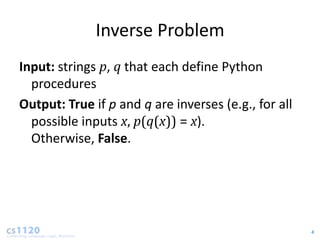
Inverse Problem
Input: strings p, q that each define Python
  procedures
Output: True if p and q are inverses (e.g., for all
  possible inputs x, p(q(x)) = x).
  Otherwise, False.


                                                      4
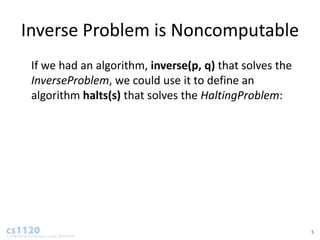
Inverse Problem is Noncomputable
 If we had an algorithm, inverse(p, q) that solves the
 InverseProblem, we could use it to define an
 algorithm halts(s) that solves the HaltingProblem:


                                                         5
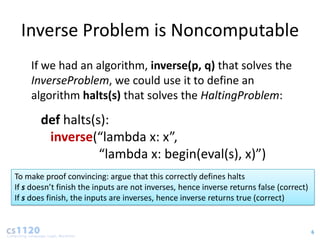
Inverse Problem is Noncomputable
    If we had an algorithm, inverse(p, q) that solves the
    InverseProblem, we could use it to define an
    algorithm halts(s) that solves the HaltingProblem:

       def halts(s):
        inverse(“lambda x: x”,
                  “lambda x: begin(eval(s), x)”)
To make proof convincing: argue that this correctly defines halts
If s doesn’t finish the inputs are not inverses, hence inverse returns false (correct)
If s does finish, the inputs are inverses, hence inverse returns true (correct)


                                                                                         6
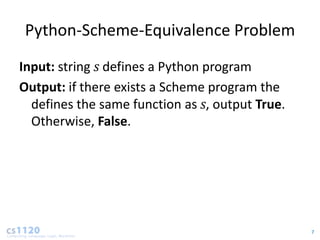
Python-Scheme-Equivalence Problem
Input: string s defines a Python program
Output: if there exists a Scheme program the
  defines the same function as s, output True.
  Otherwise, False.


                                                 7
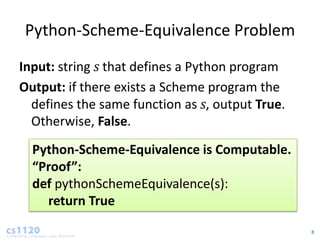
Python-Scheme-Equivalence Problem
Input: string s that defines a Python program
Output: if there exists a Scheme program the
  defines the same function as s, output True.
  Otherwise, False.
  Python-Scheme-Equivalence is Computable.
  “Proof”:
  def pythonSchemeEquivalence(s):
    return True

                                                 8
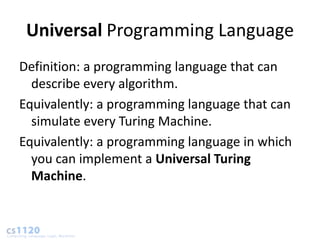
Universal Programming Language
Definition: a programming language that can
  describe every algorithm.
Equivalently: a programming language that can
  simulate every Turing Machine.
Equivalently: a programming language in which
  you can implement a Universal Turing
  Machine.
Are
Python, Scheme, Charme, Java,
     and Aazda Universal
  Programming Languages?


                                10
Yes!
Proof: implement a Turing Machine simulator in
  the language.

What do you need to simulate a TM?


                                                 11
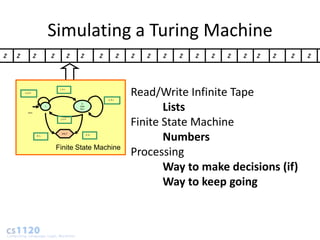
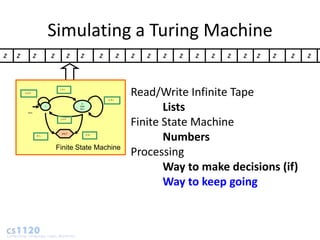
Simulating a Turing Machine
z   z              z                 z              z   z                 z             z   z   z   z   z   z   z   z   z   z   z   z   z


        ), #, R
                                          ), X, L


                                                                              (, #, L
                                                                                            Read/Write Infinite Tape
                                                                                                   Lists
                                                         2:
                                 1                      look
                                                        for (
           Start

                                          (, X, R

                                                                                            Finite State Machine
                       #, 1, -
                                            HALT                #, 0, -

                                                                                                   Numbers
                                         Finite State Machine
                                                                                            Processing
                                                                                                   Way to make decisions (if)
                                                                                                   Way to keep going
Can even simpler languages do this?


                                      13
Lambda Calculus
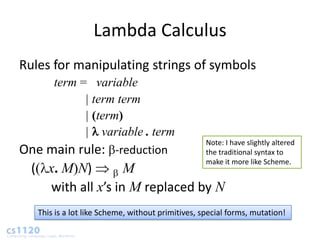
Rules for manipulating strings of symbols
     term = variable
           | term term
           | (term)
           | variable . term
                                                   Note: I have slightly altered
One main rule: -reduction                          the traditional syntax to
                                                   make it more like Scheme.
  (( x. M)N)        M
     with all x’s in M replaced by N
   This is a lot like Scheme, without primitives, special forms, mutation!
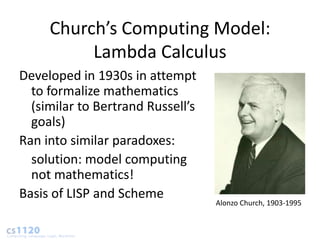
Church’s Computing Model:
          Lambda Calculus
Developed in 1930s in attempt
  to formalize mathematics
  (similar to Bertrand Russell’s
  goals)
Ran into similar paradoxes:
  solution: model computing
  not mathematics!
Basis of LISP and Scheme
                                   Alonzo Church, 1903-1995
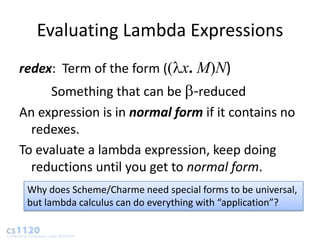
Evaluating Lambda Expressions
redex: Term of the form (( x. M)N)
     Something that can be -reduced
An expression is in normal form if it contains no
  redexes.
To evaluate a lambda expression, keep doing
  reductions until you get to normal form.
 Why does Scheme/Charme need special forms to be universal,
 but lambda calculus can do everything with “application”?
Simulating a Turing Machine
z   z              z                 z              z   z                 z             z   z   z   z   z   z   z   z   z   z   z   z   z


        ), #, R
                                          ), X, L


                                                                              (, #, L
                                                                                            Read/Write Infinite Tape
                                                                                                   Lists
                                                         2:
                                 1                      look
                                                        for (
           Start

                                          (, X, R

                                                                                            Finite State Machine
                       #, 1, -
                                            HALT                #, 0, -

                                                                                                   Numbers
                                         Finite State Machine
                                                                                            Processing
                                                                                                   Way to make decisions (if)
                                                                                                   Way to keep going
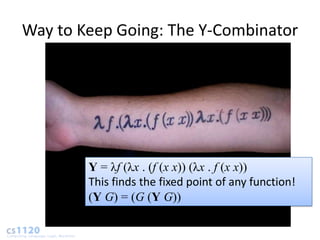
Way to Keep Going: The Y-Combinator


        Y = λf (λx . (f (x x)) (λx . f (x x))
        This finds the fixed point of any function!
        (Y G) = (G (Y G))
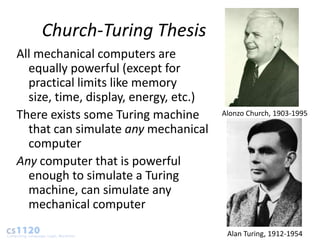
Church-Turing Thesis
All mechanical computers are
  equally powerful (except for
  practical limits like memory
  size, time, display, energy, etc.)
There exists some Turing machine       Alonzo Church, 1903-1995

  that can simulate any mechanical
  computer
Any computer that is powerful
  enough to simulate a Turing
  machine, can simulate any
  mechanical computer

                                        Alan Turing, 1912-1954
All universal programming
language are equivalent in power:
they can all simulate a TM, which
can carry out any mechanical
algorithm.
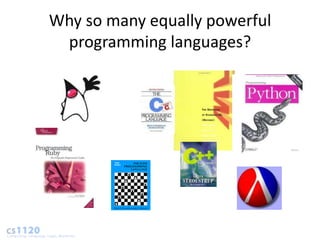
Why so many equally powerful
 programming languages?
Proliferation of Universal PLs
“Aesthetics”
   Some people like :=, others prefer =.
   Some people think whitespace shouldn’t matter
     (e.g., Java, Scheme), others think programs should be
     formatted like they mean (e.g., Python)
   Some people like goto (BASIC, C) others like throw
     (Java, Python)
Expressiveness vs. Simplicity
   Python is more expressive than Scheme
Expressiveness vs. “Truthiness”
   How much you can say with a little code vs. how likely it
    is your code means what you think it does
high                              Programming Language
                  x86
                                           Design Space
                        C
Expressiveness


                                      Scheme    (display “Hello!”)

                                      Python   print ("Hello!")


                  public class HelloWorld {                                  strict typing,
                    public static void main(String[] args) {       Java      static
                      System.out.println ("Hello!");
                    }                                                    Ada
    low           }                                                            Spec#
                 more mistake prone                               less mistake prone
                                           “Truthiness”
Leading Philosopher on
     Computability
 in Theory and Practice


 http://video.google.com/videoplay?docid=1623254076490030585#
 http://www.funny-videos.co.uk/videoAliGScienceVideo39.html
Ali G Problem
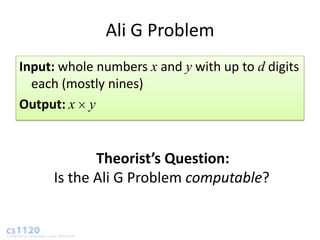
Ali G Problem
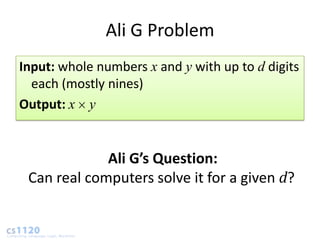
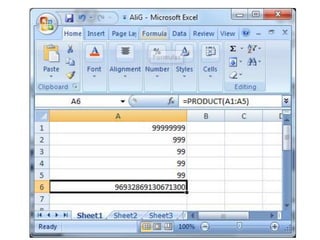
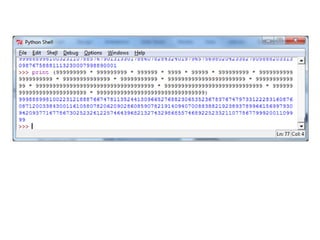
Input: whole numbers x and y with up to d digits
  each (mostly nines)
Output: x y


            Theorist’s Question:
     Is the Ali G Problem computable?
Multiplication is Computable


                               27
Ali G Problem
Input: whole numbers x and y with up to d digits
  each (mostly nines)
Output: x y


             Ali G’s Question:
 Can real computers solve it for a given d?
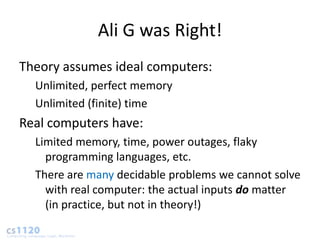
Ali G was Right!
Theory assumes ideal computers:
  Unlimited, perfect memory
  Unlimited (finite) time
Real computers have:
  Limited memory, time, power outages, flaky
    programming languages, etc.
  There are many decidable problems we cannot solve
    with real computer: the actual inputs do matter
    (in practice, but not in theory!)
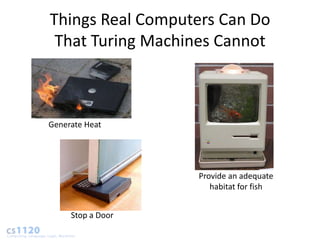
Things Real Computers Can Do
 That Turing Machines Cannot


Generate Heat


                   Provide an adequate
                      habitat for fish


     Stop a Door
flickrcc: martha_chapa95


         Happy Thanksgiving!
Don’t spend your Thanksgiving doing Exam 2! If you are well prepared, it should
only take a few hours. If you’re spending longer then that on it, you are doing
something wrong, or grossly misinterpreting the questions.

                                                                                  33

Class 37: Computability in Theory and Practice

  • 1.
    Class 37: Computability in Theoryand Practice cs1120 Fall 2011 David Evans 21 November 2011
  • 2.
    Plan Questions for Exam2 Computability Practice Universal Languages (including Java) Philosophical Discussion on Computability in Theory and Practice 2
  • 3.
  • 4.
    Inverse Problem Input: stringsp, q that each define Python procedures Output: True if p and q are inverses (e.g., for all possible inputs x, p(q(x)) = x). Otherwise, False. 4
  • 5.
    Inverse Problem isNoncomputable If we had an algorithm, inverse(p, q) that solves the InverseProblem, we could use it to define an algorithm halts(s) that solves the HaltingProblem: 5
  • 6.
    Inverse Problem isNoncomputable If we had an algorithm, inverse(p, q) that solves the InverseProblem, we could use it to define an algorithm halts(s) that solves the HaltingProblem: def halts(s): inverse(“lambda x: x”, “lambda x: begin(eval(s), x)”) To make proof convincing: argue that this correctly defines halts If s doesn’t finish the inputs are not inverses, hence inverse returns false (correct) If s does finish, the inputs are inverses, hence inverse returns true (correct) 6
  • 7.
    Python-Scheme-Equivalence Problem Input: strings defines a Python program Output: if there exists a Scheme program the defines the same function as s, output True. Otherwise, False. 7
  • 8.
    Python-Scheme-Equivalence Problem Input: strings that defines a Python program Output: if there exists a Scheme program the defines the same function as s, output True. Otherwise, False. Python-Scheme-Equivalence is Computable. “Proof”: def pythonSchemeEquivalence(s): return True 8
  • 9.
    Universal Programming Language Definition:a programming language that can describe every algorithm. Equivalently: a programming language that can simulate every Turing Machine. Equivalently: a programming language in which you can implement a Universal Turing Machine.
  • 10.
    Are Python, Scheme, Charme,Java, and Aazda Universal Programming Languages? 10
  • 11.
    Yes! Proof: implement aTuring Machine simulator in the language. What do you need to simulate a TM? 11
  • 12.
    Simulating a TuringMachine z z z z z z z z z z z z z z z z z z z z ), #, R ), X, L (, #, L Read/Write Infinite Tape Lists 2: 1 look for ( Start (, X, R Finite State Machine #, 1, - HALT #, 0, - Numbers Finite State Machine Processing Way to make decisions (if) Way to keep going
  • 13.
    Can even simplerlanguages do this? 13
  • 14.
    Lambda Calculus Rules formanipulating strings of symbols term = variable | term term | (term) | variable . term Note: I have slightly altered One main rule: -reduction the traditional syntax to make it more like Scheme. (( x. M)N) M with all x’s in M replaced by N This is a lot like Scheme, without primitives, special forms, mutation!
  • 15.
    Church’s Computing Model: Lambda Calculus Developed in 1930s in attempt to formalize mathematics (similar to Bertrand Russell’s goals) Ran into similar paradoxes: solution: model computing not mathematics! Basis of LISP and Scheme Alonzo Church, 1903-1995
  • 16.
    Evaluating Lambda Expressions redex:Term of the form (( x. M)N) Something that can be -reduced An expression is in normal form if it contains no redexes. To evaluate a lambda expression, keep doing reductions until you get to normal form. Why does Scheme/Charme need special forms to be universal, but lambda calculus can do everything with “application”?
  • 17.
    Simulating a TuringMachine z z z z z z z z z z z z z z z z z z z z ), #, R ), X, L (, #, L Read/Write Infinite Tape Lists 2: 1 look for ( Start (, X, R Finite State Machine #, 1, - HALT #, 0, - Numbers Finite State Machine Processing Way to make decisions (if) Way to keep going
  • 18.
    Way to KeepGoing: The Y-Combinator Y = λf (λx . (f (x x)) (λx . f (x x)) This finds the fixed point of any function! (Y G) = (G (Y G))
  • 19.
    Church-Turing Thesis All mechanicalcomputers are equally powerful (except for practical limits like memory size, time, display, energy, etc.) There exists some Turing machine Alonzo Church, 1903-1995 that can simulate any mechanical computer Any computer that is powerful enough to simulate a Turing machine, can simulate any mechanical computer Alan Turing, 1912-1954
  • 20.
    All universal programming languageare equivalent in power: they can all simulate a TM, which can carry out any mechanical algorithm.
  • 21.
    Why so manyequally powerful programming languages?
  • 22.
    Proliferation of UniversalPLs “Aesthetics” Some people like :=, others prefer =. Some people think whitespace shouldn’t matter (e.g., Java, Scheme), others think programs should be formatted like they mean (e.g., Python) Some people like goto (BASIC, C) others like throw (Java, Python) Expressiveness vs. Simplicity Python is more expressive than Scheme Expressiveness vs. “Truthiness” How much you can say with a little code vs. how likely it is your code means what you think it does
  • 23.
    high Programming Language x86 Design Space C Expressiveness Scheme (display “Hello!”) Python print ("Hello!") public class HelloWorld { strict typing, public static void main(String[] args) { Java static System.out.println ("Hello!"); } Ada low } Spec# more mistake prone less mistake prone “Truthiness”
  • 24.
    Leading Philosopher on Computability in Theory and Practice http://video.google.com/videoplay?docid=1623254076490030585# http://www.funny-videos.co.uk/videoAliGScienceVideo39.html
  • 25.
  • 26.
    Ali G Problem Input:whole numbers x and y with up to d digits each (mostly nines) Output: x y Theorist’s Question: Is the Ali G Problem computable?
  • 27.
  • 28.
    Ali G Problem Input:whole numbers x and y with up to d digits each (mostly nines) Output: x y Ali G’s Question: Can real computers solve it for a given d?
  • 31.
    Ali G wasRight! Theory assumes ideal computers: Unlimited, perfect memory Unlimited (finite) time Real computers have: Limited memory, time, power outages, flaky programming languages, etc. There are many decidable problems we cannot solve with real computer: the actual inputs do matter (in practice, but not in theory!)
  • 32.
    Things Real ComputersCan Do That Turing Machines Cannot Generate Heat Provide an adequate habitat for fish Stop a Door
  • 33.
    flickrcc: martha_chapa95 Happy Thanksgiving! Don’t spend your Thanksgiving doing Exam 2! If you are well prepared, it should only take a few hours. If you’re spending longer then that on it, you are doing something wrong, or grossly misinterpreting the questions. 33