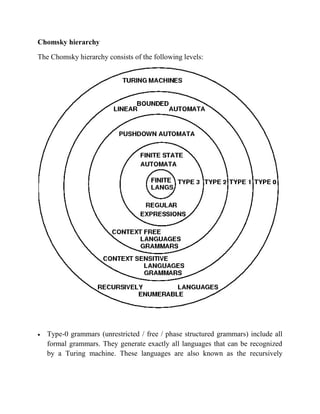
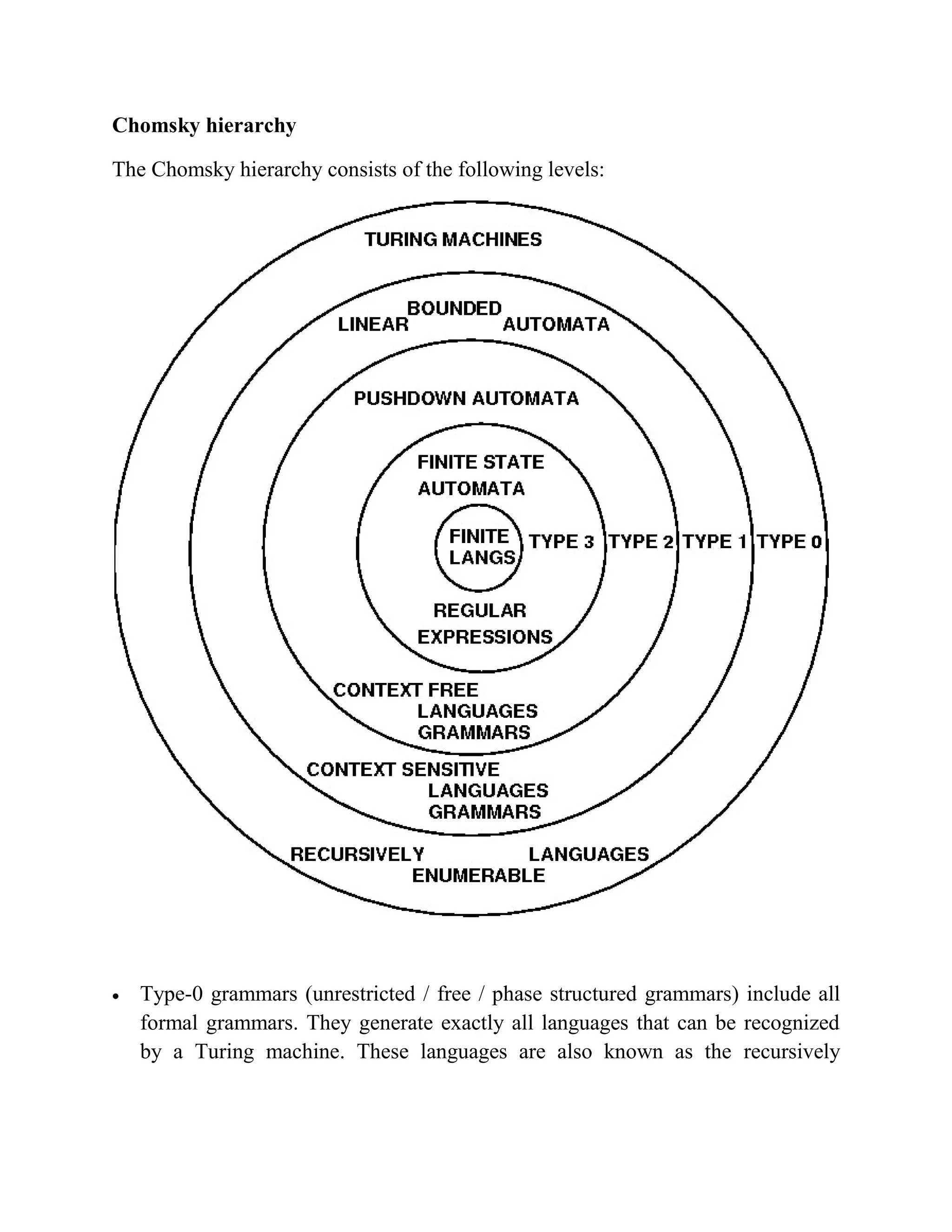
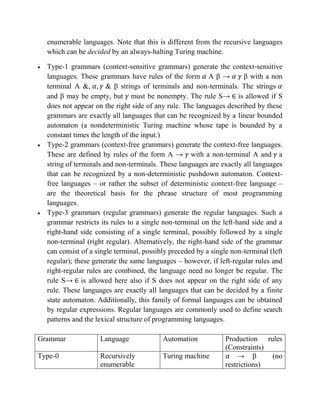
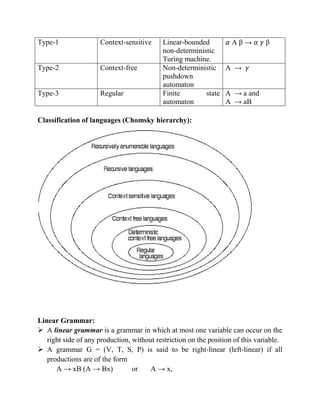
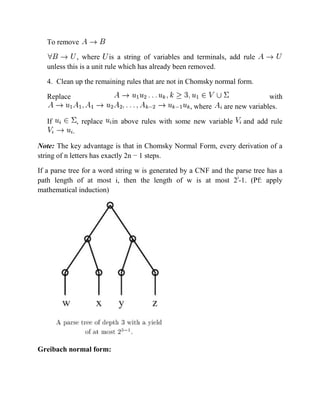
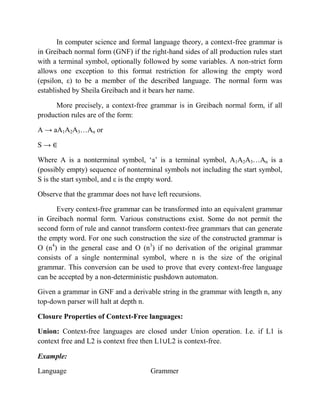
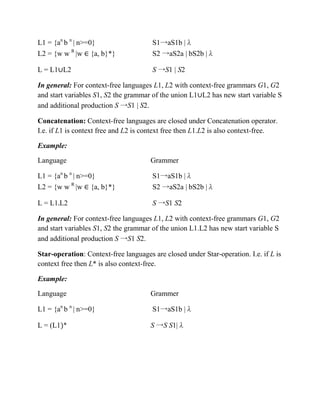
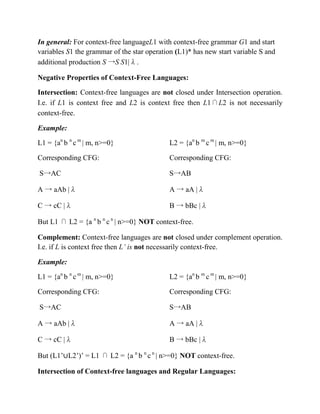
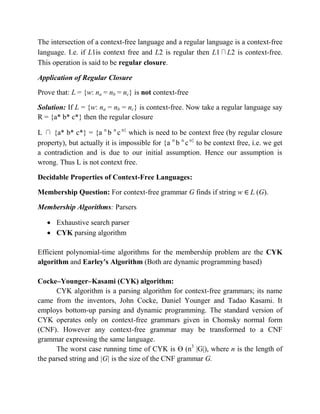
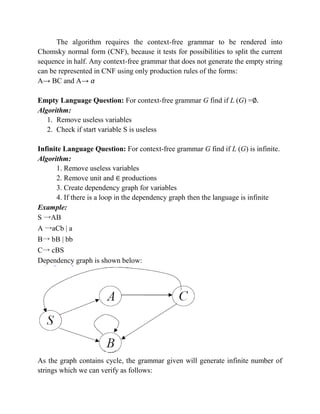
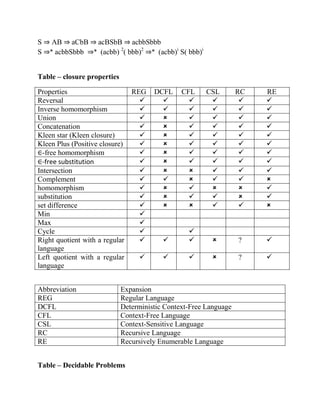
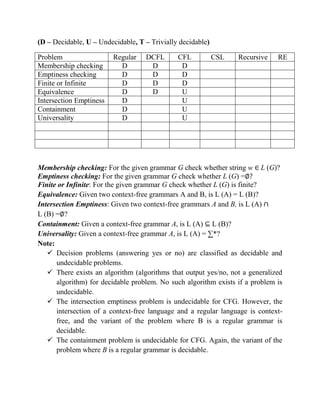
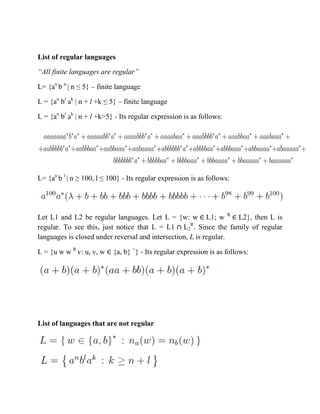
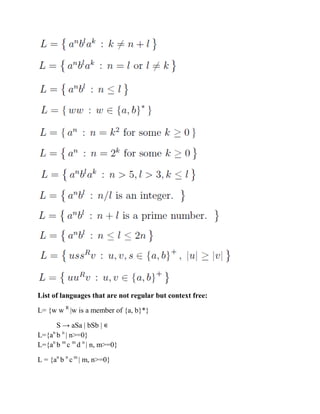
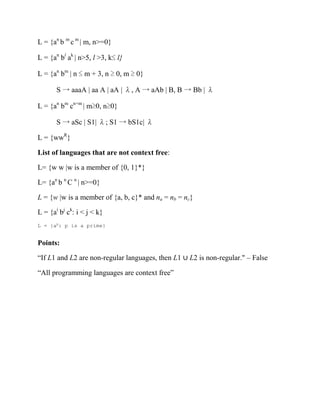
The Chomsky hierarchy classifies formal grammars into four types: type-0 (recursively enumerable languages recognized by Turing machines), type-1 (context-sensitive languages recognized by linear bounded automata), type-2 (context-free languages recognized by pushdown automata), and type-3 (regular languages recognized by finite state automata). Each type has specific production rules and language recognition capabilities, with context-free grammars being significant for programming languages and deterministic context-free languages allowing for efficient parsing. Key concepts such as the pumping lemma, a method to demonstrate language properties, and Chomsky normal form, a standardized format for context-free grammars, are also discussed.


![RegularLanguageProperties [Autosaved].pptx](https://cdn.slidesharecdn.com/ss_thumbnails/regularlanguagepropertiesautosaved-230716173745-f8e4bc8d-thumbnail.jpg?width=640&height=640&fit=bounds)


![[Deck] What's New in Spark-Iceberg Integration via DSV2.pptx](https://cdn.slidesharecdn.com/ss_thumbnails/deckwhatsnewinspark-icebergintegrationviadsv2-260210005337-25955b12-thumbnail.jpg?width=640&height=640&fit=bounds)


