Decidability
Decidable/Undecidable problems
Rama Bansal Decidability 2
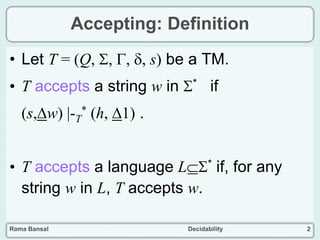
Accepting: Definition
• Let T = (Q, , , , s) be a TM.
• T accepts a string w in * if
(s,w) |-T
* (h, 1) .
• T accepts a language L* if, for any
string w in L, T accepts w.
Rama Bansal Decidability 3
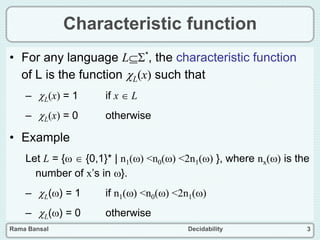
Characteristic function
• For any language L*, the characteristic function
of L is the function L(x) such that
– L(x) = 1 if x  L
– L(x) = 0 otherwise
• Example
Let L = {  {0,1}* | n1() <n0() <2n1() }, where nx() is the
number of x’s in }.
– L() = 1 if n1() <n0() <2n1()
– L() = 0 otherwise
Rama Bansal Decidability 4
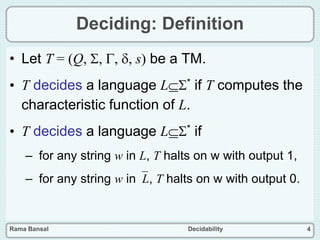
Deciding: Definition
• Let T = (Q, , , , s) be a TM.
• T decides a language L* if T computes the
characteristic function of L.
• T decides a language L* if
– for any string w in L, T halts on w with output 1,
– for any string w inL, T halts on w with output 0.
Rama Bansal Decidability 5
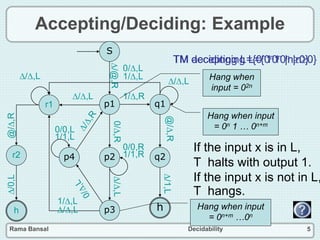
Accepting/Deciding: Example
1/,R
q2
h
q1
/1,L@/,R
/,L
S
p1
p4 p2
p3
/@,R0/,R
0/0,R
1/1,R
/,L
0/0,L
1/1,L
TM accepting L={0n10n |n0}
If the input x is in L,
T halts with output 1.
If the input x is not in L,
T hangs.
r1
/,L
1/,L
/,L
r2
h
@/,R/0,L
/,L
0/,L
1/,L
TM decidinging L={0n10n |n0}
Hang when
input = 02n
Hang when input
= 0n+m …0n
Hang when input
= 0n 1 … 0n+m
Rama Bansal Decidability 6
Recursively enumerable languages
• A language L is recursively enumerable if
there is a Turing machine T accepting L.
• A language L is Turing-acceptable if there is a
Turing machine T accepting L.
• Example:
{0n10n|n0} is a recursively-enumerable
language.
Rama Bansal Decidability 7
Recursive languages
• A language L is recursive if there is a Turing
machine T deciding L.
• A language L is Turing-decidable if there is a
Turing machine T deciding L.
• Example:
{0n10n|n0} is a recursive language.
Closure Properties of the Class of
Recursive Languages
Rama Bansal Decidability 9
Closure Property Under Complementation
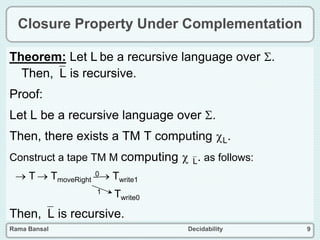
Theorem: Let L be a recursive language over .
Then,L is recursive.
Proof:
Let L be a recursive language over .
Then, there exists a TM T computing L.
Construct a tape TM M computing L. as follows:
 T  TmoveRight
0 Twrite1
1 Twrite0
Then,L is recursive.
Rama Bansal Decidability 10
Closure Property Under Union
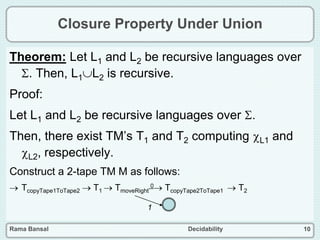
Theorem: Let L1 and L2 be recursive languages over
. Then, L1L2 is recursive.
Proof:
Let L1 and L2 be recursive languages over .
Then, there exist TM’s T1 and T2 computing L1 and
L2, respectively.
Construct a 2-tape TM M as follows:
 TcopyTape1ToTape2  T1  TmoveRight
0 TcopyTape2ToTape1  T2
1
Rama Bansal Decidability 11
Closure Property Under Union
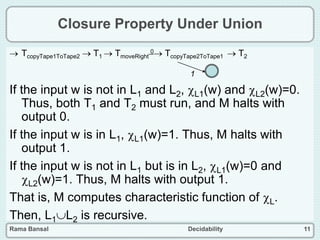
 TcopyTape1ToTape2  T1  TmoveRight
0 TcopyTape2ToTape1  T2
If the input w is not in L1 and L2, L1(w) and L2(w)=0.
Thus, both T1 and T2 must run, and M halts with
output 0.
If the input w is in L1, L1(w)=1. Thus, M halts with
output 1.
If the input w is not in L1 but is in L2, L1(w)=0 and
L2(w)=1. Thus, M halts with output 1.
That is, M computes characteristic function of L.
Then, L1L2 is recursive.
1
Rama Bansal Decidability 12
Closure Property Under Intersection
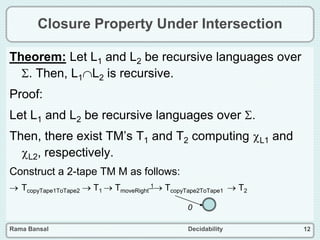
Theorem: Let L1 and L2 be recursive languages over
. Then, L1L2 is recursive.
Proof:
Let L1 and L2 be recursive languages over .
Then, there exist TM’s T1 and T2 computing L1 and
L2, respectively.
Construct a 2-tape TM M as follows:
 TcopyTape1ToTape2  T1  TmoveRight
1 TcopyTape2ToTape1  T2
0
Rama Bansal Decidability 13
Closure Property Under Intersection
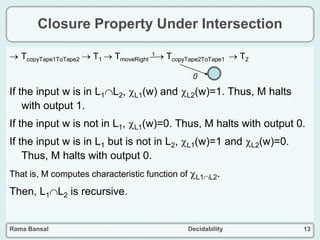
 TcopyTape1ToTape2  T1  TmoveRight
1 TcopyTape2ToTape1  T2
If the input w is in L1L2, L1(w) and L2(w)=1. Thus, M halts
with output 1.
If the input w is not in L1, L1(w)=0. Thus, M halts with output 0.
If the input w is in L1 but is not in L2, L1(w)=1 and L2(w)=0.
Thus, M halts with output 0.
That is, M computes characteristic function of L1L2.
Then, L1L2 is recursive.
0
Closure Properties of the Class of
Recursively Enumerable Languages
Rama Bansal Decidability 15
Closure Property Under Union
Theorem: Let L1 and L2 be recursively enumerable
languages over . Then, L1L2 is also recursively
enumerable.
Proof:
Let L1 and L2 be recursively enumerable languages
over .
Then, there exist TM’s T1 and T2 accepting L1 and L2,
respectively.
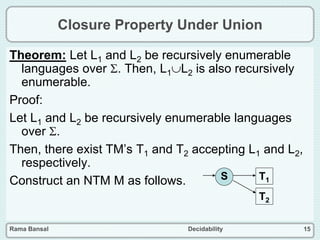
Construct an NTM M as follows. S T1
T2
Rama Bansal Decidability 16
Closure Property Under Union
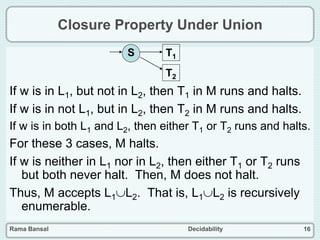
If w is in L1, but not in L2, then T1 in M runs and halts.
If w is in not L1, but in L2, then T2 in M runs and halts.
If w is in both L1 and L2, then either T1 or T2 runs and halts.
For these 3 cases, M halts.
If w is neither in L1 nor in L2, then either T1 or T2 runs
but both never halt. Then, M does not halt.
Thus, M accepts L1L2. That is, L1L2 is recursively
enumerable.
S T1
T2
Rama Bansal Decidability 17
Closure Property Under Intersection
Theorem: Let L1 and L2 be recursively enumerable
languages over . Then, L1L2 is also recursively
enumerable.
Proof:
Let L1 and L2 be recursively enumerable languages
over .
Then, there exist TM’s T1 and T2 accepting L1 and L2,
respectively.
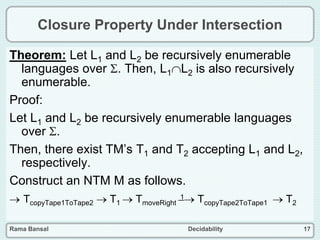
Construct an NTM M as follows.
 TcopyTape1ToTape2  T1  TmoveRight
1 TcopyTape2ToTape1  T2
Rama Bansal Decidability 18
Closure Property Under Intersection
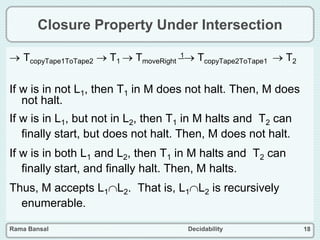
 TcopyTape1ToTape2  T1  TmoveRight
1 TcopyTape2ToTape1  T2
If w is in not L1, then T1 in M does not halt. Then, M does
not halt.
If w is in L1, but not in L2, then T1 in M halts and T2 can
finally start, but does not halt. Then, M does not halt.
If w is in both L1 and L2, then T1 in M halts and T2 can
finally start, and finally halt. Then, M halts.
Thus, M accepts L1L2. That is, L1L2 is recursively
enumerable.
Rama Bansal Decidability 19
Closure Property Under Union (II)
Theorem: Let L1 and L2 be recursively enumerable
languages over . Then, L1L2 is also recursively
enumerable.
Proof:
Let L1 and L2 be recursively enumerable languages over
.
Then, there exist DTM’s T1 =(Q1, , , 1, s1) and T2 =(Q2,
, , 2, s2) accepting L1 and L2, respectively.
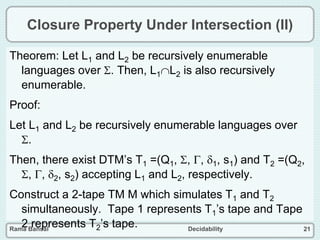
Construct a 2-tape TM M which simulates T1 and T2
simultaneously. Tape 1 represents T1’s tape and Tape
2 represents T2’s tape.
Rama Bansal Decidability 20
Closure Property Under Union (II)
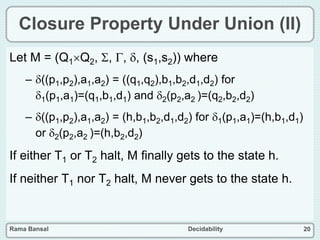
Let M = (Q1Q2, , , , (s1,s2)) where
– ((p1,p2),a1,a2) = ((q1,q2),b1,b2,d1,d2) for
1(p1,a1)=(q1,b1,d1) and 2(p2,a2 )=(q2,b2,d2)
– ((p1,p2),a1,a2) = (h,b1,b2,d1,d2) for 1(p1,a1)=(h,b1,d1)
or 2(p2,a2 )=(h,b2,d2)
If either T1 or T2 halt, M finally gets to the state h.
If neither T1 nor T2 halt, M never gets to the state h.
Rama Bansal Decidability 21
Closure Property Under Intersection (II)
Theorem: Let L1 and L2 be recursively enumerable
languages over . Then, L1L2 is also recursively
enumerable.
Proof:
Let L1 and L2 be recursively enumerable languages over
.
Then, there exist DTM’s T1 =(Q1, , , 1, s1) and T2 =(Q2,
, , 2, s2) accepting L1 and L2, respectively.
Construct a 2-tape TM M which simulates T1 and T2
simultaneously. Tape 1 represents T1’s tape and Tape
2 represents T2’s tape.
Rama Bansal Decidability 22
Closure Property Under Intersection (II)
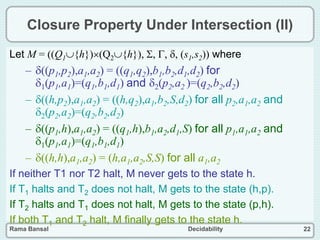
Let M = ((Q1{h})(Q2{h}), , , , (s1,s2)) where
– ((p1,p2),a1,a2) = ((q1,q2),b1,b2,d1,d2) for
1(p1,a1)=(q1,b1,d1) and 2(p2,a2 )=(q2,b2,d2)
– ((h,p2),a1,a2) = ((h,q2),a1,b2,S,d2) for all p2,a1,a2 and
2(p2,a2)=(q2,b2,d2)
– ((p1,h),a1,a2) = ((q1,h),b1,a2,d1,S) for all p1,a1,a2 and
1(p1,a1)=(q1,b1,d1)
– ((h,h),a1,a2) = (h,a1,a2,S,S) for all a1,a2
If neither T1 nor T2 halt, M never gets to the state h.
If T1 halts and T2 does not halt, M gets to the state (h,p).
If T2 halts and T1 does not halt, M gets to the state (p,h).
If both T1 and T2 halt, M finally gets to the state h.
Relationship Between the Classes of
Recursively Enumerable and
Recursive Languages
Rama Bansal Decidability 24
Relationship between RE and Recursive
Languages
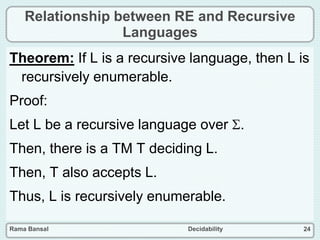
Theorem: If L is a recursive language, then L is
recursively enumerable.
Proof:
Let L be a recursive language over .
Then, there is a TM T deciding L.
Then, T also accepts L.
Thus, L is recursively enumerable.
Rama Bansal Decidability 25
Relationship between RE and Recursive
Languages
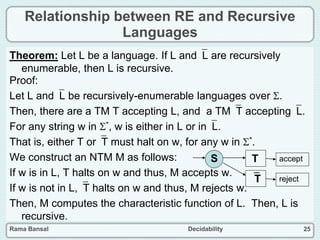
Theorem: Let L be a language. If L andL are recursively
enumerable, then L is recursive.
Proof:
Let L andL be recursively-enumerable languages over .
Then, there are a TM T accepting L, and a TMT acceptingL.
For any string w in *, w is either in L or inL.
That is, either T orT must halt on w, for any w in *.
We construct an NTM M as follows:
If w is in L, T halts on w and thus, M accepts w.
If w is not in L,T halts on w and thus, M rejects w.
Then, M computes the characteristic function of L. Then, L is
recursive.
S T
T
accept
reject
Rama Bansal Decidability 26
Decision Problems
• A decision problem is a prob. whose ans. is either
yes or no
• A yes-instance (or no-instance) of a problem P is
the instance of P whose answer is yes (or no,
respectively)
• A decision problem P can be encoded by fe over 
as a language {fe(X)| X is a yes-instance of P}.
Rama Bansal Decidability 27
Encoding of decision problems
• Is X a prime ?
{1X | X is a prime}
• Does TM T accept string e(T)?
{e(T) | T is a TM accepting string e(T)}
• Does TM T accept string w?
{e(T)e(w) | T is a TM accepting string w} or
{<T,w> | T is a TM accepting string w}
Rama Bansal Decidability 28
Decidable (or solvable) problems
Definition:
If fe is a reasonable encoding of a decision
problem P over , we say P is decidable (or
solvable) if the associated language {fe(X)| X
is a yes-instance of P} is recursive.
A problem P is undecidable (or unsolvable) if
P is not decidable.
Rama Bansal Decidability 29
Self-Accepting
• SA (Self-accepting) = {w{0,1,#, ,}*| w=e(T)
for some TM T and wL(T)}
• NSA (Non-self-accepting) = {w {0,1,#, ,}*|
w=e(T) for some TM T and wL(T)}
• E (Encoded-TM) = {w{0,1,#, ,}*| w=e(T) for
some TM T}
Rama Bansal Decidability 30
NSA is not recursively enumerable
We prove by contradiction.
Assume NSA is recursively enumerable.
Then, there is TM T0 such that L(T0)=NSA.
Is e(T0) in NSA?
– If e(T0)NSA, then e(T0)L(T0) by the definition of NSA
But L(T0)=NSA. Thus, contradiction.
– If e(T0) NSA, then e(T0) SA and e(T0)L(T0) by the
definition of SA. But L(T0)=NSA. Thus, contradiction.
Then, the assumption is false.
That is, NSA is not recursively enumerable.
Rama Bansal Decidability 31
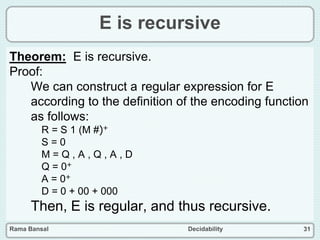
E is recursive
Theorem: E is recursive.
Proof:
We can construct a regular expression for E
according to the definition of the encoding function
as follows:
R = S 1 (M #)+
S = 0
M = Q , A , Q , A , D
Q = 0+
A = 0+
D = 0 + 00 + 000
Then, E is regular, and thus recursive.
Rama Bansal Decidability 32
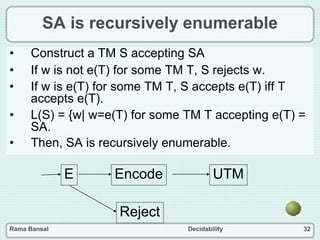
SA is recursively enumerable
• Construct a TM S accepting SA
• If w is not e(T) for some TM T, S rejects w.
• If w is e(T) for some TM T, S accepts e(T) iff T
accepts e(T).
• L(S) = {w| w=e(T) for some TM T accepting e(T) =
SA.
• Then, SA is recursively enumerable.
E UTM
Reject
Encode
Rama Bansal Decidability 33
SA is not recursive
• NSA = E – SA
• NSA is not recursively enumerable (from previous
theorem), and thus not recursive.
• But E is recursive.
• From the closure property, if L1 and L2 are
recursive, then L1 - L2 is recursive.
• Using its contrapositive, if L1 - L2 is not recursive,
then L1 or L2 are not recursive.
• Since NSA is not recursive and E is recursive, SA is
not recursive.
Rama Bansal Decidability 34
Co-R.E.
Definition
• A language L is co-R.E. if its complement L is R.E.
• It does not mean L is not R.E.
Examples:
• SA is R.E. SA=ENSA is not R.E.
– SA is co-R.E., but not R.E.
• NSA is not R.E. NSA=ESA is R.E.
– NSA is co-R.E., but not R.E.
• E is recursive, R.E., and co-R.E.
Rama Bansal Decidability 35
Relationship between R.E., co-R.E. and Recursive
Languages
Theorem: Let L be any language. L is R.E. and co-
R.E. iff L is recursive.
Proof:
• () Let L be R.E. and co-R.E. Then, L is R.E.
Thus, L is recursive.
• () Let L be recursive. Then, L is R.E. From the
closure under complementation of the class of
recursive languages,L is also recursive. Then, L
is also R.E. Thus, L is co-R.E.
Rama Bansal Decidability 36
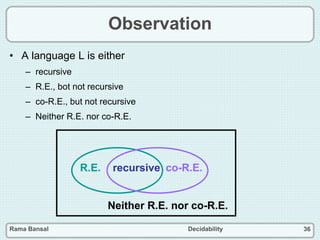
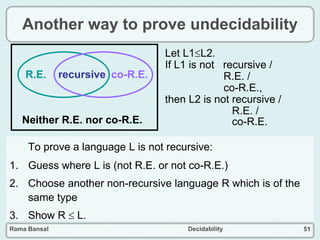
recursive co-R.E.R.E.
Neither R.E. nor co-R.E.
Observation
• A language L is either
– recursive
– R.E., bot not recursive
– co-R.E., but not recursive
– Neither R.E. nor co-R.E.
Rama Bansal Decidability 37
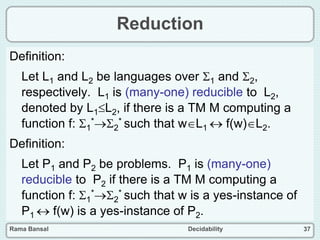
Reduction
Definition:
Let L1 and L2 be languages over 1 and 2,
respectively. L1 is (many-one) reducible to L2,
denoted by L1L2, if there is a TM M computing a
function f: 1
*2
* such that wL1  f(w)L2.
Definition:
Let P1 and P2 be problems. P1 is (many-one)
reducible to P2 if there is a TM M computing a
function f: 1
*2
* such that w is a yes-instance of
P1  f(w) is a yes-instance of P2.
Rama Bansal Decidability 38
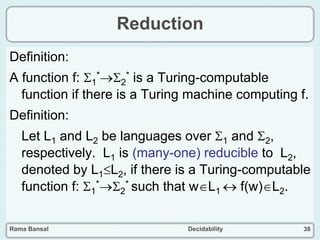
Reduction
Definition:
A function f: 1
*2
* is a Turing-computable
function if there is a Turing machine computing f.
Definition:
Let L1 and L2 be languages over 1 and 2,
respectively. L1 is (many-one) reducible to L2,
denoted by L1L2, if there is a Turing-computable
function f: 1
*2
* such that wL1  f(w)L2.
Rama Bansal Decidability 39
Meaning of Reduction
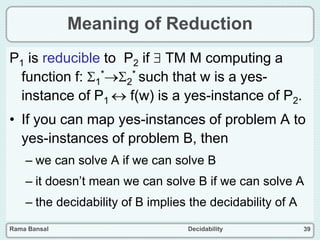
P1 is reducible to P2 if  TM M computing a
function f: 1
*2
* such that w is a yes-
instance of P1  f(w) is a yes-instance of P2.
• If you can map yes-instances of problem A to
yes-instances of problem B, then
– we can solve A if we can solve B
– it doesn’t mean we can solve B if we can solve A
– the decidability of B implies the decidability of A
Rama Bansal Decidability 40
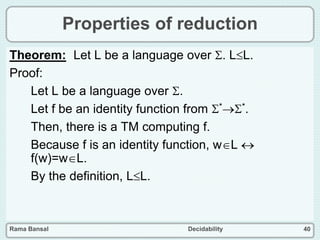
Properties of reduction
Theorem: Let L be a language over . LL.
Proof:
Let L be a language over .
Let f be an identity function from **.
Then, there is a TM computing f.
Because f is an identity function, wL 
f(w)=wL.
By the definition, LL.
Rama Bansal Decidability 41
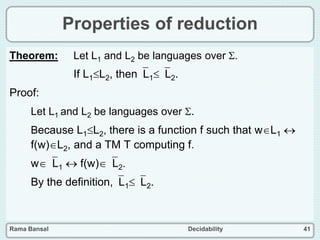
Properties of reduction
Theorem: Let L1 and L2 be languages over .
If L1L2, thenL1L2.
Proof:
Let L1 and L2 be languages over .
Because L1L2, there is a function f such that wL1 
f(w)L2, and a TM T computing f.
wL1  f(w)L2.
By the definition,L1L2.
Rama Bansal Decidability 42
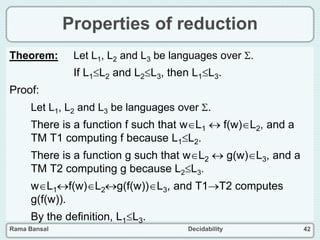
Properties of reduction
Theorem: Let L1, L2 and L3 be languages over .
If L1L2 and L2L3, then L1L3.
Proof:
Let L1, L2 and L3 be languages over .
There is a function f such that wL1  f(w)L2, and a
TM T1 computing f because L1L2.
There is a function g such that wL2  g(w)L3, and a
TM T2 computing g because L2L3.
wL1f(w)L2g(f(w))L3, and T1T2 computes
g(f(w)).
By the definition, L1L3.
Rama Bansal Decidability 43
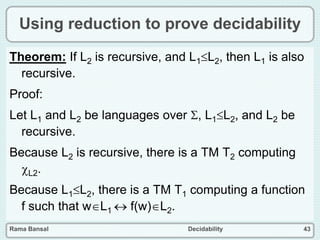
Using reduction to prove decidability
Theorem: If L2 is recursive, and L1L2, then L1 is also
recursive.
Proof:
Let L1 and L2 be languages over , L1L2, and L2 be
recursive.
Because L2 is recursive, there is a TM T2 computing
L2.
Because L1L2, there is a TM T1 computing a function
f such that wL1  f(w)L2.
Rama Bansal Decidability 44
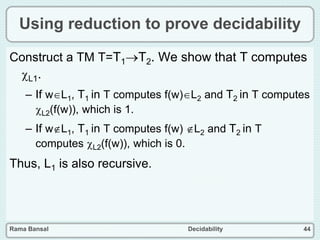
Using reduction to prove decidability
Construct a TM T=T1T2. We show that T computes
L1.
– If wL1, T1 in T computes f(w)L2 and T2 in T computes
L2(f(w)), which is 1.
– If wL1, T1 in T computes f(w) L2 and T2 in T
computes L2(f(w)), which is 0.
Thus, L1 is also recursive.
Rama Bansal Decidability 45
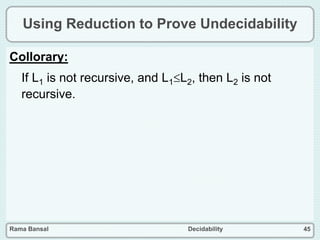
Using Reduction to Prove Undecidability
Collorary:
If L1 is not recursive, and L1L2, then L2 is not
recursive.
Rama Bansal Decidability 46
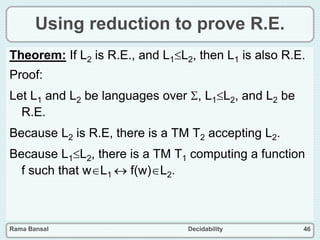
Using reduction to prove R.E.
Theorem: If L2 is R.E., and L1L2, then L1 is also R.E.
Proof:
Let L1 and L2 be languages over , L1L2, and L2 be
R.E.
Because L2 is R.E, there is a TM T2 accepting L2.
Because L1L2, there is a TM T1 computing a function
f such that wL1  f(w)L2.
Rama Bansal Decidability 47
Using reduction to prove R.E.
Construct a TM T=T1T2. We show that T accepts
L1.
– If wL1, T1 in T computes f(w)L2 and T2 in T accepts
f(w). Thus, T accepts w.
– If wL1, T1 in T computes f(w)L2 and T2 in T does not
accept (f(w)). Thus, T does not accept w.
Thus, L1 is also R.E.
Rama Bansal Decidability 48
Using reduction to prove non-R.E.
Collorary:
If L1 is not recursively enumerable, and L1L2,
then L2 is not recursively enumerable.
Rama Bansal Decidability 49
Using reduction to prove co-R.E.
Theorem: If L2 is co-R.E., and L1L2, then L1 is also
co-R.E.
Proof:
Let L1 and L2 be languages over , L1L2, and L2 be
co-R.E.
Because L2 is co-R.E,L2 is R.E.
Because L1L2,L1L2. Then,L1 is R.E.
Thus, L1 is co-R.E.
Rama Bansal Decidability 50
Using reduction to prove non-co-R.E.
Collorary:
If L1 is not co-R.E., and L1L2, then L2 is not
co-R.E.
Rama Bansal Decidability 51
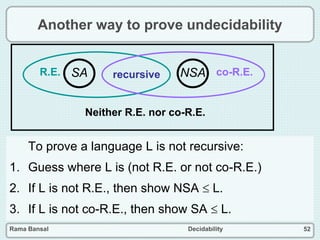
Let L1L2.
If L1 is not recursive /
R.E. /
co-R.E.,
then L2 is not recursive /
R.E. /
co-R.E.
Another way to prove undecidability
To prove a language L is not recursive:
1. Guess where L is (not R.E. or not co-R.E.)
2. Choose another non-recursive language R which is of the
same type
3. Show R  L.
recursive co-R.E.R.E.
Neither R.E. nor co-R.E.
Rama Bansal Decidability 52
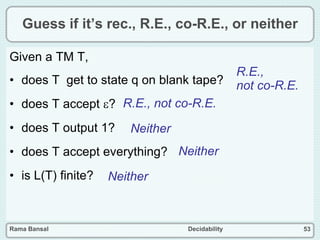
Another way to prove undecidability
To prove a language L is not recursive:
1. Guess where L is (not R.E. or not co-R.E.)
2. If L is not R.E., then show NSA  L.
3. If L is not co-R.E., then show SA  L.
recursive co-R.E.R.E.
Neither R.E. nor co-R.E.
NSASA
Rama Bansal Decidability 53
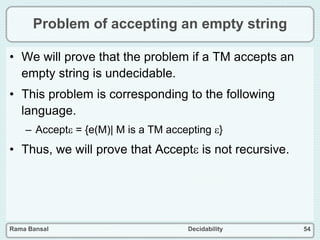
Guess if it’s rec., R.E., co-R.E., or neither
Given a TM T,
• does T get to state q on blank tape?
• does T accept ?
• does T output 1?
• does T accept everything?
• is L(T) finite?
R.E.,
not co-R.E.
R.E., not co-R.E.
Neither
Neither
Neither
Rama Bansal Decidability 54
Problem of accepting an empty string
• We will prove that the problem if a TM accepts an
empty string is undecidable.
• This problem is corresponding to the following
language.
– Accept = {e(M)| M is a TM accepting }
• Thus, we will prove that Accept is not recursive.
Rama Bansal Decidability 55
Accept is not recursive.
Proof:
(Guess Accept is in R.E., but not co-R.E.)
• Show SA  Accept
(We want a Turing-computable f n f(<T>)=<M> such that
– T accepts e(T)  M accepts 
– T does not accept e(T)  M does not accept 
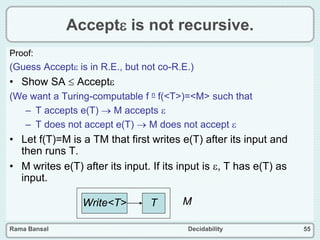
• Let f(T)=M is a TM that first writes e(T) after its input and
then runs T.
• M writes e(T) after its input. If its input is , T has e(T) as
input.
Write<T> T M
Rama Bansal Decidability 56
Accept is not co–R.E.
Verify that T accepts e(T)  M accepts 
M writes e(T) and lets T run. If the input of M is :
• when T accepts e(T), M accepts .
• when T doesn’t accept e(T), then M doesn’t accept
.
Rama Bansal Decidability 57
Accept is not co–R.E.
Next, we show that there is a TM TF computing f.
TF works as follows:
• changes the start state of T in e(T) to a new state
• add e(Write<T>), make its start state the start state
of TF, and make the transition from its halt state to
T’s start state.
Then, SA  Accept.
Then,Accept is not co-R.E, and is not recursive.
Rama Bansal Decidability 58
Halting problem
• Problem
– Given a Turing machine T and string z, does T
halt on z?
– Given a program P and input z, does P halt on z?
• Language
– Halt = {w*| w=e(T)e(z) for a Turing machine T
halting on z}.
– Halt = {<T,z>| T is a Turing machine halting on z}.
Rama Bansal Decidability 59
Halting problem is undecidable
Proof:
Let Halt = {<T,z>| T is a Turing machine halting on z}.
(Guess Halt is in R.E., but not co-R.E.)
• Show SA  Halt
(We want a Turing-computable f n f(<T1>)=<T2 ,z>
such that
– T1 accepts e(T1)  T2 halts on z
– T1 does not accept e(T1)  T2 does not halt on z
Then, a possible function is f(<T>) = <T, e(T)>
because T accepts e(T)  T halts on e(T).)
Rama Bansal Decidability 60
Halting problem is undecidable
• Let f(X) = Xe(X). f is Turing-computable because
there is a TM that can write an encoding of an input
string after the string itself.
• If f(<T>)=<T>e(<T>), then T accepts e(T) T halts
on e(T).
• Then, SA  Halt, and Halt is not co-R.E. Thus,
Halting problem is undecidable.
Rama Bansal Decidability 61
Some other undecidable problems
• FINITE
Given a TM T, is L(T) finite?
Guess FINITE is neither R.E. nor co-R.E.
• To assure L(T) is finite, we need to run T on all possible
input and count if T accepts a finite number of strings.
• To assure L(T) is infinite, we need to run T on all
possible input and count if T accepts an infinite number
of strings.
Rama Bansal Decidability 62
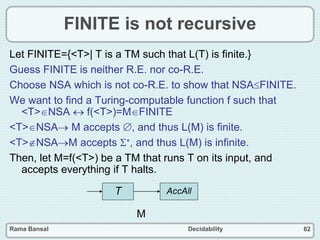
FINITE is not recursive
Let FINITE={<T>| T is a TM such that L(T) is finite.}
Guess FINITE is neither R.E. nor co-R.E.
Choose NSA which is not co-R.E. to show that NSAFINITE.
We want to find a Turing-computable function f such that
<T>NSA  f(<T>)=MFINITE
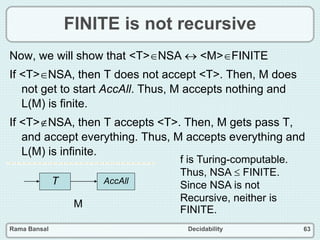
<T>NSA M accepts , and thus L(M) is finite.
<T>NSAM accepts *, and thus L(M) is infinite.
Then, let M=f(<T>) be a TM that runs T on its input, and
accepts everything if T halts.
T AccAll
M
Rama Bansal Decidability 63
FINITE is not recursive
Now, we will show that <T>NSA  <M>FINITE
If <T>NSA, then T does not accept <T>. Then, M does
not get to start AccAll. Thus, M accepts nothing and
L(M) is finite.
If <T>NSA, then T accepts <T>. Then, M gets pass T,
and accept everything. Thus, M accepts everything and
L(M) is infinite.
T AccAll
M
f is Turing-computable.
Thus, NSA  FINITE.
Since NSA is not
Recursive, neither is
FINITE.
Rama Bansal Decidability 64
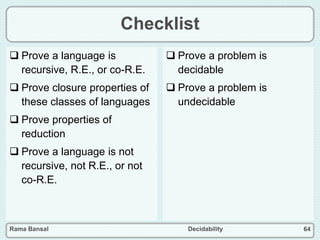
Checklist
 Prove a language is
recursive, R.E., or co-R.E.
 Prove closure properties of
these classes of languages
 Prove properties of
reduction
 Prove a language is not
recursive, not R.E., or not
co-R.E.
 Prove a problem is
decidable
 Prove a problem is
undecidable

5 decidability theory of computation

  • 1.
  • 2.
    Rama Bansal Decidability2 Accepting: Definition • Let T = (Q, , , , s) be a TM. • T accepts a string w in * if (s,w) |-T * (h, 1) . • T accepts a language L* if, for any string w in L, T accepts w.
  • 3.
    Rama Bansal Decidability3 Characteristic function • For any language L*, the characteristic function of L is the function L(x) such that – L(x) = 1 if x  L – L(x) = 0 otherwise • Example Let L = {  {0,1}* | n1() <n0() <2n1() }, where nx() is the number of x’s in }. – L() = 1 if n1() <n0() <2n1() – L() = 0 otherwise
  • 4.
    Rama Bansal Decidability4 Deciding: Definition • Let T = (Q, , , , s) be a TM. • T decides a language L* if T computes the characteristic function of L. • T decides a language L* if – for any string w in L, T halts on w with output 1, – for any string w inL, T halts on w with output 0.
  • 5.
    Rama Bansal Decidability5 Accepting/Deciding: Example 1/,R q2 h q1 /1,L@/,R /,L S p1 p4 p2 p3 /@,R0/,R 0/0,R 1/1,R /,L 0/0,L 1/1,L TM accepting L={0n10n |n0} If the input x is in L, T halts with output 1. If the input x is not in L, T hangs. r1 /,L 1/,L /,L r2 h @/,R/0,L /,L 0/,L 1/,L TM decidinging L={0n10n |n0} Hang when input = 02n Hang when input = 0n+m …0n Hang when input = 0n 1 … 0n+m
  • 6.
    Rama Bansal Decidability6 Recursively enumerable languages • A language L is recursively enumerable if there is a Turing machine T accepting L. • A language L is Turing-acceptable if there is a Turing machine T accepting L. • Example: {0n10n|n0} is a recursively-enumerable language.
  • 7.
    Rama Bansal Decidability7 Recursive languages • A language L is recursive if there is a Turing machine T deciding L. • A language L is Turing-decidable if there is a Turing machine T deciding L. • Example: {0n10n|n0} is a recursive language.
  • 8.
    Closure Properties ofthe Class of Recursive Languages
  • 9.
    Rama Bansal Decidability9 Closure Property Under Complementation Theorem: Let L be a recursive language over . Then,L is recursive. Proof: Let L be a recursive language over . Then, there exists a TM T computing L. Construct a tape TM M computing L. as follows:  T  TmoveRight 0 Twrite1 1 Twrite0 Then,L is recursive.
  • 10.
    Rama Bansal Decidability10 Closure Property Under Union Theorem: Let L1 and L2 be recursive languages over . Then, L1L2 is recursive. Proof: Let L1 and L2 be recursive languages over . Then, there exist TM’s T1 and T2 computing L1 and L2, respectively. Construct a 2-tape TM M as follows:  TcopyTape1ToTape2  T1  TmoveRight 0 TcopyTape2ToTape1  T2 1
  • 11.
    Rama Bansal Decidability11 Closure Property Under Union  TcopyTape1ToTape2  T1  TmoveRight 0 TcopyTape2ToTape1  T2 If the input w is not in L1 and L2, L1(w) and L2(w)=0. Thus, both T1 and T2 must run, and M halts with output 0. If the input w is in L1, L1(w)=1. Thus, M halts with output 1. If the input w is not in L1 but is in L2, L1(w)=0 and L2(w)=1. Thus, M halts with output 1. That is, M computes characteristic function of L. Then, L1L2 is recursive. 1
  • 12.
    Rama Bansal Decidability12 Closure Property Under Intersection Theorem: Let L1 and L2 be recursive languages over . Then, L1L2 is recursive. Proof: Let L1 and L2 be recursive languages over . Then, there exist TM’s T1 and T2 computing L1 and L2, respectively. Construct a 2-tape TM M as follows:  TcopyTape1ToTape2  T1  TmoveRight 1 TcopyTape2ToTape1  T2 0
  • 13.
    Rama Bansal Decidability13 Closure Property Under Intersection  TcopyTape1ToTape2  T1  TmoveRight 1 TcopyTape2ToTape1  T2 If the input w is in L1L2, L1(w) and L2(w)=1. Thus, M halts with output 1. If the input w is not in L1, L1(w)=0. Thus, M halts with output 0. If the input w is in L1 but is not in L2, L1(w)=1 and L2(w)=0. Thus, M halts with output 0. That is, M computes characteristic function of L1L2. Then, L1L2 is recursive. 0
  • 14.
    Closure Properties ofthe Class of Recursively Enumerable Languages
  • 15.
    Rama Bansal Decidability15 Closure Property Under Union Theorem: Let L1 and L2 be recursively enumerable languages over . Then, L1L2 is also recursively enumerable. Proof: Let L1 and L2 be recursively enumerable languages over . Then, there exist TM’s T1 and T2 accepting L1 and L2, respectively. Construct an NTM M as follows. S T1 T2
  • 16.
    Rama Bansal Decidability16 Closure Property Under Union If w is in L1, but not in L2, then T1 in M runs and halts. If w is in not L1, but in L2, then T2 in M runs and halts. If w is in both L1 and L2, then either T1 or T2 runs and halts. For these 3 cases, M halts. If w is neither in L1 nor in L2, then either T1 or T2 runs but both never halt. Then, M does not halt. Thus, M accepts L1L2. That is, L1L2 is recursively enumerable. S T1 T2
  • 17.
    Rama Bansal Decidability17 Closure Property Under Intersection Theorem: Let L1 and L2 be recursively enumerable languages over . Then, L1L2 is also recursively enumerable. Proof: Let L1 and L2 be recursively enumerable languages over . Then, there exist TM’s T1 and T2 accepting L1 and L2, respectively. Construct an NTM M as follows.  TcopyTape1ToTape2  T1  TmoveRight 1 TcopyTape2ToTape1  T2
  • 18.
    Rama Bansal Decidability18 Closure Property Under Intersection  TcopyTape1ToTape2  T1  TmoveRight 1 TcopyTape2ToTape1  T2 If w is in not L1, then T1 in M does not halt. Then, M does not halt. If w is in L1, but not in L2, then T1 in M halts and T2 can finally start, but does not halt. Then, M does not halt. If w is in both L1 and L2, then T1 in M halts and T2 can finally start, and finally halt. Then, M halts. Thus, M accepts L1L2. That is, L1L2 is recursively enumerable.
  • 19.
    Rama Bansal Decidability19 Closure Property Under Union (II) Theorem: Let L1 and L2 be recursively enumerable languages over . Then, L1L2 is also recursively enumerable. Proof: Let L1 and L2 be recursively enumerable languages over . Then, there exist DTM’s T1 =(Q1, , , 1, s1) and T2 =(Q2, , , 2, s2) accepting L1 and L2, respectively. Construct a 2-tape TM M which simulates T1 and T2 simultaneously. Tape 1 represents T1’s tape and Tape 2 represents T2’s tape.
  • 20.
    Rama Bansal Decidability20 Closure Property Under Union (II) Let M = (Q1Q2, , , , (s1,s2)) where – ((p1,p2),a1,a2) = ((q1,q2),b1,b2,d1,d2) for 1(p1,a1)=(q1,b1,d1) and 2(p2,a2 )=(q2,b2,d2) – ((p1,p2),a1,a2) = (h,b1,b2,d1,d2) for 1(p1,a1)=(h,b1,d1) or 2(p2,a2 )=(h,b2,d2) If either T1 or T2 halt, M finally gets to the state h. If neither T1 nor T2 halt, M never gets to the state h.
  • 21.
    Rama Bansal Decidability21 Closure Property Under Intersection (II) Theorem: Let L1 and L2 be recursively enumerable languages over . Then, L1L2 is also recursively enumerable. Proof: Let L1 and L2 be recursively enumerable languages over . Then, there exist DTM’s T1 =(Q1, , , 1, s1) and T2 =(Q2, , , 2, s2) accepting L1 and L2, respectively. Construct a 2-tape TM M which simulates T1 and T2 simultaneously. Tape 1 represents T1’s tape and Tape 2 represents T2’s tape.
  • 22.
    Rama Bansal Decidability22 Closure Property Under Intersection (II) Let M = ((Q1{h})(Q2{h}), , , , (s1,s2)) where – ((p1,p2),a1,a2) = ((q1,q2),b1,b2,d1,d2) for 1(p1,a1)=(q1,b1,d1) and 2(p2,a2 )=(q2,b2,d2) – ((h,p2),a1,a2) = ((h,q2),a1,b2,S,d2) for all p2,a1,a2 and 2(p2,a2)=(q2,b2,d2) – ((p1,h),a1,a2) = ((q1,h),b1,a2,d1,S) for all p1,a1,a2 and 1(p1,a1)=(q1,b1,d1) – ((h,h),a1,a2) = (h,a1,a2,S,S) for all a1,a2 If neither T1 nor T2 halt, M never gets to the state h. If T1 halts and T2 does not halt, M gets to the state (h,p). If T2 halts and T1 does not halt, M gets to the state (p,h). If both T1 and T2 halt, M finally gets to the state h.
  • 23.
    Relationship Between theClasses of Recursively Enumerable and Recursive Languages
  • 24.
    Rama Bansal Decidability24 Relationship between RE and Recursive Languages Theorem: If L is a recursive language, then L is recursively enumerable. Proof: Let L be a recursive language over . Then, there is a TM T deciding L. Then, T also accepts L. Thus, L is recursively enumerable.
  • 25.
    Rama Bansal Decidability25 Relationship between RE and Recursive Languages Theorem: Let L be a language. If L andL are recursively enumerable, then L is recursive. Proof: Let L andL be recursively-enumerable languages over . Then, there are a TM T accepting L, and a TMT acceptingL. For any string w in *, w is either in L or inL. That is, either T orT must halt on w, for any w in *. We construct an NTM M as follows: If w is in L, T halts on w and thus, M accepts w. If w is not in L,T halts on w and thus, M rejects w. Then, M computes the characteristic function of L. Then, L is recursive. S T T accept reject
  • 26.
    Rama Bansal Decidability26 Decision Problems • A decision problem is a prob. whose ans. is either yes or no • A yes-instance (or no-instance) of a problem P is the instance of P whose answer is yes (or no, respectively) • A decision problem P can be encoded by fe over  as a language {fe(X)| X is a yes-instance of P}.
  • 27.
    Rama Bansal Decidability27 Encoding of decision problems • Is X a prime ? {1X | X is a prime} • Does TM T accept string e(T)? {e(T) | T is a TM accepting string e(T)} • Does TM T accept string w? {e(T)e(w) | T is a TM accepting string w} or {<T,w> | T is a TM accepting string w}
  • 28.
    Rama Bansal Decidability28 Decidable (or solvable) problems Definition: If fe is a reasonable encoding of a decision problem P over , we say P is decidable (or solvable) if the associated language {fe(X)| X is a yes-instance of P} is recursive. A problem P is undecidable (or unsolvable) if P is not decidable.
  • 29.
    Rama Bansal Decidability29 Self-Accepting • SA (Self-accepting) = {w{0,1,#, ,}*| w=e(T) for some TM T and wL(T)} • NSA (Non-self-accepting) = {w {0,1,#, ,}*| w=e(T) for some TM T and wL(T)} • E (Encoded-TM) = {w{0,1,#, ,}*| w=e(T) for some TM T}
  • 30.
    Rama Bansal Decidability30 NSA is not recursively enumerable We prove by contradiction. Assume NSA is recursively enumerable. Then, there is TM T0 such that L(T0)=NSA. Is e(T0) in NSA? – If e(T0)NSA, then e(T0)L(T0) by the definition of NSA But L(T0)=NSA. Thus, contradiction. – If e(T0) NSA, then e(T0) SA and e(T0)L(T0) by the definition of SA. But L(T0)=NSA. Thus, contradiction. Then, the assumption is false. That is, NSA is not recursively enumerable.
  • 31.
    Rama Bansal Decidability31 E is recursive Theorem: E is recursive. Proof: We can construct a regular expression for E according to the definition of the encoding function as follows: R = S 1 (M #)+ S = 0 M = Q , A , Q , A , D Q = 0+ A = 0+ D = 0 + 00 + 000 Then, E is regular, and thus recursive.
  • 32.
    Rama Bansal Decidability32 SA is recursively enumerable • Construct a TM S accepting SA • If w is not e(T) for some TM T, S rejects w. • If w is e(T) for some TM T, S accepts e(T) iff T accepts e(T). • L(S) = {w| w=e(T) for some TM T accepting e(T) = SA. • Then, SA is recursively enumerable. E UTM Reject Encode
  • 33.
    Rama Bansal Decidability33 SA is not recursive • NSA = E – SA • NSA is not recursively enumerable (from previous theorem), and thus not recursive. • But E is recursive. • From the closure property, if L1 and L2 are recursive, then L1 - L2 is recursive. • Using its contrapositive, if L1 - L2 is not recursive, then L1 or L2 are not recursive. • Since NSA is not recursive and E is recursive, SA is not recursive.
  • 34.
    Rama Bansal Decidability34 Co-R.E. Definition • A language L is co-R.E. if its complement L is R.E. • It does not mean L is not R.E. Examples: • SA is R.E. SA=ENSA is not R.E. – SA is co-R.E., but not R.E. • NSA is not R.E. NSA=ESA is R.E. – NSA is co-R.E., but not R.E. • E is recursive, R.E., and co-R.E.
  • 35.
    Rama Bansal Decidability35 Relationship between R.E., co-R.E. and Recursive Languages Theorem: Let L be any language. L is R.E. and co- R.E. iff L is recursive. Proof: • () Let L be R.E. and co-R.E. Then, L is R.E. Thus, L is recursive. • () Let L be recursive. Then, L is R.E. From the closure under complementation of the class of recursive languages,L is also recursive. Then, L is also R.E. Thus, L is co-R.E.
  • 36.
    Rama Bansal Decidability36 recursive co-R.E.R.E. Neither R.E. nor co-R.E. Observation • A language L is either – recursive – R.E., bot not recursive – co-R.E., but not recursive – Neither R.E. nor co-R.E.
  • 37.
    Rama Bansal Decidability37 Reduction Definition: Let L1 and L2 be languages over 1 and 2, respectively. L1 is (many-one) reducible to L2, denoted by L1L2, if there is a TM M computing a function f: 1 *2 * such that wL1  f(w)L2. Definition: Let P1 and P2 be problems. P1 is (many-one) reducible to P2 if there is a TM M computing a function f: 1 *2 * such that w is a yes-instance of P1  f(w) is a yes-instance of P2.
  • 38.
    Rama Bansal Decidability38 Reduction Definition: A function f: 1 *2 * is a Turing-computable function if there is a Turing machine computing f. Definition: Let L1 and L2 be languages over 1 and 2, respectively. L1 is (many-one) reducible to L2, denoted by L1L2, if there is a Turing-computable function f: 1 *2 * such that wL1  f(w)L2.
  • 39.
    Rama Bansal Decidability39 Meaning of Reduction P1 is reducible to P2 if  TM M computing a function f: 1 *2 * such that w is a yes- instance of P1  f(w) is a yes-instance of P2. • If you can map yes-instances of problem A to yes-instances of problem B, then – we can solve A if we can solve B – it doesn’t mean we can solve B if we can solve A – the decidability of B implies the decidability of A
  • 40.
    Rama Bansal Decidability40 Properties of reduction Theorem: Let L be a language over . LL. Proof: Let L be a language over . Let f be an identity function from **. Then, there is a TM computing f. Because f is an identity function, wL  f(w)=wL. By the definition, LL.
  • 41.
    Rama Bansal Decidability41 Properties of reduction Theorem: Let L1 and L2 be languages over . If L1L2, thenL1L2. Proof: Let L1 and L2 be languages over . Because L1L2, there is a function f such that wL1  f(w)L2, and a TM T computing f. wL1  f(w)L2. By the definition,L1L2.
  • 42.
    Rama Bansal Decidability42 Properties of reduction Theorem: Let L1, L2 and L3 be languages over . If L1L2 and L2L3, then L1L3. Proof: Let L1, L2 and L3 be languages over . There is a function f such that wL1  f(w)L2, and a TM T1 computing f because L1L2. There is a function g such that wL2  g(w)L3, and a TM T2 computing g because L2L3. wL1f(w)L2g(f(w))L3, and T1T2 computes g(f(w)). By the definition, L1L3.
  • 43.
    Rama Bansal Decidability43 Using reduction to prove decidability Theorem: If L2 is recursive, and L1L2, then L1 is also recursive. Proof: Let L1 and L2 be languages over , L1L2, and L2 be recursive. Because L2 is recursive, there is a TM T2 computing L2. Because L1L2, there is a TM T1 computing a function f such that wL1  f(w)L2.
  • 44.
    Rama Bansal Decidability44 Using reduction to prove decidability Construct a TM T=T1T2. We show that T computes L1. – If wL1, T1 in T computes f(w)L2 and T2 in T computes L2(f(w)), which is 1. – If wL1, T1 in T computes f(w) L2 and T2 in T computes L2(f(w)), which is 0. Thus, L1 is also recursive.
  • 45.
    Rama Bansal Decidability45 Using Reduction to Prove Undecidability Collorary: If L1 is not recursive, and L1L2, then L2 is not recursive.
  • 46.
    Rama Bansal Decidability46 Using reduction to prove R.E. Theorem: If L2 is R.E., and L1L2, then L1 is also R.E. Proof: Let L1 and L2 be languages over , L1L2, and L2 be R.E. Because L2 is R.E, there is a TM T2 accepting L2. Because L1L2, there is a TM T1 computing a function f such that wL1  f(w)L2.
  • 47.
    Rama Bansal Decidability47 Using reduction to prove R.E. Construct a TM T=T1T2. We show that T accepts L1. – If wL1, T1 in T computes f(w)L2 and T2 in T accepts f(w). Thus, T accepts w. – If wL1, T1 in T computes f(w)L2 and T2 in T does not accept (f(w)). Thus, T does not accept w. Thus, L1 is also R.E.
  • 48.
    Rama Bansal Decidability48 Using reduction to prove non-R.E. Collorary: If L1 is not recursively enumerable, and L1L2, then L2 is not recursively enumerable.
  • 49.
    Rama Bansal Decidability49 Using reduction to prove co-R.E. Theorem: If L2 is co-R.E., and L1L2, then L1 is also co-R.E. Proof: Let L1 and L2 be languages over , L1L2, and L2 be co-R.E. Because L2 is co-R.E,L2 is R.E. Because L1L2,L1L2. Then,L1 is R.E. Thus, L1 is co-R.E.
  • 50.
    Rama Bansal Decidability50 Using reduction to prove non-co-R.E. Collorary: If L1 is not co-R.E., and L1L2, then L2 is not co-R.E.
  • 51.
    Rama Bansal Decidability51 Let L1L2. If L1 is not recursive / R.E. / co-R.E., then L2 is not recursive / R.E. / co-R.E. Another way to prove undecidability To prove a language L is not recursive: 1. Guess where L is (not R.E. or not co-R.E.) 2. Choose another non-recursive language R which is of the same type 3. Show R  L. recursive co-R.E.R.E. Neither R.E. nor co-R.E.
  • 52.
    Rama Bansal Decidability52 Another way to prove undecidability To prove a language L is not recursive: 1. Guess where L is (not R.E. or not co-R.E.) 2. If L is not R.E., then show NSA  L. 3. If L is not co-R.E., then show SA  L. recursive co-R.E.R.E. Neither R.E. nor co-R.E. NSASA
  • 53.
    Rama Bansal Decidability53 Guess if it’s rec., R.E., co-R.E., or neither Given a TM T, • does T get to state q on blank tape? • does T accept ? • does T output 1? • does T accept everything? • is L(T) finite? R.E., not co-R.E. R.E., not co-R.E. Neither Neither Neither
  • 54.
    Rama Bansal Decidability54 Problem of accepting an empty string • We will prove that the problem if a TM accepts an empty string is undecidable. • This problem is corresponding to the following language. – Accept = {e(M)| M is a TM accepting } • Thus, we will prove that Accept is not recursive.
  • 55.
    Rama Bansal Decidability55 Accept is not recursive. Proof: (Guess Accept is in R.E., but not co-R.E.) • Show SA  Accept (We want a Turing-computable f n f(<T>)=<M> such that – T accepts e(T)  M accepts  – T does not accept e(T)  M does not accept  • Let f(T)=M is a TM that first writes e(T) after its input and then runs T. • M writes e(T) after its input. If its input is , T has e(T) as input. Write<T> T M
  • 56.
    Rama Bansal Decidability56 Accept is not co–R.E. Verify that T accepts e(T)  M accepts  M writes e(T) and lets T run. If the input of M is : • when T accepts e(T), M accepts . • when T doesn’t accept e(T), then M doesn’t accept .
  • 57.
    Rama Bansal Decidability57 Accept is not co–R.E. Next, we show that there is a TM TF computing f. TF works as follows: • changes the start state of T in e(T) to a new state • add e(Write<T>), make its start state the start state of TF, and make the transition from its halt state to T’s start state. Then, SA  Accept. Then,Accept is not co-R.E, and is not recursive.
  • 58.
    Rama Bansal Decidability58 Halting problem • Problem – Given a Turing machine T and string z, does T halt on z? – Given a program P and input z, does P halt on z? • Language – Halt = {w*| w=e(T)e(z) for a Turing machine T halting on z}. – Halt = {<T,z>| T is a Turing machine halting on z}.
  • 59.
    Rama Bansal Decidability59 Halting problem is undecidable Proof: Let Halt = {<T,z>| T is a Turing machine halting on z}. (Guess Halt is in R.E., but not co-R.E.) • Show SA  Halt (We want a Turing-computable f n f(<T1>)=<T2 ,z> such that – T1 accepts e(T1)  T2 halts on z – T1 does not accept e(T1)  T2 does not halt on z Then, a possible function is f(<T>) = <T, e(T)> because T accepts e(T)  T halts on e(T).)
  • 60.
    Rama Bansal Decidability60 Halting problem is undecidable • Let f(X) = Xe(X). f is Turing-computable because there is a TM that can write an encoding of an input string after the string itself. • If f(<T>)=<T>e(<T>), then T accepts e(T) T halts on e(T). • Then, SA  Halt, and Halt is not co-R.E. Thus, Halting problem is undecidable.
  • 61.
    Rama Bansal Decidability61 Some other undecidable problems • FINITE Given a TM T, is L(T) finite? Guess FINITE is neither R.E. nor co-R.E. • To assure L(T) is finite, we need to run T on all possible input and count if T accepts a finite number of strings. • To assure L(T) is infinite, we need to run T on all possible input and count if T accepts an infinite number of strings.
  • 62.
    Rama Bansal Decidability62 FINITE is not recursive Let FINITE={<T>| T is a TM such that L(T) is finite.} Guess FINITE is neither R.E. nor co-R.E. Choose NSA which is not co-R.E. to show that NSAFINITE. We want to find a Turing-computable function f such that <T>NSA  f(<T>)=MFINITE <T>NSA M accepts , and thus L(M) is finite. <T>NSAM accepts *, and thus L(M) is infinite. Then, let M=f(<T>) be a TM that runs T on its input, and accepts everything if T halts. T AccAll M
  • 63.
    Rama Bansal Decidability63 FINITE is not recursive Now, we will show that <T>NSA  <M>FINITE If <T>NSA, then T does not accept <T>. Then, M does not get to start AccAll. Thus, M accepts nothing and L(M) is finite. If <T>NSA, then T accepts <T>. Then, M gets pass T, and accept everything. Thus, M accepts everything and L(M) is infinite. T AccAll M f is Turing-computable. Thus, NSA  FINITE. Since NSA is not Recursive, neither is FINITE.
  • 64.
    Rama Bansal Decidability64 Checklist  Prove a language is recursive, R.E., or co-R.E.  Prove closure properties of these classes of languages  Prove properties of reduction  Prove a language is not recursive, not R.E., or not co-R.E.  Prove a problem is decidable  Prove a problem is undecidable