Computer
Science
Foundations
Turing Machine Edition


Jason Dew
Geezeo / Catamorphic Labs
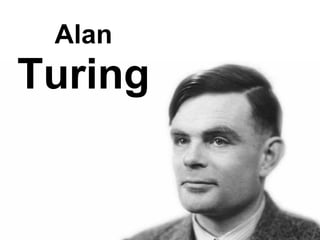
Alan
Turing
Entscheidungsproblem


             David
            Hilbert
Alphabet
any set of symbols

examples:
● {a, b, c, d, ..., z}

● {0, 1, 2, 3, ..., 9}

● {0, 1}
String
sequence of symbols from the alphabet

examples:
● foobar

● 0101001

● (empty string)
Formal Language
any set of strings over an alphabet

examples:
● {foo, bar, baz}

● {00, 01, 10, 11}

● {b, ab, aab, aaab, aaaab, ... }
Deterministic
Finite Automata


    http://15mmvsf.bagofmice.com/vsf/prev_robot.htm
Formal Definition
● an alphabet

● a set of states
   ○ one denoted as a "starting state"
   ○ one or more denoted as "accepting states"

● a transition function
   ○ takes a symbol and a state and returns a new state
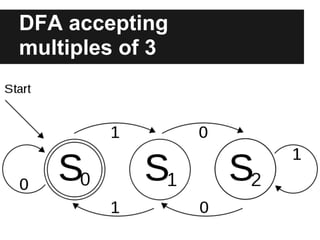
DFA accepting
multiples of 3
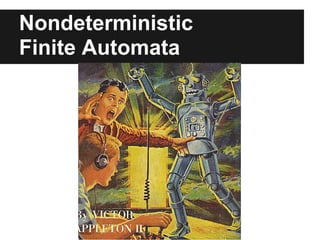
Nondeterministic
Finite Automata
Formal Definition
● an alphabet

● a set of states
   ○ one denoted as a "starting state"
   ○ one or more denoted as "accepting states"

● a transition function
  ○ takes a symbol and a state and returns
      zero or more states
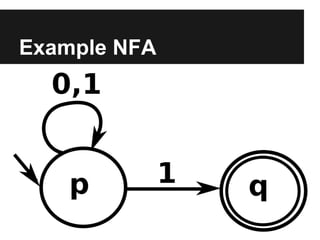
Example NFA
Theorem


 Any NFA can be converted
  into an equivalent DFA.
Regular Language


    Any language which
   can be recognized by
  some finite automaton.
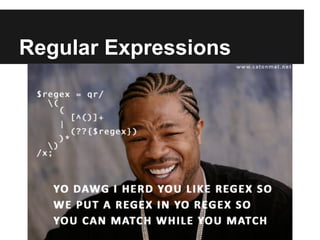
Regular Expressions
Theorem


  A language is regular
       if and only if
 some regular expression
       describes it.
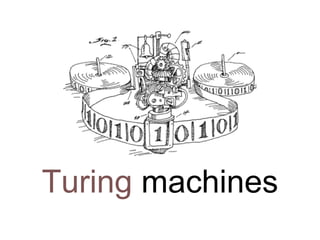
Turing machines
Formal Definition                      (slightly simplified)


● two alphabets
  ○ one for reading, the input alphabet
  ○ one for writing, the output (or tape) alphabet

● a set of states
   ○ one starting state
   ○ one accepting state
   ○ one rejecting state

● a transition function
     takes a symbol and a state and returns
       a new state, a symbol to write, and Left or Right
Example TM
Let's call it M

It accepts strings whose length is a power of 2

Accepted strings: "0", "00", "0000"

Rejected strings: "", "000", "000000"
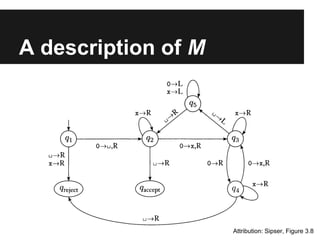
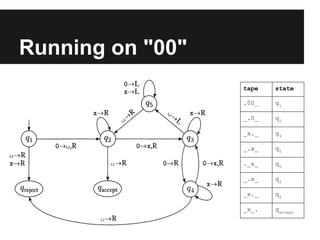
A description of M


                     Attribution: Sipser, Figure 3.8
Running on "00"
                  tape   state

                  .00_   q1

                  _.0_   q2

                  _x._   q3

                  _.x_   q5

                  ._x_   q5

                  _.x_   q2

                  _x._   q2

                  _x_.   qaccept
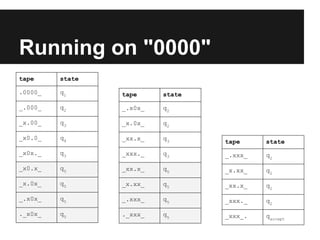
Running on "0000"
tape     state

.0000_   q1      tape     state

_.000_   q2      _.x0x_   q2

_x.00_   q3      _x.0x_   q2

_x0.0_   q4      _xx.x_   q3
                                  tape     state
_x0x._   q3      _xxx._   q3      _.xxx_   q2

_x0.x_   q5      _xx.x_   q5      _x.xx_   q2

_x.0x_   q5      _x.xx_   q5      _xx.x_   q2

_.x0x_   q5      _.xxx_   q5      _xxx._   q2

._x0x_   q5      ._xxx_   q5      _xxx_.   qaccept
Wrapping up


Why do we care about
 Turing machines?
References
Deterministic finite automaton. (2012, March 11). Retrieved from http://en.wikipedia.
org/wiki/Deterministic_finite_automaton

Nondeterministic finite automaton. (2012, April 20). Retrieved from http://en.
wikipedia.org/wiki/Nondeterministic_finite_automaton

Petzold, C. (2008). The annotated turing. Indianapolis: Wiley Publishing, Inc.

Sipser, M. (2006). Introduction to the theory of computation. (2nd ed.). Boston:
Thompson Course Technology.

Turing machine. (2012, April 17). Retrieved from http://en.wikipedia.
org/wiki/Turing_machine
Come work with me!

Computer Science Fundamentals - Turing Machines

  • 1.
  • 2.
  • 3.
    Entscheidungsproblem David Hilbert
  • 4.
    Alphabet any set ofsymbols examples: ● {a, b, c, d, ..., z} ● {0, 1, 2, 3, ..., 9} ● {0, 1}
  • 5.
    String sequence of symbolsfrom the alphabet examples: ● foobar ● 0101001 ● (empty string)
  • 6.
    Formal Language any setof strings over an alphabet examples: ● {foo, bar, baz} ● {00, 01, 10, 11} ● {b, ab, aab, aaab, aaaab, ... }
  • 7.
    Deterministic Finite Automata http://15mmvsf.bagofmice.com/vsf/prev_robot.htm
  • 8.
    Formal Definition ● analphabet ● a set of states ○ one denoted as a "starting state" ○ one or more denoted as "accepting states" ● a transition function ○ takes a symbol and a state and returns a new state
  • 9.
  • 10.
  • 11.
    Formal Definition ● analphabet ● a set of states ○ one denoted as a "starting state" ○ one or more denoted as "accepting states" ● a transition function ○ takes a symbol and a state and returns zero or more states
  • 12.
  • 13.
    Theorem Any NFAcan be converted into an equivalent DFA.
  • 14.
    Regular Language Any language which can be recognized by some finite automaton.
  • 15.
  • 16.
    Theorem Alanguage is regular if and only if some regular expression describes it.
  • 17.
  • 18.
    Formal Definition (slightly simplified) ● two alphabets ○ one for reading, the input alphabet ○ one for writing, the output (or tape) alphabet ● a set of states ○ one starting state ○ one accepting state ○ one rejecting state ● a transition function takes a symbol and a state and returns a new state, a symbol to write, and Left or Right
  • 19.
    Example TM Let's callit M It accepts strings whose length is a power of 2 Accepted strings: "0", "00", "0000" Rejected strings: "", "000", "000000"
  • 20.
    A description ofM Attribution: Sipser, Figure 3.8
  • 21.
    Running on "00" tape state .00_ q1 _.0_ q2 _x._ q3 _.x_ q5 ._x_ q5 _.x_ q2 _x._ q2 _x_. qaccept
  • 22.
    Running on "0000" tape state .0000_ q1 tape state _.000_ q2 _.x0x_ q2 _x.00_ q3 _x.0x_ q2 _x0.0_ q4 _xx.x_ q3 tape state _x0x._ q3 _xxx._ q3 _.xxx_ q2 _x0.x_ q5 _xx.x_ q5 _x.xx_ q2 _x.0x_ q5 _x.xx_ q5 _xx.x_ q2 _.x0x_ q5 _.xxx_ q5 _xxx._ q2 ._x0x_ q5 ._xxx_ q5 _xxx_. qaccept
  • 23.
    Wrapping up Why dowe care about Turing machines?
  • 24.
    References Deterministic finite automaton.(2012, March 11). Retrieved from http://en.wikipedia. org/wiki/Deterministic_finite_automaton Nondeterministic finite automaton. (2012, April 20). Retrieved from http://en. wikipedia.org/wiki/Nondeterministic_finite_automaton Petzold, C. (2008). The annotated turing. Indianapolis: Wiley Publishing, Inc. Sipser, M. (2006). Introduction to the theory of computation. (2nd ed.). Boston: Thompson Course Technology. Turing machine. (2012, April 17). Retrieved from http://en.wikipedia. org/wiki/Turing_machine
  • 25.