
DYNAMICS OF
MARKETS
DEMAND AND SUPPLY (grade 10)
L. MGAGA 201244296
Introduction
The following slides are the compilation of different
slides from five different authors about the topic
Demand and Supply.
Authors : Ankit Bist
Ujjwal 'Shanu‘
KASBIT
Jiten Sharma
NepDevWiki
Topics:
• Demand
Define demand
Law of demand
Demand Schedule
(elasticity of demand)

Factors Affecting
Demand curve (graphs)

Markets equilibrium

• Supply
Define supply
Law of supply
Supply Schedule
Factors Affecting
Supply curve (graphs)

Elasticity
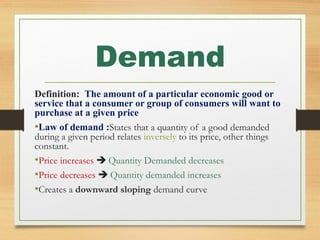
Demand
Definition: The amount of a particular economic good or
service that a consumer or group of consumers will want to
purchase at a given price
•Law of demand :States that a quantity of a good demanded
during a given period relates inversely to its price, other things
constant.
•Price increases  Quantity Demanded decreases
•Price decreases  Quantity demanded increases
•Creates a downward sloping demand curve
Demand schedule
Demand Schedule

Demand Curve

Price [Rs per unit]

Quantity demanded of X
[kg. per month]

a
b
c
d
e
f

0.50
1.00
1.50
2.00
2.50
3.00

7.0
5.0
3.
5
2.5
1.5
1.0

3.00

f
e

2.50

d
Price of X

Point

2.00

c
1.50

b

1.00

a

0.50

1

2

3

4

5

6

7

Quantity of X
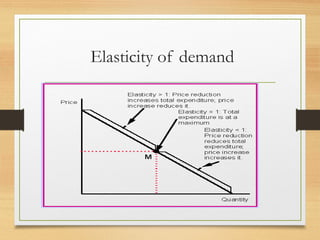
Elasticity of demand
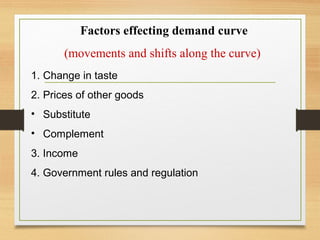
Factors effecting demand curve
(movements and shifts along the curve)
1. Change in taste
2. Prices of other goods
• Substitute
• Complement
3. Income
4. Government rules and regulation
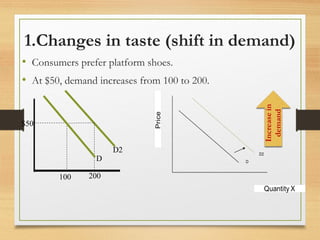
1.Changes in taste (shift in demand)
• Consumers prefer platform shoes.
• At $50, demand increases from 100 to 200.

$50

D
100

200

D2
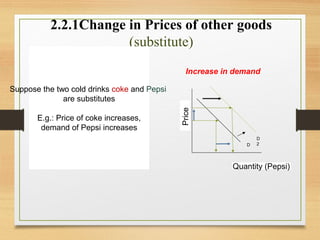
2.2.1Change in Prices of other goods
(substitute)
Increase in demand

E.g.: Price of coke increases,
demand of Pepsi increases

Price

Suppose the two cold drinks coke and Pepsi
are substitutes

D

D
2

Quantity (Pepsi)
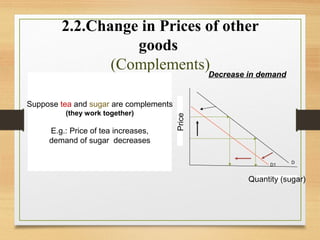
2.2.Change in Prices of other
goods
(Complements)Decrease in demand
(they work together)

E.g.: Price of tea increases,
demand of sugar decreases

Price

Suppose tea and sugar are complements

D1

D

Quantity (sugar)
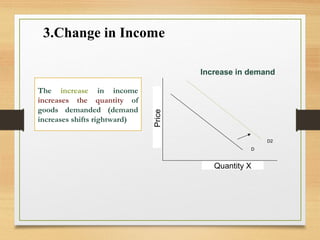
3.Change in Income

The increase in income
increases the quantity of
goods demanded (demand
increases shifts rightward)

Price

Increase in demand

D2
D

Quantity X
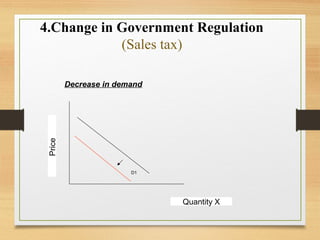
4.Change in Government Regulation
(Sales tax)

Price

Decrease in demand

D1

Quantity X
SUPPLY:
• Definition: The total amount of a good or

service available for purchase; along with
demand, one of the two key determinants of
price.

Law of supply: If demand is held constant, an

increase in supply leads to a decreased price,
while a decrease in supply leads to an
increased price.
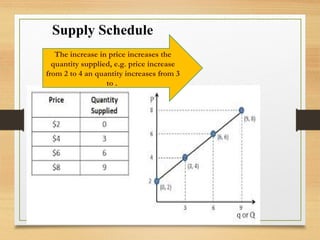
Supply Schedule
The increase in price increases the
quantity supplied, e.g. price increase
from 2 to 4 an quantity increases from 3
to .
Factors that effect the Supply
curve
•
•
•
•
•

Technology
Changes in prices of Alternative Goods
Changes in Relevant Resources
Changes in the Number of Producers
Changes in Producers Expectations
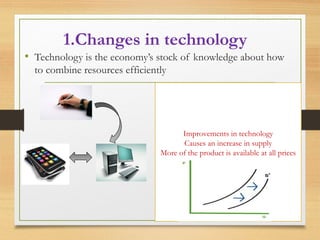
1.Changes in technology

• Technology is the economy’s stock of knowledge about how
to combine resources efficiently

Improvements in technology
Causes an increase in supply
More of the product is available at all prices
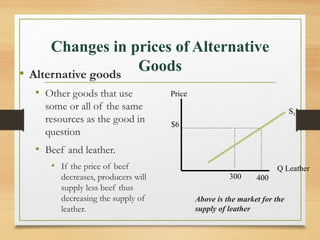
Changes in prices of Alternative
Goods
• Alternative goods
• Other goods that use
some or all of the same
resources as the good in
question

Price
S1
$6

• Beef and leather.
• If the price of beef
decreases, producers will
supply less beef thus
decreasing the supply of
leather.

300

Q Leather
400

Above is the market for the
supply of leather
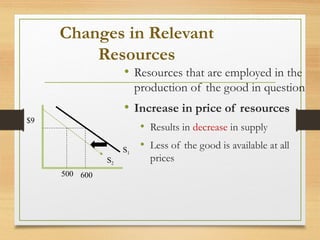
Changes in Relevant
Resources

• Resources that are employed in the
production of the good in question

• Increase in price of resources
$9

S1
S2
500 600

• Results in decrease in supply
• Less of the good is available at all
prices
Changes in the Number of
Producers
• As the number of producers change so does the
supply of the product

• A decrease in the number of producers will lead to
a decrease in supply
Changes in Producers
Expectations
• Expectation of future prices of resources or their
own product can cause producers to change what
they offer at each individual price
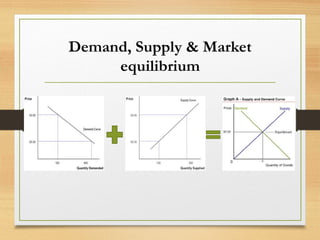
Demand, Supply & Market
equilibrium
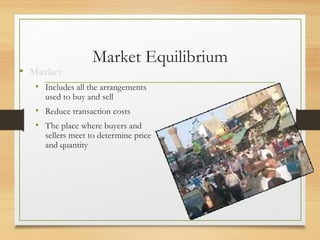
• Market

Market Equilibrium

• Includes all the arrangements
used to buy and sell

• Reduce transaction costs
• The place where buyers and

sellers meet to determine price
and quantity
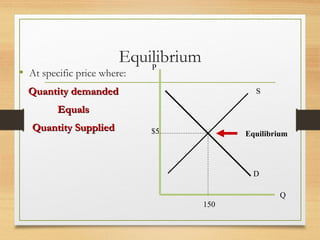
Equilibrium
P

• At specific price where:
Quantity demanded

S

Equals
Quantity Supplied

$5

Equilibrium

D
Q
150
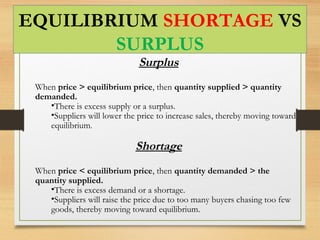
EQUILIBRIUM SHORTAGE VS
SURPLUS
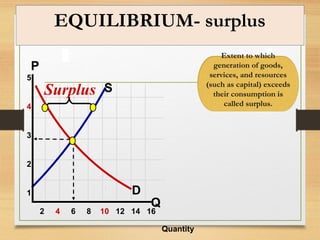
Surplus

When price > equilibrium price, then quantity supplied > quantity
demanded.
•There is excess supply or a surplus.
•Suppliers will lower the price to increase sales, thereby moving toward
equilibrium.

Shortage
When price < equilibrium price, then quantity demanded > the
quantity supplied.
•There is excess demand or a shortage.
•Suppliers will raise the price due to too many buyers chasing too few
goods, thereby moving toward equilibrium.
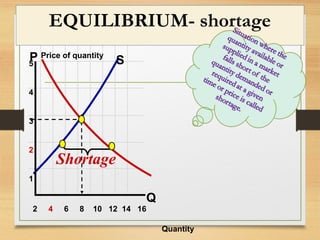
EQUILIBRIUM- shortage
P Price of quantity
5

S

4
3
2

Shortage

1

2

4

6

8

Q

10 12 14 16

Quantity
EQUILIBRIUM- surplus
Extent to which
generation of goods,
services, and resources
(such as capital) exceeds
their consumption is
called surplus.

P
5

Surplus

S

4
3
2

D

1
2

4

6

8

Q

10 12 14 16

Quantity
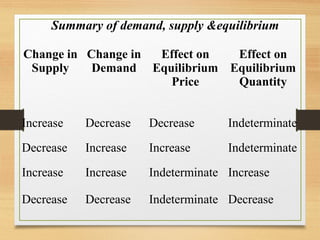
Summary of demand, supply &equilibrium
Change in Change in
Effect on
Effect on
Supply
Demand Equilibrium Equilibrium
Price
Quantity
Increase

Decrease

Decrease

Indeterminate

Decrease

Increase

Increase

Indeterminate

Increase

Increase

Indeterminate Increase

Decrease

Decrease

Indeterminate Decrease
References
• Ankit Bist (2011) DEMAND AND SUPPLY at http://www.slideshare.net/AnkitBist/demand-andsupply-10629356?qid=94fd494d-bed6-4867-a65f-f0d7a1e25582&v=default&b=&from_search=4

• Ujjwal Shanu (2013) DEMAND AND SUPPLY at http://www.slideshare.net/ujjmishra1/demandand-supply-28840569?qid=94fd494d-bed6-4867-a65f-f0d7a1e25582&v=default&b=&from_search=8

•

KASBIT (2011) Basic elements of supply and demand, at
http://www.slideshare.net/imranbashir69/basic-elements-of-supply-and-demand

• Jiten Sharma (2012) demand and supply at http://www.slideshare.net/JitenSharma1/demandsupply-market-equilibrium-15222434

• NepDevWiki (2012) 05 price elasticity of demand and supply at
http://www.slideshare.net/NepDevWiki/05-price-elasticity-of-demand-and-supply

Complilation powepoint final

  • 1.
    DYNAMICS OF MARKETS DEMAND ANDSUPPLY (grade 10) L. MGAGA 201244296
  • 2.
    Introduction The following slidesare the compilation of different slides from five different authors about the topic Demand and Supply. Authors : Ankit Bist Ujjwal 'Shanu‘ KASBIT Jiten Sharma NepDevWiki
  • 3.
    Topics: • Demand Define demand Lawof demand Demand Schedule (elasticity of demand) Factors Affecting Demand curve (graphs) Markets equilibrium • Supply Define supply Law of supply Supply Schedule Factors Affecting Supply curve (graphs) Elasticity
  • 4.
    Demand Definition: The amountof a particular economic good or service that a consumer or group of consumers will want to purchase at a given price •Law of demand :States that a quantity of a good demanded during a given period relates inversely to its price, other things constant. •Price increases  Quantity Demanded decreases •Price decreases  Quantity demanded increases •Creates a downward sloping demand curve
  • 5.
    Demand schedule Demand Schedule DemandCurve Price [Rs per unit] Quantity demanded of X [kg. per month] a b c d e f 0.50 1.00 1.50 2.00 2.50 3.00 7.0 5.0 3. 5 2.5 1.5 1.0 3.00 f e 2.50 d Price of X Point 2.00 c 1.50 b 1.00 a 0.50 1 2 3 4 5 6 7 Quantity of X
  • 6.
  • 7.
    Factors effecting demandcurve (movements and shifts along the curve) 1. Change in taste 2. Prices of other goods • Substitute • Complement 3. Income 4. Government rules and regulation
  • 8.
    1.Changes in taste(shift in demand) • Consumers prefer platform shoes. • At $50, demand increases from 100 to 200. $50 D 100 200 D2
  • 9.
    2.2.1Change in Pricesof other goods (substitute) Increase in demand E.g.: Price of coke increases, demand of Pepsi increases Price Suppose the two cold drinks coke and Pepsi are substitutes D D 2 Quantity (Pepsi)
  • 10.
    2.2.Change in Pricesof other goods (Complements)Decrease in demand (they work together) E.g.: Price of tea increases, demand of sugar decreases Price Suppose tea and sugar are complements D1 D Quantity (sugar)
  • 11.
    3.Change in Income Theincrease in income increases the quantity of goods demanded (demand increases shifts rightward) Price Increase in demand D2 D Quantity X
  • 12.
    4.Change in GovernmentRegulation (Sales tax) Price Decrease in demand D1 Quantity X
  • 13.
    SUPPLY: • Definition: Thetotal amount of a good or service available for purchase; along with demand, one of the two key determinants of price. Law of supply: If demand is held constant, an increase in supply leads to a decreased price, while a decrease in supply leads to an increased price.
  • 14.
    Supply Schedule The increasein price increases the quantity supplied, e.g. price increase from 2 to 4 an quantity increases from 3 to .
  • 15.
    Factors that effectthe Supply curve • • • • • Technology Changes in prices of Alternative Goods Changes in Relevant Resources Changes in the Number of Producers Changes in Producers Expectations
  • 16.
    1.Changes in technology •Technology is the economy’s stock of knowledge about how to combine resources efficiently Improvements in technology Causes an increase in supply More of the product is available at all prices
  • 17.
    Changes in pricesof Alternative Goods • Alternative goods • Other goods that use some or all of the same resources as the good in question Price S1 $6 • Beef and leather. • If the price of beef decreases, producers will supply less beef thus decreasing the supply of leather. 300 Q Leather 400 Above is the market for the supply of leather
  • 18.
    Changes in Relevant Resources •Resources that are employed in the production of the good in question • Increase in price of resources $9 S1 S2 500 600 • Results in decrease in supply • Less of the good is available at all prices
  • 19.
    Changes in theNumber of Producers • As the number of producers change so does the supply of the product • A decrease in the number of producers will lead to a decrease in supply
  • 20.
    Changes in Producers Expectations •Expectation of future prices of resources or their own product can cause producers to change what they offer at each individual price
  • 21.
    Demand, Supply &Market equilibrium
  • 22.
    • Market Market Equilibrium •Includes all the arrangements used to buy and sell • Reduce transaction costs • The place where buyers and sellers meet to determine price and quantity
  • 23.
    Equilibrium P • At specificprice where: Quantity demanded S Equals Quantity Supplied $5 Equilibrium D Q 150
  • 24.
    EQUILIBRIUM SHORTAGE VS SURPLUS Surplus Whenprice > equilibrium price, then quantity supplied > quantity demanded. •There is excess supply or a surplus. •Suppliers will lower the price to increase sales, thereby moving toward equilibrium. Shortage When price < equilibrium price, then quantity demanded > the quantity supplied. •There is excess demand or a shortage. •Suppliers will raise the price due to too many buyers chasing too few goods, thereby moving toward equilibrium.
  • 25.
    EQUILIBRIUM- shortage P Priceof quantity 5 S 4 3 2 Shortage 1 2 4 6 8 Q 10 12 14 16 Quantity
  • 26.
    EQUILIBRIUM- surplus Extent towhich generation of goods, services, and resources (such as capital) exceeds their consumption is called surplus. P 5 Surplus S 4 3 2 D 1 2 4 6 8 Q 10 12 14 16 Quantity
  • 27.
    Summary of demand,supply &equilibrium Change in Change in Effect on Effect on Supply Demand Equilibrium Equilibrium Price Quantity Increase Decrease Decrease Indeterminate Decrease Increase Increase Indeterminate Increase Increase Indeterminate Increase Decrease Decrease Indeterminate Decrease
  • 29.
    References • Ankit Bist(2011) DEMAND AND SUPPLY at http://www.slideshare.net/AnkitBist/demand-andsupply-10629356?qid=94fd494d-bed6-4867-a65f-f0d7a1e25582&v=default&b=&from_search=4 • Ujjwal Shanu (2013) DEMAND AND SUPPLY at http://www.slideshare.net/ujjmishra1/demandand-supply-28840569?qid=94fd494d-bed6-4867-a65f-f0d7a1e25582&v=default&b=&from_search=8 • KASBIT (2011) Basic elements of supply and demand, at http://www.slideshare.net/imranbashir69/basic-elements-of-supply-and-demand • Jiten Sharma (2012) demand and supply at http://www.slideshare.net/JitenSharma1/demandsupply-market-equilibrium-15222434 • NepDevWiki (2012) 05 price elasticity of demand and supply at http://www.slideshare.net/NepDevWiki/05-price-elasticity-of-demand-and-supply