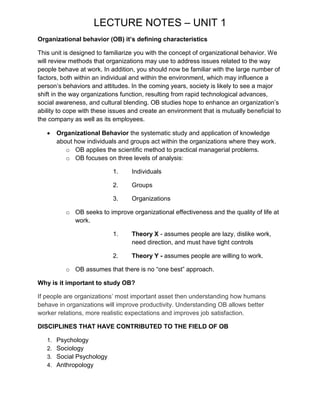
LECTURE NOTES – UNIT 1
Organizational behavior (OB) it’s defining characteristics

This unit is designed to familiarize you with the concept of organizational behavior. We
will review methods that organizations may use to address issues related to the way
people behave at work. In addition, you should now be familiar with the large number of
factors, both within an individual and within the environment, which may influence a
person’s behaviors and attitudes. In the coming years, society is likely to see a major
shift in the way organizations function, resulting from rapid technological advances,
social awareness, and cultural blending. OB studies hope to enhance an organization’s
ability to cope with these issues and create an environment that is mutually beneficial to
the company as well as its employees.

   ď‚·    Organizational Behavior the systematic study and application of knowledge
        about how individuals and groups act within the organizations where they work.
           o OB applies the scientific method to practical managerial problems.
           o OB focuses on three levels of analysis:

                            1.    Individuals

                            2.    Groups

                            3.    Organizations

           o OB seeks to improve organizational effectiveness and the quality of life at
             work.

                            1.    Theory X - assumes people are lazy, dislike work,
                                  need direction, and must have tight controls

                            2.    Theory Y - assumes people are willing to work.

           o OB assumes that there is no “one best” approach.

Why is it important to study OB?

If people are organizations’ most important asset then understanding how humans
behave in organizations will improve productivity. Understanding OB allows better
worker relations, more realistic expectations and improves job satisfaction.

DISCIPLINES THAT HAVE CONTRIBUTED TO THE FIELD OF OB

   1.   Psychology
   2.   Sociology
   3.   Social Psychology
   4.   Anthropology
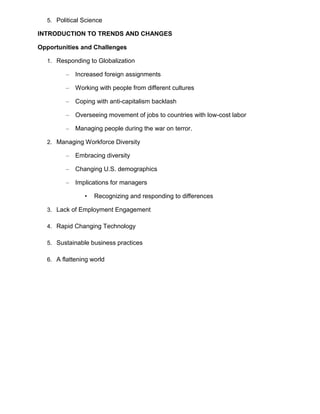
5. Political Science

INTRODUCTION TO TRENDS AND CHANGES

Opportunities and Challenges

  1. Responding to Globalization

        –   Increased foreign assignments

        –   Working with people from different cultures

        –   Coping with anti-capitalism backlash

        –   Overseeing movement of jobs to countries with low-cost labor

        –   Managing people during the war on terror.

  2. Managing Workforce Diversity

        –   Embracing diversity

        –   Changing U.S. demographics

        –   Implications for managers

               •   Recognizing and responding to differences

  3. Lack of Employment Engagement

  4. Rapid Changing Technology

  5. Sustainable business practices

  6. A flattening world

Lecture note: lesson1

  • 1.
    LECTURE NOTES –UNIT 1 Organizational behavior (OB) it’s defining characteristics This unit is designed to familiarize you with the concept of organizational behavior. We will review methods that organizations may use to address issues related to the way people behave at work. In addition, you should now be familiar with the large number of factors, both within an individual and within the environment, which may influence a person’s behaviors and attitudes. In the coming years, society is likely to see a major shift in the way organizations function, resulting from rapid technological advances, social awareness, and cultural blending. OB studies hope to enhance an organization’s ability to cope with these issues and create an environment that is mutually beneficial to the company as well as its employees.  Organizational Behavior the systematic study and application of knowledge about how individuals and groups act within the organizations where they work. o OB applies the scientific method to practical managerial problems. o OB focuses on three levels of analysis: 1. Individuals 2. Groups 3. Organizations o OB seeks to improve organizational effectiveness and the quality of life at work. 1. Theory X - assumes people are lazy, dislike work, need direction, and must have tight controls 2. Theory Y - assumes people are willing to work. o OB assumes that there is no “one best” approach. Why is it important to study OB? If people are organizations’ most important asset then understanding how humans behave in organizations will improve productivity. Understanding OB allows better worker relations, more realistic expectations and improves job satisfaction. DISCIPLINES THAT HAVE CONTRIBUTED TO THE FIELD OF OB 1. Psychology 2. Sociology 3. Social Psychology 4. Anthropology
  • 2.
    5. Political Science INTRODUCTIONTO TRENDS AND CHANGES Opportunities and Challenges 1. Responding to Globalization – Increased foreign assignments – Working with people from different cultures – Coping with anti-capitalism backlash – Overseeing movement of jobs to countries with low-cost labor – Managing people during the war on terror. 2. Managing Workforce Diversity – Embracing diversity – Changing U.S. demographics – Implications for managers • Recognizing and responding to differences 3. Lack of Employment Engagement 4. Rapid Changing Technology 5. Sustainable business practices 6. A flattening world