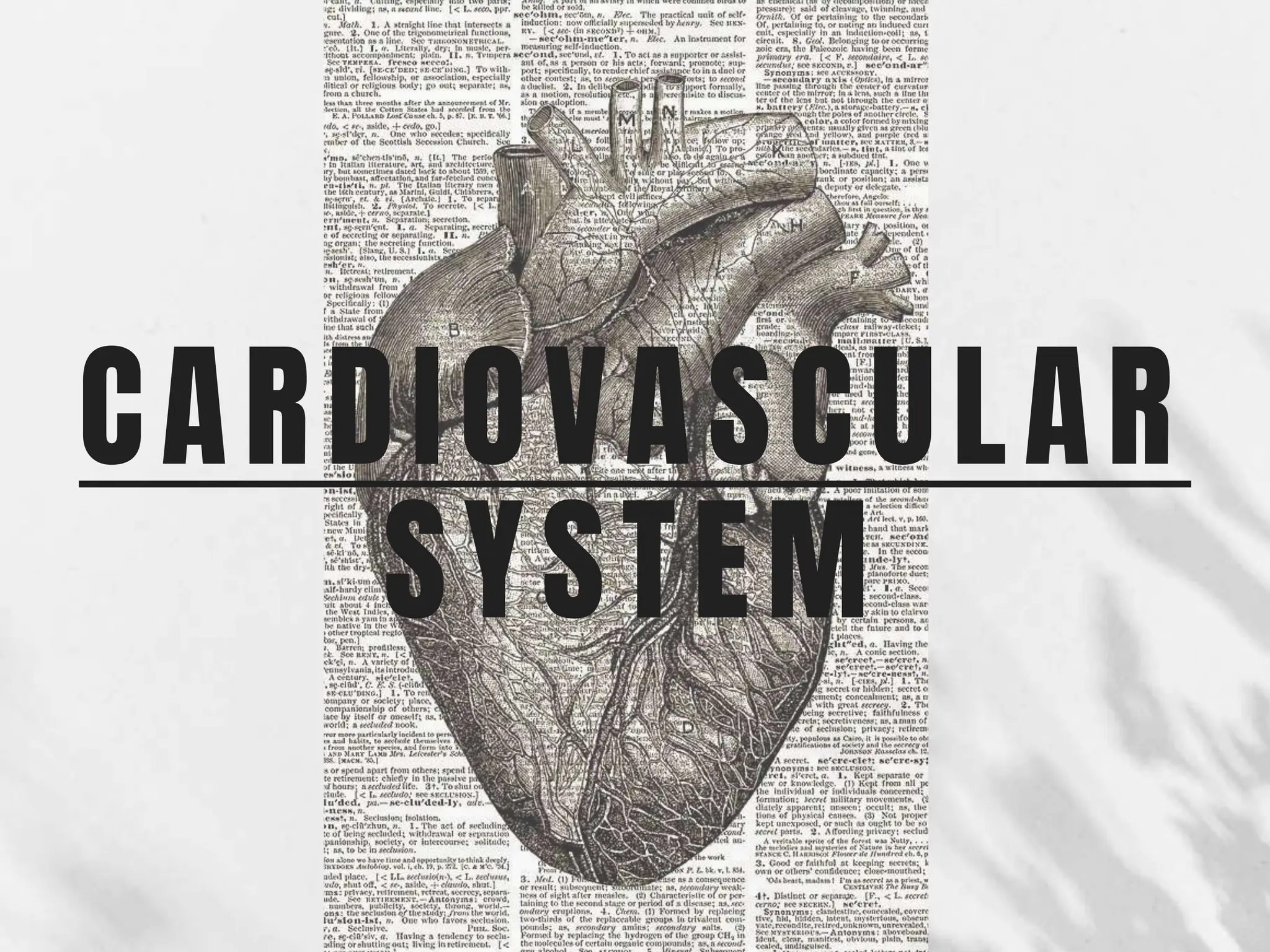
CARDIOVASCULAR
SYSTEM
INTRODUCTION TO
CARDIOVASCULAR SYSTEM
The cardiovascular system, also known as the
circulatory system, consists of the heart, blood vessels
(arteries, veins, and capillaries), and blood. It is
responsible for transporting oxygen, nutrients,
hormones, and waste products throughout the body.
The heart pumps blood through the vessels, ensuring
efficient delivery to and from tissues. This system is
essential for maintaining homeostasis, supporting
cellular functions, and overall health.
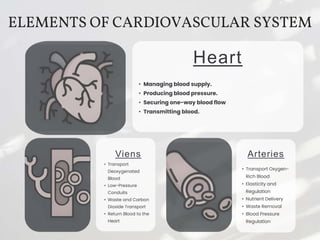
Heart
• Managing blood supply.
• Producing blood pressure.
• Securing one-way blood flow
• Transmitting blood.
Viens
• Transport
Deoxygenated
Blood
• Low-Pressure
Conduits
• Waste and Carbon
Dioxide Transport
• Return Blood to the
Heart
Arteries
• Transport Oxygen-
Rich Blood
• Elasticity and
Regulation
• Nutrient Delivery
• Waste Removal
• Blood Pressure
Regulation
ELEMENTS OF CARDIOVASCULAR SYSTEM
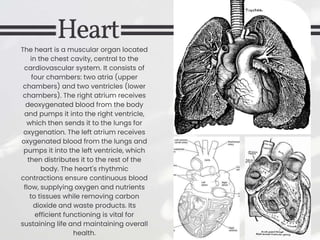
Heart
The heart is a muscular organ located
in the chest cavity, central to the
cardiovascular system. It consists of
four chambers: two atria (upper
chambers) and two ventricles (lower
chambers). The right atrium receives
deoxygenated blood from the body
and pumps it into the right ventricle,
which then sends it to the lungs for
oxygenation. The left atrium receives
oxygenated blood from the lungs and
pumps it into the left ventricle, which
then distributes it to the rest of the
body. The heart's rhythmic
contractions ensure continuous blood
flow, supplying oxygen and nutrients
to tissues while removing carbon
dioxide and waste products. Its
efficient functioning is vital for
sustaining life and maintaining overall
health.
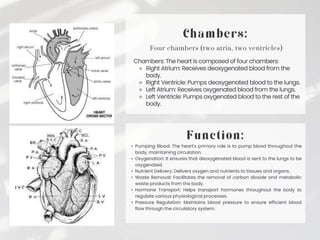
Chambers: The heart is composed of four chambers:
⚬ Right Atrium: Receives deoxygenated blood from the
body.
⚬ Right Ventricle: Pumps deoxygenated blood to the lungs.
⚬ Left Atrium: Receives oxygenated blood from the lungs.
⚬ Left Ventricle: Pumps oxygenated blood to the rest of the
body.
Four chambers (two atria, two ventricles)
• Pumping Blood: The heart's primary role is to pump blood throughout the
body, maintaining circulation.
• Oxygenation: It ensures that deoxygenated blood is sent to the lungs to be
oxygenated.
• Nutrient Delivery: Delivers oxygen and nutrients to tissues and organs.
• Waste Removal: Facilitates the removal of carbon dioxide and metabolic
waste products from the body.
• Hormone Transport: Helps transport hormones throughout the body to
regulate various physiological processes.
• Pressure Regulation: Maintains blood pressure to ensure efficient blood
flow through the circulatory system.
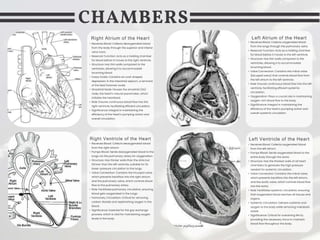
Right Atrium of the Heart
• Receives Blood: Collects deoxygenated blood
from the body through the superior and inferior
vena cava.
• Reservoir Function: Acts as a holding chamber
for blood before it moves to the right ventricle.
• Structure: Has thin walls compared to the
ventricles, allowing it to accommodate
incoming blood.
• Fossa Ovalis: Contains an oval-shaped
depression in the interatrial septum, a remnant
of the fetal foramen ovale.
• Sinoatrial Node: Houses the sinoatrial (SA)
node, the heart's natural pacemaker, which
initiates the heartbeat.
• Role: Ensures continuous blood flow into the
right ventricle, facilitating efficient circulation.
• Significance: Integral in maintaining the
efficiency of the heart’s pumping action and
overall circulation.
Right Ventricle of the Heart
• Receives Blood: Collects deoxygenated blood
from the right atrium.
• Pumps Blood: Sends deoxygenated blood to the
lungs via the pulmonary artery for oxygenation.
• Structure: Has thicker walls than the atria but
thinner than the left ventricle, suitable for its
lower-pressure circulation to the lungs.
• Valve Connection: Contains the tricuspid valve,
which prevents backflow into the right atrium,
and the pulmonary valve, which controls blood
flow to the pulmonary artery.
• Role: Facilitates pulmonary circulation, ensuring
blood gets oxygenated in the lungs.
• Pulmonary Circulation: Critical for removing
carbon dioxide and replenishing oxygen in the
blood.
• Significance: Essential for the gas exchange
process, which is vital for maintaining oxygen
levels in the body.
Left Ventricle of the Heart
• Receives Blood: Collects oxygenated blood
from the left atrium.
• Pumps Blood: Sends oxygenated blood to the
entire body through the aorta.
• Structure: Has the thickest walls of all heart
chambers to generate the high pressure
needed for systemic circulation.
• Valve Connection: Contains the mitral valve,
which prevents backflow into the left atrium,
and the aortic valve, which controls blood flow
into the aorta.
• Role: Facilitates systemic circulation, ensuring
that oxygenated blood reaches all tissues and
organs.
• Systemic Circulation: Delivers nutrients and
oxygen to the body while removing metabolic
waste.
• Significance: Critical for sustaining life by
providing the necessary force to maintain
blood flow throughout the body.
CHAMBERS
Left Atrium of the Heart
• Receives Blood: Collects oxygenated blood
from the lungs through the pulmonary veins.
• Reservoir Function: Acts as a holding chamber
for blood before it moves to the left ventricle.
• Structure: Has thin walls compared to the
ventricles, allowing it to accommodate
incoming blood.
• Valve Connection: Contains the mitral valve
(bicuspid valve) that controls blood flow from
the left atrium to the left ventricle.
• Role: Ensures continuous blood flow into the left
ventricle, facilitating efficient systemic
circulation.
• Oxygenation: Plays a crucial role in maintaining
oxygen-rich blood flow to the body.
• Significance: Integral in maintaining the
efficiency of the heart’s pumping action and
overall systemic circulation
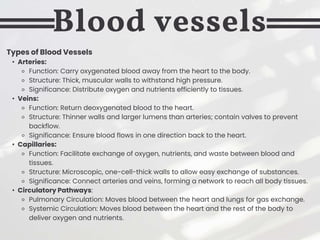
Types of Blood Vessels
• Arteries:
⚬ Function: Carry oxygenated blood away from the heart to the body.
⚬ Structure: Thick, muscular walls to withstand high pressure.
⚬ Significance: Distribute oxygen and nutrients efficiently to tissues.
• Veins:
⚬ Function: Return deoxygenated blood to the heart.
⚬ Structure: Thinner walls and larger lumens than arteries; contain valves to prevent
backflow.
⚬ Significance: Ensure blood flows in one direction back to the heart.
• Capillaries:
⚬ Function: Facilitate exchange of oxygen, nutrients, and waste between blood and
tissues.
⚬ Structure: Microscopic, one-cell-thick walls to allow easy exchange of substances.
⚬ Significance: Connect arteries and veins, forming a network to reach all body tissues.
• Circulatory Pathways:
⚬ Pulmonary Circulation: Moves blood between the heart and lungs for gas exchange.
⚬ Systemic Circulation: Moves blood between the heart and the rest of the body to
deliver oxygen and nutrients.
Blood vessels
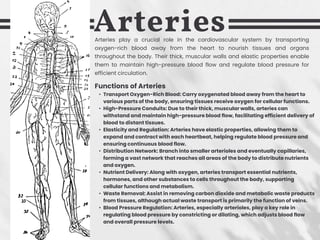
Arteries
Arteries play a crucial role in the cardiovascular system by transporting
oxygen-rich blood away from the heart to nourish tissues and organs
throughout the body. Their thick, muscular walls and elastic properties enable
them to maintain high-pressure blood flow and regulate blood pressure for
efficient circulation.
Functions of Arteries
• Transport Oxygen-Rich Blood: Carry oxygenated blood away from the heart to
various parts of the body, ensuring tissues receive oxygen for cellular functions.
• High-Pressure Conduits: Due to their thick, muscular walls, arteries can
withstand and maintain high-pressure blood flow, facilitating efficient delivery of
blood to distant tissues.
• Elasticity and Regulation: Arteries have elastic properties, allowing them to
expand and contract with each heartbeat, helping regulate blood pressure and
ensuring continuous blood flow.
• Distribution Network: Branch into smaller arterioles and eventually capillaries,
forming a vast network that reaches all areas of the body to distribute nutrients
and oxygen.
• Nutrient Delivery: Along with oxygen, arteries transport essential nutrients,
hormones, and other substances to cells throughout the body, supporting
cellular functions and metabolism.
• Waste Removal: Assist in removing carbon dioxide and metabolic waste products
from tissues, although actual waste transport is primarily the function of veins.
• Blood Pressure Regulation: Arteries, especially arterioles, play a key role in
regulating blood pressure by constricting or dilating, which adjusts blood flow
and overall pressure levels.
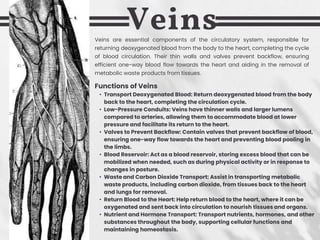
Veins
Functions of Veins
• Transport Deoxygenated Blood: Return deoxygenated blood from the body
back to the heart, completing the circulation cycle.
• Low-Pressure Conduits: Veins have thinner walls and larger lumens
compared to arteries, allowing them to accommodate blood at lower
pressure and facilitate its return to the heart.
• Valves to Prevent Backflow: Contain valves that prevent backflow of blood,
ensuring one-way flow towards the heart and preventing blood pooling in
the limbs.
• Blood Reservoir: Act as a blood reservoir, storing excess blood that can be
mobilized when needed, such as during physical activity or in response to
changes in posture.
• Waste and Carbon Dioxide Transport: Assist in transporting metabolic
waste products, including carbon dioxide, from tissues back to the heart
and lungs for removal.
• Return Blood to the Heart: Help return blood to the heart, where it can be
oxygenated and sent back into circulation to nourish tissues and organs.
• Nutrient and Hormone Transport: Transport nutrients, hormones, and other
substances throughout the body, supporting cellular functions and
maintaining homeostasis.
Veins are essential components of the circulatory system, responsible for
returning deoxygenated blood from the body to the heart, completing the cycle
of blood circulation. Their thin walls and valves prevent backflow, ensuring
efficient one-way blood flow towards the heart and aiding in the removal of
metabolic waste products from tissues.
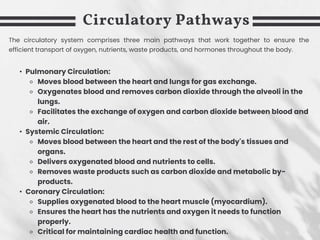
Circulatory Pathways
• Pulmonary Circulation:
⚬ Moves blood between the heart and lungs for gas exchange.
⚬ Oxygenates blood and removes carbon dioxide through the alveoli in the
lungs.
⚬ Facilitates the exchange of oxygen and carbon dioxide between blood and
air.
• Systemic Circulation:
⚬ Moves blood between the heart and the rest of the body's tissues and
organs.
⚬ Delivers oxygenated blood and nutrients to cells.
⚬ Removes waste products such as carbon dioxide and metabolic by-
products.
• Coronary Circulation:
⚬ Supplies oxygenated blood to the heart muscle (myocardium).
⚬ Ensures the heart has the nutrients and oxygen it needs to function
properly.
⚬ Critical for maintaining cardiac health and function.
The circulatory system comprises three main pathways that work together to ensure the
efficient transport of oxygen, nutrients, waste products, and hormones throughout the body.
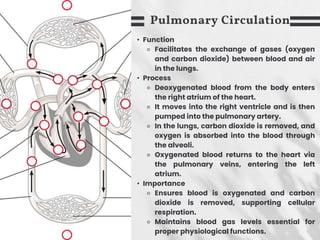
Pulmonary Circulation
• Function
⚬ Facilitates the exchange of gases (oxygen
and carbon dioxide) between blood and air
in the lungs.
• Process
⚬ Deoxygenated blood from the body enters
the right atrium of the heart.
⚬ It moves into the right ventricle and is then
pumped into the pulmonary artery.
⚬ In the lungs, carbon dioxide is removed, and
oxygen is absorbed into the blood through
the alveoli.
⚬ Oxygenated blood returns to the heart via
the pulmonary veins, entering the left
atrium.
• Importance
⚬ Ensures blood is oxygenated and carbon
dioxide is removed, supporting cellular
respiration.
⚬ Maintains blood gas levels essential for
proper physiological functions.
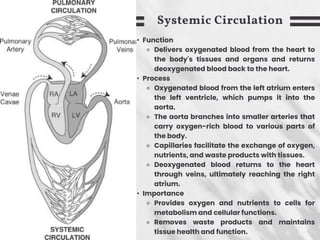
Systemic Circulation
• Function
⚬ Delivers oxygenated blood from the heart to
the body's tissues and organs and returns
deoxygenated blood back to the heart.
• Process
⚬ Oxygenated blood from the left atrium enters
the left ventricle, which pumps it into the
aorta.
⚬ The aorta branches into smaller arteries that
carry oxygen-rich blood to various parts of
the body.
⚬ Capillaries facilitate the exchange of oxygen,
nutrients, and waste products with tissues.
⚬ Deoxygenated blood returns to the heart
through veins, ultimately reaching the right
atrium.
• Importance
⚬ Provides oxygen and nutrients to cells for
metabolism and cellular functions.
⚬ Removes waste products and maintains
tissue health and function.
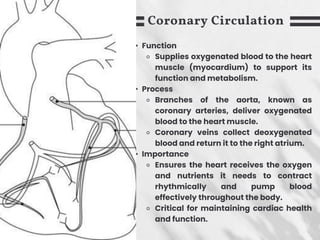
Coronary Circulation
• Function
⚬ Supplies oxygenated blood to the heart
muscle (myocardium) to support its
function and metabolism.
• Process
⚬ Branches of the aorta, known as
coronary arteries, deliver oxygenated
blood to the heart muscle.
⚬ Coronary veins collect deoxygenated
blood and return it to the right atrium.
• Importance
⚬ Ensures the heart receives the oxygen
and nutrients it needs to contract
rhythmically and pump blood
effectively throughout the body.
⚬ Critical for maintaining cardiac health
and function.
Homeostasis
Maintaining Homeostasis
• Oxygen and Nutrient Delivery: Ensures continuous delivery of oxygen and
essential nutrients to tissues and organs for metabolic processes and cellular
functions.
• Waste Removal: Facilitates the removal of metabolic waste products, such as
carbon dioxide, from cells and tissues, helping maintain proper pH balance and
cellular function.
• Hormone Transport: Supports endocrine function by transporting hormones
produced by glands to target cells, regulating various physiological processes
such as metabolism, growth, and reproduction.
• Temperature Regulation: Contributes to temperature regulation by distributing
heat throughout the body, helping maintain optimal internal temperature for
cellular activities and metabolic processes.
Homeostasis is the body's ability to maintain stable internal conditions essential for optimal
function. It involves regulating factors like temperature, pH, and nutrient levels within narrow ranges
despite external fluctuations. This balance ensures cells and organs can operate efficiently and
maintain overall health.Homeostasis maintains stable internal conditions, crucial for circulatory
pathways' efficiency in delivering oxygen, nutrients, and removing waste products.
Key Takeaway
Vital for Life:
The cardiovascular system is vital for
sustaining life by circulating blood,
nutrients, oxygen, and removing
waste throughout the body.
Arteries and Veins:
Arteries carry oxygen-rich blood
away from the heart, while veins
return deoxygenated blood,
completing the circulation cycle.
Homeostasis Maintenance:
The cardiovascular system plays a
crucial role in maintaining
homeostasis by delivering essential
substances, removing waste, and
regulating hormone transport.
Heart's Central Role:
The heart's structure and function
are central to maintaining proper
blood flow, ensuring efficient
oxygenation and nutrient delivery.
Capillaries and Exchange:
Capillaries facilitate the exchange of
oxygen, nutrients, and waste
products between blood and tissues,
supporting cellular functions.
Health Impact:
Cardiovascular health is integral to
overall health, highlighting the
importance of a healthy heart and
circulatory system for optimal
functioning
thankyou
for your time

PowerPoint presentation on cardio-vascular system

  • 1.
  • 2.
    INTRODUCTION TO CARDIOVASCULAR SYSTEM Thecardiovascular system, also known as the circulatory system, consists of the heart, blood vessels (arteries, veins, and capillaries), and blood. It is responsible for transporting oxygen, nutrients, hormones, and waste products throughout the body. The heart pumps blood through the vessels, ensuring efficient delivery to and from tissues. This system is essential for maintaining homeostasis, supporting cellular functions, and overall health.
  • 3.
    Heart • Managing bloodsupply. • Producing blood pressure. • Securing one-way blood flow • Transmitting blood. Viens • Transport Deoxygenated Blood • Low-Pressure Conduits • Waste and Carbon Dioxide Transport • Return Blood to the Heart Arteries • Transport Oxygen- Rich Blood • Elasticity and Regulation • Nutrient Delivery • Waste Removal • Blood Pressure Regulation ELEMENTS OF CARDIOVASCULAR SYSTEM
  • 4.
    Heart The heart isa muscular organ located in the chest cavity, central to the cardiovascular system. It consists of four chambers: two atria (upper chambers) and two ventricles (lower chambers). The right atrium receives deoxygenated blood from the body and pumps it into the right ventricle, which then sends it to the lungs for oxygenation. The left atrium receives oxygenated blood from the lungs and pumps it into the left ventricle, which then distributes it to the rest of the body. The heart's rhythmic contractions ensure continuous blood flow, supplying oxygen and nutrients to tissues while removing carbon dioxide and waste products. Its efficient functioning is vital for sustaining life and maintaining overall health.
  • 5.
    Chambers: The heartis composed of four chambers: ⚬ Right Atrium: Receives deoxygenated blood from the body. ⚬ Right Ventricle: Pumps deoxygenated blood to the lungs. ⚬ Left Atrium: Receives oxygenated blood from the lungs. ⚬ Left Ventricle: Pumps oxygenated blood to the rest of the body. Four chambers (two atria, two ventricles) • Pumping Blood: The heart's primary role is to pump blood throughout the body, maintaining circulation. • Oxygenation: It ensures that deoxygenated blood is sent to the lungs to be oxygenated. • Nutrient Delivery: Delivers oxygen and nutrients to tissues and organs. • Waste Removal: Facilitates the removal of carbon dioxide and metabolic waste products from the body. • Hormone Transport: Helps transport hormones throughout the body to regulate various physiological processes. • Pressure Regulation: Maintains blood pressure to ensure efficient blood flow through the circulatory system.
  • 6.
    Right Atrium ofthe Heart • Receives Blood: Collects deoxygenated blood from the body through the superior and inferior vena cava. • Reservoir Function: Acts as a holding chamber for blood before it moves to the right ventricle. • Structure: Has thin walls compared to the ventricles, allowing it to accommodate incoming blood. • Fossa Ovalis: Contains an oval-shaped depression in the interatrial septum, a remnant of the fetal foramen ovale. • Sinoatrial Node: Houses the sinoatrial (SA) node, the heart's natural pacemaker, which initiates the heartbeat. • Role: Ensures continuous blood flow into the right ventricle, facilitating efficient circulation. • Significance: Integral in maintaining the efficiency of the heart’s pumping action and overall circulation. Right Ventricle of the Heart • Receives Blood: Collects deoxygenated blood from the right atrium. • Pumps Blood: Sends deoxygenated blood to the lungs via the pulmonary artery for oxygenation. • Structure: Has thicker walls than the atria but thinner than the left ventricle, suitable for its lower-pressure circulation to the lungs. • Valve Connection: Contains the tricuspid valve, which prevents backflow into the right atrium, and the pulmonary valve, which controls blood flow to the pulmonary artery. • Role: Facilitates pulmonary circulation, ensuring blood gets oxygenated in the lungs. • Pulmonary Circulation: Critical for removing carbon dioxide and replenishing oxygen in the blood. • Significance: Essential for the gas exchange process, which is vital for maintaining oxygen levels in the body. Left Ventricle of the Heart • Receives Blood: Collects oxygenated blood from the left atrium. • Pumps Blood: Sends oxygenated blood to the entire body through the aorta. • Structure: Has the thickest walls of all heart chambers to generate the high pressure needed for systemic circulation. • Valve Connection: Contains the mitral valve, which prevents backflow into the left atrium, and the aortic valve, which controls blood flow into the aorta. • Role: Facilitates systemic circulation, ensuring that oxygenated blood reaches all tissues and organs. • Systemic Circulation: Delivers nutrients and oxygen to the body while removing metabolic waste. • Significance: Critical for sustaining life by providing the necessary force to maintain blood flow throughout the body. CHAMBERS Left Atrium of the Heart • Receives Blood: Collects oxygenated blood from the lungs through the pulmonary veins. • Reservoir Function: Acts as a holding chamber for blood before it moves to the left ventricle. • Structure: Has thin walls compared to the ventricles, allowing it to accommodate incoming blood. • Valve Connection: Contains the mitral valve (bicuspid valve) that controls blood flow from the left atrium to the left ventricle. • Role: Ensures continuous blood flow into the left ventricle, facilitating efficient systemic circulation. • Oxygenation: Plays a crucial role in maintaining oxygen-rich blood flow to the body. • Significance: Integral in maintaining the efficiency of the heart’s pumping action and overall systemic circulation
  • 7.
    Types of BloodVessels • Arteries: ⚬ Function: Carry oxygenated blood away from the heart to the body. ⚬ Structure: Thick, muscular walls to withstand high pressure. ⚬ Significance: Distribute oxygen and nutrients efficiently to tissues. • Veins: ⚬ Function: Return deoxygenated blood to the heart. ⚬ Structure: Thinner walls and larger lumens than arteries; contain valves to prevent backflow. ⚬ Significance: Ensure blood flows in one direction back to the heart. • Capillaries: ⚬ Function: Facilitate exchange of oxygen, nutrients, and waste between blood and tissues. ⚬ Structure: Microscopic, one-cell-thick walls to allow easy exchange of substances. ⚬ Significance: Connect arteries and veins, forming a network to reach all body tissues. • Circulatory Pathways: ⚬ Pulmonary Circulation: Moves blood between the heart and lungs for gas exchange. ⚬ Systemic Circulation: Moves blood between the heart and the rest of the body to deliver oxygen and nutrients. Blood vessels
  • 8.
    Arteries Arteries play acrucial role in the cardiovascular system by transporting oxygen-rich blood away from the heart to nourish tissues and organs throughout the body. Their thick, muscular walls and elastic properties enable them to maintain high-pressure blood flow and regulate blood pressure for efficient circulation. Functions of Arteries • Transport Oxygen-Rich Blood: Carry oxygenated blood away from the heart to various parts of the body, ensuring tissues receive oxygen for cellular functions. • High-Pressure Conduits: Due to their thick, muscular walls, arteries can withstand and maintain high-pressure blood flow, facilitating efficient delivery of blood to distant tissues. • Elasticity and Regulation: Arteries have elastic properties, allowing them to expand and contract with each heartbeat, helping regulate blood pressure and ensuring continuous blood flow. • Distribution Network: Branch into smaller arterioles and eventually capillaries, forming a vast network that reaches all areas of the body to distribute nutrients and oxygen. • Nutrient Delivery: Along with oxygen, arteries transport essential nutrients, hormones, and other substances to cells throughout the body, supporting cellular functions and metabolism. • Waste Removal: Assist in removing carbon dioxide and metabolic waste products from tissues, although actual waste transport is primarily the function of veins. • Blood Pressure Regulation: Arteries, especially arterioles, play a key role in regulating blood pressure by constricting or dilating, which adjusts blood flow and overall pressure levels.
  • 9.
    Veins Functions of Veins •Transport Deoxygenated Blood: Return deoxygenated blood from the body back to the heart, completing the circulation cycle. • Low-Pressure Conduits: Veins have thinner walls and larger lumens compared to arteries, allowing them to accommodate blood at lower pressure and facilitate its return to the heart. • Valves to Prevent Backflow: Contain valves that prevent backflow of blood, ensuring one-way flow towards the heart and preventing blood pooling in the limbs. • Blood Reservoir: Act as a blood reservoir, storing excess blood that can be mobilized when needed, such as during physical activity or in response to changes in posture. • Waste and Carbon Dioxide Transport: Assist in transporting metabolic waste products, including carbon dioxide, from tissues back to the heart and lungs for removal. • Return Blood to the Heart: Help return blood to the heart, where it can be oxygenated and sent back into circulation to nourish tissues and organs. • Nutrient and Hormone Transport: Transport nutrients, hormones, and other substances throughout the body, supporting cellular functions and maintaining homeostasis. Veins are essential components of the circulatory system, responsible for returning deoxygenated blood from the body to the heart, completing the cycle of blood circulation. Their thin walls and valves prevent backflow, ensuring efficient one-way blood flow towards the heart and aiding in the removal of metabolic waste products from tissues.
  • 10.
    Circulatory Pathways • PulmonaryCirculation: ⚬ Moves blood between the heart and lungs for gas exchange. ⚬ Oxygenates blood and removes carbon dioxide through the alveoli in the lungs. ⚬ Facilitates the exchange of oxygen and carbon dioxide between blood and air. • Systemic Circulation: ⚬ Moves blood between the heart and the rest of the body's tissues and organs. ⚬ Delivers oxygenated blood and nutrients to cells. ⚬ Removes waste products such as carbon dioxide and metabolic by- products. • Coronary Circulation: ⚬ Supplies oxygenated blood to the heart muscle (myocardium). ⚬ Ensures the heart has the nutrients and oxygen it needs to function properly. ⚬ Critical for maintaining cardiac health and function. The circulatory system comprises three main pathways that work together to ensure the efficient transport of oxygen, nutrients, waste products, and hormones throughout the body.
  • 11.
    Pulmonary Circulation • Function ⚬Facilitates the exchange of gases (oxygen and carbon dioxide) between blood and air in the lungs. • Process ⚬ Deoxygenated blood from the body enters the right atrium of the heart. ⚬ It moves into the right ventricle and is then pumped into the pulmonary artery. ⚬ In the lungs, carbon dioxide is removed, and oxygen is absorbed into the blood through the alveoli. ⚬ Oxygenated blood returns to the heart via the pulmonary veins, entering the left atrium. • Importance ⚬ Ensures blood is oxygenated and carbon dioxide is removed, supporting cellular respiration. ⚬ Maintains blood gas levels essential for proper physiological functions.
  • 12.
    Systemic Circulation • Function ⚬Delivers oxygenated blood from the heart to the body's tissues and organs and returns deoxygenated blood back to the heart. • Process ⚬ Oxygenated blood from the left atrium enters the left ventricle, which pumps it into the aorta. ⚬ The aorta branches into smaller arteries that carry oxygen-rich blood to various parts of the body. ⚬ Capillaries facilitate the exchange of oxygen, nutrients, and waste products with tissues. ⚬ Deoxygenated blood returns to the heart through veins, ultimately reaching the right atrium. • Importance ⚬ Provides oxygen and nutrients to cells for metabolism and cellular functions. ⚬ Removes waste products and maintains tissue health and function.
  • 13.
    Coronary Circulation • Function ⚬Supplies oxygenated blood to the heart muscle (myocardium) to support its function and metabolism. • Process ⚬ Branches of the aorta, known as coronary arteries, deliver oxygenated blood to the heart muscle. ⚬ Coronary veins collect deoxygenated blood and return it to the right atrium. • Importance ⚬ Ensures the heart receives the oxygen and nutrients it needs to contract rhythmically and pump blood effectively throughout the body. ⚬ Critical for maintaining cardiac health and function.
  • 14.
    Homeostasis Maintaining Homeostasis • Oxygenand Nutrient Delivery: Ensures continuous delivery of oxygen and essential nutrients to tissues and organs for metabolic processes and cellular functions. • Waste Removal: Facilitates the removal of metabolic waste products, such as carbon dioxide, from cells and tissues, helping maintain proper pH balance and cellular function. • Hormone Transport: Supports endocrine function by transporting hormones produced by glands to target cells, regulating various physiological processes such as metabolism, growth, and reproduction. • Temperature Regulation: Contributes to temperature regulation by distributing heat throughout the body, helping maintain optimal internal temperature for cellular activities and metabolic processes. Homeostasis is the body's ability to maintain stable internal conditions essential for optimal function. It involves regulating factors like temperature, pH, and nutrient levels within narrow ranges despite external fluctuations. This balance ensures cells and organs can operate efficiently and maintain overall health.Homeostasis maintains stable internal conditions, crucial for circulatory pathways' efficiency in delivering oxygen, nutrients, and removing waste products.
  • 15.
    Key Takeaway Vital forLife: The cardiovascular system is vital for sustaining life by circulating blood, nutrients, oxygen, and removing waste throughout the body. Arteries and Veins: Arteries carry oxygen-rich blood away from the heart, while veins return deoxygenated blood, completing the circulation cycle. Homeostasis Maintenance: The cardiovascular system plays a crucial role in maintaining homeostasis by delivering essential substances, removing waste, and regulating hormone transport. Heart's Central Role: The heart's structure and function are central to maintaining proper blood flow, ensuring efficient oxygenation and nutrient delivery. Capillaries and Exchange: Capillaries facilitate the exchange of oxygen, nutrients, and waste products between blood and tissues, supporting cellular functions. Health Impact: Cardiovascular health is integral to overall health, highlighting the importance of a healthy heart and circulatory system for optimal functioning
  • 16.