Sedative- Hypnotic Drugs
Drug that cause sleep and reduce anxiety are
called sedative-hypnotic .
OR
Sedative-hypnotic, a sedative that depresses
activity of the central nervous system and reduces
anxiety and induces sleep.
Basic Pharmacology of Sedative-
Hypnotics
Sedative (Anxiolytic): decrease activity, calming
effect.
An Anxiolytic agent should reduce anxiety
An Anxiolytic should exert a calming effect with
little or no effects on motor or mental functions.
Depression of CNS should be the minimum
consistent with therapeutic efficacy.
• Hypnotic: induce sleep
A Hypnotic drug should produce drowsiness.
Should encourage the onset and maintenance
of a state of sleep that resembles the natural
sleep states.
CNS depression should be more pronounced
than sedation.
(all Sedative- Hypnotics can cross the placenta)
HYPNOSIS
• Hypnosis is a subconscious condition in
which the objective manifestations of the
mind are more or less inactive,
accompanied by abnormal sensitivity.
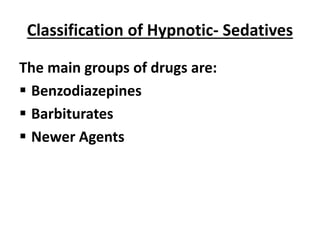
Classification of Hypnotic- Sedatives
The main groups of drugs are:
 Benzodiazepines
 Barbiturates
 Newer Agents
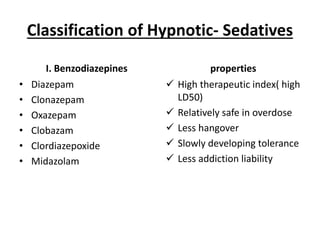
Classification of Hypnotic- Sedatives
I. Benzodiazepines
• Diazepam
• Clonazepam
• Oxazepam
• Clobazam
• Clordiazepoxide
• Midazolam
properties
 High therapeutic index( high
LD50)
 Relatively safe in overdose
 Less hangover
 Slowly developing tolerance
 Less addiction liability
Classification of Hypnotic- Sedatives
II. Barbiturates
• Phenobarbitone
• Amobarbital
• Thiopental- Na
properties
 Nonselective CNS
depressants
 less therapeutic index( not
safe)
 Marked hangover
 Enzyme inducer, so rapidly
develops tolerance
 Addiction liability marked
 Acute over dose causes
cardio respiratory failure
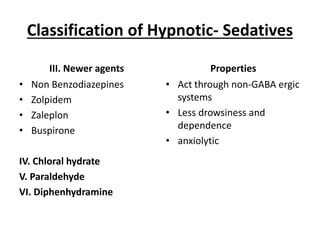
Classification of Hypnotic- Sedatives
III. Newer agents
• Non Benzodiazepines
• Zolpidem
• Zaleplon
• Buspirone
IV. Chloral hydrate
V. Paraldehyde
VI. Diphenhydramine
Properties
• Act through non-GABA ergic
systems
• Less drowsiness and
dependence
• anxiolytic
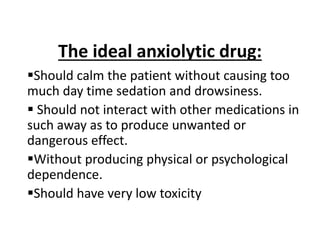
The ideal anxiolytic drug:
Should calm the patient without causing too
much day time sedation and drowsiness.
 Should not interact with other medications in
such away as to produce unwanted or
dangerous effect.
Without producing physical or psychological
dependence.
Should have very low toxicity
The ideal hypnotic drug:
• Should allow the patient to fall asleep quickly.
• Should maintain sleep of sufficient quality and
duration so that the patient awakes refreshed
without a drug hangover) feeling of tiredness
well after the patient wakes. This may lead to
impaired ability to function normally for many
hours after waking. Occasionally, nausea and
dizziness occur.
Barbiturates
• They have been largely replaced by the benzodiazepines,
because Barbiturates:
• 1. Low therapeutic index.
• 2. Induce tolerance, Physical dependence, Very severe
withdrawal symptoms
• 3. Induce drug-metabolizing enzymes.
• 4. Ability to cause coma in toxic doses.
• 5. When used as hypnotics, they suppress REM sleep more
than other stages. Certain barbiturates, such as the very
short-acting thiopental, are still used to induce anesthesia
Classification of Barbiturates
Barbiturates are classified according to their duration
of action into:
I. Ultra short acting Barbiturates
• Thiopental-Na
Properties
• High lipid soluble, so
• High rate of entry into the
CNS, so
• Rapid onset of CNS
effects(Acts within second)
• Duration of action: 30
second
• Quickly metabolized by
liver(hence called Ultra
short acting)
• Main use: Intravenous
Classification of Barbiturates
II. Short acting:
• Pentobarbital
• Secobarbital
• Hexobarbital
III. Intermediate acting:
• Amobarbital
• Butabarbital
IV. Long acting:
• Phenobarbital
• Barbital
Properties
• Duration of action: (2 hours)
• Main use: as sedatives
• -------------------------------------
• Duration of action: (3-5 hours)
• Main use: as hypnotic
• ----------------------------------
• Duration of action: (>6 hours)
• Main use: as anticonvulsant
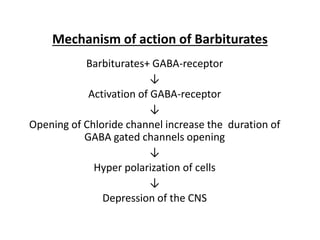
Mechanism of action of Barbiturates
Barbiturates+ GABA-receptor
↓
Activation of GABA-receptor
↓
Opening of Chloride channel increase the duration of
GABA gated channels opening
↓
Hyper polarization of cells
↓
Depression of the CNS
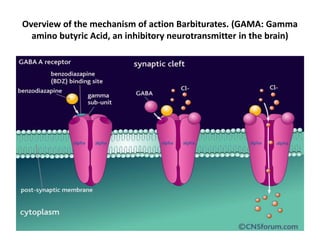
Overview of the mechanism of action Barbiturates. (GAMA: Gamma
amino butyric Acid, an inhibitory neurotransmitter in the brain)
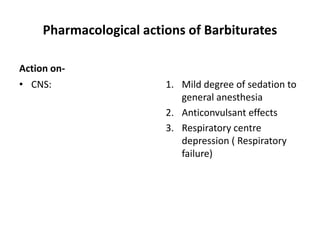
Pharmacological actions of Barbiturates
Action on-
• CNS: 1. Mild degree of sedation to
general anesthesia
2. Anticonvulsant effects
3. Respiratory centre
depression ( Respiratory
failure)
Pharmacological actions of Barbiturates
Actions on-
• CVS
• Liver
1. Hypotension
2. Decrease heart rate
3. Circulatory collapse
1.Enzyme induction, so
increase metabolism of
itself and other drugs
2. Stimulate glucoronyl
transferase
Pharmacological actions of Barbiturates
Actions on-
• Eye
• kidney
1. No effect(normal dose)
2. Miosis (toxic dose)
1. Anti diuretic effect
Disadvantages of Barbiturate as
Hypnotic
1. Low TI, i.e relatively small doses endangers the
life and causes respiratory depression
2. Drug of social abuse
3. Physical depence occurs with withdrawal
syndrome
4. Induces hepatic microsomal enzyme, so it is a
source of drug interaction and development of
tolerance
5. Generalized CNS depressant
6.Marked hangover
7. Chance of more suicidal tendency.
Indication of Barbiturates
1. As anticonvulsants-
Tetanus
Epilepsy
Eclampsia
2. Intravenous anaesthesia (thiopental- Na)
3. Hyperbilirubinaemia
4.Kernicterus (children)
5.Hemolytic jaundice
6.cholestasis
• Barbiturates stimulate liver glucoronyl
transferase which is responsible for bilirubin
metabolism, that is why barbiturates are used
in Hyperbilirubinaemia, kernicterus and
jaundice.
Contraindications of Barbiturates
• Acute porphyria (Barbiturate potentiate
porphyrin synthesis)
• Severe pulmonary insufficiency
• Congestive cardiac failure
• Hypovolumic shock
• Renal failure
• Hepatic failure
Adverse effects of Barbiturates
1. Hangover-
-drowsiness
-lethargy
-weakness
-disorientation
Lack of concentration
2. automatism(accidental poisoning)
3.Addiction liability(physical & psychological
dependence)
4. Enzyme induction, so rapid tolerance develop.
Barbiturates poisoning
• Due to administration of 10-100 times of
clinically used dose.
• Death comes from cardio respiratory failure
Sign & symptoms of Barbiturate
poisoning
• CNS
• CVS
1. Drowsiness
2. Respiratory depression
3. Slow & shallow breating
4. Coma
1.Cardiovascular collapse
2. Hypotension
3.Shock
4. dehydration
• Lungs
• Kidney
• Temperature
• eye
1. Pulmonary edema
2. Bronchopneumonia
1.Severe oliguria/anuria
2.Renal failure
1. Hypothermia
1.Miosis
2.Hypoxic paralytic dilatation
3. Light reflex present
Treatment of Barbiturate poisoning
General measure:
1. O2 inhalation
2. Stabiles' artificial respiration
3. Give stomach wash by KMnO4
4. Activated charcoal
5. Use specific antidote. Inj. Bemigride
6. Establish intravenous channel
Treatment
1. Give antibiotic: to prevent pulmonary infection
2. Use cardiotonic agent (if patient is in shock)-
inject Dopamine. Dopamine also increases renal
blood flow.
3. Forced alkaline diuresis:
Barbiturates is an acidic drug. In alkaline urine the
ionization of barbiturates is more. Ionized drugs
are less lipid soluble. So, less reabsorption from
renal tubules and hence more excretion occur.
Benzodiazepines replaced barbiturates as
hypnotic-sedative agent. Explain?
• Drawbacks of barbiturates as hypnotic-
sedative are-
1. More pronounced central depressant action
2. Barbiturates have narrow therapeutic index.
3. Non-selective CNS depressant Barbiturates
also depress the action of excitatory
neurotransmitter. So,
4. Acute overdose cause cardio respiratory
depression and coma which ends in death.
5. Develops rapid tolerance due to enzyme
induction.
6. Addiction liability is greater with barbiturates.
7. Hangover is marked with barbiturates.
What is drug automatism?
• Barbiturates cause drowsiness, confusion and
amnesia( inability to remember events
occurring during the drug action). So, the
patient take the drug repeatedly and thus
poisoned himself. This phenomenon is known
as drug automatism.
Benzodiazepines
• They are the most widely used anxiolytic drugs. They
have largely replaced barbiturates because:
1.The benzodiazepines are safer (have a wide
therapeutic index) and more effective
2. Not cause drug –drug interaction(not induce hepatic
microsomal enzyme)
3. Produce tolerance and psychological dependence
but physical dependence and withdrawal symptom
are less marked
4. Benzodiazepine antagonist is available
Benzodiazepines
are classified according to their duration of
action into :
• Short –acting : Oxazepam, Triazolam (3-8)
hours
• Intermediate –acting: Alprazolam, Lorazepam,
Temazepam (10-20) hours
• Long-acting: Chlordiazepoxide, Diazepam,
Flurazepam
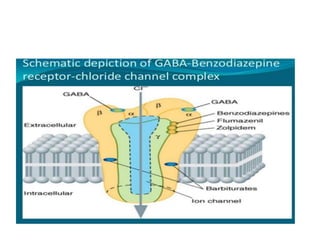
Mechanism of action of
Benzodiazepine:
• Binding of GABA to its receptor triggers an
opening of a chloride channel, which leads to
an increase in chloride conductance.
Benzodiazepines increase the frequency of
channel openings produced by GABA. The
influx of chloride ions causes a small
hyperpolarization, inhibits the formation of
action potentials.
Pharmacological action of BDZ
1.Reduction of anxiety:
• At low doses, the benzodiazepines are anxiolytic.
• They are thought to reduce anxiety by selectively
inhibiting neuronal circuits in the limbic system of
the brain.
2. Sedative and hypnotic actions:
• All of the benzodiazepines used to treat anxiety
have some sedative properties, and some can
produce hypnosis at higher doses.
3. Anticonvulsant:
• some are used to treat epilepsy (status
epilepticus) and other seizure disorders.
4. Muscle relaxant:
• At high doses, the benzodiazepines relax the
spasticity of skeletal muscle
Therapeutic uses of BDZ
• Benzodiazepines are effective for the
treatment of the anxiety symptoms
-secondary to panic disorder
-generalized anxiety disorder
-specific phobias, such as fear of flying.
• Midazolam is an injectable only
benzodiazepine also used for the induction of
anesthesia
Adverse effects of BDZ
• Drowsiness and confusion: Ataxia occurs at
high doses.
• Psychological and physical dependence on
benzodiazepines can develop if high doses of
the drugs are given over a prolonged period.
• Abrupt discontinuation of the
benzodiazepines results in withdrawal
symptoms, including confusion, anxiety,
agitation, restlessness, insomnia, tension.
Benzodiazepine Antagonist
Flumazenil (is a GABAreceptor antagonist) that
can rapidly reverse the effects of
benzodiazepines (competitively occupies a
GABA-receptor without causing a functional
change in CL channel). The drug is available
for intravenous administration only. Onset is
rapid but duration is short, with a half-life of
about 1 hour. Frequent administration may be
necessary to maintain reversal of a long-acting
benzodiazepine
• Side effects of Flumazenil:
1.Dizziness, nausea, vomiting, and agitation are
the most common.
2.Withdrawal in dependent patients
3.Seizures:
- If a benzodiazepine is used to control seizure
activity
- -If the patient ingests tricyclic antidepressants.

Lecture about sedative hypnotic drugs

  • 1.
    Sedative- Hypnotic Drugs Drugthat cause sleep and reduce anxiety are called sedative-hypnotic . OR Sedative-hypnotic, a sedative that depresses activity of the central nervous system and reduces anxiety and induces sleep.
  • 2.
    Basic Pharmacology ofSedative- Hypnotics Sedative (Anxiolytic): decrease activity, calming effect. An Anxiolytic agent should reduce anxiety An Anxiolytic should exert a calming effect with little or no effects on motor or mental functions. Depression of CNS should be the minimum consistent with therapeutic efficacy.
  • 3.
    • Hypnotic: inducesleep A Hypnotic drug should produce drowsiness. Should encourage the onset and maintenance of a state of sleep that resembles the natural sleep states. CNS depression should be more pronounced than sedation. (all Sedative- Hypnotics can cross the placenta)
  • 4.
    HYPNOSIS • Hypnosis isa subconscious condition in which the objective manifestations of the mind are more or less inactive, accompanied by abnormal sensitivity.
  • 5.
    Classification of Hypnotic-Sedatives The main groups of drugs are:  Benzodiazepines  Barbiturates  Newer Agents
  • 6.
    Classification of Hypnotic-Sedatives I. Benzodiazepines • Diazepam • Clonazepam • Oxazepam • Clobazam • Clordiazepoxide • Midazolam properties  High therapeutic index( high LD50)  Relatively safe in overdose  Less hangover  Slowly developing tolerance  Less addiction liability
  • 7.
    Classification of Hypnotic-Sedatives II. Barbiturates • Phenobarbitone • Amobarbital • Thiopental- Na properties  Nonselective CNS depressants  less therapeutic index( not safe)  Marked hangover  Enzyme inducer, so rapidly develops tolerance  Addiction liability marked  Acute over dose causes cardio respiratory failure
  • 8.
    Classification of Hypnotic-Sedatives III. Newer agents • Non Benzodiazepines • Zolpidem • Zaleplon • Buspirone IV. Chloral hydrate V. Paraldehyde VI. Diphenhydramine Properties • Act through non-GABA ergic systems • Less drowsiness and dependence • anxiolytic
  • 9.
    The ideal anxiolyticdrug: Should calm the patient without causing too much day time sedation and drowsiness.  Should not interact with other medications in such away as to produce unwanted or dangerous effect. Without producing physical or psychological dependence. Should have very low toxicity
  • 10.
    The ideal hypnoticdrug: • Should allow the patient to fall asleep quickly. • Should maintain sleep of sufficient quality and duration so that the patient awakes refreshed without a drug hangover) feeling of tiredness well after the patient wakes. This may lead to impaired ability to function normally for many hours after waking. Occasionally, nausea and dizziness occur.
  • 11.
    Barbiturates • They havebeen largely replaced by the benzodiazepines, because Barbiturates: • 1. Low therapeutic index. • 2. Induce tolerance, Physical dependence, Very severe withdrawal symptoms • 3. Induce drug-metabolizing enzymes. • 4. Ability to cause coma in toxic doses. • 5. When used as hypnotics, they suppress REM sleep more than other stages. Certain barbiturates, such as the very short-acting thiopental, are still used to induce anesthesia
  • 12.
    Classification of Barbiturates Barbituratesare classified according to their duration of action into: I. Ultra short acting Barbiturates • Thiopental-Na Properties • High lipid soluble, so • High rate of entry into the CNS, so • Rapid onset of CNS effects(Acts within second) • Duration of action: 30 second • Quickly metabolized by liver(hence called Ultra short acting) • Main use: Intravenous
  • 13.
    Classification of Barbiturates II.Short acting: • Pentobarbital • Secobarbital • Hexobarbital III. Intermediate acting: • Amobarbital • Butabarbital IV. Long acting: • Phenobarbital • Barbital Properties • Duration of action: (2 hours) • Main use: as sedatives • ------------------------------------- • Duration of action: (3-5 hours) • Main use: as hypnotic • ---------------------------------- • Duration of action: (>6 hours) • Main use: as anticonvulsant
  • 14.
    Mechanism of actionof Barbiturates Barbiturates+ GABA-receptor ↓ Activation of GABA-receptor ↓ Opening of Chloride channel increase the duration of GABA gated channels opening ↓ Hyper polarization of cells ↓ Depression of the CNS
  • 16.
    Overview of themechanism of action Barbiturates. (GAMA: Gamma amino butyric Acid, an inhibitory neurotransmitter in the brain)
  • 17.
    Pharmacological actions ofBarbiturates Action on- • CNS: 1. Mild degree of sedation to general anesthesia 2. Anticonvulsant effects 3. Respiratory centre depression ( Respiratory failure)
  • 18.
    Pharmacological actions ofBarbiturates Actions on- • CVS • Liver 1. Hypotension 2. Decrease heart rate 3. Circulatory collapse 1.Enzyme induction, so increase metabolism of itself and other drugs 2. Stimulate glucoronyl transferase
  • 19.
    Pharmacological actions ofBarbiturates Actions on- • Eye • kidney 1. No effect(normal dose) 2. Miosis (toxic dose) 1. Anti diuretic effect
  • 20.
    Disadvantages of Barbiturateas Hypnotic 1. Low TI, i.e relatively small doses endangers the life and causes respiratory depression 2. Drug of social abuse 3. Physical depence occurs with withdrawal syndrome 4. Induces hepatic microsomal enzyme, so it is a source of drug interaction and development of tolerance
  • 21.
    5. Generalized CNSdepressant 6.Marked hangover 7. Chance of more suicidal tendency.
  • 22.
    Indication of Barbiturates 1.As anticonvulsants- Tetanus Epilepsy Eclampsia 2. Intravenous anaesthesia (thiopental- Na) 3. Hyperbilirubinaemia 4.Kernicterus (children) 5.Hemolytic jaundice 6.cholestasis
  • 23.
    • Barbiturates stimulateliver glucoronyl transferase which is responsible for bilirubin metabolism, that is why barbiturates are used in Hyperbilirubinaemia, kernicterus and jaundice.
  • 24.
    Contraindications of Barbiturates •Acute porphyria (Barbiturate potentiate porphyrin synthesis) • Severe pulmonary insufficiency • Congestive cardiac failure • Hypovolumic shock • Renal failure • Hepatic failure
  • 25.
    Adverse effects ofBarbiturates 1. Hangover- -drowsiness -lethargy -weakness -disorientation Lack of concentration 2. automatism(accidental poisoning) 3.Addiction liability(physical & psychological dependence) 4. Enzyme induction, so rapid tolerance develop.
  • 26.
    Barbiturates poisoning • Dueto administration of 10-100 times of clinically used dose. • Death comes from cardio respiratory failure
  • 27.
    Sign & symptomsof Barbiturate poisoning • CNS • CVS 1. Drowsiness 2. Respiratory depression 3. Slow & shallow breating 4. Coma 1.Cardiovascular collapse 2. Hypotension 3.Shock 4. dehydration
  • 28.
    • Lungs • Kidney •Temperature • eye 1. Pulmonary edema 2. Bronchopneumonia 1.Severe oliguria/anuria 2.Renal failure 1. Hypothermia 1.Miosis 2.Hypoxic paralytic dilatation 3. Light reflex present
  • 29.
    Treatment of Barbituratepoisoning General measure: 1. O2 inhalation 2. Stabiles' artificial respiration 3. Give stomach wash by KMnO4 4. Activated charcoal 5. Use specific antidote. Inj. Bemigride 6. Establish intravenous channel
  • 30.
    Treatment 1. Give antibiotic:to prevent pulmonary infection 2. Use cardiotonic agent (if patient is in shock)- inject Dopamine. Dopamine also increases renal blood flow. 3. Forced alkaline diuresis: Barbiturates is an acidic drug. In alkaline urine the ionization of barbiturates is more. Ionized drugs are less lipid soluble. So, less reabsorption from renal tubules and hence more excretion occur.
  • 31.
    Benzodiazepines replaced barbituratesas hypnotic-sedative agent. Explain? • Drawbacks of barbiturates as hypnotic- sedative are- 1. More pronounced central depressant action 2. Barbiturates have narrow therapeutic index. 3. Non-selective CNS depressant Barbiturates also depress the action of excitatory neurotransmitter. So, 4. Acute overdose cause cardio respiratory depression and coma which ends in death.
  • 32.
    5. Develops rapidtolerance due to enzyme induction. 6. Addiction liability is greater with barbiturates. 7. Hangover is marked with barbiturates.
  • 33.
    What is drugautomatism? • Barbiturates cause drowsiness, confusion and amnesia( inability to remember events occurring during the drug action). So, the patient take the drug repeatedly and thus poisoned himself. This phenomenon is known as drug automatism.
  • 34.
    Benzodiazepines • They arethe most widely used anxiolytic drugs. They have largely replaced barbiturates because: 1.The benzodiazepines are safer (have a wide therapeutic index) and more effective 2. Not cause drug –drug interaction(not induce hepatic microsomal enzyme) 3. Produce tolerance and psychological dependence but physical dependence and withdrawal symptom are less marked 4. Benzodiazepine antagonist is available
  • 35.
    Benzodiazepines are classified accordingto their duration of action into : • Short –acting : Oxazepam, Triazolam (3-8) hours • Intermediate –acting: Alprazolam, Lorazepam, Temazepam (10-20) hours • Long-acting: Chlordiazepoxide, Diazepam, Flurazepam
  • 36.
    Mechanism of actionof Benzodiazepine: • Binding of GABA to its receptor triggers an opening of a chloride channel, which leads to an increase in chloride conductance. Benzodiazepines increase the frequency of channel openings produced by GABA. The influx of chloride ions causes a small hyperpolarization, inhibits the formation of action potentials.
  • 37.
    Pharmacological action ofBDZ 1.Reduction of anxiety: • At low doses, the benzodiazepines are anxiolytic. • They are thought to reduce anxiety by selectively inhibiting neuronal circuits in the limbic system of the brain. 2. Sedative and hypnotic actions: • All of the benzodiazepines used to treat anxiety have some sedative properties, and some can produce hypnosis at higher doses.
  • 38.
    3. Anticonvulsant: • someare used to treat epilepsy (status epilepticus) and other seizure disorders. 4. Muscle relaxant: • At high doses, the benzodiazepines relax the spasticity of skeletal muscle
  • 39.
    Therapeutic uses ofBDZ • Benzodiazepines are effective for the treatment of the anxiety symptoms -secondary to panic disorder -generalized anxiety disorder -specific phobias, such as fear of flying. • Midazolam is an injectable only benzodiazepine also used for the induction of anesthesia
  • 40.
    Adverse effects ofBDZ • Drowsiness and confusion: Ataxia occurs at high doses. • Psychological and physical dependence on benzodiazepines can develop if high doses of the drugs are given over a prolonged period. • Abrupt discontinuation of the benzodiazepines results in withdrawal symptoms, including confusion, anxiety, agitation, restlessness, insomnia, tension.
  • 41.
    Benzodiazepine Antagonist Flumazenil (isa GABAreceptor antagonist) that can rapidly reverse the effects of benzodiazepines (competitively occupies a GABA-receptor without causing a functional change in CL channel). The drug is available for intravenous administration only. Onset is rapid but duration is short, with a half-life of about 1 hour. Frequent administration may be necessary to maintain reversal of a long-acting benzodiazepine
  • 42.
    • Side effectsof Flumazenil: 1.Dizziness, nausea, vomiting, and agitation are the most common. 2.Withdrawal in dependent patients 3.Seizures: - If a benzodiazepine is used to control seizure activity - -If the patient ingests tricyclic antidepressants.