Duke ECE 490L: How to Start New Ventures in
Electrical and Computer Engineering
Poornima Vijayashanker
poornima@femgineer.com
Jeff Glass
jeff.glass@duke.edu
Akshay Raut
ar118@duke.edu
1
Review
Duke ECE 490L
• More on positioning!
• Digging into the Competitor
• Horizontal vs. Vertical Market
• Substitutes
• Secondary Markets
• Point Tool vs. Integrated Solutions
• Customer Discovery
2
Announcements
• Quiz 1 results coming soon!
• Questions on Lab 2?
Duke ECE 490L
3
Idea Summary
4
Agenda
Duke ECE 490L
• Customer Discovery
• Mental Models
• Customer Interviews
5
Duke ECE 490L
Still no building...
6
Duke ECE 490L
Myth of the omniscient founder.
Supplemental Reading: The Steve Jobs Way
7
Duke ECE 490L
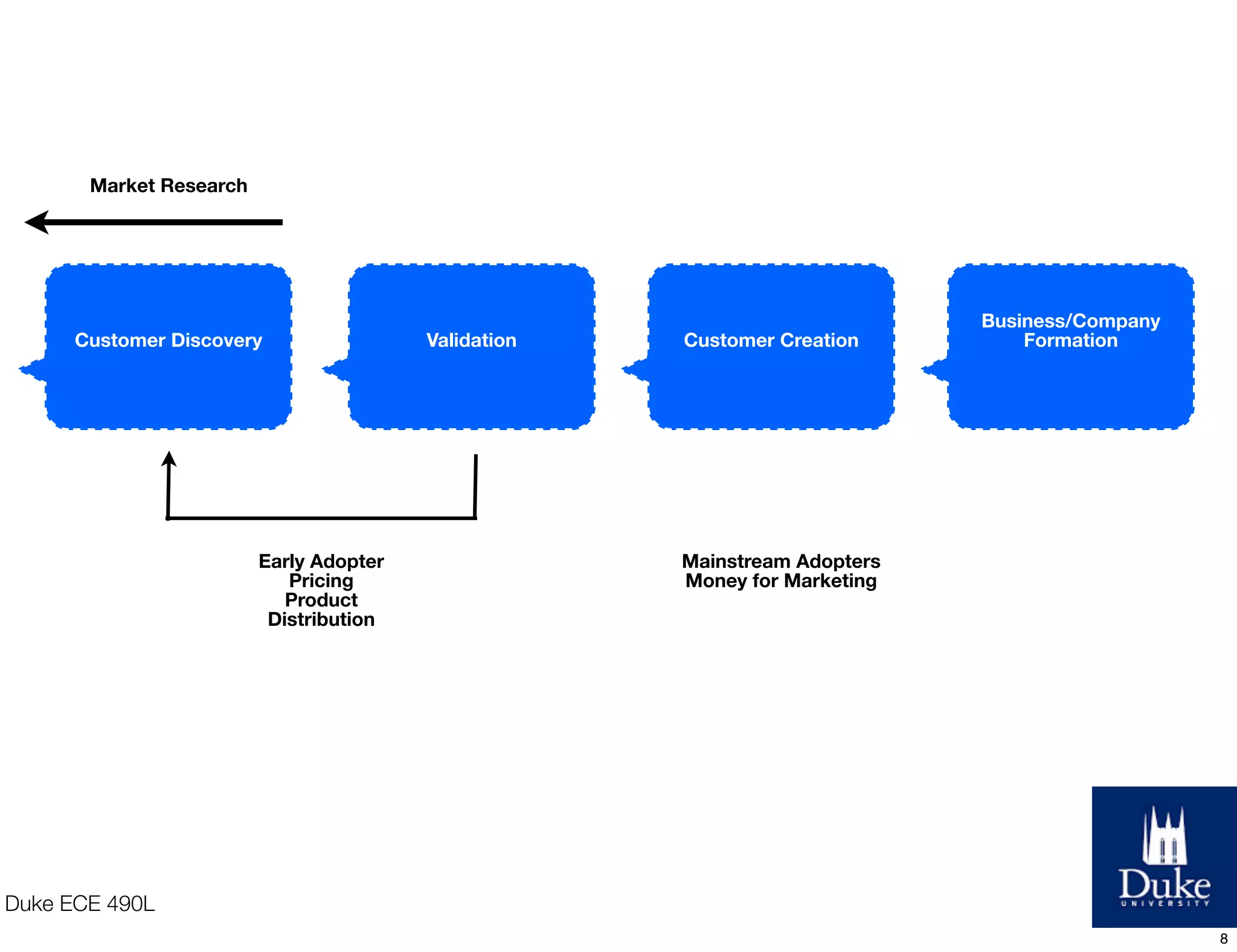
Customer Discovery Validation Customer Creation
Business/Company
Formation
Early Adopter
Pricing
Product
Distribution
Mainstream Adopters
Money for Marketing
Market Research
8
Duke ECE 490L
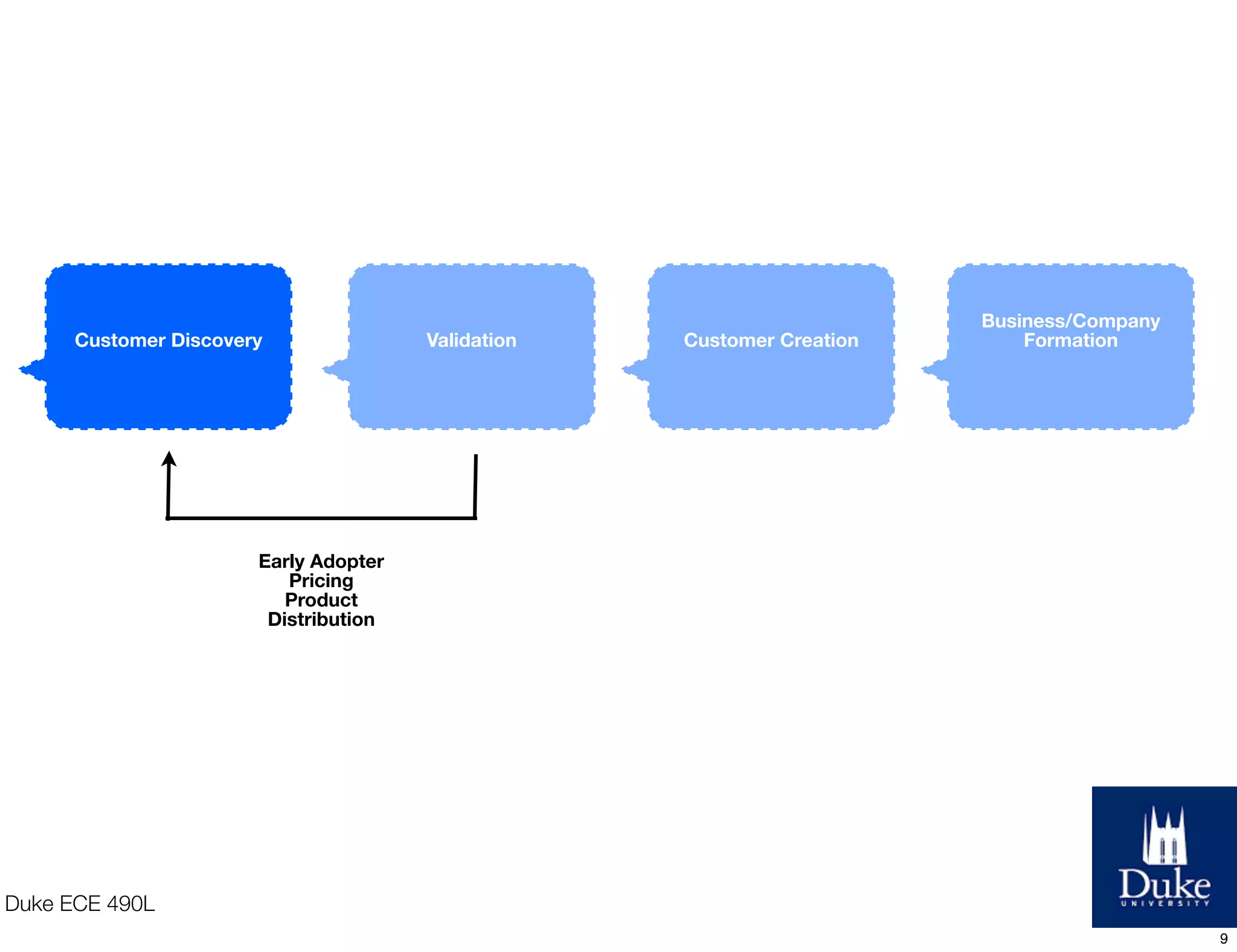
Customer Discovery Validation Customer Creation
Business/Company
Formation
Early Adopter
Pricing
Product
Distribution
9
Test across various user segments.
Duke ECE 490L
10
Duke ECE 490L
Mental Model of an early adopter.
11
Duke ECE 490L
Mental models give you a deep
understanding of people’s motivations
and thought-processes, along with the
emotional and philosophical landscape
in which they are operating.
Supplemental Reading: Mental Models
12
Duke ECE 490L
Mental Model per segment.
13
Duke ECE 490L
Understand the differences to bring
clarity to design and product
implementation.
14
Benefits of Mental Models
Duke ECE 490L
• Confidence in your design: guide the design
of the solution
• Clarity in direction: make good user and
business decisions
• Continuity of strategy: ensure longevity of
vision and opportunity
15
Duke ECE 490L
How do you know the design is right?
16
Duke ECE 490L
Research.
17
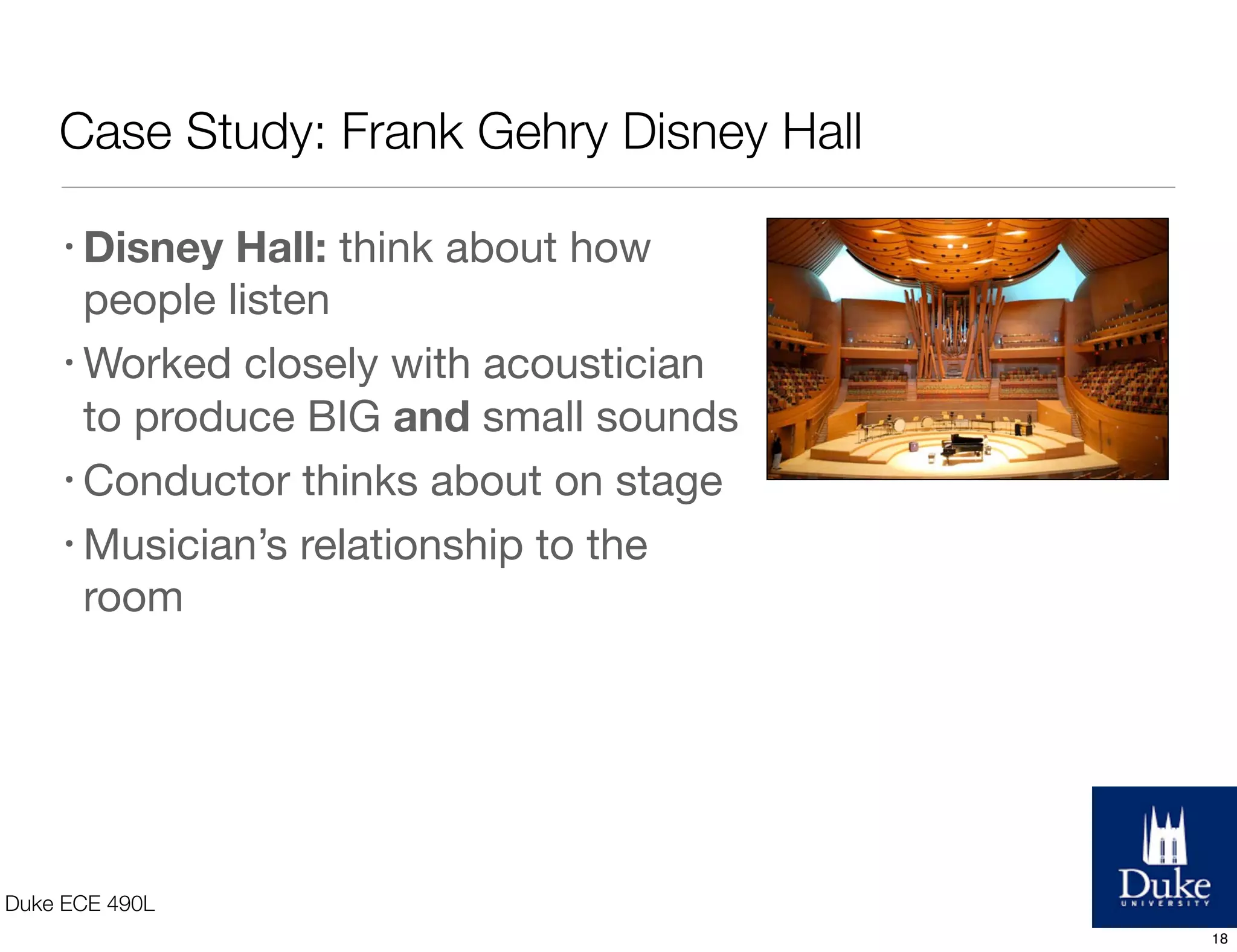
Case Study: Frank Gehry Disney Hall
Duke ECE 490L
• Disney Hall: think about how
people listen
• Worked closely with acoustician
to produce BIG and small sounds
• Conductor thinks about on stage
• Musician’s relationship to the
room
18
Duke ECE 490L
Whole experience.
19
Duke ECE 490L
Pay attention to the entire spectrum
of interactions customer will have,
not just a single service or tool.
20
Duke ECE 490L
MM captures cognitive intent and
emotion, social environment, and
cultural traits of a concept.
21
Duke ECE 490L
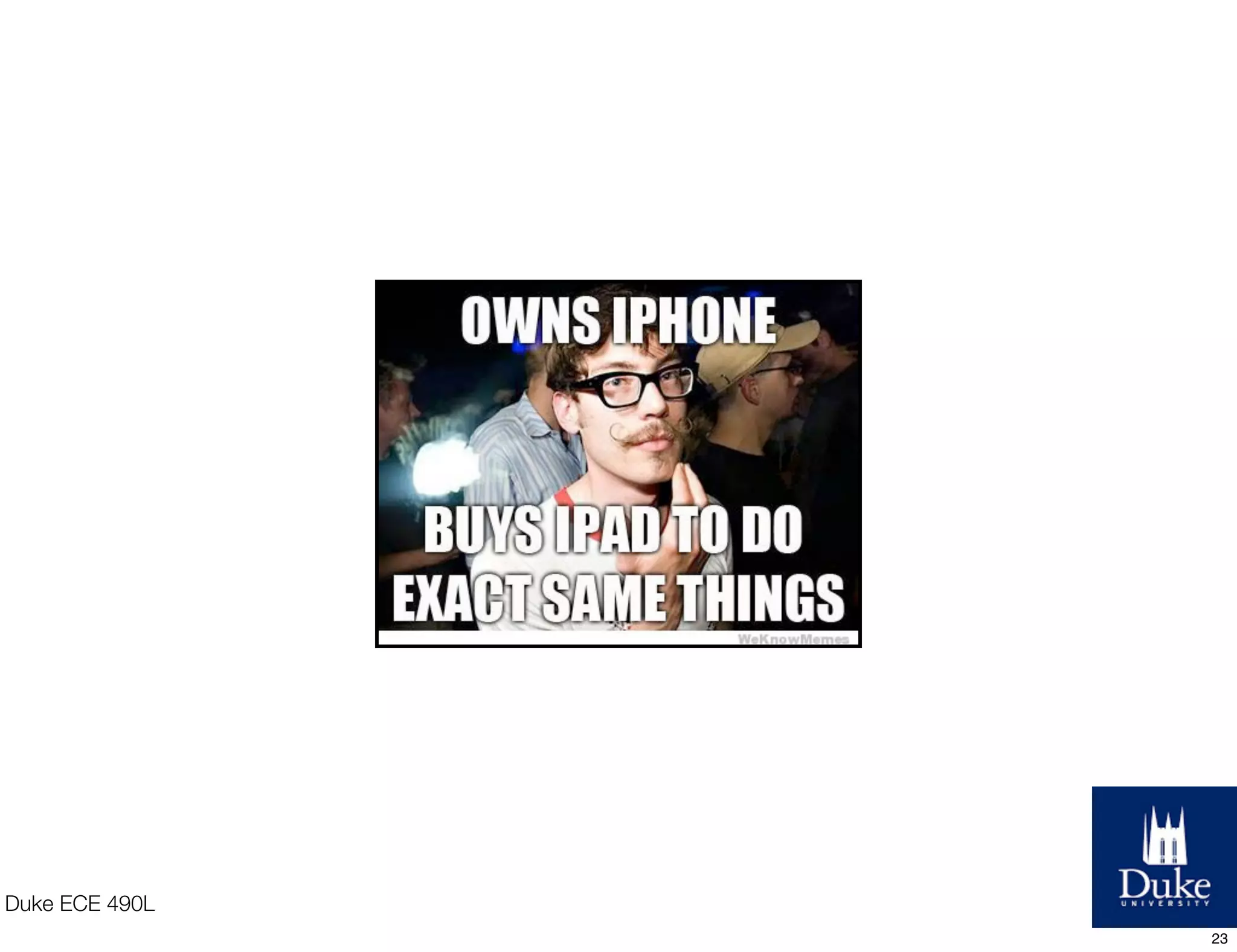
What does that mean?
22
Duke ECE 490L
23
Duke ECE 490L
Science + Intuition = communicate product info
24
Purpose of Mental Models
Duke ECE 490L
• Validate ideas and match them to needs of customers
• Mental models capture
• Cognitive intent
• Emotions
• Social and culture traits of a concept
• Experience Strategy = Business Strategy + UX Strategy
• Jesse James Garrett
25
Duke ECE 490L
How do we create a mental model?
26
Duke ECE 490L
1. Learn verbs of a customer.
27
Duke ECE 490L
e.g. Yoga studio owner
28
Duke ECE 490L
Teach yoga classes.
Take attendance.
Schedule instructors.
Ask students for payments.
Owns or manages studio.
Performs back office tasks or business
partner does.
29
Duke ECE 490L
e.g. Yoga instructor
30
Duke ECE 490L
Teach yoga classes 1-1.
Teach yoga classes at a studio.
Teach yoga classes in corporations.
May teach full-time or part-time.
Take attendance.
Ask students for payments.
Travel to teach.
31
Duke ECE 490L
2. Create personas.
32
Duke ECE 490L
Personas are user profiles that
help design and other teams such
as sales and marketing get more
useful products into the hands of
customers.
Supplemental Reading: Getting Your Startup Team to Understand Your
Customer, About Face 2.0: The Essentials of Interaction Design
33
Personas Benefit Other Teams
Duke ECE 490L
• Marketing
• Develop positions based on personas
• Sales
• Communicate how product will meet needs of customers
• Engineering
• Understand importance of building not for themselves but
for the customer by understanding customer’s needs
34
Personas Benefit Other Teams
Duke ECE 490L
• Focus on end goals & life goals
• what a person wishes to accomplish
• why a person wishes to accomplish something
• Create Segments
• task based: people who do similar things but don’t necessarily buy the same
product
• e.g. teens & seniors are both “movie-goers”
• Avoid traditional market segment traps
• list distinguishing behavior
• group behavior
• name groups
35
Avoid Traditional Marketing Segment Traps
Duke ECE 490L
• List distinguishing behaviors: Sketch out all
the ways many types of individuals might
behave
• Group the behaviors: study these behaviors
and put them into groups
• Name the groups: assign provisional labels
to the groups
36
Duke ECE 490L
Multiple user segments, each has a
different need.
37
Duke ECE 490L
Determining needs will help with design.
38
Duke ECE 490L
To determine needs we need to do
user research.
39
Duke ECE 490L
User Research Types.
40
Duke ECE 490L
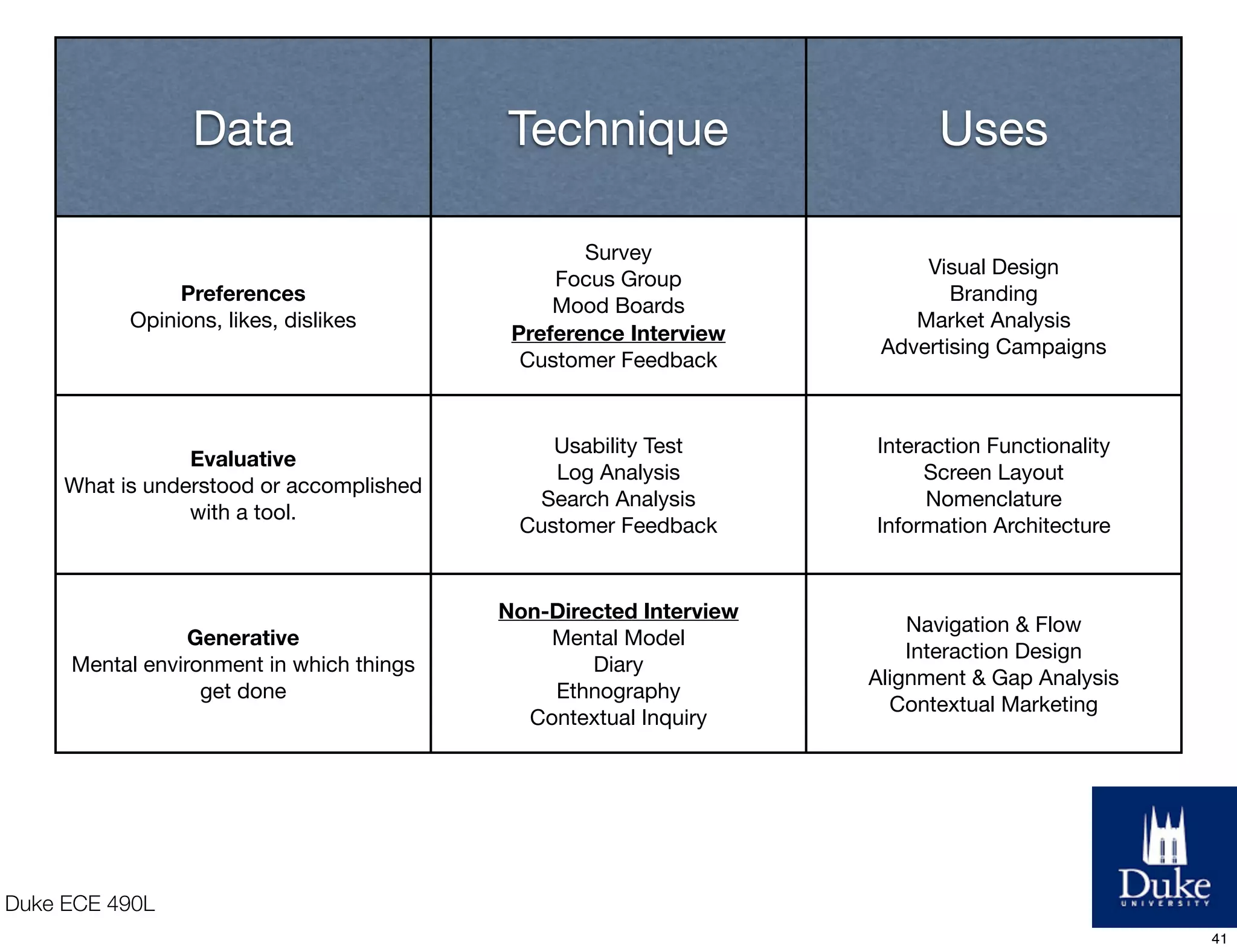
Data Technique Uses
Preferences
Opinions, likes, dislikes
Survey
Focus Group
Mood Boards
Preference Interview
Customer Feedback
Visual Design
Branding
Market Analysis
Advertising Campaigns
Evaluative
What is understood or accomplished
with a tool.
Usability Test
Log Analysis
Search Analysis
Customer Feedback
Interaction Functionality
Screen Layout
Nomenclature
Information Architecture
Generative
Mental environment in which things
get done
Non-Directed Interview
Mental Model
Diary
Ethnography
Contextual Inquiry
Navigation & Flow
Interaction Design
Alignment & Gap Analysis
Contextual Marketing
41
Duke ECE 490L
Set goals relating back to customer discovery.
42
Duke ECE 490L
Personas come out of interviewing
user segments.
43
Duke ECE 490L
Collect feedback and categorize customers.
44
Duke ECE 490L
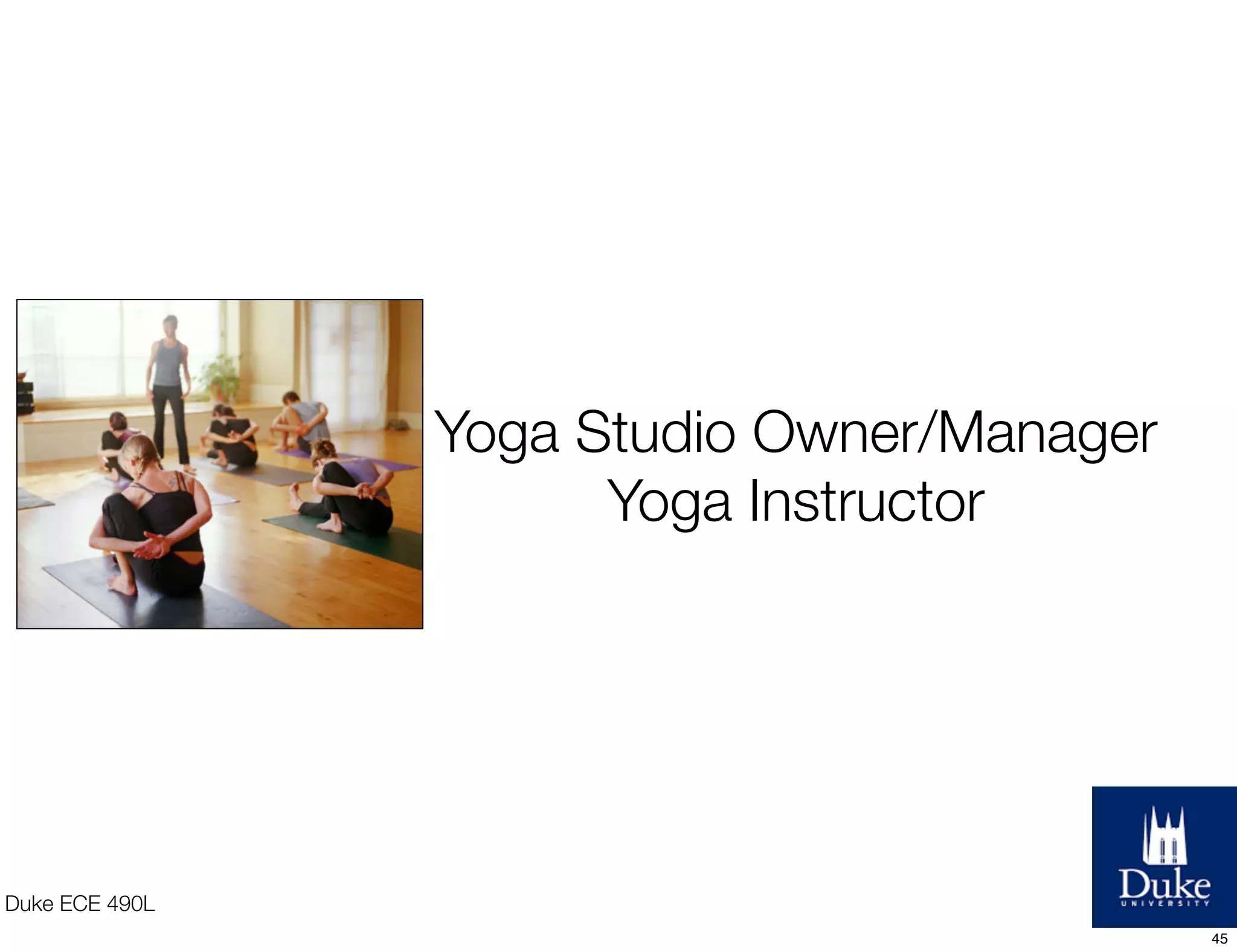
Yoga Studio Owner/Manager
Yoga Instructor
45
Duke ECE 490L
Some needs will be the same. While
others have a stark contrast.
46
Duke ECE 490L
Results from interview will point out
the general cases.
47
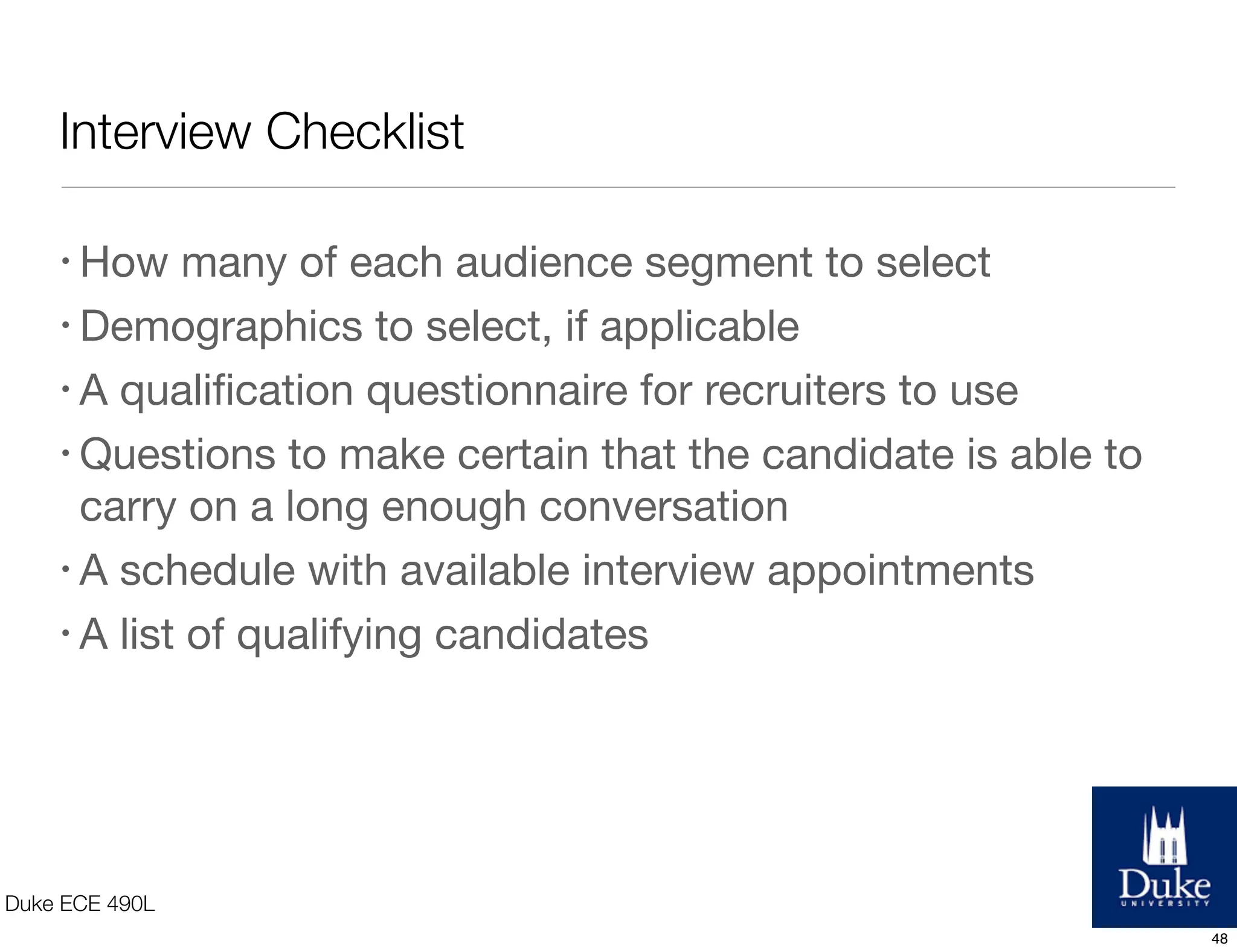
Interview Checklist
Duke ECE 490L
• How many of each audience segment to select
• Demographics to select, if applicable
• A qualification questionnaire for recruiters to use
• Questions to make certain that the candidate is able to
carry on a long enough conversation
• A schedule with available interview appointments
• A list of qualifying candidates
48
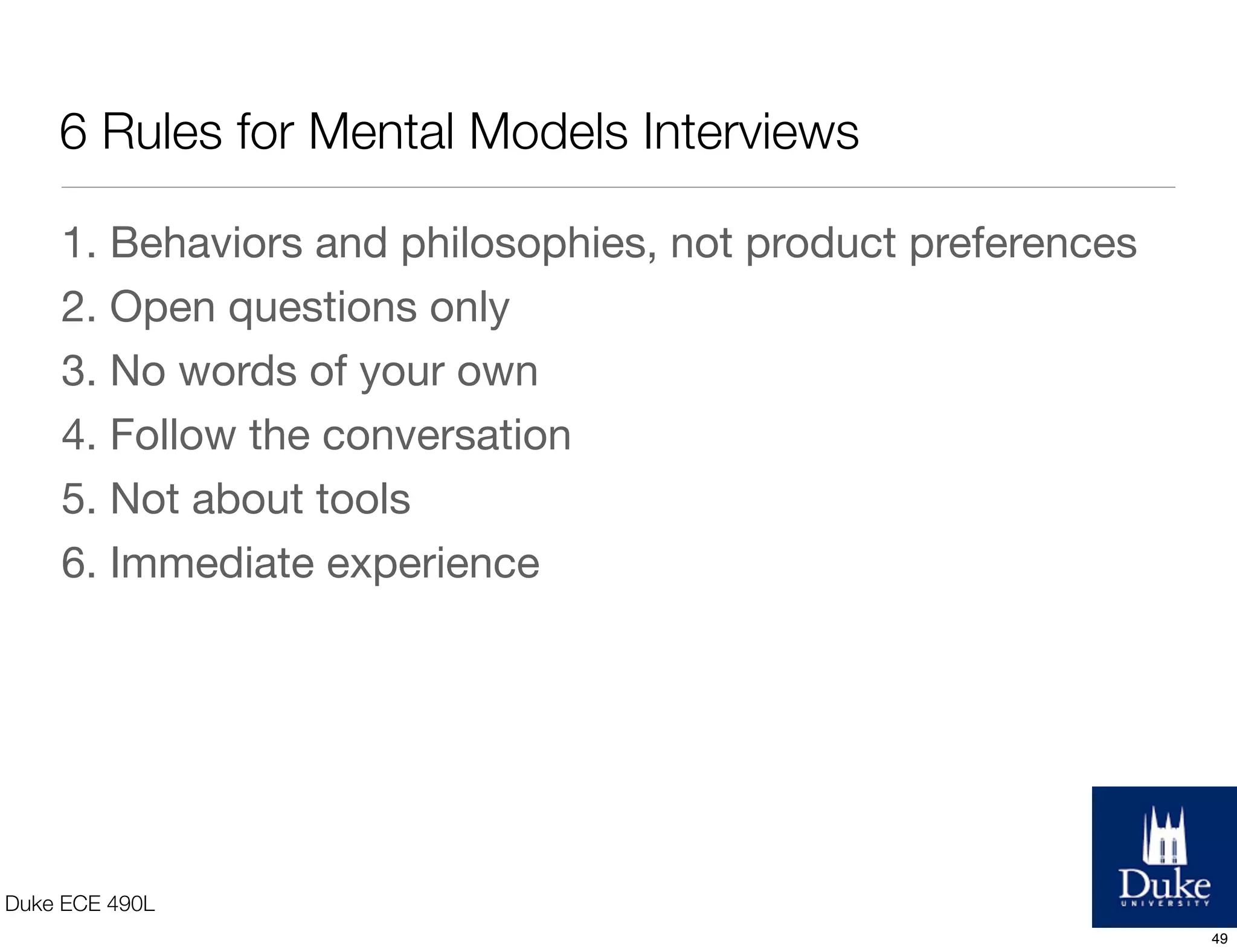
6 Rules for Mental Models Interviews
Duke ECE 490L
1. Behaviors and philosophies, not product preferences
2. Open questions only
3. No words of your own
4. Follow the conversation
5. Not about tools
6. Immediate experience
49
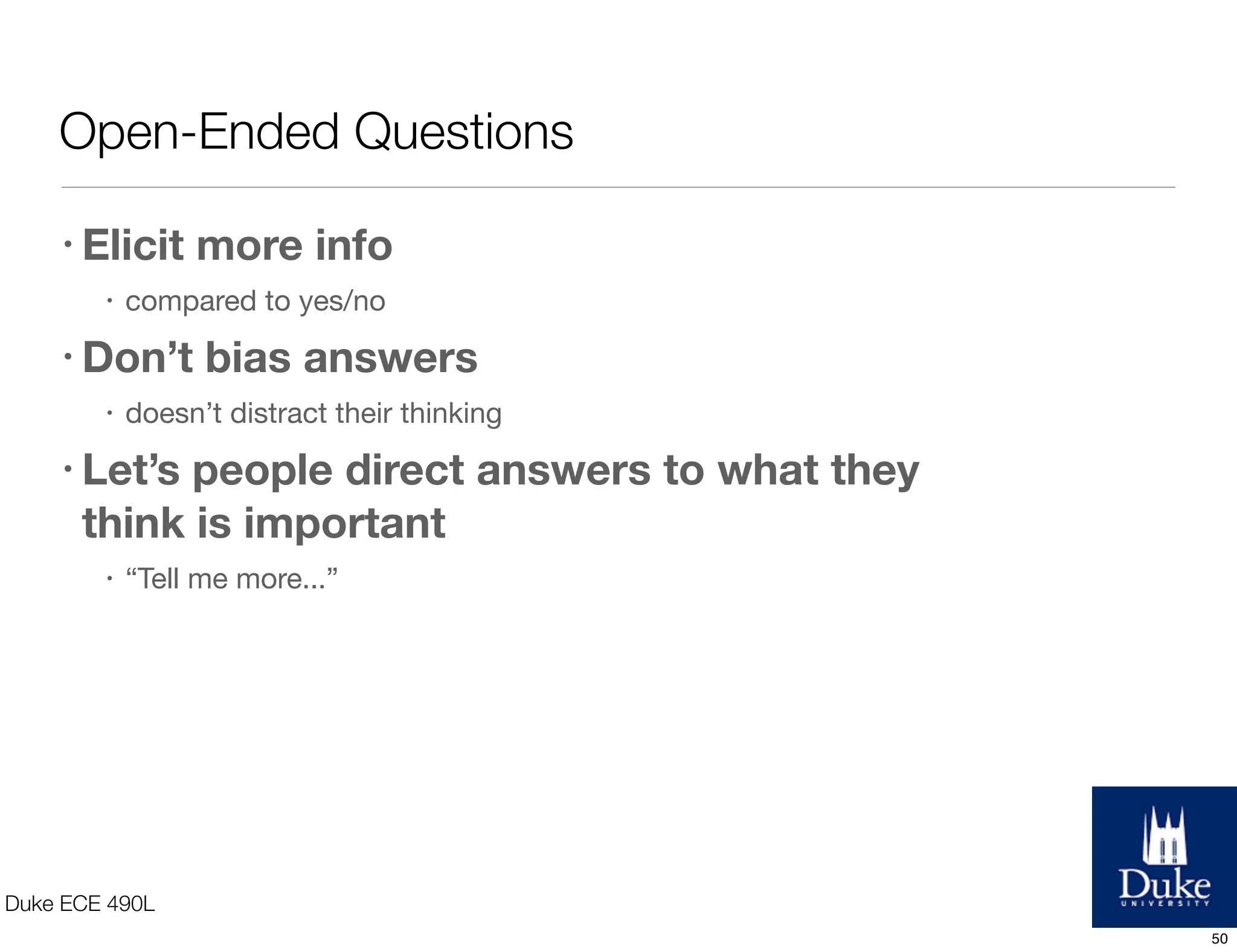
Open-Ended Questions
Duke ECE 490L
• Elicit more info
• compared to yes/no
• Don’t bias answers
• doesn’t distract their thinking
• Let’s people direct answers to what they
think is important
• “Tell me more...”
50
Examples of Open-Ended Questions
Duke ECE 490L
• How did you do that?
• How did you actually get that info?
• So is that’s one of the things you’re doing right now?
(Encouraging him to tell me more.)
• How do you keep up to date on the latest?
• Can you mention a couple of examples?
• Can you tell me…what are your next steps?
51
Duke ECE 490L
Find out as much as possible about
the customer.
52
Digging Deeper into the Personas
Duke ECE 490L
• Where do they hang out?
• What do they read?
• Who influences them? Or recommends products?
53
Duke ECE 490L
Interview results.
54
Duke ECE 490L
3. Comb for tasks.
55
Duke ECE 490L
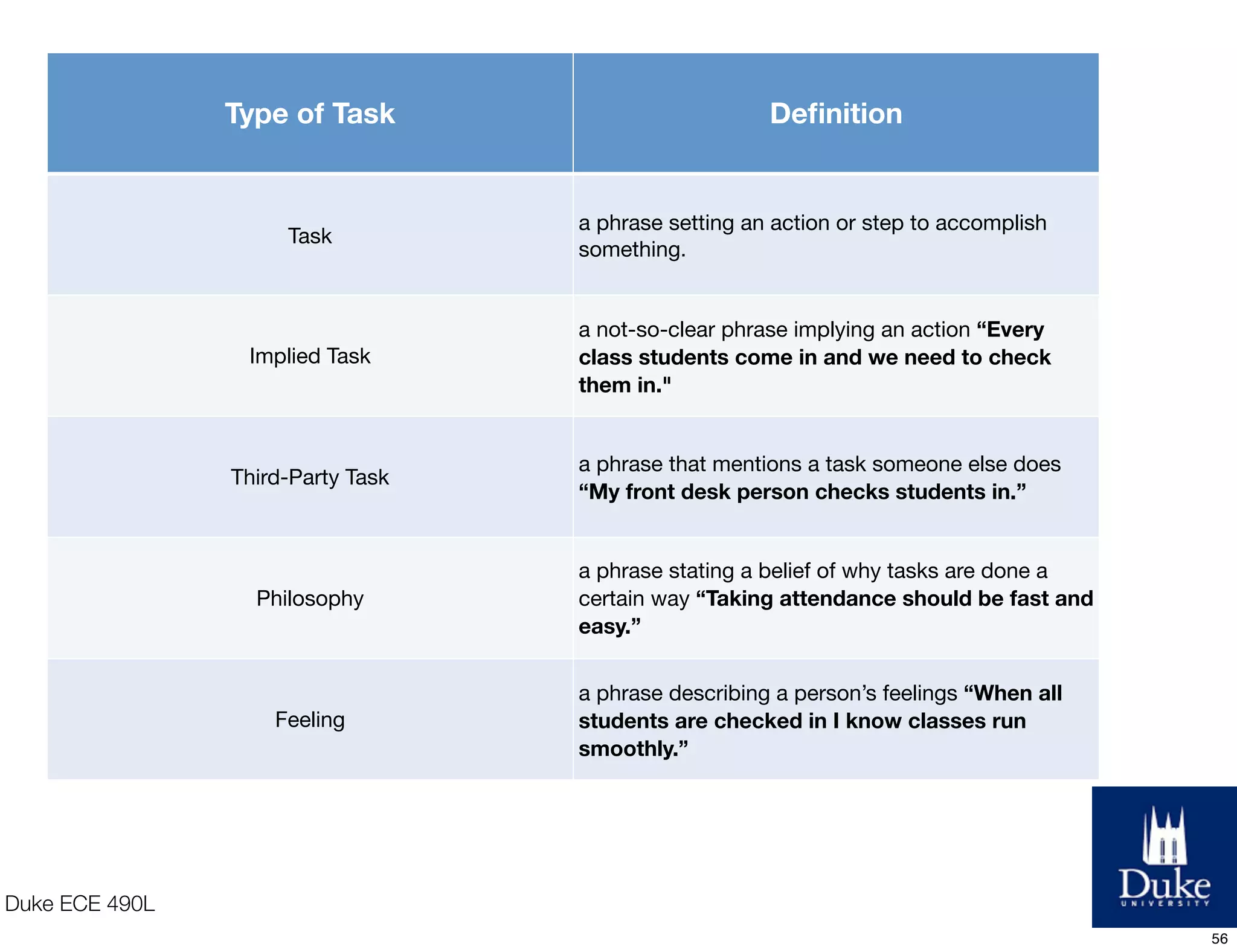
Type of Task Definition
Task
a phrase setting an action or step to accomplish
something.
Implied Task
a not-so-clear phrase implying an action “Every
class students come in and we need to check
them in."
Third-Party Task
a phrase that mentions a task someone else does
“My front desk person checks students in.”
Philosophy
a phrase stating a belief of why tasks are done a
certain way “Taking attendance should be fast and
easy.”
Feeling
a phrase describing a person’s feelings “When all
students are checked in I know classes run
smoothly.”
56
Duke ECE 490L
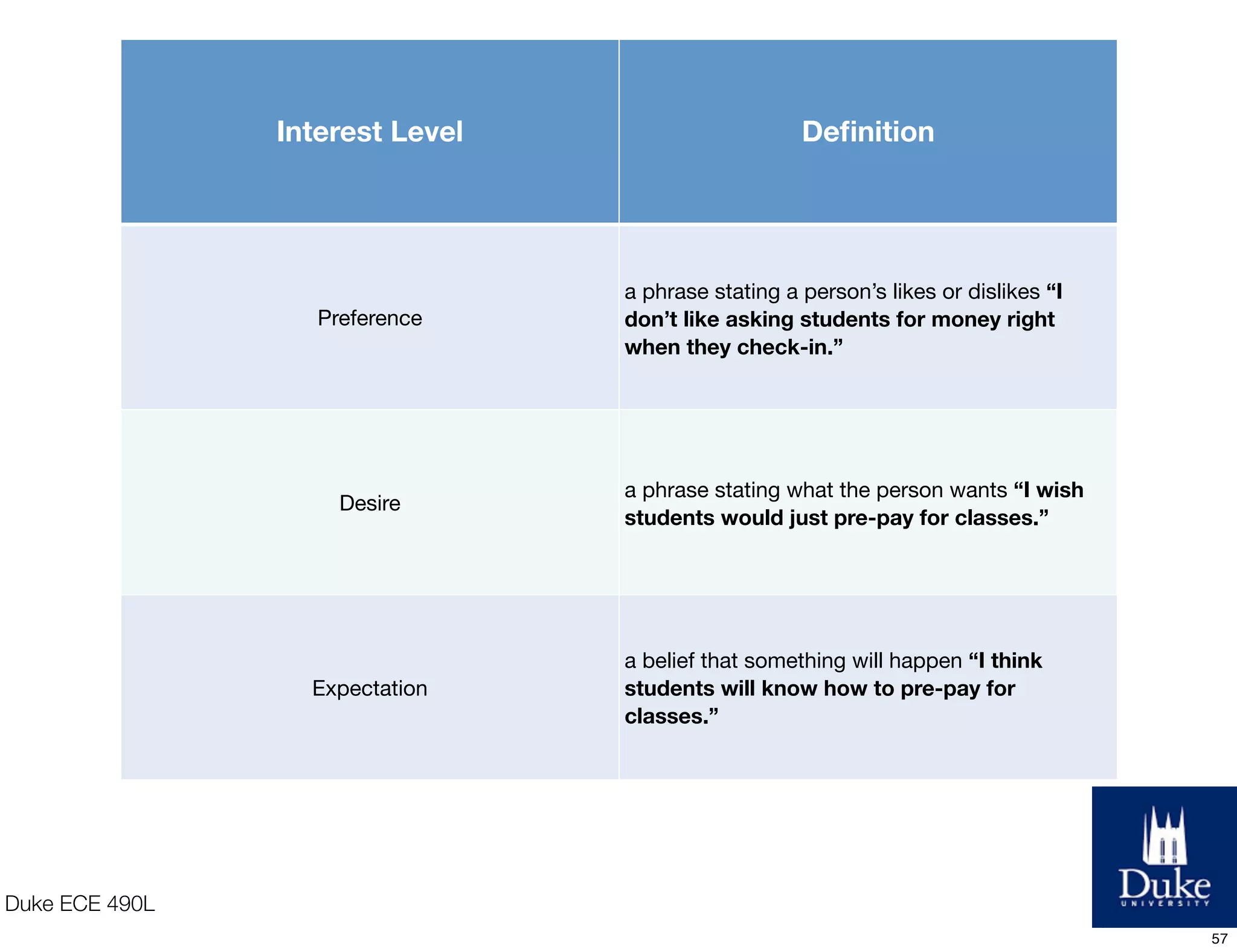
Interest Level Definition
Preference
a phrase stating a person’s likes or dislikes “I
don’t like asking students for money right
when they check-in.”
Desire
a phrase stating what the person wants “I wish
students would just pre-pay for classes.”
Expectation
a belief that something will happen “I think
students will know how to pre-pay for
classes.”
57
Duke ECE 490L
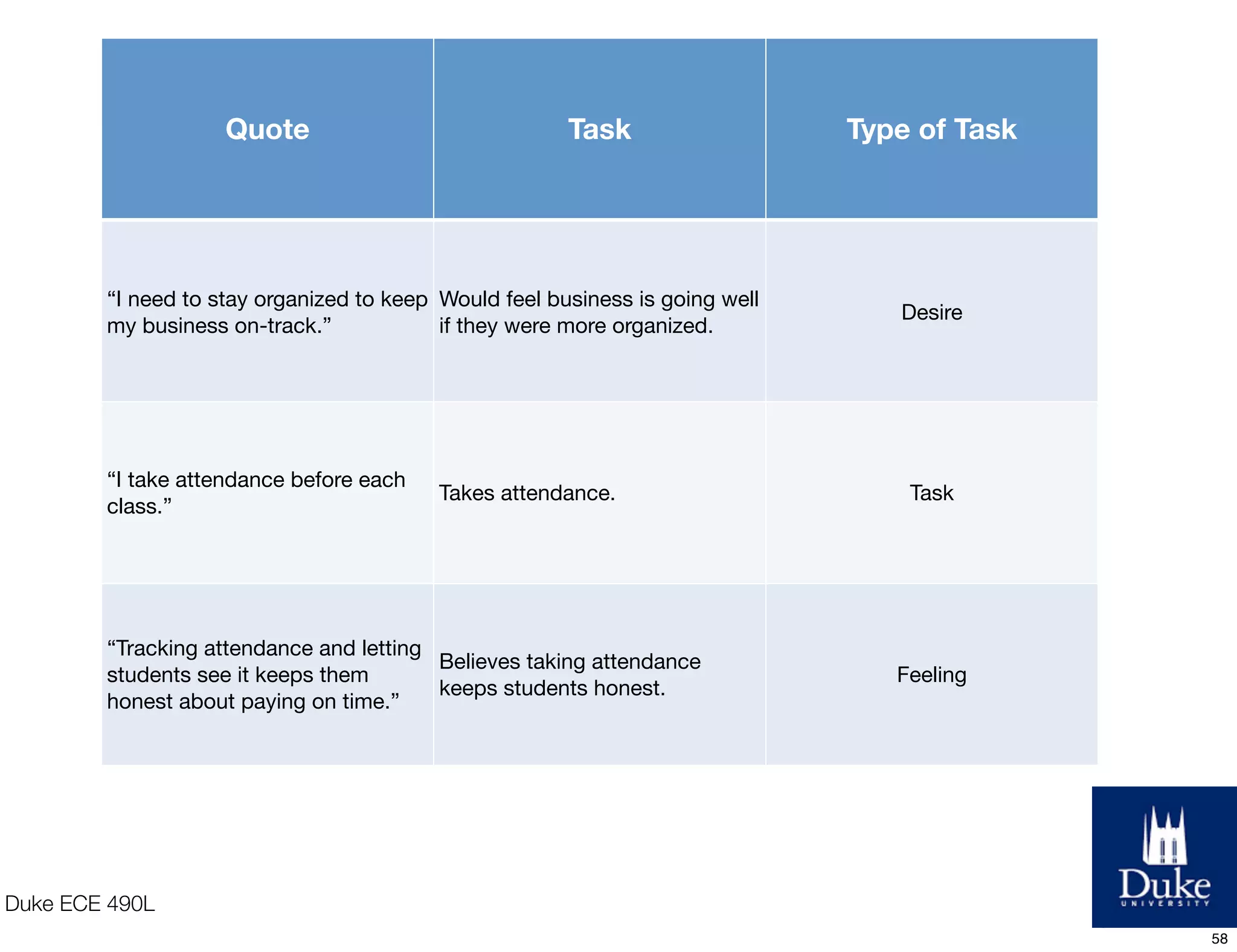
Quote Task Type of Task
“I need to stay organized to keep
my business on-track.”
Would feel business is going well
if they were more organized.
Desire
“I take attendance before each
class.”
Takes attendance. Task
“Tracking attendance and letting
students see it keeps them
honest about paying on time.”
Believes taking attendance
keeps students honest.
Feeling
58
Duke ECE 490L
What’s the point?
59
Duke ECE 490L
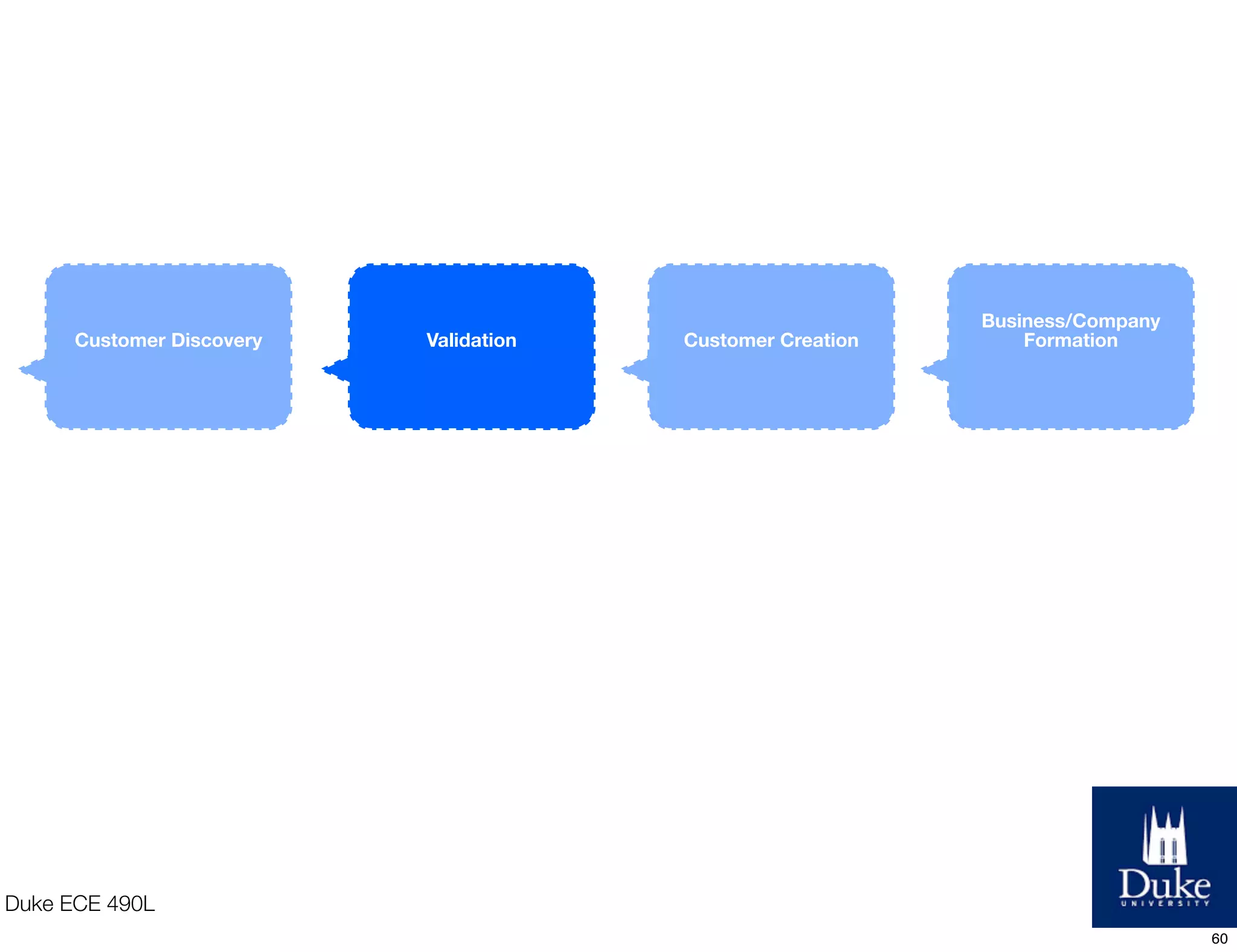
Customer Discovery Validation Customer Creation
Business/Company
Formation
60
Duke ECE 490L
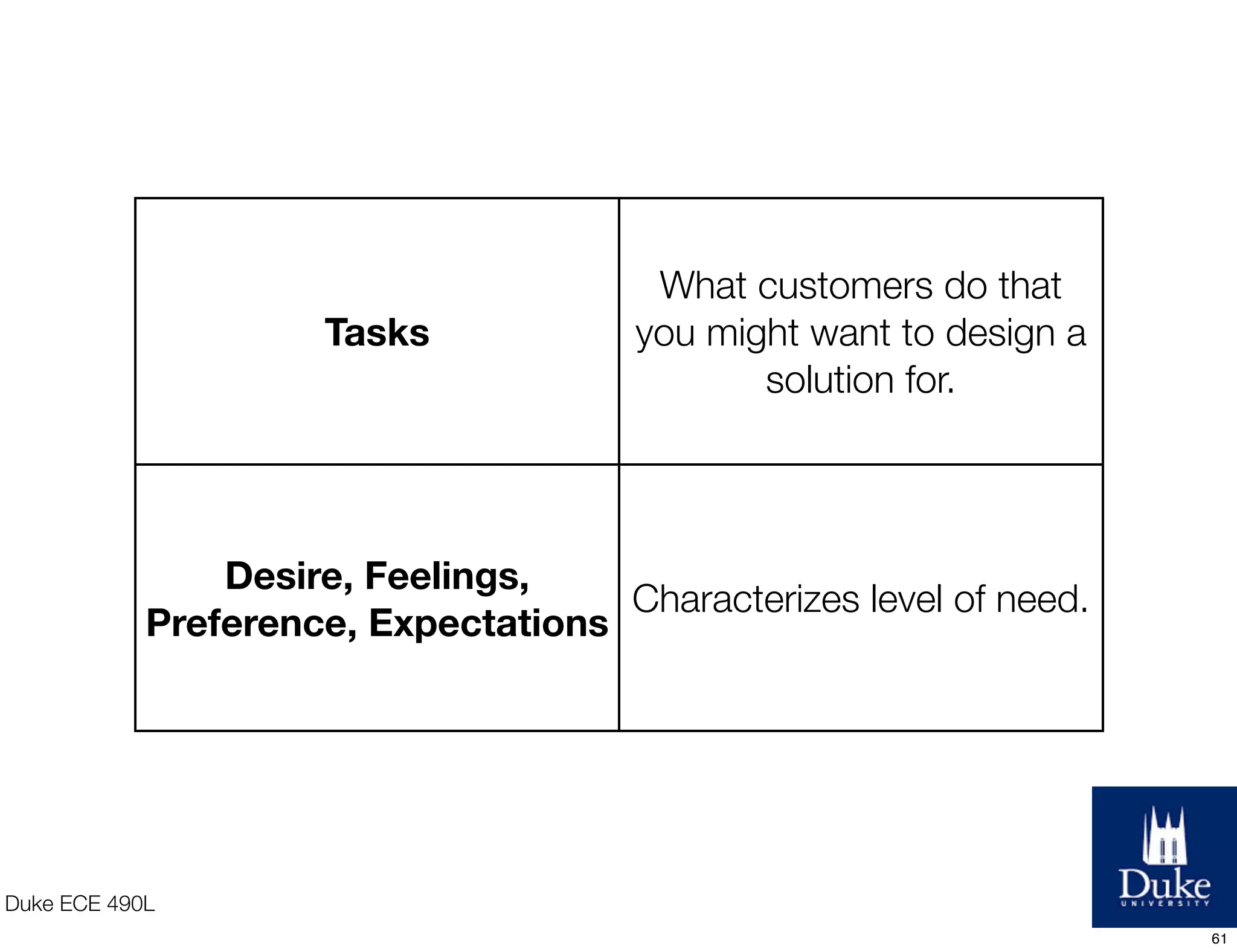
Tasks
What customers do that
you might want to design a
solution for.
Desire, Feelings,
Preference, Expectations
Characterizes level of need.
61
Duke ECE 490L
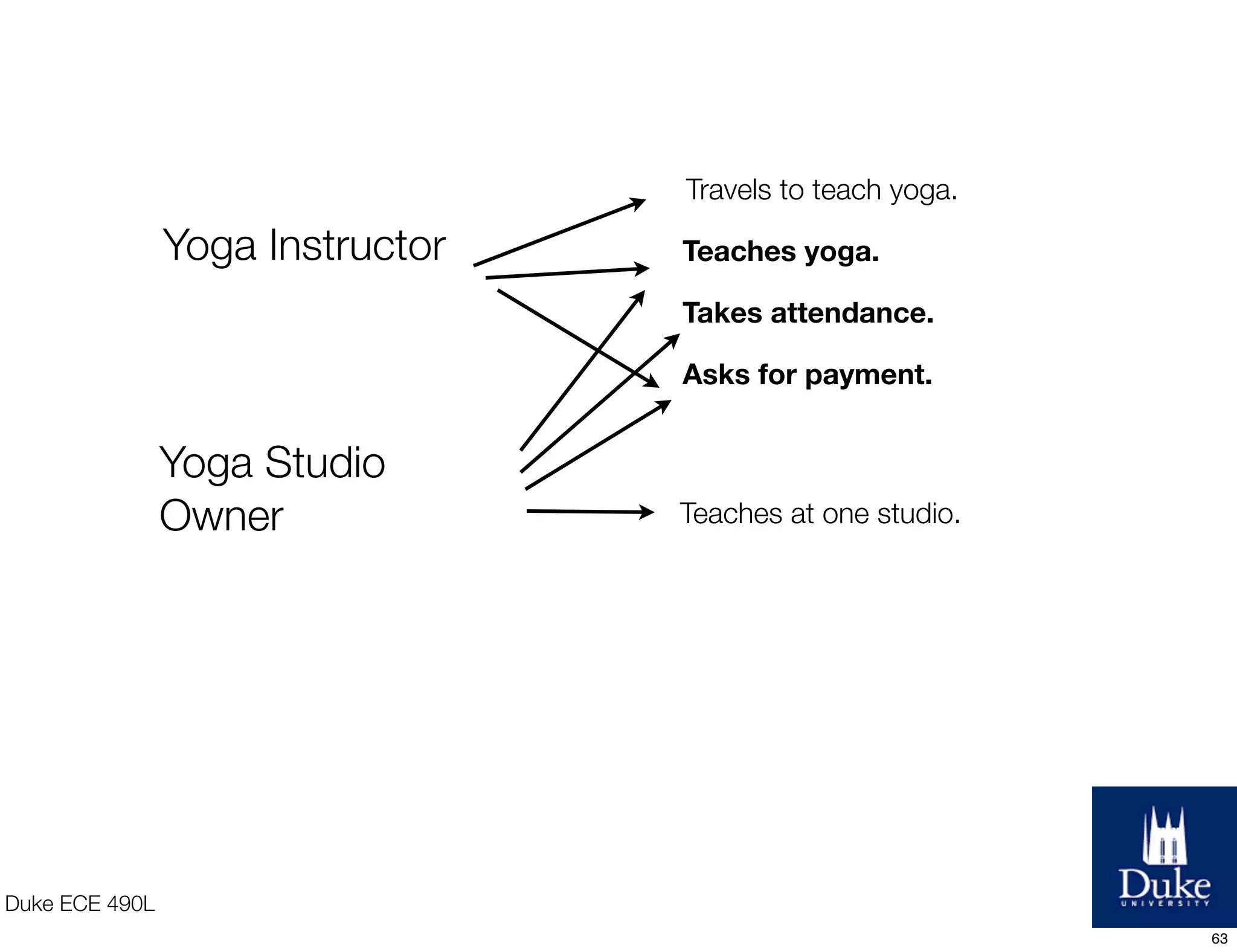
4. Match personas to tasks.
62
Duke ECE 490L
Yoga Instructor Teaches yoga.
Takes attendance.
Asks for payment.
Yoga Studio
Owner Teaches at one studio.
Travels to teach yoga.
63
Duke ECE 490L
5. Look for patterns.
64
Duke ECE 490L
Track
Attendance
Inform Students
about Membership
Status
Take Payments
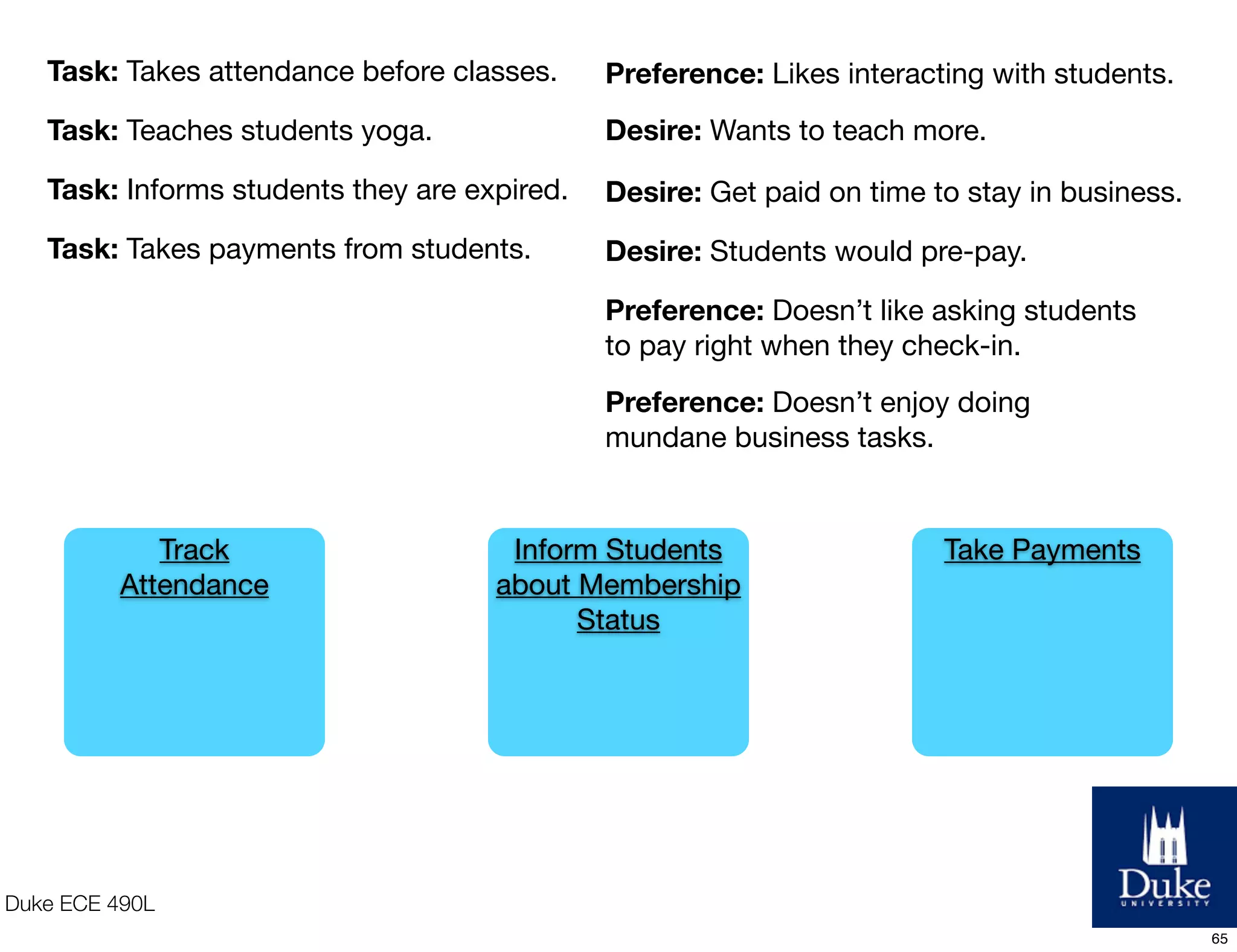
Task: Takes attendance before classes.
Task: Informs students they are expired.
Task: Teaches students yoga.
Desire: Get paid on time to stay in business.
Desire: Students would pre-pay.
Preference: Doesn’t like asking students
to pay right when they check-in.
Task: Takes payments from students.
Desire: Wants to teach more.
Preference: Likes interacting with students.
Preference: Doesn’t enjoy doing
mundane business tasks.
65
Duke ECE 490L
6. Tasks become “stories”.
66
Duke ECE 490L
Persona + what is it they are doing = accomplish a goal.
67
Duke ECE 490L
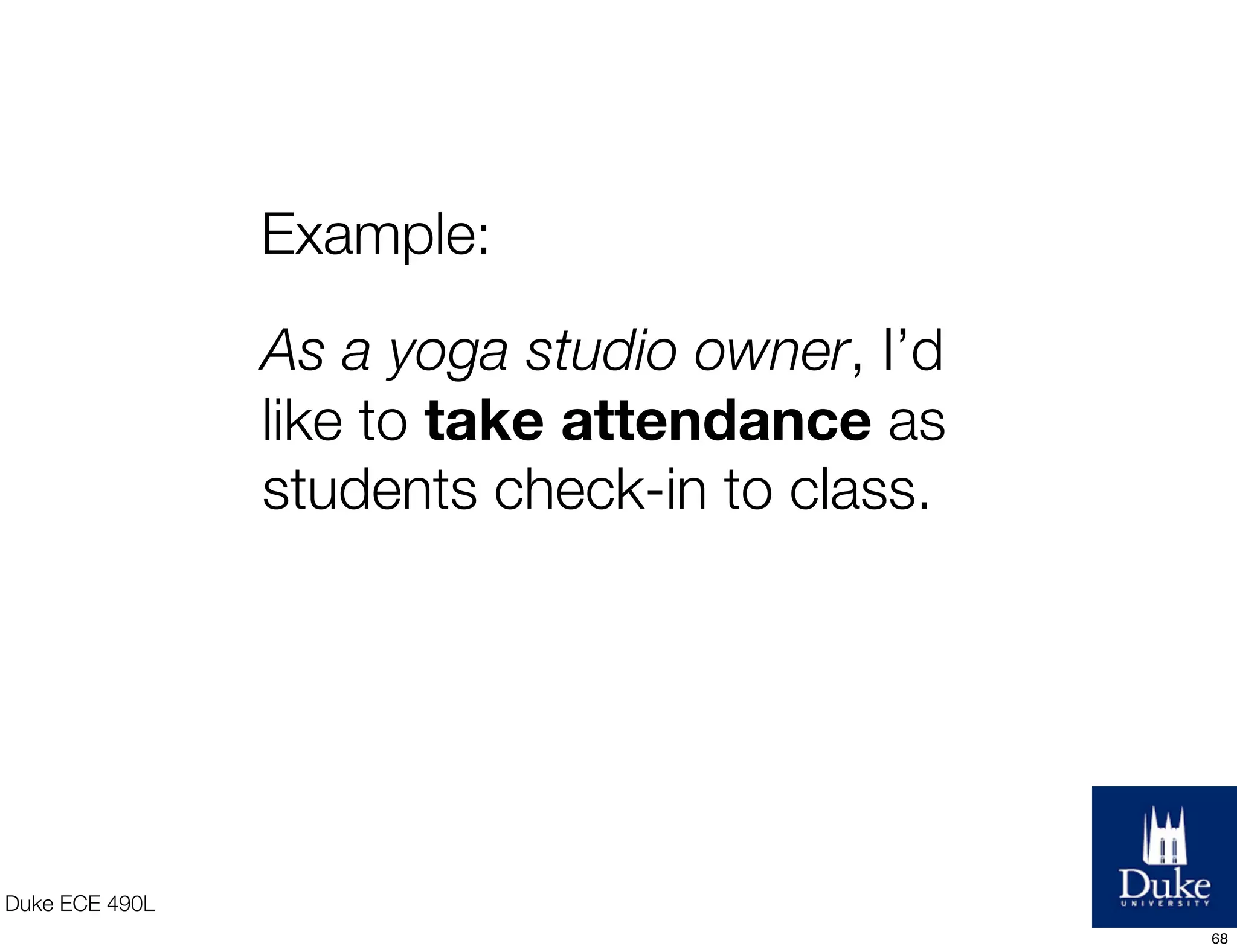
As a yoga studio owner, I’d
like to take attendance as
students check-in to class.
Example:
68
Duke ECE 490L
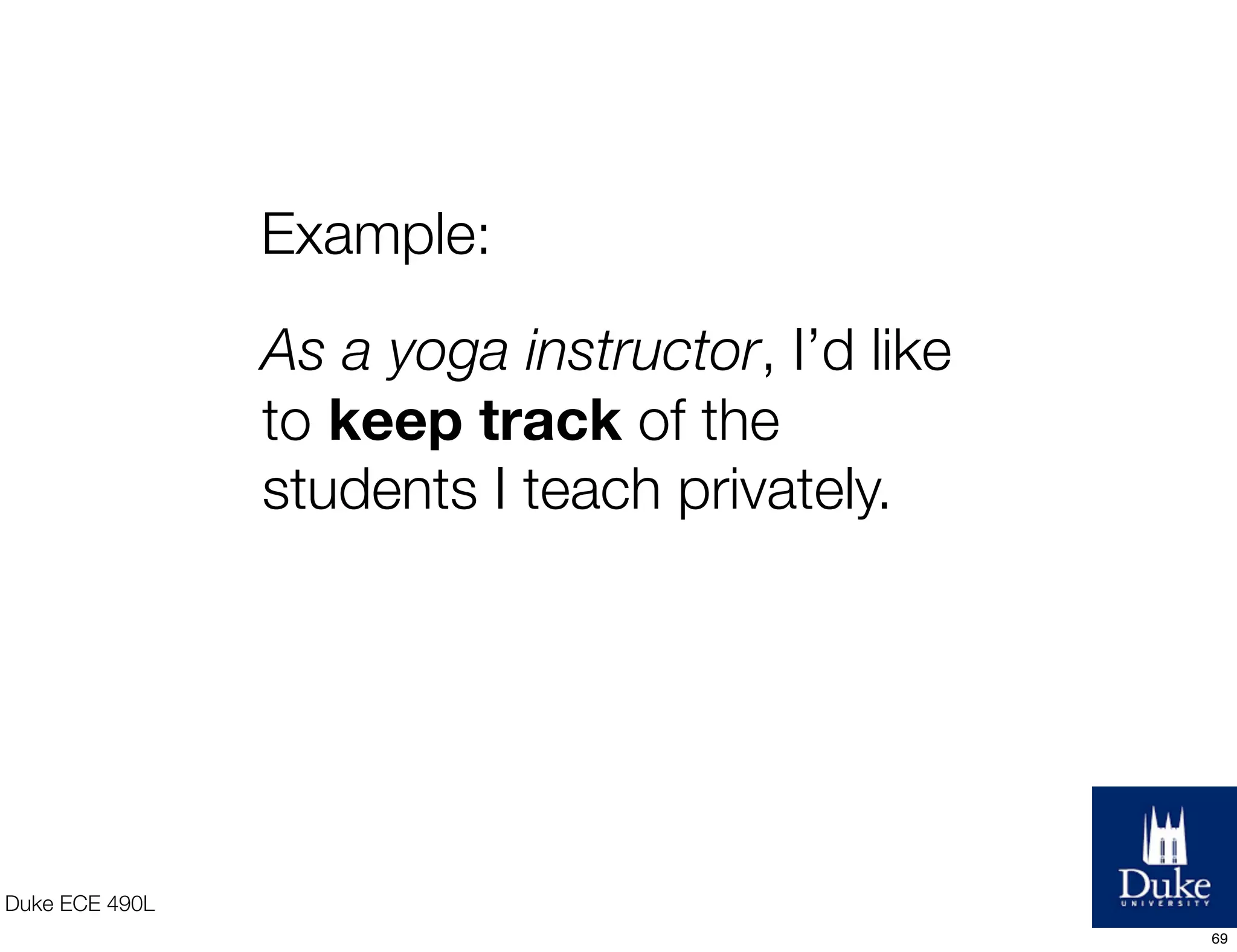
As a yoga instructor, I’d like
to keep track of the
students I teach privately.
Example:
69
Duke ECE 490L
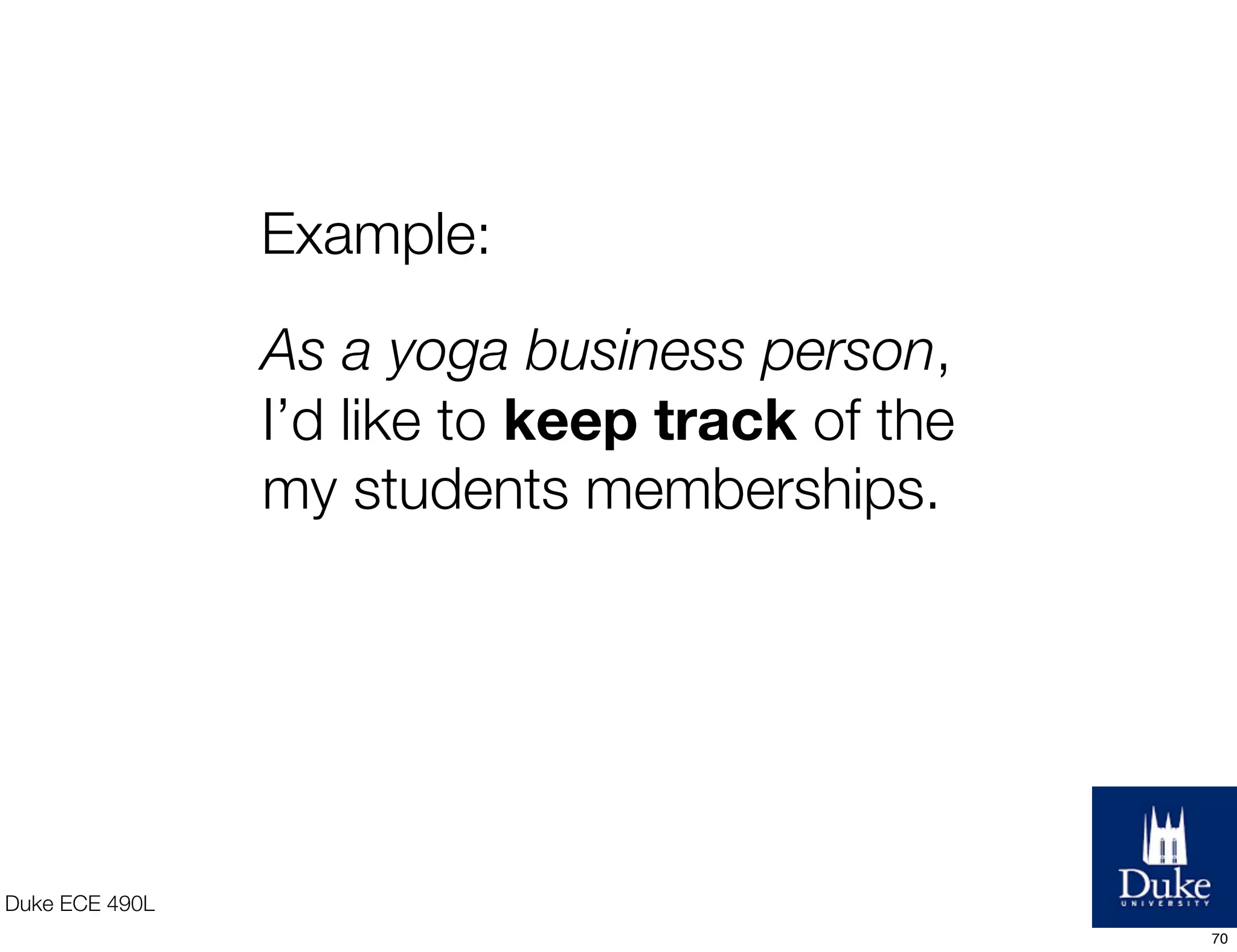
As a yoga business person,
I’d like to keep track of the
my students memberships.
Example:
70
Duke ECE 490L
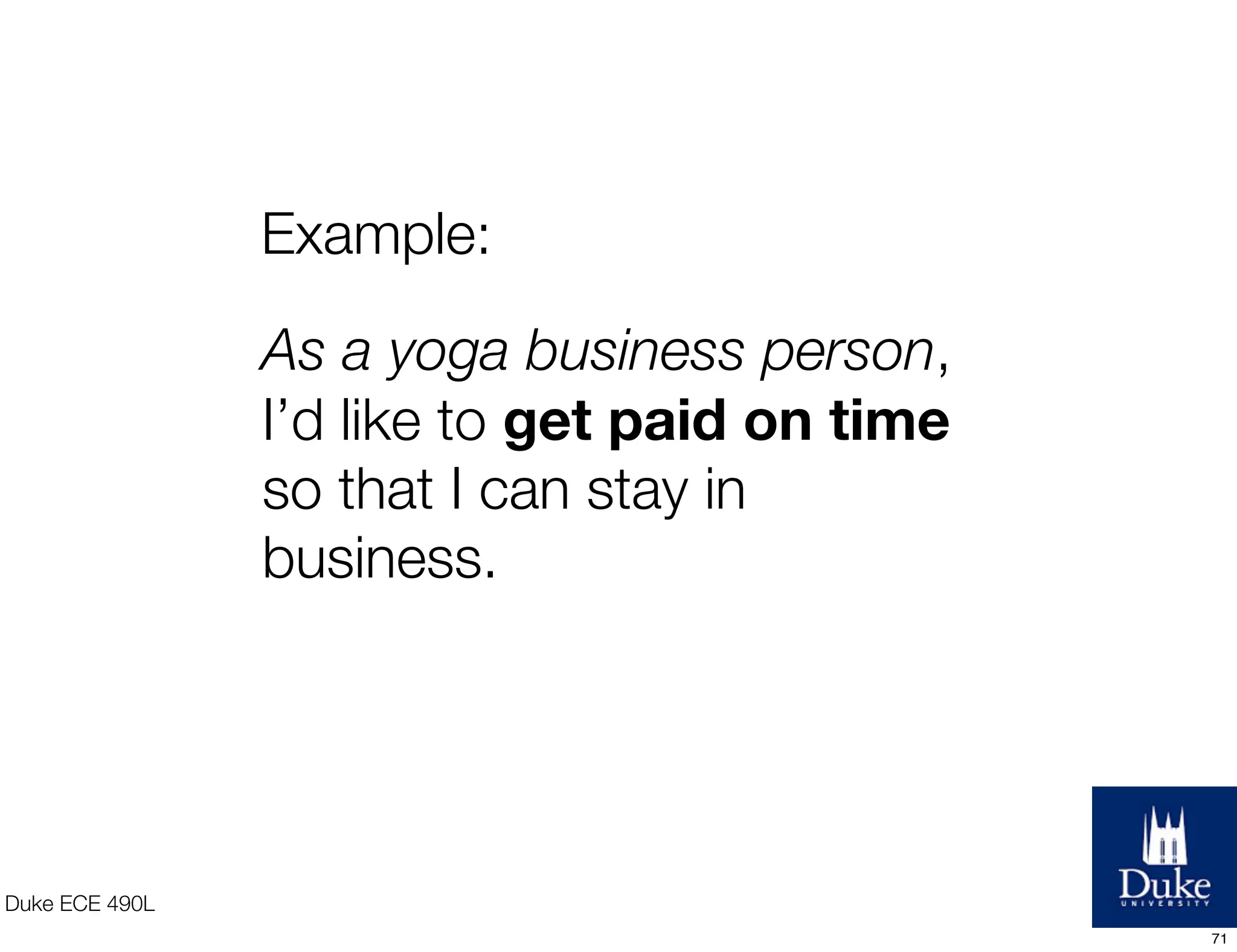
As a yoga business person,
I’d like to get paid on time
so that I can stay in
business.
Example:
71
Duke ECE 490L
7. Stories feed into features.
72
Duke ECE 490L
Features fit into product implementation.
73
Duke ECE 490L
More details in next lecture!
74
Review
Duke ECE 490L
• More on positioning!
• Digging into the Competitor
• Horizontal vs. Vertical Market
• Substitutes
• Secondary Markets
• Point Tool vs. Integrated Solutions
75

Lecture 9: Customer Discovery

  • 1.
    Duke ECE 490L:How to Start New Ventures in Electrical and Computer Engineering Poornima Vijayashanker poornima@femgineer.com Jeff Glass jeff.glass@duke.edu Akshay Raut ar118@duke.edu 1
  • 2.
    Review Duke ECE 490L •More on positioning! • Digging into the Competitor • Horizontal vs. Vertical Market • Substitutes • Secondary Markets • Point Tool vs. Integrated Solutions • Customer Discovery 2
  • 3.
    Announcements • Quiz 1results coming soon! • Questions on Lab 2? Duke ECE 490L 3
  • 4.
  • 5.
    Agenda Duke ECE 490L •Customer Discovery • Mental Models • Customer Interviews 5
  • 6.
    Duke ECE 490L Stillno building... 6
  • 7.
    Duke ECE 490L Mythof the omniscient founder. Supplemental Reading: The Steve Jobs Way 7
  • 8.
    Duke ECE 490L CustomerDiscovery Validation Customer Creation Business/Company Formation Early Adopter Pricing Product Distribution Mainstream Adopters Money for Marketing Market Research 8
  • 9.
    Duke ECE 490L CustomerDiscovery Validation Customer Creation Business/Company Formation Early Adopter Pricing Product Distribution 9
  • 10.
    Test across varioususer segments. Duke ECE 490L 10
  • 11.
    Duke ECE 490L MentalModel of an early adopter. 11
  • 12.
    Duke ECE 490L Mentalmodels give you a deep understanding of people’s motivations and thought-processes, along with the emotional and philosophical landscape in which they are operating. Supplemental Reading: Mental Models 12
  • 13.
    Duke ECE 490L MentalModel per segment. 13
  • 14.
    Duke ECE 490L Understandthe differences to bring clarity to design and product implementation. 14
  • 15.
    Benefits of MentalModels Duke ECE 490L • Confidence in your design: guide the design of the solution • Clarity in direction: make good user and business decisions • Continuity of strategy: ensure longevity of vision and opportunity 15
  • 16.
    Duke ECE 490L Howdo you know the design is right? 16
  • 17.
  • 18.
    Case Study: FrankGehry Disney Hall Duke ECE 490L • Disney Hall: think about how people listen • Worked closely with acoustician to produce BIG and small sounds • Conductor thinks about on stage • Musician’s relationship to the room 18
  • 19.
    Duke ECE 490L Wholeexperience. 19
  • 20.
    Duke ECE 490L Payattention to the entire spectrum of interactions customer will have, not just a single service or tool. 20
  • 21.
    Duke ECE 490L MMcaptures cognitive intent and emotion, social environment, and cultural traits of a concept. 21
  • 22.
    Duke ECE 490L Whatdoes that mean? 22
  • 23.
  • 24.
    Duke ECE 490L Science+ Intuition = communicate product info 24
  • 25.
    Purpose of MentalModels Duke ECE 490L • Validate ideas and match them to needs of customers • Mental models capture • Cognitive intent • Emotions • Social and culture traits of a concept • Experience Strategy = Business Strategy + UX Strategy • Jesse James Garrett 25
  • 26.
    Duke ECE 490L Howdo we create a mental model? 26
  • 27.
    Duke ECE 490L 1.Learn verbs of a customer. 27
  • 28.
    Duke ECE 490L e.g.Yoga studio owner 28
  • 29.
    Duke ECE 490L Teachyoga classes. Take attendance. Schedule instructors. Ask students for payments. Owns or manages studio. Performs back office tasks or business partner does. 29
  • 30.
    Duke ECE 490L e.g.Yoga instructor 30
  • 31.
    Duke ECE 490L Teachyoga classes 1-1. Teach yoga classes at a studio. Teach yoga classes in corporations. May teach full-time or part-time. Take attendance. Ask students for payments. Travel to teach. 31
  • 32.
    Duke ECE 490L 2.Create personas. 32
  • 33.
    Duke ECE 490L Personasare user profiles that help design and other teams such as sales and marketing get more useful products into the hands of customers. Supplemental Reading: Getting Your Startup Team to Understand Your Customer, About Face 2.0: The Essentials of Interaction Design 33
  • 34.
    Personas Benefit OtherTeams Duke ECE 490L • Marketing • Develop positions based on personas • Sales • Communicate how product will meet needs of customers • Engineering • Understand importance of building not for themselves but for the customer by understanding customer’s needs 34
  • 35.
    Personas Benefit OtherTeams Duke ECE 490L • Focus on end goals & life goals • what a person wishes to accomplish • why a person wishes to accomplish something • Create Segments • task based: people who do similar things but don’t necessarily buy the same product • e.g. teens & seniors are both “movie-goers” • Avoid traditional market segment traps • list distinguishing behavior • group behavior • name groups 35
  • 36.
    Avoid Traditional MarketingSegment Traps Duke ECE 490L • List distinguishing behaviors: Sketch out all the ways many types of individuals might behave • Group the behaviors: study these behaviors and put them into groups • Name the groups: assign provisional labels to the groups 36
  • 37.
    Duke ECE 490L Multipleuser segments, each has a different need. 37
  • 38.
    Duke ECE 490L Determiningneeds will help with design. 38
  • 39.
    Duke ECE 490L Todetermine needs we need to do user research. 39
  • 40.
    Duke ECE 490L UserResearch Types. 40
  • 41.
    Duke ECE 490L DataTechnique Uses Preferences Opinions, likes, dislikes Survey Focus Group Mood Boards Preference Interview Customer Feedback Visual Design Branding Market Analysis Advertising Campaigns Evaluative What is understood or accomplished with a tool. Usability Test Log Analysis Search Analysis Customer Feedback Interaction Functionality Screen Layout Nomenclature Information Architecture Generative Mental environment in which things get done Non-Directed Interview Mental Model Diary Ethnography Contextual Inquiry Navigation & Flow Interaction Design Alignment & Gap Analysis Contextual Marketing 41
  • 42.
    Duke ECE 490L Setgoals relating back to customer discovery. 42
  • 43.
    Duke ECE 490L Personascome out of interviewing user segments. 43
  • 44.
    Duke ECE 490L Collectfeedback and categorize customers. 44
  • 45.
    Duke ECE 490L YogaStudio Owner/Manager Yoga Instructor 45
  • 46.
    Duke ECE 490L Someneeds will be the same. While others have a stark contrast. 46
  • 47.
    Duke ECE 490L Resultsfrom interview will point out the general cases. 47
  • 48.
    Interview Checklist Duke ECE490L • How many of each audience segment to select • Demographics to select, if applicable • A qualification questionnaire for recruiters to use • Questions to make certain that the candidate is able to carry on a long enough conversation • A schedule with available interview appointments • A list of qualifying candidates 48
  • 49.
    6 Rules forMental Models Interviews Duke ECE 490L 1. Behaviors and philosophies, not product preferences 2. Open questions only 3. No words of your own 4. Follow the conversation 5. Not about tools 6. Immediate experience 49
  • 50.
    Open-Ended Questions Duke ECE490L • Elicit more info • compared to yes/no • Don’t bias answers • doesn’t distract their thinking • Let’s people direct answers to what they think is important • “Tell me more...” 50
  • 51.
    Examples of Open-EndedQuestions Duke ECE 490L • How did you do that? • How did you actually get that info? • So is that’s one of the things you’re doing right now? (Encouraging him to tell me more.) • How do you keep up to date on the latest? • Can you mention a couple of examples? • Can you tell me…what are your next steps? 51
  • 52.
    Duke ECE 490L Findout as much as possible about the customer. 52
  • 53.
    Digging Deeper intothe Personas Duke ECE 490L • Where do they hang out? • What do they read? • Who influences them? Or recommends products? 53
  • 54.
  • 55.
    Duke ECE 490L 3.Comb for tasks. 55
  • 56.
    Duke ECE 490L Typeof Task Definition Task a phrase setting an action or step to accomplish something. Implied Task a not-so-clear phrase implying an action “Every class students come in and we need to check them in." Third-Party Task a phrase that mentions a task someone else does “My front desk person checks students in.” Philosophy a phrase stating a belief of why tasks are done a certain way “Taking attendance should be fast and easy.” Feeling a phrase describing a person’s feelings “When all students are checked in I know classes run smoothly.” 56
  • 57.
    Duke ECE 490L InterestLevel Definition Preference a phrase stating a person’s likes or dislikes “I don’t like asking students for money right when they check-in.” Desire a phrase stating what the person wants “I wish students would just pre-pay for classes.” Expectation a belief that something will happen “I think students will know how to pre-pay for classes.” 57
  • 58.
    Duke ECE 490L QuoteTask Type of Task “I need to stay organized to keep my business on-track.” Would feel business is going well if they were more organized. Desire “I take attendance before each class.” Takes attendance. Task “Tracking attendance and letting students see it keeps them honest about paying on time.” Believes taking attendance keeps students honest. Feeling 58
  • 59.
  • 60.
    Duke ECE 490L CustomerDiscovery Validation Customer Creation Business/Company Formation 60
  • 61.
    Duke ECE 490L Tasks Whatcustomers do that you might want to design a solution for. Desire, Feelings, Preference, Expectations Characterizes level of need. 61
  • 62.
    Duke ECE 490L 4.Match personas to tasks. 62
  • 63.
    Duke ECE 490L YogaInstructor Teaches yoga. Takes attendance. Asks for payment. Yoga Studio Owner Teaches at one studio. Travels to teach yoga. 63
  • 64.
    Duke ECE 490L 5.Look for patterns. 64
  • 65.
    Duke ECE 490L Track Attendance InformStudents about Membership Status Take Payments Task: Takes attendance before classes. Task: Informs students they are expired. Task: Teaches students yoga. Desire: Get paid on time to stay in business. Desire: Students would pre-pay. Preference: Doesn’t like asking students to pay right when they check-in. Task: Takes payments from students. Desire: Wants to teach more. Preference: Likes interacting with students. Preference: Doesn’t enjoy doing mundane business tasks. 65
  • 66.
    Duke ECE 490L 6.Tasks become “stories”. 66
  • 67.
    Duke ECE 490L Persona+ what is it they are doing = accomplish a goal. 67
  • 68.
    Duke ECE 490L Asa yoga studio owner, I’d like to take attendance as students check-in to class. Example: 68
  • 69.
    Duke ECE 490L Asa yoga instructor, I’d like to keep track of the students I teach privately. Example: 69
  • 70.
    Duke ECE 490L Asa yoga business person, I’d like to keep track of the my students memberships. Example: 70
  • 71.
    Duke ECE 490L Asa yoga business person, I’d like to get paid on time so that I can stay in business. Example: 71
  • 72.
    Duke ECE 490L 7.Stories feed into features. 72
  • 73.
    Duke ECE 490L Featuresfit into product implementation. 73
  • 74.
    Duke ECE 490L Moredetails in next lecture! 74
  • 75.
    Review Duke ECE 490L •More on positioning! • Digging into the Competitor • Horizontal vs. Vertical Market • Substitutes • Secondary Markets • Point Tool vs. Integrated Solutions 75