CULTURE
Compiled by:
Rana Zahid Zulfiqar
PhD Scholar Sociology
Government College University, Faisalabad.
Visiting Lecturer Sociology, Bahauddin Zakariya
University Multan, Pakistan
ranazahidzulfiqar@gmail.Com
DEFINITION OF CULTURE
Culture is a complex whole which
includes, Knowledge, Belief, Art,
Morals, Law, Customs and any
other capabilities and habits
acquired by man as a member of
society (Edward B. Tylor).
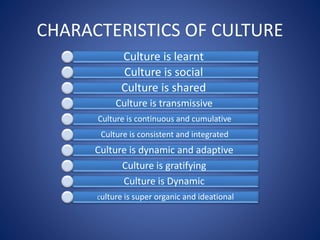
CHARACTERISTICS OF CULTURE
Culture is learnt
Culture is social
Culture is shared
Culture is transmissive
Culture is continuous and cumulative
Culture is consistent and integrated
Culture is dynamic and adaptive
Culture is gratifying
Culture is Dynamic
Culture is super organic and ideational
FUNCTIONS OF CULTURE
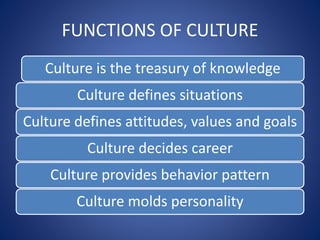
Culture is the treasury of knowledge
Culture defines situations
Culture defines attitudes, values and goals
Culture decides career
Culture provides behavior pattern
Culture molds personality
SALIENT FEATURES OF PAKISTANI
CULTURE
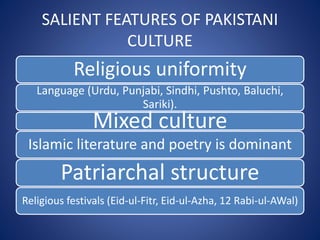
Religious uniformity
Language (Urdu, Punjabi, Sindhi, Pushto, Baluchi,
Sariki).
Mixed culture
Islamic literature and poetry is dominant
Patriarchal structure
Religious festivals (Eid-ul-Fitr, Eid-ul-Azha, 12 Rabi-ul-AWal)
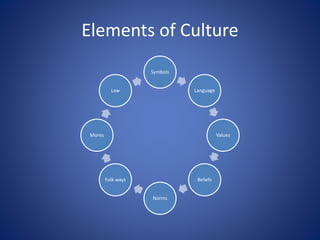
Elements of Culture
Symbols
Language
Values
Beliefs
Norms
Folk ways
Mores
Law
SYMBOL
A symbol is anything that carries a particular meaning
recognized by people who share a culture. There is a
great importance of symbols for the human being.
Every society construct its symbols for the well
functionality of the society. The individuals start to
learn the different symbols at the time of the birth
and continue till death. Actually, symbols play an
important role in the identity construction and
develop the meaning of right and wrong. It is
probability that some symbols are recognized good in
one culture and bad in other culture. For example,
the Asians like veil but European don’t like this one.
LANGUAGE
The key to the world of culture, is a symbols that allows
people to communicate with one another.
Cultural transmission the process by which one generation
passes culture to the next.
It is estimated that there are 7000 languages in the world.
1.3 billion people speaks Chinese, English is the second
largest spoken language in the world.
VALUES
Culturally standards that
people use o decide
what is desirable, good
and beautiful and that
serve a as broad
guidelines for social
living. People who share
a culture use values to
make choices about how
to live.
Values are broad principles
that support beliefs,
specific thoughts or ideas
that people hold to he
true. In other words, values
are abstract standards of
goodness, and beliefs are
particular matters that
individuals consider true or
false. Examples of Pakistani
culture; patriarchy, respect
of elders and teachers etc.
BELIEFS
Beliefs in empirical terms are neither true nor
false. Tested empirical knowledge and untestable
beliefs are “elements ” of culture. Because, they
are often mixed together in the same concrete
acts. Only through an intellectual analysis the
different elements could be separated from one
another. For example, the missionary says a silent
prayer and at the same time administers modern
medical tests to the patient.
SOCIAL NORMS
Social Norms are the standard pattern
behavior.
Norms are a fundamental concept in the
social sciences.
They are most commonly defined as rules or
expectations that are socially enforced.
Norms may be prescriptive (encouraging positive behavior;
for example, “be honest” or proscriptive (discouraging negative
behavior; for example, “do not cheat”).
FOLK WAYS
Folkways – these
are everyday
habits; customs,
traditions and
conventions
people obey
without giving
much thought to
the matter.
Some examples comm
on in western societies
include, standing in
line, holding the door
for someone, greeting
fellow passengers at a
bus stop (perhaps
varies from city to
city), waiting for fellow
diners food to arrive
before you start
eating.
MORES
Mores are often
dictated by a
society's values,
ethics, and
sometimes
religious
influences.
Some mores
examples include: It is
not considered
acceptable or
mainstream to abuse
drugs, particularly those
such as heroine and
cocaine. It is not
considered acceptable
to drive at 90 mph in a
residential area.
LAWS
Laws- these are formalized norms enacted
by people vested with legitimate authority.
TYPES OF CULTURE
Material
Non-material
Ideal
Real
MATERIAL CULTURE
1. Tangible and observable
objects
2. Material culture consists of man-made objects
such as tools, implements, furniture, automobiles,
buildings, dams, roads, bridges, and in fact, the
physical substance which has been changed and
used by man. It is concerned with the external,
mechanical and utilitarian objects. For example,
Schools, Banks, Currency system etc.
NON- MATERIAL CULTURE
Non tangible and non-observable
objects
Non-material culture consists of the words the
people use or the language they speak, the belief
they hold, values and virtues they cherish, habits
they follow, rituals and practices that they do and
the ceremonies they observed. It also includes
our customs and tastes, attitudes and outlooks.
IDEAL CULTURE
The culture that
people want to
follow and
idealize in daily
routine of life.
Ideal culture includes the
formally approved
folkways and norms which
people are a supposed to
follow or how we should
behave. For example,
follow the Islamic Beliefs
in practice and look to
neighbor rights are basic
principles of Islam.
REAL CULTURE
Real culture refers to
the reality of the
people. For example,
throughout the world
more than 196
countries signed
“CEDAW” but in reality
its application is not
practice in majority of
the signed countries.
Real culture means the
norms and values a
society adheres to in
practices or how we
actually heave. Such a
gap is visible at the
level of individual
behavior.
DIVERSITY
The concept of diversity encompasses acceptance and respect.
It means understanding that each individual is unique.
Recognizing our individual differences.
These can be along the dimensions of race, ethnicity, gender, sexual
orientation, socio-economic status, age, physical abilities, religious
beliefs, political beliefs, or other ideologies
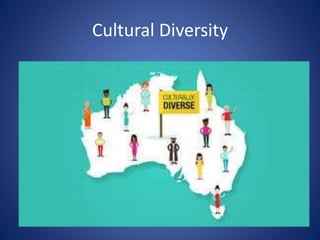
Cultural Diversity
Cultural Diversity in Pakistan
Pakistan is a
country with
diverse social,
ethnic, linguistic
and cultural
circumstances.
The country came
into existence after
division of British
Indian colony in
1947 on the basis
of Islamic identity
of people living in
this region but
different social and
ethnic groups have
maintained their
distinct character.
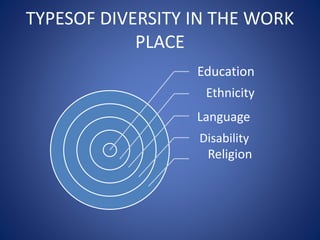
TYPESOF DIVERSITY IN THE WORK
PLACE
Education
Ethnicity
Language
Religion
Disability
Subculture
The term subculture refer to cultural patterns that set apart
some segments of a society’s population.
A segment of society which shares a distinctive pattern of
mores, folkways and values which differ fro the pattern of
larger society. Such groups are may have their values, norms
and symbols but they largely blend into mainstream society.
Example: In Pakistan there are different subculture
like Punjabi, Sindhi, Sariki, Balochi, Pushto etc.
Multiculturalism
Multiculturalism is a perspective recognizing the
cultural diversity and take them in to account
accordingly. Pakistan is a diverse country in
which different subculture have their own
norms and values but as a whole it is called
Pakistani society. The Government of Pakistan
also take care the provincial differences and give
them freedom to enjoy their traits at some
extent.
Counter culture
A subculture that rejects societal norms
and values and seeks alternative
lifestyles (Yinger, 1960).
Example: In Pakistan the Taliban constituted
countercultures as they reject the Government of
Pakistan rite and intended to impose their own rules and
regulations within the state. These Militant groups have
become counterculture in Pakistan.
CULTURAL CHANGE
Some elements of cultural change faster than
others. William Ogburn (1964) observed that
technology moves quickly, generating new
element of material culture (things) faster
than nonmaterial culture (ideas) can keep up
with them. Ogburn called this inconsistencey
cultural lag, the fact that some cultural
elements change more quickly than others,
disrupting a cultural system.
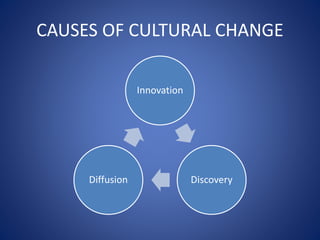
CAUSES OF CULTURAL CHANGE
Innovation
DiscoveryDiffusion
Cultural Lag
The period of maladjustment during which
the nonmaterial culture is still adapting to the
new material conditions. We will be willing to
use technological innovations from other
cultures (material culture) that will make our
lives easier, but we will be reluctant to adopt
the ideologies of that culture that will change
our way of seeing the world, for example
democracy in Pakistan.
ETHNOCENTRISM
Tendency of each group t take for
granted the superiority of its own
culture (Horton & Hunt, 1984).
Ethnocentrism is a term coined by William
Graham Sumner, is the belief that your consider your
culture superior as compared to others. This leads to
making incorrect assumptions about others behavior
based on your own norms, values, and beliefs.
XENOCENTRISM
The opposite of ethnocentrism is
xenocentrism which means prefering ideas
and things from other cultures over ideas
and things from your own culture. For
example, Pakistani always consider
American’s values superior, Japani’s
products better, Korean auto technology
durable etc.
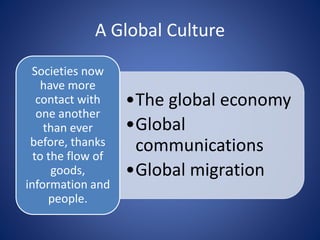
A Global Culture
•The global economy
•Global
communications
•Global migration
Societies now
have more
contact with
one another
than ever
before, thanks
to the flow of
goods,
information and
people.
Best of Luck

Lecture 3. culture

  • 1.
    CULTURE Compiled by: Rana ZahidZulfiqar PhD Scholar Sociology Government College University, Faisalabad. Visiting Lecturer Sociology, Bahauddin Zakariya University Multan, Pakistan ranazahidzulfiqar@gmail.Com
  • 2.
    DEFINITION OF CULTURE Cultureis a complex whole which includes, Knowledge, Belief, Art, Morals, Law, Customs and any other capabilities and habits acquired by man as a member of society (Edward B. Tylor).
  • 3.
    CHARACTERISTICS OF CULTURE Cultureis learnt Culture is social Culture is shared Culture is transmissive Culture is continuous and cumulative Culture is consistent and integrated Culture is dynamic and adaptive Culture is gratifying Culture is Dynamic Culture is super organic and ideational
  • 4.
    FUNCTIONS OF CULTURE Cultureis the treasury of knowledge Culture defines situations Culture defines attitudes, values and goals Culture decides career Culture provides behavior pattern Culture molds personality
  • 5.
    SALIENT FEATURES OFPAKISTANI CULTURE Religious uniformity Language (Urdu, Punjabi, Sindhi, Pushto, Baluchi, Sariki). Mixed culture Islamic literature and poetry is dominant Patriarchal structure Religious festivals (Eid-ul-Fitr, Eid-ul-Azha, 12 Rabi-ul-AWal)
  • 6.
  • 7.
    SYMBOL A symbol isanything that carries a particular meaning recognized by people who share a culture. There is a great importance of symbols for the human being. Every society construct its symbols for the well functionality of the society. The individuals start to learn the different symbols at the time of the birth and continue till death. Actually, symbols play an important role in the identity construction and develop the meaning of right and wrong. It is probability that some symbols are recognized good in one culture and bad in other culture. For example, the Asians like veil but European don’t like this one.
  • 8.
    LANGUAGE The key tothe world of culture, is a symbols that allows people to communicate with one another. Cultural transmission the process by which one generation passes culture to the next. It is estimated that there are 7000 languages in the world. 1.3 billion people speaks Chinese, English is the second largest spoken language in the world.
  • 9.
    VALUES Culturally standards that peopleuse o decide what is desirable, good and beautiful and that serve a as broad guidelines for social living. People who share a culture use values to make choices about how to live. Values are broad principles that support beliefs, specific thoughts or ideas that people hold to he true. In other words, values are abstract standards of goodness, and beliefs are particular matters that individuals consider true or false. Examples of Pakistani culture; patriarchy, respect of elders and teachers etc.
  • 10.
    BELIEFS Beliefs in empiricalterms are neither true nor false. Tested empirical knowledge and untestable beliefs are “elements ” of culture. Because, they are often mixed together in the same concrete acts. Only through an intellectual analysis the different elements could be separated from one another. For example, the missionary says a silent prayer and at the same time administers modern medical tests to the patient.
  • 11.
    SOCIAL NORMS Social Normsare the standard pattern behavior. Norms are a fundamental concept in the social sciences. They are most commonly defined as rules or expectations that are socially enforced. Norms may be prescriptive (encouraging positive behavior; for example, “be honest” or proscriptive (discouraging negative behavior; for example, “do not cheat”).
  • 12.
    FOLK WAYS Folkways –these are everyday habits; customs, traditions and conventions people obey without giving much thought to the matter. Some examples comm on in western societies include, standing in line, holding the door for someone, greeting fellow passengers at a bus stop (perhaps varies from city to city), waiting for fellow diners food to arrive before you start eating.
  • 13.
    MORES Mores are often dictatedby a society's values, ethics, and sometimes religious influences. Some mores examples include: It is not considered acceptable or mainstream to abuse drugs, particularly those such as heroine and cocaine. It is not considered acceptable to drive at 90 mph in a residential area.
  • 14.
    LAWS Laws- these areformalized norms enacted by people vested with legitimate authority.
  • 15.
  • 16.
    MATERIAL CULTURE 1. Tangibleand observable objects 2. Material culture consists of man-made objects such as tools, implements, furniture, automobiles, buildings, dams, roads, bridges, and in fact, the physical substance which has been changed and used by man. It is concerned with the external, mechanical and utilitarian objects. For example, Schools, Banks, Currency system etc.
  • 17.
    NON- MATERIAL CULTURE Nontangible and non-observable objects Non-material culture consists of the words the people use or the language they speak, the belief they hold, values and virtues they cherish, habits they follow, rituals and practices that they do and the ceremonies they observed. It also includes our customs and tastes, attitudes and outlooks.
  • 18.
    IDEAL CULTURE The culturethat people want to follow and idealize in daily routine of life. Ideal culture includes the formally approved folkways and norms which people are a supposed to follow or how we should behave. For example, follow the Islamic Beliefs in practice and look to neighbor rights are basic principles of Islam.
  • 19.
    REAL CULTURE Real culturerefers to the reality of the people. For example, throughout the world more than 196 countries signed “CEDAW” but in reality its application is not practice in majority of the signed countries. Real culture means the norms and values a society adheres to in practices or how we actually heave. Such a gap is visible at the level of individual behavior.
  • 20.
    DIVERSITY The concept ofdiversity encompasses acceptance and respect. It means understanding that each individual is unique. Recognizing our individual differences. These can be along the dimensions of race, ethnicity, gender, sexual orientation, socio-economic status, age, physical abilities, religious beliefs, political beliefs, or other ideologies
  • 21.
  • 22.
    Cultural Diversity inPakistan Pakistan is a country with diverse social, ethnic, linguistic and cultural circumstances. The country came into existence after division of British Indian colony in 1947 on the basis of Islamic identity of people living in this region but different social and ethnic groups have maintained their distinct character.
  • 23.
    TYPESOF DIVERSITY INTHE WORK PLACE Education Ethnicity Language Religion Disability
  • 24.
    Subculture The term subculturerefer to cultural patterns that set apart some segments of a society’s population. A segment of society which shares a distinctive pattern of mores, folkways and values which differ fro the pattern of larger society. Such groups are may have their values, norms and symbols but they largely blend into mainstream society. Example: In Pakistan there are different subculture like Punjabi, Sindhi, Sariki, Balochi, Pushto etc.
  • 25.
    Multiculturalism Multiculturalism is aperspective recognizing the cultural diversity and take them in to account accordingly. Pakistan is a diverse country in which different subculture have their own norms and values but as a whole it is called Pakistani society. The Government of Pakistan also take care the provincial differences and give them freedom to enjoy their traits at some extent.
  • 26.
    Counter culture A subculturethat rejects societal norms and values and seeks alternative lifestyles (Yinger, 1960). Example: In Pakistan the Taliban constituted countercultures as they reject the Government of Pakistan rite and intended to impose their own rules and regulations within the state. These Militant groups have become counterculture in Pakistan.
  • 27.
    CULTURAL CHANGE Some elementsof cultural change faster than others. William Ogburn (1964) observed that technology moves quickly, generating new element of material culture (things) faster than nonmaterial culture (ideas) can keep up with them. Ogburn called this inconsistencey cultural lag, the fact that some cultural elements change more quickly than others, disrupting a cultural system.
  • 28.
    CAUSES OF CULTURALCHANGE Innovation DiscoveryDiffusion
  • 29.
    Cultural Lag The periodof maladjustment during which the nonmaterial culture is still adapting to the new material conditions. We will be willing to use technological innovations from other cultures (material culture) that will make our lives easier, but we will be reluctant to adopt the ideologies of that culture that will change our way of seeing the world, for example democracy in Pakistan.
  • 30.
    ETHNOCENTRISM Tendency of eachgroup t take for granted the superiority of its own culture (Horton & Hunt, 1984). Ethnocentrism is a term coined by William Graham Sumner, is the belief that your consider your culture superior as compared to others. This leads to making incorrect assumptions about others behavior based on your own norms, values, and beliefs.
  • 31.
    XENOCENTRISM The opposite ofethnocentrism is xenocentrism which means prefering ideas and things from other cultures over ideas and things from your own culture. For example, Pakistani always consider American’s values superior, Japani’s products better, Korean auto technology durable etc.
  • 32.
    A Global Culture •Theglobal economy •Global communications •Global migration Societies now have more contact with one another than ever before, thanks to the flow of goods, information and people.
  • 33.