Safety and biosecurity
Lecture 5:-Control of Substances hazard to health (Coshh)
Dr. Raghda Saad Mohammed
WHAT IS COSHH?
COSHH is the law that requires employers to control all the
substances and hazardous to health and safety you can prevent that
by:
 Finding out what the health hazards are;
 Deciding how to prevent harm to health (risk assessment)
 Providing control measures and make sure they are used
 Keep all the control measures in good order
 providing instructions and training to others
 Providing monitoring health surveillance appropriate cases
 Planning for all the emergencies
What is substances hazardous to health?
COSHH covers substances hazardous to health such as:
Chemicals
Products containing chemicals
 Fumes
 Dusts
Vapours
 Mists
Nanotechnology
Biological agents
Germs that cause diseases
COSHH ASSESSMENT
IDENTIFYING HAZARD AND ASSESSING RISK
 You can walk around the work area and find where is
the potential for exposure to substance that might be
hazardous to health for example processing the emit
dusts fume, vapour, mist or gas and also skin contact
with liquids , pastes and dusts.
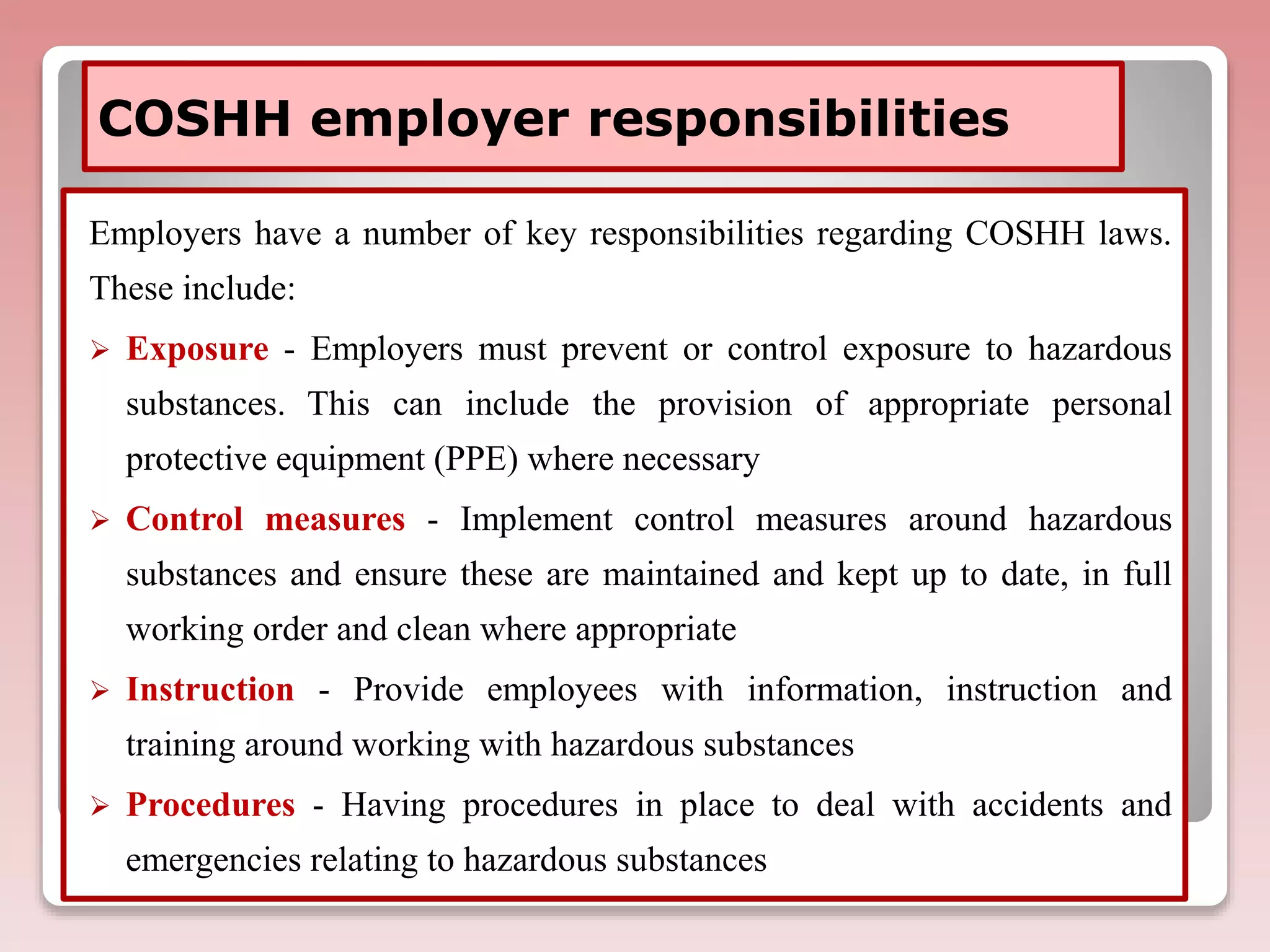
COSHH employer responsibilities
Employers have a number of key responsibilities regarding COSHH laws.
These include:
 Exposure - Employers must prevent or control exposure to hazardous
substances. This can include the provision of appropriate personal
protective equipment (PPE) where necessary
 Control measures - Implement control measures around hazardous
substances and ensure these are maintained and kept up to date, in full
working order and clean where appropriate
 Instruction - Provide employees with information, instruction and
training around working with hazardous substances
 Procedures - Having procedures in place to deal with accidents and
emergencies relating to hazardous substances
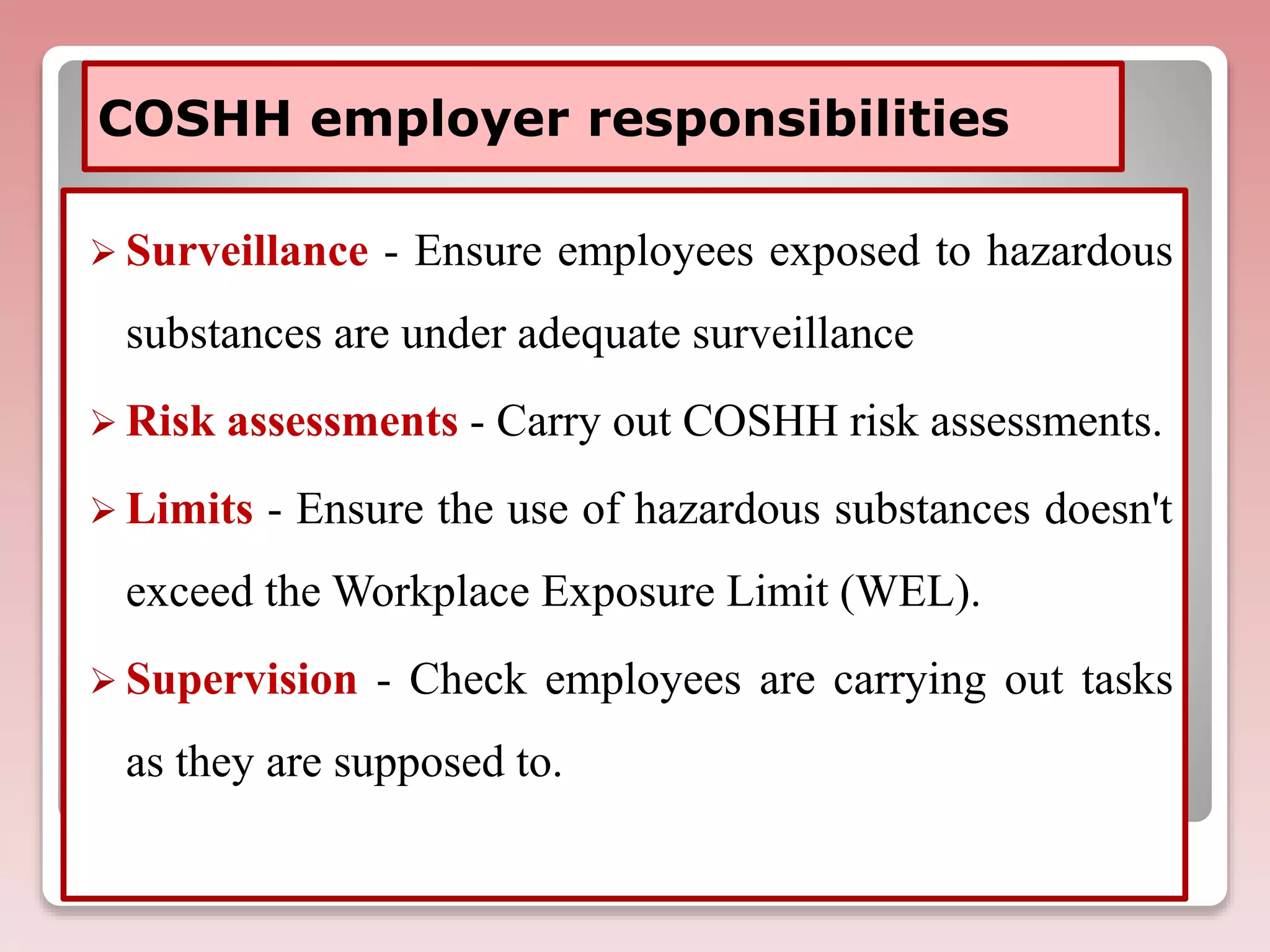
COSHH employer responsibilities
 Surveillance - Ensure employees exposed to hazardous
substances are under adequate surveillance
 Risk assessments - Carry out COSHH risk assessments.
 Limits - Ensure the use of hazardous substances doesn't
exceed the Workplace Exposure Limit (WEL).
 Supervision - Check employees are carrying out tasks
as they are supposed to.
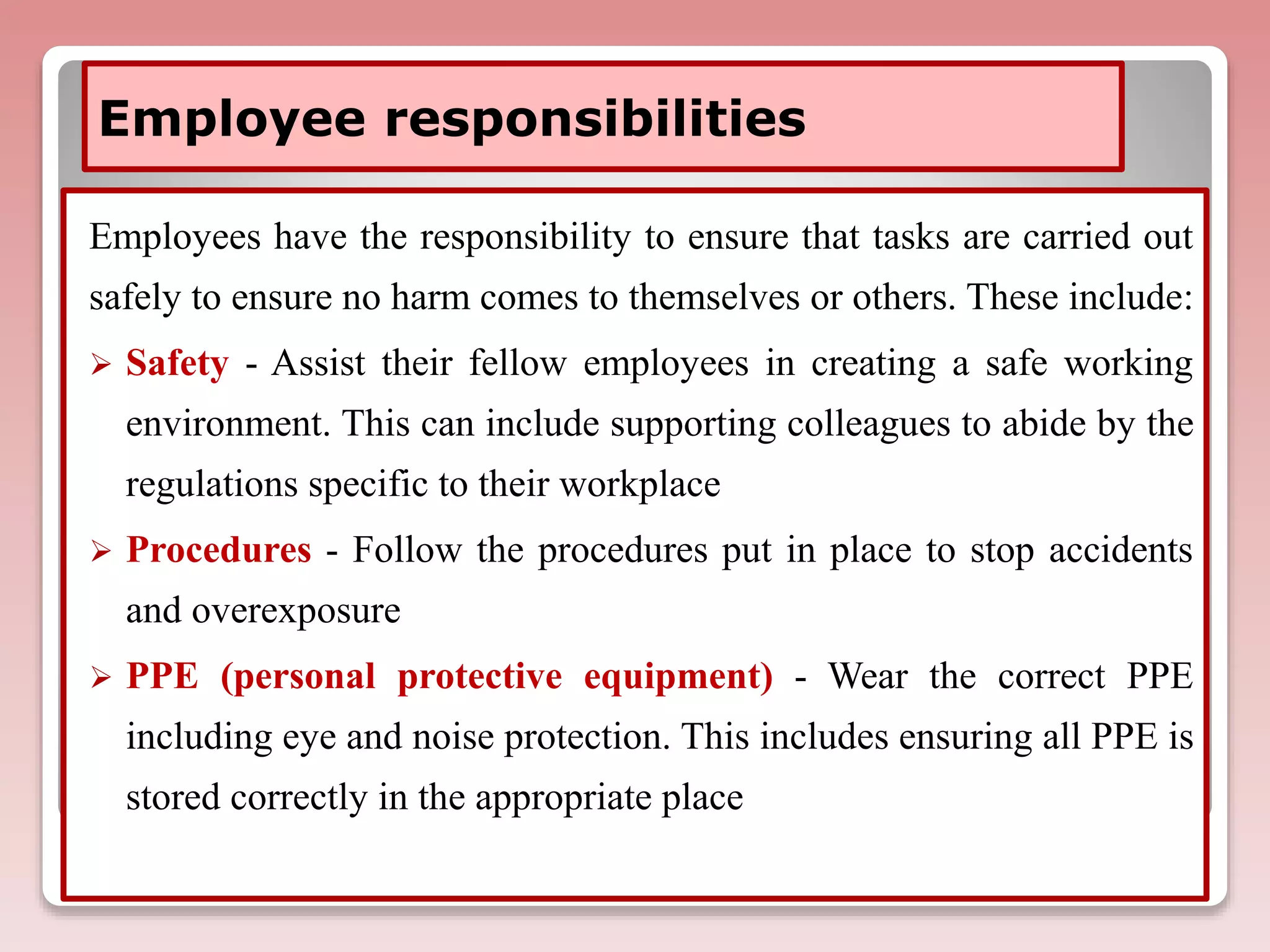
Employee responsibilities
Employees have the responsibility to ensure that tasks are carried out
safely to ensure no harm comes to themselves or others. These include:
 Safety - Assist their fellow employees in creating a safe working
environment. This can include supporting colleagues to abide by the
regulations specific to their workplace
 Procedures - Follow the procedures put in place to stop accidents
and overexposure
 PPE (personal protective equipment) - Wear the correct PPE
including eye and noise protection. This includes ensuring all PPE is
stored correctly in the appropriate place
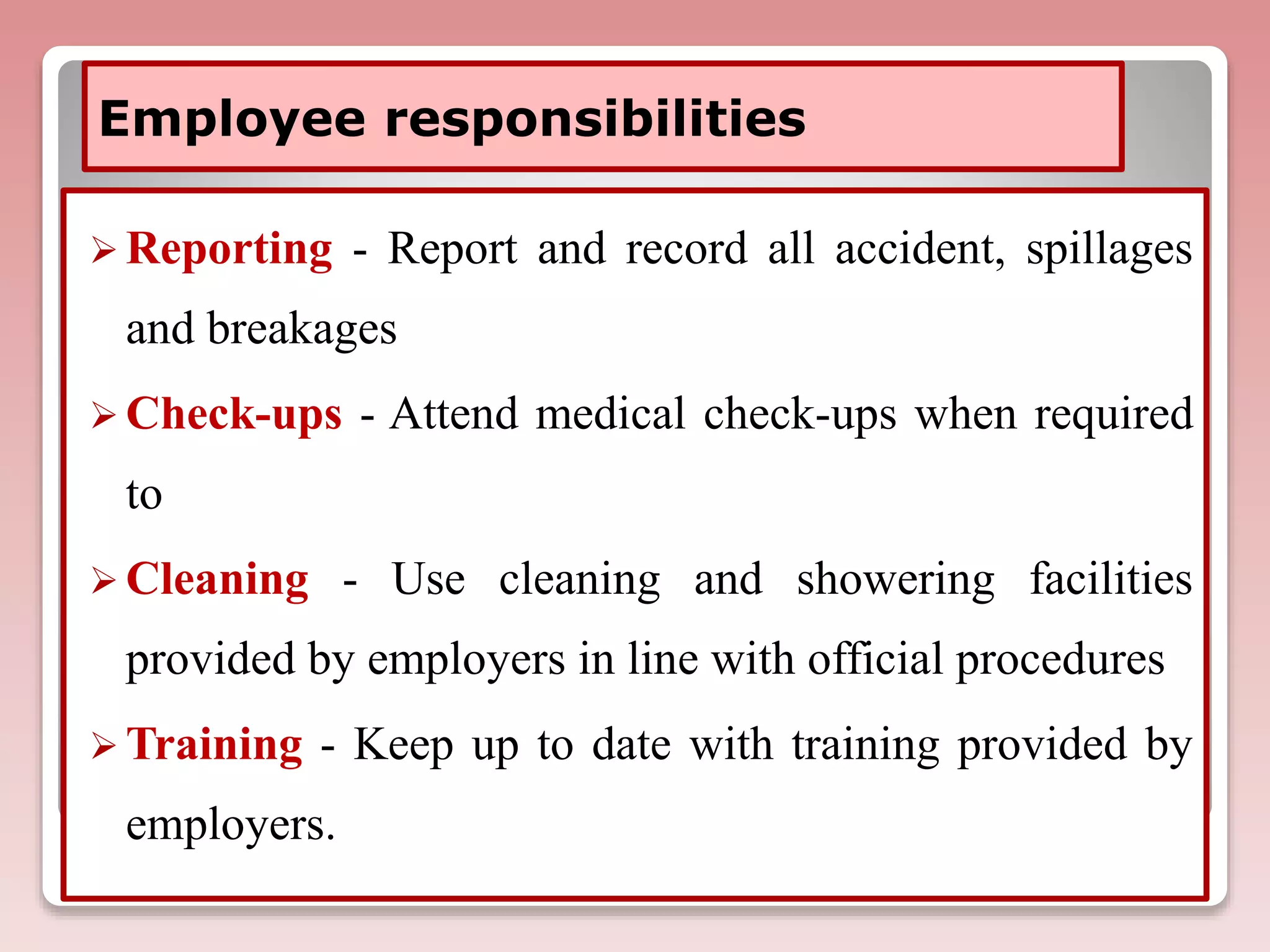
Employee responsibilities
 Reporting - Report and record all accident, spillages
and breakages
 Check-ups - Attend medical check-ups when required
to
 Cleaning - Use cleaning and showering facilities
provided by employers in line with official procedures
 Training - Keep up to date with training provided by
employers.
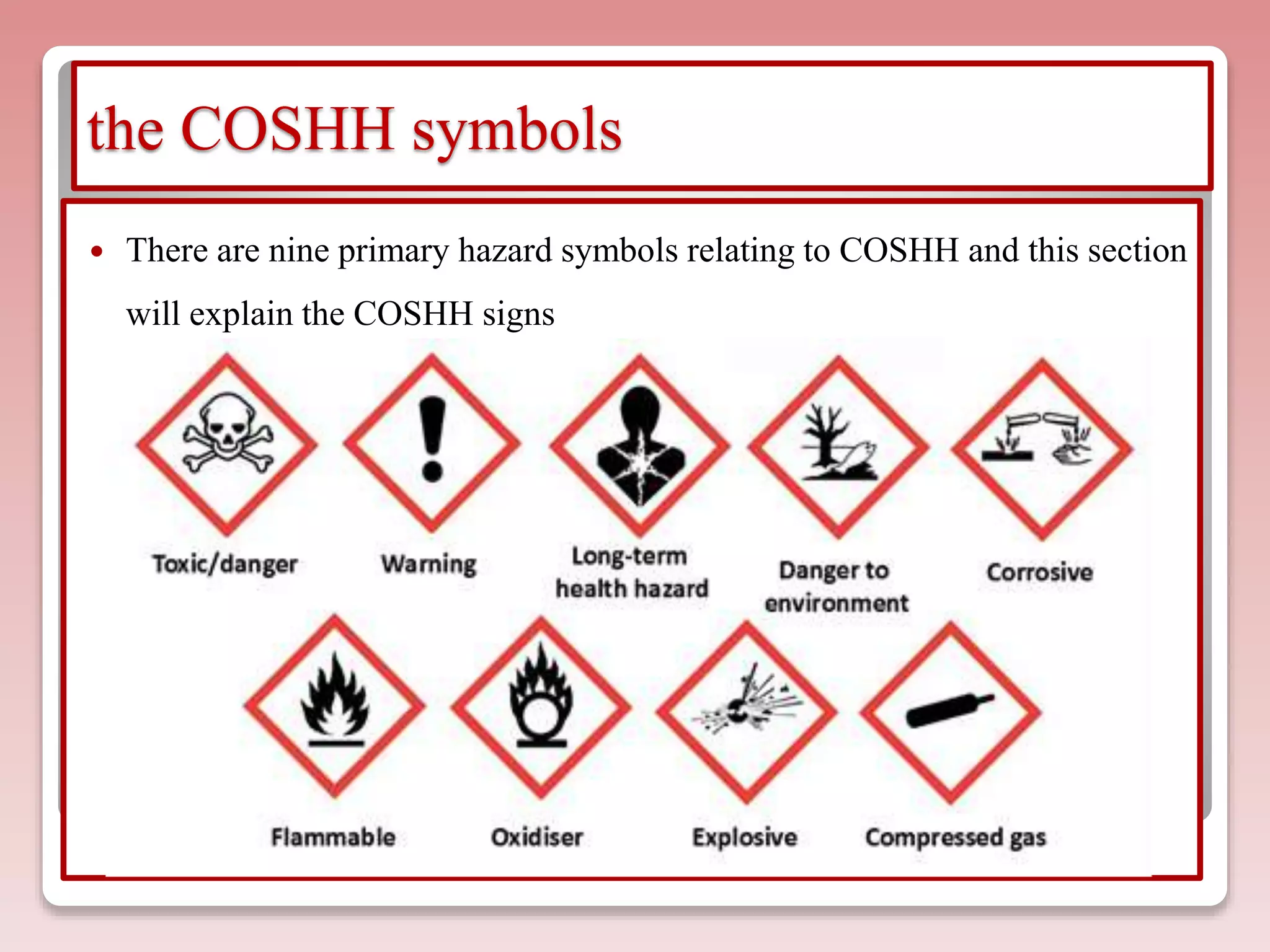
the COSHH symbols
 There are nine primary hazard symbols relating to COSHH and this section
will explain the COSHH signs
Assessing risk for work with blood and human tissues hazards
Blood and Blood-related Material
As discussed there are pathogenic microorganisms which are generally
associated with human blood. These are often also referred to as Blood-Born
Pathogens (BBP). In addition to blood samples, these BBP s may also be
found in:
 semen, vaginal fluids and secretions,
 CSF-cerebro-spinal fluid,
 other specimens containing visible blood (fresh swabs of a wound, sputum,
etc.),
 unscreened or inadequately treated blood products,
 serum-derived fluids or products,
 saliva,
 unfixed tissues and organs.
Assessing risk for work with blood and human tissues hazards
The BBPs of most concern include, but are in no way limited to, Hepatitis B
or Hepatitis C virus and human immunodeficiency virus. A brief discussion
of these viruses can be found below. Additionally, the Pathogen Safety Data
Sheets(previously known as Material Safety Data Sheets or MSDSs for
infectious material)for these pathogens should be available for reference
when working with the human blood, tissues and body fluids listed above.
 Hepatitis B virus (HBV)-This is a virus that infects the liver. While there
are several types of hepatitis, Hepatitis B infection is transmitted primarily
through exposure to infectious body fluids (blood, blood products, CSF,
serum-derived fluids, saliva, semen, vaginal fluids, unfixed tissues and
Assessing risk for work with blood and human tissues hazards
organs). It initially causes an inflammation of the liver but can lead to more
serious conditions, such as cirrhosis and liver cancer. It is the most
frequently occurring laboratory-associated infection; the incidence of Hep
B in some categories of lab workers is 7 times greater than that of the
general population. A vaccine is available for HBV prevention.
 Human immunodeficiency virus (HIV)-This is a virus that infects the
immune system, weakening it so that it is ineffective in fighting other
diseases as well as HIV. HIV can be found in blood, semen, vaginal
secretions, CSF, other specimens containing visible blood, unscreened or
inadequately treated blood products.
Procedures related to work with Blood-Borne Pathogens
 Blood-born pathogens are primarily transmitted by inoculation and contact with mucous
membranes. Evaluate all procedures for the following types of incidents:
A. Accidental puncture by a contaminated sharp object. In the lab, examples of such
tasks could include using needles/syringes, razor blades, glass tubing, pipettes,
pipette man tips, and handling waste and trash.
B. Contamination of skin and mucous membranes:
◦ Direct contact with contaminated material through open cuts or skin abrasions, or to
mucous membranes (e.g. unprotected mouth, eyes, nose) through unanticipated
splashes, e.g. opening tubes of uneven pressure, tubes, bottles breaking releasing liquid
hitting a hard surface.
◦ Indirect transmission to open cuts or mucous membranes(eyes, mouth, nose
,genitals) through transfer by hand/glove contact of unknowingly contaminated
surfaces. i.e. created by splashes or aerosols that land at a distance from the source
procedure .
Procedures related to work with Blood-Borne Pathogens
Note:
 Hepatitis B virus can survive in dried blood for long periods (weeks) and
can remain stable on environmental surfaces for at least 7days at 25ºC.
Therefore, attention to surface disinfection after spills and at the end of the
working day is critical.
 For HIV, survival in the environment is not as much an issue. Drying in
the environment causes a rapid 90-99% reduction in HIV
concentration(within several hours). Keep hands away from the eyes, nose
and mouth in order to avoid potential exposure of the mucous membranes;
eye goggles or face shields may assist in accomplishing this objective.
Control measures for work with blood and human tissues
Blood Specimens - Safety
Follow universal precautions for the prevention of blood borne pathogens
when working with human serum and other body fluids. These include:
1. Wear personal protective equipment such as safety glasses, gloves,
laboratory coats.
2. If you have cuts or abrasions on the skin of your hands, cover them
with adhesive dressing.
3. Use needles and lancets only once, and dispose of them in a “sharps”
container for decontamination.
4. Remove gloves and wash your hands after completing any task
involving the handling of biological material.
Control measures for work with blood and human tissues
Immunization
A. Vaccines are currently available for Hepatitis B Virus (HBV) and are
recommended for all personnel working with BBP as part of their
research project. The vaccine is not currently provided free-of-charge to
all Manitobans, but is available at a cost as needed for potential
occupational exposure.
B. Following are the requirements for HBV vaccination for all workers with
occupational exposure to human blood and body fluids and tissues
Thanks for
your
attention
12/10/2021 17

Lecture 5 : control of substances hazard to health

  • 1.
    Safety and biosecurity Lecture5:-Control of Substances hazard to health (Coshh) Dr. Raghda Saad Mohammed
  • 2.
    WHAT IS COSHH? COSHHis the law that requires employers to control all the substances and hazardous to health and safety you can prevent that by:  Finding out what the health hazards are;  Deciding how to prevent harm to health (risk assessment)  Providing control measures and make sure they are used  Keep all the control measures in good order  providing instructions and training to others  Providing monitoring health surveillance appropriate cases  Planning for all the emergencies
  • 3.
    What is substanceshazardous to health? COSHH covers substances hazardous to health such as: Chemicals Products containing chemicals  Fumes  Dusts Vapours  Mists Nanotechnology Biological agents Germs that cause diseases
  • 4.
    COSHH ASSESSMENT IDENTIFYING HAZARDAND ASSESSING RISK  You can walk around the work area and find where is the potential for exposure to substance that might be hazardous to health for example processing the emit dusts fume, vapour, mist or gas and also skin contact with liquids , pastes and dusts.
  • 5.
    COSHH employer responsibilities Employershave a number of key responsibilities regarding COSHH laws. These include:  Exposure - Employers must prevent or control exposure to hazardous substances. This can include the provision of appropriate personal protective equipment (PPE) where necessary  Control measures - Implement control measures around hazardous substances and ensure these are maintained and kept up to date, in full working order and clean where appropriate  Instruction - Provide employees with information, instruction and training around working with hazardous substances  Procedures - Having procedures in place to deal with accidents and emergencies relating to hazardous substances
  • 6.
    COSHH employer responsibilities Surveillance - Ensure employees exposed to hazardous substances are under adequate surveillance  Risk assessments - Carry out COSHH risk assessments.  Limits - Ensure the use of hazardous substances doesn't exceed the Workplace Exposure Limit (WEL).  Supervision - Check employees are carrying out tasks as they are supposed to.
  • 7.
    Employee responsibilities Employees havethe responsibility to ensure that tasks are carried out safely to ensure no harm comes to themselves or others. These include:  Safety - Assist their fellow employees in creating a safe working environment. This can include supporting colleagues to abide by the regulations specific to their workplace  Procedures - Follow the procedures put in place to stop accidents and overexposure  PPE (personal protective equipment) - Wear the correct PPE including eye and noise protection. This includes ensuring all PPE is stored correctly in the appropriate place
  • 8.
    Employee responsibilities  Reporting- Report and record all accident, spillages and breakages  Check-ups - Attend medical check-ups when required to  Cleaning - Use cleaning and showering facilities provided by employers in line with official procedures  Training - Keep up to date with training provided by employers.
  • 9.
    the COSHH symbols There are nine primary hazard symbols relating to COSHH and this section will explain the COSHH signs
  • 10.
    Assessing risk forwork with blood and human tissues hazards Blood and Blood-related Material As discussed there are pathogenic microorganisms which are generally associated with human blood. These are often also referred to as Blood-Born Pathogens (BBP). In addition to blood samples, these BBP s may also be found in:  semen, vaginal fluids and secretions,  CSF-cerebro-spinal fluid,  other specimens containing visible blood (fresh swabs of a wound, sputum, etc.),  unscreened or inadequately treated blood products,  serum-derived fluids or products,  saliva,  unfixed tissues and organs.
  • 11.
    Assessing risk forwork with blood and human tissues hazards The BBPs of most concern include, but are in no way limited to, Hepatitis B or Hepatitis C virus and human immunodeficiency virus. A brief discussion of these viruses can be found below. Additionally, the Pathogen Safety Data Sheets(previously known as Material Safety Data Sheets or MSDSs for infectious material)for these pathogens should be available for reference when working with the human blood, tissues and body fluids listed above.  Hepatitis B virus (HBV)-This is a virus that infects the liver. While there are several types of hepatitis, Hepatitis B infection is transmitted primarily through exposure to infectious body fluids (blood, blood products, CSF, serum-derived fluids, saliva, semen, vaginal fluids, unfixed tissues and
  • 12.
    Assessing risk forwork with blood and human tissues hazards organs). It initially causes an inflammation of the liver but can lead to more serious conditions, such as cirrhosis and liver cancer. It is the most frequently occurring laboratory-associated infection; the incidence of Hep B in some categories of lab workers is 7 times greater than that of the general population. A vaccine is available for HBV prevention.  Human immunodeficiency virus (HIV)-This is a virus that infects the immune system, weakening it so that it is ineffective in fighting other diseases as well as HIV. HIV can be found in blood, semen, vaginal secretions, CSF, other specimens containing visible blood, unscreened or inadequately treated blood products.
  • 13.
    Procedures related towork with Blood-Borne Pathogens  Blood-born pathogens are primarily transmitted by inoculation and contact with mucous membranes. Evaluate all procedures for the following types of incidents: A. Accidental puncture by a contaminated sharp object. In the lab, examples of such tasks could include using needles/syringes, razor blades, glass tubing, pipettes, pipette man tips, and handling waste and trash. B. Contamination of skin and mucous membranes: ◦ Direct contact with contaminated material through open cuts or skin abrasions, or to mucous membranes (e.g. unprotected mouth, eyes, nose) through unanticipated splashes, e.g. opening tubes of uneven pressure, tubes, bottles breaking releasing liquid hitting a hard surface. ◦ Indirect transmission to open cuts or mucous membranes(eyes, mouth, nose ,genitals) through transfer by hand/glove contact of unknowingly contaminated surfaces. i.e. created by splashes or aerosols that land at a distance from the source procedure .
  • 14.
    Procedures related towork with Blood-Borne Pathogens Note:  Hepatitis B virus can survive in dried blood for long periods (weeks) and can remain stable on environmental surfaces for at least 7days at 25ºC. Therefore, attention to surface disinfection after spills and at the end of the working day is critical.  For HIV, survival in the environment is not as much an issue. Drying in the environment causes a rapid 90-99% reduction in HIV concentration(within several hours). Keep hands away from the eyes, nose and mouth in order to avoid potential exposure of the mucous membranes; eye goggles or face shields may assist in accomplishing this objective.
  • 15.
    Control measures forwork with blood and human tissues Blood Specimens - Safety Follow universal precautions for the prevention of blood borne pathogens when working with human serum and other body fluids. These include: 1. Wear personal protective equipment such as safety glasses, gloves, laboratory coats. 2. If you have cuts or abrasions on the skin of your hands, cover them with adhesive dressing. 3. Use needles and lancets only once, and dispose of them in a “sharps” container for decontamination. 4. Remove gloves and wash your hands after completing any task involving the handling of biological material.
  • 16.
    Control measures forwork with blood and human tissues Immunization A. Vaccines are currently available for Hepatitis B Virus (HBV) and are recommended for all personnel working with BBP as part of their research project. The vaccine is not currently provided free-of-charge to all Manitobans, but is available at a cost as needed for potential occupational exposure. B. Following are the requirements for HBV vaccination for all workers with occupational exposure to human blood and body fluids and tissues
  • 17.