TODAY’S ESL LEARNERS:  AN ATTEMPT AT CHARACTERIZATION Cecilia M. Mendiola Philippine Normal University
Why don’t learners learn what teachers teach?
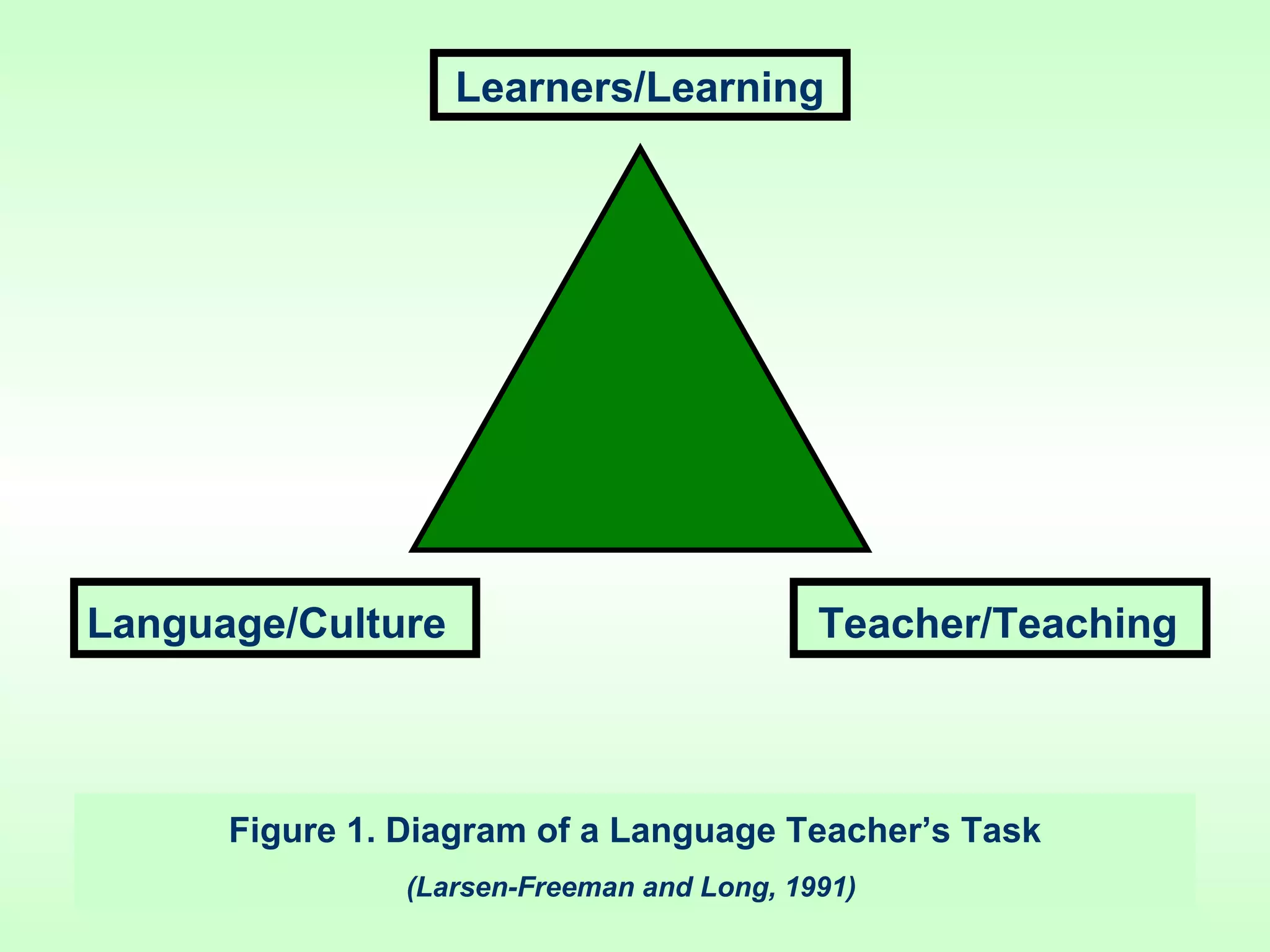
Learners/Learning Language/Culture   Teacher/Teaching   Figure 1. Diagram of a Language Teacher’s Task   (Larsen-Freeman and Long, 1991)
“ Language teachers’ decisions about the teaching process should, to a large extent, be informed by knowledge of the subject matter they are teaching (i.e. the target language and culture) and by knowledge of the unique group of learners with whom they are working and of the language-learning process.”
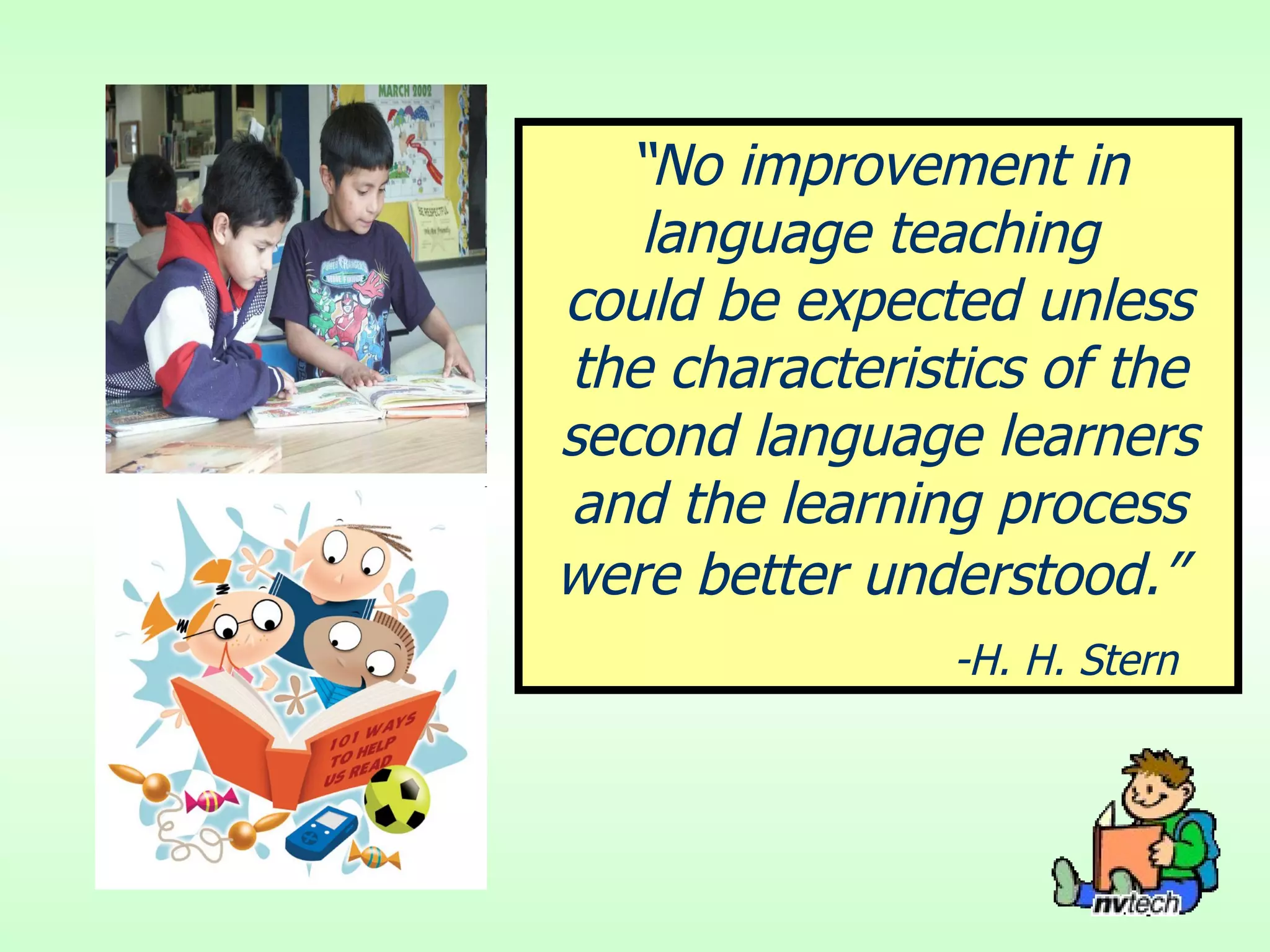
“ No improvement in language teaching  could be expected unless the characteristics of the second language learners and the learning process were better understood.”   -H. H. Stern
Do good learners tackle the language learning task differently from poor learners?
Do learners have certain characteristics which predispose them to  good   or  poor  learning?
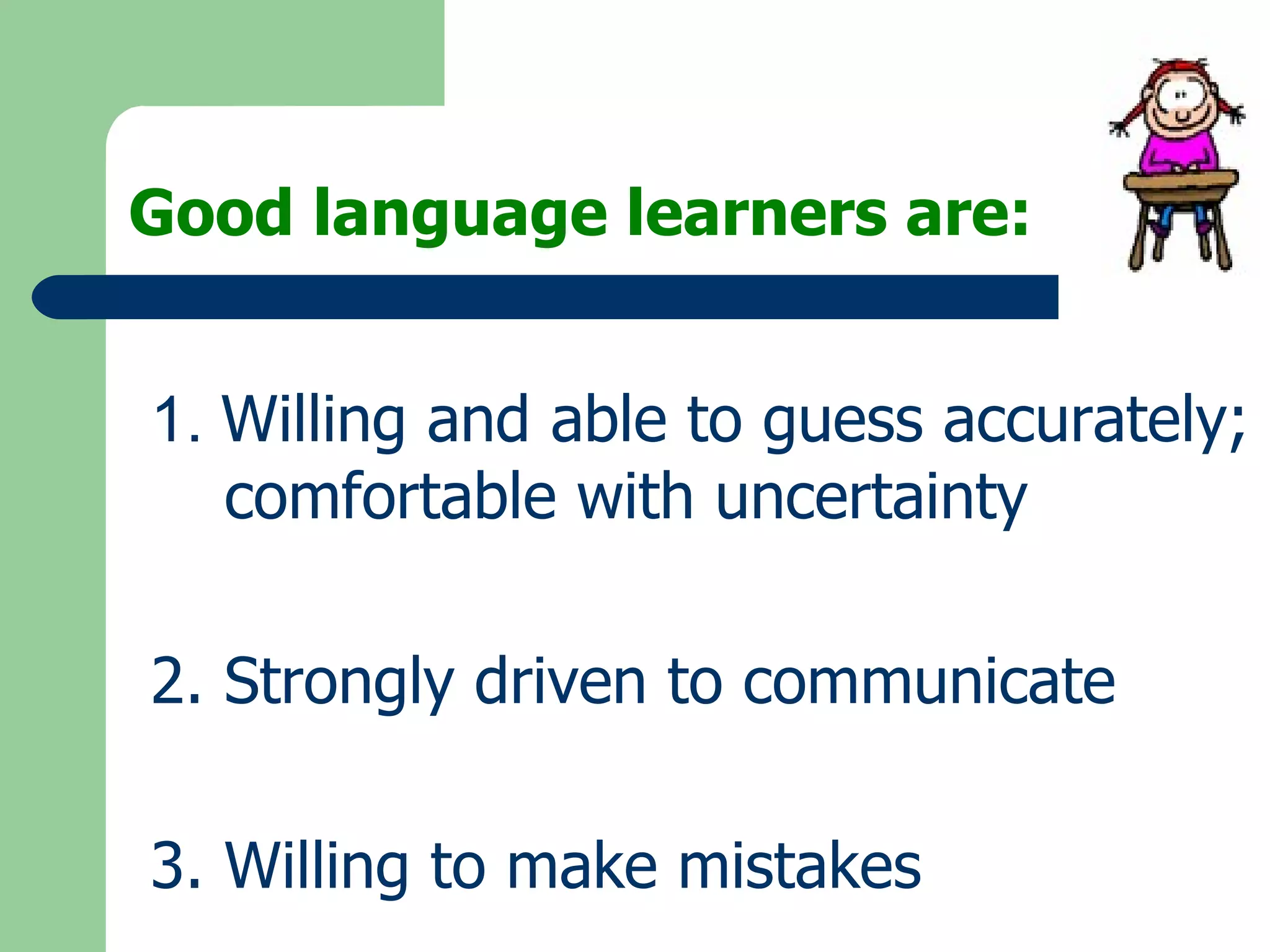
Good language learners are: 1.  Willing and able to guess accurately; comfortable with uncertainty 2. Strongly driven to communicate 3. Willing to make mistakes
Good language learners are: 4.   Can distinguish relevant from irrelevant clues  5. Eager to seek opportunities to use the language
Good language learners are: 6.  Able to process information whether or not being called on to perform 7. Can go beyond surface forms and can consider social factors to get at meaning
“ Good language learners take advantage of potentially useful learning situations, and if necessary create them. They develop learning techniques appropriate to their individual needs.”
A successful language learner has to: 1. Find his/her own way. 2. Organize. 3. Be creative. 4. Make opportunities for practice.
5. Learn to live with uncertainty. 6. Use mnemonics. 7. Learn from errors. 8. Use linguistic knowledge. A successful language learner has to:
A successful language learner has to: 9. Get help from the context. 10. Make intelligent guesses. 11. Learn some word strings as  wholes.


A successful language learner has to: 12. Adopt formalized routines. 13. Learn production techniques. 14. Use different styles of speech.
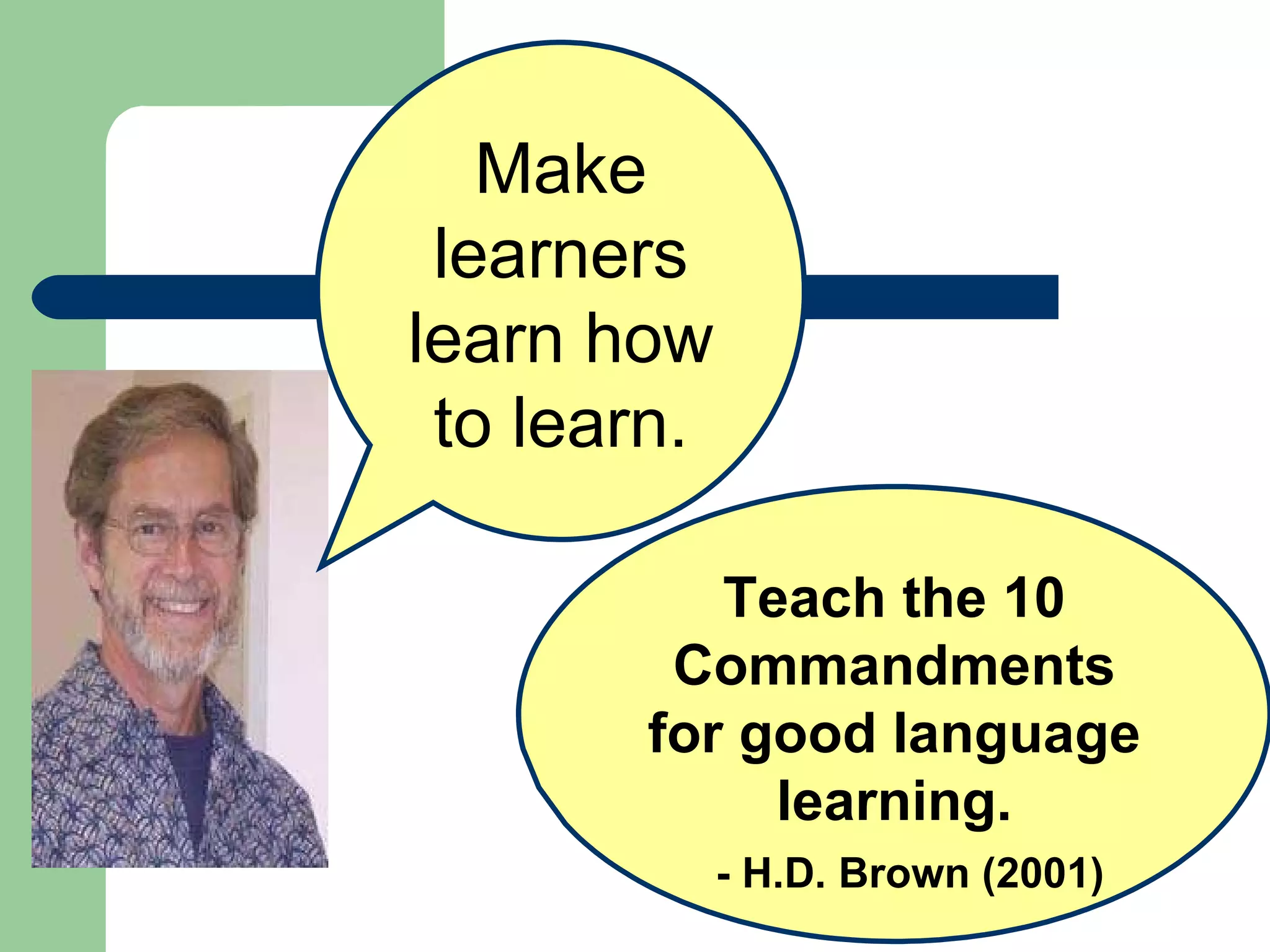
Teach the 10 Commandments for good language learning. - H.D. Brown (2001) Make learners learn how to learn.
“ Ten Commandments”  for good language learning   1. Fear not! 2. Dive in. 3. Believe in yourself. “ You can’t learn without goofin’.” - Burt and Dulay
“ Ten Commandments”  for good language learning 4. Seize the day. 5. Love thy neighbor. 6. Get the BIG picture.
“ Ten Commandments”  for good language learning 7. Cope with the chaos. 8. Go with the hunches. 9. Make mistakes work FOR you. 10. Set your own goals.
THE FILIPINO AS A SECOND LANGUAGE LEARNER
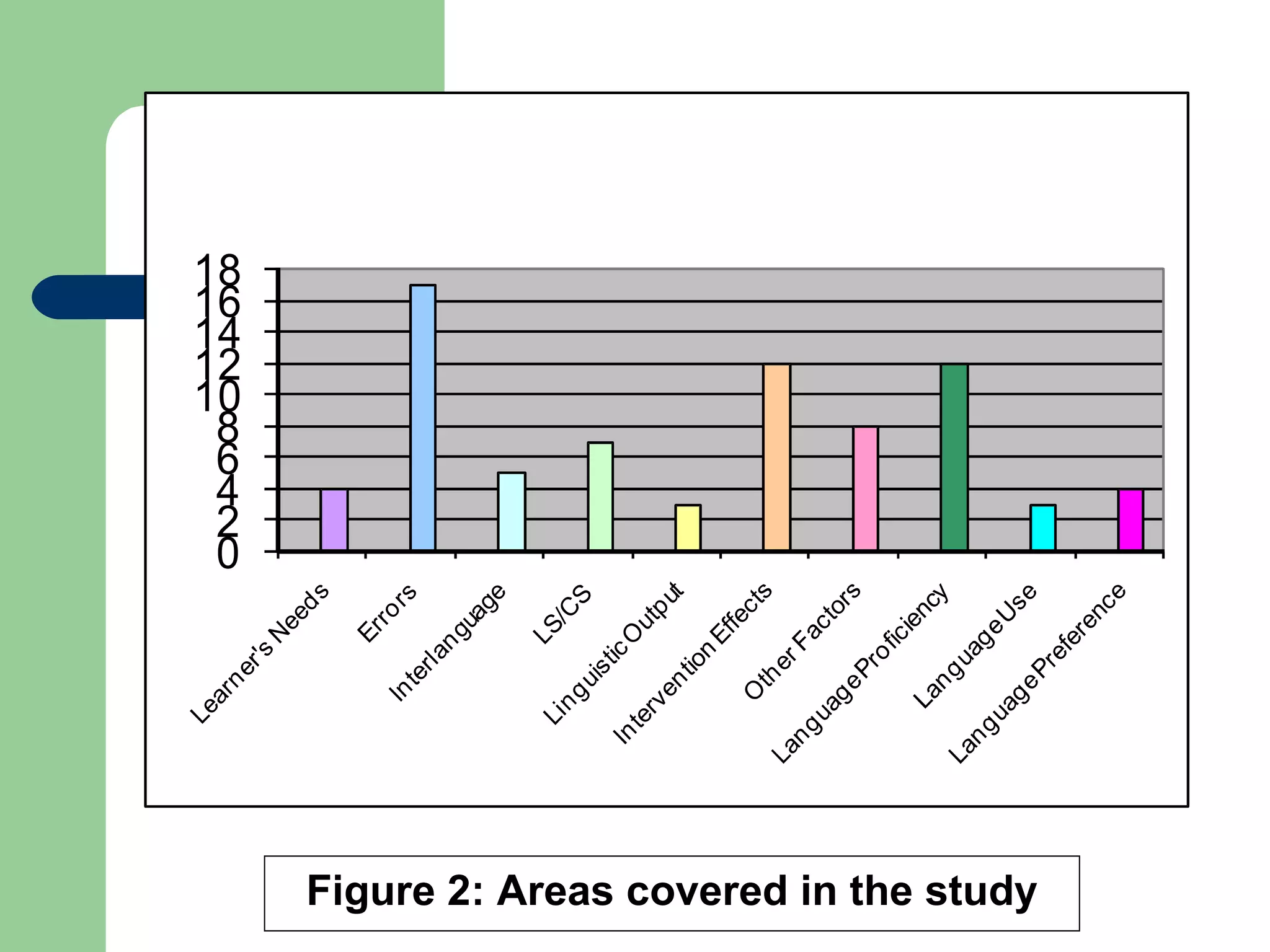
Figure 2: Areas covered in the study
TYPES OF DATA Oral and written L 2  production Self – reports Test – generated data Technology – generated data
FILIPINO SECOND LANGUAGE  LEARNERS… Give short responses and ask factual questions Perform more and varied communicative acts using L 1  in small group discussion High achievers use more learning strategies than the low achievers.
Less successful learners do not use  chaining strategies Use metacognitive strategies most  frequently Are good comprehenders, interactive  readers and risk takers as shown in  Think–Aloud protocols s FILIPINO SECOND LANGUAGE  LEARNERS…
Use culture–bound strategies, e.g., risk  taking, empathy, relying on Divine  Providence, grade–consciousness View reading as meaning–focused and  goal-oriented FILIPINO SECOND LANGUAGE  LEARNERS…
Find difficulties in summarizing -    constructing a synthesizing  statement, combining/deleting ideas FILIPINO SECOND LANGUAGE  LEARNERS… Are  not  strategic in processing  expository text and in dealing with  vocabulary problems
Display emerging behavior patterns in  reading, e.g., translating,  re–reading, questioning,  using prior knowledge, and agreeing Less proficient readers possess limited  repertoire of strategies. FILIPINO SECOND LANGUAGE  LEARNERS…
Show better comprehension in the  familiar text than in the unfamiliar  one Experience problems in text processing  due to lack of prior knowledge and  inadequate grasp of English FILIPINO SECOND LANGUAGE  LEARNERS…
ESL learners compose texts in linear  and  recursive fashion. ESL writers display emerging composing  patterns -- quick writing of substantive  essays, slow starters’ writing pattern, the highly recursive pattern, slow-but- sure writing, unproductive writing  pattern and the strategists’ writing  pattern.   FILIPINO SECOND LANGUAGE  LEARNERS…
Elementary pupils’ written output is  wanting in content, format and  grammatical accuracy. FILIPINO SECOND LANGUAGE  LEARNERS…
Manifest learners’ communicative  difficulties in oral production through  gap marks, namely gestures and facial  expressions Bridge oral production gaps by using  communication strategies FILIPINO SECOND LANGUAGE  LEARNERS…
Some computer students experience  lathophobic aphasia. Use Tagalog–English (codeswitch  variety) in cognitively oriented  academic discussions Pupils’ English ratings significantly  correlate with learning opportunities. FILIPINO SECOND LANGUAGE  LEARNERS…
Females are better critical thinkers and  more language proficient than males. Highly proficient language learners are  better critical thinkers, but not better  academic achievers. Motivational behavior remains learner’s  significant determinant of  achievement. FILIPINO SECOND LANGUAGE  LEARNERS…
Learners’ motivational behavior is influenced by goal setting, valence, and self-efficacy. Learners’ communicative competence may be influenced by language facility, vocabulary and communicative practice.   FILIPINO SECOND LANGUAGE  LEARNERS…
Learners respond positively to intervention  programs. Show improved performance using  computer-assisted grammar materials FILIPINO SECOND LANGUAGE  LEARNERS…
Demonstrate improved composition through  process writing Display improved attitudes toward  technical writing using computer-assisted  materials FILIPINO SECOND LANGUAGE  LEARNERS…
‘ ONLINE’ PROCESSING OF IDIOMS
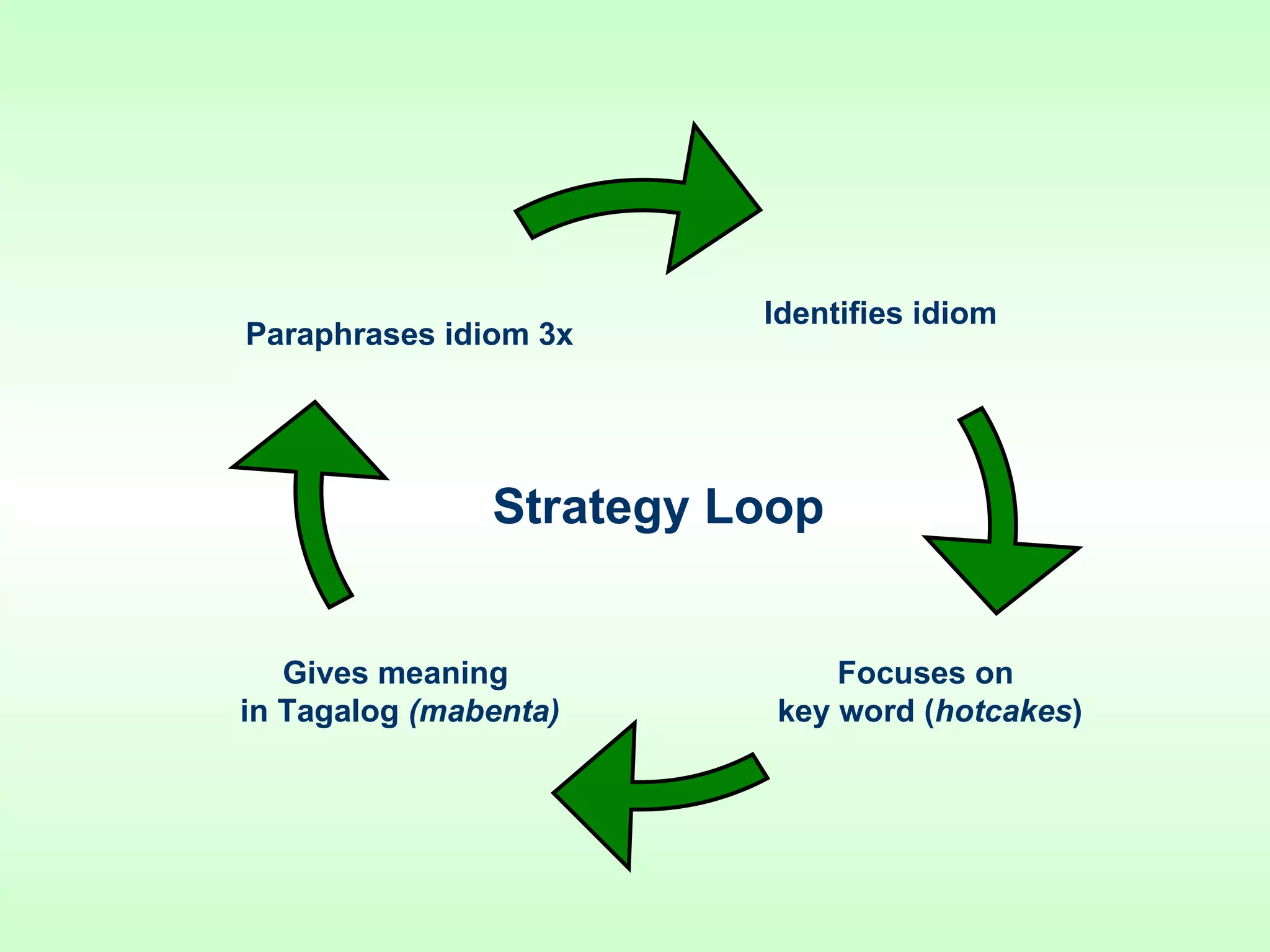
Emergent Pattern (Familiar Idiom) Idiom: “Our cornicks are  selling like hotcakes .  We don’t ever have to advertise. TAP: So ‘selling like hotcakes’ So hotcakes are,  the nature of hotcakes, very popular. It’s ahh… tawag dun, masyadong    mabenta. Masyadong sikat na hindi na kailangan ng  advertisement. So selling like hotcakes means ‘popular.’ It is very well known. So parang there is a trademark .
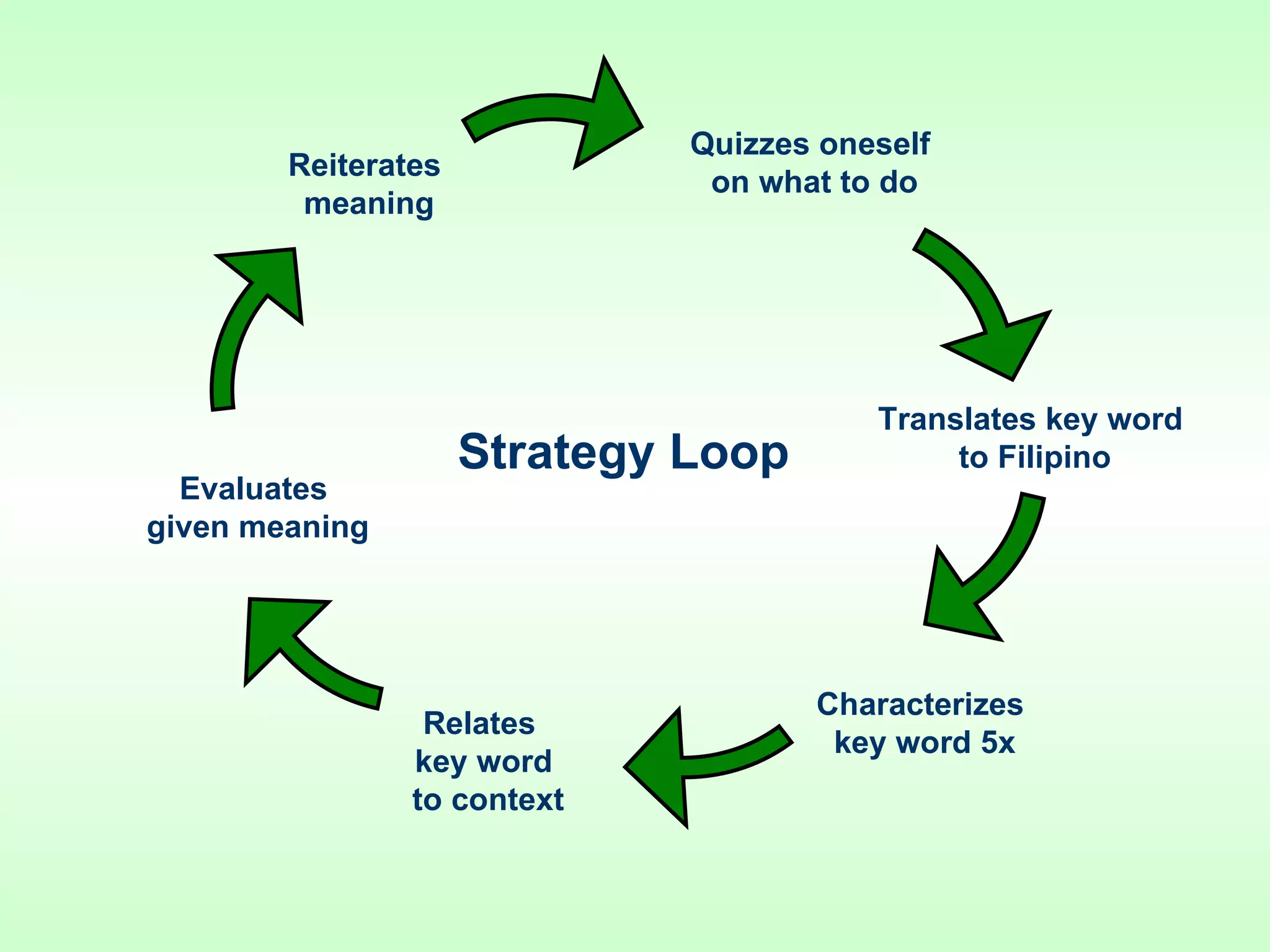
Identifies idiom Focuses on key word ( hotcakes ) Gives meaning  in Tagalog  (mabenta) Paraphrases idiom 3x   Strategy Loop
Emergent Pattern (Unfamiliar Idiom ) Idiom: Guingona was plagued by a problem that he is a politician and  was virtually  a babe in the woods  in the foreign office.  He bungled his job and blundered his way early in his term. TAP: So pa’no ba ito? Siguro, kung titingnan natin in Filipino translation, ahm,  ‘sanggol sa kakahuyan’ So alam naman natin ano yung characteristic ng isang sanggol Kumbaga, walang kapasidad na gawin ang isang bagay Walang kakayahan Salat sa karanasan Kumbaga lacks experience Ahm, is an expert of nothing Kung ilalapat dito sa ano sa sentence dito Kumbaga na si Guingona umano has less experience or lacks    experience in handling ah the said office or position or job. Siguro I’m quite certain about sa ibinigay kong definition. Kumbaga, lacks experience or expertise about a position or a    work or a job
Translates key word  to Filipino Characterizes key word 5x Relates  key word   to context Reiterates  meaning Quizzes oneself  on what to do Evaluates  given meaning Strategy Loop
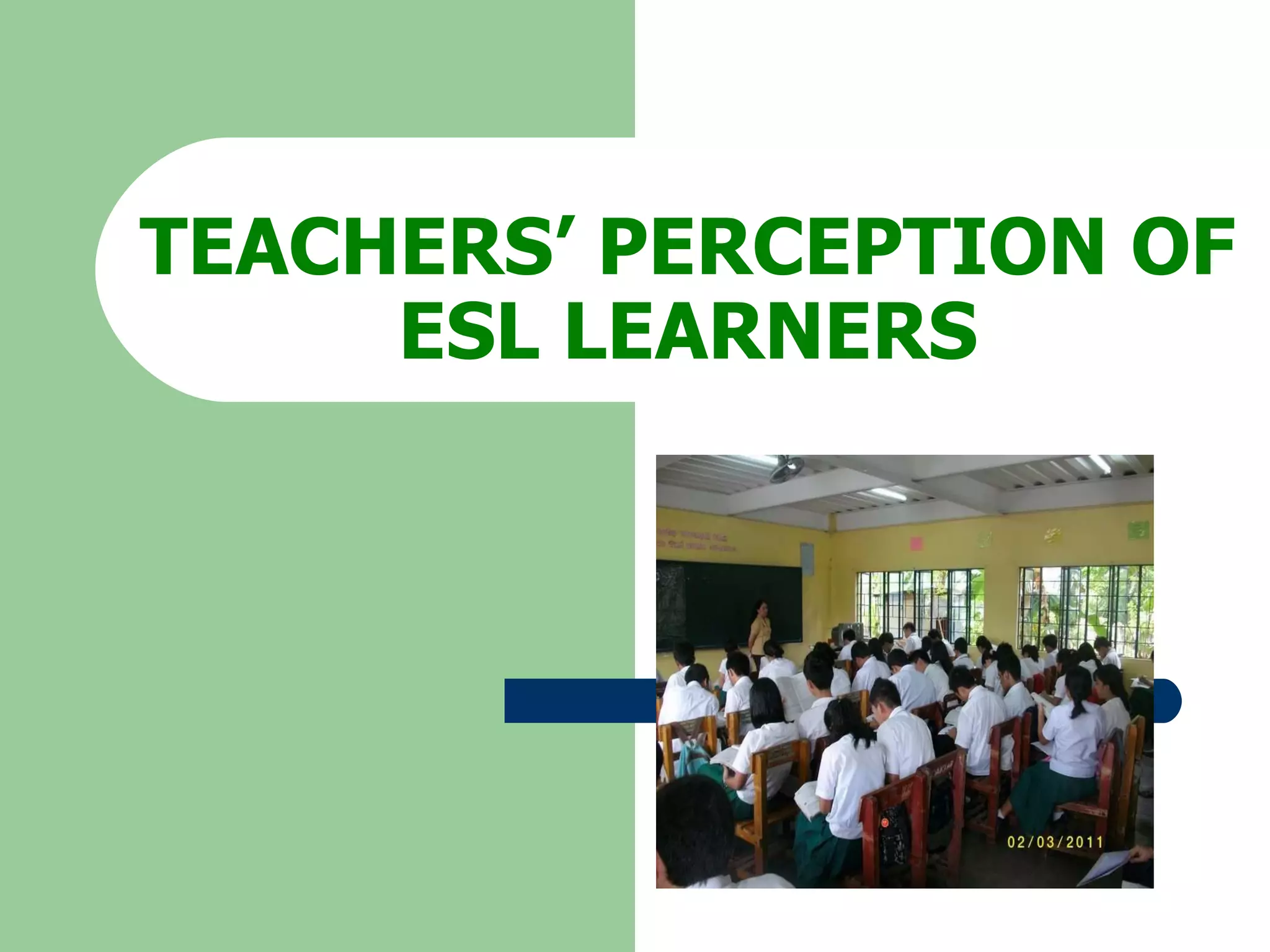
TEACHERS’ PERCEPTION OF ESL LEARNERS
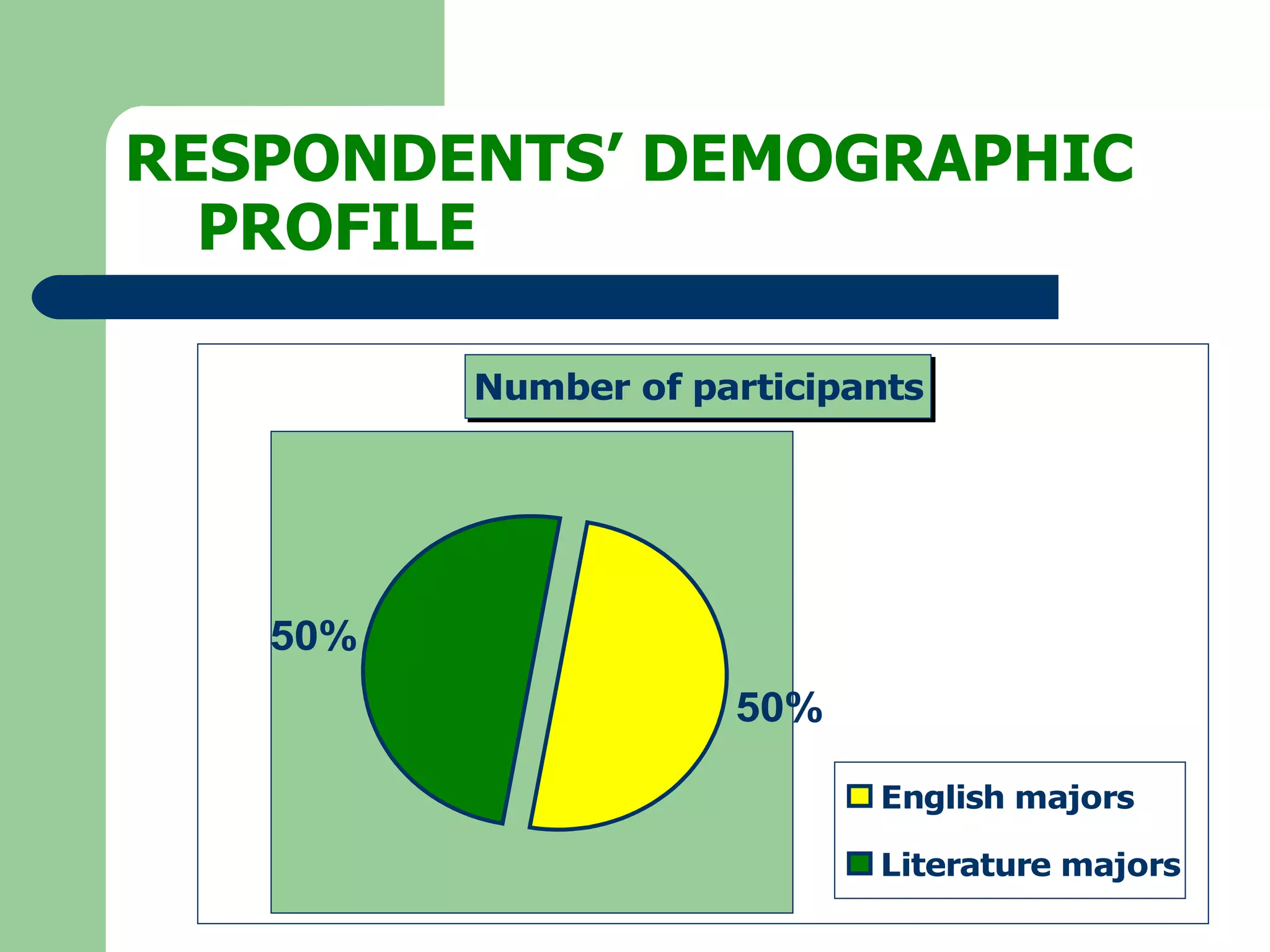
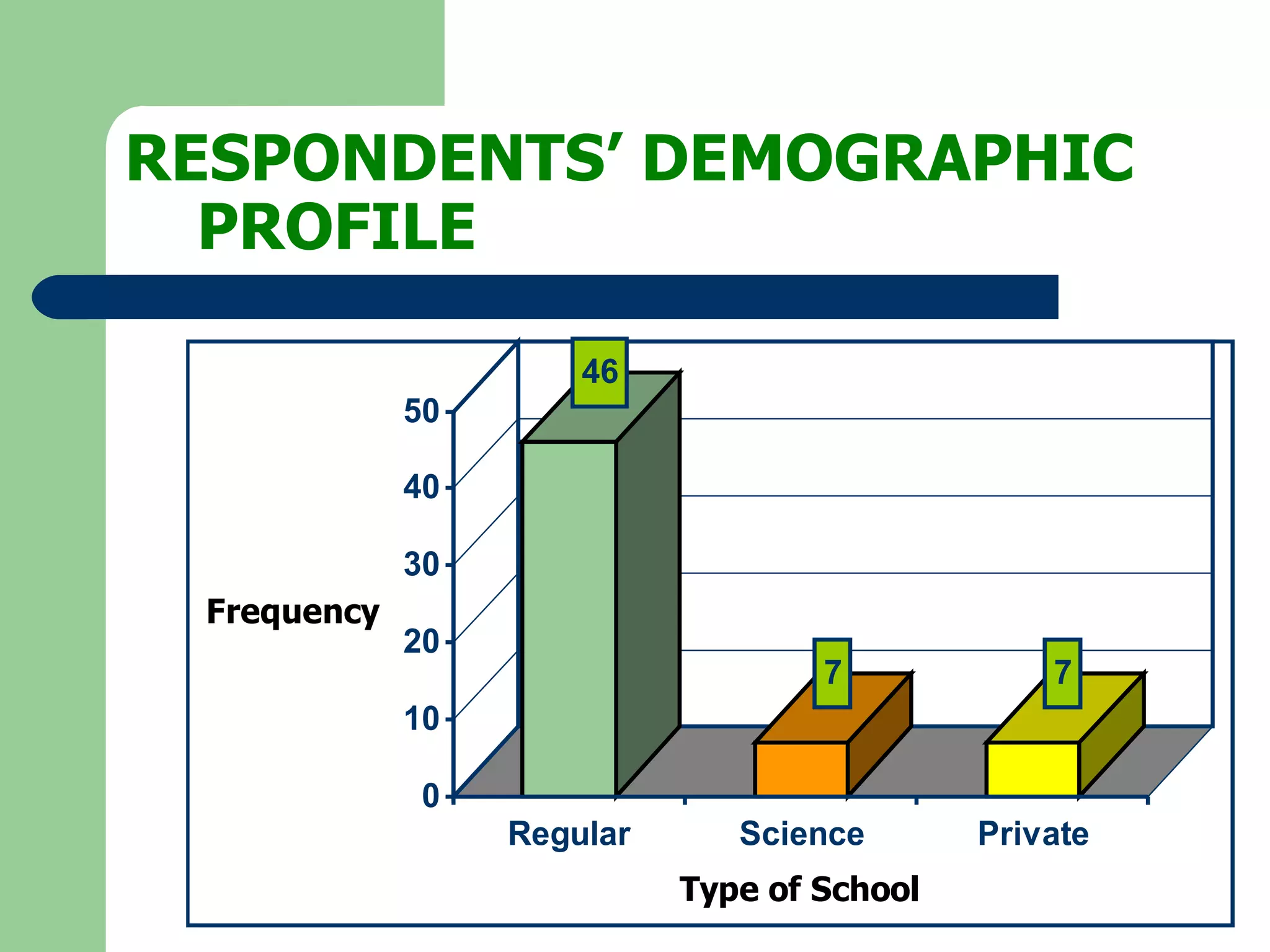
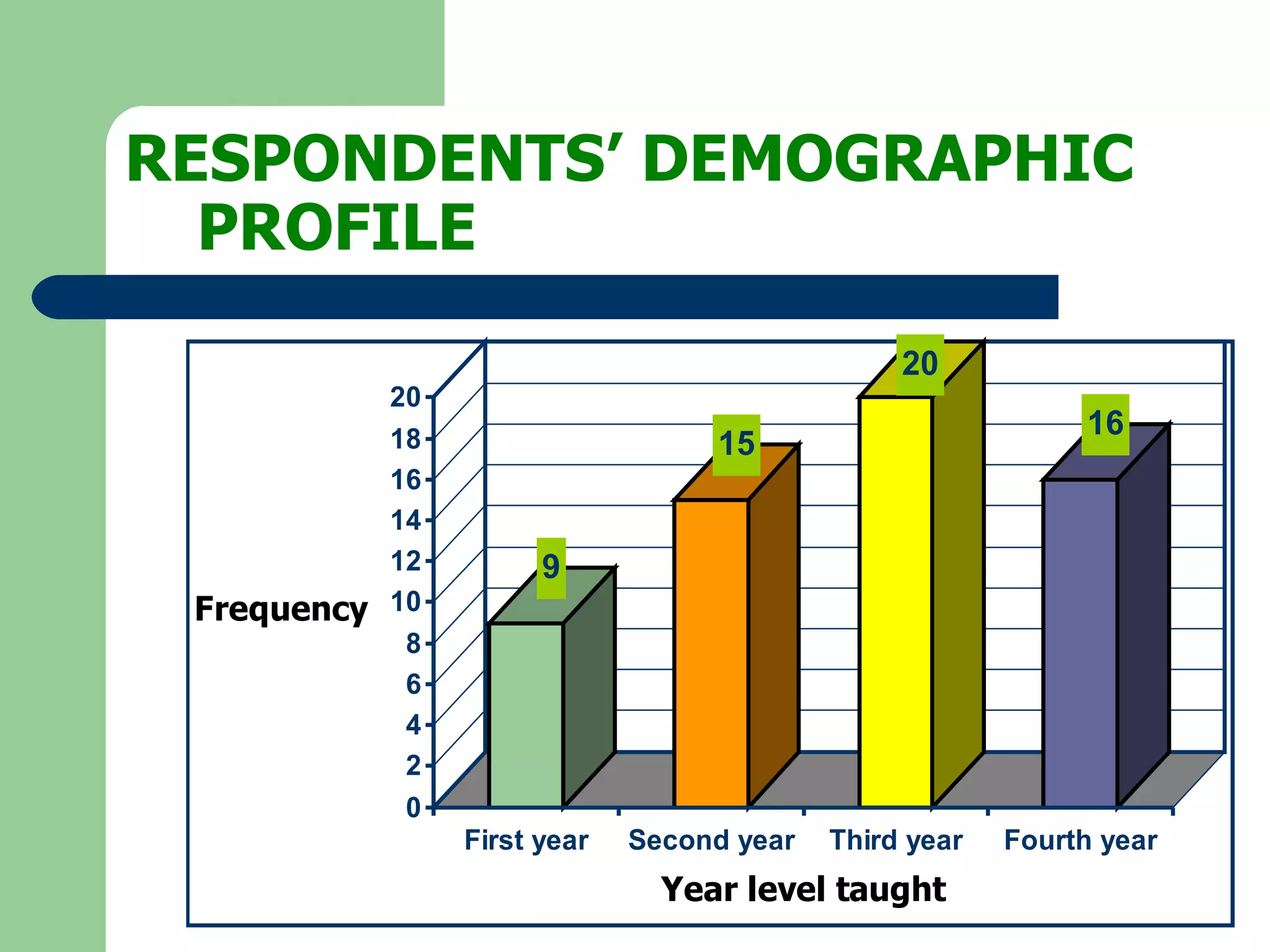
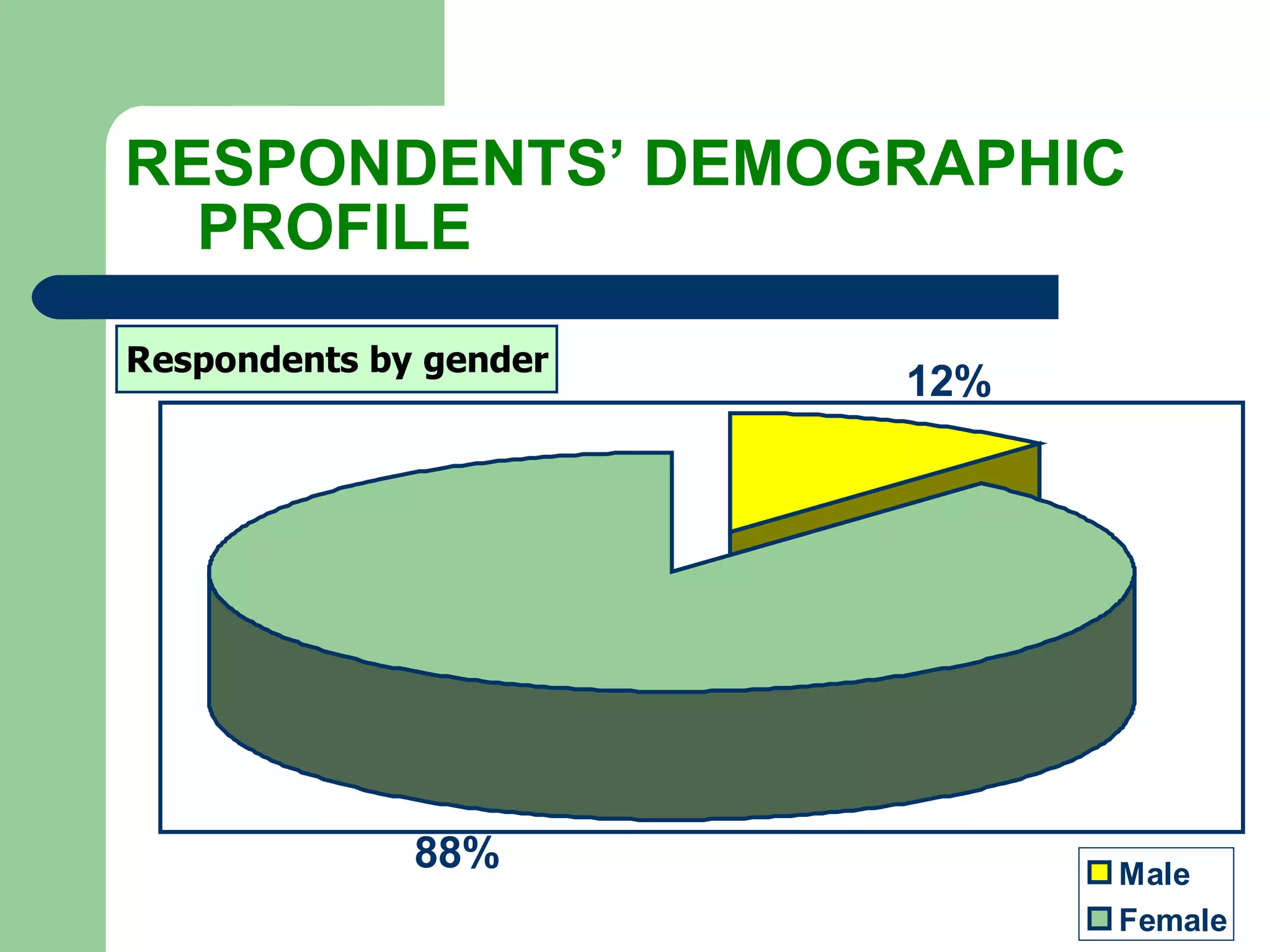
RESPONDENTS’ DEMOGRAPHIC  PROFILE
TODAY’S ESL LEARNERS… Enjoy doing tasks/activities in dyads,  triads or small groups Code switch from English to Filipino or  vice – versa when reciting in an  English class ( Always  Observed)
Use technology, mostly the computer  and the Internet in accomplishing  reports, projects, etc. Show interest in and drive to learn  English Use strategies, e.g., oral reading, using  the dictionary/references, note-taking,  highlighting TODAY’S ESL LEARNERS… ( Often  Observed)
Are willing to take risks, don’t mind being  corrected, don’t worry about making  mistakes Seek teacher’s and/or classmates’ help  when faced with difficulties Remain silent when asked to recite TODAY’S ESL LEARNERS… ( Often  Observed)
Make time for language–related activities inside and outside of the classroom Display good study habits TODAY’S ESL LEARNERS… ( Rarely  Observed)
Monitor (self–edit) themselves in grammar, pronunciation, spelling or when speaking or writing in English Use language terms such as  relative clauses, verbals, prepositional phrases,  etc. when describing/analyzing sentences TODAY’S ESL LEARNERS… ( Rarely  Observed)
POINTS TO REFLECT ON… Are you willing to adjust your teaching style/methods to differences in the learning styles/strategies and personality characteristics of your students? Will you ‘teach learners how to learn’ so they will become autonomous learners?
POINTS TO REFLECT ON… Are you going to sensitize yourself to differences in predispositions with which different learners will approach language learning? Will you be more tolerant of students’ code–switching behavior?
POINTS TO REFLECT ON… Will you heighten your technology skills to enhance learning? Will you encourage your students to take a more active role in their own learning?
POINTS TO REFLECT ON… Will you encourage, build and sustain effective language learning strategies in your students? Do you realize that learning a second language is such a complex process that knowing who the learners are is  only one  of its facets?
When I began the interview,  I was hoping to find out what the successful language learners did alike. If we could teach their secrets to our students, I thought that every one else would become as successful as the people I had talked with. It soon became apparent, however, that learners are even more different from one another than I had expected. Success with foreign language, I found, does not come by one single formula.”   - E. Stevick, 1989
Thank you!

Lecture 4 dr. cecilia mendiola

  • 1.
    TODAY’S ESL LEARNERS: AN ATTEMPT AT CHARACTERIZATION Cecilia M. Mendiola Philippine Normal University
  • 2.
    Why don’t learnerslearn what teachers teach?
  • 3.
    Learners/Learning Language/Culture Teacher/Teaching Figure 1. Diagram of a Language Teacher’s Task (Larsen-Freeman and Long, 1991)
  • 4.
    “ Language teachers’decisions about the teaching process should, to a large extent, be informed by knowledge of the subject matter they are teaching (i.e. the target language and culture) and by knowledge of the unique group of learners with whom they are working and of the language-learning process.”
  • 5.
    “ No improvementin language teaching could be expected unless the characteristics of the second language learners and the learning process were better understood.” -H. H. Stern
  • 6.
    Do good learnerstackle the language learning task differently from poor learners?
  • 7.
    Do learners havecertain characteristics which predispose them to good or poor learning?
  • 8.
    Good language learnersare: 1. Willing and able to guess accurately; comfortable with uncertainty 2. Strongly driven to communicate 3. Willing to make mistakes
  • 9.
    Good language learnersare: 4. Can distinguish relevant from irrelevant clues 5. Eager to seek opportunities to use the language
  • 10.
    Good language learnersare: 6. Able to process information whether or not being called on to perform 7. Can go beyond surface forms and can consider social factors to get at meaning
  • 11.
    “ Good languagelearners take advantage of potentially useful learning situations, and if necessary create them. They develop learning techniques appropriate to their individual needs.”
  • 12.
    A successful languagelearner has to: 1. Find his/her own way. 2. Organize. 3. Be creative. 4. Make opportunities for practice.
  • 13.
    5. Learn tolive with uncertainty. 6. Use mnemonics. 7. Learn from errors. 8. Use linguistic knowledge. A successful language learner has to:
  • 14.
    A successful languagelearner has to: 9. Get help from the context. 10. Make intelligent guesses. 11. Learn some word strings as wholes.
  • 15.
    A successful languagelearner has to: 12. Adopt formalized routines. 13. Learn production techniques. 14. Use different styles of speech.
  • 16.
    Teach the 10Commandments for good language learning. - H.D. Brown (2001) Make learners learn how to learn.
  • 17.
    “ Ten Commandments” for good language learning 1. Fear not! 2. Dive in. 3. Believe in yourself. “ You can’t learn without goofin’.” - Burt and Dulay
  • 18.
    “ Ten Commandments” for good language learning 4. Seize the day. 5. Love thy neighbor. 6. Get the BIG picture.
  • 19.
    “ Ten Commandments” for good language learning 7. Cope with the chaos. 8. Go with the hunches. 9. Make mistakes work FOR you. 10. Set your own goals.
  • 20.
    THE FILIPINO ASA SECOND LANGUAGE LEARNER
  • 21.
    Figure 2: Areascovered in the study
  • 22.
    TYPES OF DATAOral and written L 2 production Self – reports Test – generated data Technology – generated data
  • 23.
    FILIPINO SECOND LANGUAGE LEARNERS… Give short responses and ask factual questions Perform more and varied communicative acts using L 1 in small group discussion High achievers use more learning strategies than the low achievers.
  • 24.
    Less successful learnersdo not use chaining strategies Use metacognitive strategies most frequently Are good comprehenders, interactive readers and risk takers as shown in Think–Aloud protocols s FILIPINO SECOND LANGUAGE LEARNERS…
  • 25.
    Use culture–bound strategies,e.g., risk taking, empathy, relying on Divine Providence, grade–consciousness View reading as meaning–focused and goal-oriented FILIPINO SECOND LANGUAGE LEARNERS…
  • 26.
    Find difficulties insummarizing - constructing a synthesizing statement, combining/deleting ideas FILIPINO SECOND LANGUAGE LEARNERS… Are not strategic in processing expository text and in dealing with vocabulary problems
  • 27.
    Display emerging behaviorpatterns in reading, e.g., translating, re–reading, questioning, using prior knowledge, and agreeing Less proficient readers possess limited repertoire of strategies. FILIPINO SECOND LANGUAGE LEARNERS…
  • 28.
    Show better comprehensionin the familiar text than in the unfamiliar one Experience problems in text processing due to lack of prior knowledge and inadequate grasp of English FILIPINO SECOND LANGUAGE LEARNERS…
  • 29.
    ESL learners composetexts in linear and recursive fashion. ESL writers display emerging composing patterns -- quick writing of substantive essays, slow starters’ writing pattern, the highly recursive pattern, slow-but- sure writing, unproductive writing pattern and the strategists’ writing pattern. FILIPINO SECOND LANGUAGE LEARNERS…
  • 30.
    Elementary pupils’ writtenoutput is wanting in content, format and grammatical accuracy. FILIPINO SECOND LANGUAGE LEARNERS…
  • 31.
    Manifest learners’ communicative difficulties in oral production through gap marks, namely gestures and facial expressions Bridge oral production gaps by using communication strategies FILIPINO SECOND LANGUAGE LEARNERS…
  • 32.
    Some computer studentsexperience lathophobic aphasia. Use Tagalog–English (codeswitch variety) in cognitively oriented academic discussions Pupils’ English ratings significantly correlate with learning opportunities. FILIPINO SECOND LANGUAGE LEARNERS…
  • 33.
    Females are bettercritical thinkers and more language proficient than males. Highly proficient language learners are better critical thinkers, but not better academic achievers. Motivational behavior remains learner’s significant determinant of achievement. FILIPINO SECOND LANGUAGE LEARNERS…
  • 34.
    Learners’ motivational behavioris influenced by goal setting, valence, and self-efficacy. Learners’ communicative competence may be influenced by language facility, vocabulary and communicative practice. FILIPINO SECOND LANGUAGE LEARNERS…
  • 35.
    Learners respond positivelyto intervention programs. Show improved performance using computer-assisted grammar materials FILIPINO SECOND LANGUAGE LEARNERS…
  • 36.
    Demonstrate improved compositionthrough process writing Display improved attitudes toward technical writing using computer-assisted materials FILIPINO SECOND LANGUAGE LEARNERS…
  • 37.
  • 38.
    Emergent Pattern (FamiliarIdiom) Idiom: “Our cornicks are selling like hotcakes . We don’t ever have to advertise. TAP: So ‘selling like hotcakes’ So hotcakes are, the nature of hotcakes, very popular. It’s ahh… tawag dun, masyadong mabenta. Masyadong sikat na hindi na kailangan ng advertisement. So selling like hotcakes means ‘popular.’ It is very well known. So parang there is a trademark .
  • 39.
    Identifies idiom Focuseson key word ( hotcakes ) Gives meaning in Tagalog (mabenta) Paraphrases idiom 3x Strategy Loop
  • 40.
    Emergent Pattern (UnfamiliarIdiom ) Idiom: Guingona was plagued by a problem that he is a politician and was virtually a babe in the woods in the foreign office. He bungled his job and blundered his way early in his term. TAP: So pa’no ba ito? Siguro, kung titingnan natin in Filipino translation, ahm, ‘sanggol sa kakahuyan’ So alam naman natin ano yung characteristic ng isang sanggol Kumbaga, walang kapasidad na gawin ang isang bagay Walang kakayahan Salat sa karanasan Kumbaga lacks experience Ahm, is an expert of nothing Kung ilalapat dito sa ano sa sentence dito Kumbaga na si Guingona umano has less experience or lacks experience in handling ah the said office or position or job. Siguro I’m quite certain about sa ibinigay kong definition. Kumbaga, lacks experience or expertise about a position or a work or a job
  • 41.
    Translates key word to Filipino Characterizes key word 5x Relates key word to context Reiterates meaning Quizzes oneself on what to do Evaluates given meaning Strategy Loop
  • 42.
  • 43.
  • 44.
  • 45.
  • 46.
  • 47.
    TODAY’S ESL LEARNERS…Enjoy doing tasks/activities in dyads, triads or small groups Code switch from English to Filipino or vice – versa when reciting in an English class ( Always Observed)
  • 48.
    Use technology, mostlythe computer and the Internet in accomplishing reports, projects, etc. Show interest in and drive to learn English Use strategies, e.g., oral reading, using the dictionary/references, note-taking, highlighting TODAY’S ESL LEARNERS… ( Often Observed)
  • 49.
    Are willing totake risks, don’t mind being corrected, don’t worry about making mistakes Seek teacher’s and/or classmates’ help when faced with difficulties Remain silent when asked to recite TODAY’S ESL LEARNERS… ( Often Observed)
  • 50.
    Make time forlanguage–related activities inside and outside of the classroom Display good study habits TODAY’S ESL LEARNERS… ( Rarely Observed)
  • 51.
    Monitor (self–edit) themselvesin grammar, pronunciation, spelling or when speaking or writing in English Use language terms such as relative clauses, verbals, prepositional phrases, etc. when describing/analyzing sentences TODAY’S ESL LEARNERS… ( Rarely Observed)
  • 52.
    POINTS TO REFLECTON… Are you willing to adjust your teaching style/methods to differences in the learning styles/strategies and personality characteristics of your students? Will you ‘teach learners how to learn’ so they will become autonomous learners?
  • 53.
    POINTS TO REFLECTON… Are you going to sensitize yourself to differences in predispositions with which different learners will approach language learning? Will you be more tolerant of students’ code–switching behavior?
  • 54.
    POINTS TO REFLECTON… Will you heighten your technology skills to enhance learning? Will you encourage your students to take a more active role in their own learning?
  • 55.
    POINTS TO REFLECTON… Will you encourage, build and sustain effective language learning strategies in your students? Do you realize that learning a second language is such a complex process that knowing who the learners are is only one of its facets?
  • 56.
    When I beganthe interview, I was hoping to find out what the successful language learners did alike. If we could teach their secrets to our students, I thought that every one else would become as successful as the people I had talked with. It soon became apparent, however, that learners are even more different from one another than I had expected. Success with foreign language, I found, does not come by one single formula.” - E. Stevick, 1989
  • 57.