Teachers as Successful
      Learners
(or how to eliminate pedagogical phenakism)
                            David Fay
                     Director, RELO Andes
            (Regional English Language Office)
                     reloandes@state.gov
            http://lima.usembassy.gov/relo.html
                      http://reloandes.com
                        RELO Andes on
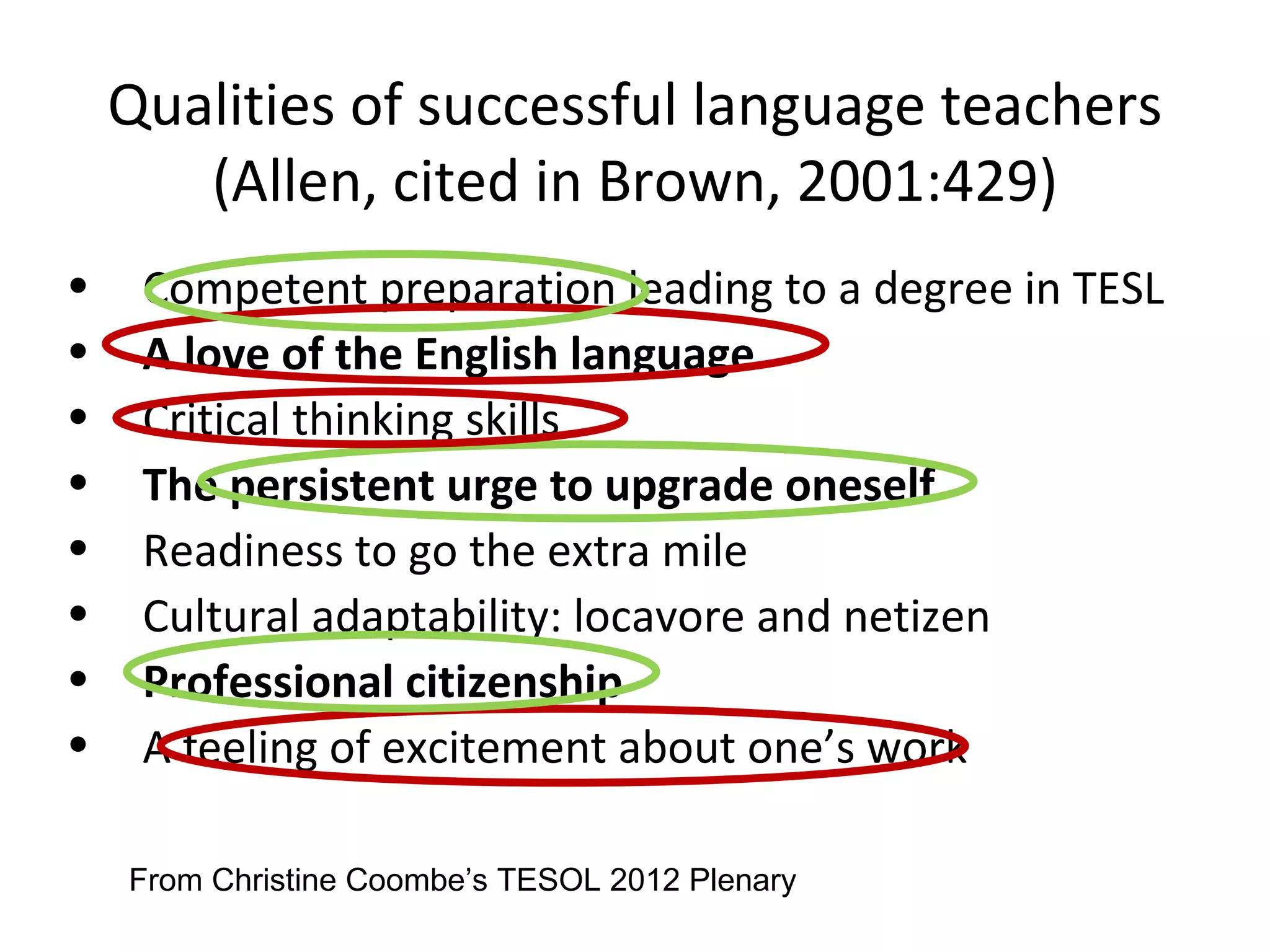
Qualities of successful language teachers
       (Allen, cited in Brown, 2001:429)
•    Competent preparation leading to a degree in TESL
•    A love of the English language
•    Critical thinking skills
•    The persistent urge to upgrade oneself
•    Readiness to go the extra mile
•    Cultural adaptability: locavore and netizen
•    Professional citizenship
•    A feeling of excitement about one’s work

    From Christine Coombe’s TESOL 2012 Plenary
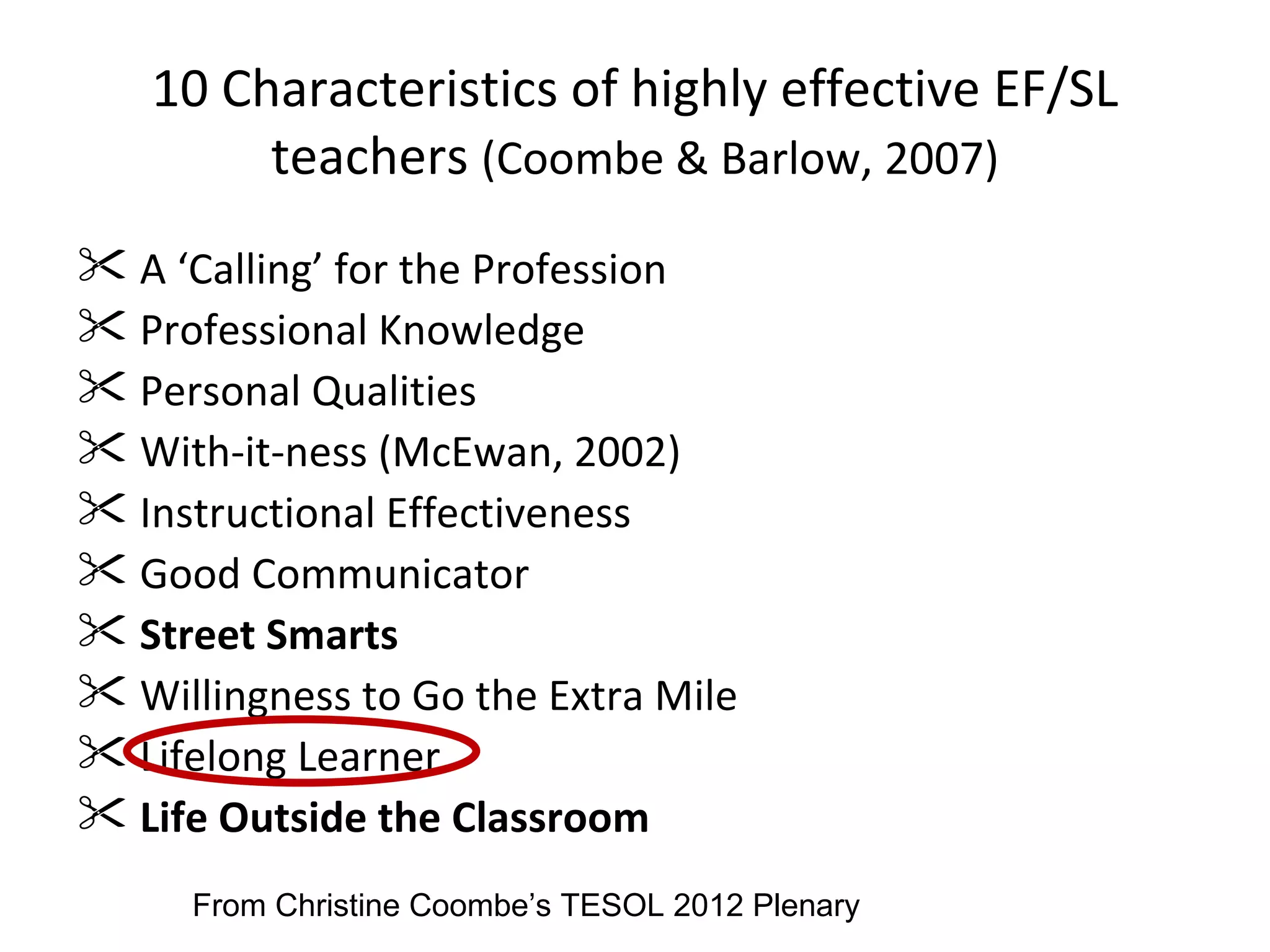
10 Characteristics of highly effective EF/SL
        teachers (Coombe & Barlow, 2007)
 A ‘Calling’ for the Profession
 Professional Knowledge
 Personal Qualities
 With-it-ness (McEwan, 2002)
 Instructional Effectiveness
 Good Communicator
 Street Smarts
 Willingness to Go the Extra Mile
 Lifelong Learner
 Life Outside the Classroom
     From Christine Coombe’s TESOL 2012 Plenary
New words from previous slide

What have you done with this new word?
Did you write it down? Did you guess its
meaning? Here in the plenary, you did not
have time to ask. Will you look it up later?
 Will you commit yourself to trying to use it
somehow?
4 steps: from pronk to quintastic

•   Be open to new ideas
•   Expose yourself to new ideas
•   Adapt and try the new ideas
•   Take time to consider how the new ideas
    worked in your context
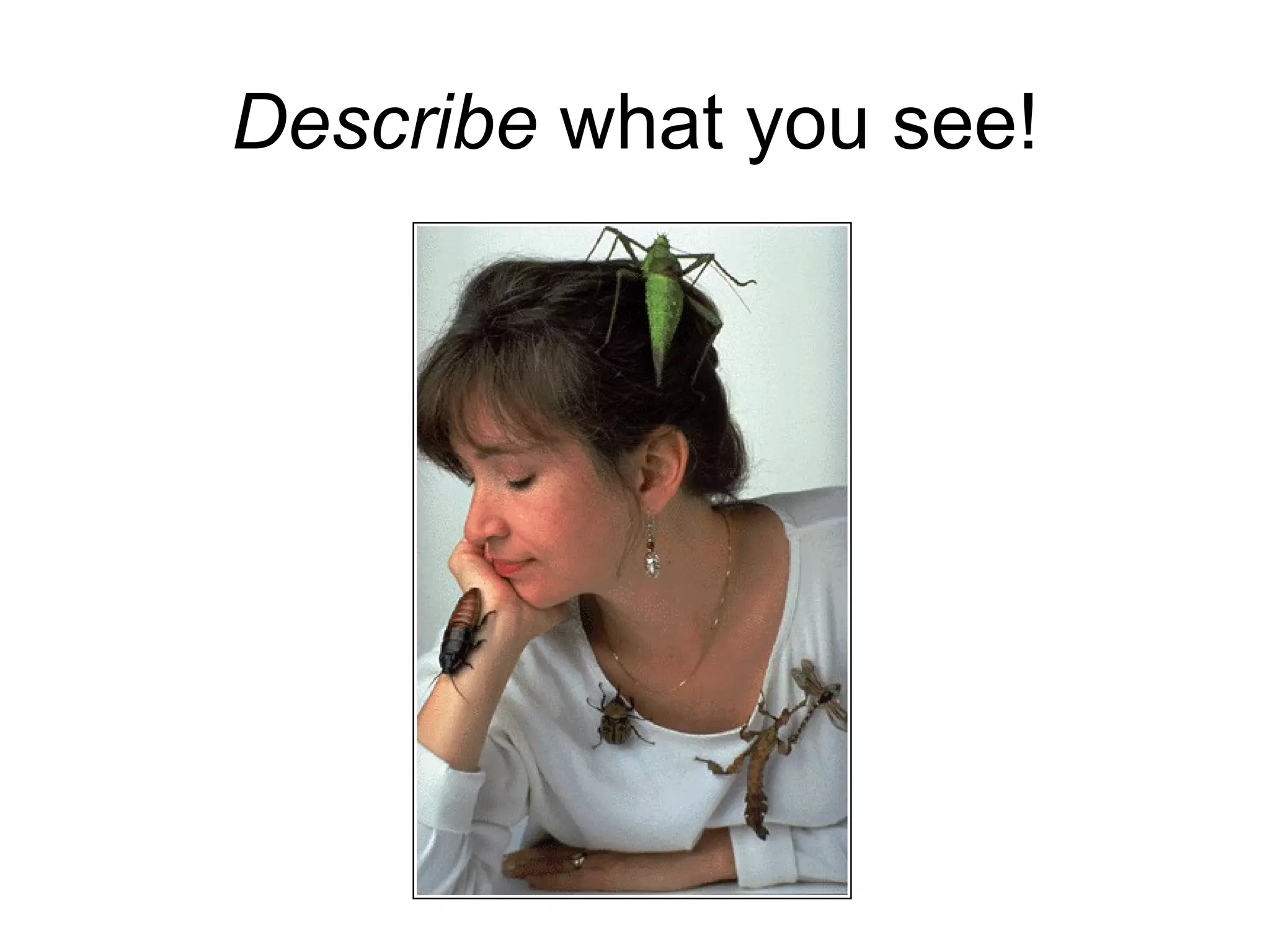
Describe what you see!
Stella Ting-Toomey’s 3 step
              process
1. Describe
2. Interpret
3. Evaluate
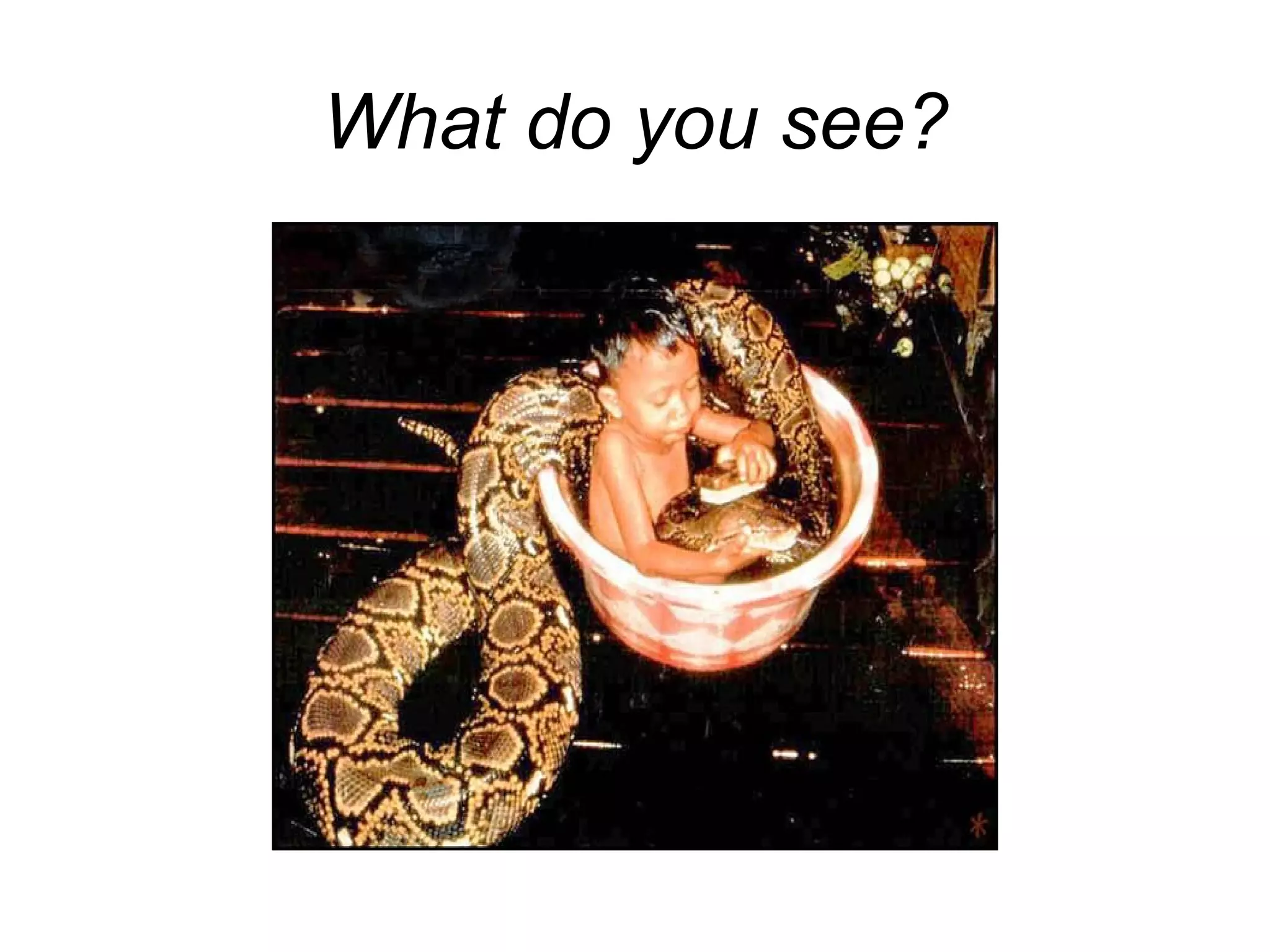
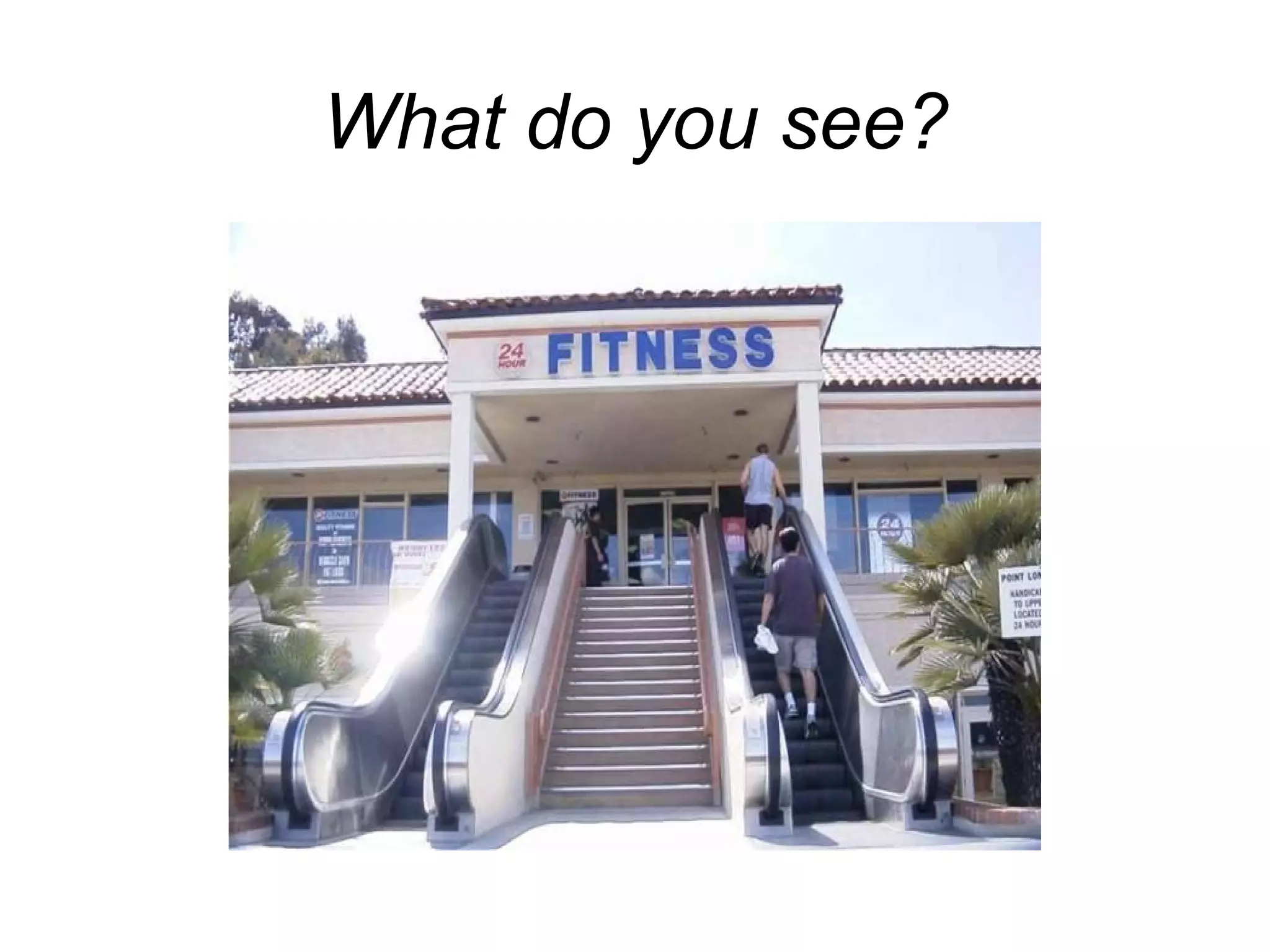
What do you see?
What do you see?
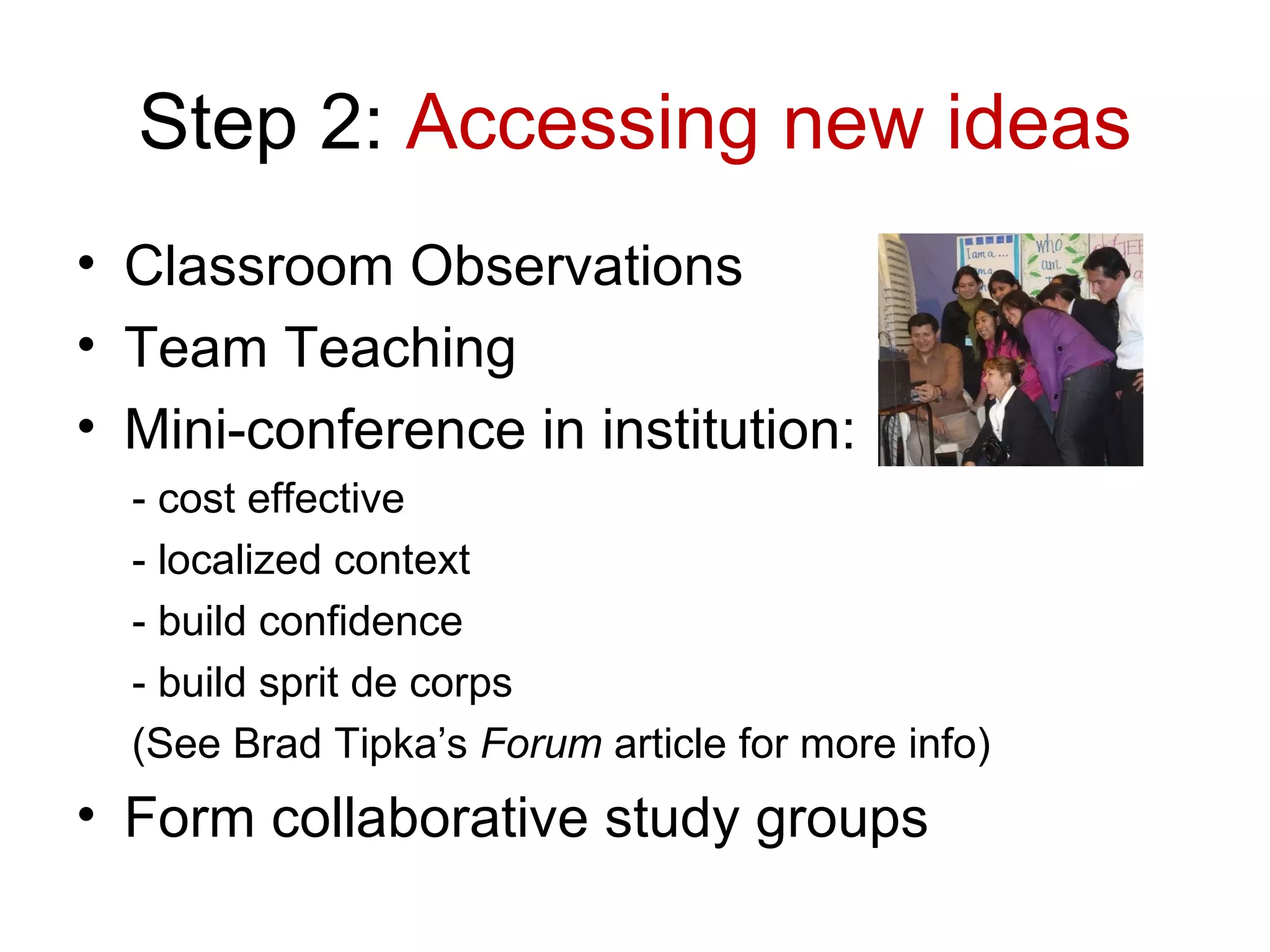
Step 2: Accessing new ideas
• Classroom Observations
• Team Teaching
• Mini-conference in institution:
  - cost effective
  - localized context
  - build confidence
  - build sprit de corps
  (See Brad Tipka’s Forum article for more info)
• Form collaborative study groups
Accessing new ideas (continued)
• Subscribe to and read academic journals
• Keep dialogue journals with a peer or mentor
  (Forum article by Diaz-Maggioli)
• Write up and share short activities through
  newsletter; write review of new resource book
• Practice English through book clubs, debate
  clubs, drama clubs, and tea parties
• Conduct action research: see Tsui’s (1996)
  article on how teachers collectively researched
  students’ reticence to participate in class
Areas where we need to be
                better learners:
• IT (Ryan & Cooper, 2001)
• TEYL
• Links between language and culture: literature
• Writing
• Speaking
• Critical and creative thinking
• Critical media literacy
• Awareness of Global English: new ways in which non-
  natives are communicating, impact on English, varieties
• Awareness of English in Colombia (Guerrero, in HOW,
  2009
• Language policy in Colombia and in other countries:
  successes and failures
• A new language
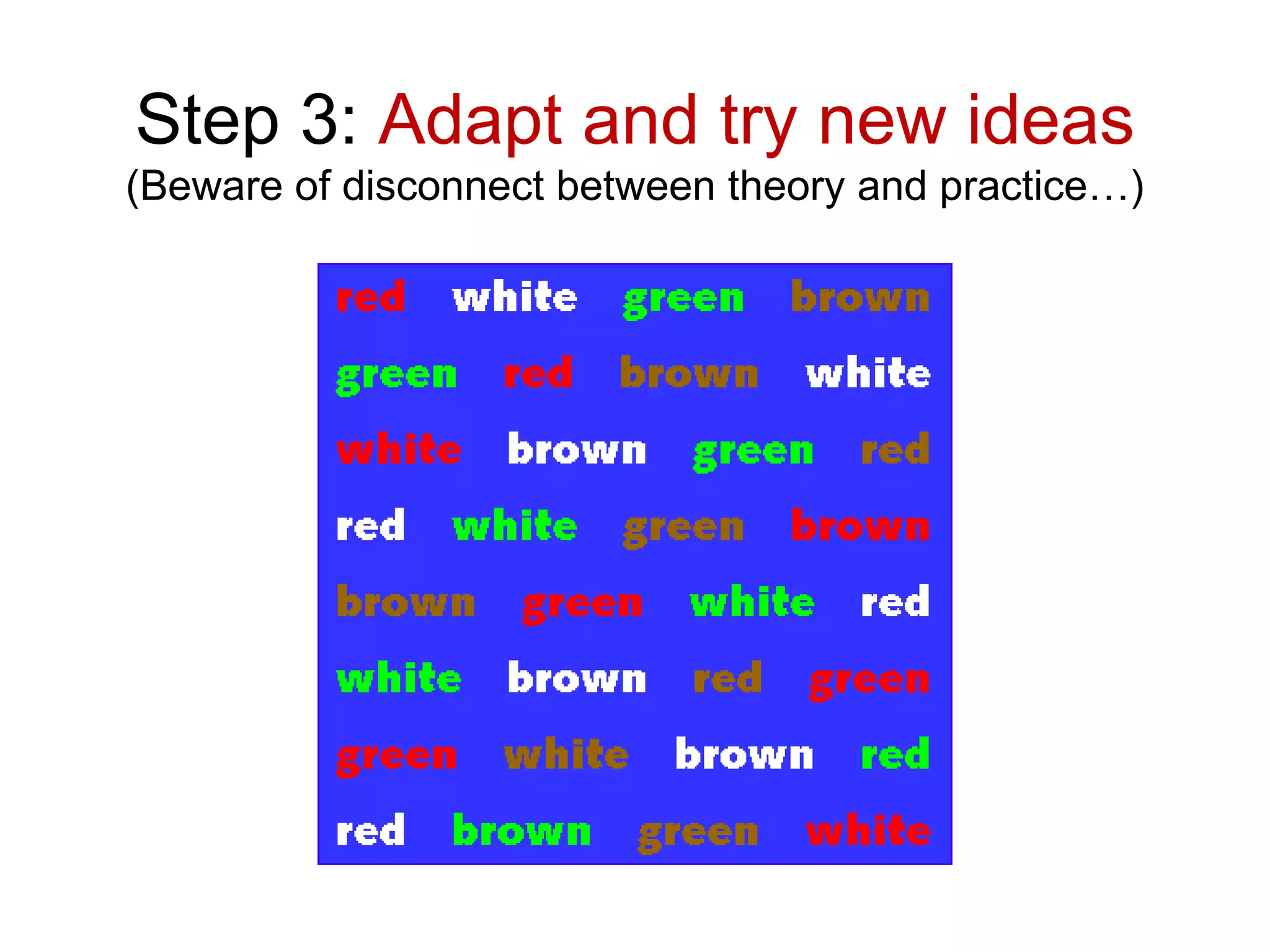
Step 3: Adapt and try new ideas
(Beware of disconnect between theory and practice…)
Step 4: Take time to consider
how the new ideas worked in
         your context

… like a callipygean in front of
          the mirror
Reflective Practice
1. Were the goals of the session met? Why or
   why not?
2. What worked well? What didn’t?
3. Did learners act as expected? Why or why
   not?
4. How can the activity/lesson be improved to
   provide to provide opportunities for better
   learning?
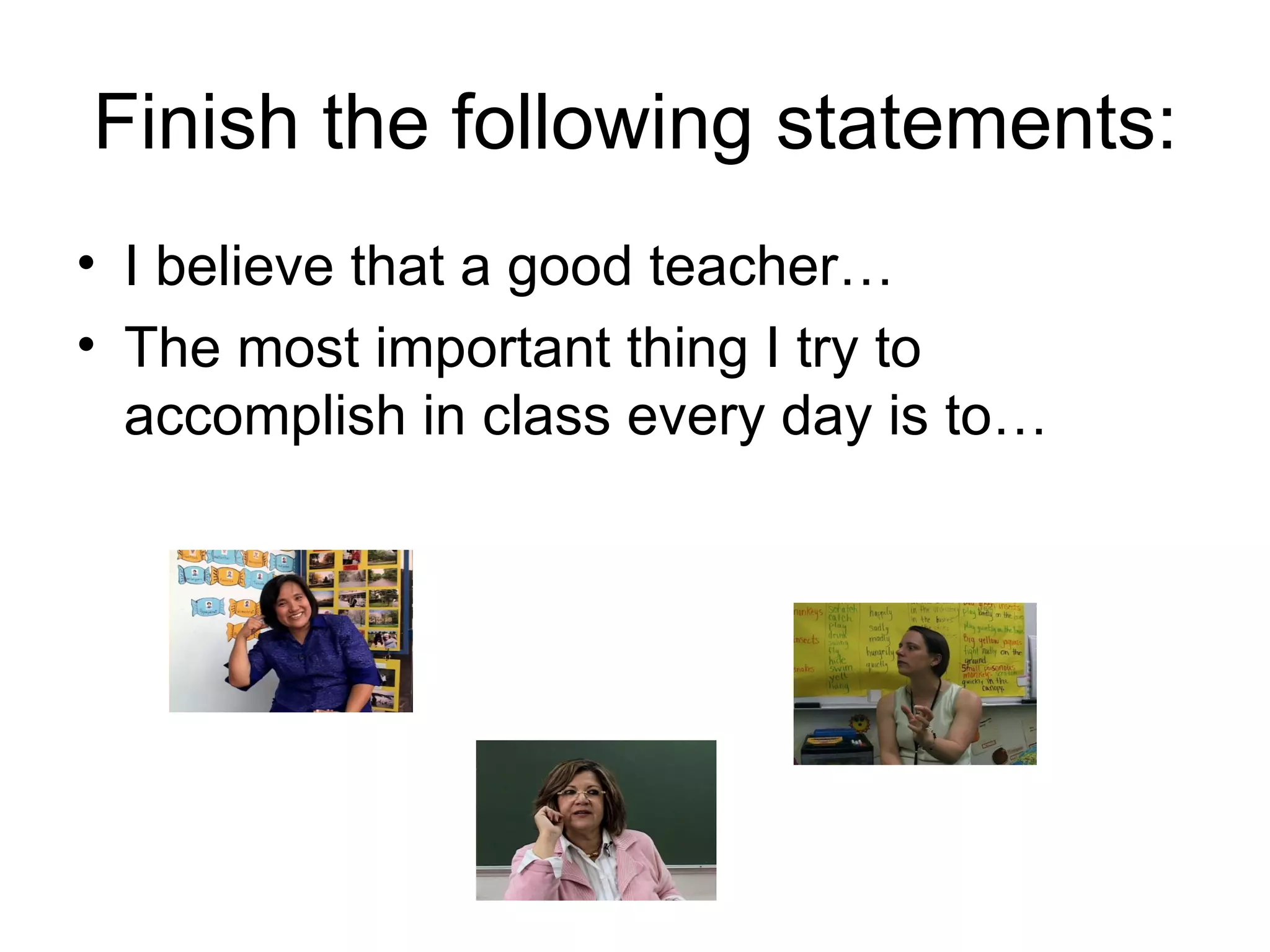
Finish the following statements:
• I believe that a good teacher…
• The most important thing I try to
  accomplish in class every day is to…
Teachers as Successful
      Learners
                      David Fay
               Director, RELO Andes
      (Regional English Language Office)
               reloandes@state.gov
      http://lima.usembassy.gov/relo.html
                http://reloandes.com
                  RELO Andes on
Language example
• For example (model lesson in Turkish). Are you
  rehearsing it silently? Did you write it down? Did
  you guess the meaning of the exchange? Do
  you have specific questions you want to ask the
  teacher? How will you practice it tonight? Will
  you role play with yourself? Try it in front the
  mirror? Record it and listen to yourself? Ask
  another firned from the class for feedback? To
  practice? Will you try altering the text slightly so
  that it can fit in a new context?
What do you see?

Teachers as Successful Learners

  • 1.
    Teachers as Successful Learners (or how to eliminate pedagogical phenakism) David Fay Director, RELO Andes (Regional English Language Office) reloandes@state.gov http://lima.usembassy.gov/relo.html http://reloandes.com RELO Andes on
  • 3.
    Qualities of successfullanguage teachers (Allen, cited in Brown, 2001:429) • Competent preparation leading to a degree in TESL • A love of the English language • Critical thinking skills • The persistent urge to upgrade oneself • Readiness to go the extra mile • Cultural adaptability: locavore and netizen • Professional citizenship • A feeling of excitement about one’s work From Christine Coombe’s TESOL 2012 Plenary
  • 4.
    10 Characteristics ofhighly effective EF/SL teachers (Coombe & Barlow, 2007)  A ‘Calling’ for the Profession  Professional Knowledge  Personal Qualities  With-it-ness (McEwan, 2002)  Instructional Effectiveness  Good Communicator  Street Smarts  Willingness to Go the Extra Mile  Lifelong Learner  Life Outside the Classroom From Christine Coombe’s TESOL 2012 Plenary
  • 5.
    New words fromprevious slide What have you done with this new word? Did you write it down? Did you guess its meaning? Here in the plenary, you did not have time to ask. Will you look it up later? Will you commit yourself to trying to use it somehow?
  • 6.
    4 steps: frompronk to quintastic • Be open to new ideas • Expose yourself to new ideas • Adapt and try the new ideas • Take time to consider how the new ideas worked in your context
  • 7.
  • 8.
    Stella Ting-Toomey’s 3step process 1. Describe 2. Interpret 3. Evaluate
  • 9.
  • 10.
  • 12.
    Step 2: Accessingnew ideas • Classroom Observations • Team Teaching • Mini-conference in institution: - cost effective - localized context - build confidence - build sprit de corps (See Brad Tipka’s Forum article for more info) • Form collaborative study groups
  • 13.
    Accessing new ideas(continued) • Subscribe to and read academic journals • Keep dialogue journals with a peer or mentor (Forum article by Diaz-Maggioli) • Write up and share short activities through newsletter; write review of new resource book • Practice English through book clubs, debate clubs, drama clubs, and tea parties • Conduct action research: see Tsui’s (1996) article on how teachers collectively researched students’ reticence to participate in class
  • 14.
    Areas where weneed to be better learners: • IT (Ryan & Cooper, 2001) • TEYL • Links between language and culture: literature • Writing • Speaking • Critical and creative thinking • Critical media literacy • Awareness of Global English: new ways in which non- natives are communicating, impact on English, varieties • Awareness of English in Colombia (Guerrero, in HOW, 2009 • Language policy in Colombia and in other countries: successes and failures • A new language
  • 15.
    Step 3: Adaptand try new ideas (Beware of disconnect between theory and practice…)
  • 16.
    Step 4: Taketime to consider how the new ideas worked in your context … like a callipygean in front of the mirror
  • 17.
    Reflective Practice 1. Werethe goals of the session met? Why or why not? 2. What worked well? What didn’t? 3. Did learners act as expected? Why or why not? 4. How can the activity/lesson be improved to provide to provide opportunities for better learning?
  • 18.
    Finish the followingstatements: • I believe that a good teacher… • The most important thing I try to accomplish in class every day is to…
  • 19.
    Teachers as Successful Learners David Fay Director, RELO Andes (Regional English Language Office) reloandes@state.gov http://lima.usembassy.gov/relo.html http://reloandes.com RELO Andes on
  • 21.
    Language example • Forexample (model lesson in Turkish). Are you rehearsing it silently? Did you write it down? Did you guess the meaning of the exchange? Do you have specific questions you want to ask the teacher? How will you practice it tonight? Will you role play with yourself? Try it in front the mirror? Record it and listen to yourself? Ask another firned from the class for feedback? To practice? Will you try altering the text slightly so that it can fit in a new context?
  • 22.

Editor's Notes

  • #4 Allen ’ s qualities focused on study skills necessary to pass a professional qualification and a belief in continued personal development. Personal characteristics such as tenacity, thoughtfulness and enthusiasm factored into Allen ’ s list as well as the ability to adapt to the classroom, the learners and the target culture. Green – manifestations of learning for profession; Red – ingredients, or requirements
  • #5 Teaches decide which ones are connected to “Teacher as Learner”. We are all life-long learners. I cannot imagine someone who has completely stopped learning: our environment changes so quickly (new road, hard to find certain ingredient, new students, etc.). But the question is how, and to what extent!
  • #7 Pronk – a weak or foolish person; we often forget #4
  • #8 One partner closes eyes. The other describes it to them. Tell them what you see!
  • #9 Professor of Human Communication Study at California State University, Fullerton. Developed to help describe and understand cultural experiences -
  • #10 Provide positive evaluation
  • #13 Discuss how many are afraid of observation because they think it is evaluative; two seconds: tell someone sitting next to you that you’d like to observe their class (give them a good reason they should let you into their class); now let’s go one step further - the teacher being observed will will finish the sentence “Yes, and…” and provide some criteria. After doing this, ask: did any of you say, “Yes, and please let’s discuss my lesson afterward since I’d like some feedback.” Or, “Yes, and let’s discuss this before you come into my class so that you understand the context of the lesson you will observe.”
  • #14 Collaborative Study Groups, with participants taking turns as facilitator.
  • #16 While sitting down (or standing if you have good balance), lift your right foot off the floor and make clockwise circles with it. At the same time, repeatedly draw the number 6 in the air with your right hand. Your foot will change direction and without an awful lot of practice, there's nothing you can do to prevent it.
  • #17 What do you need to fish? How many of you have actually fished? Moral: huge gap between knowledge and application.
  • #19 PRE: complete the sentences; explain GLAD: Guided Language Acquisition Design WHILE: take notes; determine the context of the teachers Post compare… Note how she speaks ON CAMERA! Note what is in the background (walls full of visuals) From SHAPING THE WAY…