1
LECTURE 2:
TENDER PROCESS
AND
DOCUMENTATION
2
WHAT IS TENDER?
3
Tender is an offer which incorporates
the sum of money, time and other
conditions required to carry out the
contract obligations in order to complete
a project or a part of it consisting of
specified works.
4
WHAT IS
TENDERING ?
5
Stages of a project
 Stage 1: inception & feasibility – identifying
project objectives / set up project brief
 Stage 2: design – develop further project brief /
develop concept & schematic design / Undertake
detailed design & detailing / prepare cost plan &
budget
 Stage 3: tendering – issue tender documents /
prepare & submit tender / evaluation of tender /
award tenders / prepare contract documents
6
Stages of a project
 Stage 4: construction – site possession &
mobilization / undertake procurement fabrication,
installation, construction / carry out contract
admin
 Stage 5: handover & maintenance –
undertake all testing, commissioning & training /
obtain CF / handover project to owner /carry out
necessary maintenance / Defect rectification / etc
7
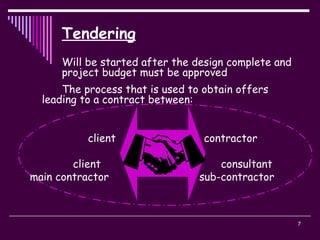
Tendering
Will be started after the design complete and
project budget must be approved
The process that is used to obtain offers
leading to a contract between:
client contractor
client consultant
main contractor sub-contractor
8
Purpose of tendering process
 To select a suitable contractor at a
time appropriate to the situation of
the project.
 To obtain from the contractor
selected at the proper time, an
acceptable tender or offer upon which
a contract can be let.
9
 A tender formally means an invitation
to trade under the terms of offer.
 A contract is the term used for when
the parties have reached agreement.
Difference between a contract and
a tender
10
General
TENDERING
PROCESS
11
Tendering process –
PRINCIPAL ACTIVITIES
1. Selection of the most preferable or
appropriate contract procurement
method.
2. Development of tender list
3. Preparation of tender documentation
4. Invitation / calling off tender
5. Preparation and submission of
tenders
12
Tendering process –
PRINCIPAL ACTIVITIES (cont’d)
6. Receipt and opening of tenders
7. Evaluation of tenders
8. Acceptance of tender award or award
of contract
13
Stage 1: Selection of the most preferable or
appropriate contract procurement
method.
 Traditional contract procurement
route
 Longer time – lead to critical work
scheduling
 Less errors – more precise
 Fast-track contract procurement
route
 Shorter time
 Consequences – may be lead to critical
error, variation.
14
Stage 2: Development of tender list
 Potential tenderers can directly apply to
the employer for future works.
 Employer generate list based on previous
dealings
 The professional team generate their own
list and recommend to the employer.
15
Stage 3: Preparation of tender
documentation – typical contents
 Letter of invitation
 Checklist for submission of tender
 Articles of agreement
 Conditions of contract
 Form of tender
 Tender specifications
 Bills of quantities
 Tender drawings
 Sample copy of letter of acceptance
 Sample copy of bang guarantee for performance
bond
 Schedule of day work rates
 Sample copy bank guarantee for advance payment
16
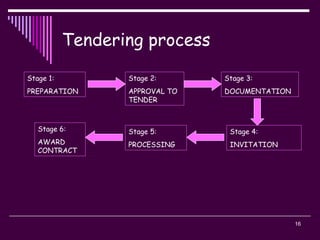
Tendering process
Stage 2:
APPROVAL TO
TENDER
Stage 1:
PREPARATION
Stage 3:
DOCUMENTATION
Stage 4:
INVITATION
Stage 5:
PROCESSING
Stage 6:
AWARD
CONTRACT
17
Stage 1: Preparation
 Final completion of drawings,
specification, measurement / take-off
process.
 Choose conditions of contract.
 Parties involved: architect, engineers,
QS, client, project manager
18
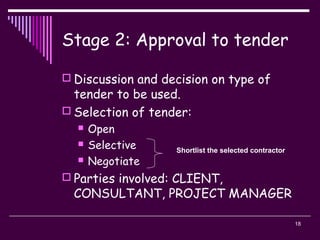
Stage 2: Approval to tender
 Discussion and decision on type of
tender to be used.
 Selection of tender:
 Open
 Selective
 Negotiate
 Parties involved: CLIENT,
CONSULTANT, PROJECT MANAGER
Shortlist the selected contractor
19
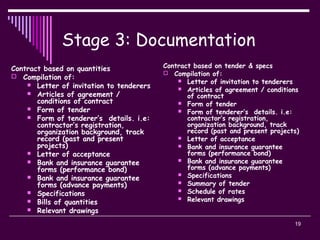
Stage 3: Documentation
Contract based on quantities
 Compilation of:
 Letter of invitation to tenderers
 Articles of agreement /
conditions of contract
 Form of tender
 Form of tenderer’s details. i.e:
contractor’s registration,
organization background, track
record (past and present
projects)
 Letter of acceptance
 Bank and insurance guarantee
forms (performance bond)
 Bank and insurance guarantee
forms (advance payments)
 Specifications
 Bills of quantities
 Relevant drawings
Contract based on tender & specs
 Compilation of:
 Letter of invitation to tenderers
 Articles of agreement / conditions
of contract
 Form of tender
 Form of tenderer’s details. i.e:
contractor’s registration,
organization background, track
record (past and present projects)
 Letter of acceptance
 Bank and insurance guarantee
forms (performance bond)
 Bank and insurance guarantee
forms (advance payments)
 Specifications
 Summary of tender
 Schedule of rates
 Relevant drawings
20
Stage 4: Invitation
 Based on selection of tendering
methods
 Open / competitive / bid tender –
produce tender notice
 Selective – shot listed contractors will
be invited to tender if they wish
 Negotiated – only one contractor is
approached- direct entry to project
21
TENDER NOTICE
OR NOTICE
INVITING TENDER
22
 The Tender Notice is a brief
description of the job being tendered
which is to be published in Newspapers
and on the Internet.
 The Internet is a very cost effective
way of publishing the tenders.
23
Format of an ideal Tender
Notice
a. Name of the Project.
b. Name & Address of the
Company floating the
tender.
c. Name of work, materials
or services.
d. Place of work location.
e. Approximate estimated
cost of work.
f. Earnest Money.
g. Period of completion.
h. Date on which the Tender
Document sale commences.
i. Date on which the Tender
Document sale commences.
j. Date and time up to which
tender documents can be
obtained.
k. The cost of tender
documents.
l. The date and time up to
which the tenders to be
submitted and are to be
opened.
m. Specification.
n. Eligibility Criterion.
24
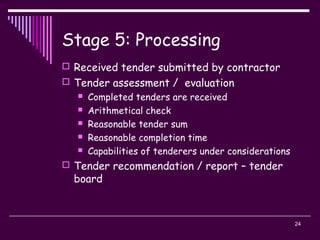
Stage 5: Processing
 Received tender submitted by contractor
 Tender assessment / evaluation
 Completed tenders are received
 Arithmetical check
 Reasonable tender sum
 Reasonable completion time
 Capabilities of tenderers under considerations
 Tender recommendation / report – tender
board
25
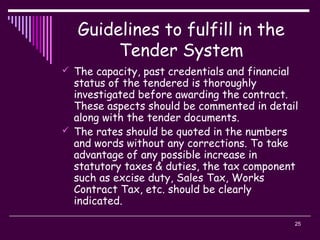
Guidelines to fulfill in the
Tender System
 The capacity, past credentials and financial
status of the tendered is thoroughly
investigated before awarding the contract.
These aspects should be commented in detail
along with the tender documents.
 The rates should be quoted in the numbers
and words without any corrections. To take
advantage of any possible increase in
statutory taxes & duties, the tax component
such as excise duty, Sales Tax, Works
Contract Tax, etc. should be clearly
indicated.
26
 Tenderers should not quote many
special conditions as some of them may
have financial implications, did this can
be added to your quoted cost. Also it
creates confusion and creates room
for manipulative forces.
 The rates quoted for individual items
should be realistic and should not be
abnormal and unworkable.  
27
Stage 6: Award contract
 Pre-award meeting with contractors –
validation of lowest complying bid
 Validate lowest bid - Pre-contract meeting
with contractor for contract signing
 Approval by tender board / treasury (tender
exceeds RM10 mill.) – an acceptance of
tender form is issued to tenderer , signed by
the authorised officer
28
TENDER PROCESS
FOR CONTRACTOR
29
Tendering process
Stage 2:
Determine
basis of
tender
Stage 1:
Decision to
tender
Stage 3:
Preparation of
cost estimates
Stage 4:
Commercial
appreciation
Stage 5:
Conversion
of estimate
to tender
Stage 6:
Submissio
n of
tender
30
Stage 1: Decision to tender
 Receipt of tender documents
 Pre-tender data sheet
 Decision to tender
 Consider implications of:
 Bonds
 Warranties
 Parent company
 Guarantees
 Funding
31
Stage 2: Determine basis of
tender
 Abstract materials and subcons
 Sent out enquiries
 Consider construction methods / prepare method
statement
 Design temporary works / consider alternatives
 Prepare outline programme
 Check major quantities
 Identify restrictions
 Visit site and compile site report
 Campaigning meeting (designating areas
responsibilities)
32
Stage 3: Preparation of cost
estimate
 Calculate recurrent rates using:
 Operational
 Unit rates
 Man-hours estimating
 Analyse and check subcontractors’ quotations
 Price prelims / general items (in association
with members of the team
 Prepare summary sheets
LOC1/AC2 33
Stage 4: Commercial
appreciation
 Tender committee meeting part 1-
 Review:
 Method
 Programme
 Technical and commercial risks
 Cash flow and finance
 Use of own plant
 Competition
 Commercial opportunities
 Economic climate
 Check prelims against historical cost data
34
Stage 5: Conversion of tender
estimate to tender bid
 Tender committee meeting – part 2
 Calculate ‘spread’ and add to estimate
35
Stage 6: Submission of tender
 Submit in format required
 Organize delivery

Lecture 2 tender process n documentation

  • 1.
  • 2.
  • 3.
    3 Tender is anoffer which incorporates the sum of money, time and other conditions required to carry out the contract obligations in order to complete a project or a part of it consisting of specified works.
  • 4.
  • 5.
    5 Stages of aproject  Stage 1: inception & feasibility – identifying project objectives / set up project brief  Stage 2: design – develop further project brief / develop concept & schematic design / Undertake detailed design & detailing / prepare cost plan & budget  Stage 3: tendering – issue tender documents / prepare & submit tender / evaluation of tender / award tenders / prepare contract documents
  • 6.
    6 Stages of aproject  Stage 4: construction – site possession & mobilization / undertake procurement fabrication, installation, construction / carry out contract admin  Stage 5: handover & maintenance – undertake all testing, commissioning & training / obtain CF / handover project to owner /carry out necessary maintenance / Defect rectification / etc
  • 7.
    7 Tendering Will be startedafter the design complete and project budget must be approved The process that is used to obtain offers leading to a contract between: client contractor client consultant main contractor sub-contractor
  • 8.
    8 Purpose of tenderingprocess  To select a suitable contractor at a time appropriate to the situation of the project.  To obtain from the contractor selected at the proper time, an acceptable tender or offer upon which a contract can be let.
  • 9.
    9  A tenderformally means an invitation to trade under the terms of offer.  A contract is the term used for when the parties have reached agreement. Difference between a contract and a tender
  • 10.
  • 11.
    11 Tendering process – PRINCIPALACTIVITIES 1. Selection of the most preferable or appropriate contract procurement method. 2. Development of tender list 3. Preparation of tender documentation 4. Invitation / calling off tender 5. Preparation and submission of tenders
  • 12.
    12 Tendering process – PRINCIPALACTIVITIES (cont’d) 6. Receipt and opening of tenders 7. Evaluation of tenders 8. Acceptance of tender award or award of contract
  • 13.
    13 Stage 1: Selectionof the most preferable or appropriate contract procurement method.  Traditional contract procurement route  Longer time – lead to critical work scheduling  Less errors – more precise  Fast-track contract procurement route  Shorter time  Consequences – may be lead to critical error, variation.
  • 14.
    14 Stage 2: Developmentof tender list  Potential tenderers can directly apply to the employer for future works.  Employer generate list based on previous dealings  The professional team generate their own list and recommend to the employer.
  • 15.
    15 Stage 3: Preparationof tender documentation – typical contents  Letter of invitation  Checklist for submission of tender  Articles of agreement  Conditions of contract  Form of tender  Tender specifications  Bills of quantities  Tender drawings  Sample copy of letter of acceptance  Sample copy of bang guarantee for performance bond  Schedule of day work rates  Sample copy bank guarantee for advance payment
  • 16.
    16 Tendering process Stage 2: APPROVALTO TENDER Stage 1: PREPARATION Stage 3: DOCUMENTATION Stage 4: INVITATION Stage 5: PROCESSING Stage 6: AWARD CONTRACT
  • 17.
    17 Stage 1: Preparation Final completion of drawings, specification, measurement / take-off process.  Choose conditions of contract.  Parties involved: architect, engineers, QS, client, project manager
  • 18.
    18 Stage 2: Approvalto tender  Discussion and decision on type of tender to be used.  Selection of tender:  Open  Selective  Negotiate  Parties involved: CLIENT, CONSULTANT, PROJECT MANAGER Shortlist the selected contractor
  • 19.
    19 Stage 3: Documentation Contractbased on quantities  Compilation of:  Letter of invitation to tenderers  Articles of agreement / conditions of contract  Form of tender  Form of tenderer’s details. i.e: contractor’s registration, organization background, track record (past and present projects)  Letter of acceptance  Bank and insurance guarantee forms (performance bond)  Bank and insurance guarantee forms (advance payments)  Specifications  Bills of quantities  Relevant drawings Contract based on tender & specs  Compilation of:  Letter of invitation to tenderers  Articles of agreement / conditions of contract  Form of tender  Form of tenderer’s details. i.e: contractor’s registration, organization background, track record (past and present projects)  Letter of acceptance  Bank and insurance guarantee forms (performance bond)  Bank and insurance guarantee forms (advance payments)  Specifications  Summary of tender  Schedule of rates  Relevant drawings
  • 20.
    20 Stage 4: Invitation Based on selection of tendering methods  Open / competitive / bid tender – produce tender notice  Selective – shot listed contractors will be invited to tender if they wish  Negotiated – only one contractor is approached- direct entry to project
  • 21.
  • 22.
    22  The TenderNotice is a brief description of the job being tendered which is to be published in Newspapers and on the Internet.  The Internet is a very cost effective way of publishing the tenders.
  • 23.
    23 Format of anideal Tender Notice a. Name of the Project. b. Name & Address of the Company floating the tender. c. Name of work, materials or services. d. Place of work location. e. Approximate estimated cost of work. f. Earnest Money. g. Period of completion. h. Date on which the Tender Document sale commences. i. Date on which the Tender Document sale commences. j. Date and time up to which tender documents can be obtained. k. The cost of tender documents. l. The date and time up to which the tenders to be submitted and are to be opened. m. Specification. n. Eligibility Criterion.
  • 24.
    24 Stage 5: Processing Received tender submitted by contractor  Tender assessment / evaluation  Completed tenders are received  Arithmetical check  Reasonable tender sum  Reasonable completion time  Capabilities of tenderers under considerations  Tender recommendation / report – tender board
  • 25.
    25 Guidelines to fulfillin the Tender System  The capacity, past credentials and financial status of the tendered is thoroughly investigated before awarding the contract. These aspects should be commented in detail along with the tender documents.  The rates should be quoted in the numbers and words without any corrections. To take advantage of any possible increase in statutory taxes & duties, the tax component such as excise duty, Sales Tax, Works Contract Tax, etc. should be clearly indicated.
  • 26.
    26  Tenderers shouldnot quote many special conditions as some of them may have financial implications, did this can be added to your quoted cost. Also it creates confusion and creates room for manipulative forces.  The rates quoted for individual items should be realistic and should not be abnormal and unworkable.  
  • 27.
    27 Stage 6: Awardcontract  Pre-award meeting with contractors – validation of lowest complying bid  Validate lowest bid - Pre-contract meeting with contractor for contract signing  Approval by tender board / treasury (tender exceeds RM10 mill.) – an acceptance of tender form is issued to tenderer , signed by the authorised officer
  • 28.
  • 29.
    29 Tendering process Stage 2: Determine basisof tender Stage 1: Decision to tender Stage 3: Preparation of cost estimates Stage 4: Commercial appreciation Stage 5: Conversion of estimate to tender Stage 6: Submissio n of tender
  • 30.
    30 Stage 1: Decisionto tender  Receipt of tender documents  Pre-tender data sheet  Decision to tender  Consider implications of:  Bonds  Warranties  Parent company  Guarantees  Funding
  • 31.
    31 Stage 2: Determinebasis of tender  Abstract materials and subcons  Sent out enquiries  Consider construction methods / prepare method statement  Design temporary works / consider alternatives  Prepare outline programme  Check major quantities  Identify restrictions  Visit site and compile site report  Campaigning meeting (designating areas responsibilities)
  • 32.
    32 Stage 3: Preparationof cost estimate  Calculate recurrent rates using:  Operational  Unit rates  Man-hours estimating  Analyse and check subcontractors’ quotations  Price prelims / general items (in association with members of the team  Prepare summary sheets
  • 33.
    LOC1/AC2 33 Stage 4:Commercial appreciation  Tender committee meeting part 1-  Review:  Method  Programme  Technical and commercial risks  Cash flow and finance  Use of own plant  Competition  Commercial opportunities  Economic climate  Check prelims against historical cost data
  • 34.
    34 Stage 5: Conversionof tender estimate to tender bid  Tender committee meeting – part 2  Calculate ‘spread’ and add to estimate
  • 35.
    35 Stage 6: Submissionof tender  Submit in format required  Organize delivery