PROJECT MANAGEMENT &
OPTIMIZATION
UNIT-I
CONCEPTS OF PROJECT
MANAGEMENT
DEFINITION
PROJECT:
Temporary endeavor undertaken to create a unique product, service, or result.
The temporary nature of projects indicates a definite beginning and end. The end is
reached when the project’s objectives have been achieved or when the project is
terminated
PROJECT MANAGEMENT:
Project management is the planning, scheduling, and controlling of project activities to
meet project objectives.
The major objectives that must be met include performance, cost, and time goals, while
at the same time you control or maintain the scope of the project at the correct level.
PROJECT CHARACTERISTICS
Projects are unique.
Projects are temporary in nature.
Projects have a definite beginning and ending date.
Projects are completed when the project goals are achieved or it’s
determined the project is no longer viable.
To identify the Project
First, is it a project or an ongoing operation?
Second, if it is a project, who are the stakeholders? And
Third, what characteristics distinguish this endeavor as a project?
PROCESS OF PROJECT MANAGEMENT
 On any project, A number of project constraints are competing for attention.
 Cost is the budget approved for the project including all necessary expenses needed to
deliver the project.
 Scope is what the project is trying to achieve.
 Quality is a combination of the standards and criteria to which the project’s products must
be delivered for them to perform effectively.
 Risk is defined by potential external events that will have a negative impact on your
project if they occur.
 Resources are required to carry out the project tasks.
 Time is defined as the time to complete the project.
TECHNICAL AND SOCIOCULTURAL DIMENSION OF
PROJECT MANAGEMENT
TECHNICAL DIMENSION:
Technical dimensions are often quantifiable and tangible.
Ex: income levels, age demographics, or geographic location.
Technical dimensions can be measured and compared objectively.
Technical dimensions are the measurable properties of an object or system, such
as its length, width, height, mass, and electrical conductivity
The technical side of the management process is the formal, disciplined and purely
logical part and includes defining the scope, schedule, and resource allocation,
status report, planning and controlling the projects.
Technical dimension represents the “science” of project management
Technical dimensions can be studied objectively using scientific methods.
SOCIO-CULTURAL DIMENSION:
Sociocultural dimensions are more unformulated concepts like values, beliefs, or
attitudes.
Subjective factors cannot be quantified in the same way as technical dimensions, but they
play a significant role in shaping our behaviour.
How social factors (ex: Culture, politics, religion) affect how people work together to
achieve common goals. It includes an understanding of how different cultures approach
problem-solving and conflict resolution and an appreciation for the impact of societal
norms on team dynamics.
Sociocultural dimensions are the non-measurable aspects of an object or system, such as
its function, use, history, and meaning within a culture.
Sociocultural dimensions cannot be studied objectively and must be inferred from data
collected through interviews, surveys, and other qualitative research methods.
Sociocultural dimension represents the “art” of managing a project.
THE PROJECT LIFE CYCLE
A standard project typically has the following four major phases
(each with its own agenda of tasks and issues): initiation,
planning, implementation, and closure.
Taken together, these phases represent the path a project takes
from the beginning to its end and are generally referred to as the
project “life cycle.”
THE PROJECT LIFE CYCLE
PHASES OF PROJECT
INITIATION PHASE:
The project objective or need is identified.
A feasibility study is conducted to investigate whether each option
addresses the project objective and a final recommended solution is
determined.
Issues of feasibility (“can we do the project?”) and justification (“should we
do the project?”) are addressed.
Once the recommended solution is approved, a project is initiated to deliver
the approved solution and a project manager is appointed.
Approval is then sought by the project manager to move onto the detailed
planning phase.
PHASES OF PROJECT
PLANNING PHASE:
The project solution is further developed in as much detail as possible and the steps
necessary to meet the project’s objective are planned.
The project’s tasks and resource requirements are identified, along with the strategy for
producing them- “scope management.”
A project plan is created outlining the activities, tasks, dependencies, and timeframes.
The project manager coordinates the preparation of a project budget by providing cost
estimates for the labour, equipment, and materials costs.
Once the project team has identified the work, prepared the schedule, and estimated the
costs, the three fundamental components of the planning process are complete.
Anything that might pose a threat to the successful completion of the project is also
identified in this phase, which is called “risk management”.
In risk management, “high-threat” potential problems are identified along with
the action that is to be taken on each high-threat potential problem, either to
reduce the probability that the problem will occur or to reduce the impact on the
project if it does occur.
All stakeholders of the project are identified and establish a communication plan
describing the information needed and the delivery method to be used to keep
the stakeholders informed.
Finally, a document with quality plan, providing quality targets, assurance, and
control measures, along with an acceptance plan, listing the criteria to be met to
gain customer acceptance is prepared.
At this point, the project would have been planned in detail and is ready to be
executed.
IMPLEMENTATION (EXECUTION) PHASE
The project plan is put into motion and the work of the project is performed.
It is important to maintain control and communicate as needed during implementation.
Progress is continuously monitored and appropriate adjustments are made and recorded
as variances from the original plan.
In any project, a project manager spends most of the time in this step.
During project implementation, people are carrying out the tasks, and progress
information is being reported through regular team meetings.
The project manager uses this information to maintain control over the direction of the
project by comparing the progress reports with the project plan to measure the
performance of the project activities and take corrective action as needed.
 The first course of action should always be to bring the project back on course (i.E., To
return it to the original plan) when deviations are observed.
 If that cannot happen, the team should record variations from the original plan and
record and publish modifications to the plan.
 Throughout this step, project sponsors and other key stakeholders should be kept
informed of the project’s status according to the agreed-on frequency and format of
communication.
 The plan should be updated and published on a regular basis.
 Status reports should always emphasize the anticipated end point in terms of cost,
schedule, and quality of deliverables.
 Each project deliverable produced should be reviewed for quality and measured against
the acceptance criteria.
 Once all of the deliverables have been produced and the customer has accepted the
final solution, the project is ready for closure.
CLOSING PHASE
During the final closure, or completion phase, the emphasis is on
releasing the final deliverables to the customer, handing over project
documentation to the business, terminating supplier contracts, releasing
project resources, and communicating the closure of the project to all
stakeholders.
The last remaining step is to conduct lessons-learned studies to examine
what went well and what didn’t.
Through this type of analysis, the wisdom of experience is transferred
back to the project organization, which will help future project teams.
PROJECT PLANNING
Heart of the project life cycle and the most challenging phase for a project
manager
The project plans are documented, the project deliverables and requirements
defined, and the project schedule created.
It involves creating a set of plans to help guide your team through the
execution and closure phases of the project.
The plans created during this phase will help you to manage time, cost,
quality, change, risk and related issues.
It will also help you manage staff and external suppliers, to ensure that you
deliver the project on time and within schedule.
THE PURPOSE OF THE PROJECT PLANNING PHASE IS:
ESTABLISH BUSINESS REQUIREMENTS.
ESTABLISH COST, SCHEDULE, LIST OF DELIVERABLES AND DELIVERY
DATES.
ESTABLISH RESOURCE PLAN.
GET MANAGEMENT APPROVAL AND PROCEED TO THE NEXT PHASE.
SCOPE PLANNING
Specifies the in-scope requirements for the project and facilitates creating the work
breakdown structure.
PREPARING THE WORK BREAKDOWN STRUCTURE
Specifies the breakdown of the project into tasks and sub tasks.
PROJECT SCHEDULE DEVELOPMENT
Specifies the entire schedule of the activities detailing their sequence of execution.
RESOURCE PLANNING
Specifies who will do what work at which time of the project and if any special skills are
needed to accomplish the project tasks.
BUDGET PLANNING
Specifies the budgeted cost to be incurred in the completion of the project.
The basic processes of the project planning are:
Procurement planning
Focuses on dealing with vendors outside of your company
Risk management planning
Charts the risks, contingency plan and mitigation strategies.
Quality planning
For quality assurance to be applied to the project.
Communication planning
On the communication strategy with all project stakeholders.
GRAPHICAL REPRESENTATION OF PROJECT
Project management charts are visual representations of data that turn difficult
project management concepts into easily digestible assets.
 especially useful to communicate complex project planning information.
 visualize data and turn complex concepts such as project schedule or scope into
digestible data for the project management team and stakeholders.
Before considering which project management chart is best, it’s important that
which project management methodology is used.
It’s also important to note that a variety of project management charts are needed
as each serves different project planning purposes such as creating a project
timeline, allocating project resources, planning project work and more.
1. GANTT CHARTS
It’s a dynamic bar chart that shows the project schedule on a timeline.
 Although Gantt charts started out as a basic tool, they’ve matured and include
enticing features such as task dependencies that note when one task is related to
another.
Gantt charts are essential for modern project planning and scheduling because they
allow project managers to visualize all of the activities that make up the project on a
timeline.
They’re also useful to monitor progress once the execution phase begins.
With new computing power, Gantt charts evolved from a basic bar chart to an
essential project management tool that allows project managers to identify the critical
path, assign tasks, establish task dependencies, generate a project timeline and much
more.
2. WORK BREAKDOWN STRUCTURE (WBS)
In project planning to organize project activities, deliverables and timelines a work
breakdown structure (WBS) comes in handy.
It’s a way to take the tasks that a team must accomplish and split them into
manageable sections.
The WBS is a deliverable-oriented hierarchical decomposition of the work to be
executed by the project team.
In other words, it’s a great way to visualize the tasks that need to be done in order
to complete the project.
It acts as a slightly higher-level view than a Gantt chart, which is useful for
complex projects.
A WBS can be represented as a list, a tree diagram, a spreadsheet or a column on a
Gantt chart.
3. FLOW CHART
 The flow chart is a graphic display of the project’s objective and helps create a
logical order of the work required to reach that goal.
Planning a project is all about control, and a flow chart gives a project manager a
tool to exercise control over tasks, resources and time.
This means all processes, including planning and monitoring, refer to the flow chart
to increase efficiency.
Following the plan are tasks, resources, budgets, schedules, etc., Each of which
flows down to communications, risk management, change control, quality
management, etc.
Finally, there’s the approval stage. If approved, the project plan is a go. If not, the
flow chart circles back to the beginning to start again.
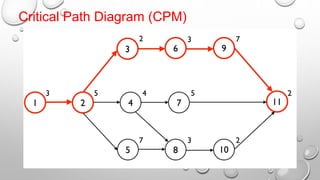
4. CRITICAL PATH DIAGRAM (CPM)
It’s used to show the activities that are required to complete the project.
The diagram illustrates the duration of each activity and the preceding activity, how the two
are related and lag (the amount of time between two activities).
A critical path diagram helps project managers break down a more extensive project into
necessary activities in order to deliver a successful project.
These activities are represented on the diagram as boxes.
 Between these activities or boxes are lines that represent the flow to show how each
activity is connected and interconnected.
The purpose of using a critical path diagram is to allow project managers to calculate the
total duration of a project.
Critical path is made up of critical activities but non-critical activities are also shown.
Non-critical activities allow for more flexibility as they don’t have a major impact on the
project.
Critical Path Diagram (CPM)
5. RACI MATRIX
RACI is an acronym that stands for responsible, accountable, consulted and informed.
A RACI matrix is a chart that helps assign responsibilities in project management.
This table helps project managers identify stakeholders in their projects and gauge each
level of involvement.
This is done by noting next to each the initial r, a, c or i to categorize engagement.
This is useful for assigning the responsibilities of team members on a project. But it can
also be used to manage stakeholders.
The RACI matrix helps a project manager to figure out which stakeholders need to
know what and the frequency by which they should be updated on the progress of the
project.
RACI Matrix
6. PERT CHART
 PERT is another acronym that stands for project (or program) evaluation and review
technique.
It provides a graphical view of the project’s tasks, schedule and timelines.
Pert charts are made of nodes, boxes or circles that represent milestones.
Connecting arrows show what must be completed between nodes and they represent
the duration of each task.
They use directional, concurrent arrows to indicate a series of tasks that must be
completed in a specific sequence.
Diverging arrows indicate work that can be done in parallel.
7. WORKFLOW DIAGRAM
Workflow diagrams visually show the layout of a process, project or job.
This is done as a flow chart.
Workflow diagrams are commonly used to show the full business process and
information flows, help employees understand their roles and responsibilities,
expose redundancies and bottlenecks and avoid risks.
They’re a great tool for clear communication across the organization.
The workflow diagram is also a way to strengthen security.
Workflow diagrams track information securely and make sure that the organization
is on top of any security gaps.
WORK BREAKDOWN STRUCTURE (WBS)
A complex project is made manageable by first breaking it down into individual
components in hierarchical structure known as work breakdown structure.
As the name indicates WBS represents a logical and systematic breakdown of project
into its component parts.
It is constructed by dividing the project into its major parts to individual manageable
tasks.
The breaking down of a project into its component parts facilitates resource allocation
and the assignment of individual responsibilities.
The work breakdown structure is the foundation of project planning.
It is developed before dependencies are identified and activity durations are estimated.
The WBS can be used to identify the tasks CPM and pert project planning models.
WORK BREAKDOWN STRUCTURE
Work Breakdown Structure helps in:
 Effective planning by dividing work into manageable elements that can be
planned, budgeted and allocated easily
 Assignment of responsibility of work elements to project personnel and
outside agencies.
 Development of information and control system.
 Defines the works to be done in detail manner.
 WBS is integrated with Organizational structure for assignment of tasks
NETWORKING IN PM
The activities of the project have inter-relationships between them.
To represent these inter-relationships for the allocation of resources, network techniques
are applied.
PERT and CPM are the two network representations for probabilistic and deterministic
approaches.
Basic to PERT and CPM is the network diagram.
It is constructed using ‘activities’ and ‘events’.
Size of the network depends on the number of activities and the precedence relations.
There are two types of notations used in the network diagram. They are as under,
1. Activity-on-arrow (AOA), and
2. Activity-on-node (AON).
Examples
 In AOA notation, the arrow represents the work to be done and the circle represents an
event – either the beginning of another activity or completion of previous one.
 For AON notation, a box (or node) is used to show the task itself and the arrow simply
show the sequence in which work is done.
DUMMY ACTIVITIES
A dummy activity is a type of operation in a project network which
neither requires any time nor any resource. It is an imaginary activity
shown in a project network to identify the dependence among
operation.
Dummy activity forms a connecting link for control purpose or for
maintaining the uniqueness of the activity. A dummy activity is used to
maintain the network logic and to avoid ambiguity.
1. IDENTITY DUMMIES: When two or more parallel independent activities have
the same head and tail nodes, the identity of the activities, as given by the node
numbers, could be lost.
EX:
1 2
3
Dummy
1 2
Boiling Water
Boiling milk
2. LOGIC DUMMIES:
It is difficult to represent an activity having two sets of operation running parallel to each
other in a network. The use of a dummy activity helps to give a logical representation
without difficulty in interpretation.
For example, consider the network given in figure-3 where there are two activities Q and
R. Both have a common end node. The predecessors of Q are O and P while that of R
are P and N.
TERMINOLOGY IN NETWORKING
• ACTIVITY: A recognizable work item of a project requiring time and resource for its
completion.
• CRITICAL ACTIVITY: Activities on the critical path having zero slack / float time.
• CRITICAL PATH: The longest time path connecting the critical activities in the project
network. The total time on this path is the shortest duration of the project.
• EVENT: An instantaneous point in time signifying completion or beginning of an activity.
• BURST EVENT: An event which gives rise to more than one activity.
• MERGE EVENT: The event which occurs only when more than one activity are
accomplished.
• EXPECTED TIME: The weighted average of the estimated optimistic, most likely and
pessimistic time duration of a project activity.
EARLIEST START TIME (EST):
The earliest possible time at which the event can occur.
The EST also denotes the earliest start time (EST) of an activity as activities emanate from events.
The EST of an activity is the time before which it can not commence without affecting the immediate
preceding activity.
LATEST START TIME (LST):
The latest time at which the event can take place.
Also referred as the latest start time (lst) indicating the latest time at which an activity
can begin without delaying the project completion time.
SLACK:
The amount of spare time available between completion of an activity and beginning of
next activity.
RULES FOR DRAWING NW
For the construction of a network, generally, the following rules are followed:
(I) Each activity is represented by one and only one arrow.(I.E.) Only one activity
can connect any two nodes.
(II) No two activities can be identified by the same head and tail events.
(III) Nodes are numbered to identify an activity uniquely. Tail node (starting point)
should be lower than the head node (end point) of an activity.
(IV) Arrows should not cross each other.
(V) Arrows should be kept straight and not curved or bent.
(VI) Every node must have atleast one activity preceding it and atleast one activity
following it except for the node at the beginning and at the end of the network.
FULKERSON RULE FOR NUMBERING NW
After the network is drawn in a logical sequence, every event is assigned a number.
The number sequence must be such as to reflect the flow of the network. In event
numbering, the following rules should be observed:
(i) Event numbers should be unique.
(ii) Event numbering should be carried out on a sequential basis from left to right.
(iii) The initial event is numbered 0 or 1.
(iv) The head of an arrow should always bear a number higher than the one assigned
at the tail of the arrow.
(v) Gap should be left in the sequence of event numbering to accommodate
subsequent inclusion of activities, if necessary.

UNIT-1.pptx

  • 1.
  • 2.
    DEFINITION PROJECT: Temporary endeavor undertakento create a unique product, service, or result. The temporary nature of projects indicates a definite beginning and end. The end is reached when the project’s objectives have been achieved or when the project is terminated PROJECT MANAGEMENT: Project management is the planning, scheduling, and controlling of project activities to meet project objectives. The major objectives that must be met include performance, cost, and time goals, while at the same time you control or maintain the scope of the project at the correct level.
  • 3.
    PROJECT CHARACTERISTICS Projects areunique. Projects are temporary in nature. Projects have a definite beginning and ending date. Projects are completed when the project goals are achieved or it’s determined the project is no longer viable.
  • 4.
    To identify theProject First, is it a project or an ongoing operation? Second, if it is a project, who are the stakeholders? And Third, what characteristics distinguish this endeavor as a project?
  • 5.
    PROCESS OF PROJECTMANAGEMENT  On any project, A number of project constraints are competing for attention.  Cost is the budget approved for the project including all necessary expenses needed to deliver the project.  Scope is what the project is trying to achieve.  Quality is a combination of the standards and criteria to which the project’s products must be delivered for them to perform effectively.  Risk is defined by potential external events that will have a negative impact on your project if they occur.  Resources are required to carry out the project tasks.  Time is defined as the time to complete the project.
  • 6.
    TECHNICAL AND SOCIOCULTURALDIMENSION OF PROJECT MANAGEMENT TECHNICAL DIMENSION: Technical dimensions are often quantifiable and tangible. Ex: income levels, age demographics, or geographic location. Technical dimensions can be measured and compared objectively. Technical dimensions are the measurable properties of an object or system, such as its length, width, height, mass, and electrical conductivity The technical side of the management process is the formal, disciplined and purely logical part and includes defining the scope, schedule, and resource allocation, status report, planning and controlling the projects. Technical dimension represents the “science” of project management Technical dimensions can be studied objectively using scientific methods.
  • 7.
    SOCIO-CULTURAL DIMENSION: Sociocultural dimensionsare more unformulated concepts like values, beliefs, or attitudes. Subjective factors cannot be quantified in the same way as technical dimensions, but they play a significant role in shaping our behaviour. How social factors (ex: Culture, politics, religion) affect how people work together to achieve common goals. It includes an understanding of how different cultures approach problem-solving and conflict resolution and an appreciation for the impact of societal norms on team dynamics. Sociocultural dimensions are the non-measurable aspects of an object or system, such as its function, use, history, and meaning within a culture. Sociocultural dimensions cannot be studied objectively and must be inferred from data collected through interviews, surveys, and other qualitative research methods. Sociocultural dimension represents the “art” of managing a project.
  • 8.
    THE PROJECT LIFECYCLE A standard project typically has the following four major phases (each with its own agenda of tasks and issues): initiation, planning, implementation, and closure. Taken together, these phases represent the path a project takes from the beginning to its end and are generally referred to as the project “life cycle.”
  • 9.
  • 10.
    PHASES OF PROJECT INITIATIONPHASE: The project objective or need is identified. A feasibility study is conducted to investigate whether each option addresses the project objective and a final recommended solution is determined. Issues of feasibility (“can we do the project?”) and justification (“should we do the project?”) are addressed. Once the recommended solution is approved, a project is initiated to deliver the approved solution and a project manager is appointed. Approval is then sought by the project manager to move onto the detailed planning phase.
  • 11.
    PHASES OF PROJECT PLANNINGPHASE: The project solution is further developed in as much detail as possible and the steps necessary to meet the project’s objective are planned. The project’s tasks and resource requirements are identified, along with the strategy for producing them- “scope management.” A project plan is created outlining the activities, tasks, dependencies, and timeframes. The project manager coordinates the preparation of a project budget by providing cost estimates for the labour, equipment, and materials costs. Once the project team has identified the work, prepared the schedule, and estimated the costs, the three fundamental components of the planning process are complete. Anything that might pose a threat to the successful completion of the project is also identified in this phase, which is called “risk management”.
  • 12.
    In risk management,“high-threat” potential problems are identified along with the action that is to be taken on each high-threat potential problem, either to reduce the probability that the problem will occur or to reduce the impact on the project if it does occur. All stakeholders of the project are identified and establish a communication plan describing the information needed and the delivery method to be used to keep the stakeholders informed. Finally, a document with quality plan, providing quality targets, assurance, and control measures, along with an acceptance plan, listing the criteria to be met to gain customer acceptance is prepared. At this point, the project would have been planned in detail and is ready to be executed.
  • 13.
    IMPLEMENTATION (EXECUTION) PHASE Theproject plan is put into motion and the work of the project is performed. It is important to maintain control and communicate as needed during implementation. Progress is continuously monitored and appropriate adjustments are made and recorded as variances from the original plan. In any project, a project manager spends most of the time in this step. During project implementation, people are carrying out the tasks, and progress information is being reported through regular team meetings. The project manager uses this information to maintain control over the direction of the project by comparing the progress reports with the project plan to measure the performance of the project activities and take corrective action as needed.
  • 14.
     The firstcourse of action should always be to bring the project back on course (i.E., To return it to the original plan) when deviations are observed.  If that cannot happen, the team should record variations from the original plan and record and publish modifications to the plan.  Throughout this step, project sponsors and other key stakeholders should be kept informed of the project’s status according to the agreed-on frequency and format of communication.  The plan should be updated and published on a regular basis.  Status reports should always emphasize the anticipated end point in terms of cost, schedule, and quality of deliverables.  Each project deliverable produced should be reviewed for quality and measured against the acceptance criteria.  Once all of the deliverables have been produced and the customer has accepted the final solution, the project is ready for closure.
  • 15.
    CLOSING PHASE During thefinal closure, or completion phase, the emphasis is on releasing the final deliverables to the customer, handing over project documentation to the business, terminating supplier contracts, releasing project resources, and communicating the closure of the project to all stakeholders. The last remaining step is to conduct lessons-learned studies to examine what went well and what didn’t. Through this type of analysis, the wisdom of experience is transferred back to the project organization, which will help future project teams.
  • 16.
    PROJECT PLANNING Heart ofthe project life cycle and the most challenging phase for a project manager The project plans are documented, the project deliverables and requirements defined, and the project schedule created. It involves creating a set of plans to help guide your team through the execution and closure phases of the project. The plans created during this phase will help you to manage time, cost, quality, change, risk and related issues. It will also help you manage staff and external suppliers, to ensure that you deliver the project on time and within schedule.
  • 17.
    THE PURPOSE OFTHE PROJECT PLANNING PHASE IS: ESTABLISH BUSINESS REQUIREMENTS. ESTABLISH COST, SCHEDULE, LIST OF DELIVERABLES AND DELIVERY DATES. ESTABLISH RESOURCE PLAN. GET MANAGEMENT APPROVAL AND PROCEED TO THE NEXT PHASE.
  • 18.
    SCOPE PLANNING Specifies thein-scope requirements for the project and facilitates creating the work breakdown structure. PREPARING THE WORK BREAKDOWN STRUCTURE Specifies the breakdown of the project into tasks and sub tasks. PROJECT SCHEDULE DEVELOPMENT Specifies the entire schedule of the activities detailing their sequence of execution. RESOURCE PLANNING Specifies who will do what work at which time of the project and if any special skills are needed to accomplish the project tasks. BUDGET PLANNING Specifies the budgeted cost to be incurred in the completion of the project. The basic processes of the project planning are:
  • 19.
    Procurement planning Focuses ondealing with vendors outside of your company Risk management planning Charts the risks, contingency plan and mitigation strategies. Quality planning For quality assurance to be applied to the project. Communication planning On the communication strategy with all project stakeholders.
  • 20.
    GRAPHICAL REPRESENTATION OFPROJECT Project management charts are visual representations of data that turn difficult project management concepts into easily digestible assets.  especially useful to communicate complex project planning information.  visualize data and turn complex concepts such as project schedule or scope into digestible data for the project management team and stakeholders. Before considering which project management chart is best, it’s important that which project management methodology is used. It’s also important to note that a variety of project management charts are needed as each serves different project planning purposes such as creating a project timeline, allocating project resources, planning project work and more.
  • 21.
    1. GANTT CHARTS It’sa dynamic bar chart that shows the project schedule on a timeline.  Although Gantt charts started out as a basic tool, they’ve matured and include enticing features such as task dependencies that note when one task is related to another. Gantt charts are essential for modern project planning and scheduling because they allow project managers to visualize all of the activities that make up the project on a timeline. They’re also useful to monitor progress once the execution phase begins. With new computing power, Gantt charts evolved from a basic bar chart to an essential project management tool that allows project managers to identify the critical path, assign tasks, establish task dependencies, generate a project timeline and much more.
  • 23.
    2. WORK BREAKDOWNSTRUCTURE (WBS) In project planning to organize project activities, deliverables and timelines a work breakdown structure (WBS) comes in handy. It’s a way to take the tasks that a team must accomplish and split them into manageable sections. The WBS is a deliverable-oriented hierarchical decomposition of the work to be executed by the project team. In other words, it’s a great way to visualize the tasks that need to be done in order to complete the project. It acts as a slightly higher-level view than a Gantt chart, which is useful for complex projects. A WBS can be represented as a list, a tree diagram, a spreadsheet or a column on a Gantt chart.
  • 25.
    3. FLOW CHART The flow chart is a graphic display of the project’s objective and helps create a logical order of the work required to reach that goal. Planning a project is all about control, and a flow chart gives a project manager a tool to exercise control over tasks, resources and time. This means all processes, including planning and monitoring, refer to the flow chart to increase efficiency. Following the plan are tasks, resources, budgets, schedules, etc., Each of which flows down to communications, risk management, change control, quality management, etc. Finally, there’s the approval stage. If approved, the project plan is a go. If not, the flow chart circles back to the beginning to start again.
  • 27.
    4. CRITICAL PATHDIAGRAM (CPM) It’s used to show the activities that are required to complete the project. The diagram illustrates the duration of each activity and the preceding activity, how the two are related and lag (the amount of time between two activities). A critical path diagram helps project managers break down a more extensive project into necessary activities in order to deliver a successful project. These activities are represented on the diagram as boxes.  Between these activities or boxes are lines that represent the flow to show how each activity is connected and interconnected. The purpose of using a critical path diagram is to allow project managers to calculate the total duration of a project. Critical path is made up of critical activities but non-critical activities are also shown. Non-critical activities allow for more flexibility as they don’t have a major impact on the project.
  • 28.
  • 29.
    5. RACI MATRIX RACIis an acronym that stands for responsible, accountable, consulted and informed. A RACI matrix is a chart that helps assign responsibilities in project management. This table helps project managers identify stakeholders in their projects and gauge each level of involvement. This is done by noting next to each the initial r, a, c or i to categorize engagement. This is useful for assigning the responsibilities of team members on a project. But it can also be used to manage stakeholders. The RACI matrix helps a project manager to figure out which stakeholders need to know what and the frequency by which they should be updated on the progress of the project.
  • 30.
  • 31.
    6. PERT CHART PERT is another acronym that stands for project (or program) evaluation and review technique. It provides a graphical view of the project’s tasks, schedule and timelines. Pert charts are made of nodes, boxes or circles that represent milestones. Connecting arrows show what must be completed between nodes and they represent the duration of each task. They use directional, concurrent arrows to indicate a series of tasks that must be completed in a specific sequence. Diverging arrows indicate work that can be done in parallel.
  • 33.
    7. WORKFLOW DIAGRAM Workflowdiagrams visually show the layout of a process, project or job. This is done as a flow chart. Workflow diagrams are commonly used to show the full business process and information flows, help employees understand their roles and responsibilities, expose redundancies and bottlenecks and avoid risks. They’re a great tool for clear communication across the organization. The workflow diagram is also a way to strengthen security. Workflow diagrams track information securely and make sure that the organization is on top of any security gaps.
  • 35.
    WORK BREAKDOWN STRUCTURE(WBS) A complex project is made manageable by first breaking it down into individual components in hierarchical structure known as work breakdown structure. As the name indicates WBS represents a logical and systematic breakdown of project into its component parts. It is constructed by dividing the project into its major parts to individual manageable tasks. The breaking down of a project into its component parts facilitates resource allocation and the assignment of individual responsibilities. The work breakdown structure is the foundation of project planning. It is developed before dependencies are identified and activity durations are estimated. The WBS can be used to identify the tasks CPM and pert project planning models.
  • 36.
  • 37.
    Work Breakdown Structurehelps in:  Effective planning by dividing work into manageable elements that can be planned, budgeted and allocated easily  Assignment of responsibility of work elements to project personnel and outside agencies.  Development of information and control system.  Defines the works to be done in detail manner.  WBS is integrated with Organizational structure for assignment of tasks
  • 38.
    NETWORKING IN PM Theactivities of the project have inter-relationships between them. To represent these inter-relationships for the allocation of resources, network techniques are applied. PERT and CPM are the two network representations for probabilistic and deterministic approaches. Basic to PERT and CPM is the network diagram. It is constructed using ‘activities’ and ‘events’. Size of the network depends on the number of activities and the precedence relations. There are two types of notations used in the network diagram. They are as under, 1. Activity-on-arrow (AOA), and 2. Activity-on-node (AON).
  • 39.
    Examples  In AOAnotation, the arrow represents the work to be done and the circle represents an event – either the beginning of another activity or completion of previous one.  For AON notation, a box (or node) is used to show the task itself and the arrow simply show the sequence in which work is done.
  • 40.
    DUMMY ACTIVITIES A dummyactivity is a type of operation in a project network which neither requires any time nor any resource. It is an imaginary activity shown in a project network to identify the dependence among operation. Dummy activity forms a connecting link for control purpose or for maintaining the uniqueness of the activity. A dummy activity is used to maintain the network logic and to avoid ambiguity.
  • 41.
    1. IDENTITY DUMMIES:When two or more parallel independent activities have the same head and tail nodes, the identity of the activities, as given by the node numbers, could be lost. EX: 1 2 3 Dummy 1 2 Boiling Water Boiling milk
  • 42.
    2. LOGIC DUMMIES: Itis difficult to represent an activity having two sets of operation running parallel to each other in a network. The use of a dummy activity helps to give a logical representation without difficulty in interpretation. For example, consider the network given in figure-3 where there are two activities Q and R. Both have a common end node. The predecessors of Q are O and P while that of R are P and N.
  • 43.
    TERMINOLOGY IN NETWORKING •ACTIVITY: A recognizable work item of a project requiring time and resource for its completion. • CRITICAL ACTIVITY: Activities on the critical path having zero slack / float time. • CRITICAL PATH: The longest time path connecting the critical activities in the project network. The total time on this path is the shortest duration of the project. • EVENT: An instantaneous point in time signifying completion or beginning of an activity. • BURST EVENT: An event which gives rise to more than one activity. • MERGE EVENT: The event which occurs only when more than one activity are accomplished. • EXPECTED TIME: The weighted average of the estimated optimistic, most likely and pessimistic time duration of a project activity.
  • 44.
    EARLIEST START TIME(EST): The earliest possible time at which the event can occur. The EST also denotes the earliest start time (EST) of an activity as activities emanate from events. The EST of an activity is the time before which it can not commence without affecting the immediate preceding activity. LATEST START TIME (LST): The latest time at which the event can take place. Also referred as the latest start time (lst) indicating the latest time at which an activity can begin without delaying the project completion time. SLACK: The amount of spare time available between completion of an activity and beginning of next activity.
  • 45.
    RULES FOR DRAWINGNW For the construction of a network, generally, the following rules are followed: (I) Each activity is represented by one and only one arrow.(I.E.) Only one activity can connect any two nodes. (II) No two activities can be identified by the same head and tail events. (III) Nodes are numbered to identify an activity uniquely. Tail node (starting point) should be lower than the head node (end point) of an activity. (IV) Arrows should not cross each other. (V) Arrows should be kept straight and not curved or bent. (VI) Every node must have atleast one activity preceding it and atleast one activity following it except for the node at the beginning and at the end of the network.
  • 46.
    FULKERSON RULE FORNUMBERING NW After the network is drawn in a logical sequence, every event is assigned a number. The number sequence must be such as to reflect the flow of the network. In event numbering, the following rules should be observed: (i) Event numbers should be unique. (ii) Event numbering should be carried out on a sequential basis from left to right. (iii) The initial event is numbered 0 or 1. (iv) The head of an arrow should always bear a number higher than the one assigned at the tail of the arrow. (v) Gap should be left in the sequence of event numbering to accommodate subsequent inclusion of activities, if necessary.