ATOMIC STRUCTURE ISOTOPES Lecture for 10/9/07
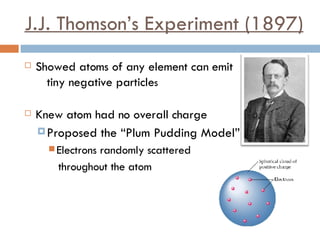
J.J. Thomson’s Experiment (1897) Showed atoms of any element can emit  tiny negative particle s Knew atom had no overall charge Proposed the “Plum Pudding Model” Electrons randomly scattered  throughout the atom
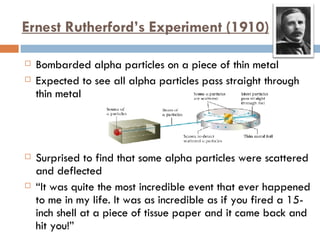
Ernest Rutherford’s Experiment (1910) Bombarded alpha particles on a piece of thin metal Expected to see all alpha particles pass straight through thin metal Surprised to find that some alpha particles were scattered and deflected “ It was quite the most incredible event that ever happened to me in my life. It was as incredible as if you fired a 15-inch shell at a piece of tissue paper and it came back and hit you!”
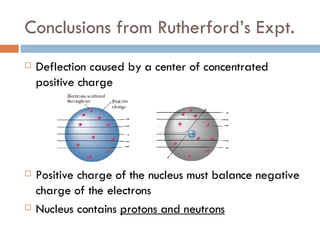
Conclusions from Rutherford’s Expt. Deflection caused by a center of concentrated positive charge  Positive charge of the nucleus must balance negative charge of the electrons Nucleus contains  protons and neutrons
Isotopes and Modern Atomic Theory Atom is comprised of: electrons, protons, and neutrons mass of electron <<< mass of proton ≈ mass of neutron Nucleus contains: Particles involved in chemical reactions are: Isotope – atoms with same number of protons, different number of neutrons Atomic number (Z) = number of protons in the nucleus Mass number (A) = sum of the number of neutrons and the number of protons Relative atomic mass = sum of all isotope masses x natural abundance
Practice Problems Write the symbol for each of the following atoms, and list the number of protons, neutrons, and electrons for each. The cesium atom with a mass number of 132. The iron atom with a mass number of 56. The silver atom that has 62 neutrons.

Lecture 2 Atomic Structure, Isotopes

  • 1.
    ATOMIC STRUCTURE ISOTOPESLecture for 10/9/07
  • 2.
    J.J. Thomson’s Experiment(1897) Showed atoms of any element can emit tiny negative particle s Knew atom had no overall charge Proposed the “Plum Pudding Model” Electrons randomly scattered throughout the atom
  • 3.
    Ernest Rutherford’s Experiment(1910) Bombarded alpha particles on a piece of thin metal Expected to see all alpha particles pass straight through thin metal Surprised to find that some alpha particles were scattered and deflected “ It was quite the most incredible event that ever happened to me in my life. It was as incredible as if you fired a 15-inch shell at a piece of tissue paper and it came back and hit you!”
  • 4.
    Conclusions from Rutherford’sExpt. Deflection caused by a center of concentrated positive charge Positive charge of the nucleus must balance negative charge of the electrons Nucleus contains protons and neutrons
  • 5.
    Isotopes and ModernAtomic Theory Atom is comprised of: electrons, protons, and neutrons mass of electron <<< mass of proton ≈ mass of neutron Nucleus contains: Particles involved in chemical reactions are: Isotope – atoms with same number of protons, different number of neutrons Atomic number (Z) = number of protons in the nucleus Mass number (A) = sum of the number of neutrons and the number of protons Relative atomic mass = sum of all isotope masses x natural abundance
  • 6.
    Practice Problems Writethe symbol for each of the following atoms, and list the number of protons, neutrons, and electrons for each. The cesium atom with a mass number of 132. The iron atom with a mass number of 56. The silver atom that has 62 neutrons.