Scope Rules
Md. Imran Hossain Showrov (showrovsworld@gmail.com)
14
1
Outline
 What is Scope Rules?
 Different Scopes Declaration
 LocalVariables
 GlobalVariables
 Formal Parameters
 Initializing Local and GlobalVariables
What is Scope Rules?
 A scope in any programming is a region of the
program where a defined variable can have its
existence and beyond that variable it cannot be
accessed.
Scopes Declaration
There are three places where variables can be declared
in C programming language −
1. Inside a function or a block which is called local
variables.
2. Outside of all functions which is called global
variables.
3. In the definition of function parameters which are
called formal parameters.
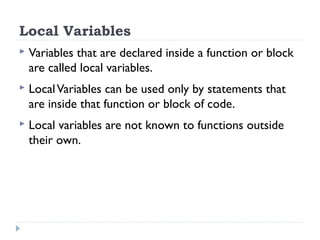
Local Variables
 Variables that are declared inside a function or block
are called local variables.
 LocalVariables can be used only by statements that
are inside that function or block of code.
 Local variables are not known to functions outside
their own.
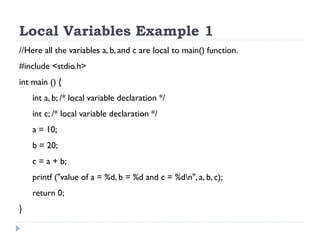
Local Variables Example 1
//Here all the variables a, b, and c are local to main() function.
#include <stdio.h>
int main () {
int a, b; /* local variable declaration */
int c; /* local variable declaration */
a = 10;
b = 20;
c = a + b;
printf ("value of a = %d, b = %d and c = %dn", a, b, c);
return 0;
}
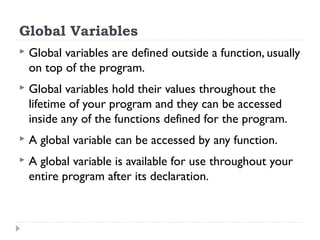
Global Variables
 Global variables are defined outside a function, usually
on top of the program.
 Global variables hold their values throughout the
lifetime of your program and they can be accessed
inside any of the functions defined for the program.
 A global variable can be accessed by any function.
 A global variable is available for use throughout your
entire program after its declaration.
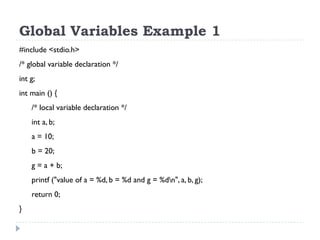
Global Variables Example 1
#include <stdio.h>
/* global variable declaration */
int g;
int main () {
/* local variable declaration */
int a, b;
a = 10;
b = 20;
g = a + b;
printf ("value of a = %d, b = %d and g = %dn", a, b, g);
return 0;
}
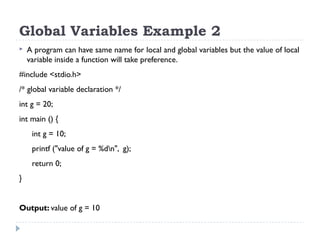
Global Variables Example 2
 A program can have same name for local and global variables but the value of local
variable inside a function will take preference.
#include <stdio.h>
/* global variable declaration */
int g = 20;
int main () {
int g = 10;
printf ("value of g = %dn", g);
return 0;
}
Output: value of g = 10
Formal Parameters
 Formal parameters, are treated as local variables
with-in a function and they take precedence over
global variables.
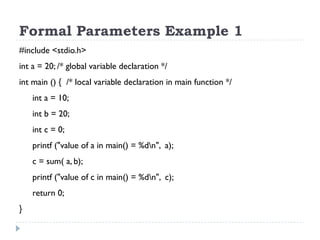
Formal Parameters Example 1
#include <stdio.h>
int a = 20; /* global variable declaration */
int main () { /* local variable declaration in main function */
int a = 10;
int b = 20;
int c = 0;
printf ("value of a in main() = %dn", a);
c = sum( a, b);
printf ("value of c in main() = %dn", c);
return 0;
}
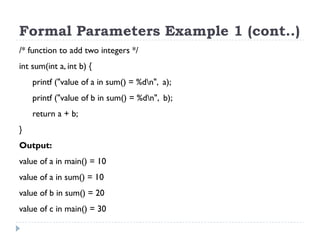
Formal Parameters Example 1 (cont..)
/* function to add two integers */
int sum(int a, int b) {
printf ("value of a in sum() = %dn", a);
printf ("value of b in sum() = %dn", b);
return a + b;
}
Output:
value of a in main() = 10
value of a in sum() = 10
value of b in sum() = 20
value of c in main() = 30
Initializing Local and Global Variables
 When a local variable is defined, it is not initialized by
the system, you must initialize it yourself.
 Global variables are initialized automatically by the
system when you define them.
Initializing Local and Global Variables
(cont..)
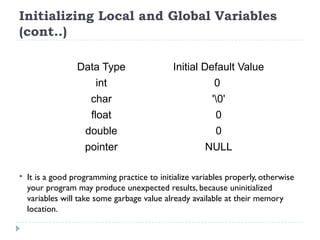
 It is a good programming practice to initialize variables properly, otherwise
your program may produce unexpected results, because uninitialized
variables will take some garbage value already available at their memory
location.
Data Type Initial Default Value
int 0
char '0'
float 0
double 0
pointer NULL
Lecture 14 - Scope Rules

Lecture 14 - Scope Rules

  • 1.
    Scope Rules Md. ImranHossain Showrov (showrovsworld@gmail.com) 14 1
  • 2.
    Outline  What isScope Rules?  Different Scopes Declaration  LocalVariables  GlobalVariables  Formal Parameters  Initializing Local and GlobalVariables
  • 3.
    What is ScopeRules?  A scope in any programming is a region of the program where a defined variable can have its existence and beyond that variable it cannot be accessed.
  • 4.
    Scopes Declaration There arethree places where variables can be declared in C programming language − 1. Inside a function or a block which is called local variables. 2. Outside of all functions which is called global variables. 3. In the definition of function parameters which are called formal parameters.
  • 5.
    Local Variables  Variablesthat are declared inside a function or block are called local variables.  LocalVariables can be used only by statements that are inside that function or block of code.  Local variables are not known to functions outside their own.
  • 6.
    Local Variables Example1 //Here all the variables a, b, and c are local to main() function. #include <stdio.h> int main () { int a, b; /* local variable declaration */ int c; /* local variable declaration */ a = 10; b = 20; c = a + b; printf ("value of a = %d, b = %d and c = %dn", a, b, c); return 0; }
  • 7.
    Global Variables  Globalvariables are defined outside a function, usually on top of the program.  Global variables hold their values throughout the lifetime of your program and they can be accessed inside any of the functions defined for the program.  A global variable can be accessed by any function.  A global variable is available for use throughout your entire program after its declaration.
  • 8.
    Global Variables Example1 #include <stdio.h> /* global variable declaration */ int g; int main () { /* local variable declaration */ int a, b; a = 10; b = 20; g = a + b; printf ("value of a = %d, b = %d and g = %dn", a, b, g); return 0; }
  • 9.
    Global Variables Example2  A program can have same name for local and global variables but the value of local variable inside a function will take preference. #include <stdio.h> /* global variable declaration */ int g = 20; int main () { int g = 10; printf ("value of g = %dn", g); return 0; } Output: value of g = 10
  • 10.
    Formal Parameters  Formalparameters, are treated as local variables with-in a function and they take precedence over global variables.
  • 11.
    Formal Parameters Example1 #include <stdio.h> int a = 20; /* global variable declaration */ int main () { /* local variable declaration in main function */ int a = 10; int b = 20; int c = 0; printf ("value of a in main() = %dn", a); c = sum( a, b); printf ("value of c in main() = %dn", c); return 0; }
  • 12.
    Formal Parameters Example1 (cont..) /* function to add two integers */ int sum(int a, int b) { printf ("value of a in sum() = %dn", a); printf ("value of b in sum() = %dn", b); return a + b; } Output: value of a in main() = 10 value of a in sum() = 10 value of b in sum() = 20 value of c in main() = 30
  • 13.
    Initializing Local andGlobal Variables  When a local variable is defined, it is not initialized by the system, you must initialize it yourself.  Global variables are initialized automatically by the system when you define them.
  • 14.
    Initializing Local andGlobal Variables (cont..)  It is a good programming practice to initialize variables properly, otherwise your program may produce unexpected results, because uninitialized variables will take some garbage value already available at their memory location. Data Type Initial Default Value int 0 char '0' float 0 double 0 pointer NULL