9

Basic Construction of C Programming Language

By kinish kumar(kinishcybersec.blogspot.in)
(www.facebook.com/kinishkumar)

                Program construction of C program should include the
    following segments:-
       1. Documentation Section
       2. Linking Section
       3. Symbolic Constant Section or Macro Section
       4. Global declaration Section
       5. Main Function Section
          {
             a.  Declaration Section
             b.  Executable Section
           }

      6.    User Define Function Definition Section


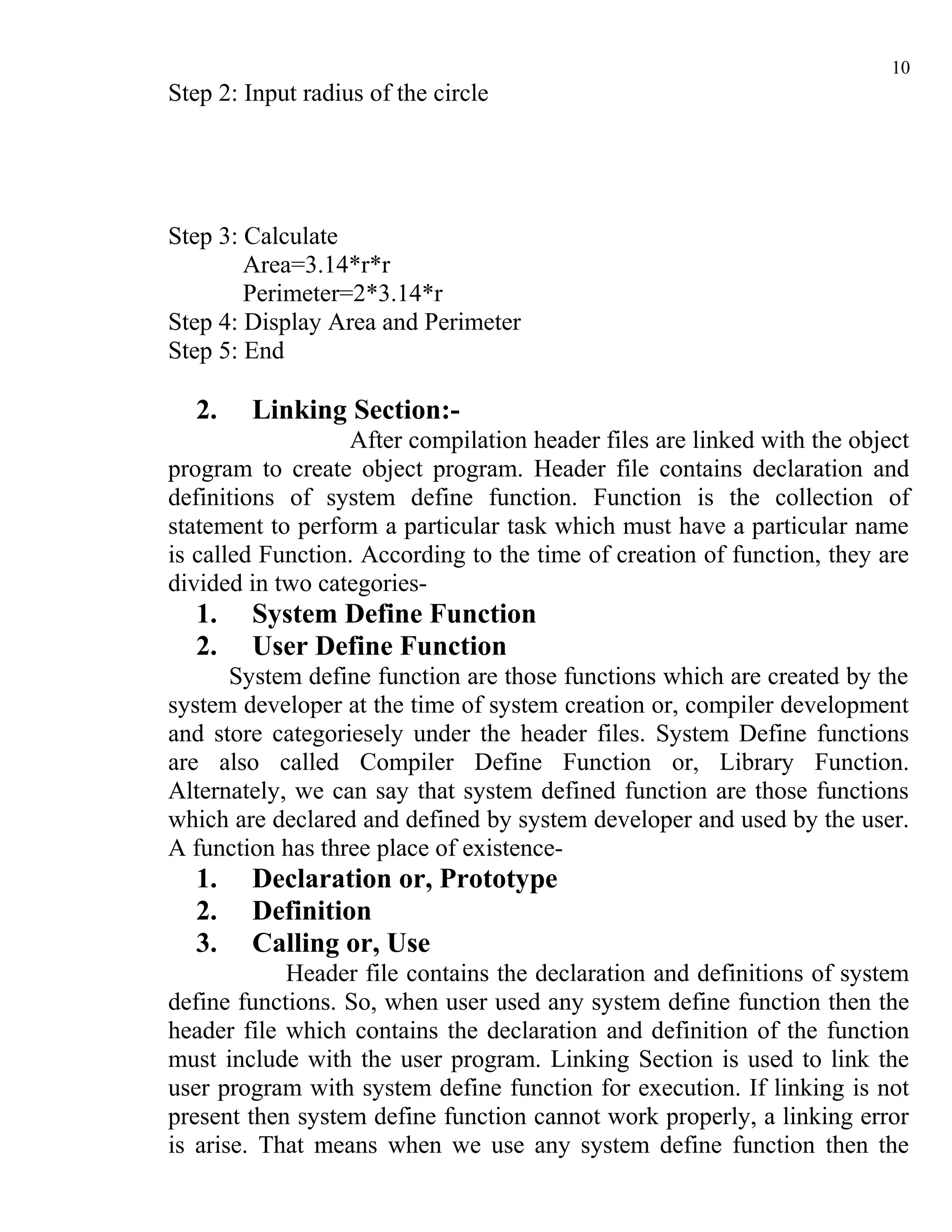
      1.    Documentation Section:-
                               It contains detail description of the problem, the
    programmer and the logic that means user can write details about the
    problem, can describe detail information about the programmer. This
    section can also contain detail algorithm of the problem. Documentation
    section generally present within comment. Comments are non executable
    statement present in C program to enhance the understandability and
    readability of C program. Documentation Section is optional. User may or
    may not write the documentation section in C program.
         For example:- Write a program to find area & perimeter of a circle.
    The documentation of above problem should be-
    /* This program is used to find area and perimeter of a circle. Developed
    by Aftab, BCA-2nd Year Student, Roll number-123 on 19-07-08 at 06:30
    PM.
       The actual logic to solve the problem is-
    Step 1: Start
10
Step 2: Input radius of the circle


Step 3: Calculate
        Area=3.14*r*r
        Perimeter=2*3.14*r
Step 4: Display Area and Perimeter
Step 5: End

  2.    Linking Section:-
                  After compilation header files are linked with the object
program to create object program. Header file contains declaration and
definitions of system define function. Function is the collection of
statement to perform a particular task which must have a particular name
is called Function. According to the time of creation of function, they are
divided in two categories-
  1.    System Define Function
  2.    User Define Function
      System define function are those functions which are created by the
system developer at the time of system creation or, compiler development
and store categoriesely under the header files. System Define functions
are also called Compiler Define Function or, Library Function.
Alternately, we can say that system defined function are those functions
which are declared and defined by system developer and used by the user.
A function has three place of existence-
  1.    Declaration or, Prototype
  2.    Definition
  3.    Calling or, Use
            Header file contains the declaration and definitions of system
define functions. So, when user used any system define function then the
header file which contains the declaration and definition of the function
must include with the user program. Linking Section is used to link the
user program with system define function for execution. If linking is not
present then system define function cannot work properly, a linking error
is arise. That means when we use any system define function then the
11
header file of the function must be linked with the user program using the
linking statement. Linking is established using

# include <header filename> or, # include “header filename”.

User define function are those type of function which are developed,
defined and used by the user as the requirement of the user.

3. Symbolic Constant Section:-
                           Constants are those type of entities that’s value
cannot be changed during program execution. Value of variable is also
called Constant. Symbolic Constant is that type of constant which are
temporary in nature and can be used in program in many positions. Any
temporary constant can be declared in C programming language using the
concept of symbolic constant as-
                            # define Max 100
     The above statement creates a symbolic constant Max that’s value is
10 and can be used in any position in a C program but cannot be changed
the value of the constant. Symbolic constant are generally used in those
situation where a particular constant is used repeatedly in a C program.
Symbolic constants are used to increase the debugging process of a C
program.
          User can store statements under a particular names, those type of
name is called Macro. Macro is an identifier that can store collection of
statement to perform some particular task and which is repeatedly used in
a C program. When a macro is called then the control is not transferred to
the statement present in the macro. The statements are inserted at the
calling position of the macro.
For example-
# define pf
printf(“n Enter a no.”);
Scanf(“%d”,&a)
  4.    Global Declaration Section:-
                   Variables are those type of elements that value can be
changed during program execution. Alternately, we can say that variable
are the name of memory location that’s value can be changed during
program execution. According to the scope or visibility, variables are
divided in two categories:-
12
  1.    Global Variable
  2.    Local Variable


Global variables are those type of variables thats value can be accessed in
any position of the entire program. Global variables are also called
External Variable. If user wants to create any global variable then the
variable should be declared in the global declaration section.
       Local variable are those types of variables which are visible in a
particular function in which they are declared. That means local variables
are visible in a particular segment of a C program. Local variables are
also called Internal Variable. Local variables are divided in three
categories:-
  1. Auto Variable
  2. Static Variable
  3. Register Variable

5. Main Function Section:- It contains a main function which is the
execution starting point of a C program. Every C program must contain a
main function but only single copy can be present. That means a C
program cannot contain more than one main function. The opening brace
of main function is the logical starting point of execution and
corresponding closing brace is the logical ending point of execution. Main
function is divided in two code segment-
a). Declaration Section
b). Executable Section
        Declaration Section contains all the variables which can be used in
the main function. This section is generally used to declare all the time
variables which can be used in the main function. Since, C language is a
typed programming language so, every variable must be declared before
their used.
          Executable section contains actual segments which can produce
output after execution. That means actual executable statement should be
present in the executable section.
6. User Define Function Definition:-
    We know that a function has three place of existence-
a). Declaration or, Prototype of function
13
b). Calling or Use of function
c). Definition of the function


User define function are those functions which are declared, defined and
used by the user. Function is by default global. So, declaration of the
function should be present in the global declaration section. Function
cannot be local in any situation. Actually, executable statements are
present in the executable section of main function. So, calling of function
is performed in the executable section of main function. The definition of
user define function are present after the closing brace of main function in
any order. That means the definition of user defined functions can be of
any order as the choice of the user.


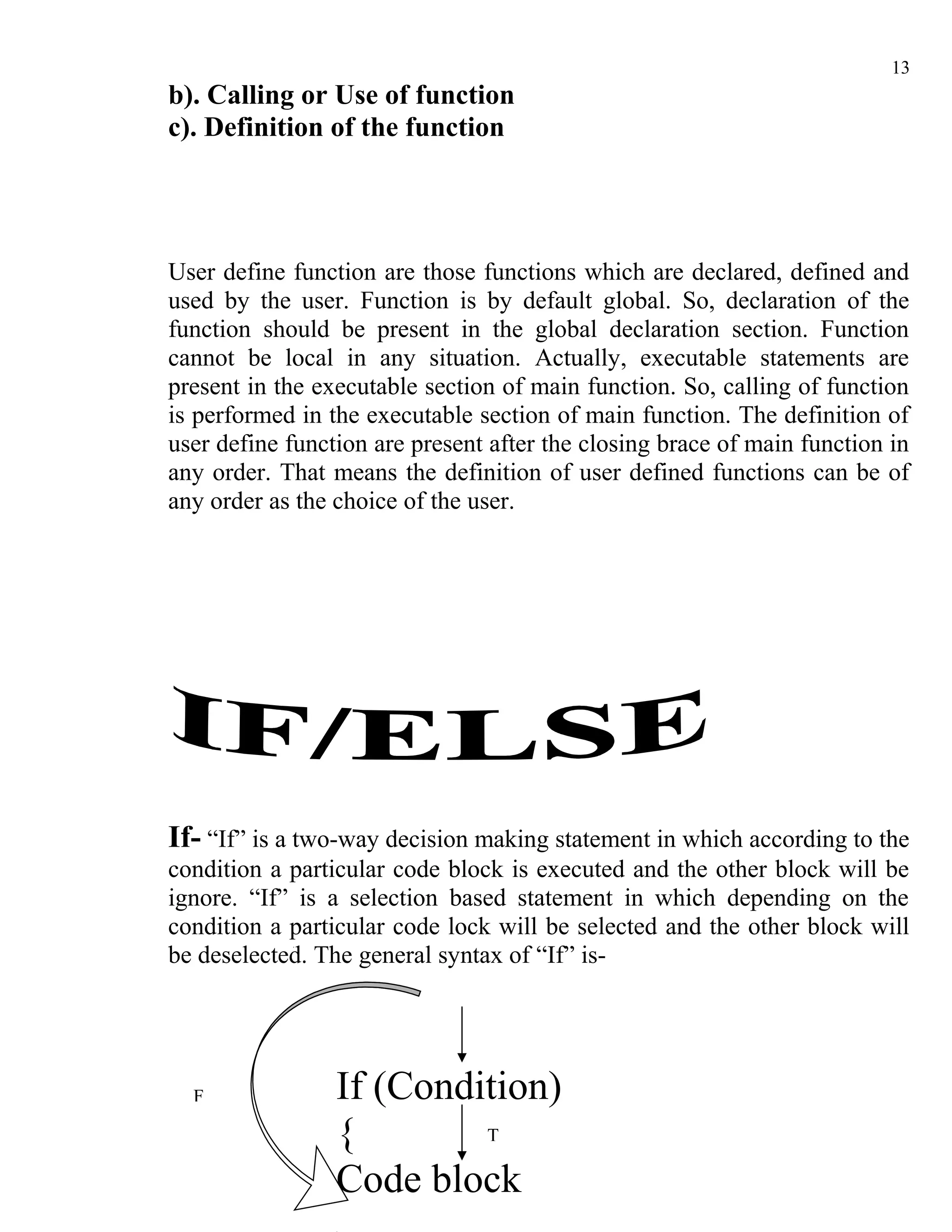
If- “If” is a two-way decision making statement in which according to the
condition a particular code block is executed and the other block will be
ignore. “If” is a selection based statement in which depending on the
condition a particular code lock will be selected and the other block will
be deselected. The general syntax of “If” is-


  F              If (Condition)
                 {        T

                 Code block
14

                }


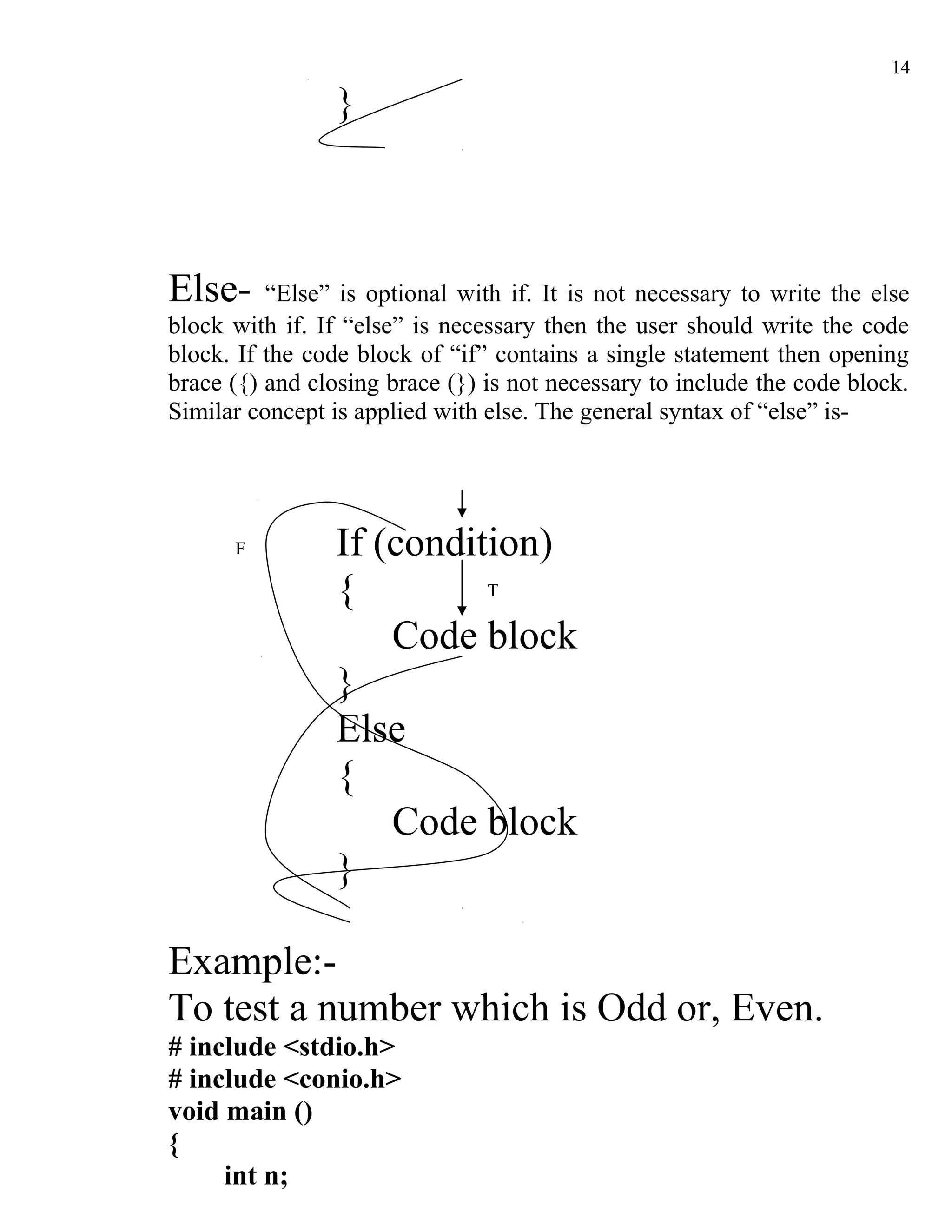
Else-     “Else” is optional with if. It is not necessary to write the else
block with if. If “else” is necessary then the user should write the code
block. If the code block of “if” contains a single statement then opening
brace ({) and closing brace (}) is not necessary to include the code block.
Similar concept is applied with else. The general syntax of “else” is-


      F         If (condition)
                {         T

                    Code block
                }
                Else
                {
                    Code block
                }

Example:-
To test a number which is Odd or, Even.
# include <stdio.h>
# include <conio.h>
void main ()
{
     int n;
15
       clrscr ();
       printf ("n Enter an Integer Number : ");
       scanf ("%d",&n);
       if (n%2==0)

    {
              printf ("n %d is Even Number.",n);
       }
       else
       {
              printf ("n %d is Odd Number.",n);
       }
       getch ();
       }


Loop is a program construction by which a particular code block will be
executed depending on some condition repeatedly. That means Loop is a
program construction by which a code block can be repeatedly executed.
Generally a loop contains two segments:-
  1.     Condition
  2.     Code Block

     According to the position of the condition loops are divided in two
categories-
a). Entry Controlled Loop
b). Exit Controlled Loop
16


                       Entry Controlled Loop
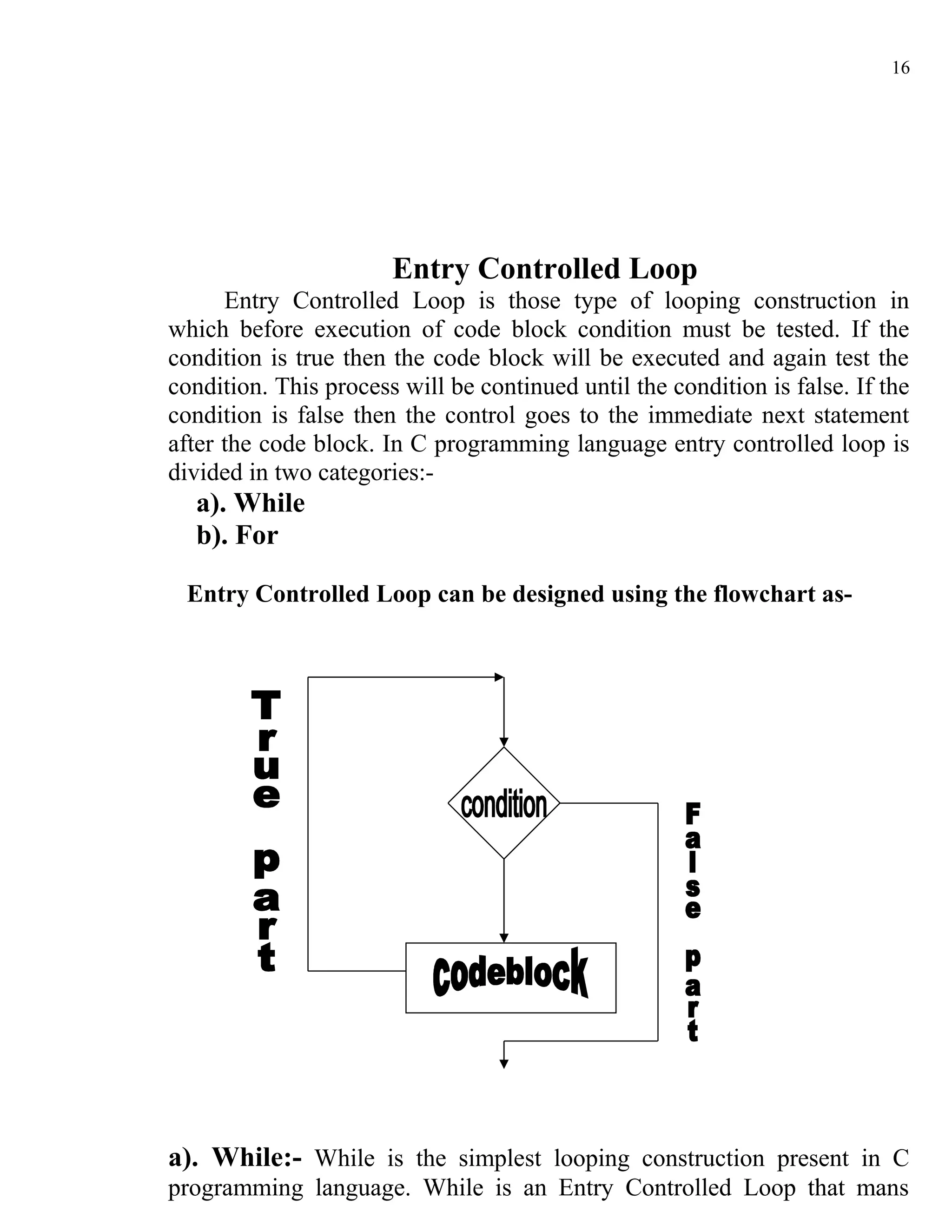
      Entry Controlled Loop is those type of looping construction in
which before execution of code block condition must be tested. If the
condition is true then the code block will be executed and again test the
condition. This process will be continued until the condition is false. If the
condition is false then the control goes to the immediate next statement
after the code block. In C programming language entry controlled loop is
divided in two categories:-
  a). While
  b). For

 Entry Controlled Loop can be designed using the flowchart as-


a). While:- While is the simplest looping construction present in C
programming language. While is an Entry Controlled Loop that mans
17
before execution of code block, condition must be tested. If the condition
is true then the code block will be executed and again test the condition.
This process will continue till the condition is true. If the condition is
false then the control goes to the immediate next statement after the code
block. The general syntax of While is-

Example-
i=1;
while (i<=10)
{
     Printf (“n A.K.Singh”);
     i++;
}

Note:-     While loop is appropriate used in those situation where the
starting point of the loop and the ending point of the loop is present but
the increment and decrement is not present.

b). For:-     For is also an Entry Controlled Loop that means before
execution of code block condition must be tested. If the condition is true
then the code lock will be executed and again test the condition. This
process will continue until the condition is false. If the condition is false
then the control goes to the immediate next statement after the code block.
If the code block contains a single statement then the opening brace and
the closing brace is not necessary to inclose the code block. The general
syntax of For is:-

Example:-
For (i=1;i<=10;i++)
{
     Printf (“n A.M.COLLEGE”);
}
      The above code segment will display the name “A.M.COLLEGE”
10 times.

Note:- For loop is appropriately used to handle those type of situation in
which initialization, condition and increment/decrement is given.
18
Alternately, we can say that For loop is appropriate to handle Arithmetic
Progression.


                    Exit Controlled Loop
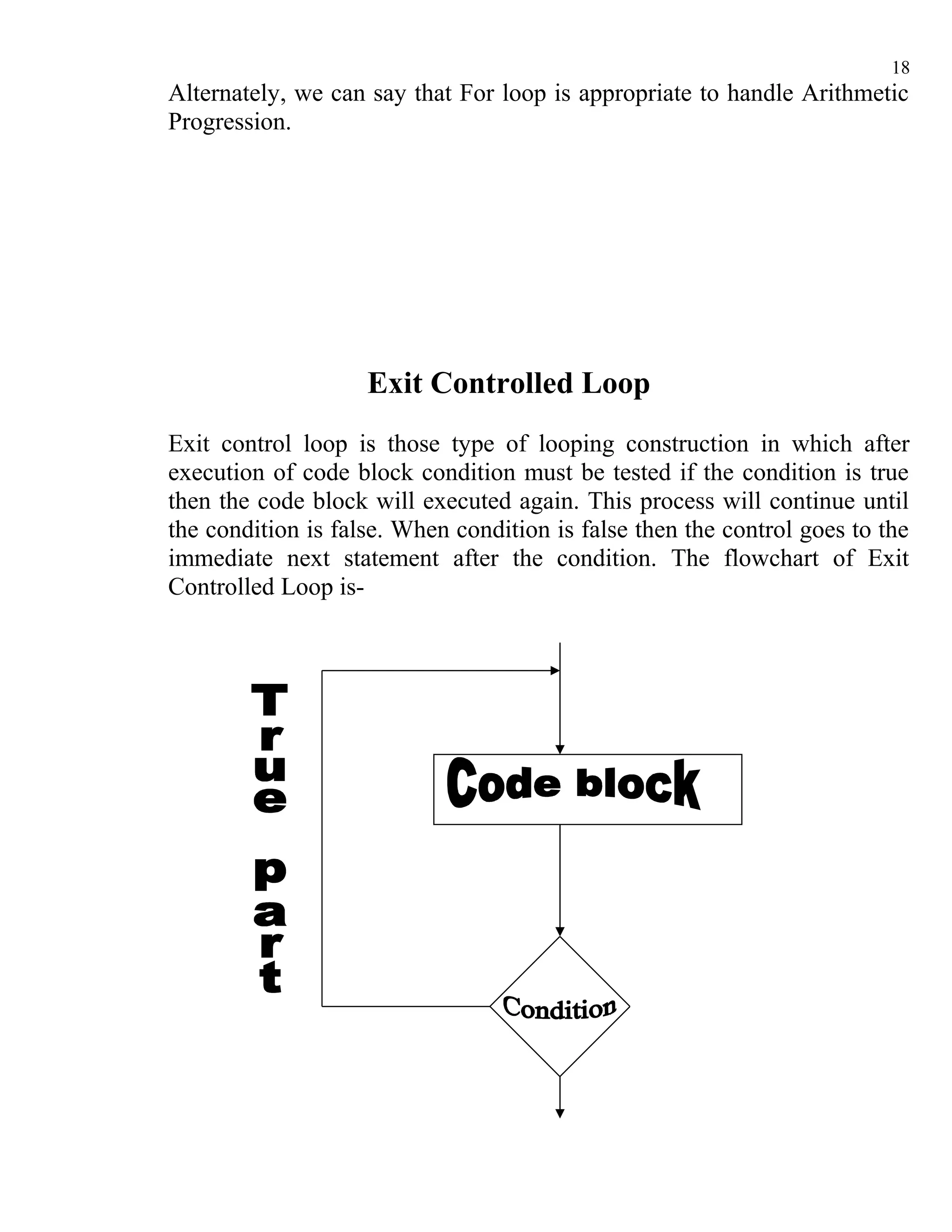
Exit control loop is those type of looping construction in which after
execution of code block condition must be tested if the condition is true
then the code block will executed again. This process will continue until
the condition is false. When condition is false then the control goes to the
immediate next statement after the condition. The flowchart of Exit
Controlled Loop is-
19
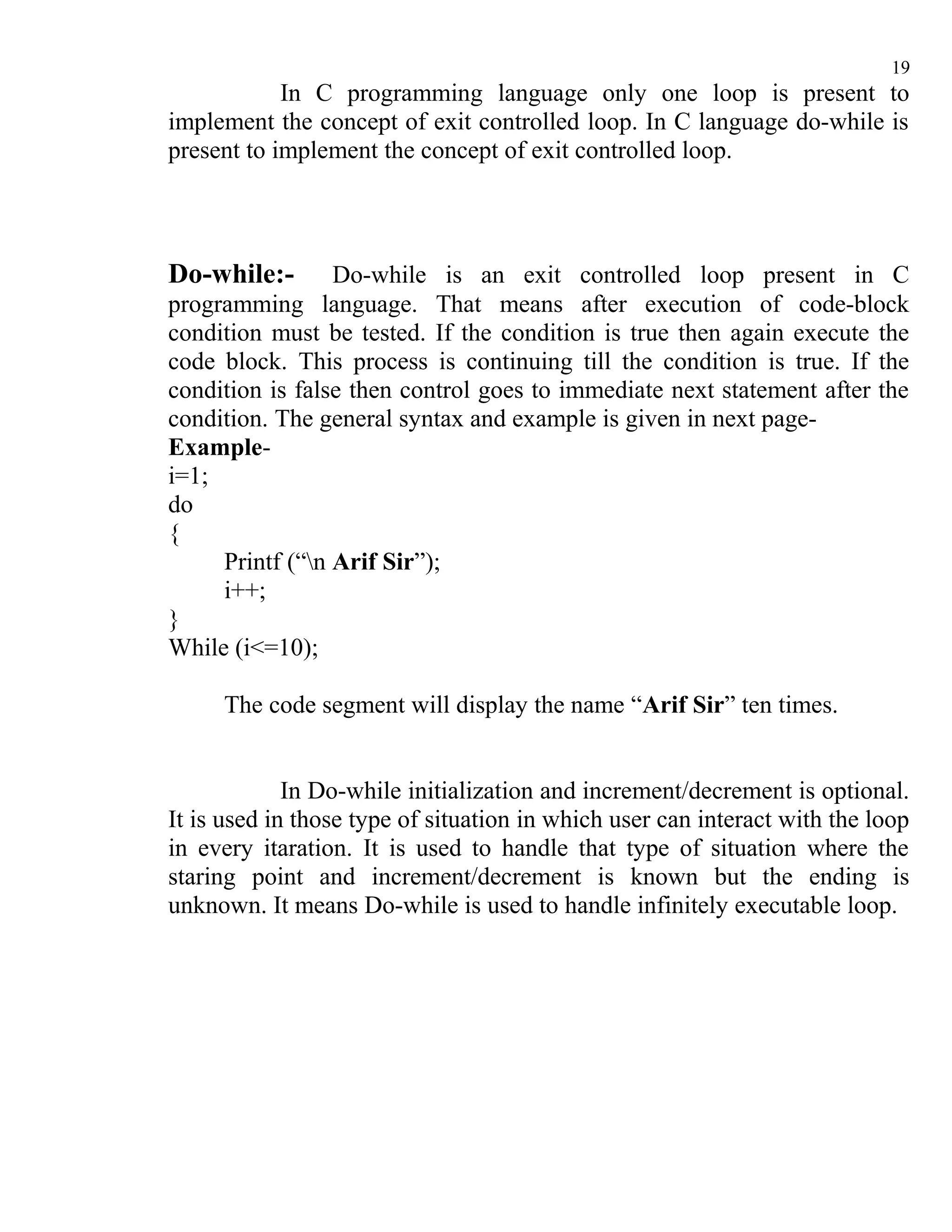
            In C programming language only one loop is present to
implement the concept of exit controlled loop. In C language do-while is
present to implement the concept of exit controlled loop.


Do-while:-       Do-while is an exit controlled loop present in C
programming language. That means after execution of code-block
condition must be tested. If the condition is true then again execute the
code block. This process is continuing till the condition is true. If the
condition is false then control goes to immediate next statement after the
condition. The general syntax and example is given in next page-
Example-
i=1;
do
{
     Printf (“n Arif Sir”);
     i++;
}
While (i<=10);

     The code segment will display the name “Arif Sir” ten times.


             In Do-while initialization and increment/decrement is optional.
It is used in those type of situation in which user can interact with the loop
in every itaration. It is used to handle that type of situation where the
staring point and increment/decrement is known but the ending is
unknown. It means Do-while is used to handle infinitely executable loop.
20


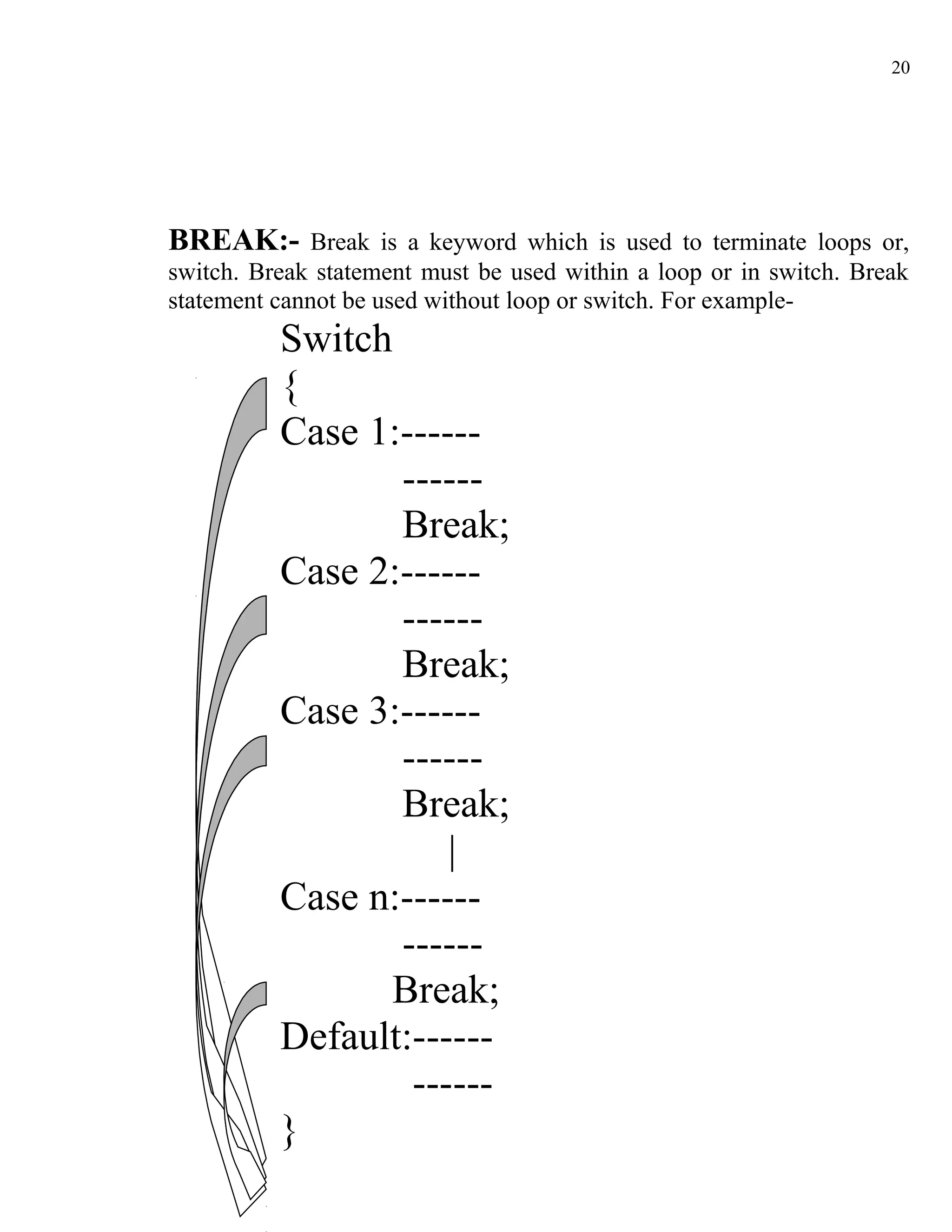
BREAK:- Break is a keyword which is used to terminate loops or,
switch. Break statement must be used within a loop or in switch. Break
statement cannot be used without loop or switch. For example-
          Switch
          {
          Case 1:------
                 ------
                 Break;
          Case 2:------
                 ------
                 Break;
          Case 3:------
                 ------
                 Break;
                     |
          Case n:------
                 ------
                Break;
          Default:------
                  ------
          }
21

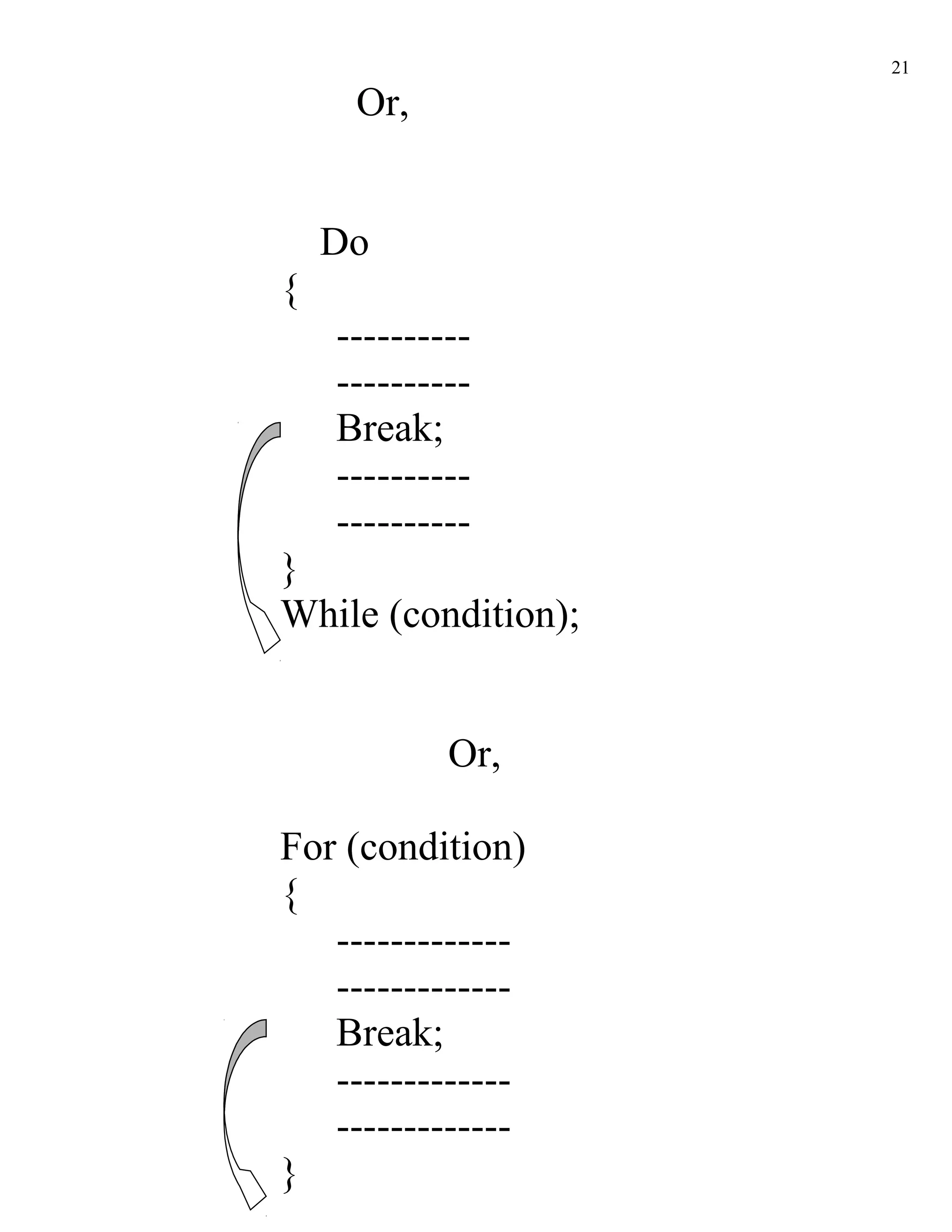
     Or,


    Do
{
    ----------
    ----------
    Break;
    ----------
    ----------
}
While (condition);


            Or,

For (condition)
{
   -------------
   -------------
   Break;
   -------------
   -------------
}
22

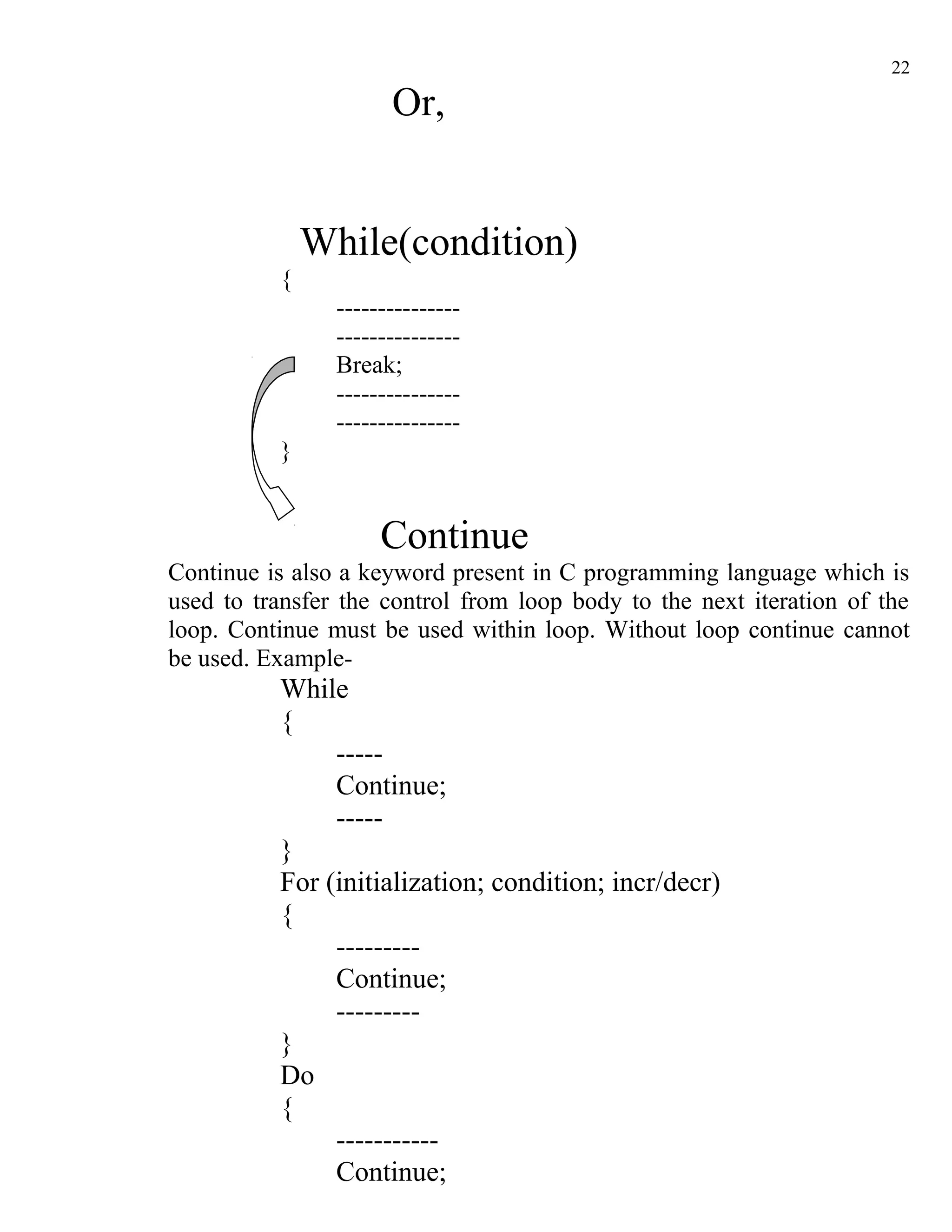
                      Or,


              While(condition)
          {
                ---------------
                ---------------
                Break;
                ---------------
                ---------------
          }


                     Continue
Continue is also a keyword present in C programming language which is
used to transfer the control from loop body to the next iteration of the
loop. Continue must be used within loop. Without loop continue cannot
be used. Example-
          While
          {
               -----
               Continue;
               -----
          }
          For (initialization; condition; incr/decr)
          {
               ---------
               Continue;
               ---------
          }
          Do
          {
               -----------
               Continue;
23
                -----------
           }
           While (condition);


Collection of similar type of element in a linear form is called Array.
Alternately, we can define array is a common name shared by various
variable of same type and allocates contiguous memory space in the
primary memory RAM. Array is also called vector or subscripted variable
or, index variable. The index number is start from o & up to size-1 of the
array. Variable present in the array are represented using the name of the
array and the subscript of the block. So, it is also called Subscripted
variable. If an array contains a single row then it is called Single
Dimensional Array or, Single Subscripted Variable. If the array contains
more then one row then it is called Two-Dimensional Array. That means
collection of single dimensional array is called Two-Dimensional Array.
Two-Dimensional Array is also called Double Subscripted Variable. The
first subscript indicates the row and the second subscript indicates the
column. Two-Dimensional Array is also called Matrix in mathematics,
Table in accounting. Collection of TWO-Dimensional Array is called
Three-Dimensional Array or, Triple Subscripted Variable. The first
subscript indicates the height, second subscript indicates the row and the
third subscript indicates the column. In C language maximum 15
dimensional array is allowed. C compiler is not capable to handle more
than 15 dimensional array.
Advantages of Array:-
 The following advantages can be achieved using the concept of an
Array-

1.Using a single statement huge number of variable can be declared using
the concept an Array. For example:-
      Int a[100]
 The above statement declares 100 integer type variable.

2. Huge number of variable can be handled very easily and efficiently
using the concept of array.
24

3. Since, array allocates contiguous memory spaces in the primary
memory RAM. So, the access time of array variable is minimum.
Consiquently, the processing speed is maximum.


4. Internally the concept of array is implemented using the concept of
pointer without pointer array cannot be implemented. Since, array
internally is a pointer so, the execution speed of array is just four times
faster than the speed of normal variable.


Disadvantages f array:-
     The following disadvantages are present with array-

1. It is not possible to store different types of values in a particular array.
Since, all the variable present in array is of same type.

2. We cannot store much number of values than the size of the array. That
means, if the size of an array is n then we cannot store more than n
different values.

3. If the size of an array is maximum(huge) then the chances of memory
wastage is maximum.

4. Insertion operation is very time consuming operation due to right
shifting of all elements present in the right side of the insertion point.

5. Similarly, deletion is also time consuming process due to left shift
operation of all the values present in the right side of the deletion point.
      General syntax to declare an array is-
           Data-type array name[size]
The data-type indicates the type of values which can be stored in the
array. The data-type can be any system defined data-type like int, float,
double, long double etc. It can be any derived data-type like pointer. The
data can be any user-defined data-type like Structure and Union.
25
Array name can be any legal identifier name allowed in C-programming.
That means array name must be start with an alphabet or underscore(_)
and can be up to 32 character of length. In array name capital letter, small
letter and mixed form characters can be used. Only one special symbol
underscore (_) can be used in array name, No other special symbol even
space cannot be used in array name. The size of array can be any positive
integer number greater than one. Generally, size of array is any positive
integer greater than one but positive floating point can also used as array
size but the integer part of the number is treated as the size of the array.
For example-
                  Int a[10];
       The above declaration declares an array of integer types of 10 block
and allocates memory in the primary memory RAM as-


  0,0   0,1   0,2   0,3   0,4   0,5   0,6   0,7   0,8   0,9


Collection of single dimensional array is called Two-Dimensional Array.
The first dimension indicates the row and the second indicates the
column. Two-Dimensional Array is also called Double-Subscripted
variable because every block of a Two-Dimensional array is represented
using two subscript. The first subscript represents the row and the second
subscript represents the column. In mathematics Two-Dimensional array
is called Matrix and in physics it is called as Two-Dimensional Vector.
The main purpose of Two-Dimensional array is to handle table data (the
data stored in tubular format). The general syntax to declare Two-
Dimensional Array is-
      Data-type array name[rows][columns];
26
      The Data-type indicates the type of values which can be stored in
the array. In C programming language can be any standard data-type or,
any user defined data-type like Structure and Union. Array name can be
any legal identifier name allowed in C programming language. The rows
must be any positive integer number greater than or equal to one.
Similarly, columns must be any positive number greater than or equal to
one but both the values cannot be one at a time. For example-
            Int A[3][4]

     The above declaration declares a Two-Dimensional Array of three
rows and four columns which depicted (picturised form) as:-
                0A        1            2           3
             00         01          02            03            0
             10           11           12           13
             20           21           22           23
        1
        2


The subscript is written in the blocks. It rows and columns are equal then
the matrix is called Square Matrix. In the above graphical representation
we can see that A row contains that number of elements equal to the size
of the column. Similarly, a column contains that number of elements
equal to the row of the matrix. It is also noticed that row wise second
subscript is incremented and column wise. The first subscript is increased.
The memory representation of the above Two-Dimensional array is-


Array of character is called String. That means linear collection of
character in linear form is called String. String value must be
enclosed with double quotes and terminated by a null character
generally supplied by the compiler. The null character indicates the
end of the string. String variable must be a character type. If a string
27
variable contains a single row then it is called Single Dimensional
String. If the string contains more than one row then it is called Two-
Dimensional String. The general syntax to declare string variable of
single dimension is-
      Char var name [size];
For Example:-
      Char A[135];
      The above declaration declares a string variable A of 135
character size. In C language the variable can store 135 character
excluding null character but in C++ the variable can store 134
characters excluding null character.
Note:- In C &C++ bound checking of string variable is not present.
So, string variable can store more number of characters than the size
of the variable but it is situation dependent. The general syntax to
declare two-dimensional string variable is-
             Char varname[rows][size of rows/column]
For example:-
      Char A[135][8]


In the above declaration declares a two dimensional string variable A of
135 row and 8 columns. That means each row can store 8 characters in
 in C language


Named block of statement to perform a particular task is called Function.
Collection of statement which must have a particular name to perform a
particular task is called Function. The main purpose of function is to re-
use the existing code and easily debugging code.
      We know that C is a modular programming language i.e. C language
has the capability to decompose a large program to smaller segment and
at the end all the segment can combined and produces the actual program.
In C programming language concept of modular programming is
implemented using the concept of function.
Advantage of Function:-
     The following advantages are present in function-
28
  1.     The concept of code re-use ability can be implemented using
         function i.e. a function can be used in any program as the
         requirement of the user without modifying the existing code.

  2.     Using function existing code can be re-used consequently the
         productivity of the programmer will be maximized and product
         cost as well as maintenance cost will be minimized.

  3.     Product cost and maintenance cost are minimized due to the
         concept of function. If product cost and maintenance are
         minimum then the acceptability will be maximum.

  4.     Using function existing code can be re-used by creating users
         own header files, which also hides the existing code but can
         perform particular task as the requirement of the user. Using the
         concept of header file security of code will be increased.


  Disadvantages of function:-
       The following disadvantages are present with function-

  1.     Understandability of program is decreased because actual code is
         present in another file which actually produced the required
         output which is not visible to the user.
  2.     Execution speed of program is decreased due to fluctuations of
         control bellowing Calling Function and Called Function.
  3.     Space complexity of a program is increased due to reallocation of
         memory at the time of execution. This also noticed that the size
         of a program is increased using the concept of function. So, the
         execution speed will be decreased.

            Components of Function
The general representation is-
29
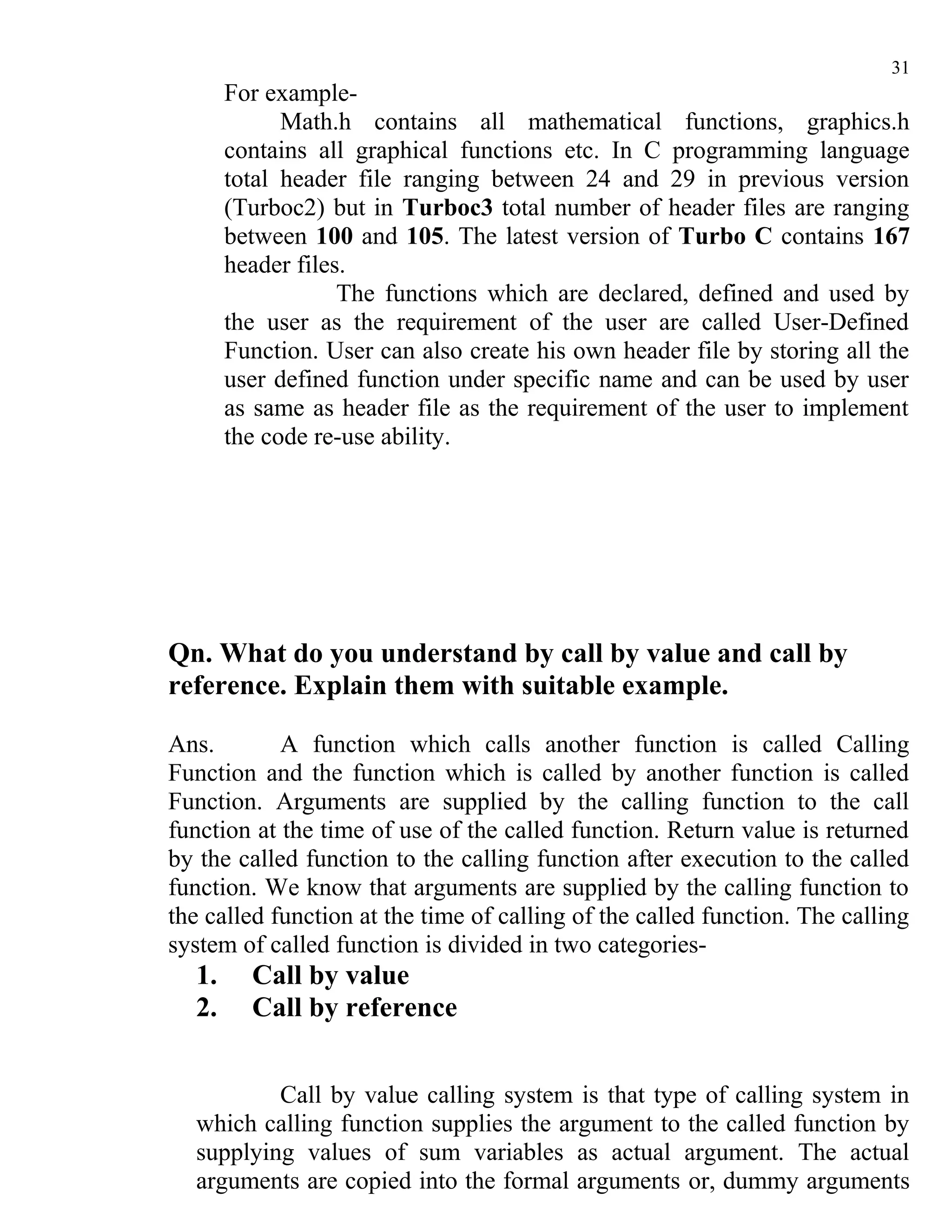
                      Y= f(x)
Where, x is the argument or parameter, f is the function name and y is the
return value. So, any programming language a function has three
components-
   1.   Function name
   2.   Argument
   3.   Return value or return type

Function name is any legal identifier allowed in C programming
language. The argument is the initial values which must be supplied by
the calling function to the called function at the time of activation of the
called function. The function which calls another function is called
Calling Function and the function which is called by another function is
known as Called Function. The arguments supplied by the calling
function to the called function at the time of calling. A function can take
any number of argument and any type of argument allowed in C


programming language. The return type indicates the type of value which
should be return by the called function to the calling function after
execution of the called function. The return type can be any data type
allowed in C programming language.

              TYPES OF FUNCTION
We know that function has three components-Function name, argument
and returned type. It is also known to us that function name is fixed for a
particular function but argument and return type can be changed.
According to the argument and return type function is divided in four
categories-
  1.    With return with argument
  2.    With return without argument
  3.    Without return with argument
  4.    Without return without argument
                       A function has three place of existence that means a
  function is present in three locations in program-
30
1. Declaration or, Prototype
2. Calling or Use
3. Definition or Body
   The declaration or prototype of a function declares the name of the
function and the type of arguments separated by comma and the return
type of the returned value. The declaration or prototype is present in
the global declaration section of the program because functions are
global by default. Functions cannot be local in any situation in C
programming language. The prototype can also be present in the
declaration section of main function, but in this situation function is
also global. The calling or use is the actual invocation point of the
called function by the calling function. In this position actual
arguments are supplied by the calling function to the called function.
After that, control goes to the function definition to process the actual
task. A function may be called many times in any location of another
function or, in the same function as the requirement of the user.


The function definition is the actual code block to perform the task
specified by the user. Generally the function definition or body present
after the closing brace of main function. If a program contains more
than one function then the function definition can be present in any
order as the choice of the user. A program can contain any number of
functions and can be called in any order and can be declare in any
order. A particular function can return a single value after execution to
the calling function more than one function cannot be returned by
called function to the calling function.
                                           According to the declaration
and definition functions are divided in two categories:-
  1.    System Defined Function
  2.    User Defined Function
             System Defined Functions are that type of function
  which are declared and defined by the system developers at the time
  of system development and stored in compiled form under header
  files and used by the users as the requirement of the user. The
  container of system defined function group wise is called Header
  File.
31
       For example-
             Math.h contains all mathematical functions, graphics.h
       contains all graphical functions etc. In C programming language
       total header file ranging between 24 and 29 in previous version
       (Turboc2) but in Turboc3 total number of header files are ranging
       between 100 and 105. The latest version of Turbo C contains 167
       header files.
                   The functions which are declared, defined and used by
       the user as the requirement of the user are called User-Defined
       Function. User can also create his own header file by storing all the
       user defined function under specific name and can be used by user
       as same as header file as the requirement of the user to implement
       the code re-use ability.


Qn. What do you understand by call by value and call by
reference. Explain them with suitable example.

Ans.        A function which calls another function is called Calling
Function and the function which is called by another function is called
Function. Arguments are supplied by the calling function to the call
function at the time of use of the called function. Return value is returned
by the called function to the calling function after execution to the called
function. We know that arguments are supplied by the calling function to
the called function at the time of calling of the called function. The calling
system of called function is divided in two categories-
  1.     Call by value
  2.     Call by reference


          Call by value calling system is that type of calling system in
  which calling function supplies the argument to the called function by
  supplying values of sum variables as actual argument. The actual
  arguments are copied into the formal arguments or, dummy arguments
32
of the called function and the dummy arguments must be identical with
type but not necessary same named. In call by value call system actual
and formal arguments allocate distinct memory and they are not linked
internally. So, any changing of dummy variable cannot effect on actual
argument. Similarly, any changing of actual argument cannot effect on
dummy argument. That means in call by value calling system no
internal linking is established between the calling function and the
called function.


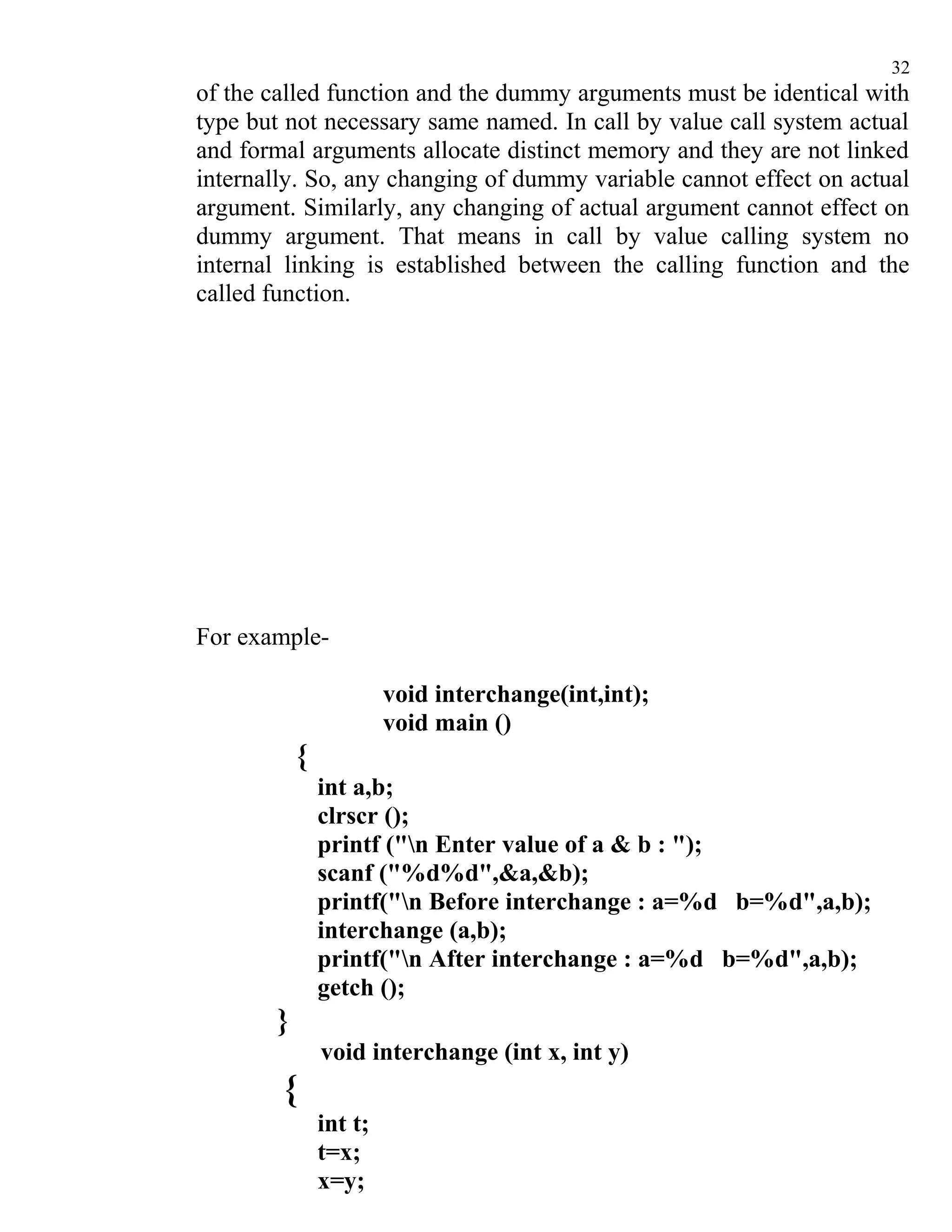
For example-

                        void interchange(int,int);
                        void main ()
           {
               int a,b;
               clrscr ();
               printf ("n Enter value of a & b : ");
               scanf ("%d%d",&a,&b);
               printf("n Before interchange : a=%d b=%d",a,b);
               interchange (a,b);
               printf("n After interchange : a=%d b=%d",a,b);
               getch ();
       }
               void interchange (int x, int y)
        {
               int t;
               t=x;
               x=y;
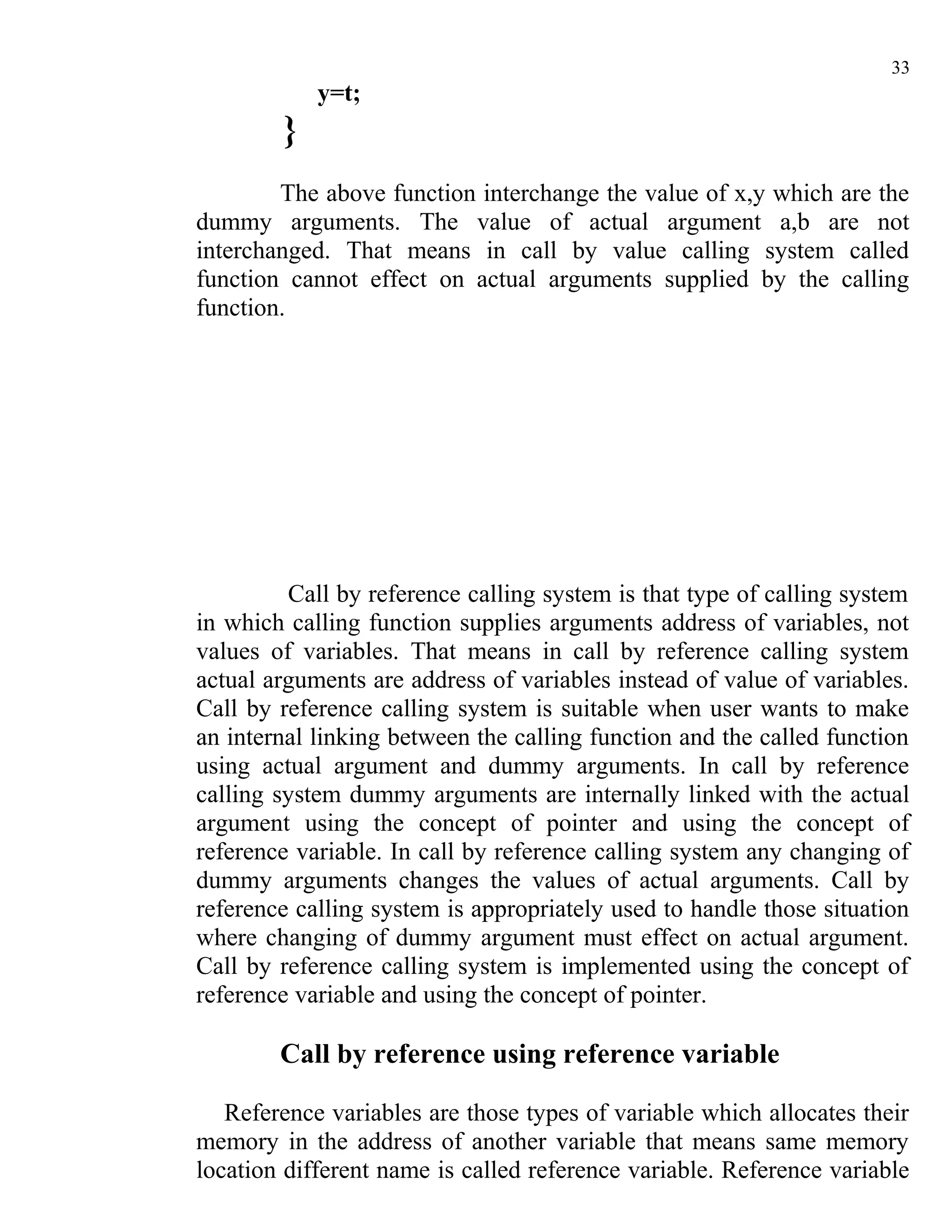
33
            y=t;
        }
        The above function interchange the value of x,y which are the
dummy arguments. The value of actual argument a,b are not
interchanged. That means in call by value calling system called
function cannot effect on actual arguments supplied by the calling
function.


         Call by reference calling system is that type of calling system
in which calling function supplies arguments address of variables, not
values of variables. That means in call by reference calling system
actual arguments are address of variables instead of value of variables.
Call by reference calling system is suitable when user wants to make
an internal linking between the calling function and the called function
using actual argument and dummy arguments. In call by reference
calling system dummy arguments are internally linked with the actual
argument using the concept of pointer and using the concept of
reference variable. In call by reference calling system any changing of
dummy arguments changes the values of actual arguments. Call by
reference calling system is appropriately used to handle those situation
where changing of dummy argument must effect on actual argument.
Call by reference calling system is implemented using the concept of
reference variable and using the concept of pointer.

        Call by reference using reference variable

   Reference variables are those types of variable which allocates their
memory in the address of another variable that means same memory
location different name is called reference variable. Reference variable
34
is also called Alias. Reference variable must be initialized with same
variables not values. Reference variable allocates the memory in the
same location of the address of the variable by which it initialized.


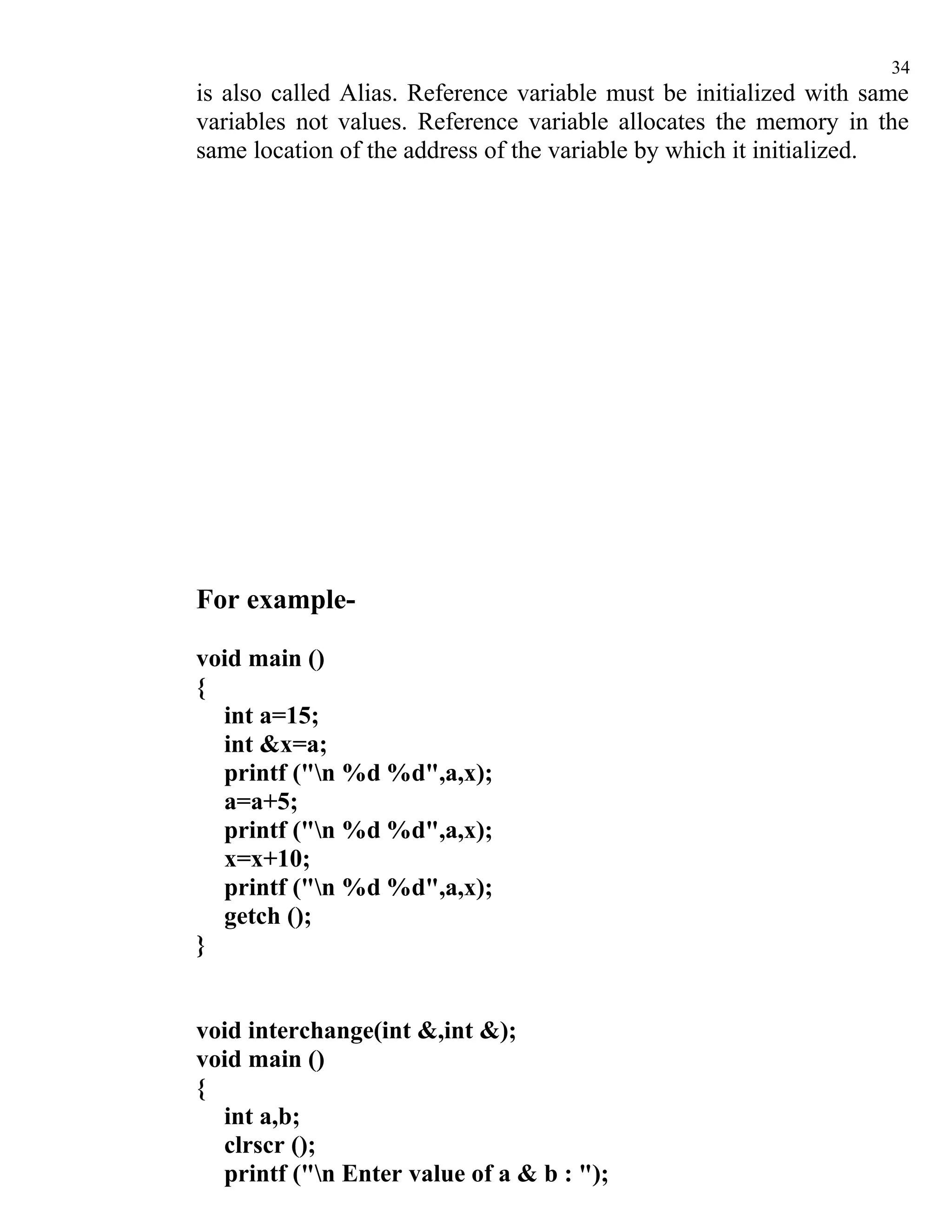
For example-

void main ()
{
  int a=15;
  int &x=a;
  printf ("n %d %d",a,x);
  a=a+5;
  printf ("n %d %d",a,x);
  x=x+10;
  printf ("n %d %d",a,x);
  getch ();
}


void interchange(int &,int &);
void main ()
{
  int a,b;
  clrscr ();
  printf ("n Enter value of a & b : ");
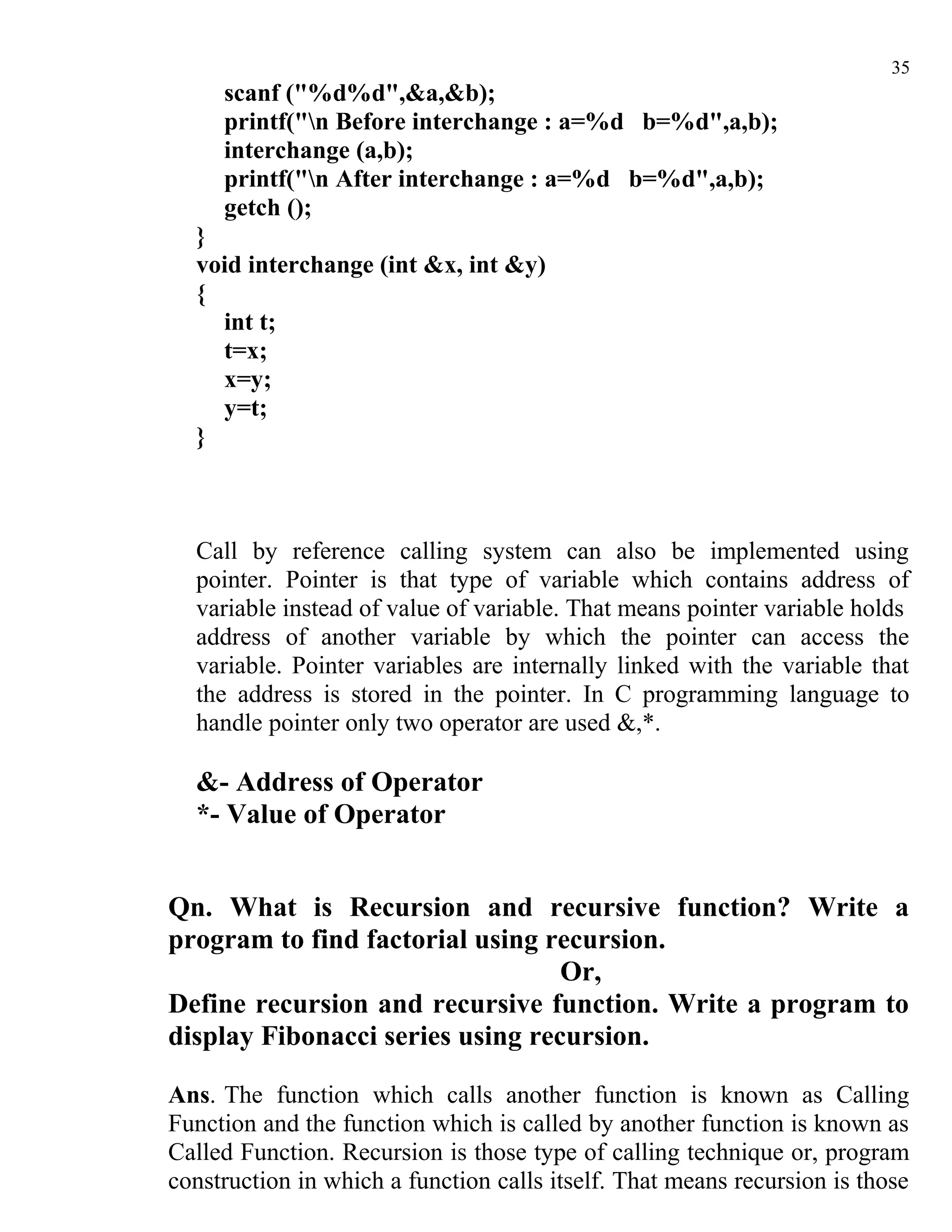
35
     scanf ("%d%d",&a,&b);
     printf("n Before interchange : a=%d b=%d",a,b);
     interchange (a,b);
     printf("n After interchange : a=%d b=%d",a,b);
     getch ();
  }
  void interchange (int &x, int &y)
  {
    int t;
    t=x;
    x=y;
    y=t;
  }


  Call by reference calling system can also be implemented using
  pointer. Pointer is that type of variable which contains address of
  variable instead of value of variable. That means pointer variable holds
  address of another variable by which the pointer can access the
  variable. Pointer variables are internally linked with the variable that
  the address is stored in the pointer. In C programming language to
  handle pointer only two operator are used &,*.

  &- Address of Operator
  *- Value of Operator


Qn. What is Recursion and recursive function? Write a
program to find factorial using recursion.
                                  Or,
Define recursion and recursive function. Write a program to
display Fibonacci series using recursion.

Ans. The function which calls another function is known as Calling
Function and the function which is called by another function is known as
Called Function. Recursion is those type of calling technique or, program
construction in which a function calls itself. That means recursion is those
36
type of program construction in which the calling function and the called
function are same. The function which is used to implement the concept
of recursion is known as Recursive Function. Recursion is divided in two
categories:-
  1.       Direct Recursion
  2.       Indirect Recursion

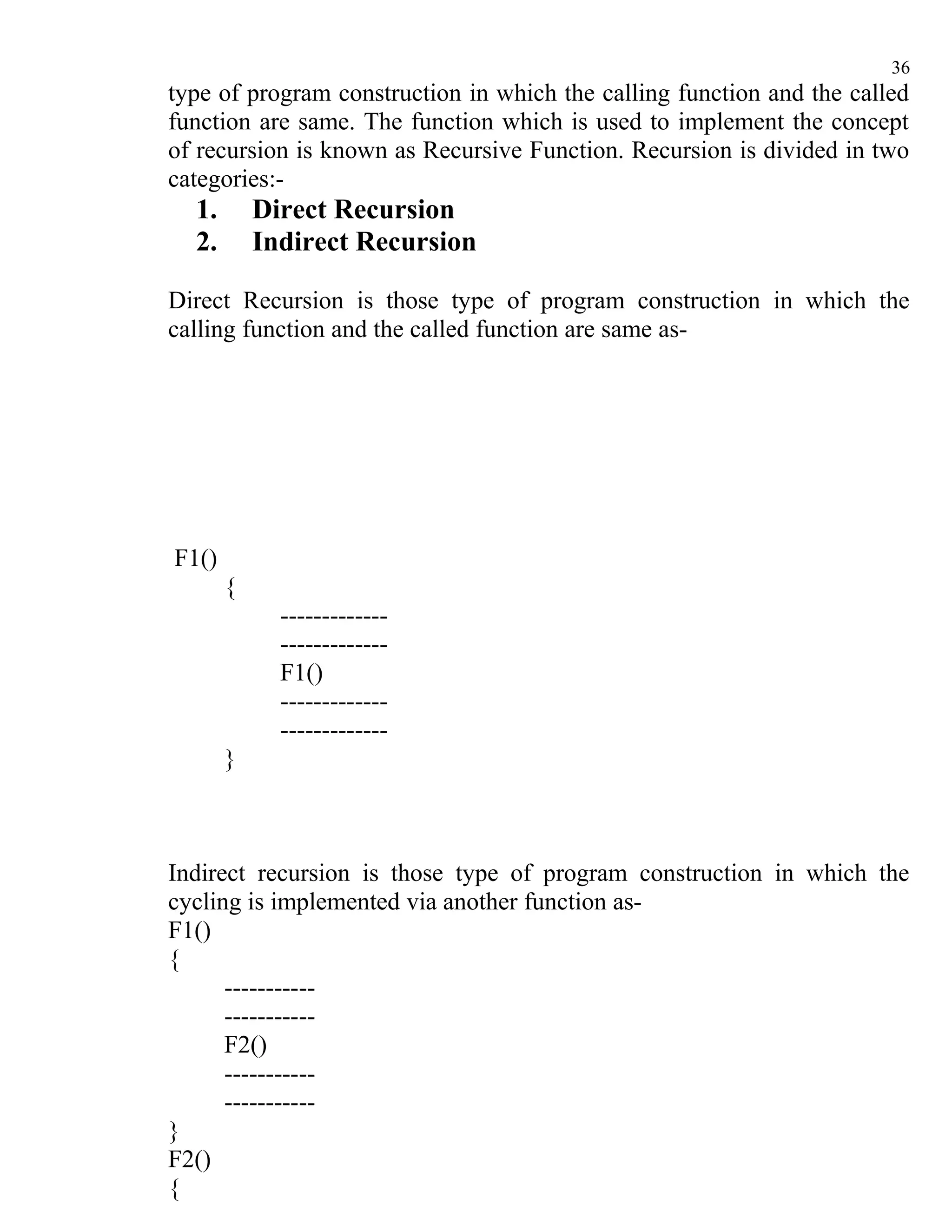
Direct Recursion is those type of program construction in which the
calling function and the called function are same as-


F1()
       {
             -------------
             -------------
             F1()
             -------------
             -------------
       }


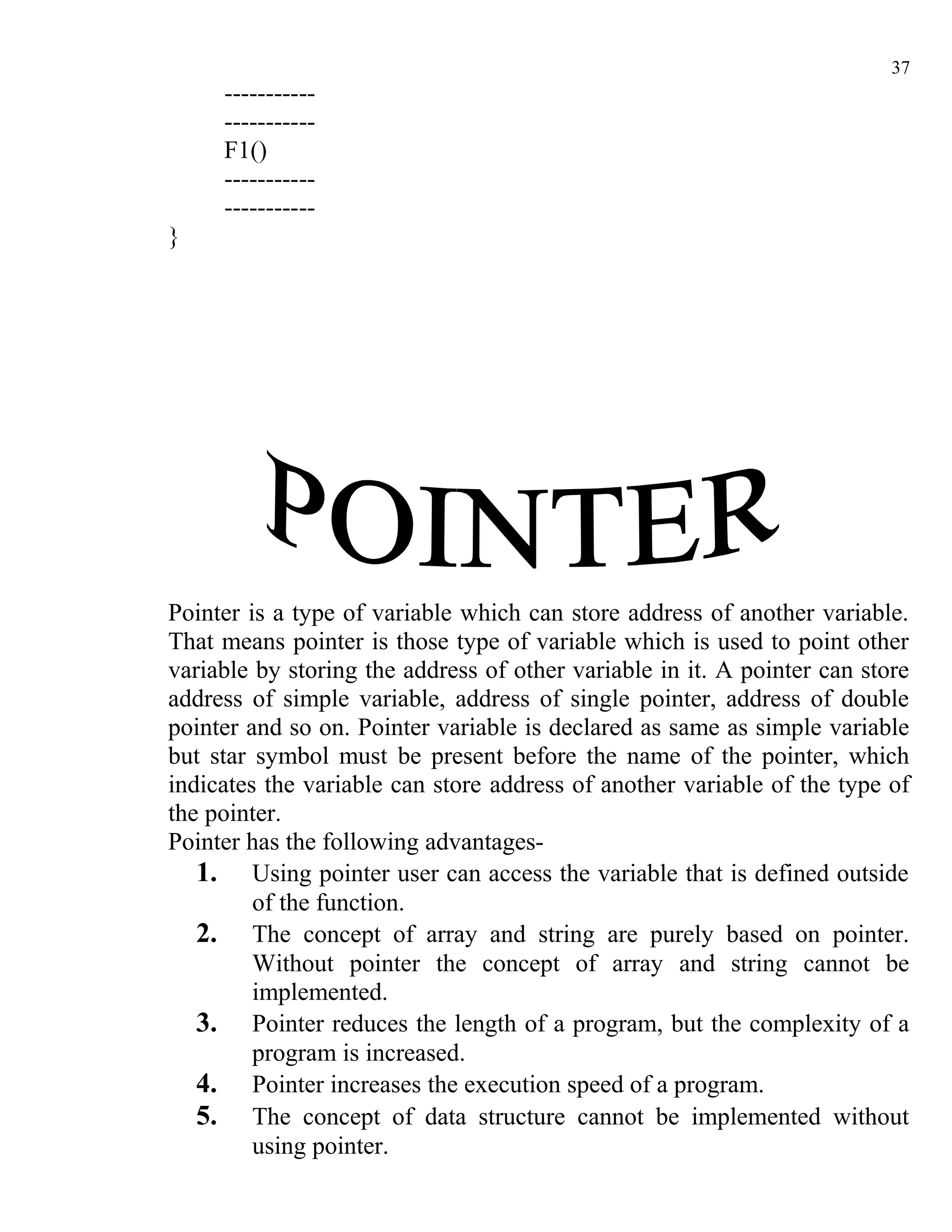
Indirect recursion is those type of program construction in which the
cycling is implemented via another function as-
F1()
{
      -----------
      -----------
      F2()
      -----------
      -----------
}
F2()
{
37
     -----------
     -----------
     F1()
     -----------
     -----------
}


Pointer is a type of variable which can store address of another variable.
That means pointer is those type of variable which is used to point other
variable by storing the address of other variable in it. A pointer can store
address of simple variable, address of single pointer, address of double
pointer and so on. Pointer variable is declared as same as simple variable
but star symbol must be present before the name of the pointer, which
indicates the variable can store address of another variable of the type of
the pointer.
Pointer has the following advantages-
   1. Using pointer user can access the variable that is defined outside
         of the function.
   2. The concept of array and string are purely based on pointer.
         Without pointer the concept of array and string cannot be
         implemented.
   3. Pointer reduces the length of a program, but the complexity of a
         program is increased.
   4. Pointer increases the execution speed of a program.
   5. The concept of data structure cannot be implemented without
         using pointer.
38
  6.    The concept of external file is purely based on pointer. A file type
        pointer is used to interface between RAM and hard disk. Without
        file pointer the concept of external file cannot be implemented.
Disadvantages of pointer:-

           The following disadvantages are present with pointer-
  1.    Pointers increase the complexity of a program as well as decrease
        the understandability of a program.
  2.     In pointer variable arithmetic operation division, multiplication,
        modular division etc are not allowed, only increasement and
        decreasement as well as addition and subtraction.


                     Structure
             Structure is an user defined data type which is used to create
new data type by encapsulating between different variable in a single unit
as the choice of the user. That means structure is an abstract data type
which is used to create new data type by abstracting different standard
variable by other define variable in single unit as the choice of the user. In
C programming language structure is created using the keyword “struct”
as-
             Struct student
             {
                   Char name [20];
                   Int roll;
             };
In the above declaration student is the name of the structure. It is also
called Tangent or, Template. Actually, structured name is new type of
name. User can create that type of variable as the requirement of the user.
Alternately, we can define Structure is the blue print of logical design of
objects. It is also possible to say, common name of a set of object is called
Structure. Components of structure not allocate their memory at the time
of structure declaration. When structure type variable is created then the
internal components of the structure allocates their memory and can store
values. At the time of declaration of structure internal component cannot
be initialized because they cannot allocate memory at the time of structure
declaration. Structure variable allocates distinct memory for the entire
39
internal component present in the structure. The following advantages are
present with structure-
   1. Structure is the encapsulated form of objects. Due to the concept
         of encapsulation an extra layer is imposed around the component
         of structure variable so, the internal components are hidden from
         the outside of the world as well as abstraction is implemented.
         Abstraction is a process by which we can hide internal
         complexity of structure variable. So, structure variable is also
         called Abstract Variable.
   2. Since, structure is encapsulated so, a single unit is created by
         encapsulation different types of components. So, the single
         variable can move one location to another at a time.
   3. The concept of database management system can only be
         implemented using the concept of structure. Without using
         structure the concept of record is not possible.
   4. The concept of data structure cannot be implemented without
         using structure.
   5. Using the concept of structure a whole record can be supply as a
         single unit to an external file.
Union is also a user defined data type which is used to create new data
type by encapsulating standard data type and other user defined data type
which are already created as the requirement of the user. The only
difference between structure and union is that union allocates a common
memory space for all the components present in the union which is equal
to the size of the largest variable present in the union. The main purpose
of union is to decrease space complexity of a program because a common
memory can be used for all the variable present in the union and different
type of value can be store in the memory location.
           Syntax:-
          Union union name
          {
            Data type variable 1;
            Data type variable 2;
          };
            for ex……..
            Union student
          {
             Char name [20];
40
     Char class [10];
     int year;
};

Basic construction of c

  • 1.
    9 Basic Construction ofC Programming Language By kinish kumar(kinishcybersec.blogspot.in) (www.facebook.com/kinishkumar) Program construction of C program should include the following segments:- 1. Documentation Section 2. Linking Section 3. Symbolic Constant Section or Macro Section 4. Global declaration Section 5. Main Function Section { a. Declaration Section b. Executable Section } 6. User Define Function Definition Section 1. Documentation Section:- It contains detail description of the problem, the programmer and the logic that means user can write details about the problem, can describe detail information about the programmer. This section can also contain detail algorithm of the problem. Documentation section generally present within comment. Comments are non executable statement present in C program to enhance the understandability and readability of C program. Documentation Section is optional. User may or may not write the documentation section in C program. For example:- Write a program to find area & perimeter of a circle. The documentation of above problem should be- /* This program is used to find area and perimeter of a circle. Developed by Aftab, BCA-2nd Year Student, Roll number-123 on 19-07-08 at 06:30 PM. The actual logic to solve the problem is- Step 1: Start
  • 2.
    10 Step 2: Inputradius of the circle Step 3: Calculate Area=3.14*r*r Perimeter=2*3.14*r Step 4: Display Area and Perimeter Step 5: End 2. Linking Section:- After compilation header files are linked with the object program to create object program. Header file contains declaration and definitions of system define function. Function is the collection of statement to perform a particular task which must have a particular name is called Function. According to the time of creation of function, they are divided in two categories- 1. System Define Function 2. User Define Function System define function are those functions which are created by the system developer at the time of system creation or, compiler development and store categoriesely under the header files. System Define functions are also called Compiler Define Function or, Library Function. Alternately, we can say that system defined function are those functions which are declared and defined by system developer and used by the user. A function has three place of existence- 1. Declaration or, Prototype 2. Definition 3. Calling or, Use Header file contains the declaration and definitions of system define functions. So, when user used any system define function then the header file which contains the declaration and definition of the function must include with the user program. Linking Section is used to link the user program with system define function for execution. If linking is not present then system define function cannot work properly, a linking error is arise. That means when we use any system define function then the
  • 3.
    11 header file ofthe function must be linked with the user program using the linking statement. Linking is established using # include <header filename> or, # include “header filename”. User define function are those type of function which are developed, defined and used by the user as the requirement of the user. 3. Symbolic Constant Section:- Constants are those type of entities that’s value cannot be changed during program execution. Value of variable is also called Constant. Symbolic Constant is that type of constant which are temporary in nature and can be used in program in many positions. Any temporary constant can be declared in C programming language using the concept of symbolic constant as- # define Max 100 The above statement creates a symbolic constant Max that’s value is 10 and can be used in any position in a C program but cannot be changed the value of the constant. Symbolic constant are generally used in those situation where a particular constant is used repeatedly in a C program. Symbolic constants are used to increase the debugging process of a C program. User can store statements under a particular names, those type of name is called Macro. Macro is an identifier that can store collection of statement to perform some particular task and which is repeatedly used in a C program. When a macro is called then the control is not transferred to the statement present in the macro. The statements are inserted at the calling position of the macro. For example- # define pf printf(“n Enter a no.”); Scanf(“%d”,&a) 4. Global Declaration Section:- Variables are those type of elements that value can be changed during program execution. Alternately, we can say that variable are the name of memory location that’s value can be changed during program execution. According to the scope or visibility, variables are divided in two categories:-
  • 4.
    12 1. Global Variable 2. Local Variable Global variables are those type of variables thats value can be accessed in any position of the entire program. Global variables are also called External Variable. If user wants to create any global variable then the variable should be declared in the global declaration section. Local variable are those types of variables which are visible in a particular function in which they are declared. That means local variables are visible in a particular segment of a C program. Local variables are also called Internal Variable. Local variables are divided in three categories:- 1. Auto Variable 2. Static Variable 3. Register Variable 5. Main Function Section:- It contains a main function which is the execution starting point of a C program. Every C program must contain a main function but only single copy can be present. That means a C program cannot contain more than one main function. The opening brace of main function is the logical starting point of execution and corresponding closing brace is the logical ending point of execution. Main function is divided in two code segment- a). Declaration Section b). Executable Section Declaration Section contains all the variables which can be used in the main function. This section is generally used to declare all the time variables which can be used in the main function. Since, C language is a typed programming language so, every variable must be declared before their used. Executable section contains actual segments which can produce output after execution. That means actual executable statement should be present in the executable section. 6. User Define Function Definition:- We know that a function has three place of existence- a). Declaration or, Prototype of function
  • 5.
    13 b). Calling orUse of function c). Definition of the function User define function are those functions which are declared, defined and used by the user. Function is by default global. So, declaration of the function should be present in the global declaration section. Function cannot be local in any situation. Actually, executable statements are present in the executable section of main function. So, calling of function is performed in the executable section of main function. The definition of user define function are present after the closing brace of main function in any order. That means the definition of user defined functions can be of any order as the choice of the user. If- “If” is a two-way decision making statement in which according to the condition a particular code block is executed and the other block will be ignore. “If” is a selection based statement in which depending on the condition a particular code lock will be selected and the other block will be deselected. The general syntax of “If” is- F If (Condition) { T Code block
  • 6.
    14 } Else- “Else” is optional with if. It is not necessary to write the else block with if. If “else” is necessary then the user should write the code block. If the code block of “if” contains a single statement then opening brace ({) and closing brace (}) is not necessary to include the code block. Similar concept is applied with else. The general syntax of “else” is- F If (condition) { T Code block } Else { Code block } Example:- To test a number which is Odd or, Even. # include <stdio.h> # include <conio.h> void main () { int n;
  • 7.
    15 clrscr (); printf ("n Enter an Integer Number : "); scanf ("%d",&n); if (n%2==0) { printf ("n %d is Even Number.",n); } else { printf ("n %d is Odd Number.",n); } getch (); } Loop is a program construction by which a particular code block will be executed depending on some condition repeatedly. That means Loop is a program construction by which a code block can be repeatedly executed. Generally a loop contains two segments:- 1. Condition 2. Code Block According to the position of the condition loops are divided in two categories- a). Entry Controlled Loop b). Exit Controlled Loop
  • 8.
    16 Entry Controlled Loop Entry Controlled Loop is those type of looping construction in which before execution of code block condition must be tested. If the condition is true then the code block will be executed and again test the condition. This process will be continued until the condition is false. If the condition is false then the control goes to the immediate next statement after the code block. In C programming language entry controlled loop is divided in two categories:- a). While b). For Entry Controlled Loop can be designed using the flowchart as- a). While:- While is the simplest looping construction present in C programming language. While is an Entry Controlled Loop that mans
  • 9.
    17 before execution ofcode block, condition must be tested. If the condition is true then the code block will be executed and again test the condition. This process will continue till the condition is true. If the condition is false then the control goes to the immediate next statement after the code block. The general syntax of While is- Example- i=1; while (i<=10) { Printf (“n A.K.Singh”); i++; } Note:- While loop is appropriate used in those situation where the starting point of the loop and the ending point of the loop is present but the increment and decrement is not present. b). For:- For is also an Entry Controlled Loop that means before execution of code block condition must be tested. If the condition is true then the code lock will be executed and again test the condition. This process will continue until the condition is false. If the condition is false then the control goes to the immediate next statement after the code block. If the code block contains a single statement then the opening brace and the closing brace is not necessary to inclose the code block. The general syntax of For is:- Example:- For (i=1;i<=10;i++) { Printf (“n A.M.COLLEGE”); } The above code segment will display the name “A.M.COLLEGE” 10 times. Note:- For loop is appropriately used to handle those type of situation in which initialization, condition and increment/decrement is given.
  • 10.
    18 Alternately, we cansay that For loop is appropriate to handle Arithmetic Progression. Exit Controlled Loop Exit control loop is those type of looping construction in which after execution of code block condition must be tested if the condition is true then the code block will executed again. This process will continue until the condition is false. When condition is false then the control goes to the immediate next statement after the condition. The flowchart of Exit Controlled Loop is-
  • 11.
    19 In C programming language only one loop is present to implement the concept of exit controlled loop. In C language do-while is present to implement the concept of exit controlled loop. Do-while:- Do-while is an exit controlled loop present in C programming language. That means after execution of code-block condition must be tested. If the condition is true then again execute the code block. This process is continuing till the condition is true. If the condition is false then control goes to immediate next statement after the condition. The general syntax and example is given in next page- Example- i=1; do { Printf (“n Arif Sir”); i++; } While (i<=10); The code segment will display the name “Arif Sir” ten times. In Do-while initialization and increment/decrement is optional. It is used in those type of situation in which user can interact with the loop in every itaration. It is used to handle that type of situation where the staring point and increment/decrement is known but the ending is unknown. It means Do-while is used to handle infinitely executable loop.
  • 12.
    20 BREAK:- Break isa keyword which is used to terminate loops or, switch. Break statement must be used within a loop or in switch. Break statement cannot be used without loop or switch. For example- Switch { Case 1:------ ------ Break; Case 2:------ ------ Break; Case 3:------ ------ Break; | Case n:------ ------ Break; Default:------ ------ }
  • 13.
    21 Or, Do { ---------- ---------- Break; ---------- ---------- } While (condition); Or, For (condition) { ------------- ------------- Break; ------------- ------------- }
  • 14.
    22 Or, While(condition) { --------------- --------------- Break; --------------- --------------- } Continue Continue is also a keyword present in C programming language which is used to transfer the control from loop body to the next iteration of the loop. Continue must be used within loop. Without loop continue cannot be used. Example- While { ----- Continue; ----- } For (initialization; condition; incr/decr) { --------- Continue; --------- } Do { ----------- Continue;
  • 15.
    23 ----------- } While (condition); Collection of similar type of element in a linear form is called Array. Alternately, we can define array is a common name shared by various variable of same type and allocates contiguous memory space in the primary memory RAM. Array is also called vector or subscripted variable or, index variable. The index number is start from o & up to size-1 of the array. Variable present in the array are represented using the name of the array and the subscript of the block. So, it is also called Subscripted variable. If an array contains a single row then it is called Single Dimensional Array or, Single Subscripted Variable. If the array contains more then one row then it is called Two-Dimensional Array. That means collection of single dimensional array is called Two-Dimensional Array. Two-Dimensional Array is also called Double Subscripted Variable. The first subscript indicates the row and the second subscript indicates the column. Two-Dimensional Array is also called Matrix in mathematics, Table in accounting. Collection of TWO-Dimensional Array is called Three-Dimensional Array or, Triple Subscripted Variable. The first subscript indicates the height, second subscript indicates the row and the third subscript indicates the column. In C language maximum 15 dimensional array is allowed. C compiler is not capable to handle more than 15 dimensional array. Advantages of Array:- The following advantages can be achieved using the concept of an Array- 1.Using a single statement huge number of variable can be declared using the concept an Array. For example:- Int a[100] The above statement declares 100 integer type variable. 2. Huge number of variable can be handled very easily and efficiently using the concept of array.
  • 16.
    24 3. Since, arrayallocates contiguous memory spaces in the primary memory RAM. So, the access time of array variable is minimum. Consiquently, the processing speed is maximum. 4. Internally the concept of array is implemented using the concept of pointer without pointer array cannot be implemented. Since, array internally is a pointer so, the execution speed of array is just four times faster than the speed of normal variable. Disadvantages f array:- The following disadvantages are present with array- 1. It is not possible to store different types of values in a particular array. Since, all the variable present in array is of same type. 2. We cannot store much number of values than the size of the array. That means, if the size of an array is n then we cannot store more than n different values. 3. If the size of an array is maximum(huge) then the chances of memory wastage is maximum. 4. Insertion operation is very time consuming operation due to right shifting of all elements present in the right side of the insertion point. 5. Similarly, deletion is also time consuming process due to left shift operation of all the values present in the right side of the deletion point. General syntax to declare an array is- Data-type array name[size] The data-type indicates the type of values which can be stored in the array. The data-type can be any system defined data-type like int, float, double, long double etc. It can be any derived data-type like pointer. The data can be any user-defined data-type like Structure and Union.
  • 17.
    25 Array name canbe any legal identifier name allowed in C-programming. That means array name must be start with an alphabet or underscore(_) and can be up to 32 character of length. In array name capital letter, small letter and mixed form characters can be used. Only one special symbol underscore (_) can be used in array name, No other special symbol even space cannot be used in array name. The size of array can be any positive integer number greater than one. Generally, size of array is any positive integer greater than one but positive floating point can also used as array size but the integer part of the number is treated as the size of the array. For example- Int a[10]; The above declaration declares an array of integer types of 10 block and allocates memory in the primary memory RAM as- 0,0 0,1 0,2 0,3 0,4 0,5 0,6 0,7 0,8 0,9 Collection of single dimensional array is called Two-Dimensional Array. The first dimension indicates the row and the second indicates the column. Two-Dimensional Array is also called Double-Subscripted variable because every block of a Two-Dimensional array is represented using two subscript. The first subscript represents the row and the second subscript represents the column. In mathematics Two-Dimensional array is called Matrix and in physics it is called as Two-Dimensional Vector. The main purpose of Two-Dimensional array is to handle table data (the data stored in tubular format). The general syntax to declare Two- Dimensional Array is- Data-type array name[rows][columns];
  • 18.
    26 The Data-type indicates the type of values which can be stored in the array. In C programming language can be any standard data-type or, any user defined data-type like Structure and Union. Array name can be any legal identifier name allowed in C programming language. The rows must be any positive integer number greater than or equal to one. Similarly, columns must be any positive number greater than or equal to one but both the values cannot be one at a time. For example- Int A[3][4] The above declaration declares a Two-Dimensional Array of three rows and four columns which depicted (picturised form) as:- 0A 1 2 3 00 01 02 03 0 10 11 12 13 20 21 22 23 1 2 The subscript is written in the blocks. It rows and columns are equal then the matrix is called Square Matrix. In the above graphical representation we can see that A row contains that number of elements equal to the size of the column. Similarly, a column contains that number of elements equal to the row of the matrix. It is also noticed that row wise second subscript is incremented and column wise. The first subscript is increased. The memory representation of the above Two-Dimensional array is- Array of character is called String. That means linear collection of character in linear form is called String. String value must be enclosed with double quotes and terminated by a null character generally supplied by the compiler. The null character indicates the end of the string. String variable must be a character type. If a string
  • 19.
    27 variable contains asingle row then it is called Single Dimensional String. If the string contains more than one row then it is called Two- Dimensional String. The general syntax to declare string variable of single dimension is- Char var name [size]; For Example:- Char A[135]; The above declaration declares a string variable A of 135 character size. In C language the variable can store 135 character excluding null character but in C++ the variable can store 134 characters excluding null character. Note:- In C &C++ bound checking of string variable is not present. So, string variable can store more number of characters than the size of the variable but it is situation dependent. The general syntax to declare two-dimensional string variable is- Char varname[rows][size of rows/column] For example:- Char A[135][8] In the above declaration declares a two dimensional string variable A of 135 row and 8 columns. That means each row can store 8 characters in in C language Named block of statement to perform a particular task is called Function. Collection of statement which must have a particular name to perform a particular task is called Function. The main purpose of function is to re- use the existing code and easily debugging code. We know that C is a modular programming language i.e. C language has the capability to decompose a large program to smaller segment and at the end all the segment can combined and produces the actual program. In C programming language concept of modular programming is implemented using the concept of function. Advantage of Function:- The following advantages are present in function-
  • 20.
    28 1. The concept of code re-use ability can be implemented using function i.e. a function can be used in any program as the requirement of the user without modifying the existing code. 2. Using function existing code can be re-used consequently the productivity of the programmer will be maximized and product cost as well as maintenance cost will be minimized. 3. Product cost and maintenance cost are minimized due to the concept of function. If product cost and maintenance are minimum then the acceptability will be maximum. 4. Using function existing code can be re-used by creating users own header files, which also hides the existing code but can perform particular task as the requirement of the user. Using the concept of header file security of code will be increased. Disadvantages of function:- The following disadvantages are present with function- 1. Understandability of program is decreased because actual code is present in another file which actually produced the required output which is not visible to the user. 2. Execution speed of program is decreased due to fluctuations of control bellowing Calling Function and Called Function. 3. Space complexity of a program is increased due to reallocation of memory at the time of execution. This also noticed that the size of a program is increased using the concept of function. So, the execution speed will be decreased. Components of Function The general representation is-
  • 21.
    29 Y= f(x) Where, x is the argument or parameter, f is the function name and y is the return value. So, any programming language a function has three components- 1. Function name 2. Argument 3. Return value or return type Function name is any legal identifier allowed in C programming language. The argument is the initial values which must be supplied by the calling function to the called function at the time of activation of the called function. The function which calls another function is called Calling Function and the function which is called by another function is known as Called Function. The arguments supplied by the calling function to the called function at the time of calling. A function can take any number of argument and any type of argument allowed in C programming language. The return type indicates the type of value which should be return by the called function to the calling function after execution of the called function. The return type can be any data type allowed in C programming language. TYPES OF FUNCTION We know that function has three components-Function name, argument and returned type. It is also known to us that function name is fixed for a particular function but argument and return type can be changed. According to the argument and return type function is divided in four categories- 1. With return with argument 2. With return without argument 3. Without return with argument 4. Without return without argument A function has three place of existence that means a function is present in three locations in program-
  • 22.
    30 1. Declaration or,Prototype 2. Calling or Use 3. Definition or Body The declaration or prototype of a function declares the name of the function and the type of arguments separated by comma and the return type of the returned value. The declaration or prototype is present in the global declaration section of the program because functions are global by default. Functions cannot be local in any situation in C programming language. The prototype can also be present in the declaration section of main function, but in this situation function is also global. The calling or use is the actual invocation point of the called function by the calling function. In this position actual arguments are supplied by the calling function to the called function. After that, control goes to the function definition to process the actual task. A function may be called many times in any location of another function or, in the same function as the requirement of the user. The function definition is the actual code block to perform the task specified by the user. Generally the function definition or body present after the closing brace of main function. If a program contains more than one function then the function definition can be present in any order as the choice of the user. A program can contain any number of functions and can be called in any order and can be declare in any order. A particular function can return a single value after execution to the calling function more than one function cannot be returned by called function to the calling function. According to the declaration and definition functions are divided in two categories:- 1. System Defined Function 2. User Defined Function System Defined Functions are that type of function which are declared and defined by the system developers at the time of system development and stored in compiled form under header files and used by the users as the requirement of the user. The container of system defined function group wise is called Header File.
  • 23.
    31 For example- Math.h contains all mathematical functions, graphics.h contains all graphical functions etc. In C programming language total header file ranging between 24 and 29 in previous version (Turboc2) but in Turboc3 total number of header files are ranging between 100 and 105. The latest version of Turbo C contains 167 header files. The functions which are declared, defined and used by the user as the requirement of the user are called User-Defined Function. User can also create his own header file by storing all the user defined function under specific name and can be used by user as same as header file as the requirement of the user to implement the code re-use ability. Qn. What do you understand by call by value and call by reference. Explain them with suitable example. Ans. A function which calls another function is called Calling Function and the function which is called by another function is called Function. Arguments are supplied by the calling function to the call function at the time of use of the called function. Return value is returned by the called function to the calling function after execution to the called function. We know that arguments are supplied by the calling function to the called function at the time of calling of the called function. The calling system of called function is divided in two categories- 1. Call by value 2. Call by reference Call by value calling system is that type of calling system in which calling function supplies the argument to the called function by supplying values of sum variables as actual argument. The actual arguments are copied into the formal arguments or, dummy arguments
  • 24.
    32 of the calledfunction and the dummy arguments must be identical with type but not necessary same named. In call by value call system actual and formal arguments allocate distinct memory and they are not linked internally. So, any changing of dummy variable cannot effect on actual argument. Similarly, any changing of actual argument cannot effect on dummy argument. That means in call by value calling system no internal linking is established between the calling function and the called function. For example- void interchange(int,int); void main () { int a,b; clrscr (); printf ("n Enter value of a & b : "); scanf ("%d%d",&a,&b); printf("n Before interchange : a=%d b=%d",a,b); interchange (a,b); printf("n After interchange : a=%d b=%d",a,b); getch (); } void interchange (int x, int y) { int t; t=x; x=y;
  • 25.
    33 y=t; } The above function interchange the value of x,y which are the dummy arguments. The value of actual argument a,b are not interchanged. That means in call by value calling system called function cannot effect on actual arguments supplied by the calling function. Call by reference calling system is that type of calling system in which calling function supplies arguments address of variables, not values of variables. That means in call by reference calling system actual arguments are address of variables instead of value of variables. Call by reference calling system is suitable when user wants to make an internal linking between the calling function and the called function using actual argument and dummy arguments. In call by reference calling system dummy arguments are internally linked with the actual argument using the concept of pointer and using the concept of reference variable. In call by reference calling system any changing of dummy arguments changes the values of actual arguments. Call by reference calling system is appropriately used to handle those situation where changing of dummy argument must effect on actual argument. Call by reference calling system is implemented using the concept of reference variable and using the concept of pointer. Call by reference using reference variable Reference variables are those types of variable which allocates their memory in the address of another variable that means same memory location different name is called reference variable. Reference variable
  • 26.
    34 is also calledAlias. Reference variable must be initialized with same variables not values. Reference variable allocates the memory in the same location of the address of the variable by which it initialized. For example- void main () { int a=15; int &x=a; printf ("n %d %d",a,x); a=a+5; printf ("n %d %d",a,x); x=x+10; printf ("n %d %d",a,x); getch (); } void interchange(int &,int &); void main () { int a,b; clrscr (); printf ("n Enter value of a & b : ");
  • 27.
    35 scanf ("%d%d",&a,&b); printf("n Before interchange : a=%d b=%d",a,b); interchange (a,b); printf("n After interchange : a=%d b=%d",a,b); getch (); } void interchange (int &x, int &y) { int t; t=x; x=y; y=t; } Call by reference calling system can also be implemented using pointer. Pointer is that type of variable which contains address of variable instead of value of variable. That means pointer variable holds address of another variable by which the pointer can access the variable. Pointer variables are internally linked with the variable that the address is stored in the pointer. In C programming language to handle pointer only two operator are used &,*. &- Address of Operator *- Value of Operator Qn. What is Recursion and recursive function? Write a program to find factorial using recursion. Or, Define recursion and recursive function. Write a program to display Fibonacci series using recursion. Ans. The function which calls another function is known as Calling Function and the function which is called by another function is known as Called Function. Recursion is those type of calling technique or, program construction in which a function calls itself. That means recursion is those
  • 28.
    36 type of programconstruction in which the calling function and the called function are same. The function which is used to implement the concept of recursion is known as Recursive Function. Recursion is divided in two categories:- 1. Direct Recursion 2. Indirect Recursion Direct Recursion is those type of program construction in which the calling function and the called function are same as- F1() { ------------- ------------- F1() ------------- ------------- } Indirect recursion is those type of program construction in which the cycling is implemented via another function as- F1() { ----------- ----------- F2() ----------- ----------- } F2() {
  • 29.
    37 ----------- ----------- F1() ----------- ----------- } Pointer is a type of variable which can store address of another variable. That means pointer is those type of variable which is used to point other variable by storing the address of other variable in it. A pointer can store address of simple variable, address of single pointer, address of double pointer and so on. Pointer variable is declared as same as simple variable but star symbol must be present before the name of the pointer, which indicates the variable can store address of another variable of the type of the pointer. Pointer has the following advantages- 1. Using pointer user can access the variable that is defined outside of the function. 2. The concept of array and string are purely based on pointer. Without pointer the concept of array and string cannot be implemented. 3. Pointer reduces the length of a program, but the complexity of a program is increased. 4. Pointer increases the execution speed of a program. 5. The concept of data structure cannot be implemented without using pointer.
  • 30.
    38 6. The concept of external file is purely based on pointer. A file type pointer is used to interface between RAM and hard disk. Without file pointer the concept of external file cannot be implemented. Disadvantages of pointer:- The following disadvantages are present with pointer- 1. Pointers increase the complexity of a program as well as decrease the understandability of a program. 2. In pointer variable arithmetic operation division, multiplication, modular division etc are not allowed, only increasement and decreasement as well as addition and subtraction. Structure Structure is an user defined data type which is used to create new data type by encapsulating between different variable in a single unit as the choice of the user. That means structure is an abstract data type which is used to create new data type by abstracting different standard variable by other define variable in single unit as the choice of the user. In C programming language structure is created using the keyword “struct” as- Struct student { Char name [20]; Int roll; }; In the above declaration student is the name of the structure. It is also called Tangent or, Template. Actually, structured name is new type of name. User can create that type of variable as the requirement of the user. Alternately, we can define Structure is the blue print of logical design of objects. It is also possible to say, common name of a set of object is called Structure. Components of structure not allocate their memory at the time of structure declaration. When structure type variable is created then the internal components of the structure allocates their memory and can store values. At the time of declaration of structure internal component cannot be initialized because they cannot allocate memory at the time of structure declaration. Structure variable allocates distinct memory for the entire
  • 31.
    39 internal component presentin the structure. The following advantages are present with structure- 1. Structure is the encapsulated form of objects. Due to the concept of encapsulation an extra layer is imposed around the component of structure variable so, the internal components are hidden from the outside of the world as well as abstraction is implemented. Abstraction is a process by which we can hide internal complexity of structure variable. So, structure variable is also called Abstract Variable. 2. Since, structure is encapsulated so, a single unit is created by encapsulation different types of components. So, the single variable can move one location to another at a time. 3. The concept of database management system can only be implemented using the concept of structure. Without using structure the concept of record is not possible. 4. The concept of data structure cannot be implemented without using structure. 5. Using the concept of structure a whole record can be supply as a single unit to an external file. Union is also a user defined data type which is used to create new data type by encapsulating standard data type and other user defined data type which are already created as the requirement of the user. The only difference between structure and union is that union allocates a common memory space for all the components present in the union which is equal to the size of the largest variable present in the union. The main purpose of union is to decrease space complexity of a program because a common memory can be used for all the variable present in the union and different type of value can be store in the memory location. Syntax:- Union union name { Data type variable 1; Data type variable 2; }; for ex…….. Union student { Char name [20];
  • 32.
    40 Char class [10]; int year; };