Topic10:
Linear Programming
This topic will cover:
◦ Formulating a two variable linear programme
◦ Graphical solution of a linear programme
◦ Introduction to sensitivity analysis
By the end of this topic students will be able
to:
◦ Recognise the concept of constrained optimisation
◦ Formulate a two variable linear programme
 Maximisation and minimisation problems
◦ Find a graphical solution to a two variable LP
◦ Appreciate the process of sensitivity analysis
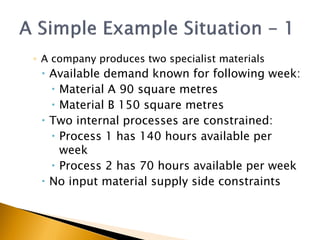
◦ A company produces two specialist materials
 Available demand known for following week:
 Material A 90 square metres
 Material B 150 square metres
 Two internal processes are constrained:
 Process 1 has 140 hours available per
week
 Process 2 has 70 hours available per week
 No input material supply side constraints
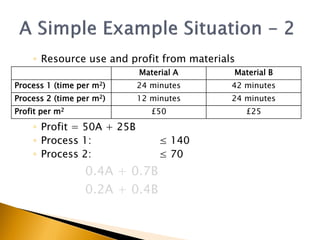
◦ Resource use and profit from materials
◦ Profit = 50A + 25B
◦ Process 1: ≤ 140
◦ Process 2: ≤ 70
Material A Material B
Process 1 (time per m2) 24 minutes 42 minutes
Process 2 (time per m2) 12 minutes 24 minutes
Profit per m2 £50 £25
0.4A + 0.7B
0.2A + 0.4B
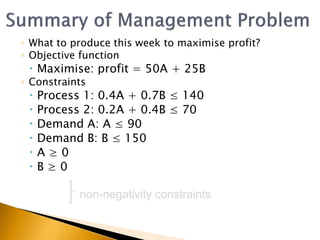
◦ What to produce this week to maximise profit?
◦ Objective function
 Maximise: profit = 50A + 25B
◦ Constraints
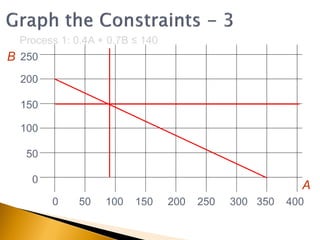
 Process 1: 0.4A + 0.7B ≤ 140
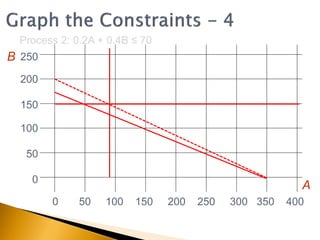
 Process 2: 0.2A + 0.4B ≤ 70
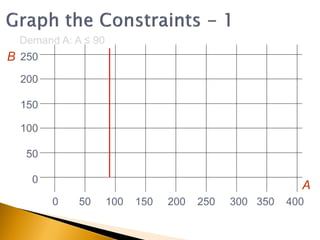
 Demand A: A ≤ 90
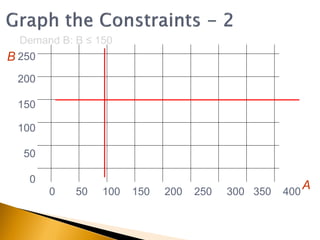
 Demand B: B ≤ 150
 A ≥ 0
 B ≥ 0
non-negativity constraints
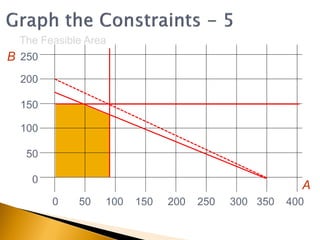
0 50 100 150 200 250 300 350 400
250
200
150
100
50
0
A
B
Demand A: A ≤ 90
0 50 100 150 200 250 300 350 400
250
200
150
100
50
0
A
B
Demand B: B ≤ 150
0 50 100 150 200 250 300 350 400
250
200
150
100
50
0
A
B
Process 1: 0.4A + 0.7B ≤ 140
0 50 100 150 200 250 300 350 400
250
200
150
100
50
0
A
B
Process 2: 0.2A + 0.4B ≤ 70
0 50 100 150 200 250 300 350 400
250
200
150
100
50
0
A
B
The Feasible Area
0 30 60 90
150
120
90
60
30
0
A
B
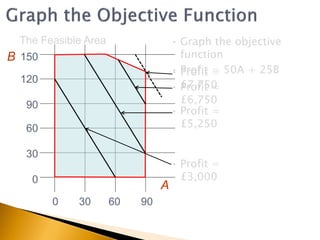
The Feasible Area • Graph the objective
function
• Profit = 50A + 25B
• Profit =
£3,000
• Profit =
£5,250
• Profit =
£6,750
• Profit =
£7,750
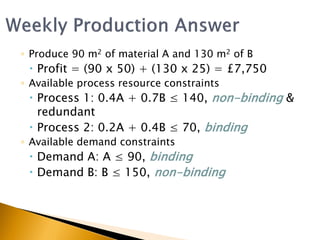
◦ Produce 90 m2 of material A and 130 m2 of B
 Profit = (90 x 50) + (130 x 25) = £7,750
◦ Available process resource constraints
 Process 1: 0.4A + 0.7B ≤ 140, non-binding &
redundant
 Process 2: 0.2A + 0.4B ≤ 70, binding
◦ Available demand constraints
 Demand A: A ≤ 90, binding
 Demand B: B ≤ 150, non-binding
0 30 60 90
150
120
90
60
30
0
A
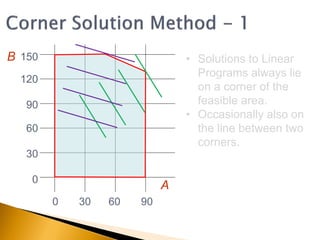
B • Solutions to Linear
Programs always lie
on a corner of the
feasible area.
• Occasionally also on
the line between two
corners.
0 30 60 90
150
120
90
60
30
0
A
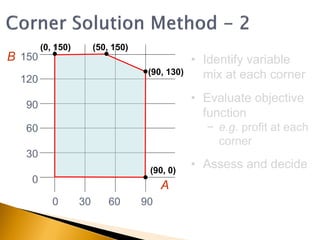
B • Identify variable
mix at each corner
• Evaluate objective
function
− e.g. profit at each
corner
• Assess and decide(90, 0)
(90, 130)
(50, 150)(0, 150)
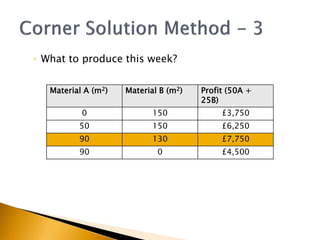
◦ What to produce this week?
Material A (m2) Material B (m2) Profit (50A +
25B)
0 150 £3,750
50 150 £6,250
90 130 £7,750
90 0 £4,500
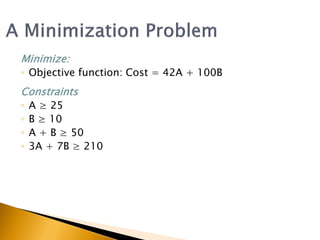
Minimize:
◦ Objective function: Cost = 42A + 100B
Constraints
◦ A ≥ 25
◦ B ≥ 10
◦ A + B ≥ 50
◦ 3A + 7B ≥ 210
0 10 20 30 40 50 60 70 80
50
40
30
20
10
0
A
B
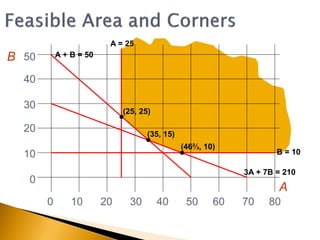
A = 25
B = 10
A + B = 50
3A + 7B = 210
(25, 25)
(46⅔, 10)
(35, 15)
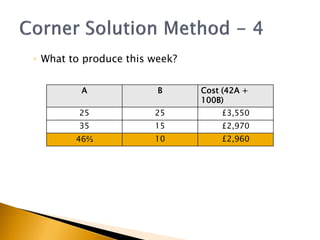
◦ What to produce this week?
A B Cost (42A +
100B)
25 25 £3,550
35 15 £2,970
46⅔ 10 £2,960
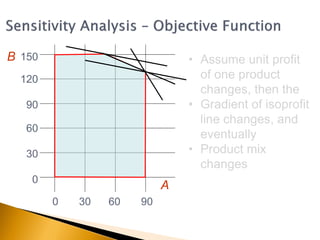
0 30 60 90
150
120
90
60
30
0
A
B • Assume unit profit
of one product
changes, then the
• Gradient of isoprofit
line changes, and
eventually
• Product mix
changes
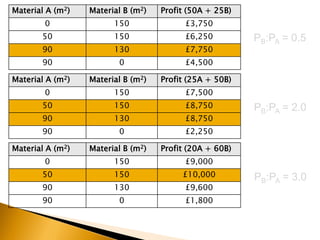
Material A (m2) Material B (m2) Profit (50A + 25B)
0 150 £3,750
50 150 £6,250
90 130 £7,750
90 0 £4,500
Material A (m2) Material B (m2) Profit (25A + 50B)
0 150 £7,500
50 150 £8,750
90 130 £8,750
90 0 £2,250
Material A (m2) Material B (m2) Profit (20A + 60B)
0 150 £9,000
50 150 £10,000
90 130 £9,600
90 0 £1,800
PB:PA = 0.5
PB:PA = 2.0
PB:PA = 3.0
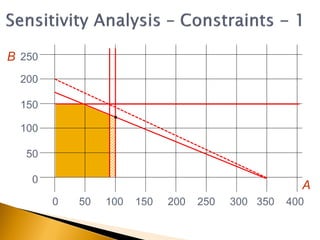
0 50 100 150 200 250 300 350 400
250
200
150
100
50
0
A
B
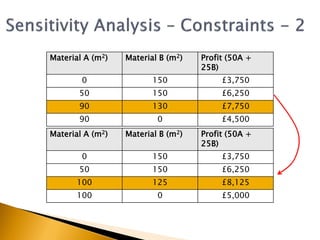
Material A (m2) Material B (m2) Profit (50A +
25B)
0 150 £3,750
50 150 £6,250
90 130 £7,750
90 0 £4,500
Material A (m2) Material B (m2) Profit (50A +
25B)
0 150 £3,750
50 150 £6,250
100 125 £8,125
100 0 £5,000
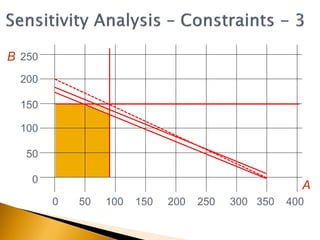
0 50 100 150 200 250 300 350 400
250
200
150
100
50
0
A
B
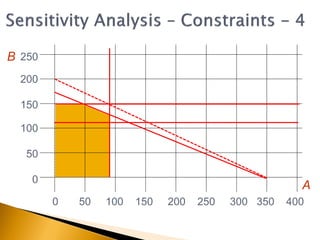
0 50 100 150 200 250 300 350 400
250
200
150
100
50
0
A
B
By the end of this topic students will be able
to:
◦ Recognise the concept of constrained optimization
◦ Formulate a two variable linear programme
 Maximisation and minimisation problems
◦ Find a graphical solution to a two variable LP
◦ Appreciate the process of sensitivity analysis
◦ Hillier, F. and Lieberman. G. Introduction to
Operations Research. McGraw Hill
◦ Keast, S. and Towler M. Rational Decision-Making
for Managers. Wiley.
◦ Wisniewski, M. Quantitative Methods for Decision
Makers. FT Prentice Hall.
Any Questions?

Lecture 10 Linear Programming

  • 1.
  • 2.
    This topic willcover: ◦ Formulating a two variable linear programme ◦ Graphical solution of a linear programme ◦ Introduction to sensitivity analysis
  • 3.
    By the endof this topic students will be able to: ◦ Recognise the concept of constrained optimisation ◦ Formulate a two variable linear programme  Maximisation and minimisation problems ◦ Find a graphical solution to a two variable LP ◦ Appreciate the process of sensitivity analysis
  • 4.
    ◦ A companyproduces two specialist materials  Available demand known for following week:  Material A 90 square metres  Material B 150 square metres  Two internal processes are constrained:  Process 1 has 140 hours available per week  Process 2 has 70 hours available per week  No input material supply side constraints
  • 5.
    ◦ Resource useand profit from materials ◦ Profit = 50A + 25B ◦ Process 1: ≤ 140 ◦ Process 2: ≤ 70 Material A Material B Process 1 (time per m2) 24 minutes 42 minutes Process 2 (time per m2) 12 minutes 24 minutes Profit per m2 £50 £25 0.4A + 0.7B 0.2A + 0.4B
  • 6.
    ◦ What toproduce this week to maximise profit? ◦ Objective function  Maximise: profit = 50A + 25B ◦ Constraints  Process 1: 0.4A + 0.7B ≤ 140  Process 2: 0.2A + 0.4B ≤ 70  Demand A: A ≤ 90  Demand B: B ≤ 150  A ≥ 0  B ≥ 0 non-negativity constraints
  • 7.
    0 50 100150 200 250 300 350 400 250 200 150 100 50 0 A B Demand A: A ≤ 90
  • 8.
    0 50 100150 200 250 300 350 400 250 200 150 100 50 0 A B Demand B: B ≤ 150
  • 9.
    0 50 100150 200 250 300 350 400 250 200 150 100 50 0 A B Process 1: 0.4A + 0.7B ≤ 140
  • 10.
    0 50 100150 200 250 300 350 400 250 200 150 100 50 0 A B Process 2: 0.2A + 0.4B ≤ 70
  • 11.
    0 50 100150 200 250 300 350 400 250 200 150 100 50 0 A B The Feasible Area
  • 12.
    0 30 6090 150 120 90 60 30 0 A B The Feasible Area • Graph the objective function • Profit = 50A + 25B • Profit = £3,000 • Profit = £5,250 • Profit = £6,750 • Profit = £7,750
  • 13.
    ◦ Produce 90m2 of material A and 130 m2 of B  Profit = (90 x 50) + (130 x 25) = £7,750 ◦ Available process resource constraints  Process 1: 0.4A + 0.7B ≤ 140, non-binding & redundant  Process 2: 0.2A + 0.4B ≤ 70, binding ◦ Available demand constraints  Demand A: A ≤ 90, binding  Demand B: B ≤ 150, non-binding
  • 14.
    0 30 6090 150 120 90 60 30 0 A B • Solutions to Linear Programs always lie on a corner of the feasible area. • Occasionally also on the line between two corners.
  • 15.
    0 30 6090 150 120 90 60 30 0 A B • Identify variable mix at each corner • Evaluate objective function − e.g. profit at each corner • Assess and decide(90, 0) (90, 130) (50, 150)(0, 150)
  • 16.
    ◦ What toproduce this week? Material A (m2) Material B (m2) Profit (50A + 25B) 0 150 £3,750 50 150 £6,250 90 130 £7,750 90 0 £4,500
  • 17.
    Minimize: ◦ Objective function:Cost = 42A + 100B Constraints ◦ A ≥ 25 ◦ B ≥ 10 ◦ A + B ≥ 50 ◦ 3A + 7B ≥ 210
  • 18.
    0 10 2030 40 50 60 70 80 50 40 30 20 10 0 A B A = 25 B = 10 A + B = 50 3A + 7B = 210 (25, 25) (46⅔, 10) (35, 15)
  • 19.
    ◦ What toproduce this week? A B Cost (42A + 100B) 25 25 £3,550 35 15 £2,970 46⅔ 10 £2,960
  • 20.
    0 30 6090 150 120 90 60 30 0 A B • Assume unit profit of one product changes, then the • Gradient of isoprofit line changes, and eventually • Product mix changes
  • 21.
    Material A (m2)Material B (m2) Profit (50A + 25B) 0 150 £3,750 50 150 £6,250 90 130 £7,750 90 0 £4,500 Material A (m2) Material B (m2) Profit (25A + 50B) 0 150 £7,500 50 150 £8,750 90 130 £8,750 90 0 £2,250 Material A (m2) Material B (m2) Profit (20A + 60B) 0 150 £9,000 50 150 £10,000 90 130 £9,600 90 0 £1,800 PB:PA = 0.5 PB:PA = 2.0 PB:PA = 3.0
  • 22.
    0 50 100150 200 250 300 350 400 250 200 150 100 50 0 A B
  • 23.
    Material A (m2)Material B (m2) Profit (50A + 25B) 0 150 £3,750 50 150 £6,250 90 130 £7,750 90 0 £4,500 Material A (m2) Material B (m2) Profit (50A + 25B) 0 150 £3,750 50 150 £6,250 100 125 £8,125 100 0 £5,000
  • 24.
    0 50 100150 200 250 300 350 400 250 200 150 100 50 0 A B
  • 25.
    0 50 100150 200 250 300 350 400 250 200 150 100 50 0 A B
  • 26.
    By the endof this topic students will be able to: ◦ Recognise the concept of constrained optimization ◦ Formulate a two variable linear programme  Maximisation and minimisation problems ◦ Find a graphical solution to a two variable LP ◦ Appreciate the process of sensitivity analysis
  • 27.
    ◦ Hillier, F.and Lieberman. G. Introduction to Operations Research. McGraw Hill ◦ Keast, S. and Towler M. Rational Decision-Making for Managers. Wiley. ◦ Wisniewski, M. Quantitative Methods for Decision Makers. FT Prentice Hall.
  • 28.