Topic 1:
Introductory Management Statistics
This topic will cover:
◦ Data types
◦ A revision of summary statistics
◦ Index numbers
By the end of this topic students will be able
to:
◦ recognise nominal, ordinal, interval and ratio data
types
◦ recognise and use mode, median, mean, range,
standard deviation and coefficient of variation
◦ calculate Laspeyres and Paasche index numbers
◦ use index numbers to calculate percentage changes
and to deflate series
◦ Nominal
◦ Ordinal
◦ Interval
◦ Ratio
Information Content
High
Low
◦ Data which is only categorised (group characteristic)
 Count but not order, nor measure nor ratio
◦ Examples
 Gender (male or female)
 Job role (administration, production, accounting,
sales)
 Product type (fruit cake, chocolate cake, cream
cake)
◦ Summary statistics
 Mode
• Parts in stock
• Mode
- The number or category that occurs the most
3 7 6 6 8
10 5 5 11 8
9 12 9 6 4
6 7 4 2 4
8 5 6 10 9
7 8 10 7 5
2 5 1 9 7
11 7 8 7 9
6 8 3 4 3
part number frequency
7 7
6 6
8 6
5 5
9 5
4 4
3 3
10 3
2 2
11 2
1 1
12 1
total 45
◦ Data which can be ranked
 Count and put in order but not measure nor
ratio
◦ Examples
 Employee grades (A, B, C …)
 Voting preferences (best candidate, 2nd best
…)
 Product preferences
◦ Summary statistics
 Mode, median
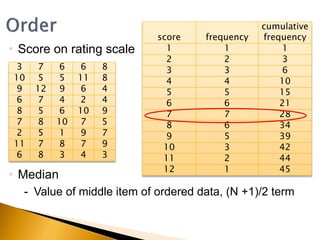
• Score on rating scale
• Median
- Value of middle item of ordered data, (N +1)/2 term
score frequency
cumulative
frequency
1 1 1
2 2 3
3 3 6
4 4 10
5 5 15
6 6 21
7 7 28
8 6 34
9 5 39
10 3 42
11 2 44
12 1 45
3 7 6 6 8
10 5 5 11 8
9 12 9 6 4
6 7 4 2 4
8 5 6 10 9
7 8 10 7 5
2 5 1 9 7
11 7 8 7 9
6 8 3 4 3
◦ Data which can be placed along a scale
 Count, put in order, measure but not ratio
◦ Examples
 Centigrade temperature scale (10C, 15C,
20C)
 IQ score (100, 115, 130)
◦ Summary statistics
 Mode, median, mean
 Range, standard deviation
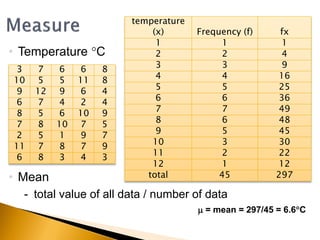
• Temperature C
• Mean
- total value of all data / number of data
3 7 6 6 8
10 5 5 11 8
9 12 9 6 4
6 7 4 2 4
8 5 6 10 9
7 8 10 7 5
2 5 1 9 7
11 7 8 7 9
6 8 3 4 3
temperature
(x) Frequency (f) fx
1 1 1
2 2 4
3 3 9
4 4 16
5 5 25
6 6 36
7 7 49
8 6 48
9 5 45
10 3 30
11 2 22
12 1 12
total 45 297
 = mean = 297/45 = 6.6C
 Population variance is 𝜎2 =
𝑓 𝑖 𝑥 𝑖−𝜇 2
𝑁
 where𝑁 = 𝑓𝑖and the mean 𝜇 =
𝑓 𝑖 𝑥 𝑖
𝑁
 and the standard deviation is
 𝜎 =
𝑓𝑖 𝑥 𝑖−𝜇 2
𝑁
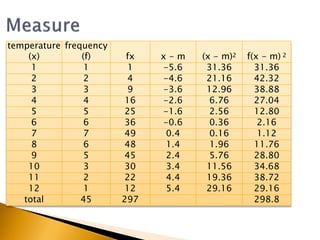
temperature
(x)
frequency
(f) fx x - m (x - m)2 f(x - m) 2
1 1 1 -5.6 31.36 31.36
2 2 4 -4.6 21.16 42.32
3 3 9 -3.6 12.96 38.88
4 4 16 -2.6 6.76 27.04
5 5 25 -1.6 2.56 12.80
6 6 36 -0.6 0.36 2.16
7 7 49 0.4 0.16 1.12
8 6 48 1.4 1.96 11.76
9 5 45 2.4 5.76 28.80
10 3 30 3.4 11.56 34.68
11 2 22 4.4 19.36 38.72
12 1 12 5.4 29.16 29.16
total 45 297 298.8
 𝑁 = 𝑓𝑖 = 45
 𝜇 =
𝑓 𝑖 𝑥 𝑖
𝑁
=
297
45
= 6.6
 𝜎 =
𝑓𝑖 𝑥 𝑖−𝜇 2
𝑁
=
298.8
45
= 2.577
◦ Data along a scale which can be ratioed
 Count, put in order, measure and ratio
◦ Examples
 Kelvin temperature scale
 Time spent in queue (10, 20, 30 minutes)
 Differences on interval scales
◦ Summary statistics
 Mode, median, mean
 Range, standard deviation, coefficient of
variation, skewness
queuing time
(x)
frequency
(f) fx x - m
(x -
m)2 f(x - m) 2
1 1 1 -5.6 31.36 31.36
2 2 4 -4.6 21.16 42.32
etc. etc. etc. etc. etc. etc.
11 2 22 4.4 19.36 38.72
12 1 12 5.4 29.16 29.16
total 45 297 298.8
𝜇 =
𝑓𝑖 𝑥𝑖
𝑁
= 6.6𝜎 =
𝑓𝑖 𝑥𝑖 − 𝜇 2
𝑁
= 2.577
coefficient of variation 𝐶𝑉 =
𝜎
𝜇
=
2.577
6.6
= 0.39
◦ Discrete data
 Can take a countable number of values
 Number of products built (1,237,502)
 Number of questions correct in test (4)
◦ Continuous
 Can take an uncountable number of values
 Length of fabric cut (45.9847248738…metres)
 Time in queue (23 minutes
5.2084792…seconds)
◦ How to show the change of data (often price or
quantity) over time
 Relative to a reference point (the base period)
◦ e.g. simple price index (aka price relative)
𝑅 =
𝑝 𝑛
𝑝0
× 100where 0 denotes the base year
i.e. arbitrarily set price as 100 in base year
Consider chocolate bar, set 2009 as base year
Price (GBP)
Jan 2009 Jan 2010 Jan 2011
Chocolate bar 0.47 0.52 0.56
Sandwich 1.85 1.92 2.00
Bag of crisps 0.60 0.61 0.63
year price
Jan 2009 0.47 1.0000 100.00
Jan 2010 0.52 1.1064 110.64
Jan 2011 0.56 1.1915 119.15
◦ Compare the prices of snack products over time
year chocolate bar
price index
sandwich
price index
bag of crisps
price index
Jan 2009 0.47 100.00 1.85 0.60
Jan 2010 0.52 110.64 1.92 0.61
Jan 2011 0.56 119.15 2.00 0.63
𝑅 =
𝑝 𝑛
𝑝0
× 100
year chocolate bar
price index
sandwich
price index
bag of crisps
price index
Jan 2009 0.47 100.00 1.85 100.00 0.60 100.00
Jan 2010 0.52 110.64 1.92 103.78 0.61 101.67
Jan 2011 0.56 119.15 2.00 108.11 0.63 105.00
95.00
100.00
105.00
110.00
115.00
120.00
125.00
priceindex£-
£0.50
£1.00
£1.50
£2.00
£2.50
priceperunit
% 𝑐ℎ𝑎𝑛𝑔𝑒 =
𝑛𝑒𝑤 𝑖𝑛𝑑𝑒𝑥 − 𝑜𝑙𝑑 𝑖𝑛𝑑𝑒𝑥
𝑜𝑙𝑑 𝑖𝑛𝑑𝑒𝑥
× 100
% 𝑐ℎ𝑎𝑛𝑔𝑒 =
119.15 − 110.64
110.64
× 100 = 7.69%
year chocolate bar
index annual
%
sandwich
price index
bag of crisps
price index
Jan
2009
100.00 - 100.00 - 100.00 -
Jan
2010
110.64 10.64 103.78 ? 101.67 ?
Jan
2011
119.15 7.69 108.11 ? 105.00 ?
year chocolate bar
index annual
%
sandwich
price index
bag of crisps
price index
Jan
2009
100.00 - 100.00 - 100.00 -
Jan
2010
110.64 10.64 103.78 3.78 101.67 1.67
Jan
2011
119.15 7.69 108.11 4.17 105.00 3.27
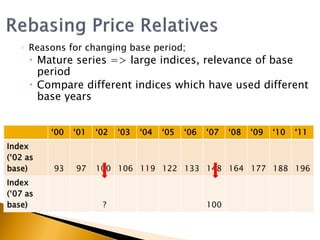
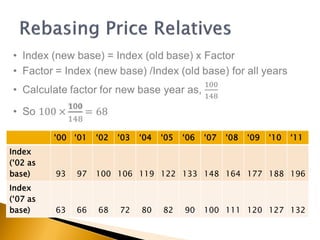
◦ Reasons for changing base period;
 Mature series => large indices, relevance of base
period
 Compare different indices which have used different
base years
‘00 ‘01 ‘02 ‘03 ‘04 ‘05 ‘06 ‘07 ‘08 ‘09 ‘10 ‘11
Index
(‘02 as
base) 93 97 100 106 119 122 133 148 164 177 188 196
Index
(‘07 as
base) ? 100
‘00 ‘01 ‘02 ‘03 ‘04 ‘05 ‘06 ‘07 ‘08 ‘09 ‘10 ‘11
Index
(‘02 as
base) 93 97 100 106 119 122 133 148 164 177 188 196
Index
(‘07 as
base) ? ? 68 ? ? ? ? 100 ? ? ? ?
‘00 ‘01 ‘02 ‘03 ‘04 ‘05 ‘06 ‘07 ‘08 ‘09 ‘10 ‘11
Index
(‘02 as
base) 93 97 100 106 119 122 133 148 164 177 188 196
Index
(‘07 as
base) 63 66 68 72 80 82 90 100 111 120 127 132
year price
chocolate bar sandwich bag of crisps I
Jan 2009 0.47 1.85 0.60 100.00
Jan 2010 0.52 1.92 0.61 104.45
Jan 2011 0.56 2.00 0.63 ?
𝐿𝑃𝐼09 = 100 ×
𝑞09 𝑝09
𝑞09 𝑝09
= 100 ×
45 × 0.47 + 17 × 1.85 + 13 × 0.60
45 × 0.47 + 17 × 1.85 + 13 × 0.60
= 100
𝐿𝑃𝐼10 = 100 ×
𝑞09 𝑝10
𝑞09 𝑝09
= 100 ×
45 × 0.52 + 17 × 1.92 + 13 × 0.61
45 × 0.47 + 17 × 1.85 + 13 × 0.60
= 105.91
𝐿𝑃𝐼11 = 100 ×
𝑞09 𝑝11
𝑞09 𝑝09
= 100 ×
45 ×? + 17 ×? + 13 ×?
45 × 0.47 + 17 × 1.85 + 13 × 0.60
=? ? ?
year chocolate bar
price quantity
sandwich
price quantity
bag of crisps
price quantity
’09 0.47 45 1.85 17 0.60 13
’10 0.52 30 1.92 20 0.61 13
‘11 0.56 22 2.00 22 0.63 13
𝑃𝑃𝐼09 = 100 ×
𝑞09 𝑝09
𝑞09 𝑝09
= 100 ×
45 × 0.47 + 17 × 1.85 + 13 × 0.60
45 × 0.47 + 17 × 1.85 + 13 × 0.60
= 100
𝑃𝑃𝐼10 = 100 ×
𝑞10 𝑝10
𝑞10 𝑝09
= 100 ×
30 × 0.52 + 20 × 1.92 + 13 × 0.61
30 × 0.47 + 20 × 1.85 + 13 × 0.60
= 105.14
𝑃𝑃𝐼11 = 100 ×
𝑞11 𝑝11
𝑞11 𝑝09
= 100 ×
?×? + ?×? + ?×?
?× 0.47 + ?× 1.85 + ?× 0.60
=? ? ?
year chocolate bar
price quantity
sandwich
price quantity
bag of crisps
price quantity
’09 0.47 45 1.85 17 0.60 13
’10 0.52 30 1.92 20 0.61 13
‘11 0.56 22 2.00 22 0.63 13
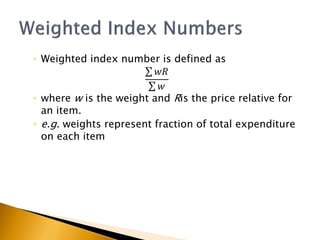
◦ Weighted index number is defined as
𝑤𝑅
𝑤
◦ where w is the weight and Ris the price relative for
an item.
◦ e.g. weights represent fraction of total expenditure
on each item
◦ Weighted index number is defined as
𝑤𝑅
𝑤
=
27358
100
= 273.58
w R
eggs 18 151.00 2718.00
flour 16 225.70 3611.20
fat 5 94.60 473.00
sugar 14 405.00 5670.00
lemons 2 256.40 512.80
gas 45 319.40 14373.00
100 27358.00
◦ Use ratio of price indices to deflate actual values into
those of comparison year.
◦
104.7
108.5
× £17,127 = £16,527
1. ONS (2011)
Year CPI1 actual pay deflated (2007)
2007 104.7 £16,769 £16,769
2008 108.5 £17,127
2009 110.8 £17,582
2010 114.5 £17,940
Year CPI actual pay deflated (2007)
2007 104.7 £16,769 £16,769
2008 108.5 £17,127 £16,527
2009 110.8 £17,582 £16,614
2010 114.5 £17,940 £16,405
£16,000
£16,500
£17,000
£17,500
£18,000
actual
deflated (2007)
◦ Recognise nominal, ordinal, interval and ratio data
types
◦ Recognise and use mode, median, mean, range,
standard deviation and coefficient of variation
◦ Calculate Laspeyres and Paasche index numbers
◦ Use index numbers to calculate percentage changes
and to deflate series
◦ ONS (2011),
www.statistics.gov.uk/statbase/product.asp?vlnk=8
68, accessed 2nd March 2011
Any Questions?

Lecture 01 Introductory Management Statistics

  • 1.
  • 2.
    This topic willcover: ◦ Data types ◦ A revision of summary statistics ◦ Index numbers
  • 3.
    By the endof this topic students will be able to: ◦ recognise nominal, ordinal, interval and ratio data types ◦ recognise and use mode, median, mean, range, standard deviation and coefficient of variation ◦ calculate Laspeyres and Paasche index numbers ◦ use index numbers to calculate percentage changes and to deflate series
  • 4.
    ◦ Nominal ◦ Ordinal ◦Interval ◦ Ratio Information Content High Low
  • 5.
    ◦ Data whichis only categorised (group characteristic)  Count but not order, nor measure nor ratio ◦ Examples  Gender (male or female)  Job role (administration, production, accounting, sales)  Product type (fruit cake, chocolate cake, cream cake) ◦ Summary statistics  Mode
  • 6.
    • Parts instock • Mode - The number or category that occurs the most 3 7 6 6 8 10 5 5 11 8 9 12 9 6 4 6 7 4 2 4 8 5 6 10 9 7 8 10 7 5 2 5 1 9 7 11 7 8 7 9 6 8 3 4 3 part number frequency 7 7 6 6 8 6 5 5 9 5 4 4 3 3 10 3 2 2 11 2 1 1 12 1 total 45
  • 7.
    ◦ Data whichcan be ranked  Count and put in order but not measure nor ratio ◦ Examples  Employee grades (A, B, C …)  Voting preferences (best candidate, 2nd best …)  Product preferences ◦ Summary statistics  Mode, median
  • 8.
    • Score onrating scale • Median - Value of middle item of ordered data, (N +1)/2 term score frequency cumulative frequency 1 1 1 2 2 3 3 3 6 4 4 10 5 5 15 6 6 21 7 7 28 8 6 34 9 5 39 10 3 42 11 2 44 12 1 45 3 7 6 6 8 10 5 5 11 8 9 12 9 6 4 6 7 4 2 4 8 5 6 10 9 7 8 10 7 5 2 5 1 9 7 11 7 8 7 9 6 8 3 4 3
  • 9.
    ◦ Data whichcan be placed along a scale  Count, put in order, measure but not ratio ◦ Examples  Centigrade temperature scale (10C, 15C, 20C)  IQ score (100, 115, 130) ◦ Summary statistics  Mode, median, mean  Range, standard deviation
  • 10.
    • Temperature C •Mean - total value of all data / number of data 3 7 6 6 8 10 5 5 11 8 9 12 9 6 4 6 7 4 2 4 8 5 6 10 9 7 8 10 7 5 2 5 1 9 7 11 7 8 7 9 6 8 3 4 3 temperature (x) Frequency (f) fx 1 1 1 2 2 4 3 3 9 4 4 16 5 5 25 6 6 36 7 7 49 8 6 48 9 5 45 10 3 30 11 2 22 12 1 12 total 45 297  = mean = 297/45 = 6.6C
  • 11.
     Population varianceis 𝜎2 = 𝑓 𝑖 𝑥 𝑖−𝜇 2 𝑁  where𝑁 = 𝑓𝑖and the mean 𝜇 = 𝑓 𝑖 𝑥 𝑖 𝑁  and the standard deviation is  𝜎 = 𝑓𝑖 𝑥 𝑖−𝜇 2 𝑁
  • 12.
    temperature (x) frequency (f) fx x- m (x - m)2 f(x - m) 2 1 1 1 -5.6 31.36 31.36 2 2 4 -4.6 21.16 42.32 3 3 9 -3.6 12.96 38.88 4 4 16 -2.6 6.76 27.04 5 5 25 -1.6 2.56 12.80 6 6 36 -0.6 0.36 2.16 7 7 49 0.4 0.16 1.12 8 6 48 1.4 1.96 11.76 9 5 45 2.4 5.76 28.80 10 3 30 3.4 11.56 34.68 11 2 22 4.4 19.36 38.72 12 1 12 5.4 29.16 29.16 total 45 297 298.8
  • 13.
     𝑁 =𝑓𝑖 = 45  𝜇 = 𝑓 𝑖 𝑥 𝑖 𝑁 = 297 45 = 6.6  𝜎 = 𝑓𝑖 𝑥 𝑖−𝜇 2 𝑁 = 298.8 45 = 2.577
  • 14.
    ◦ Data alonga scale which can be ratioed  Count, put in order, measure and ratio ◦ Examples  Kelvin temperature scale  Time spent in queue (10, 20, 30 minutes)  Differences on interval scales ◦ Summary statistics  Mode, median, mean  Range, standard deviation, coefficient of variation, skewness
  • 15.
    queuing time (x) frequency (f) fxx - m (x - m)2 f(x - m) 2 1 1 1 -5.6 31.36 31.36 2 2 4 -4.6 21.16 42.32 etc. etc. etc. etc. etc. etc. 11 2 22 4.4 19.36 38.72 12 1 12 5.4 29.16 29.16 total 45 297 298.8 𝜇 = 𝑓𝑖 𝑥𝑖 𝑁 = 6.6𝜎 = 𝑓𝑖 𝑥𝑖 − 𝜇 2 𝑁 = 2.577 coefficient of variation 𝐶𝑉 = 𝜎 𝜇 = 2.577 6.6 = 0.39
  • 16.
    ◦ Discrete data Can take a countable number of values  Number of products built (1,237,502)  Number of questions correct in test (4) ◦ Continuous  Can take an uncountable number of values  Length of fabric cut (45.9847248738…metres)  Time in queue (23 minutes 5.2084792…seconds)
  • 17.
    ◦ How toshow the change of data (often price or quantity) over time  Relative to a reference point (the base period) ◦ e.g. simple price index (aka price relative) 𝑅 = 𝑝 𝑛 𝑝0 × 100where 0 denotes the base year i.e. arbitrarily set price as 100 in base year
  • 18.
    Consider chocolate bar,set 2009 as base year Price (GBP) Jan 2009 Jan 2010 Jan 2011 Chocolate bar 0.47 0.52 0.56 Sandwich 1.85 1.92 2.00 Bag of crisps 0.60 0.61 0.63 year price Jan 2009 0.47 1.0000 100.00 Jan 2010 0.52 1.1064 110.64 Jan 2011 0.56 1.1915 119.15
  • 19.
    ◦ Compare theprices of snack products over time year chocolate bar price index sandwich price index bag of crisps price index Jan 2009 0.47 100.00 1.85 0.60 Jan 2010 0.52 110.64 1.92 0.61 Jan 2011 0.56 119.15 2.00 0.63 𝑅 = 𝑝 𝑛 𝑝0 × 100
  • 20.
    year chocolate bar priceindex sandwich price index bag of crisps price index Jan 2009 0.47 100.00 1.85 100.00 0.60 100.00 Jan 2010 0.52 110.64 1.92 103.78 0.61 101.67 Jan 2011 0.56 119.15 2.00 108.11 0.63 105.00 95.00 100.00 105.00 110.00 115.00 120.00 125.00 priceindex£- £0.50 £1.00 £1.50 £2.00 £2.50 priceperunit
  • 21.
    % 𝑐ℎ𝑎𝑛𝑔𝑒 = 𝑛𝑒𝑤𝑖𝑛𝑑𝑒𝑥 − 𝑜𝑙𝑑 𝑖𝑛𝑑𝑒𝑥 𝑜𝑙𝑑 𝑖𝑛𝑑𝑒𝑥 × 100 % 𝑐ℎ𝑎𝑛𝑔𝑒 = 119.15 − 110.64 110.64 × 100 = 7.69% year chocolate bar index annual % sandwich price index bag of crisps price index Jan 2009 100.00 - 100.00 - 100.00 - Jan 2010 110.64 10.64 103.78 ? 101.67 ? Jan 2011 119.15 7.69 108.11 ? 105.00 ? year chocolate bar index annual % sandwich price index bag of crisps price index Jan 2009 100.00 - 100.00 - 100.00 - Jan 2010 110.64 10.64 103.78 3.78 101.67 1.67 Jan 2011 119.15 7.69 108.11 4.17 105.00 3.27
  • 22.
    ◦ Reasons forchanging base period;  Mature series => large indices, relevance of base period  Compare different indices which have used different base years ‘00 ‘01 ‘02 ‘03 ‘04 ‘05 ‘06 ‘07 ‘08 ‘09 ‘10 ‘11 Index (‘02 as base) 93 97 100 106 119 122 133 148 164 177 188 196 Index (‘07 as base) ? 100
  • 23.
    ‘00 ‘01 ‘02‘03 ‘04 ‘05 ‘06 ‘07 ‘08 ‘09 ‘10 ‘11 Index (‘02 as base) 93 97 100 106 119 122 133 148 164 177 188 196 Index (‘07 as base) ? ? 68 ? ? ? ? 100 ? ? ? ? ‘00 ‘01 ‘02 ‘03 ‘04 ‘05 ‘06 ‘07 ‘08 ‘09 ‘10 ‘11 Index (‘02 as base) 93 97 100 106 119 122 133 148 164 177 188 196 Index (‘07 as base) 63 66 68 72 80 82 90 100 111 120 127 132
  • 24.
    year price chocolate barsandwich bag of crisps I Jan 2009 0.47 1.85 0.60 100.00 Jan 2010 0.52 1.92 0.61 104.45 Jan 2011 0.56 2.00 0.63 ?
  • 26.
    𝐿𝑃𝐼09 = 100× 𝑞09 𝑝09 𝑞09 𝑝09 = 100 × 45 × 0.47 + 17 × 1.85 + 13 × 0.60 45 × 0.47 + 17 × 1.85 + 13 × 0.60 = 100 𝐿𝑃𝐼10 = 100 × 𝑞09 𝑝10 𝑞09 𝑝09 = 100 × 45 × 0.52 + 17 × 1.92 + 13 × 0.61 45 × 0.47 + 17 × 1.85 + 13 × 0.60 = 105.91 𝐿𝑃𝐼11 = 100 × 𝑞09 𝑝11 𝑞09 𝑝09 = 100 × 45 ×? + 17 ×? + 13 ×? 45 × 0.47 + 17 × 1.85 + 13 × 0.60 =? ? ? year chocolate bar price quantity sandwich price quantity bag of crisps price quantity ’09 0.47 45 1.85 17 0.60 13 ’10 0.52 30 1.92 20 0.61 13 ‘11 0.56 22 2.00 22 0.63 13
  • 28.
    𝑃𝑃𝐼09 = 100× 𝑞09 𝑝09 𝑞09 𝑝09 = 100 × 45 × 0.47 + 17 × 1.85 + 13 × 0.60 45 × 0.47 + 17 × 1.85 + 13 × 0.60 = 100 𝑃𝑃𝐼10 = 100 × 𝑞10 𝑝10 𝑞10 𝑝09 = 100 × 30 × 0.52 + 20 × 1.92 + 13 × 0.61 30 × 0.47 + 20 × 1.85 + 13 × 0.60 = 105.14 𝑃𝑃𝐼11 = 100 × 𝑞11 𝑝11 𝑞11 𝑝09 = 100 × ?×? + ?×? + ?×? ?× 0.47 + ?× 1.85 + ?× 0.60 =? ? ? year chocolate bar price quantity sandwich price quantity bag of crisps price quantity ’09 0.47 45 1.85 17 0.60 13 ’10 0.52 30 1.92 20 0.61 13 ‘11 0.56 22 2.00 22 0.63 13
  • 29.
    ◦ Weighted indexnumber is defined as 𝑤𝑅 𝑤 ◦ where w is the weight and Ris the price relative for an item. ◦ e.g. weights represent fraction of total expenditure on each item
  • 30.
    ◦ Weighted indexnumber is defined as 𝑤𝑅 𝑤 = 27358 100 = 273.58 w R eggs 18 151.00 2718.00 flour 16 225.70 3611.20 fat 5 94.60 473.00 sugar 14 405.00 5670.00 lemons 2 256.40 512.80 gas 45 319.40 14373.00 100 27358.00
  • 31.
    ◦ Use ratioof price indices to deflate actual values into those of comparison year. ◦ 104.7 108.5 × £17,127 = £16,527 1. ONS (2011) Year CPI1 actual pay deflated (2007) 2007 104.7 £16,769 £16,769 2008 108.5 £17,127 2009 110.8 £17,582 2010 114.5 £17,940
  • 32.
    Year CPI actualpay deflated (2007) 2007 104.7 £16,769 £16,769 2008 108.5 £17,127 £16,527 2009 110.8 £17,582 £16,614 2010 114.5 £17,940 £16,405 £16,000 £16,500 £17,000 £17,500 £18,000 actual deflated (2007)
  • 33.
    ◦ Recognise nominal,ordinal, interval and ratio data types ◦ Recognise and use mode, median, mean, range, standard deviation and coefficient of variation ◦ Calculate Laspeyres and Paasche index numbers ◦ Use index numbers to calculate percentage changes and to deflate series
  • 34.
  • 35.