Linear Programming
A model consisting of linear relationships
representing a firm’s objective and resource
constraints
Linear Programming (LP)
LP is a mathematical modeling technique used to
determine a level of operational activity in order to
achieve an objective, subject to restrictions called
constraints
LP Model Formulation
 Decision variables
 mathematical symbols representing levels of activity of an
operation
 Objective function
 a linear relationship reflecting the objective of an operation
 most frequent objective of business firms is to maximize profit
 most frequent objective of individual operational units (such as
a production or packaging department) is to minimize cost
 Constraint
 a linear relationship representing a restriction on decision
making
LP Model Formulation (cont.)
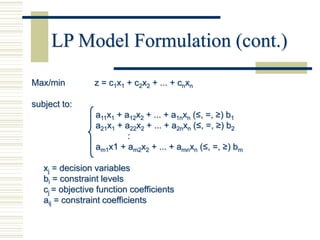
Max/min z = c1x1 + c2x2 + ... + cnxn
subject to:
a11x1 + a12x2 + ... + a1nxn (≤, =, ≥) b1
a21x1 + a22x2 + ... + a2nxn (≤, =, ≥) b2
:
am1x1 + am2x2 + ... + amnxn (≤, =, ≥) bm
xj = decision variables
bi = constraint levels
cj = objective function coefficients
aij = constraint coefficients
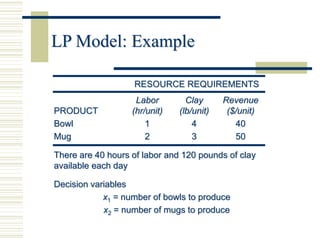
LP Model: Example
Labor Clay Revenue
PRODUCT (hr/unit) (lb/unit) ($/unit)
Bowl 1 4 40
Mug 2 3 50
There are 40 hours of labor and 120 pounds of clay
available each day
Decision variables
x1 = number of bowls to produce
x2 = number of mugs to produce
RESOURCE REQUIREMENTS
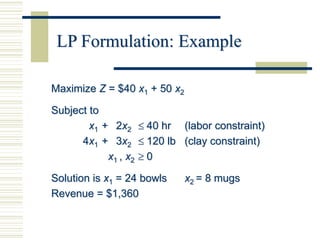
LP Formulation: Example
Maximize Z = $40 x1 + 50 x2
Subject to
x1 + 2x2 40 hr (labor constraint)
4x1 + 3x2 120 lb (clay constraint)
x1 , x2 0
Solution is x1 = 24 bowls x2 = 8 mugs
Revenue = $1,360
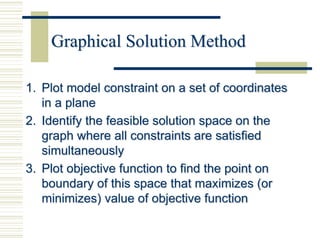
Graphical Solution Method
1. Plot model constraint on a set of coordinates
in a plane
2. Identify the feasible solution space on the
graph where all constraints are satisfied
simultaneously
3. Plot objective function to find the point on
boundary of this space that maximizes (or
minimizes) value of objective function
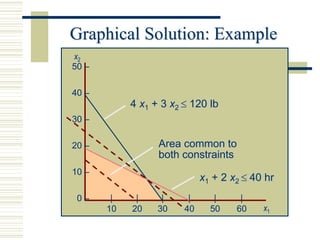
Graphical Solution: Example
4 x1 + 3 x2 120 lb
x1 + 2 x2 40 hr
Area common to
both constraints
50 –
40 –
30 –
20 –
10 –
0 – |
10
|
60
|
50
|
20
|
30
|
40 x1
x2
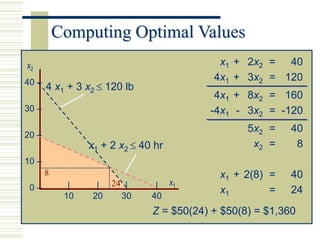
Computing Optimal Values
x1 + 2x2 = 40
4x1 + 3x2 = 120
4x1 + 8x2 = 160
-4x1 - 3x2 = -120
5x2 = 40
x2 = 8
x1 + 2(8) = 40
x1 = 24
4 x1 + 3 x2 120 lb
x1 + 2 x2 40 hr
40 –
30 –
20 –
10 –
0 – |
10
|
20
|
30
|
40
x1
x2
Z = $50(24) + $50(8) = $1,360
24
8
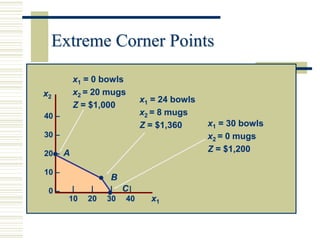
Extreme Corner Points
x1 = 24 bowls
x2 = 8 mugs
Z = $1,360 x1 = 30 bowls
x2 = 0 mugs
Z = $1,200
x1 = 0 bowls
x2 = 20 mugs
Z = $1,000
A
B
C
|
20
|
30
|
40
|
10 x1
x2
40 –
30 –
20 –
10 –
0 –
4x1 + 3x2 120 lb
x1 + 2x2 40 hr
40 –
30 –
20 –
10 –
0 –
B
|
10
|
20
|
30
|
40 x1
x2
C
A
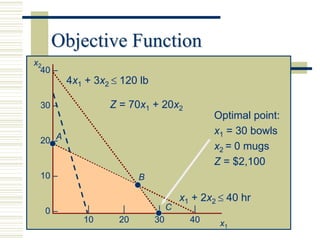
Z = 70x1 + 20x2
Optimal point:
x1 = 30 bowls
x2 = 0 mugs
Z = $2,100
Objective Function
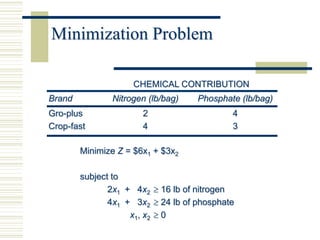
Minimization Problem
CHEMICAL CONTRIBUTION
Brand Nitrogen (lb/bag) Phosphate (lb/bag)
Gro-plus 2 4
Crop-fast 4 3
Minimize Z = $6x1 + $3x2
subject to
2x1 + 4x2  16 lb of nitrogen
4x1 + 3x2  24 lb of phosphate
x1, x2  0
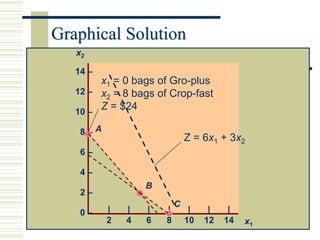
14 –
12 –
10 –
8 –
6 –
4 –
2 –
0 – |
2
|
4
|
6
|
8
|
10
|
12
|
14 x1
x2
A
B
C
Graphical Solution
x1 = 0 bags of Gro-plus
x2 = 8 bags of Crop-fast
Z = $24
Z = 6x1 + 3x2
Solving LP Problems with Excel
Click on “Tools”
to invoke “Solver.”
Objective function
Decision variables – bowls
(x1)=B10; mugs (x2)=B11
=C6*B10+D6*B11
=C7*B10+D7*B11
=E6-F6
=E7-F7
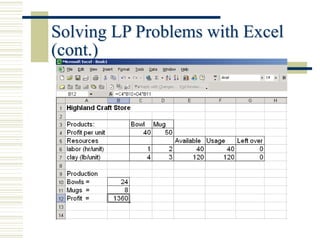
Solving LP Problems with Excel
(cont.)
After all parameters and constraints
have been input, click on “Solve.”
Objective function
Decision variables
C6*B10+D6*B11≤40
C7*B10+D7*B11≤120
Click on “Add” to
insert constraints
Solving LP Problems with Excel
(cont.)
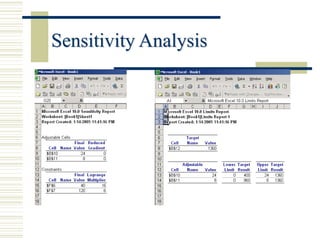
Sensitivity Analysis

Linear Programming_rereeLecture 2 (1).ppt

  • 1.
  • 2.
    A model consistingof linear relationships representing a firm’s objective and resource constraints Linear Programming (LP) LP is a mathematical modeling technique used to determine a level of operational activity in order to achieve an objective, subject to restrictions called constraints
  • 3.
    LP Model Formulation Decision variables  mathematical symbols representing levels of activity of an operation  Objective function  a linear relationship reflecting the objective of an operation  most frequent objective of business firms is to maximize profit  most frequent objective of individual operational units (such as a production or packaging department) is to minimize cost  Constraint  a linear relationship representing a restriction on decision making
  • 4.
    LP Model Formulation(cont.) Max/min z = c1x1 + c2x2 + ... + cnxn subject to: a11x1 + a12x2 + ... + a1nxn (≤, =, ≥) b1 a21x1 + a22x2 + ... + a2nxn (≤, =, ≥) b2 : am1x1 + am2x2 + ... + amnxn (≤, =, ≥) bm xj = decision variables bi = constraint levels cj = objective function coefficients aij = constraint coefficients
  • 5.
    LP Model: Example LaborClay Revenue PRODUCT (hr/unit) (lb/unit) ($/unit) Bowl 1 4 40 Mug 2 3 50 There are 40 hours of labor and 120 pounds of clay available each day Decision variables x1 = number of bowls to produce x2 = number of mugs to produce RESOURCE REQUIREMENTS
  • 6.
    LP Formulation: Example MaximizeZ = $40 x1 + 50 x2 Subject to x1 + 2x2 40 hr (labor constraint) 4x1 + 3x2 120 lb (clay constraint) x1 , x2 0 Solution is x1 = 24 bowls x2 = 8 mugs Revenue = $1,360
  • 7.
    Graphical Solution Method 1.Plot model constraint on a set of coordinates in a plane 2. Identify the feasible solution space on the graph where all constraints are satisfied simultaneously 3. Plot objective function to find the point on boundary of this space that maximizes (or minimizes) value of objective function
  • 8.
    Graphical Solution: Example 4x1 + 3 x2 120 lb x1 + 2 x2 40 hr Area common to both constraints 50 – 40 – 30 – 20 – 10 – 0 – | 10 | 60 | 50 | 20 | 30 | 40 x1 x2
  • 9.
    Computing Optimal Values x1+ 2x2 = 40 4x1 + 3x2 = 120 4x1 + 8x2 = 160 -4x1 - 3x2 = -120 5x2 = 40 x2 = 8 x1 + 2(8) = 40 x1 = 24 4 x1 + 3 x2 120 lb x1 + 2 x2 40 hr 40 – 30 – 20 – 10 – 0 – | 10 | 20 | 30 | 40 x1 x2 Z = $50(24) + $50(8) = $1,360 24 8
  • 10.
    Extreme Corner Points x1= 24 bowls x2 = 8 mugs Z = $1,360 x1 = 30 bowls x2 = 0 mugs Z = $1,200 x1 = 0 bowls x2 = 20 mugs Z = $1,000 A B C | 20 | 30 | 40 | 10 x1 x2 40 – 30 – 20 – 10 – 0 –
  • 11.
    4x1 + 3x2120 lb x1 + 2x2 40 hr 40 – 30 – 20 – 10 – 0 – B | 10 | 20 | 30 | 40 x1 x2 C A Z = 70x1 + 20x2 Optimal point: x1 = 30 bowls x2 = 0 mugs Z = $2,100 Objective Function
  • 12.
    Minimization Problem CHEMICAL CONTRIBUTION BrandNitrogen (lb/bag) Phosphate (lb/bag) Gro-plus 2 4 Crop-fast 4 3 Minimize Z = $6x1 + $3x2 subject to 2x1 + 4x2  16 lb of nitrogen 4x1 + 3x2  24 lb of phosphate x1, x2  0
  • 13.
    14 – 12 – 10– 8 – 6 – 4 – 2 – 0 – | 2 | 4 | 6 | 8 | 10 | 12 | 14 x1 x2 A B C Graphical Solution x1 = 0 bags of Gro-plus x2 = 8 bags of Crop-fast Z = $24 Z = 6x1 + 3x2
  • 14.
    Solving LP Problemswith Excel Click on “Tools” to invoke “Solver.” Objective function Decision variables – bowls (x1)=B10; mugs (x2)=B11 =C6*B10+D6*B11 =C7*B10+D7*B11 =E6-F6 =E7-F7
  • 15.
    Solving LP Problemswith Excel (cont.) After all parameters and constraints have been input, click on “Solve.” Objective function Decision variables C6*B10+D6*B11≤40 C7*B10+D7*B11≤120 Click on “Add” to insert constraints
  • 16.
    Solving LP Problemswith Excel (cont.)
  • 17.