Distinguish Lecture
on Future Directions on Wireless Communications
Presented
by
Dr L. Lakshmi Prasanna Kumar
Asst Professor of ECE
IEEE MTT Society Advisor
G PULLA REDDY ENGINEERING COLELGE (AUTONOMOUS): KURNOOL
DEPARTMENT OF ELECTRONICS AND COMMUNICATION ENGINEERING
Key Outlines
Fundamentals of Wireless Communications
Evolution of Wireless Communications
*Future Directions of Wireless Communications
Fundamentals
of
Wireless Communications
DEFINITION OF WIRELESS COMMUNICATION
Wireless communication transmits data
via electromagnetic waves through the
air, eliminating the need for physical
connections.
Major Types of Wireless Communication
• Radio Frequency (RF) Communication:
Examples: Cellular networks (4G, 5G),Wi-Fi, Bluetooth, Radio
broad casting, GPS
Uses: Mobile phones, internet access, short-range devices, etc.
• Microwave Communication:
Examples: Satellite communication, Radar systems, Microwave
ovens (a form of electromagnetic radiation)
Uses: Long-distance communication, weather forecasting,
navigation.
• Infrared Communication:
Examples: Remote controls, Short-range data transfer (e.g.,
between devices)
Uses: Consumer electronics, data exchange in limited spaces.
• Satellite Communication:
Examples:
Satellite TV, GPS, Global communication networks
Uses: Broadcasting, navigation, internet access, weather
monitoring.
• Optical Communication:
Examples:
Fiber optic communication, Free-space optical communication
(e.g., laser beams)
Uses: High-speed data transmission (internet,
telecommunications), long-distance communication.
• Acoustic Communication:
Examples:
Sonar, Underwater communication, Animal communication (e.g.,
dolphins, whales)
Uses: Underwater navigation, military applications, studying
animal behavior.
Wireless communication protocols are standardized sets of rules that
govern how devices communicate wirelessly.
•GSM (2G): An older standard for voice and basic data.
• CDMA (2G/3G): A technology allowing multiple users on the same
frequency.
•LTE (4G): Marked a significant speed increase, enabling faster data transfer.
•5G: Offers significantly higher speeds, lower latency, and greater capacity,
supporting applications like autonomous vehicles and the Internet of
Things.
•6G (Emerging): Expected to focus on AI, holographic communication, and
even brain-computer interfaces, pushing the boundaries of wireless
connectivity.
•7G (Conceptual): Still in early stages of research and development, likely to
involve revolutionary technologies like quantum communication.
•Modulation: Translates information onto a carrier wave.
•Demodulation: Recovers original information from the
carrier wave.
•Frequency Bands: Specific ranges of frequencies
allocated for communication.
•Interference: Signals from other sources disrupting
communication.
•Noise: Unwanted random signals degrading signal
quality.
Key Concepts of Communications
Path Loss
1) Free-space path loss
2) Absorption loss
3) Diffraction loss
4) Reflection loss:
Fading
2) Large-scale fading
3) Small-scale fading
4) Rayleigh fading
5) Rician fading,
Multipath Effects
6) Constructive interference
7) Destructive interference
8) Time dispersion
9) Frequency selective fading:
•FDMA (Frequency Division Multiple Access): Divides the available
bandwidth into smaller frequency bands, each assigned to a different user.
•TDMA (Time Division Multiple Access): Divides the time into slots, with
each user allocated a specific time slot within a frame to transmit data.
•CDMA (Code Division Multiple Access): Allows multiple users to share the
same frequency band simultaneously by assigning unique codes to each
user.
•OFDMA (Orthogonal Frequency Division Multiple Access): Divides the
available bandwidth into many narrowband subcarriers, each carrying a
portion of the data.
•NOMA (Non-Orthogonal Multiple Access): Allows multiple users to
transmit simultaneously on the same frequency and time slot using power-
domain multiplexing
Multiple Access Techniques used in
Communications
Evolution
of
Wireless Communications
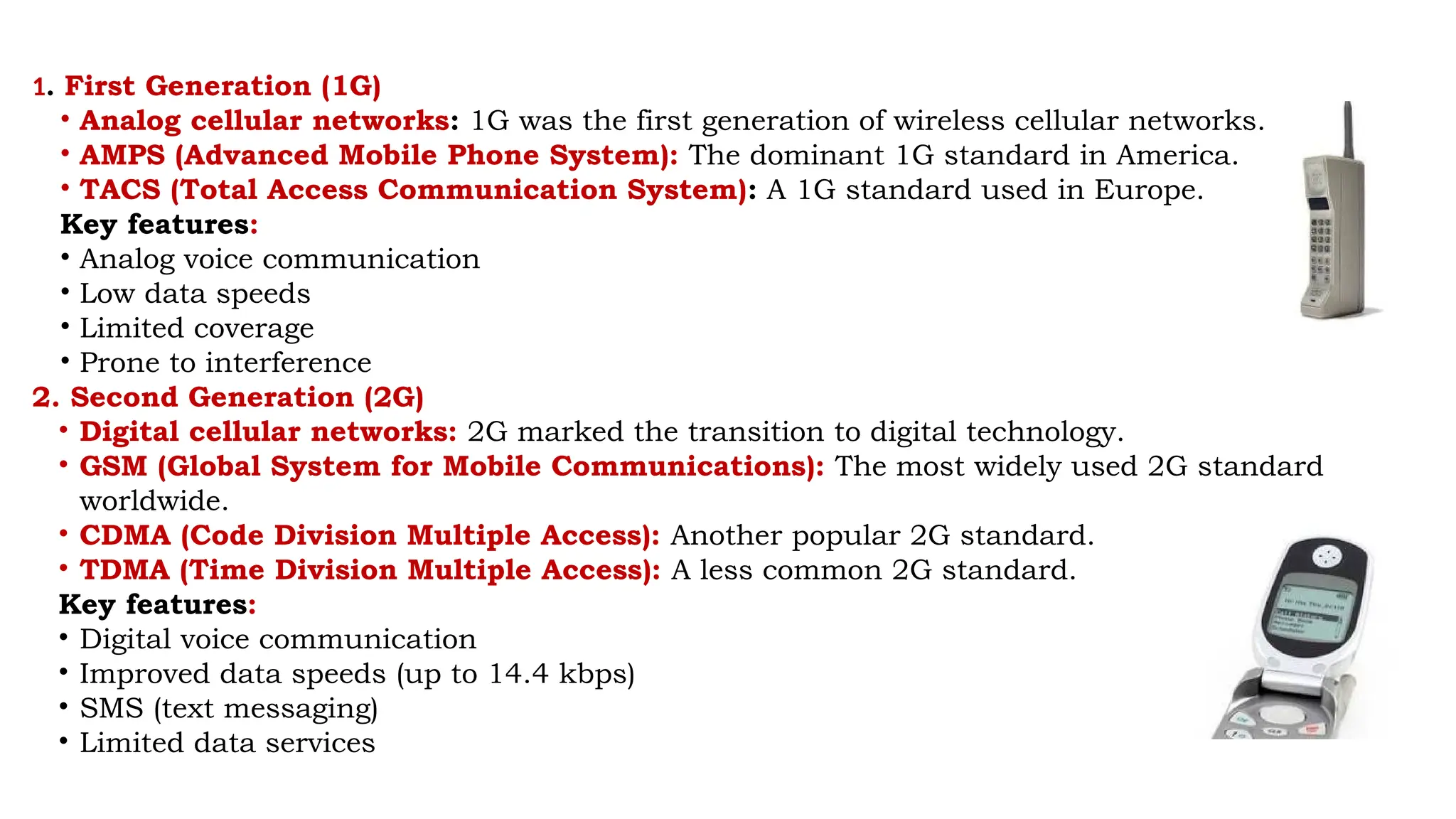
1. First Generation (1G)
• Analog cellular networks: 1G was the first generation of wireless cellular networks.
• AMPS (Advanced Mobile Phone System): The dominant 1G standard in America.
• TACS (Total Access Communication System): A 1G standard used in Europe.
Key features:
• Analog voice communication
• Low data speeds
• Limited coverage
• Prone to interference
2. Second Generation (2G)
• Digital cellular networks: 2G marked the transition to digital technology.
• GSM (Global System for Mobile Communications): The most widely used 2G standard
worldwide.
• CDMA (Code Division Multiple Access): Another popular 2G standard.
• TDMA (Time Division Multiple Access): A less common 2G standard.
Key features:
• Digital voice communication
• Improved data speeds (up to 14.4 kbps)
• SMS (text messaging)
• Limited data services
3. Third Generation (3G)
•High-speed data networks: 3G brought significant improvements in data speeds.
•UMTS (Universal Mobile Telecommunications System): The dominant 3G standard.
•CDMA2000: Another 3G standard.
•WCDMA (Wideband Code Division Multiple Access): A 3G technology used in UMTS.
Key features:
•High-speed data (up to 2 Mbps)
•Mobile internet access
•Video calling
•Multimedia messaging
4. Fourth Generation (4G)
•Long-Term Evolution (LTE): The dominant 4G standard.
•WiMAX (Worldwide Interoperability for Microwave Access): Another 4G technology.
Key features:
•Significantly higher data speeds (up to 1 Gbps)
•HD video streaming
•Online gaming
•Voice over LTE (VoLTE)
5. Fifth Generation (5G)
•New Radio (NR): The new radio access technology for 5G.
•Massive Machine-Type Communications (mMTC): Supports a
massive number of connected devices.
•Ultra-Reliable Low-Latency Communications (URLLC):
Ensures extremely low latency for critical applications.
Key features:
•Ultra-high data speeds (up to 10 Gbps)
•Low latency
•Enhanced mobile broadband
•Ultra-reliable communications
•Massive IoT connectivity
6. Sixth Generation(6G)
6G wireless technology will use a wide range of frequencies, including the sub-
terahertz (sub-THz) range, the millimeter-wave range, and the mid-band
range. 6G networks are expected to launch around 2030.
Frequency bands
• Sub-THz range
90–300 GHz, this range offers large amounts of spectrum for high data
rates. It's useful for applications that require low latency or extreme data
rates, such as holographic communication in hospitals and factories.
• Mid-band range
7–15 GHz, this range offers a balance between coverage and capacity. It
includes bands like 7.125–8.5 GHz, 10.7–13.25 GHz, and 14–15.35 GHz.
• Millimeter-wave range
6G will use this range in addition to the sub-THz and mid-band ranges.
• Lower frequency bands
410 MHz–6 GHz, these bands are similar to 4G LTE. They're important for
coverage, capacity, and mobility.
Data rates
6G aims to achieve peak data rates of up to 1 Tbps. This requires wider
bandwidths of 10 GHz or more, which are only available at higher
frequencies.
Current Operating Frequencies
•1G: 800 MHz, 900 MHz
•2G: 850 MHz, 900 MHz, 1800 MHz, 1900 MHz
•3G: 850 MHz, 900 MHz, 1700 MHz, 1900 MHz, 2100 MHz
•4G: 700 MHz, 800 MHz, 850 MHz, 1800 MHz, 1900 MHz,
2100 MHz, 2300 MHz, 2500 MHz, 2600 MHz
• 5G: Sub-6 GHz (600 MHz - 6 GHz) and
mmWave (above 24 GHz)
Key Architectural Differences between Generations
• Switching: Transitioned from circuit-switched to packet-
switched, enabling more efficient resource utilization and higher
data speeds.
• Modulation: Evolved from analog to digital modulation
techniques, improving spectral efficiency and data rates.13
• Multiple Access: Introduced techniques like CDMA, TDMA, and
OFDMA to allow multiple users to share the same frequency band.
• Network Architecture: Became more complex and layered, with
the addition of new elements like core networks, base stations,
and edge servers.
FEATURE 1G (Analog) 2G (Digital) 3G (3G) 4G (LTE) 5G (NR)
SWITCHING Circuit Circuit Packet Packet Packet
MODULATION Analog Digital Digital Digital Digital
MULTIPLE
ACCESS
None TDMA, FDMA
CDMA, WCDMA,
TDMA
OFDMA, SC-FDMA
OFDM, Massive
MIMO
NETWORK
ARCHITECTURE
Simple More Complex More Complex IP-Based
Complex, Cloud-
Native
DATA RATES 9.6 kbps - 14.4 kbps
9.6 kbps - 14.4
kbps (GPRS),
384 kbps
(EDGE)
Up to 2 Mbps Up to 1 Gbps Up to 10 Gbps
CARRIER
FREQUENCIES
800 MHz
850 MHz, 900
MHz, 1800
MHz, 1900 MHz
1900 MHz, 2100
MHz
700 MHz, 800
MHz, 1800 MHz,
2100 MHz, 2600
MHz
Sub-6 GHz (600
MHz - 6 GHz),
mmWave (24
GHz - 90 GHz)
COMPANY AT&T, Motorola
Nokia, Ericsson,
Qualcomm
Nokia, Ericsson,
Qualcomm,
Apple
Huawei,
Qualcomm,
Ericsson, Nokia,
Apple
Huawei,
Qualcomm,
Ericsson, Nokia,
Samsung, Apple
Future Directions
of
Wireless Communications
Generation Key Transceiver Blocks
1G Basic oscillators, mixers, amplifiers
2G ADCs, DACs, basic DSP units
3G Improved ADCs and DACs, sophisticated DSP algorithms
4G High-performance ADCs and DACs, advanced RF front-ends
5G
High-performance ADCs and DACs, high-frequency RF front-
ends, advanced beamforming hardware
Millimeter Wave(mm) Communications
Definition
•Millimeter wave refers to a portion of the electromagnetic spectrum with frequencies
ranging from 30 GHz to 300 GHz.
•The corresponding wavelengths fall between 1 millimeter and 10 millimeters, hence the
name.
Advantagees
1.Massive Bandwidth:
•mmWave bands offer significantly more bandwidth compared to lower-frequency bands
used in previous generations of wireless communication (like 4G).
•This large bandwidth is essential for supporting the ever-increasing demand for high-
speed data services like 4K/8K video streaming, augmented reality/virtual reality, and
autonomous driving.
2.High Data Rates:
•The availability of large bandwidths allows for significantly higher data transmission
rates, reaching multi-gigabit per second speeds.
3.Low Latency:
•Mm
•Wave's high frequencies enable faster signal propagation, leading to lower latency. This is
critical for applications like real-time gaming, remote surgery, and autonomous vehicle
control.
Applications of millimeter wave radar
for autonomous vehicles. Image
courtesy of Rohde & Schwarz
Millimeter-wave body scanner
system. Image courtesy of
Rohde & Schwarz
Massive MIMO
Massive MIMO, or Multiple-Input Multiple-
Output, is a revolutionary wireless
communication technology the same resources
without interference by creating spatially
separated channels. at's at the heart of 5G and
beyond. Think of it as a giant leap forward in
how our devices connect to the internet.
Spatial multiplexing
SDMA
EDGE COMPUTING
Edge computing is a key technology for
the future, enabling faster, more efficient,
and more responsive applications in a
connected world.
•Data is processed locally: Instead of
sending data to a distant data center, it's
processed closer to the source (like your
kitchen).
•Faster response times: This is crucial
for applications that require real-time
decisions, such as self-driving cars or
industrial automation.
•Reduced bandwidth usage: Only the
necessary data is sent to the cloud,
saving on network costs.
•Improved reliability: If the network
connection is unstable, edge devices can
still function independently.
• quantum computing offers the potential to significantly
enhance the security, efficiency, and performance of
wireless communications.
• It offers
1. Unbreakable Security:
2. Network Optimization
3. Accelerated Data Processing
Quantum Computing in wireless communications.
Blending AI Concepts to wireless
Communications and sensing
Thank You
&
Any Queries

WCM-Evolution of Wireless Communications

  • 1.
    Distinguish Lecture on FutureDirections on Wireless Communications Presented by Dr L. Lakshmi Prasanna Kumar Asst Professor of ECE IEEE MTT Society Advisor G PULLA REDDY ENGINEERING COLELGE (AUTONOMOUS): KURNOOL DEPARTMENT OF ELECTRONICS AND COMMUNICATION ENGINEERING
  • 2.
    Key Outlines Fundamentals ofWireless Communications Evolution of Wireless Communications *Future Directions of Wireless Communications
  • 3.
  • 4.
    DEFINITION OF WIRELESSCOMMUNICATION Wireless communication transmits data via electromagnetic waves through the air, eliminating the need for physical connections.
  • 5.
    Major Types ofWireless Communication • Radio Frequency (RF) Communication: Examples: Cellular networks (4G, 5G),Wi-Fi, Bluetooth, Radio broad casting, GPS Uses: Mobile phones, internet access, short-range devices, etc. • Microwave Communication: Examples: Satellite communication, Radar systems, Microwave ovens (a form of electromagnetic radiation) Uses: Long-distance communication, weather forecasting, navigation. • Infrared Communication: Examples: Remote controls, Short-range data transfer (e.g., between devices) Uses: Consumer electronics, data exchange in limited spaces.
  • 6.
    • Satellite Communication: Examples: SatelliteTV, GPS, Global communication networks Uses: Broadcasting, navigation, internet access, weather monitoring. • Optical Communication: Examples: Fiber optic communication, Free-space optical communication (e.g., laser beams) Uses: High-speed data transmission (internet, telecommunications), long-distance communication. • Acoustic Communication: Examples: Sonar, Underwater communication, Animal communication (e.g., dolphins, whales) Uses: Underwater navigation, military applications, studying animal behavior.
  • 7.
    Wireless communication protocolsare standardized sets of rules that govern how devices communicate wirelessly. •GSM (2G): An older standard for voice and basic data. • CDMA (2G/3G): A technology allowing multiple users on the same frequency. •LTE (4G): Marked a significant speed increase, enabling faster data transfer. •5G: Offers significantly higher speeds, lower latency, and greater capacity, supporting applications like autonomous vehicles and the Internet of Things. •6G (Emerging): Expected to focus on AI, holographic communication, and even brain-computer interfaces, pushing the boundaries of wireless connectivity. •7G (Conceptual): Still in early stages of research and development, likely to involve revolutionary technologies like quantum communication.
  • 8.
    •Modulation: Translates informationonto a carrier wave. •Demodulation: Recovers original information from the carrier wave. •Frequency Bands: Specific ranges of frequencies allocated for communication. •Interference: Signals from other sources disrupting communication. •Noise: Unwanted random signals degrading signal quality. Key Concepts of Communications
  • 9.
    Path Loss 1) Free-spacepath loss 2) Absorption loss 3) Diffraction loss 4) Reflection loss: Fading 2) Large-scale fading 3) Small-scale fading 4) Rayleigh fading 5) Rician fading, Multipath Effects 6) Constructive interference 7) Destructive interference 8) Time dispersion 9) Frequency selective fading:
  • 10.
    •FDMA (Frequency DivisionMultiple Access): Divides the available bandwidth into smaller frequency bands, each assigned to a different user. •TDMA (Time Division Multiple Access): Divides the time into slots, with each user allocated a specific time slot within a frame to transmit data. •CDMA (Code Division Multiple Access): Allows multiple users to share the same frequency band simultaneously by assigning unique codes to each user. •OFDMA (Orthogonal Frequency Division Multiple Access): Divides the available bandwidth into many narrowband subcarriers, each carrying a portion of the data. •NOMA (Non-Orthogonal Multiple Access): Allows multiple users to transmit simultaneously on the same frequency and time slot using power- domain multiplexing Multiple Access Techniques used in Communications
  • 11.
  • 12.
    1. First Generation(1G) • Analog cellular networks: 1G was the first generation of wireless cellular networks. • AMPS (Advanced Mobile Phone System): The dominant 1G standard in America. • TACS (Total Access Communication System): A 1G standard used in Europe. Key features: • Analog voice communication • Low data speeds • Limited coverage • Prone to interference 2. Second Generation (2G) • Digital cellular networks: 2G marked the transition to digital technology. • GSM (Global System for Mobile Communications): The most widely used 2G standard worldwide. • CDMA (Code Division Multiple Access): Another popular 2G standard. • TDMA (Time Division Multiple Access): A less common 2G standard. Key features: • Digital voice communication • Improved data speeds (up to 14.4 kbps) • SMS (text messaging) • Limited data services
  • 13.
    3. Third Generation(3G) •High-speed data networks: 3G brought significant improvements in data speeds. •UMTS (Universal Mobile Telecommunications System): The dominant 3G standard. •CDMA2000: Another 3G standard. •WCDMA (Wideband Code Division Multiple Access): A 3G technology used in UMTS. Key features: •High-speed data (up to 2 Mbps) •Mobile internet access •Video calling •Multimedia messaging 4. Fourth Generation (4G) •Long-Term Evolution (LTE): The dominant 4G standard. •WiMAX (Worldwide Interoperability for Microwave Access): Another 4G technology. Key features: •Significantly higher data speeds (up to 1 Gbps) •HD video streaming •Online gaming •Voice over LTE (VoLTE)
  • 14.
    5. Fifth Generation(5G) •New Radio (NR): The new radio access technology for 5G. •Massive Machine-Type Communications (mMTC): Supports a massive number of connected devices. •Ultra-Reliable Low-Latency Communications (URLLC): Ensures extremely low latency for critical applications. Key features: •Ultra-high data speeds (up to 10 Gbps) •Low latency •Enhanced mobile broadband •Ultra-reliable communications •Massive IoT connectivity
  • 15.
    6. Sixth Generation(6G) 6Gwireless technology will use a wide range of frequencies, including the sub- terahertz (sub-THz) range, the millimeter-wave range, and the mid-band range. 6G networks are expected to launch around 2030. Frequency bands • Sub-THz range 90–300 GHz, this range offers large amounts of spectrum for high data rates. It's useful for applications that require low latency or extreme data rates, such as holographic communication in hospitals and factories. • Mid-band range 7–15 GHz, this range offers a balance between coverage and capacity. It includes bands like 7.125–8.5 GHz, 10.7–13.25 GHz, and 14–15.35 GHz. • Millimeter-wave range 6G will use this range in addition to the sub-THz and mid-band ranges. • Lower frequency bands 410 MHz–6 GHz, these bands are similar to 4G LTE. They're important for coverage, capacity, and mobility. Data rates 6G aims to achieve peak data rates of up to 1 Tbps. This requires wider bandwidths of 10 GHz or more, which are only available at higher frequencies.
  • 16.
    Current Operating Frequencies •1G:800 MHz, 900 MHz •2G: 850 MHz, 900 MHz, 1800 MHz, 1900 MHz •3G: 850 MHz, 900 MHz, 1700 MHz, 1900 MHz, 2100 MHz •4G: 700 MHz, 800 MHz, 850 MHz, 1800 MHz, 1900 MHz, 2100 MHz, 2300 MHz, 2500 MHz, 2600 MHz • 5G: Sub-6 GHz (600 MHz - 6 GHz) and mmWave (above 24 GHz)
  • 17.
    Key Architectural Differencesbetween Generations • Switching: Transitioned from circuit-switched to packet- switched, enabling more efficient resource utilization and higher data speeds. • Modulation: Evolved from analog to digital modulation techniques, improving spectral efficiency and data rates.13 • Multiple Access: Introduced techniques like CDMA, TDMA, and OFDMA to allow multiple users to share the same frequency band. • Network Architecture: Became more complex and layered, with the addition of new elements like core networks, base stations, and edge servers.
  • 18.
    FEATURE 1G (Analog)2G (Digital) 3G (3G) 4G (LTE) 5G (NR) SWITCHING Circuit Circuit Packet Packet Packet MODULATION Analog Digital Digital Digital Digital MULTIPLE ACCESS None TDMA, FDMA CDMA, WCDMA, TDMA OFDMA, SC-FDMA OFDM, Massive MIMO NETWORK ARCHITECTURE Simple More Complex More Complex IP-Based Complex, Cloud- Native DATA RATES 9.6 kbps - 14.4 kbps 9.6 kbps - 14.4 kbps (GPRS), 384 kbps (EDGE) Up to 2 Mbps Up to 1 Gbps Up to 10 Gbps CARRIER FREQUENCIES 800 MHz 850 MHz, 900 MHz, 1800 MHz, 1900 MHz 1900 MHz, 2100 MHz 700 MHz, 800 MHz, 1800 MHz, 2100 MHz, 2600 MHz Sub-6 GHz (600 MHz - 6 GHz), mmWave (24 GHz - 90 GHz) COMPANY AT&T, Motorola Nokia, Ericsson, Qualcomm Nokia, Ericsson, Qualcomm, Apple Huawei, Qualcomm, Ericsson, Nokia, Apple Huawei, Qualcomm, Ericsson, Nokia, Samsung, Apple
  • 19.
  • 20.
    Generation Key TransceiverBlocks 1G Basic oscillators, mixers, amplifiers 2G ADCs, DACs, basic DSP units 3G Improved ADCs and DACs, sophisticated DSP algorithms 4G High-performance ADCs and DACs, advanced RF front-ends 5G High-performance ADCs and DACs, high-frequency RF front- ends, advanced beamforming hardware
  • 21.
    Millimeter Wave(mm) Communications Definition •Millimeterwave refers to a portion of the electromagnetic spectrum with frequencies ranging from 30 GHz to 300 GHz. •The corresponding wavelengths fall between 1 millimeter and 10 millimeters, hence the name. Advantagees 1.Massive Bandwidth: •mmWave bands offer significantly more bandwidth compared to lower-frequency bands used in previous generations of wireless communication (like 4G). •This large bandwidth is essential for supporting the ever-increasing demand for high- speed data services like 4K/8K video streaming, augmented reality/virtual reality, and autonomous driving. 2.High Data Rates: •The availability of large bandwidths allows for significantly higher data transmission rates, reaching multi-gigabit per second speeds. 3.Low Latency: •Mm •Wave's high frequencies enable faster signal propagation, leading to lower latency. This is critical for applications like real-time gaming, remote surgery, and autonomous vehicle control.
  • 22.
    Applications of millimeterwave radar for autonomous vehicles. Image courtesy of Rohde & Schwarz Millimeter-wave body scanner system. Image courtesy of Rohde & Schwarz
  • 23.
    Massive MIMO Massive MIMO,or Multiple-Input Multiple- Output, is a revolutionary wireless communication technology the same resources without interference by creating spatially separated channels. at's at the heart of 5G and beyond. Think of it as a giant leap forward in how our devices connect to the internet. Spatial multiplexing SDMA
  • 24.
    EDGE COMPUTING Edge computingis a key technology for the future, enabling faster, more efficient, and more responsive applications in a connected world. •Data is processed locally: Instead of sending data to a distant data center, it's processed closer to the source (like your kitchen). •Faster response times: This is crucial for applications that require real-time decisions, such as self-driving cars or industrial automation. •Reduced bandwidth usage: Only the necessary data is sent to the cloud, saving on network costs. •Improved reliability: If the network connection is unstable, edge devices can still function independently.
  • 25.
    • quantum computingoffers the potential to significantly enhance the security, efficiency, and performance of wireless communications. • It offers 1. Unbreakable Security: 2. Network Optimization 3. Accelerated Data Processing Quantum Computing in wireless communications.
  • 26.
    Blending AI Conceptsto wireless Communications and sensing
  • 34.