Chapter 1: Introduction
Wireless communications and mobility
 History of wireless/mobile communications
 Market penetration and growth
 Areas of research
Spring 2003ICS 243E - Ch. 1 Introduction 1.2
Electronic Computing Devices & Technology
Trends
 Advances in Technology
 more computing power in smaller devices
 flat, lightweight displays with low power consumption
 user interfaces suitable for small dimensions
 higher bandwidths
 multiple wireless interfaces: wireless LANs, wireless WANs,
home RF, Bluetooth
 New Electronic Computing Devices
 small, cheap, portable, replaceable and most important of all
USABLE!
 Technology Trends
 devices are aware of their environment and adapt - “location
awareness”
 devices recognize the location of the user and react
appropriately (e.g., call forwarding, fax forwarding)
Spring 2003ICS 243E - Ch. 1 Introduction 1.3
Wireless and Mobile Communications
 Definition of mobility:
 user mobility: users communicate anytime, anywhere, with anyone
 device portability: devices can be connected anytime, anywhere to the
network
 Definition of wireless:
 Un-tethered, no physical wire attachment
 Wireless vs. Mobile Examples
  stationary computer
  notebook in a hotel
  wireless LANs in legacy buildings
  Personal Digital Assistant (PDA)
 The need for mobility creates the need for integration of wireless
networks into existing fixed network environments:
 local area networks: standardization of IEEE 802.11b/g/a
 Internet: Mobile IP extension of the internet protocol IP
 wide area networks: e.g., internetworking of 3G and IP
Spring 2003ICS 243E - Ch. 1 Introduction 1.4
Applications I
 Vehicles
 transmission of news, road conditions, weather
 personal communication using cellular
 position identification via GPS
 inter vehicle communications for accident prevention
 vehicle and road inter communications for traffic control,
signaling, data gathering
 ambulances, police, etc.: early transmission of patient data to
the hospital, situation reporting
 entertainment: music, video
Spring 2003ICS 243E - Ch. 1 Introduction 1.5
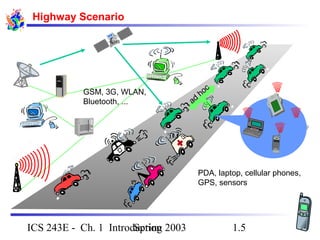
Highway Scenario
ad
hocGSM, 3G, WLAN,
Bluetooth, ...
PDA, laptop, cellular phones,
GPS, sensors
Spring 2003ICS 243E - Ch. 1 Introduction 1.6
Applications II
 Mobile workers
 access to customer files and company documents stored in a
central location
 collaborative work environments
 access to email and voice messages
 Replacement of fixed networks
 remote sensors, e.g., weather, environment, road conditions
 flexible work spaces
 LANs in legacy buildings
 Entertainment, education, ...
 outdoor Internet access
 intelligent travel guide with up-to-date
location dependent information
 ad-hoc networks for
multi user games
Built
150BC
Spring 2003ICS 243E - Ch. 1 Introduction 1.7
Mobile Devices
performanceperformance
Pager
• receive only
• tiny displays
• simple text
messages
Mobile phones
• voice, data
• simple text displays
PDA
• simple graphical displays
• character recognition
• simplified WWW
Palmtop
• tiny keyboard
• simple versions
of standard applications
Laptop
• fully functional
• standard applications
Sensors,
embedded
controllers
Spring 2003ICS 243E - Ch. 1 Introduction 1.8
Impact of Portability on Device Design/Functionality
 Power consumption
 battery capacity - limited computing power, low quality/smaller
displays, smaller disks, fewer options (I/O, CD/DVD)
 CPU: power consumption ~ CV2
f
C: internal capacity, reduced by integration
V: supply voltage, can be reduced to a certain limit
f: clock frequency, can be reduced dynamically based on usage
 Device vulnerability
 more rugged design required to withstand bumps, weather conditions,
etc.
 theft
 Limited/Simpler User Interfaces
 display size
 compromise between comfort/usability and portability (keyboard size)
 integration of character/voice recognition, abstract symbols
 Limited memory
 memory limited by size and power
 flash-memory or ? as alternative
Spring 2003ICS 243E - Ch. 1 Introduction 1.9
Wireless Networks Compared to Fixed Networks
 Higher loss-rates due to interference
 other EM signals, objects in path (multi-path, scattering)
 Limited availability of useful spectrum
 frequencies have to be coordinated, useful frequencies are
almost all occupied
 Low transmission rates
 local area: 2 – 11 Mbit/s, wide area: 9.6 – 19.2 kbit/s
 Higher delays, higher jitter
 connection setup time for cellular in the second range, several
hundred milliseconds for wireless LAN systems
 Lower security, simpler active attacking
 radio interface accessible for everyone
 base station can be simulated, thus attracting calls from
mobile phones
 Always shared medium
 secure access mechanisms important
Spring 2003ICS 243E - Ch. 1 Introduction 1.10
Location Dependent Services
 Location aware services
 what services, e.g., printer, fax, phone, server etc. exist in the
local environment that can be used by the user (security and
authentication)
 Follow-on services
 automatic call-forwarding, transmission of the actual
workspace to the current location
 Information services
 push: e.g., current special offers in the supermarket
 pull: e.g., where is the Sarah Lee New York Cheese Cake?
 Support services
 caches, intermediate results, state information, etc., follow the
mobile device through the fixed network
 Privacy
 who should gain knowledge about the location of the
user/device
Spring 2003ICS 243E - Ch. 1 Introduction 1.11
History & Development – Theoretical Foundations
 Electro Magnetic (EM) waves
 1678 Huygens work on the phenomena of light reflection and
refraction
 1819 Fresnel demonstrates the wavelike nature of light
 1831 Faraday demonstrates electromagnetic induction
 1864 J. Maxwell introduces the theory of electromagnetic
fields, wave equations
 1886 H. Hertz demonstrates experimentally the transmission
and detection of an EM wave between two points a few meters
apart
 1896 Marconi recognized that longer waves propagate over
larger distances and demonstrates a communication set-up
over 3km
Spring 2003ICS 243E - Ch. 1 Introduction 1.12
History & Development: Development & Applications
 1898 - 1901 - Guglielmo Marconi
 first demonstration of wireless
telegraphy (Morse code - digital!)
 long wave transmission over longer distances (transatlantic) at an
operating frequency of 1MHz
 1906 - 1st
World Admin. Radio Conf. (WARC -> WRC)
 increasing popularity of radio systems and their extended use
 ability to define BW using filters led to spectrum control
 recommendations for the assignment of RF bands
 1907 - Commercial transatlantic connections
 huge base stations
(30 100m high antennas)
 1915 - Wireless voice transmission N.Y. - San Francisco
 1920 - Discovery of short waves by Marconi
 reflection at the ionosphere
 smaller sender and receiver -> due to the invention of the vacuum tube
(1906 - Lee DeForest and Robert von Lieben)
Spring 2003ICS 243E - Ch. 1 Introduction 1.13
History & Development: Development & Applications
 1933 - Frequency modulation (E. H. Armstrong)
 1946 - Mobile Telephone Service (MTS) in US
 introduced in 1946, it allowed telephone calls between fixed
stations and mobile sers
 one single powerful transmitter/receiver (base station) provided
coverage of up to 50km
 based on FM technology, each voice channel of 3kHz used
120KHz of spectrum, and only half duplex service was available
 blocking probabilities were as high as 65% (only 12 simultaneous
calls could be handled!)
 1958 - A-Netz in Germany at 160MHz
 analog cellular, connection setup only from the mobile station, no
handover, 80% coverage, 1971 only 11000 customers
 1972 - B-Netz in Germany at 160MHz
 connection setup from the fixed network (location of the mobile
station had to be known)
Spring 2003ICS 243E - Ch. 1 Introduction 1.14
History & Development: Analog Cellular Services
 Two major technological improvements made the cellular
concept a reality:
 the microprocessor -> allowed for complex algorithms to be
implemented, and
 digital control links between base station and mobile unit ->
allowed for increased control of the system so more
sophisticated services could be made available:
hand-overs
digital signaling
automatic location of mobile device
 1979 - Analog Mobile Phone System (AMPS) in US
 1979 - NMT at 450MHz in Scandinavian countries
 1985 - France’s Radiocom 2000
 1985 - UK’s TACS
 1986 - C-Netz in Germany at 450MHz
Spring 2003ICS 243E - Ch. 1 Introduction 1.15
History & Development: Digital Cellular
 1991 - Specification of DECT
 Digital European Cordless Telephone (today: Digital Enhanced
Cordless Telecommunications)
 1880-1900MHz, ~100-500m range, 120 duplex channels, 1.2Mbit/s data
transmission, voice encryption, authentication, up to several 10000
user/km2
, used in more than 40 countries
 1992 - Start of GSM
 fully digital, 900MHz, 124 channels
 automatic location, hand-over, cellular
 roaming initially in Europe - now worldwide in more than 100 countries
 services: data with 9.6kbit/s, FAX, voice, ...
 Early 90’s - IS 54, IS 136, IS 95 in US in same spectrum as AMPS
 IS 54 is a TDMA digital standard that uses the old AMPS system for
transmission.
 IS 136 is the new TDMA standard and
 IS 95 is the CDMA based standard. All 4 systems are in operation in the
US!
 1994 - GSM at 1800MHz (called Digital Cellular Service (DCS1800))
 smaller cells, supported by 11 countries
Spring 2003ICS 243E - Ch. 1 Introduction 1.16
History & Development: Digital Wireless Services
 1996 - HiperLAN (High Performance Radio Local Area Network)
 ETSI, standardization of type 1: 5.15 - 5.30GHz, 23.5Mbit/s
 recommendations for type 2 and 3 (both 5GHz) and 4 (17GHz) as
wireless ATM-networks (up to 155Mbit/s)
 1997 - Wireless LANs
 many products with proprietary extensions out there already
 IEEE-Standard, 2.4 - 2.5GHz, 2Mbit/s
 1998 - Specification of GSM successors
 UMTS (Universal Mobile Telecommunication System) as the European
proposal for IMT-2000
 1998 - Specification for next generation CDMA starts
 Qualcomm starts work on wideband CDMA spec.
 1999 - Specificatipn of IEEE802.11b
 increased BW to 11Mbit/s
 2000 - Bluetooth Specification
 1Mbit/s specification, single cell
 Work on 10Mbit/s spec. with multi cell capability initiated
Spring 2003ICS 243E - Ch. 1 Introduction 1.17
Worldwide Wireless Subscribers (projected for 2001)
0
100
200
300
400
500
600
700
1996 1997 1998 1999 2000 2001
Americas
Europe
Japan
others
total
Spring 2003ICS 243E - Ch. 1 Introduction 1.18
Mobile phones per 100 people 1997
0 10 20 30 40 50
France
Germany
Western Europe
Spain
UK
Italy
USA
Japan
Denmark
Finland
Spring 2003ICS 243E - Ch. 1 Introduction 1.19
Areas of research in mobile communication
 Wireless Communication
 transmission quality (bandwidth, error rate, delay)
 modulation, coding, interference
 media access, regulations
 ...
 Mobility
 location dependent services
 location transparency
 quality of service support (delay, jitter, security)
 ...
 Portability
 power consumption
 limited computing power, sizes of display, ...
 usability
 ...

Ch1 introduction

  • 1.
    Chapter 1: Introduction Wirelesscommunications and mobility  History of wireless/mobile communications  Market penetration and growth  Areas of research
  • 2.
    Spring 2003ICS 243E- Ch. 1 Introduction 1.2 Electronic Computing Devices & Technology Trends  Advances in Technology  more computing power in smaller devices  flat, lightweight displays with low power consumption  user interfaces suitable for small dimensions  higher bandwidths  multiple wireless interfaces: wireless LANs, wireless WANs, home RF, Bluetooth  New Electronic Computing Devices  small, cheap, portable, replaceable and most important of all USABLE!  Technology Trends  devices are aware of their environment and adapt - “location awareness”  devices recognize the location of the user and react appropriately (e.g., call forwarding, fax forwarding)
  • 3.
    Spring 2003ICS 243E- Ch. 1 Introduction 1.3 Wireless and Mobile Communications  Definition of mobility:  user mobility: users communicate anytime, anywhere, with anyone  device portability: devices can be connected anytime, anywhere to the network  Definition of wireless:  Un-tethered, no physical wire attachment  Wireless vs. Mobile Examples   stationary computer   notebook in a hotel   wireless LANs in legacy buildings   Personal Digital Assistant (PDA)  The need for mobility creates the need for integration of wireless networks into existing fixed network environments:  local area networks: standardization of IEEE 802.11b/g/a  Internet: Mobile IP extension of the internet protocol IP  wide area networks: e.g., internetworking of 3G and IP
  • 4.
    Spring 2003ICS 243E- Ch. 1 Introduction 1.4 Applications I  Vehicles  transmission of news, road conditions, weather  personal communication using cellular  position identification via GPS  inter vehicle communications for accident prevention  vehicle and road inter communications for traffic control, signaling, data gathering  ambulances, police, etc.: early transmission of patient data to the hospital, situation reporting  entertainment: music, video
  • 5.
    Spring 2003ICS 243E- Ch. 1 Introduction 1.5 Highway Scenario ad hocGSM, 3G, WLAN, Bluetooth, ... PDA, laptop, cellular phones, GPS, sensors
  • 6.
    Spring 2003ICS 243E- Ch. 1 Introduction 1.6 Applications II  Mobile workers  access to customer files and company documents stored in a central location  collaborative work environments  access to email and voice messages  Replacement of fixed networks  remote sensors, e.g., weather, environment, road conditions  flexible work spaces  LANs in legacy buildings  Entertainment, education, ...  outdoor Internet access  intelligent travel guide with up-to-date location dependent information  ad-hoc networks for multi user games Built 150BC
  • 7.
    Spring 2003ICS 243E- Ch. 1 Introduction 1.7 Mobile Devices performanceperformance Pager • receive only • tiny displays • simple text messages Mobile phones • voice, data • simple text displays PDA • simple graphical displays • character recognition • simplified WWW Palmtop • tiny keyboard • simple versions of standard applications Laptop • fully functional • standard applications Sensors, embedded controllers
  • 8.
    Spring 2003ICS 243E- Ch. 1 Introduction 1.8 Impact of Portability on Device Design/Functionality  Power consumption  battery capacity - limited computing power, low quality/smaller displays, smaller disks, fewer options (I/O, CD/DVD)  CPU: power consumption ~ CV2 f C: internal capacity, reduced by integration V: supply voltage, can be reduced to a certain limit f: clock frequency, can be reduced dynamically based on usage  Device vulnerability  more rugged design required to withstand bumps, weather conditions, etc.  theft  Limited/Simpler User Interfaces  display size  compromise between comfort/usability and portability (keyboard size)  integration of character/voice recognition, abstract symbols  Limited memory  memory limited by size and power  flash-memory or ? as alternative
  • 9.
    Spring 2003ICS 243E- Ch. 1 Introduction 1.9 Wireless Networks Compared to Fixed Networks  Higher loss-rates due to interference  other EM signals, objects in path (multi-path, scattering)  Limited availability of useful spectrum  frequencies have to be coordinated, useful frequencies are almost all occupied  Low transmission rates  local area: 2 – 11 Mbit/s, wide area: 9.6 – 19.2 kbit/s  Higher delays, higher jitter  connection setup time for cellular in the second range, several hundred milliseconds for wireless LAN systems  Lower security, simpler active attacking  radio interface accessible for everyone  base station can be simulated, thus attracting calls from mobile phones  Always shared medium  secure access mechanisms important
  • 10.
    Spring 2003ICS 243E- Ch. 1 Introduction 1.10 Location Dependent Services  Location aware services  what services, e.g., printer, fax, phone, server etc. exist in the local environment that can be used by the user (security and authentication)  Follow-on services  automatic call-forwarding, transmission of the actual workspace to the current location  Information services  push: e.g., current special offers in the supermarket  pull: e.g., where is the Sarah Lee New York Cheese Cake?  Support services  caches, intermediate results, state information, etc., follow the mobile device through the fixed network  Privacy  who should gain knowledge about the location of the user/device
  • 11.
    Spring 2003ICS 243E- Ch. 1 Introduction 1.11 History & Development – Theoretical Foundations  Electro Magnetic (EM) waves  1678 Huygens work on the phenomena of light reflection and refraction  1819 Fresnel demonstrates the wavelike nature of light  1831 Faraday demonstrates electromagnetic induction  1864 J. Maxwell introduces the theory of electromagnetic fields, wave equations  1886 H. Hertz demonstrates experimentally the transmission and detection of an EM wave between two points a few meters apart  1896 Marconi recognized that longer waves propagate over larger distances and demonstrates a communication set-up over 3km
  • 12.
    Spring 2003ICS 243E- Ch. 1 Introduction 1.12 History & Development: Development & Applications  1898 - 1901 - Guglielmo Marconi  first demonstration of wireless telegraphy (Morse code - digital!)  long wave transmission over longer distances (transatlantic) at an operating frequency of 1MHz  1906 - 1st World Admin. Radio Conf. (WARC -> WRC)  increasing popularity of radio systems and their extended use  ability to define BW using filters led to spectrum control  recommendations for the assignment of RF bands  1907 - Commercial transatlantic connections  huge base stations (30 100m high antennas)  1915 - Wireless voice transmission N.Y. - San Francisco  1920 - Discovery of short waves by Marconi  reflection at the ionosphere  smaller sender and receiver -> due to the invention of the vacuum tube (1906 - Lee DeForest and Robert von Lieben)
  • 13.
    Spring 2003ICS 243E- Ch. 1 Introduction 1.13 History & Development: Development & Applications  1933 - Frequency modulation (E. H. Armstrong)  1946 - Mobile Telephone Service (MTS) in US  introduced in 1946, it allowed telephone calls between fixed stations and mobile sers  one single powerful transmitter/receiver (base station) provided coverage of up to 50km  based on FM technology, each voice channel of 3kHz used 120KHz of spectrum, and only half duplex service was available  blocking probabilities were as high as 65% (only 12 simultaneous calls could be handled!)  1958 - A-Netz in Germany at 160MHz  analog cellular, connection setup only from the mobile station, no handover, 80% coverage, 1971 only 11000 customers  1972 - B-Netz in Germany at 160MHz  connection setup from the fixed network (location of the mobile station had to be known)
  • 14.
    Spring 2003ICS 243E- Ch. 1 Introduction 1.14 History & Development: Analog Cellular Services  Two major technological improvements made the cellular concept a reality:  the microprocessor -> allowed for complex algorithms to be implemented, and  digital control links between base station and mobile unit -> allowed for increased control of the system so more sophisticated services could be made available: hand-overs digital signaling automatic location of mobile device  1979 - Analog Mobile Phone System (AMPS) in US  1979 - NMT at 450MHz in Scandinavian countries  1985 - France’s Radiocom 2000  1985 - UK’s TACS  1986 - C-Netz in Germany at 450MHz
  • 15.
    Spring 2003ICS 243E- Ch. 1 Introduction 1.15 History & Development: Digital Cellular  1991 - Specification of DECT  Digital European Cordless Telephone (today: Digital Enhanced Cordless Telecommunications)  1880-1900MHz, ~100-500m range, 120 duplex channels, 1.2Mbit/s data transmission, voice encryption, authentication, up to several 10000 user/km2 , used in more than 40 countries  1992 - Start of GSM  fully digital, 900MHz, 124 channels  automatic location, hand-over, cellular  roaming initially in Europe - now worldwide in more than 100 countries  services: data with 9.6kbit/s, FAX, voice, ...  Early 90’s - IS 54, IS 136, IS 95 in US in same spectrum as AMPS  IS 54 is a TDMA digital standard that uses the old AMPS system for transmission.  IS 136 is the new TDMA standard and  IS 95 is the CDMA based standard. All 4 systems are in operation in the US!  1994 - GSM at 1800MHz (called Digital Cellular Service (DCS1800))  smaller cells, supported by 11 countries
  • 16.
    Spring 2003ICS 243E- Ch. 1 Introduction 1.16 History & Development: Digital Wireless Services  1996 - HiperLAN (High Performance Radio Local Area Network)  ETSI, standardization of type 1: 5.15 - 5.30GHz, 23.5Mbit/s  recommendations for type 2 and 3 (both 5GHz) and 4 (17GHz) as wireless ATM-networks (up to 155Mbit/s)  1997 - Wireless LANs  many products with proprietary extensions out there already  IEEE-Standard, 2.4 - 2.5GHz, 2Mbit/s  1998 - Specification of GSM successors  UMTS (Universal Mobile Telecommunication System) as the European proposal for IMT-2000  1998 - Specification for next generation CDMA starts  Qualcomm starts work on wideband CDMA spec.  1999 - Specificatipn of IEEE802.11b  increased BW to 11Mbit/s  2000 - Bluetooth Specification  1Mbit/s specification, single cell  Work on 10Mbit/s spec. with multi cell capability initiated
  • 17.
    Spring 2003ICS 243E- Ch. 1 Introduction 1.17 Worldwide Wireless Subscribers (projected for 2001) 0 100 200 300 400 500 600 700 1996 1997 1998 1999 2000 2001 Americas Europe Japan others total
  • 18.
    Spring 2003ICS 243E- Ch. 1 Introduction 1.18 Mobile phones per 100 people 1997 0 10 20 30 40 50 France Germany Western Europe Spain UK Italy USA Japan Denmark Finland
  • 19.
    Spring 2003ICS 243E- Ch. 1 Introduction 1.19 Areas of research in mobile communication  Wireless Communication  transmission quality (bandwidth, error rate, delay)  modulation, coding, interference  media access, regulations  ...  Mobility  location dependent services  location transparency  quality of service support (delay, jitter, security)  ...  Portability  power consumption  limited computing power, sizes of display, ...  usability  ...