CS&E 1111 Excel Intro
Objectives:
 To define spreadsheets and explain
basic functionality
 To introduce the basic features of
Excel
• Vocabulary
• Entering Data
• Formatting Data
• Precision vs. Display
• Operators & Order of Precedence
Introduction to Microsoft Excel
CS&E 1111 Excel Intro
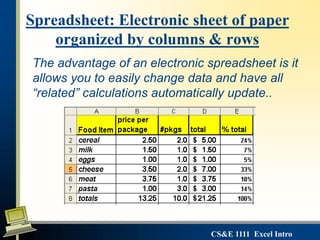
Spreadsheet: Electronic sheet of paper
organized by columns & rows
The advantage of an electronic spreadsheet is it
allows you to easily change data and have all
“related” calculations automatically update..
CS&E 1111 Excel Intro
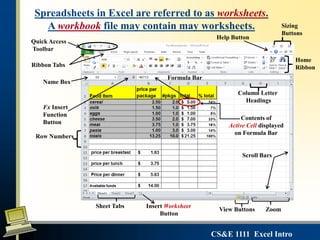
Spreadsheets in Excel are referred to as worksheets.
A workbook file may contain may worksheets.
Home
Ribbon
Sizing
Buttons
Help Button
Quick Access
Toolbar
Column Letter
Headings
Row Numbers
Ribbon Tabs
Formula Bar
Contents of
Active Cell displayed
on Formula Bar
View Buttons Zoom
Sheet Tabs Insert Worksheet
Button
Scroll Bars
Fx Insert
Function
Button
Name Box
CS&E 1111 Excel Intro
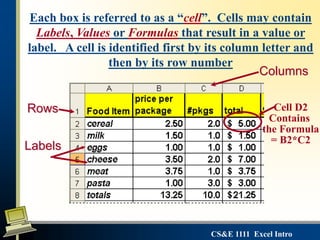
Rows
Columns
Cell D2
Contains
the Formula
= B2*C2
Each box is referred to as a “cell”. Cells may contain
Labels, Values or Formulas that result in a value or
label. A cell is identified first by its column letter and
then by its row number
Labels
CS&E 1111 Excel Intro
One can also write formulas that refer to
cells on other worksheets –
Sheetname!Cell-Reference
input!B1*input!B3 + A1
When referencing a cell
on the same
spreadsheet as the
active cell the sheet
name is not required.
Sheets may be named and displayed with different colors tabs,
The order of the worksheets may be modified as well.
CS&E 1111 Excel Intro
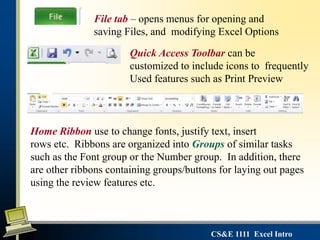
File tab – opens menus for opening and
saving Files, and modifying Excel Options
Quick Access Toolbar can be
customized to include icons to frequently
Used features such as Print Preview
Home Ribbon use to change fonts, justify text, insert
rows etc. Ribbons are organized into Groups of similar tasks
such as the Font group or the Number group. In addition, there
are other ribbons containing groups/buttons for laying out pages
using the review features etc.
CS&E 1111 Excel Intro
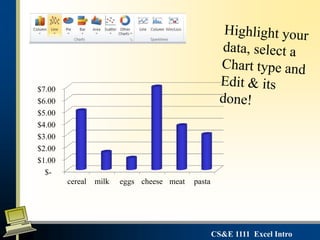
$-
$1.00
$2.00
$3.00
$4.00
$5.00
$6.00
$7.00
cereal milk eggs cheese meat pasta
CS&E 1111 Excel Intro
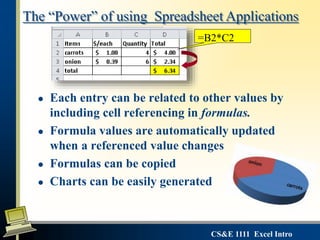
 Each entry can be related to other values by
including cell referencing in formulas.
 Formula values are automatically updated
when a referenced value changes
 Formulas can be copied
 Charts can be easily generated
The “Power” of using Spreadsheet Applications
=B2*C2
CS&E 1111 Excel Intro
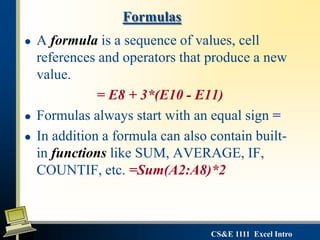
Formulas
 A formula is a sequence of values, cell
references and operators that produce a new
value.
= E8 + 3*(E10 - E11)
 Formulas always start with an equal sign =
 In addition a formula can also contain built-
in functions like SUM, AVERAGE, IF,
COUNTIF, etc. =Sum(A2:A8)*2
CS&E 1111 Excel Intro
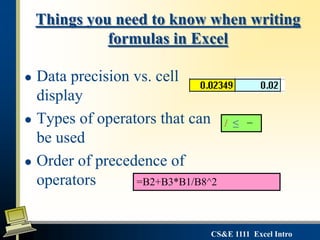
Things you need to know when writing
formulas in Excel
 Data precision vs. cell
display
 Types of operators that can
be used
 Order of precedence of
operators
/ ≤ −
=B2+B3*B1/B8^2
CS&E 1111 Excel Intro
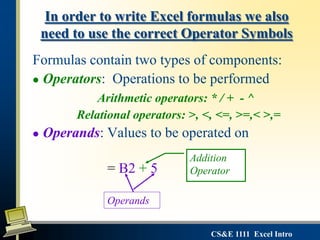
In order to write Excel formulas we also
need to use the correct Operator Symbols
Formulas contain two types of components:
 Operators: Operations to be performed
Arithmetic operators: * / + - ^
Relational operators: >, <, <=, >=,< >,=
 Operands: Values to be operated on
= B2 + 5
Operands
Addition
Operator
CS&E 1111 Excel Intro
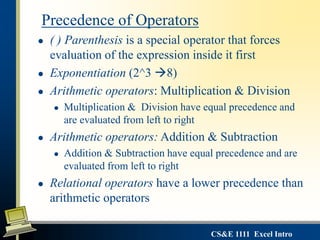
Precedence of Operators
 ( ) Parenthesis is a special operator that forces
evaluation of the expression inside it first
 Exponentiation (2^3 8)
 Arithmetic operators: Multiplication & Division
 Multiplication & Division have equal precedence and
are evaluated from left to right
 Arithmetic operators: Addition & Subtraction
 Addition & Subtraction have equal precedence and are
evaluated from left to right
 Relational operators have a lower precedence than
arithmetic operators
CS&E 1111 Excel Intro
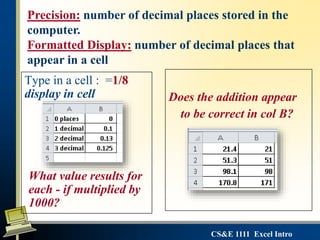
Type in a cell : =1/8
display in cell
What value results for
each - if multiplied by
1000?
Does the addition appear
to be correct in col B?
Precision: number of decimal places stored in the
computer.
Formatted Display: number of decimal places that
appear in a cell
CS&E 1111 Excel Intro
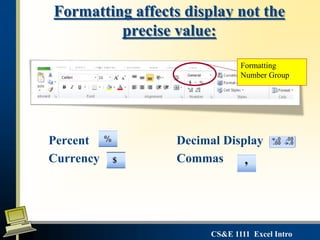
Formatting affects display not the
precise value:
Percent Decimal Display
Currency Commas
Formatting
Number Group
CS&E 1111 Excel Intro
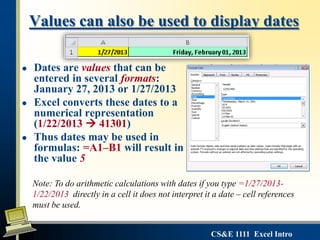
Values can also be used to display dates
 Dates are values that can be
entered in several formats:
January 27, 2013 or 1/27/2013
 Excel converts these dates to a
numerical representation
(1/22/2013  41301)
 Thus dates may be used in
formulas: =A1–B1 will result in
the value 5
Note: To do arithmetic calculations with dates if you type =1/27/2013-
1/22/2013 directly in a cell it does not interpret it a date – cell references
must be used.
CS&E 1111 Excel Intro
Walkthrough: Building a Simple
Spreadsheet
•Entering labels and values
•Formatting cells
–font, size, style, color, borders, alignment
–Numeric Format, Currency, Decimal Places
–text wrap, center titles
–Column widths, row height
•Inserting/Deleting rows and columns and sheets
•Writing a simple formula & modify decimal display
•Create a simple chart
• Sheet tabs
–Creating a new worksheets in a workbook (“new sections in a
document”, Naming Sheets
CS&E 1111 Excel Intro
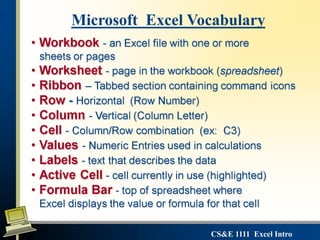
Microsoft Excel Vocabulary
CS&E 1111 Excel Intro
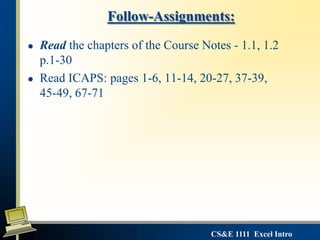
Follow-Assignments:
 Read the chapters of the Course Notes - 1.1, 1.2
p.1-30
 Read ICAPS: pages 1-6, 11-14, 20-27, 37-39,
45-49, 67-71

Lecture 1 Intro to Excel.pptx

  • 1.
    CS&E 1111 ExcelIntro Objectives:  To define spreadsheets and explain basic functionality  To introduce the basic features of Excel • Vocabulary • Entering Data • Formatting Data • Precision vs. Display • Operators & Order of Precedence Introduction to Microsoft Excel
  • 2.
    CS&E 1111 ExcelIntro Spreadsheet: Electronic sheet of paper organized by columns & rows The advantage of an electronic spreadsheet is it allows you to easily change data and have all “related” calculations automatically update..
  • 3.
    CS&E 1111 ExcelIntro Spreadsheets in Excel are referred to as worksheets. A workbook file may contain may worksheets. Home Ribbon Sizing Buttons Help Button Quick Access Toolbar Column Letter Headings Row Numbers Ribbon Tabs Formula Bar Contents of Active Cell displayed on Formula Bar View Buttons Zoom Sheet Tabs Insert Worksheet Button Scroll Bars Fx Insert Function Button Name Box
  • 4.
    CS&E 1111 ExcelIntro Rows Columns Cell D2 Contains the Formula = B2*C2 Each box is referred to as a “cell”. Cells may contain Labels, Values or Formulas that result in a value or label. A cell is identified first by its column letter and then by its row number Labels
  • 5.
    CS&E 1111 ExcelIntro One can also write formulas that refer to cells on other worksheets – Sheetname!Cell-Reference input!B1*input!B3 + A1 When referencing a cell on the same spreadsheet as the active cell the sheet name is not required. Sheets may be named and displayed with different colors tabs, The order of the worksheets may be modified as well.
  • 6.
    CS&E 1111 ExcelIntro File tab – opens menus for opening and saving Files, and modifying Excel Options Quick Access Toolbar can be customized to include icons to frequently Used features such as Print Preview Home Ribbon use to change fonts, justify text, insert rows etc. Ribbons are organized into Groups of similar tasks such as the Font group or the Number group. In addition, there are other ribbons containing groups/buttons for laying out pages using the review features etc.
  • 7.
    CS&E 1111 ExcelIntro $- $1.00 $2.00 $3.00 $4.00 $5.00 $6.00 $7.00 cereal milk eggs cheese meat pasta
  • 8.
    CS&E 1111 ExcelIntro  Each entry can be related to other values by including cell referencing in formulas.  Formula values are automatically updated when a referenced value changes  Formulas can be copied  Charts can be easily generated The “Power” of using Spreadsheet Applications =B2*C2
  • 9.
    CS&E 1111 ExcelIntro Formulas  A formula is a sequence of values, cell references and operators that produce a new value. = E8 + 3*(E10 - E11)  Formulas always start with an equal sign =  In addition a formula can also contain built- in functions like SUM, AVERAGE, IF, COUNTIF, etc. =Sum(A2:A8)*2
  • 10.
    CS&E 1111 ExcelIntro Things you need to know when writing formulas in Excel  Data precision vs. cell display  Types of operators that can be used  Order of precedence of operators / ≤ − =B2+B3*B1/B8^2
  • 11.
    CS&E 1111 ExcelIntro In order to write Excel formulas we also need to use the correct Operator Symbols Formulas contain two types of components:  Operators: Operations to be performed Arithmetic operators: * / + - ^ Relational operators: >, <, <=, >=,< >,=  Operands: Values to be operated on = B2 + 5 Operands Addition Operator
  • 12.
    CS&E 1111 ExcelIntro Precedence of Operators  ( ) Parenthesis is a special operator that forces evaluation of the expression inside it first  Exponentiation (2^3 8)  Arithmetic operators: Multiplication & Division  Multiplication & Division have equal precedence and are evaluated from left to right  Arithmetic operators: Addition & Subtraction  Addition & Subtraction have equal precedence and are evaluated from left to right  Relational operators have a lower precedence than arithmetic operators
  • 13.
    CS&E 1111 ExcelIntro Type in a cell : =1/8 display in cell What value results for each - if multiplied by 1000? Does the addition appear to be correct in col B? Precision: number of decimal places stored in the computer. Formatted Display: number of decimal places that appear in a cell
  • 14.
    CS&E 1111 ExcelIntro Formatting affects display not the precise value: Percent Decimal Display Currency Commas Formatting Number Group
  • 15.
    CS&E 1111 ExcelIntro Values can also be used to display dates  Dates are values that can be entered in several formats: January 27, 2013 or 1/27/2013  Excel converts these dates to a numerical representation (1/22/2013  41301)  Thus dates may be used in formulas: =A1–B1 will result in the value 5 Note: To do arithmetic calculations with dates if you type =1/27/2013- 1/22/2013 directly in a cell it does not interpret it a date – cell references must be used.
  • 16.
    CS&E 1111 ExcelIntro Walkthrough: Building a Simple Spreadsheet •Entering labels and values •Formatting cells –font, size, style, color, borders, alignment –Numeric Format, Currency, Decimal Places –text wrap, center titles –Column widths, row height •Inserting/Deleting rows and columns and sheets •Writing a simple formula & modify decimal display •Create a simple chart • Sheet tabs –Creating a new worksheets in a workbook (“new sections in a document”, Naming Sheets
  • 17.
    CS&E 1111 ExcelIntro Microsoft Excel Vocabulary
  • 18.
    CS&E 1111 ExcelIntro Follow-Assignments:  Read the chapters of the Course Notes - 1.1, 1.2 p.1-30  Read ICAPS: pages 1-6, 11-14, 20-27, 37-39, 45-49, 67-71