WelcomeTo First SemesterTo First Semester
NCEII2015/2016 AcademicNCEII2015/2016 Academic
SessionSession
GSE213 LecturesGSE213 Lectures
Course Contents:Course Contents:
 Introduction to Networking: Network; LAN; WAN; Internet; and its
resources gloving.
 Computer Operation:
a. Booting: Windows; Keyboards; the Mouse; Loading; Application; etc.
b. Introduction of Word Processing:
c. Practical Use of word processing application
Introduction to Electronic Spreadsheets:
 Practical Use of Spreadsheets such as Ms-Excel or Lotus 1 – 2- 3
Application of Computer in Education:
a. Advantages and disadvantages
b. Computer Assisted Instruction and Computer Assisted Learning
c. Demonstration of Educational on CDs – English; Mathematics; etc.
Spreadsheet
A Spreadsheet is any document with a grid of
columns and rows. For centuries, managers
have used papers that was lined with columns
and rows for their computations.
Spreadsheet is a document prepared with
columns and rows used for data entry and
computation which is done manually or
electronically;
Electronic Spreadsheet
Electronic Spreadsheet is software designed with a grid of columns and rows
often called cells upon which data are entered and computed automatically
with the help of formulas.
A Electronic spreadsheet is an interactive computer application program for
organization, analysis and storage of data in tabular form. Spreadsheets are
developed as computerized simulations of paper accounting worksheets.
The program operates on data represented as cells of an array, organized in
rows and columns.
However, electronic spreadsheet required managers to be computer literate
in order to use electronic spreadsheet successfully.
Implication of Electronic Spreadsheet to a 21Implication of Electronic Spreadsheet to a 21stst
Century Teachers’Century Teachers’
Computer generally classified under education as an educational
tool which assist in teaching and learning; therefore excel as a
computer programme has a very vital role to play in assisting
teachers in data processing and storage, the following are the basic
areas in which excel assist teacher:
1.Data Storage
2.Students’ Result Computation
3.Planning
4.Time Management
Data StorageData Storage
Microsoft excel helps teacher in keeping students’ data e.g.
Students Performance
Students’ Result ComputationStudents’ Result Computation
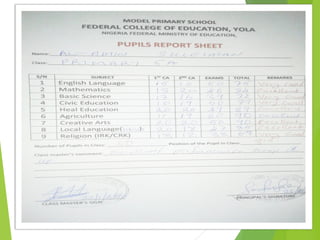
Microsoft excel helps teacher in computing students’ Continuous
Assessment (CA and Exams)
•It help teacher in entry and calculating students’ performance by
using formulas that will make the calculations to automatic
•Lets refer to the slide five
Planning /BudgetingPlanning /Budgeting
Microsoft excel helps teachers’ in planning their
activities as well as budgeting especially:
Academic Calendar: e.g. Teaching Time-Table
planning; Planning students activities within and
outside class, Scheduling for CA and Examinations and
planning examination time-table as well.
Time-ManagementTime-Management
Microsoft excel helps teachers in maintain time; e.g. if a
teacher can computes student’s result in 15minutes
manually then it can only takes him 5 minutes
electronically.
Disadvantages of Electronic SpreadsheetDisadvantages of Electronic Spreadsheet
A teacher must be computer literate before using excel,
Data might be lost due to improper saving or system damage
Solutions to the above problems:
1.Teachers must be train on the use of computer and excel programmes
2.Teachers using electronic spreadsheet must use backup devices e.g. google
drive, OneDrive and External storage devices like: flash disk, hard disk etc.
and also after data have being inputted and processed it should be printed on
hardcopy for documentation
Program Rows (per sheet) Columns (per sheet) Total Cells (per sheet) Sheets
Total Cells (per
workbook)
SSuite Accel 16,384 256 4,194,304
Limited by system
resources
Limited by system
resources
Resolver One
limited by machine
memory*
limited by machine
memory*
limited machine
memory*
limited by machine
memory*
limited by machine
memory*
Quantrix Modeler Limited by available
memory
Limited by available
memory
Limited by available
memory
Limited by available
memory
Limited by available
memory
Pyspread ~80 000 000 (limited by   
sum of row heights)
~30 000 000 (limited by   
sum of column widths)
Limited by available
memory
Limited by available
memory
Limited by available
memory
OpenOffice.org Calc 3.3
[44]
1,048,576 1024 1,073,741,824 256 274 877 906 944     
OpenOffice.org Calc
 3.0, 3.1 and 3.2[42][43]
65,536 1024 67,108,864 256 17,179,869,184
OpenOffice.org
Calc 2[41]
65,536 256 16,777,216 256 4,294,967,296
Microsoft Excel 2007[40]
1,048,576 16,384 17,179,869,184 1,024 17,592,186,044,416
Microsoft Excel 2003
65,536 256 16,777,216 65,531 1,099,427,741,696
Lotus 1-2-3[39]
65,536 256 16,777,216 256 4,294,967,296
LibreOffice Calc 4.4.2
1,048,576 1,024 1,073,741,824 1,024 1,099,511,627,776
KSpread
32,767 32,767 1,073,676,289 ? ?
GS-Calc 12,582,912 4,096 4,294,967,296
Limited by available
memory
Limited by available
memory
Gnumeric
16,777,216 16,384 274,877,906,944 ? ?
Instances of Electronic Spreadsheets
Excel
Excel: is a software design and produced by Microsoft
cooperation; which is often called Microsoft Excel, the
packages is embedded in Microsoft Office and thus has
different versions: ranges from:
Microsoft Excel 2003
Microsoft Excel 2007
Microsoft Excel 2010
Microsoft Excel 2013
Microsoft Excel 2016 which is the latest
Excel InterfaceExcel Interface
Excel interface is like any other application in computer, it is
referred to as an environment where user interact with the
computer through which computer operations are being carried
out, the application’s environment serve as a medium to which user
communicate with computer by selecting commands or entering
the commands like figures in text fields.
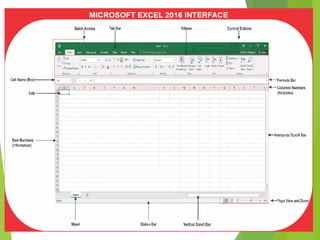
Excel as an application that computes data, it has a unique
interface than other applications. As shown in the diagram below.
A CellA Cell
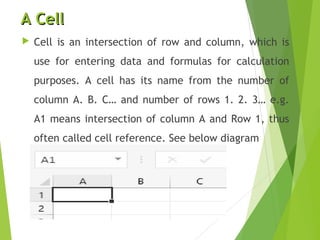
 Cell is an intersection of row and column, which is
use for entering data and formulas for calculation
purposes. A cell has its name from the number of
column A. B. C… and number of rows 1. 2. 3… e.g.
A1 means intersection of column A and Row 1, thus
often called cell reference. See below diagram
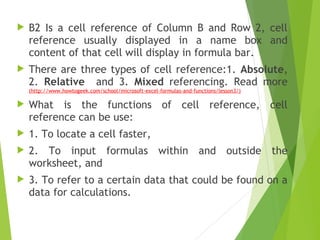
 B2 Is a cell reference of Column B and Row 2, cell
reference usually displayed in a name box and
content of that cell will display in formula bar.
 There are three types of cell reference:1. Absolute,
2. Relative and 3. Mixed referencing. Read more
(http://www.howtogeek.com/school/microsoft-excel-formulas-and-functions/lesson3/)
 What is the functions of cell reference, cell
reference can be use:
 1. To locate a cell faster,
 2. To input formulas within and outside the
worksheet, and
 3. To refer to a certain data that could be found on a
data for calculations.
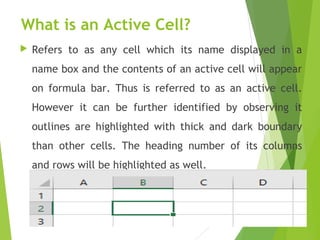
What is an Active Cell?
 Refers to as any cell which its name displayed in a
name box and the contents of an active cell will appear
on formula bar. Thus is referred to as an active cell.
However it can be further identified by observing it
outlines are highlighted with thick and dark boundary
than other cells. The heading number of its columns
and rows will be highlighted as well.
 A cell will not accept data unless it is active, to
achieve that a cell must by activated by
selecting it with the mouse pointer often called
cell selector or by using navigation keys to move
to a desired cell. If such happen then we
referred to that as an active cell.
Worksheet and Workbook
 Worksheet is a interconnections of cells which were
displayed in an array of columns and rows, a worksheet
in Microsoft Excel 2016 consist of 17,179,869,184 cells.
i.e. 1048576 number of rows XFD (16,384) Number of
Columns.
 Workbook is the collections of a worksheets range from
1 worksheet…..n. A Workbook may consist of 1,024 and
above worksheets.
Formula
 Formula is an equation that expressed
mathematical operation on a given cell,
formulas help in carrying out automatic
calculations of data on a given cell or an
array of cells.
Mathematical Operation in Microsoft ExcelMathematical Operation in Microsoft Excel
The following are the basic signs for mathematical operations
in Microsoft Excel:
= sign is used at the begging of a formula, “= sign” define to
excel that this is a mathematical operation not a data
therefore solve the defined problem .
A1, A2, B1, C1... are cells references which is used to
define what cell the formula could refer to for mathematical
operation, cell referencing could be along columns or rows or
within the worksheet or workbook, as shown in
demonstration.
 + sign for addition
 - Sign for subtraction
 * sign for multiplication
 / sign for division
 ( ) define a collected cell like in using
standard mathematics operations, e.g.
sum, average etc.
 Sheet2!A1 is to select cell A1 in Worksheet
2.
Construction of a FormulaConstruction of a Formula
 To perform calculations on a particular cell like summing cell A1
and B1 subtract cell C1. This could be express thus: = A1+B1-C1
 Performing mathematical operation on a number of cells in an
array of columns or rows e.g. Cell A1 A2 A3 and A4 has different
data which were required to be sum together, thus express as:
=sum(A1:A4)
 Performing mathematical operation on a number of cells which
could be found in different location within and outside the
worksheet; thus express as: =sum(A1, B10, W20) i.e. sum up data
found on Cell A1, Cell B10, and W20. automatically the formula will
locate and sum up data on Cell A1, B10 and W20 respectively.
Logical FormulasLogical Formulas
 This kind of formulas express the decision making on a
cell data e.g. =if(A1=1,”True”, if(A1<>1, “False”))
 That is to say if cell A1 is equal to 1 then print “True”
or/and if cell A1 is greater or less than 1 then print
“False”. In the above equation there is a great
decision making on the contents of Cell A1, the
formula reads the data in any assigned cell and it
compare with its scale of preferences to make a
decision as the output.
GroupingGrouping
Design a Scores Sheet of 20 Pupils with
first and second C.A. with Examination,
sum up the CA’s and Exams indicate their
Grades for any Primary School Subject.
NB this will be done ManuallyManually on a
Foolscap Paper Submit on February 6th
2016 In-Sha-Allah
Word ProcessingWord Processing
 Word processing is the phrase used to describe using a
computer to create, edit, and print documents. Of all
computer applications, word processing is the most
common. To perform word processing, you need a
computer, a special program called a word processor,
and a printer. A word processor enables you to create a
document, store it electronically on a disk, display it on a
screen, modify it by entering commands and characters
from the keyboard, and print it on a printer.
In SummaryIn Summary
Word Processors can be used for writing,
editing, and production of documents, as
letters, reports, and books, through the
use of a computer program or a complete
computer system designed to facilitate
rapid and efficient manipulation of text.
Word Processing Compared to Using a Typewriter
 The great advantage of word processing over using a typewriter
is that you can make changes without retyping the entire
document. If you make a typing mistake, you simply back up the
cursor and correct your mistake. If you want to delete a
paragraph, you simply remove it, without leaving a trace. It is
equally easy to insert a word, sentence, or paragraph in the
middle of a document. Word processors also make it easy to
move sections of text from one place to another within a
document, or between documents. When you have made all the
changes you want, you can send the file to a printer to get a
hard copy.
Common Word Processors
Google Docs. Online
EtherPad Online
XaitPorter Online
Polaris Office: Android and
Windows Mobile
Apple Pages, (iWork Suit) Mac
iStudio Publisher Mac
Mariner Writer Mac
Applix Word – Linux
WordPad
WordPerfect
Word Star
NotePad
Lotus Word Pro Windows
Microsoft Word Windows and Mac
https://en.wikipedia.org/wiki/List_of_word_processors
Microsoft Word
 Microsoft Word is a word processor developed by
Microsoft. It was first released in 1983 under the name
Multi-Tool Word for Xenix systems.
 1.Word for DOS
 2.Word for Windows 1 and 2; Word 3 and 4 for Mac OS
 3.Word 5 and Word 95 for Windows; Word 6 for Mac OS
 4.Word 97 and later for Windows; Word 98 and later
for Mac OS
 Office documents and is used by Word 2003, 2007,
2010, 2013 and Word 2016
Microsoft Word
2016 Interface
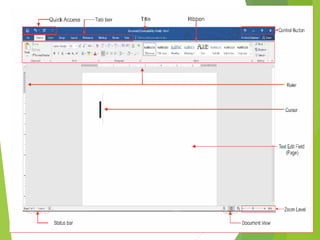
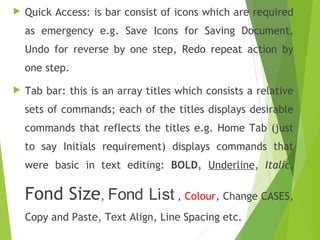
 Quick Access: is bar consist of icons which are required
as emergency e.g. Save Icons for Saving Document,
Undo for reverse by one step, Redo repeat action by
one step.
 Tab bar: this is an array titles which consists a relative
sets of commands; each of the titles displays desirable
commands that reflects the titles e.g. Home Tab (just
to say Initials requirement) displays commands that
were basic in text editing: BOLD, Underline, Italic,
Fond Size, Fond List , Colour, Change CASES,
Copy and Paste, Text Align, Line Spacing etc.
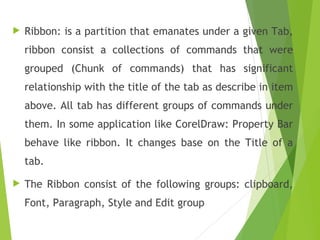
 Ribbon: is a partition that emanates under a given Tab,
ribbon consist a collections of commands that were
grouped (Chunk of commands) that has significant
relationship with the title of the tab as describe in item
above. All tab has different groups of commands under
them. In some application like CorelDraw: Property Bar
behave like ribbon. It changes base on the Title of a
tab.
 The Ribbon consist of the following groups: clipboard,
Font, Paragraph, Style and Edit group
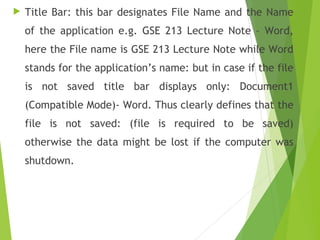
 Title Bar: this bar designates File Name and the Name
of the application e.g. GSE 213 Lecture Note – Word,
here the File name is GSE 213 Lecture Note while Word
stands for the application’s name: but in case if the file
is not saved title bar displays only: Document1
(Compatible Mode)- Word. Thus clearly defines that the
file is not saved: (file is required to be saved)
otherwise the data might be lost if the computer was
shutdown.
 Control Buttons: minimize, restore and
close: applicably minimize is to inhibit the display of the window
for desktop interface utilization, minimized application will be
active on the task bar.
 Next button is restore down when the application is cover up the
screen and the same button could be maximize button it operates
in reverse order of restore down.
 Close button is used total closer of the application, here files that
are not saved could be demanded to be saved, however a dialog
box will display intimidating the save, don’t save and cancel; one
of which must be chosen: for closure save and don’t save button
can be selected for not closure cancel button can be selected.
 Ruler; it acts on mensuration and it consist
measurement units (distance) in inches, can be used to
set margins, paragraphs, header and footers etc.
 Cursor: this indicates the readiness of the edit
environment to accept text input and text edit, the
cursor usually blinks to indicates readiness. However
cover can be used in navigation as well, when the
navigation keys were pressed the cursor will move to
the direction of any of the navigation key pressed on
the keyboard.
 Text Edit Field: (Page) it is an environment where text
can be inputted, edited, format and print out: the page
is guided by the layout tab were different sizes of
pages can be chosen and the margins as well.
 Zoom Level: this can be used to increase or decreased
the magnitude of the Text Edit Field (Page). The
positive sign is for zoom in (Increase in magnitude)
minus sign (Decrease in magnitude).
 Document View: this deals with the displays of the Text
Edit Field (Page) which has three different views: Read
Mode, Print Layout, and Web Layout.
 Status Bar: this bar displays information on a
document: e.g. number of words in the document,
number of pages in the document.
Practical Use of Microsoft WordPractical Use of Microsoft Word
Page Setup: Size, Orientation;
Typesetting: Bold, Fond Size, Fond List and Cursor
Navigation;
Insert: Table, Charts, Pictures
Save and Save As with differences;
File Retrieval and Print Document.
Group Work 1:Group Work 1:
Typeset a letter to the Head of
Department General Studies Education,
to make a complain regarding your ABS in
your results. Use formal letter writing.
Not less than fifty words not more than
100 words, use all typesetting rules. Print
and keep it with your leader.

Gse 213 lesson 3

  • 1.
    WelcomeTo First SemesterToFirst Semester NCEII2015/2016 AcademicNCEII2015/2016 Academic SessionSession GSE213 LecturesGSE213 Lectures
  • 2.
    Course Contents:Course Contents: Introduction to Networking: Network; LAN; WAN; Internet; and its resources gloving.  Computer Operation: a. Booting: Windows; Keyboards; the Mouse; Loading; Application; etc. b. Introduction of Word Processing: c. Practical Use of word processing application Introduction to Electronic Spreadsheets:  Practical Use of Spreadsheets such as Ms-Excel or Lotus 1 – 2- 3 Application of Computer in Education: a. Advantages and disadvantages b. Computer Assisted Instruction and Computer Assisted Learning c. Demonstration of Educational on CDs – English; Mathematics; etc.
  • 3.
    Spreadsheet A Spreadsheet isany document with a grid of columns and rows. For centuries, managers have used papers that was lined with columns and rows for their computations. Spreadsheet is a document prepared with columns and rows used for data entry and computation which is done manually or electronically;
  • 5.
    Electronic Spreadsheet Electronic Spreadsheetis software designed with a grid of columns and rows often called cells upon which data are entered and computed automatically with the help of formulas. A Electronic spreadsheet is an interactive computer application program for organization, analysis and storage of data in tabular form. Spreadsheets are developed as computerized simulations of paper accounting worksheets. The program operates on data represented as cells of an array, organized in rows and columns. However, electronic spreadsheet required managers to be computer literate in order to use electronic spreadsheet successfully.
  • 6.
    Implication of ElectronicSpreadsheet to a 21Implication of Electronic Spreadsheet to a 21stst Century Teachers’Century Teachers’ Computer generally classified under education as an educational tool which assist in teaching and learning; therefore excel as a computer programme has a very vital role to play in assisting teachers in data processing and storage, the following are the basic areas in which excel assist teacher: 1.Data Storage 2.Students’ Result Computation 3.Planning 4.Time Management
  • 7.
    Data StorageData Storage Microsoftexcel helps teacher in keeping students’ data e.g. Students Performance Students’ Result ComputationStudents’ Result Computation Microsoft excel helps teacher in computing students’ Continuous Assessment (CA and Exams) •It help teacher in entry and calculating students’ performance by using formulas that will make the calculations to automatic •Lets refer to the slide five
  • 8.
    Planning /BudgetingPlanning /Budgeting Microsoftexcel helps teachers’ in planning their activities as well as budgeting especially: Academic Calendar: e.g. Teaching Time-Table planning; Planning students activities within and outside class, Scheduling for CA and Examinations and planning examination time-table as well. Time-ManagementTime-Management Microsoft excel helps teachers in maintain time; e.g. if a teacher can computes student’s result in 15minutes manually then it can only takes him 5 minutes electronically.
  • 9.
    Disadvantages of ElectronicSpreadsheetDisadvantages of Electronic Spreadsheet A teacher must be computer literate before using excel, Data might be lost due to improper saving or system damage Solutions to the above problems: 1.Teachers must be train on the use of computer and excel programmes 2.Teachers using electronic spreadsheet must use backup devices e.g. google drive, OneDrive and External storage devices like: flash disk, hard disk etc. and also after data have being inputted and processed it should be printed on hardcopy for documentation
  • 10.
    Program Rows (per sheet)Columns (per sheet) Total Cells (per sheet) Sheets Total Cells (per workbook) SSuite Accel 16,384 256 4,194,304 Limited by system resources Limited by system resources Resolver One limited by machine memory* limited by machine memory* limited machine memory* limited by machine memory* limited by machine memory* Quantrix Modeler Limited by available memory Limited by available memory Limited by available memory Limited by available memory Limited by available memory Pyspread ~80 000 000 (limited by    sum of row heights) ~30 000 000 (limited by    sum of column widths) Limited by available memory Limited by available memory Limited by available memory OpenOffice.org Calc 3.3 [44] 1,048,576 1024 1,073,741,824 256 274 877 906 944      OpenOffice.org Calc  3.0, 3.1 and 3.2[42][43] 65,536 1024 67,108,864 256 17,179,869,184 OpenOffice.org Calc 2[41] 65,536 256 16,777,216 256 4,294,967,296 Microsoft Excel 2007[40] 1,048,576 16,384 17,179,869,184 1,024 17,592,186,044,416 Microsoft Excel 2003 65,536 256 16,777,216 65,531 1,099,427,741,696 Lotus 1-2-3[39] 65,536 256 16,777,216 256 4,294,967,296 LibreOffice Calc 4.4.2 1,048,576 1,024 1,073,741,824 1,024 1,099,511,627,776 KSpread 32,767 32,767 1,073,676,289 ? ? GS-Calc 12,582,912 4,096 4,294,967,296 Limited by available memory Limited by available memory Gnumeric 16,777,216 16,384 274,877,906,944 ? ? Instances of Electronic Spreadsheets
  • 11.
    Excel Excel: is asoftware design and produced by Microsoft cooperation; which is often called Microsoft Excel, the packages is embedded in Microsoft Office and thus has different versions: ranges from: Microsoft Excel 2003 Microsoft Excel 2007 Microsoft Excel 2010 Microsoft Excel 2013 Microsoft Excel 2016 which is the latest
  • 12.
    Excel InterfaceExcel Interface Excelinterface is like any other application in computer, it is referred to as an environment where user interact with the computer through which computer operations are being carried out, the application’s environment serve as a medium to which user communicate with computer by selecting commands or entering the commands like figures in text fields. Excel as an application that computes data, it has a unique interface than other applications. As shown in the diagram below.
  • 14.
    A CellA Cell Cell is an intersection of row and column, which is use for entering data and formulas for calculation purposes. A cell has its name from the number of column A. B. C… and number of rows 1. 2. 3… e.g. A1 means intersection of column A and Row 1, thus often called cell reference. See below diagram
  • 15.
     B2 Isa cell reference of Column B and Row 2, cell reference usually displayed in a name box and content of that cell will display in formula bar.  There are three types of cell reference:1. Absolute, 2. Relative and 3. Mixed referencing. Read more (http://www.howtogeek.com/school/microsoft-excel-formulas-and-functions/lesson3/)  What is the functions of cell reference, cell reference can be use:  1. To locate a cell faster,  2. To input formulas within and outside the worksheet, and  3. To refer to a certain data that could be found on a data for calculations.
  • 16.
    What is anActive Cell?  Refers to as any cell which its name displayed in a name box and the contents of an active cell will appear on formula bar. Thus is referred to as an active cell. However it can be further identified by observing it outlines are highlighted with thick and dark boundary than other cells. The heading number of its columns and rows will be highlighted as well.
  • 17.
     A cellwill not accept data unless it is active, to achieve that a cell must by activated by selecting it with the mouse pointer often called cell selector or by using navigation keys to move to a desired cell. If such happen then we referred to that as an active cell.
  • 18.
    Worksheet and Workbook Worksheet is a interconnections of cells which were displayed in an array of columns and rows, a worksheet in Microsoft Excel 2016 consist of 17,179,869,184 cells. i.e. 1048576 number of rows XFD (16,384) Number of Columns.  Workbook is the collections of a worksheets range from 1 worksheet…..n. A Workbook may consist of 1,024 and above worksheets.
  • 19.
    Formula  Formula isan equation that expressed mathematical operation on a given cell, formulas help in carrying out automatic calculations of data on a given cell or an array of cells.
  • 20.
    Mathematical Operation inMicrosoft ExcelMathematical Operation in Microsoft Excel The following are the basic signs for mathematical operations in Microsoft Excel: = sign is used at the begging of a formula, “= sign” define to excel that this is a mathematical operation not a data therefore solve the defined problem . A1, A2, B1, C1... are cells references which is used to define what cell the formula could refer to for mathematical operation, cell referencing could be along columns or rows or within the worksheet or workbook, as shown in demonstration.
  • 21.
     + signfor addition  - Sign for subtraction  * sign for multiplication  / sign for division  ( ) define a collected cell like in using standard mathematics operations, e.g. sum, average etc.  Sheet2!A1 is to select cell A1 in Worksheet 2.
  • 22.
    Construction of aFormulaConstruction of a Formula  To perform calculations on a particular cell like summing cell A1 and B1 subtract cell C1. This could be express thus: = A1+B1-C1  Performing mathematical operation on a number of cells in an array of columns or rows e.g. Cell A1 A2 A3 and A4 has different data which were required to be sum together, thus express as: =sum(A1:A4)  Performing mathematical operation on a number of cells which could be found in different location within and outside the worksheet; thus express as: =sum(A1, B10, W20) i.e. sum up data found on Cell A1, Cell B10, and W20. automatically the formula will locate and sum up data on Cell A1, B10 and W20 respectively.
  • 23.
    Logical FormulasLogical Formulas This kind of formulas express the decision making on a cell data e.g. =if(A1=1,”True”, if(A1<>1, “False”))  That is to say if cell A1 is equal to 1 then print “True” or/and if cell A1 is greater or less than 1 then print “False”. In the above equation there is a great decision making on the contents of Cell A1, the formula reads the data in any assigned cell and it compare with its scale of preferences to make a decision as the output.
  • 24.
    GroupingGrouping Design a ScoresSheet of 20 Pupils with first and second C.A. with Examination, sum up the CA’s and Exams indicate their Grades for any Primary School Subject. NB this will be done ManuallyManually on a Foolscap Paper Submit on February 6th 2016 In-Sha-Allah
  • 25.
    Word ProcessingWord Processing Word processing is the phrase used to describe using a computer to create, edit, and print documents. Of all computer applications, word processing is the most common. To perform word processing, you need a computer, a special program called a word processor, and a printer. A word processor enables you to create a document, store it electronically on a disk, display it on a screen, modify it by entering commands and characters from the keyboard, and print it on a printer.
  • 26.
    In SummaryIn Summary WordProcessors can be used for writing, editing, and production of documents, as letters, reports, and books, through the use of a computer program or a complete computer system designed to facilitate rapid and efficient manipulation of text.
  • 27.
    Word Processing Comparedto Using a Typewriter  The great advantage of word processing over using a typewriter is that you can make changes without retyping the entire document. If you make a typing mistake, you simply back up the cursor and correct your mistake. If you want to delete a paragraph, you simply remove it, without leaving a trace. It is equally easy to insert a word, sentence, or paragraph in the middle of a document. Word processors also make it easy to move sections of text from one place to another within a document, or between documents. When you have made all the changes you want, you can send the file to a printer to get a hard copy.
  • 28.
    Common Word Processors GoogleDocs. Online EtherPad Online XaitPorter Online Polaris Office: Android and Windows Mobile Apple Pages, (iWork Suit) Mac iStudio Publisher Mac Mariner Writer Mac
  • 29.
    Applix Word –Linux WordPad WordPerfect Word Star NotePad Lotus Word Pro Windows Microsoft Word Windows and Mac https://en.wikipedia.org/wiki/List_of_word_processors
  • 30.
    Microsoft Word  MicrosoftWord is a word processor developed by Microsoft. It was first released in 1983 under the name Multi-Tool Word for Xenix systems.  1.Word for DOS  2.Word for Windows 1 and 2; Word 3 and 4 for Mac OS  3.Word 5 and Word 95 for Windows; Word 6 for Mac OS  4.Word 97 and later for Windows; Word 98 and later for Mac OS  Office documents and is used by Word 2003, 2007, 2010, 2013 and Word 2016
  • 31.
  • 33.
     Quick Access:is bar consist of icons which are required as emergency e.g. Save Icons for Saving Document, Undo for reverse by one step, Redo repeat action by one step.  Tab bar: this is an array titles which consists a relative sets of commands; each of the titles displays desirable commands that reflects the titles e.g. Home Tab (just to say Initials requirement) displays commands that were basic in text editing: BOLD, Underline, Italic, Fond Size, Fond List , Colour, Change CASES, Copy and Paste, Text Align, Line Spacing etc.
  • 34.
     Ribbon: isa partition that emanates under a given Tab, ribbon consist a collections of commands that were grouped (Chunk of commands) that has significant relationship with the title of the tab as describe in item above. All tab has different groups of commands under them. In some application like CorelDraw: Property Bar behave like ribbon. It changes base on the Title of a tab.  The Ribbon consist of the following groups: clipboard, Font, Paragraph, Style and Edit group
  • 35.
     Title Bar:this bar designates File Name and the Name of the application e.g. GSE 213 Lecture Note – Word, here the File name is GSE 213 Lecture Note while Word stands for the application’s name: but in case if the file is not saved title bar displays only: Document1 (Compatible Mode)- Word. Thus clearly defines that the file is not saved: (file is required to be saved) otherwise the data might be lost if the computer was shutdown.
  • 36.
     Control Buttons:minimize, restore and close: applicably minimize is to inhibit the display of the window for desktop interface utilization, minimized application will be active on the task bar.  Next button is restore down when the application is cover up the screen and the same button could be maximize button it operates in reverse order of restore down.  Close button is used total closer of the application, here files that are not saved could be demanded to be saved, however a dialog box will display intimidating the save, don’t save and cancel; one of which must be chosen: for closure save and don’t save button can be selected for not closure cancel button can be selected.
  • 37.
     Ruler; itacts on mensuration and it consist measurement units (distance) in inches, can be used to set margins, paragraphs, header and footers etc.  Cursor: this indicates the readiness of the edit environment to accept text input and text edit, the cursor usually blinks to indicates readiness. However cover can be used in navigation as well, when the navigation keys were pressed the cursor will move to the direction of any of the navigation key pressed on the keyboard.
  • 38.
     Text EditField: (Page) it is an environment where text can be inputted, edited, format and print out: the page is guided by the layout tab were different sizes of pages can be chosen and the margins as well.  Zoom Level: this can be used to increase or decreased the magnitude of the Text Edit Field (Page). The positive sign is for zoom in (Increase in magnitude) minus sign (Decrease in magnitude).  Document View: this deals with the displays of the Text Edit Field (Page) which has three different views: Read Mode, Print Layout, and Web Layout.
  • 39.
     Status Bar:this bar displays information on a document: e.g. number of words in the document, number of pages in the document. Practical Use of Microsoft WordPractical Use of Microsoft Word Page Setup: Size, Orientation; Typesetting: Bold, Fond Size, Fond List and Cursor Navigation; Insert: Table, Charts, Pictures Save and Save As with differences; File Retrieval and Print Document.
  • 40.
    Group Work 1:GroupWork 1: Typeset a letter to the Head of Department General Studies Education, to make a complain regarding your ABS in your results. Use formal letter writing. Not less than fifty words not more than 100 words, use all typesetting rules. Print and keep it with your leader.