
Lecture 1
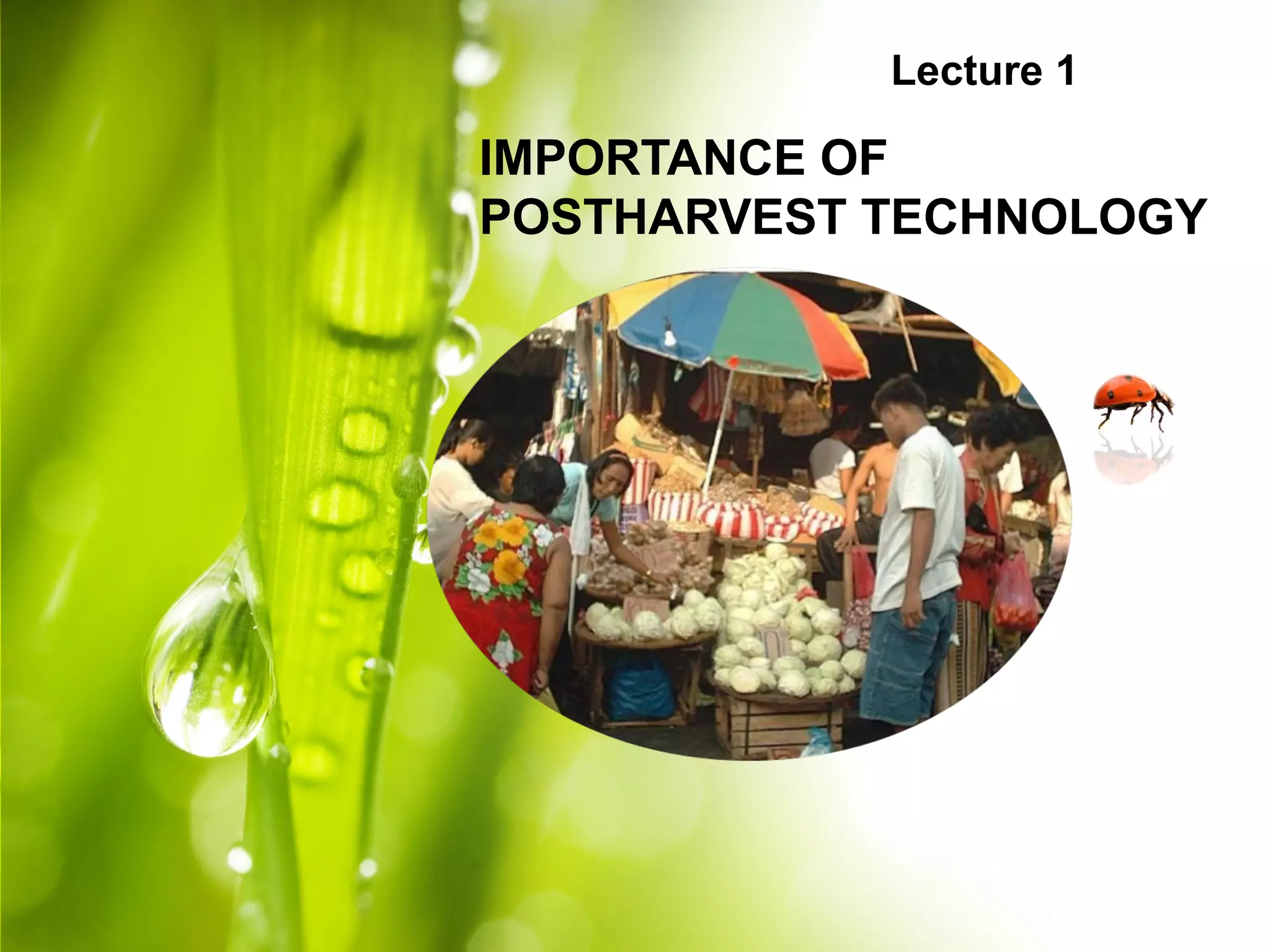
IMPORTANCE OF
POSTHARVEST TECHNOLOGY
LEARNING OBJECTIVES
At the end of the lesson, the learners are
expected to:
1. define post harvest technology;
2. determine its importance and objectives;
3. explain the causes of post harvest food losses
and the prevention measures;
4. carryout post harvest food loss assessment; and
5. determine the pre-harvest factors affecting the
post harvest life and quality aspects.
LESSON OUTLINE
1. Definition of Postharvest Technology (PHT)
2. Importance and Objectives of PHT
3. Causes of Post Harvest Food Losses and the
Prevention Measures;
4. Post Harvest food Loss Assessment; and
5. Pre-Harvest Factors Affecting the
Post Harvest Life and Quality Aspects.
Post-harvest technologies constitute an
inter-disciplinary science and techniques
applied to agricultural commodities after
harvest for the purpose of preservation,
conservation, quality control/enhancement,
processing, packaging, storage,
distribution, marketing, and utilization to
meet the food and nutritional requirements
of consumers in relation to their needs.
What is Post-Harvest Technology?
Sonam Tashi, nd
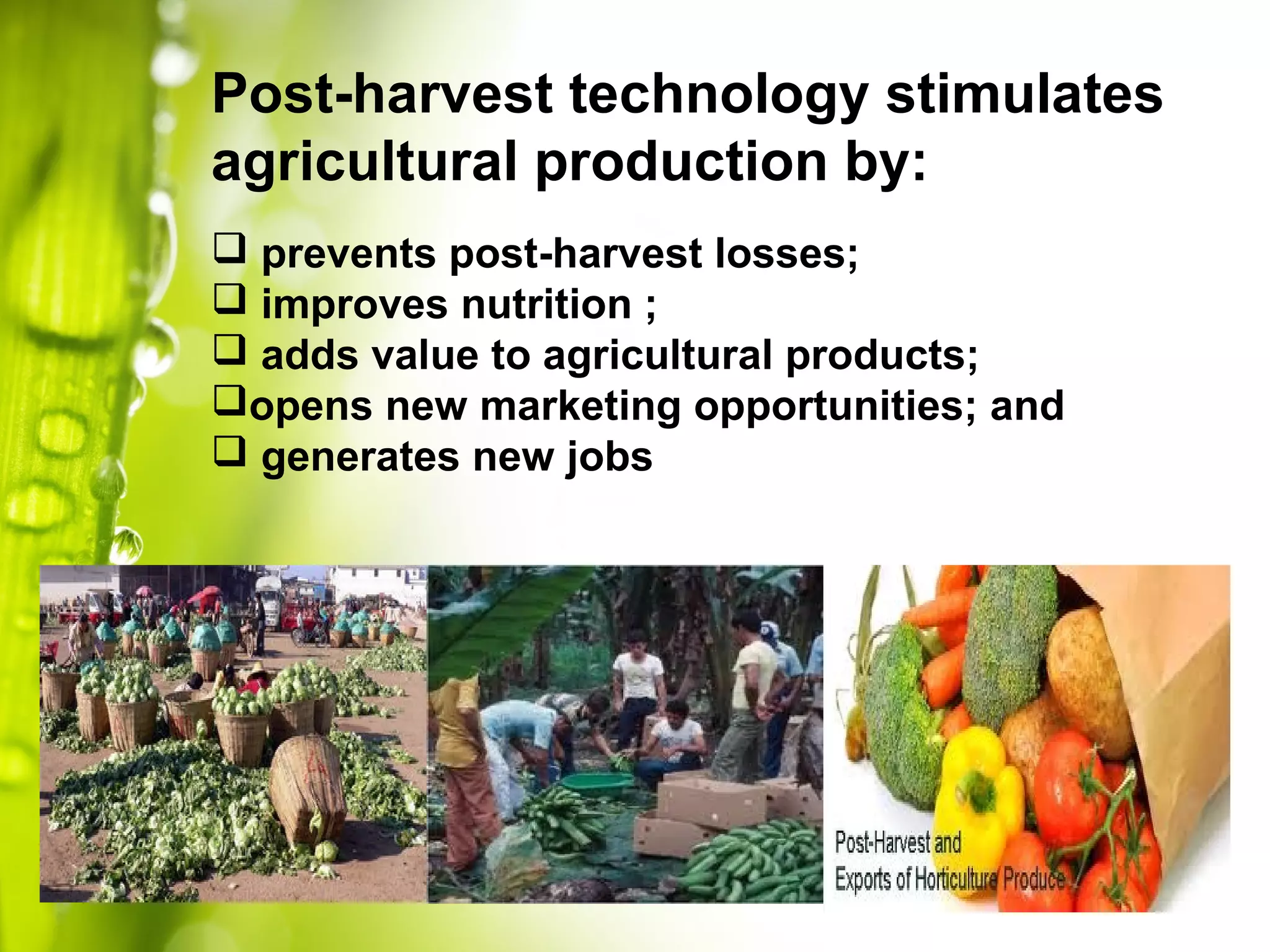
Post-harvest technology stimulates
agricultural production by:
 prevents post-harvest losses;
 improves nutrition ;
 adds value to agricultural products;
opens new marketing opportunities; and
 generates new jobs
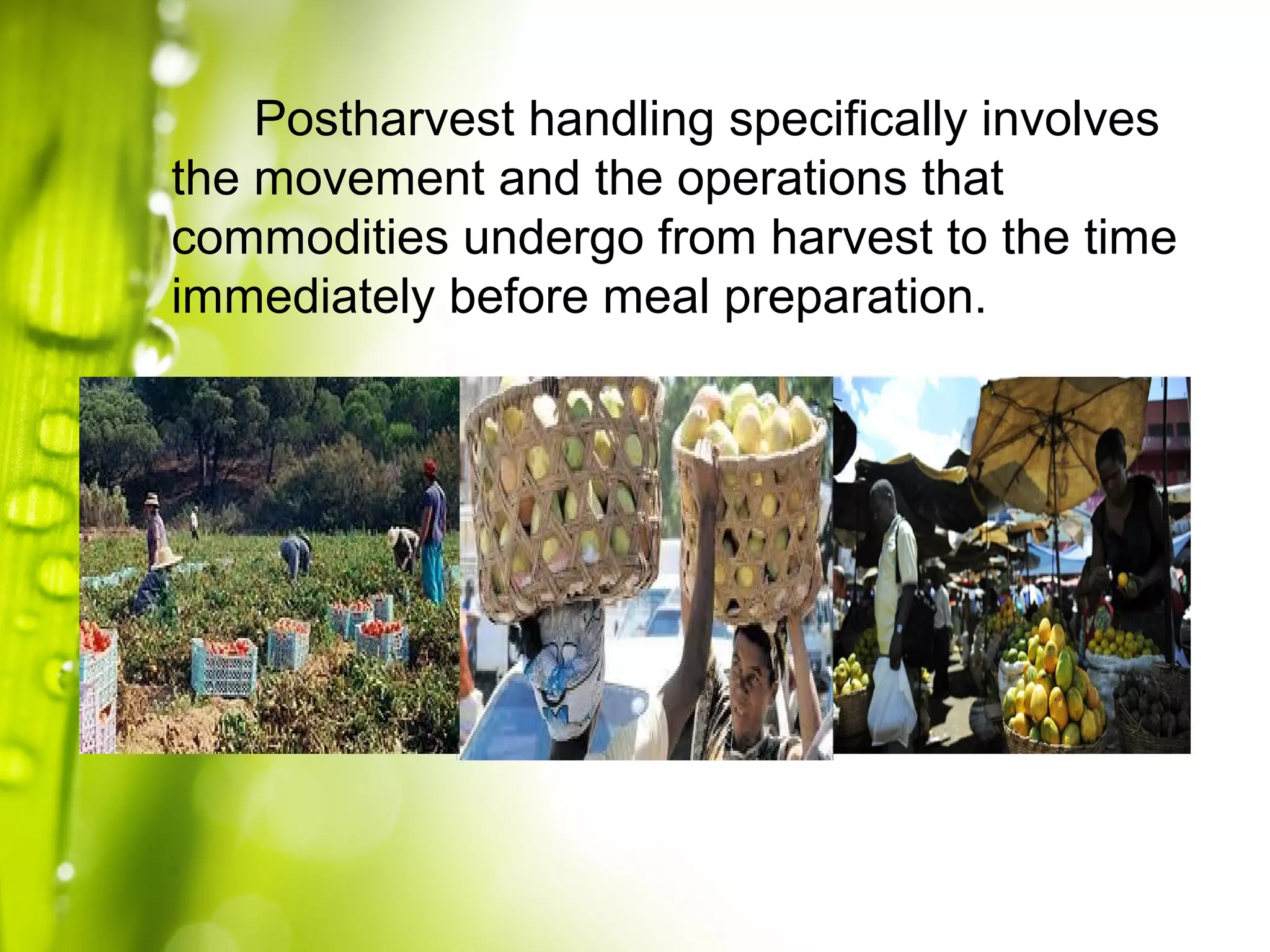
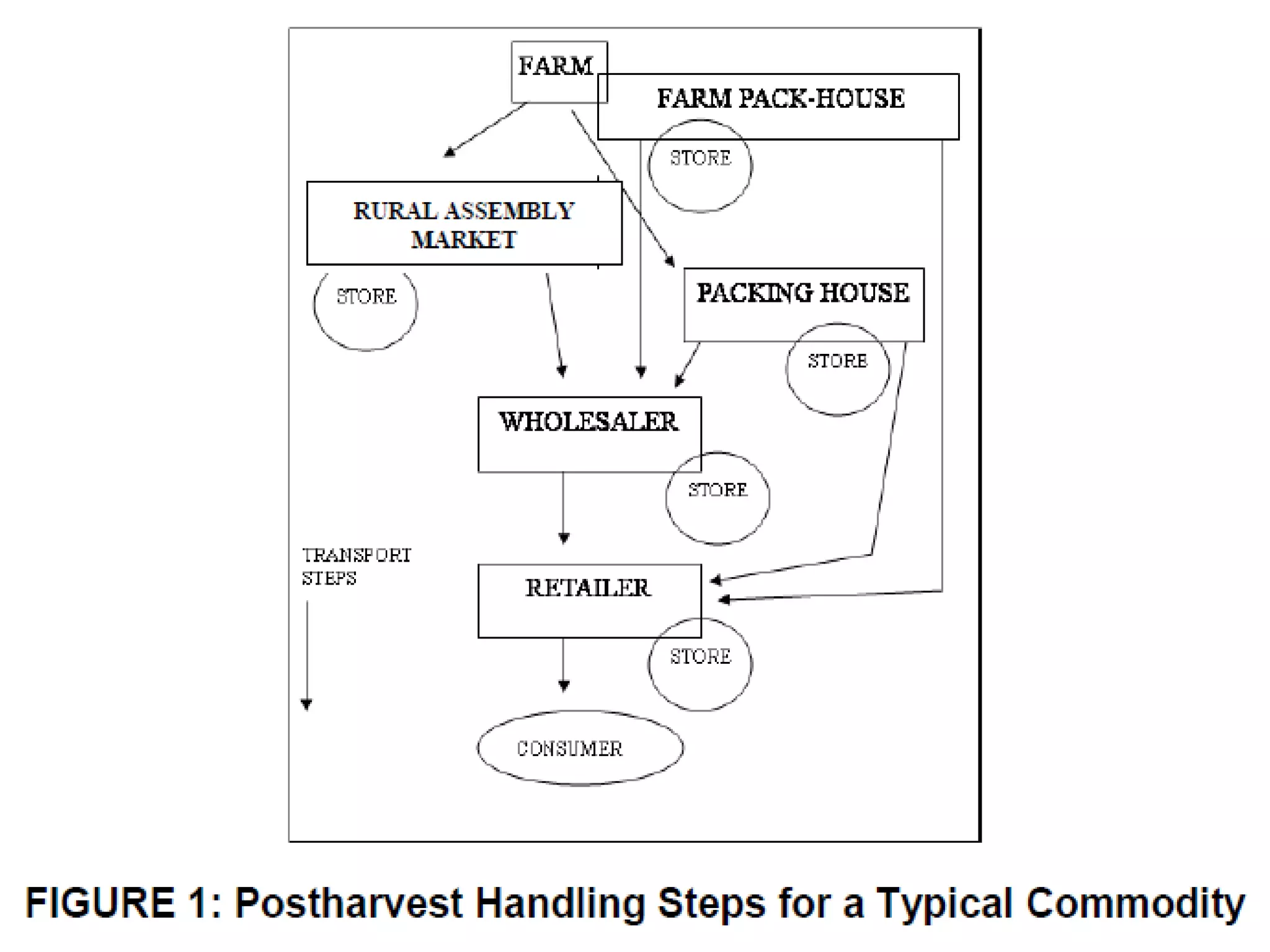
Postharvest handling specifically involves
the movement and the operations that
commodities undergo from harvest to the time
immediately before meal preparation.
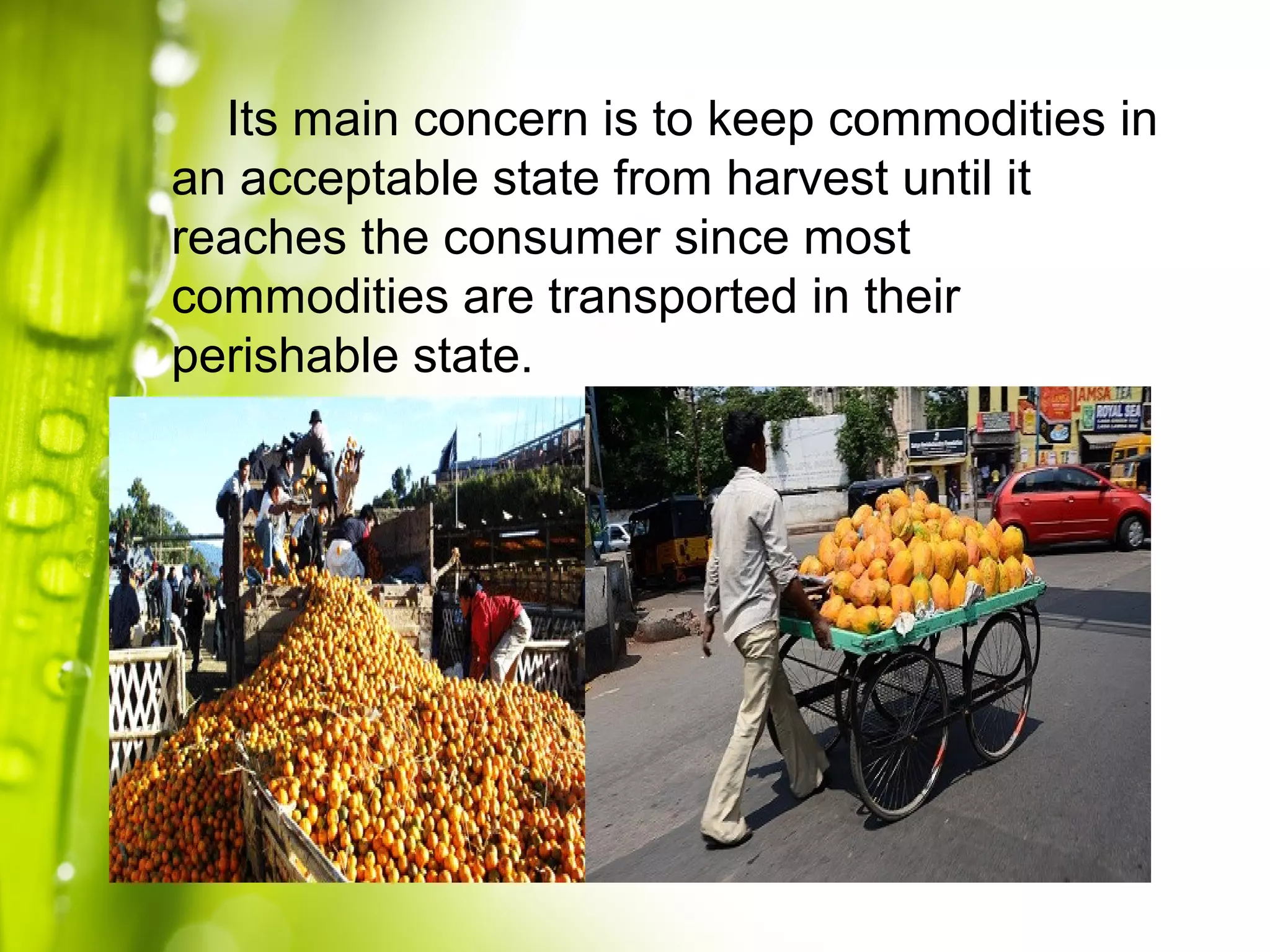
Its main concern is to keep commodities in
an acceptable state from harvest until it
reaches the consumer since most
commodities are transported in their
perishable state.
In addition, postharvest handling aims to
minimize losses at the least possible cost.
The existing postharvest environment
requires appropriate technologies to maintain
quality of commodities.
Poor handling of agricultural commodities
can result in quality deterioration and losses.
The three main objectives of applying
postharvest technology to harvested
fruits and vegetables are:
1)to maintain quality (appearance,
texture, flavor and nutritive value)
2) to protect food safety, and
3) to reduce losses between harvest
and consumption.
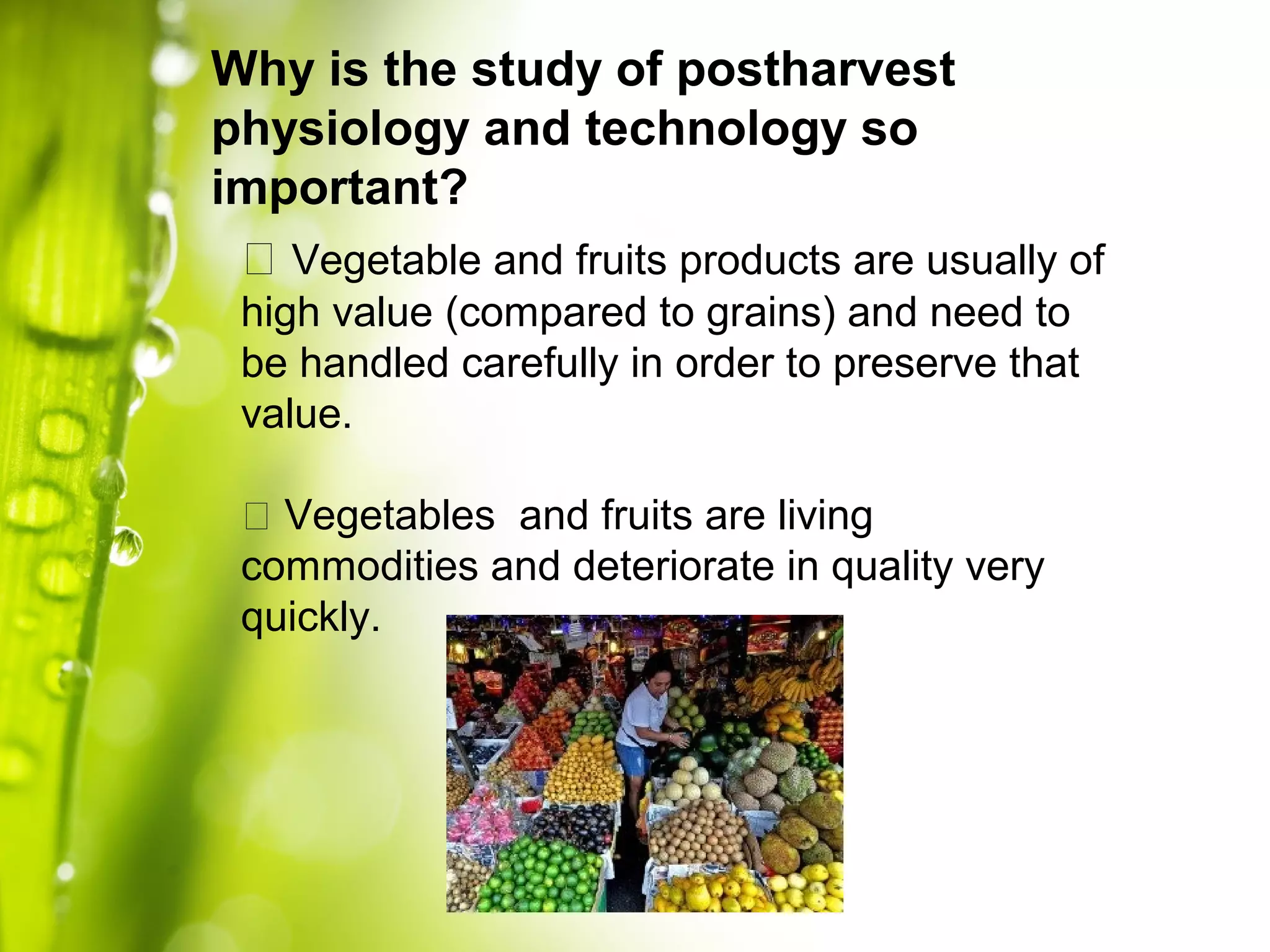
􀀹 Vegetable and fruits products are usually of
high value (compared to grains) and need to
be handled carefully in order to preserve that
value.
􀀹 Vegetables and fruits are living
commodities and deteriorate in quality very
quickly.
Why is the study of postharvest
physiology and technology so
important?
􀀹 A lot of money and other resources is
invested in growing the crop.
To get the best price possible for the
crop, it must be looked after appropriately
until it reaches the consumer.
􀀹 Vegetables and fruits are rich source of
vitamins, minerals, plant proteins and
medicinal substances - proper care helps
maintain nutritional and pharmacological
value.
Fresh fruits, vegetables, and flowers
must be in excellent condition and have
excellent quality if maximum shelf life is
desired.
The best possible quality of any
commodity exists at the moment of harvest.
From that point on, quality cannot be
improved, only maintained.
Remember that shelf life begins at harvest.
Remember:
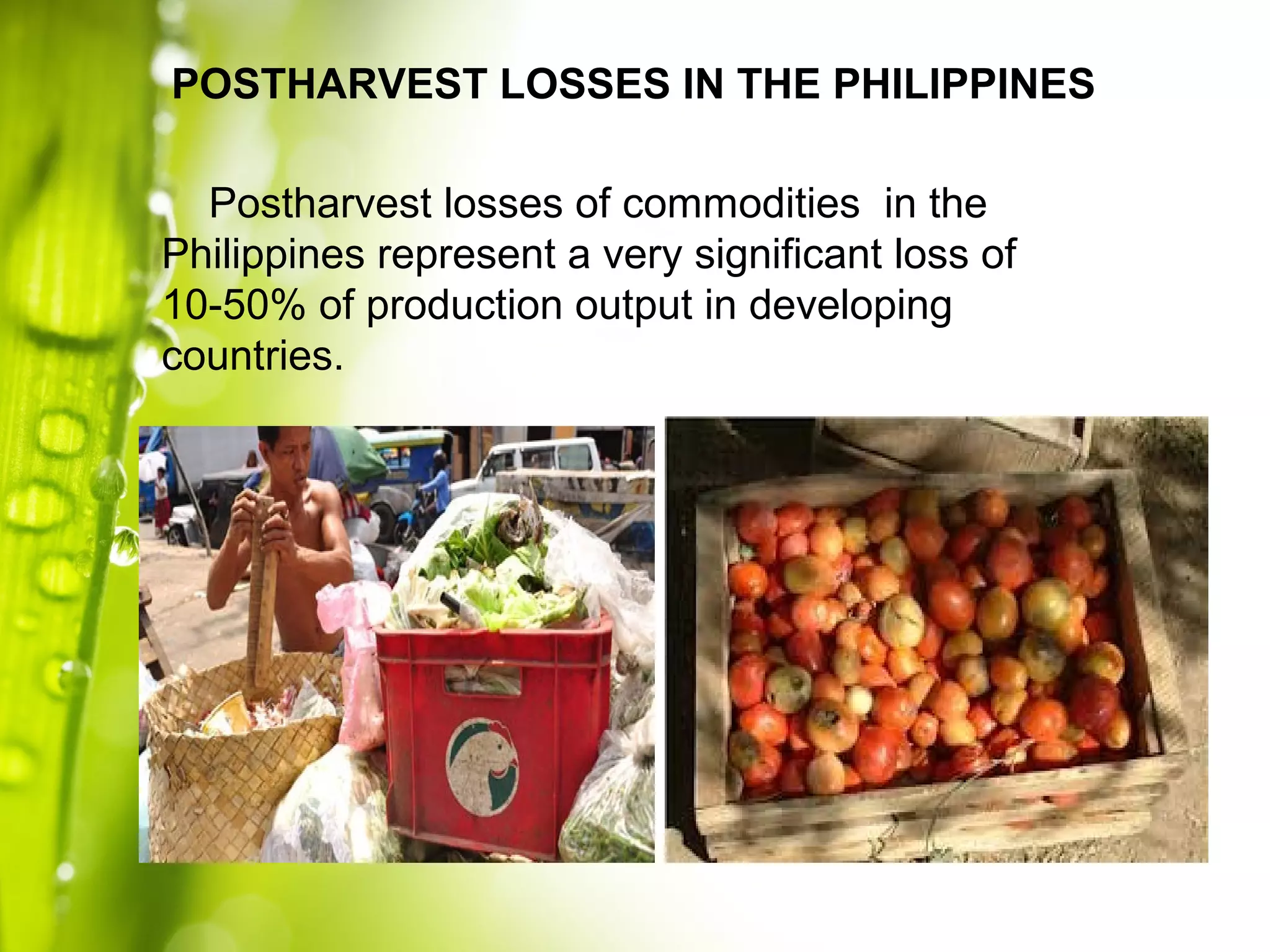
Postharvest losses of commodities in the
Philippines represent a very significant loss of
10-50% of production output in developing
countries.
POSTHARVEST LOSSES IN THE PHILIPPINES
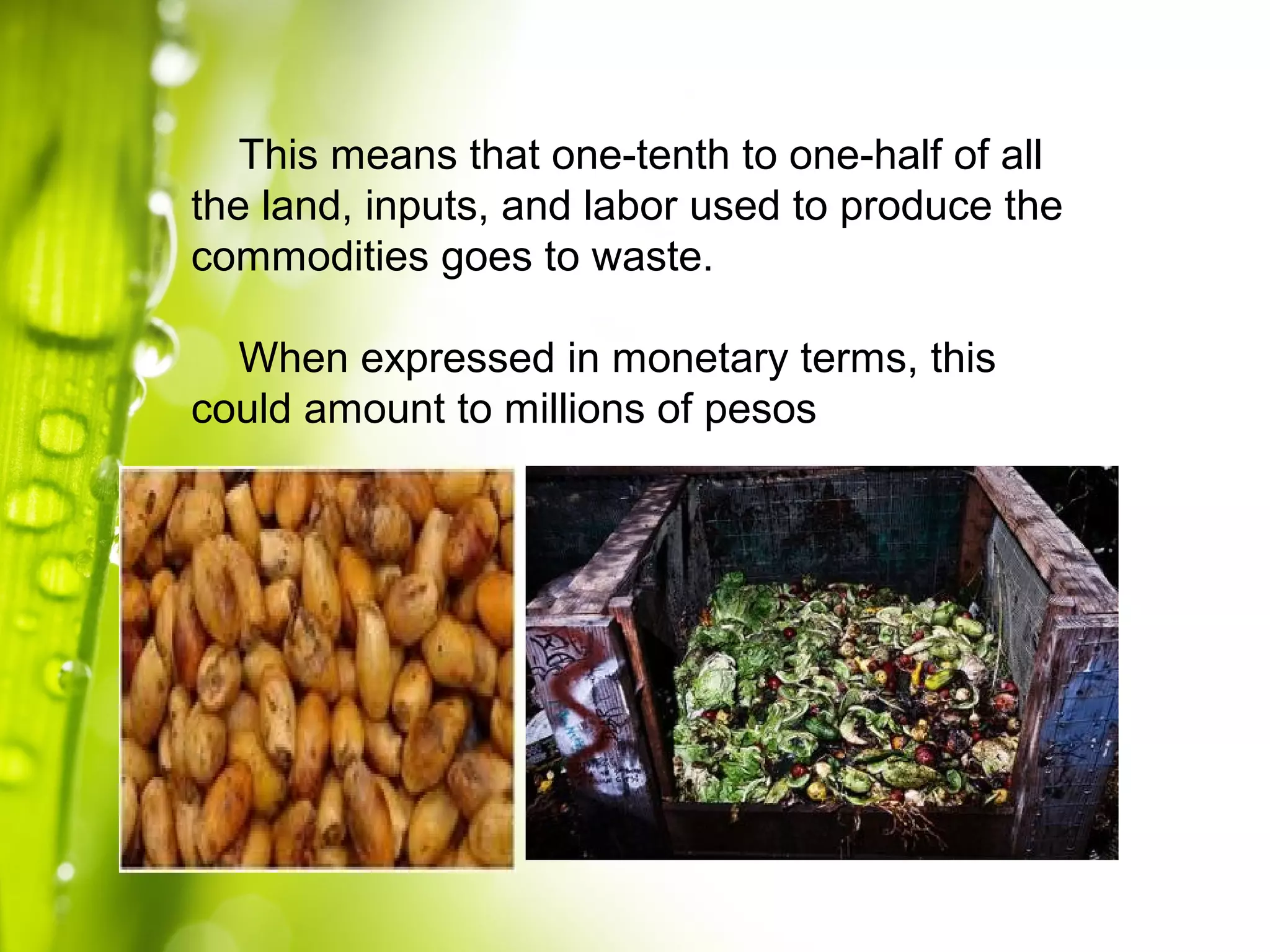
This means that one-tenth to one-half of all
the land, inputs, and labor used to produce the
commodities goes to waste.
When expressed in monetary terms, this
could amount to millions of pesos
In 2005, Philippine fruits and
vegetables were worth PhP 101.5 billion
(BAS, 2005).
An average loss of 35% thus amounts
to PhP 35.52 billion annually.
A loss reduction of 1% is equivalent to
PhP 355.2 million gain in productivity.
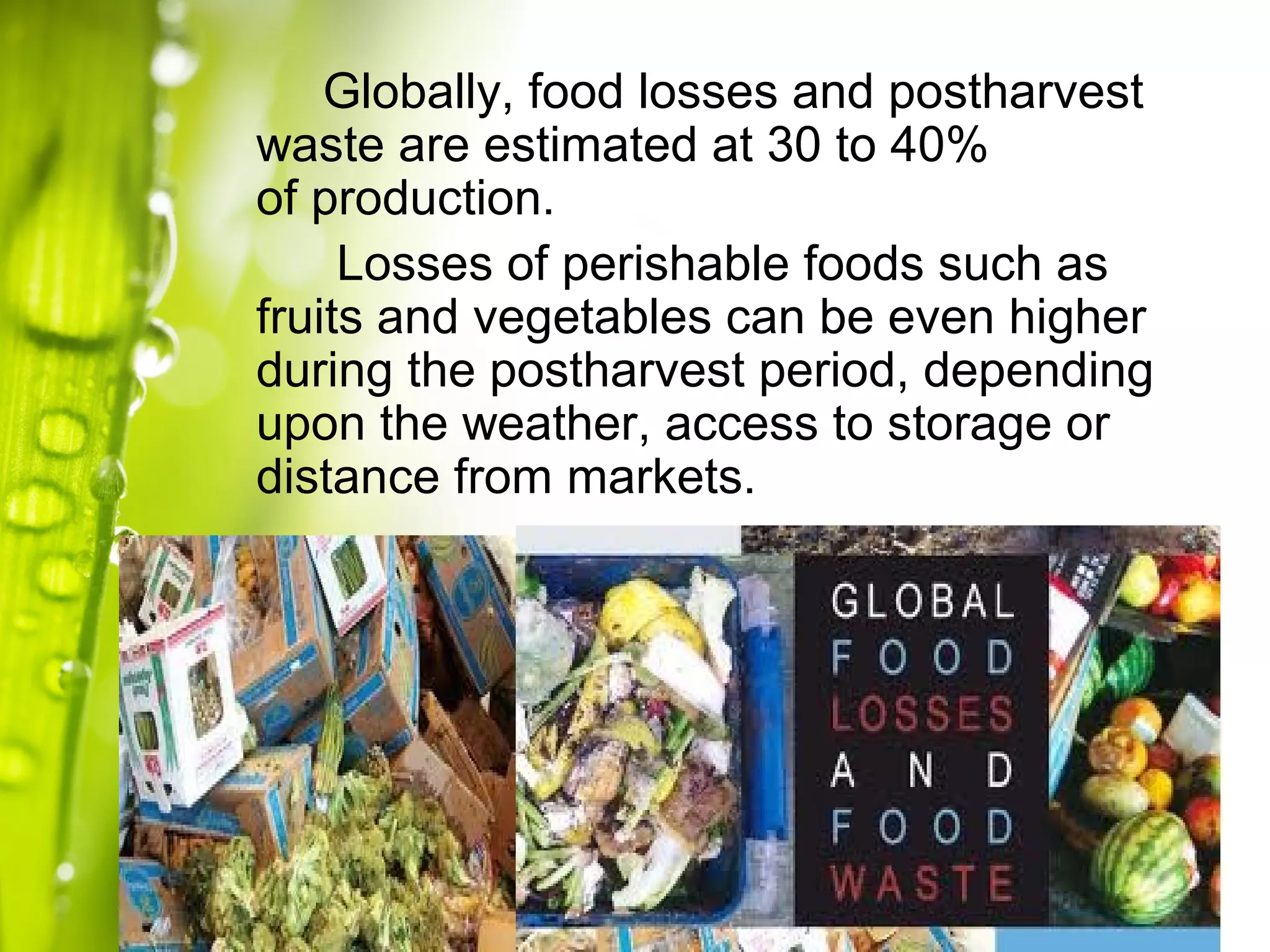
Globally, food losses and postharvest
waste are estimated at 30 to 40%
of production.
Losses of perishable foods such as
fruits and vegetables can be even higher
during the postharvest period, depending
upon the weather, access to storage or
distance from markets.
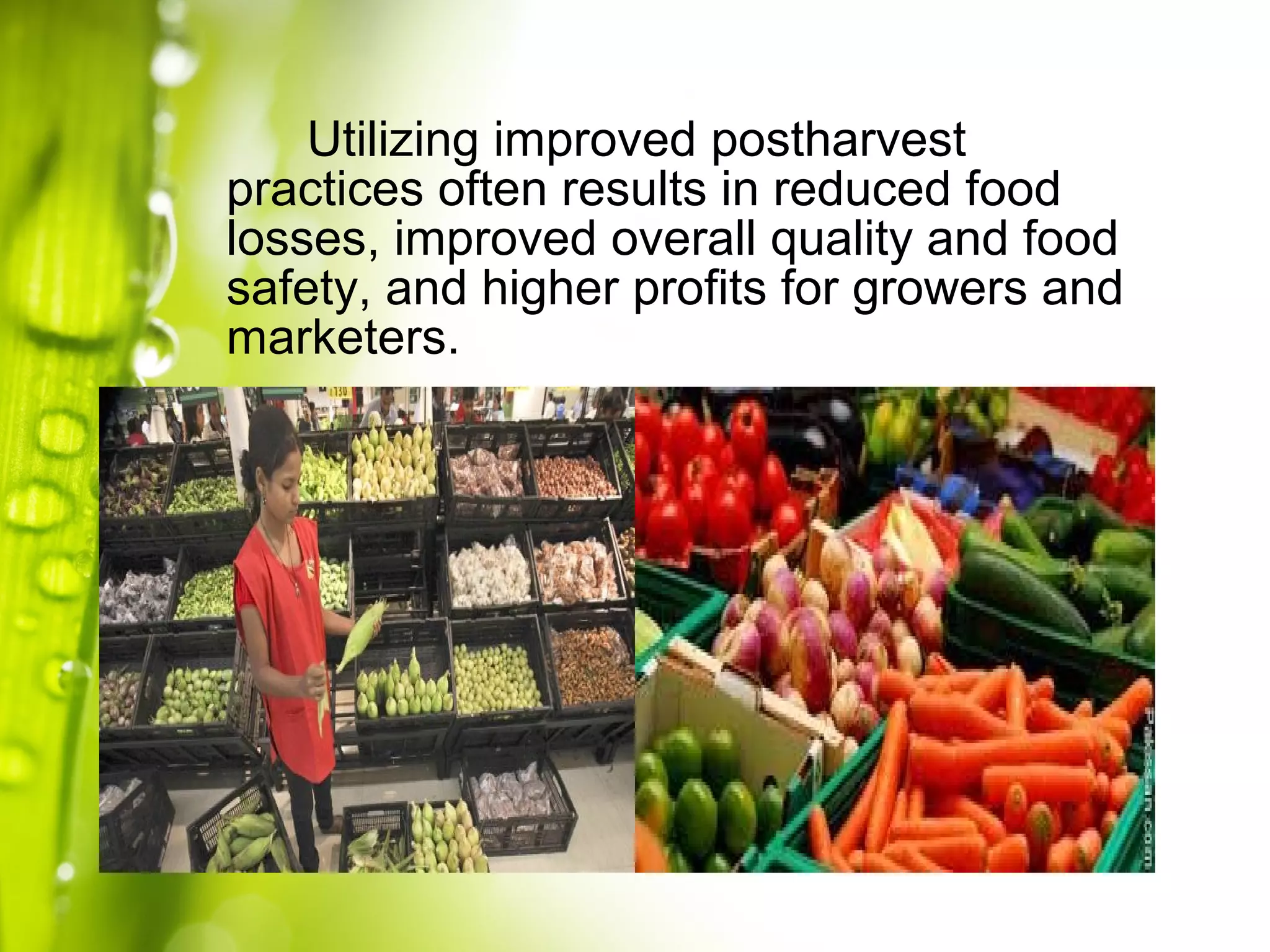
Utilizing improved postharvest
practices often results in reduced food
losses, improved overall quality and food
safety, and higher profits for growers and
marketers.
The three main objectives of applying postharvest
technology to harvested fruits and vegetables are:
 to maintain quality (appearance, texture, flavor
and nutritive value)
 to protect food safety, and
 to reduce losses (both physical and in market
value) between harvest and consumption.
THE BASICS OF POSTHARVEST TECHNOLOGY
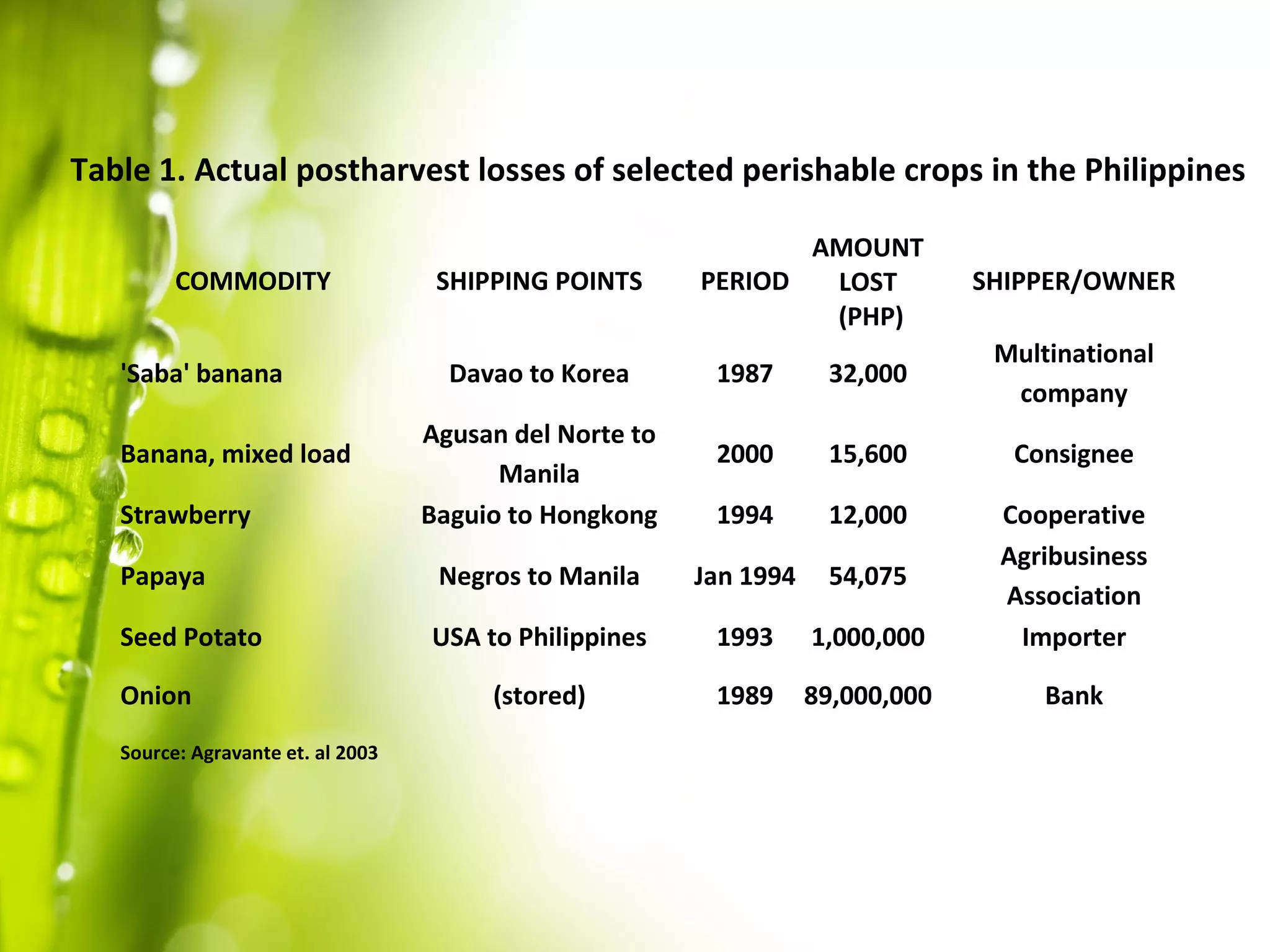
COMMODITY SHIPPING POINTS PERIOD
AMOUNT
LOST
(PHP)
SHIPPER/OWNER
'Saba' banana Davao to Korea 1987 32,000
Multinational
company
Banana, mixed load
Agusan del Norte to
Manila
2000 15,600 Consignee
Strawberry Baguio to Hongkong 1994 12,000 Cooperative
Papaya Negros to Manila Jan 1994 54,075
Agribusiness
Association
Seed Potato USA to Philippines 1993 1,000,000 Importer
Onion (stored) 1989 89,000,000 Bank
Source: Agravante et. al 2003
Table 1. Actual postharvest losses of selected perishable crops in the Philippines
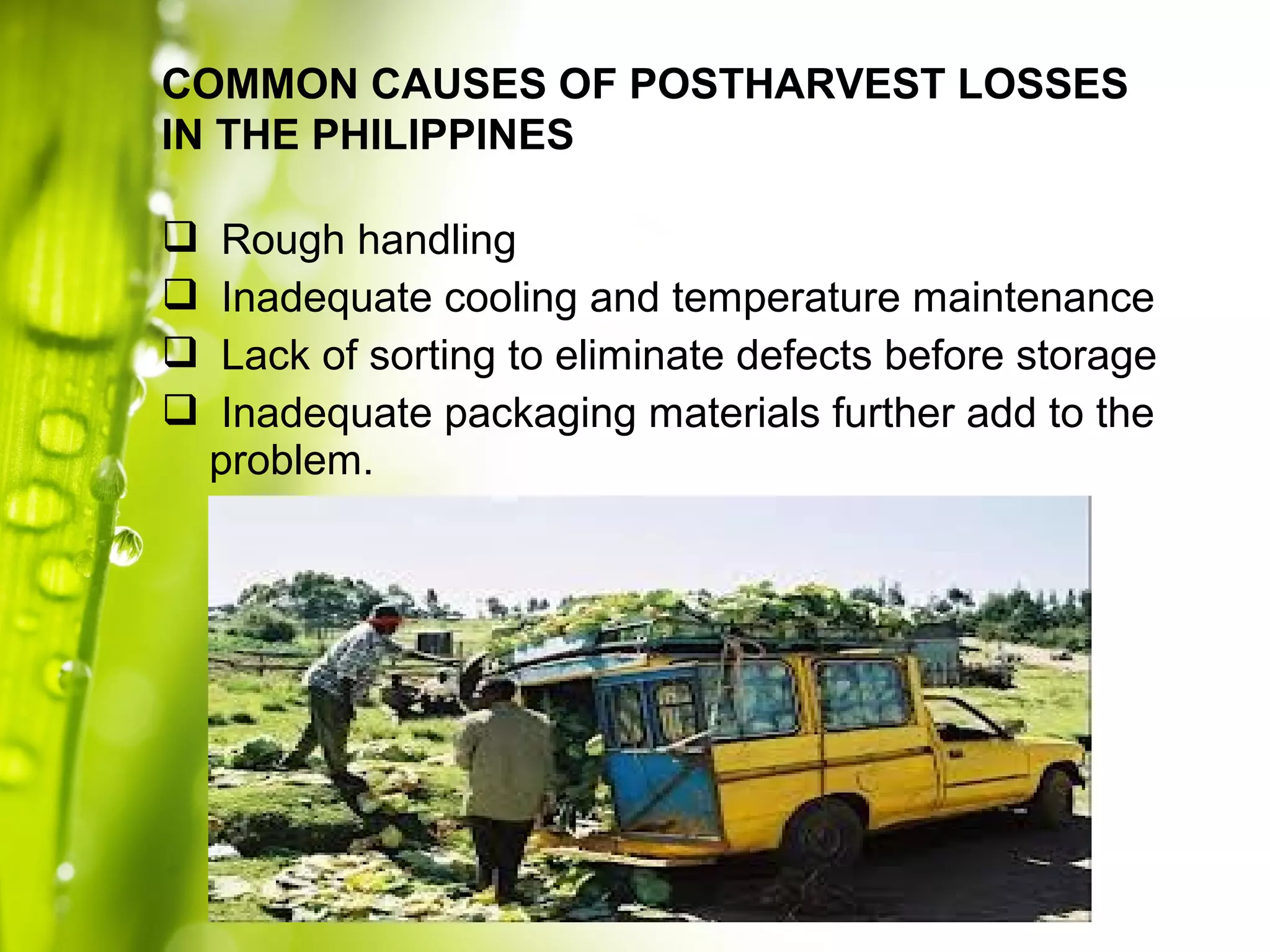
 Rough handling
 Inadequate cooling and temperature maintenance
 Lack of sorting to eliminate defects before storage
 Inadequate packaging materials further add to the
problem.
COMMON CAUSES OF POSTHARVEST LOSSES
IN THE PHILIPPINES
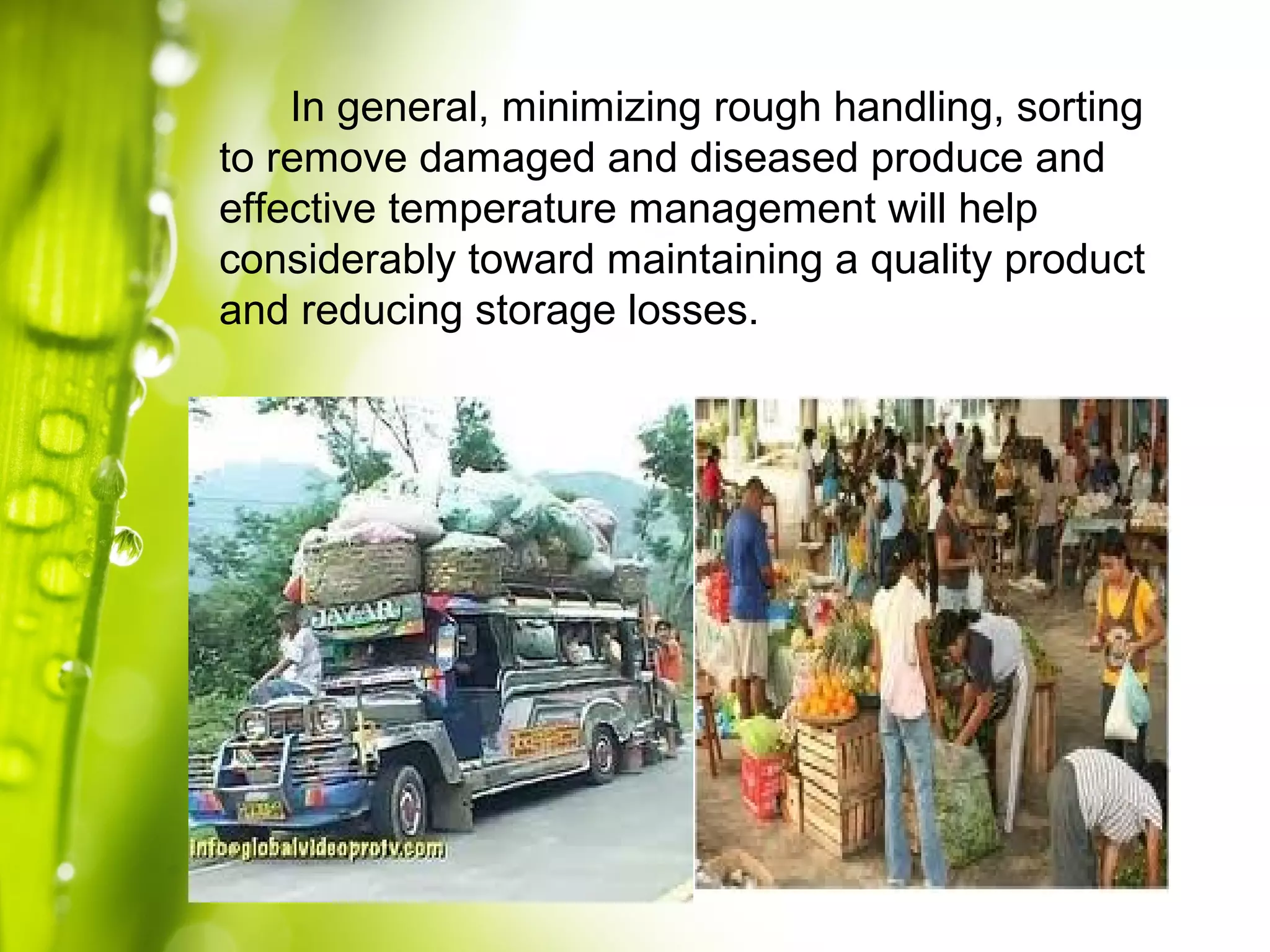
In general, minimizing rough handling, sorting
to remove damaged and diseased produce and
effective temperature management will help
considerably toward maintaining a quality product
and reducing storage losses.
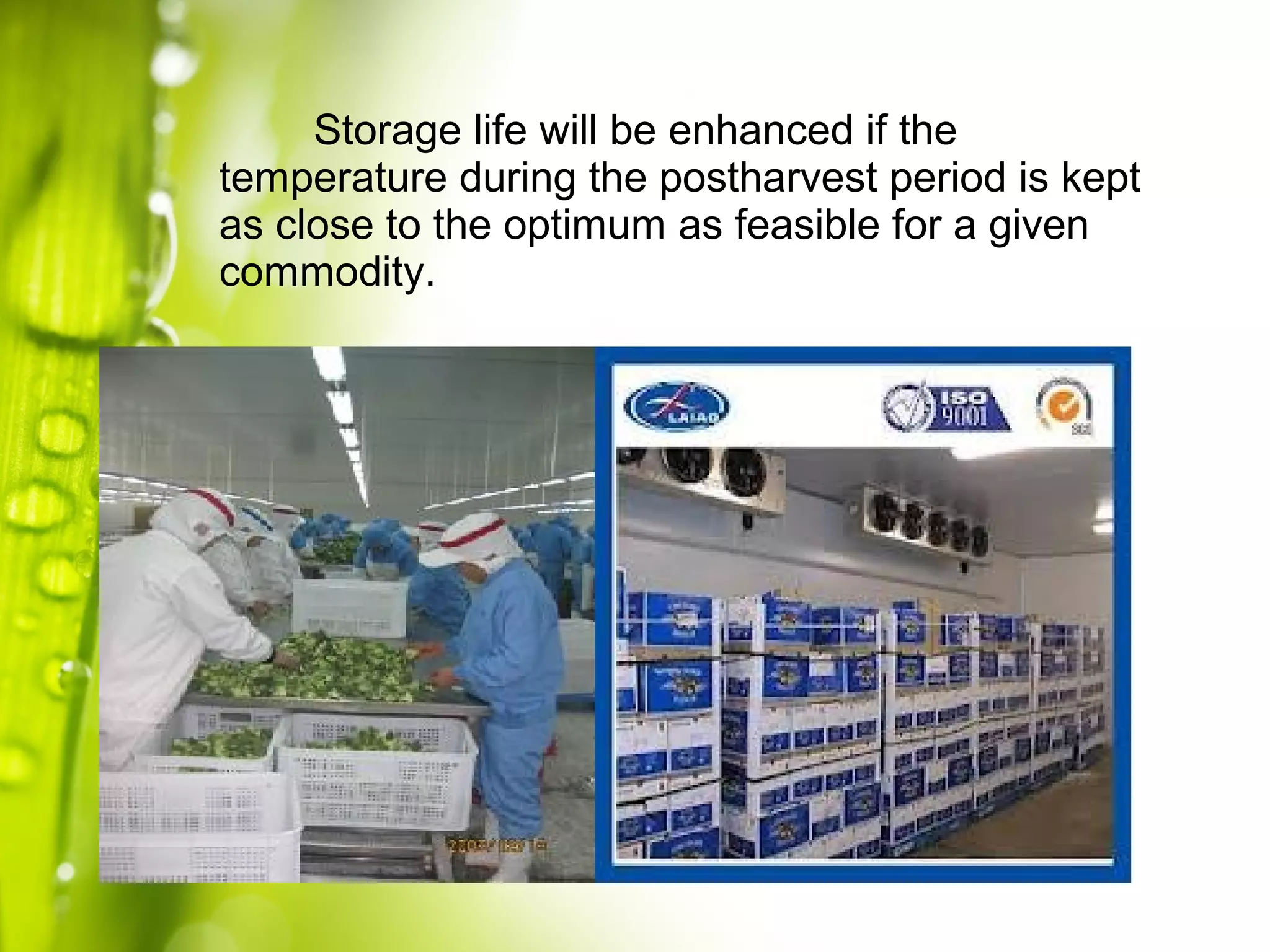
Storage life will be enhanced if the
temperature during the postharvest period is kept
as close to the optimum as feasible for a given
commodity.
The ideal temperature often depends on the
geographic origin of the product.
Tropical plants have evolved in warmer
climates and therefore cannot tolerate low
temperatures during storage.
Plants from tropical origins must be stored
above 12°C.
This is in contrast to plants which have
evolved in temperate, cooler climates which
can be stored at 0°C.
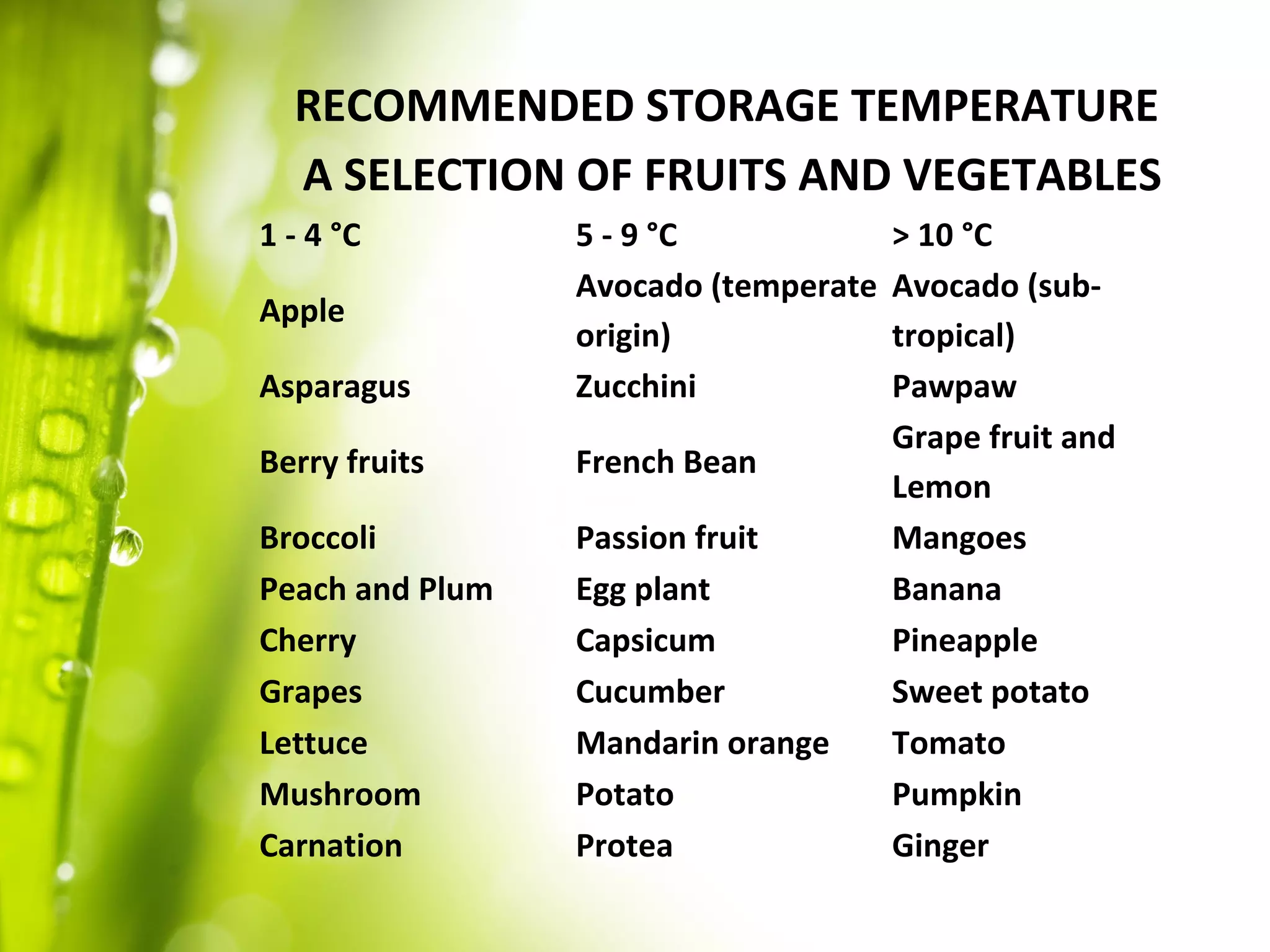
EFFECT OF TEMPERATURE ON POSTHARVEST
RECOMMENDED STORAGE TEMPERATURE
A SELECTION OF FRUITS AND VEGETABLES
1 - 4 °C 5 - 9 °C > 10 °C
Apple
Avocado (temperate
origin)
Avocado (sub-
tropical)
Asparagus Zucchini Pawpaw
Berry fruits French Bean
Grape fruit and
Lemon
Broccoli Passion fruit Mangoes
Peach and Plum Egg plant Banana
Cherry Capsicum Pineapple
Grapes Cucumber Sweet potato
Lettuce Mandarin orange Tomato
Mushroom Potato Pumpkin
Carnation Protea Ginger
The rapid cooling after harvest is so important.
If the temperature is lowered and the
harvested products are put in refrigerated
storage, water and quality loss can be reduced.
Fresh produce is alive, living and breathing.
The general term for all the processes going
on inside a living organism is called
metabolism.
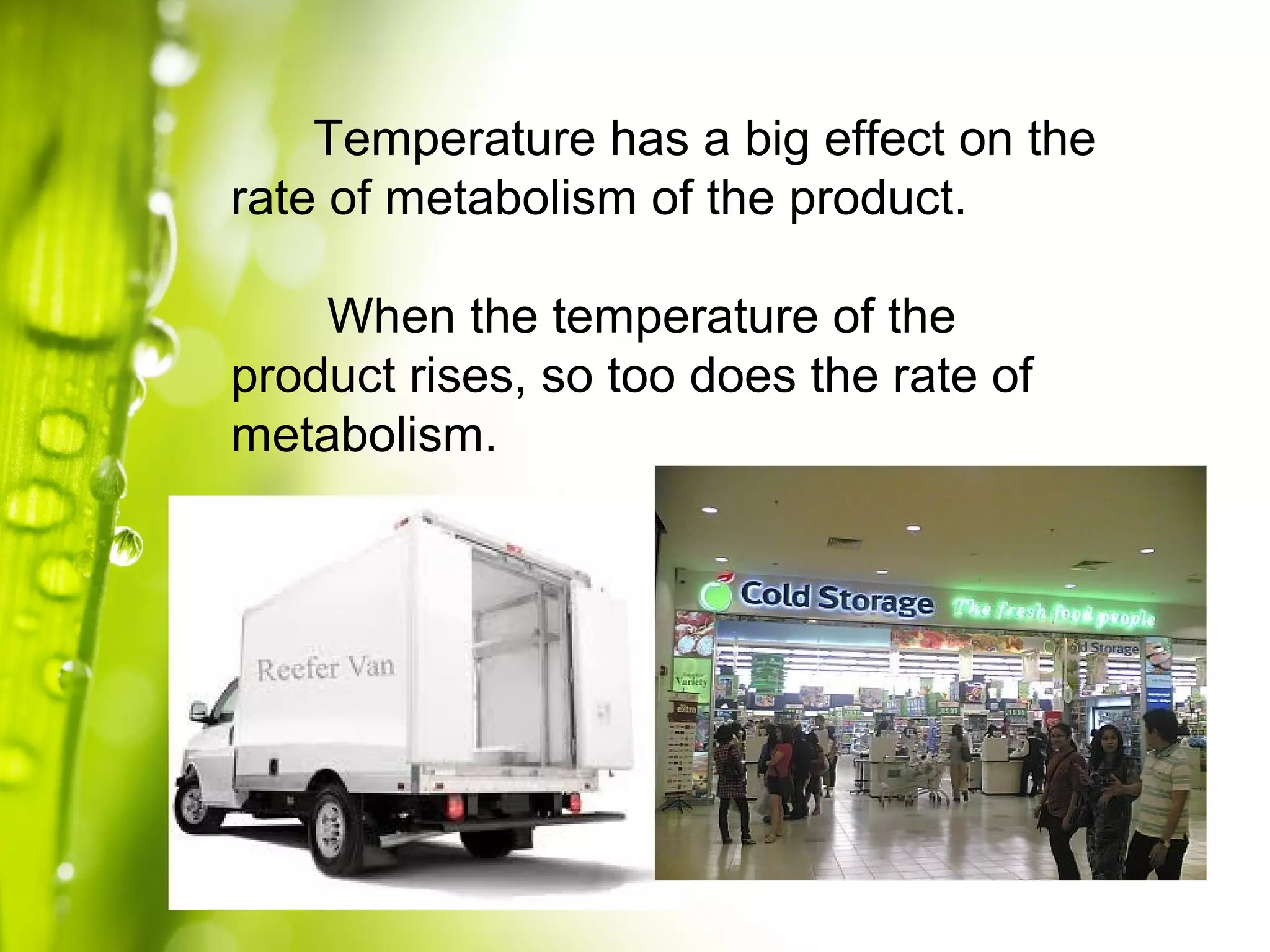
Temperature has a big effect on the
rate of metabolism of the product.
When the temperature of the
product rises, so too does the rate of
metabolism.
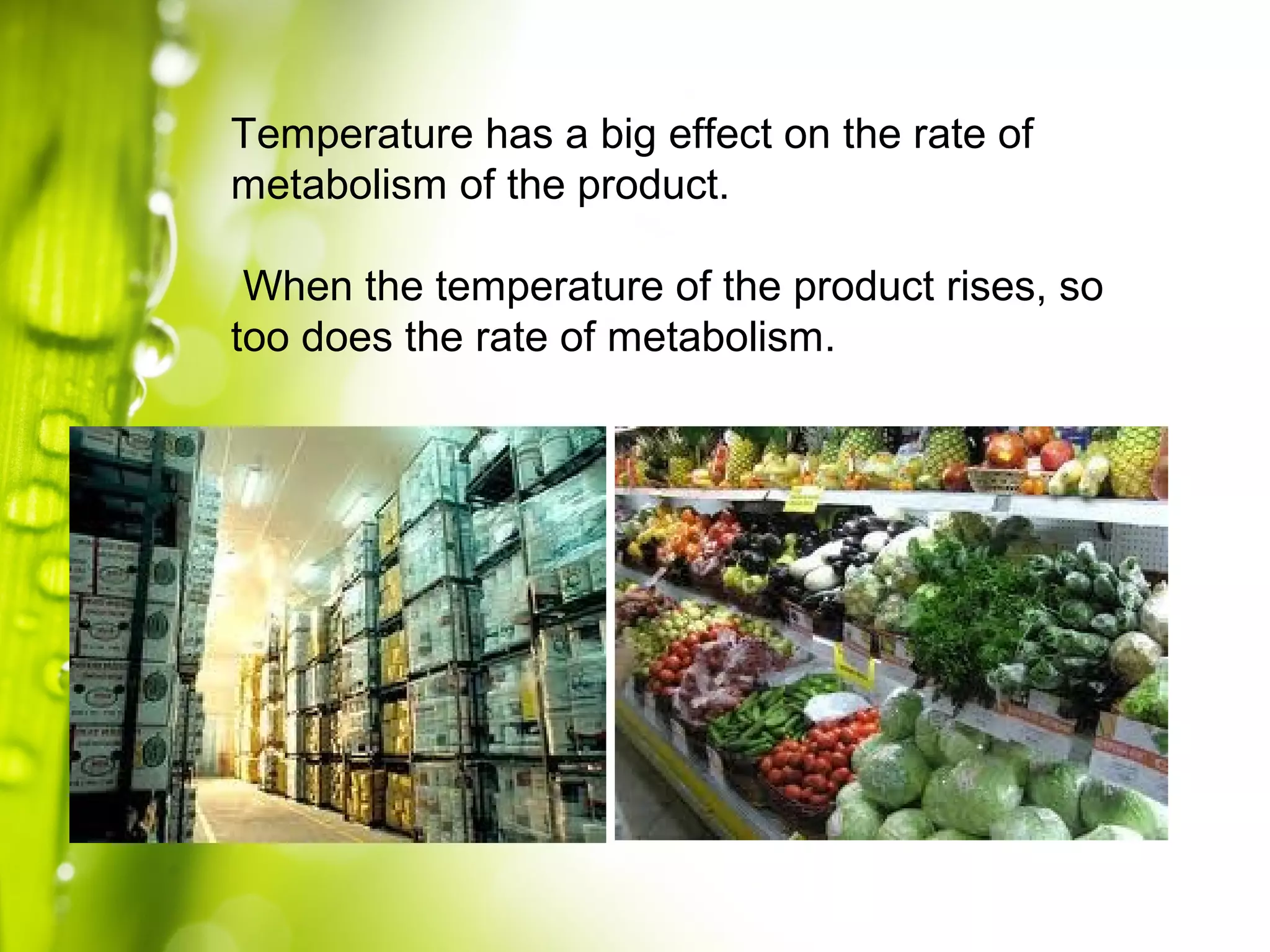
Temperature has a big effect on the rate of
metabolism of the product.
When the temperature of the product rises, so
too does the rate of metabolism.
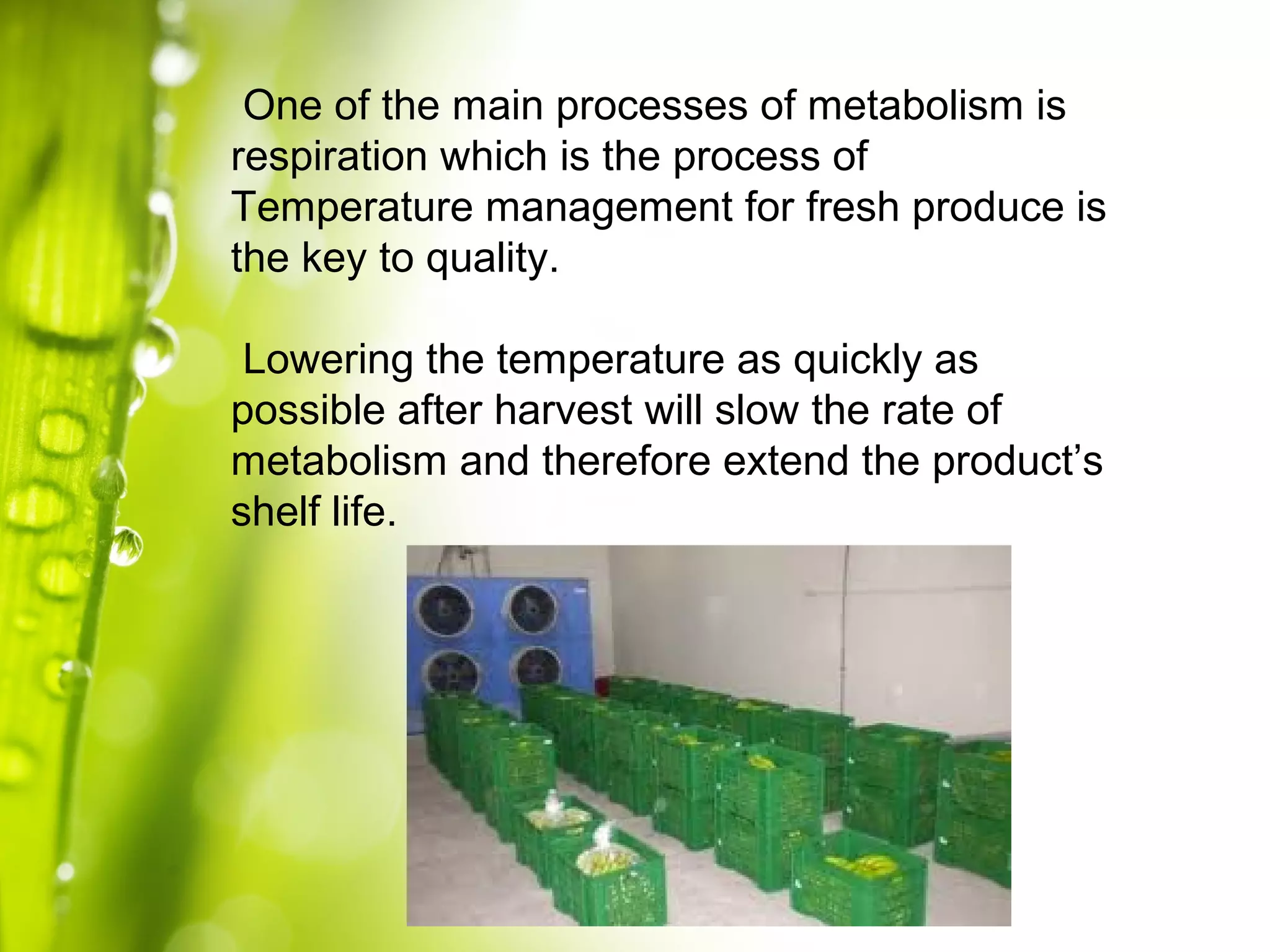
One of the main processes of metabolism is
respiration which is the process of
Temperature management for fresh produce is
the key to quality.
Lowering the temperature as quickly as
possible after harvest will slow the rate of
metabolism and therefore extend the product’s
shelf life.
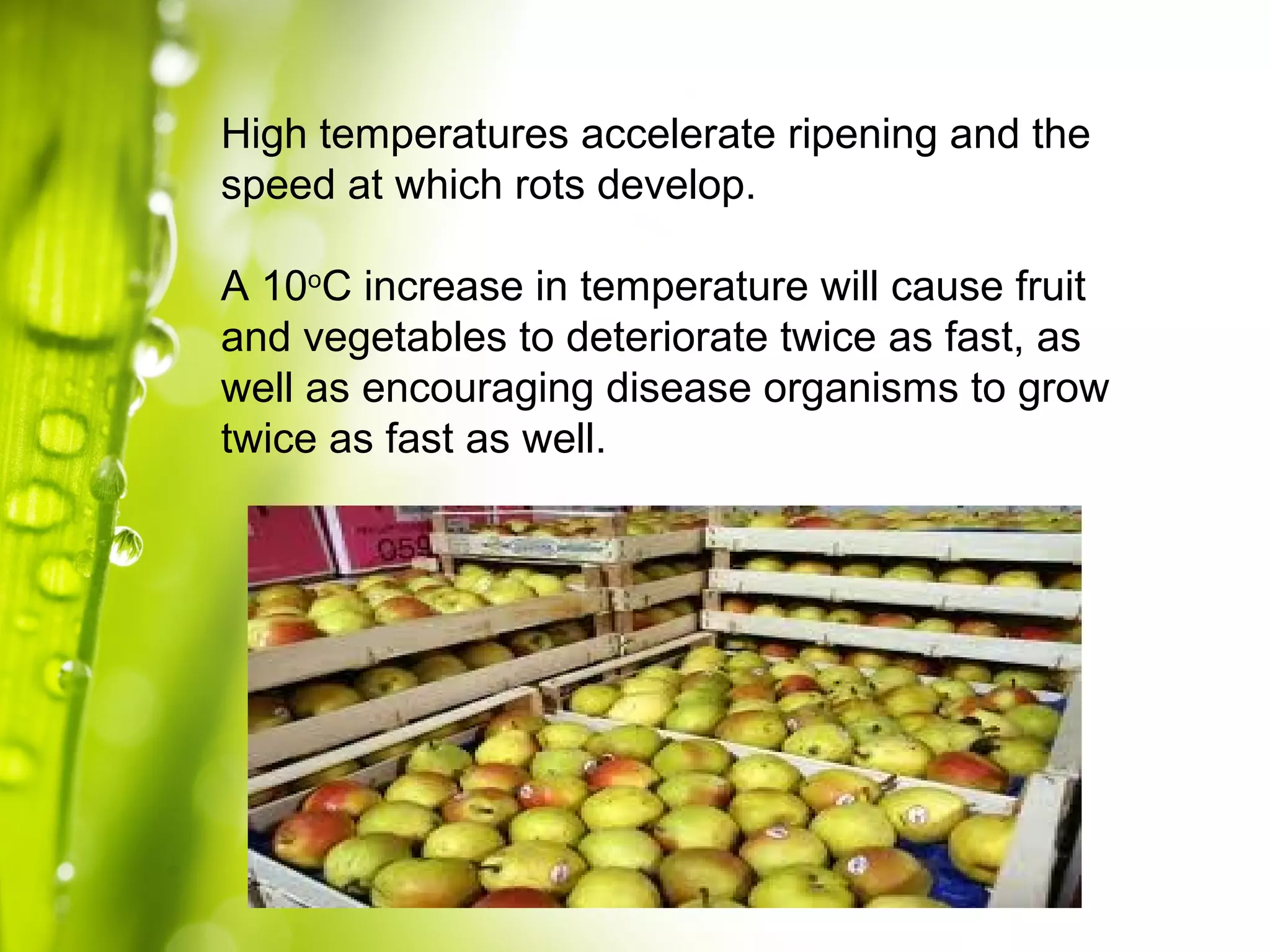
High temperatures accelerate ripening and the
speed at which rots develop.
A 10o
C increase in temperature will cause fruit
and vegetables to deteriorate twice as fast, as
well as encouraging disease organisms to grow
twice as fast as well.
Causes of post-harvest losses of fresh fruits and
vegetables:
- use of uncertified seeds
- excessive use of fertilizer,
- poor irrigation system
- poor harvesting practices,
- supply exceeding demand
- limited access to loan
- handling: poor transport and storage
- diseases and pests
Assessment of post harvest losses
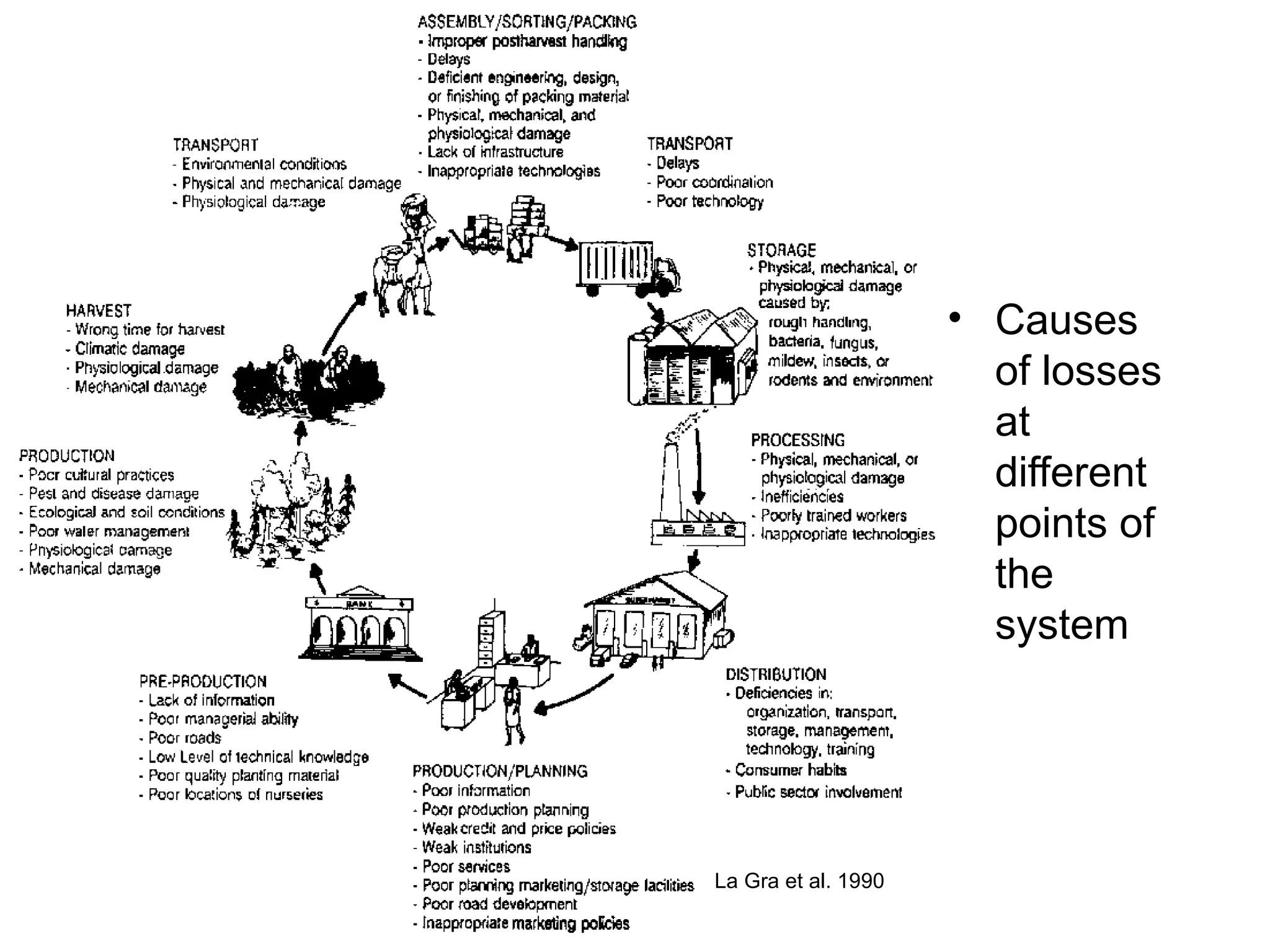
• Causes
of losses
at
different
points of
the
system
La Gra et al. 1990
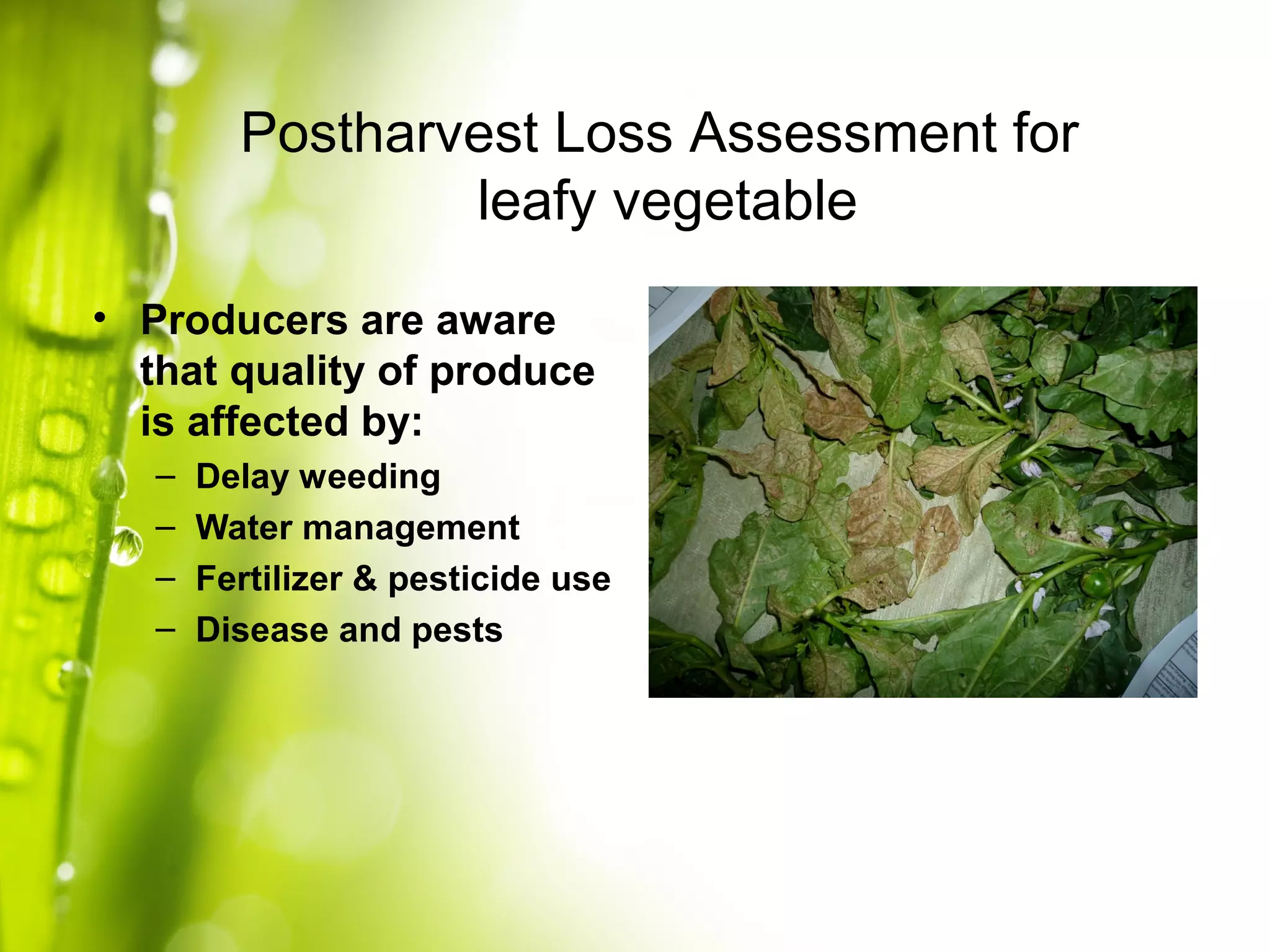
Postharvest Loss Assessment for
leafy vegetable
• Producers are aware
that quality of produce
is affected by:
– Delay weeding
– Water management
– Fertilizer & pesticide use
– Disease and pests
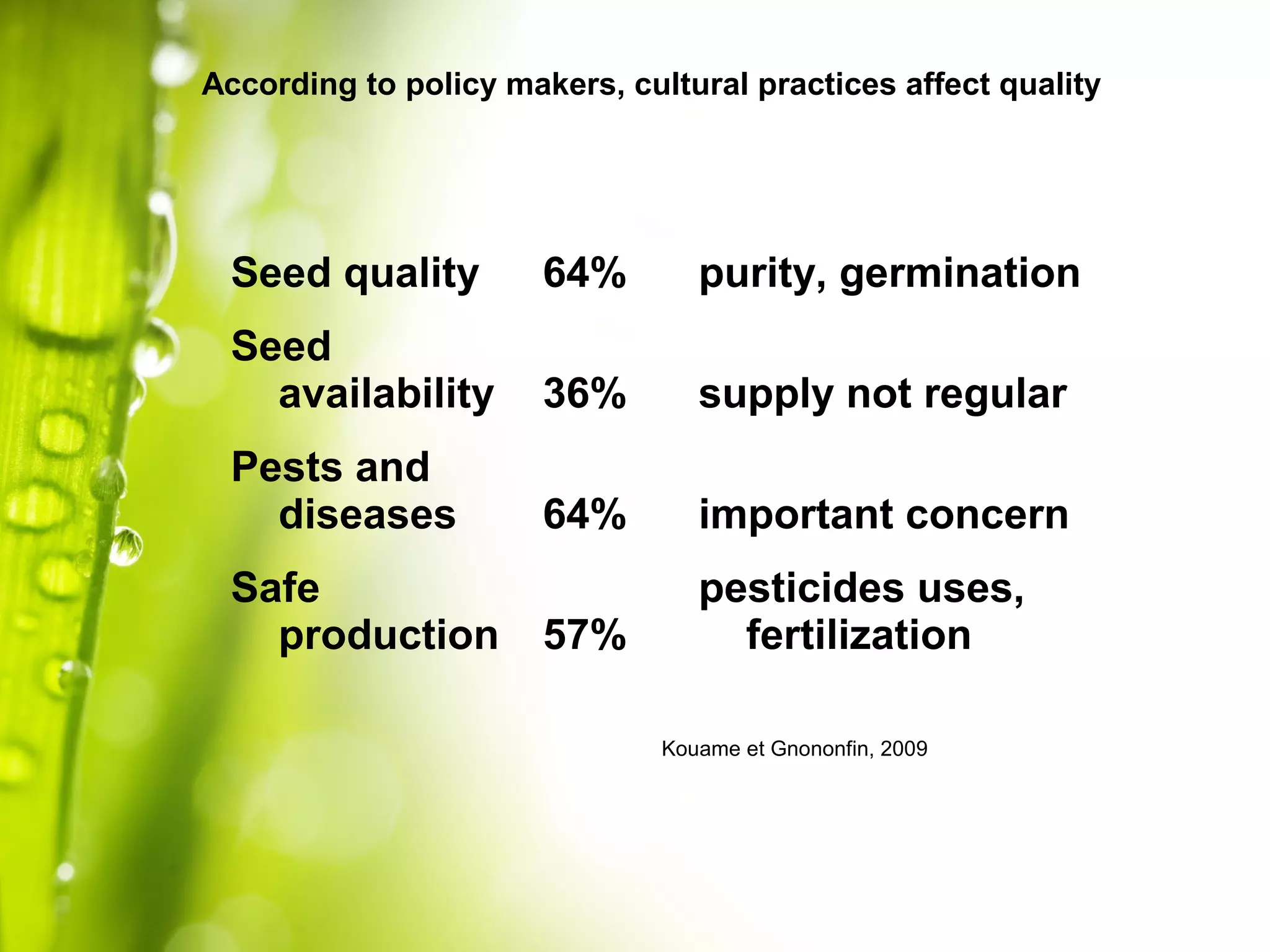
According to policy makers, cultural practices affect quality
Seed quality 64% purity, germination
Seed
availability 36% supply not regular
Pests and
diseases 64% important concern
Safe
production 57%
pesticides uses,
fertilization
Kouame et Gnononfin, 2009
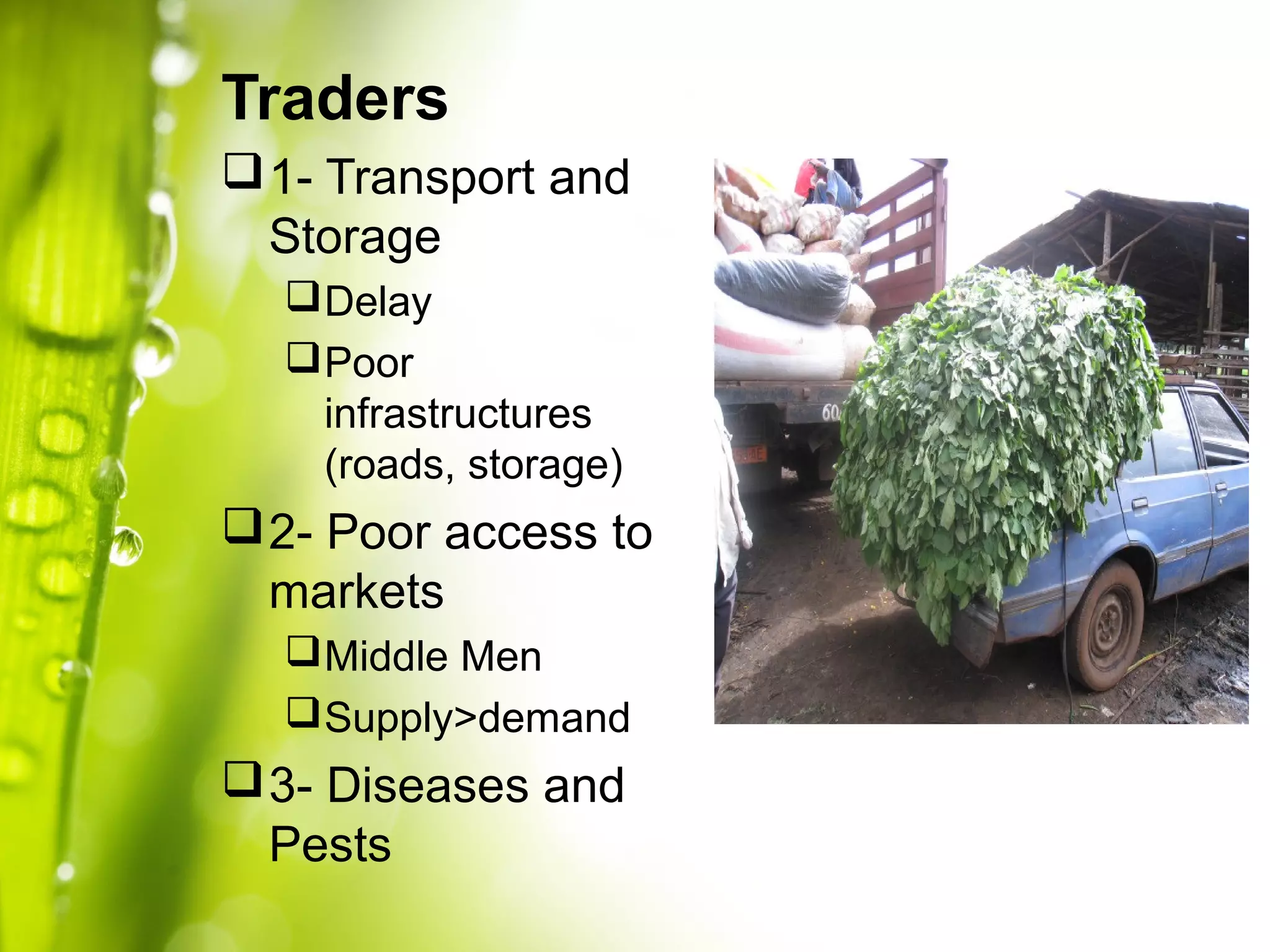
Traders
1- Transport and
Storage
Delay
Poor
infrastructures
(roads, storage)
2- Poor access to
markets
Middle Men
Supply>demand
3- Diseases and
Pests
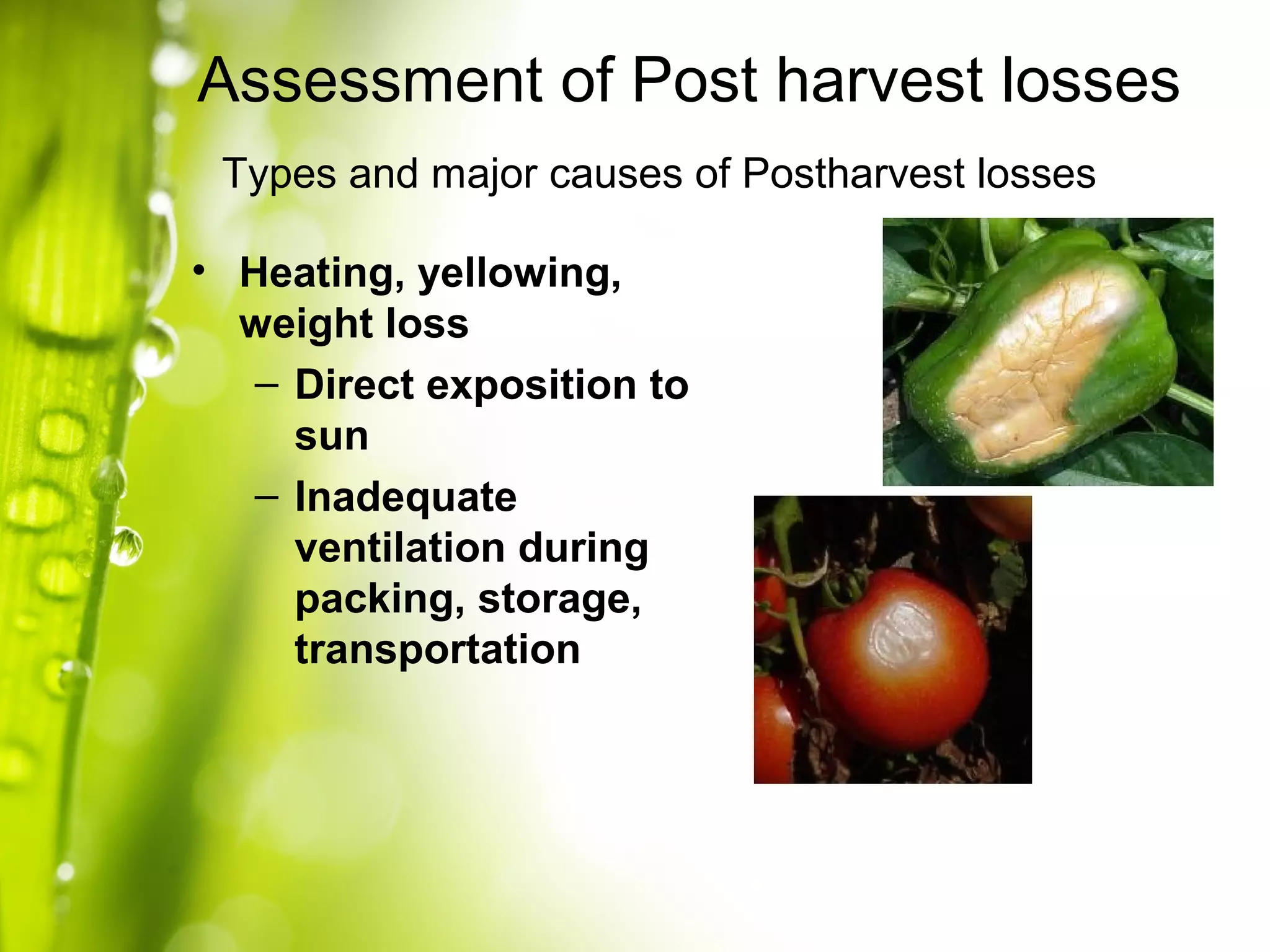
Assessment of Post harvest losses
• Heating, yellowing,
weight loss
– Direct exposition to
sun
– Inadequate
ventilation during
packing, storage,
transportation
Types and major causes of Postharvest losses
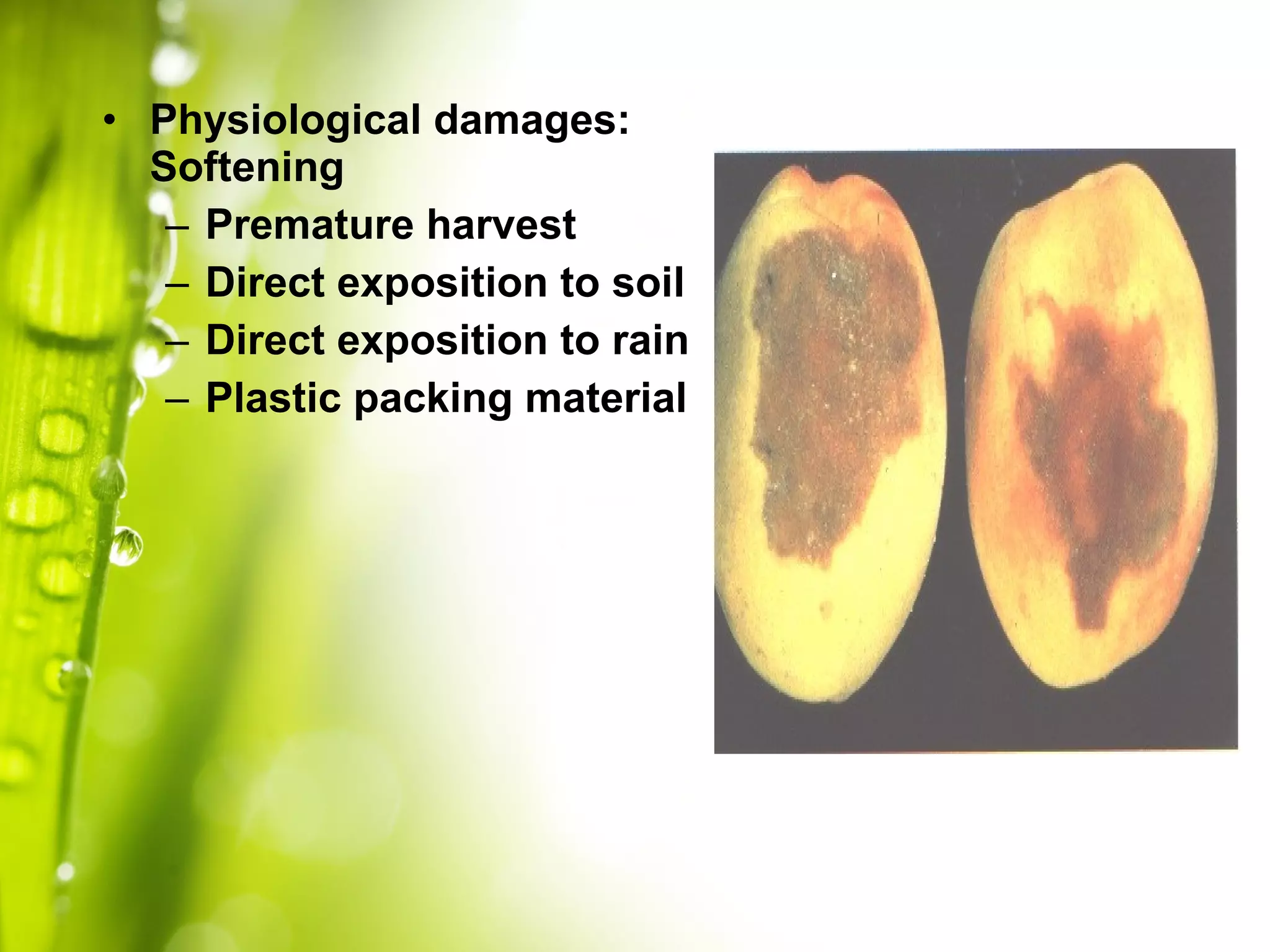
• Physiological damages:
Softening
– Premature harvest
– Direct exposition to soil
– Direct exposition to rain
– Plastic packing material
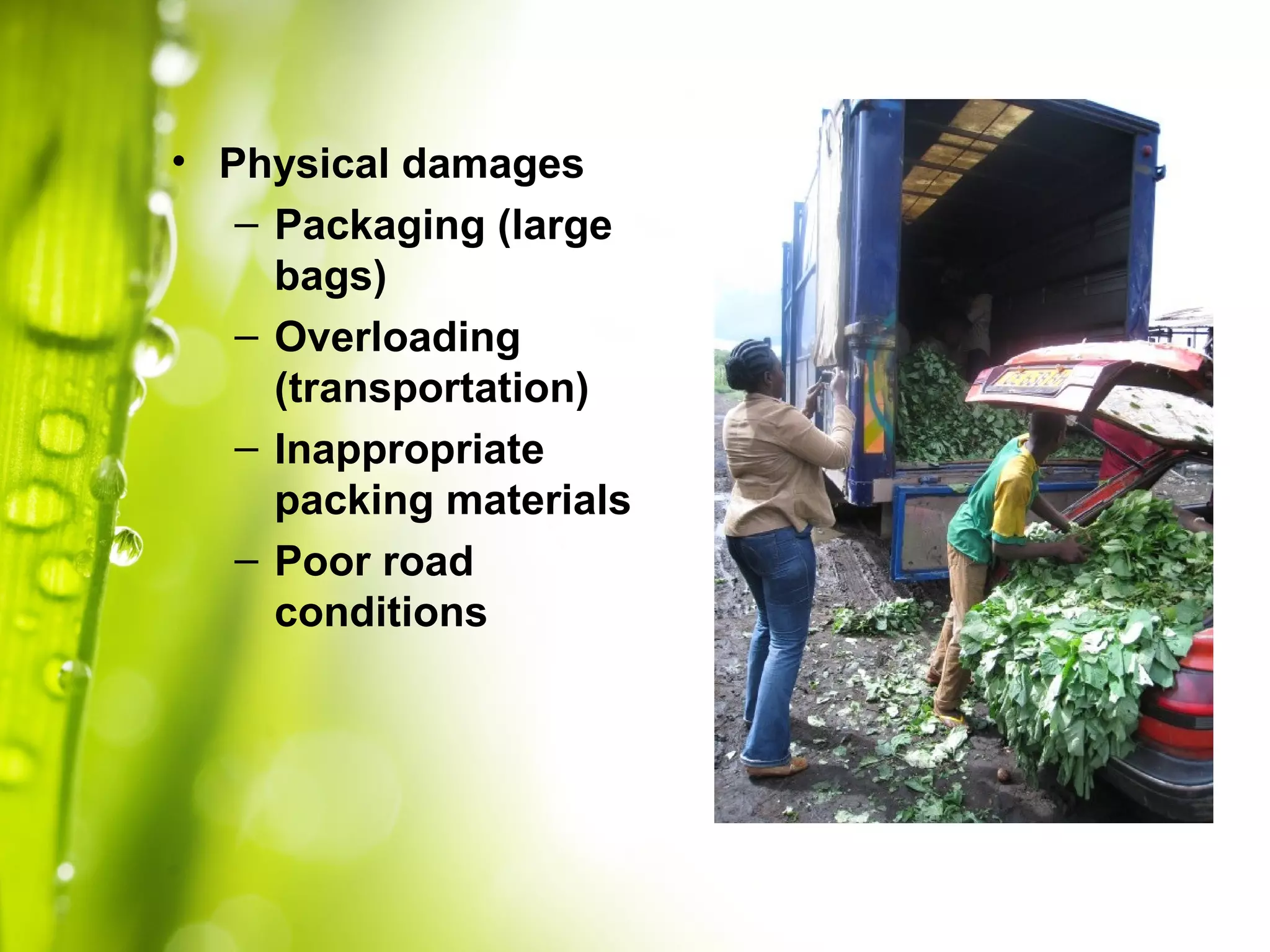
• Physical damages
– Packaging (large
bags)
– Overloading
(transportation)
– Inappropriate
packing materials
– Poor road
conditions
Thank You!

Lecture 1: Importance of Postharvest Technology

  • 1.
  • 2.
    LEARNING OBJECTIVES At theend of the lesson, the learners are expected to: 1. define post harvest technology; 2. determine its importance and objectives; 3. explain the causes of post harvest food losses and the prevention measures; 4. carryout post harvest food loss assessment; and 5. determine the pre-harvest factors affecting the post harvest life and quality aspects.
  • 3.
    LESSON OUTLINE 1. Definitionof Postharvest Technology (PHT) 2. Importance and Objectives of PHT 3. Causes of Post Harvest Food Losses and the Prevention Measures; 4. Post Harvest food Loss Assessment; and 5. Pre-Harvest Factors Affecting the Post Harvest Life and Quality Aspects.
  • 4.
    Post-harvest technologies constitutean inter-disciplinary science and techniques applied to agricultural commodities after harvest for the purpose of preservation, conservation, quality control/enhancement, processing, packaging, storage, distribution, marketing, and utilization to meet the food and nutritional requirements of consumers in relation to their needs. What is Post-Harvest Technology? Sonam Tashi, nd
  • 5.
    Post-harvest technology stimulates agriculturalproduction by:  prevents post-harvest losses;  improves nutrition ;  adds value to agricultural products; opens new marketing opportunities; and  generates new jobs
  • 6.
    Postharvest handling specificallyinvolves the movement and the operations that commodities undergo from harvest to the time immediately before meal preparation.
  • 7.
    Its main concernis to keep commodities in an acceptable state from harvest until it reaches the consumer since most commodities are transported in their perishable state.
  • 8.
    In addition, postharvesthandling aims to minimize losses at the least possible cost. The existing postharvest environment requires appropriate technologies to maintain quality of commodities. Poor handling of agricultural commodities can result in quality deterioration and losses.
  • 10.
    The three mainobjectives of applying postharvest technology to harvested fruits and vegetables are: 1)to maintain quality (appearance, texture, flavor and nutritive value) 2) to protect food safety, and 3) to reduce losses between harvest and consumption.
  • 11.
    􀀹 Vegetable andfruits products are usually of high value (compared to grains) and need to be handled carefully in order to preserve that value. 􀀹 Vegetables and fruits are living commodities and deteriorate in quality very quickly. Why is the study of postharvest physiology and technology so important?
  • 12.
    􀀹 A lotof money and other resources is invested in growing the crop. To get the best price possible for the crop, it must be looked after appropriately until it reaches the consumer. 􀀹 Vegetables and fruits are rich source of vitamins, minerals, plant proteins and medicinal substances - proper care helps maintain nutritional and pharmacological value.
  • 13.
    Fresh fruits, vegetables,and flowers must be in excellent condition and have excellent quality if maximum shelf life is desired. The best possible quality of any commodity exists at the moment of harvest. From that point on, quality cannot be improved, only maintained. Remember that shelf life begins at harvest. Remember:
  • 14.
    Postharvest losses ofcommodities in the Philippines represent a very significant loss of 10-50% of production output in developing countries. POSTHARVEST LOSSES IN THE PHILIPPINES
  • 15.
    This means thatone-tenth to one-half of all the land, inputs, and labor used to produce the commodities goes to waste. When expressed in monetary terms, this could amount to millions of pesos
  • 16.
    In 2005, Philippinefruits and vegetables were worth PhP 101.5 billion (BAS, 2005). An average loss of 35% thus amounts to PhP 35.52 billion annually. A loss reduction of 1% is equivalent to PhP 355.2 million gain in productivity.
  • 17.
    Globally, food lossesand postharvest waste are estimated at 30 to 40% of production. Losses of perishable foods such as fruits and vegetables can be even higher during the postharvest period, depending upon the weather, access to storage or distance from markets.
  • 18.
    Utilizing improved postharvest practicesoften results in reduced food losses, improved overall quality and food safety, and higher profits for growers and marketers.
  • 19.
    The three mainobjectives of applying postharvest technology to harvested fruits and vegetables are:  to maintain quality (appearance, texture, flavor and nutritive value)  to protect food safety, and  to reduce losses (both physical and in market value) between harvest and consumption. THE BASICS OF POSTHARVEST TECHNOLOGY
  • 22.
    COMMODITY SHIPPING POINTSPERIOD AMOUNT LOST (PHP) SHIPPER/OWNER 'Saba' banana Davao to Korea 1987 32,000 Multinational company Banana, mixed load Agusan del Norte to Manila 2000 15,600 Consignee Strawberry Baguio to Hongkong 1994 12,000 Cooperative Papaya Negros to Manila Jan 1994 54,075 Agribusiness Association Seed Potato USA to Philippines 1993 1,000,000 Importer Onion (stored) 1989 89,000,000 Bank Source: Agravante et. al 2003 Table 1. Actual postharvest losses of selected perishable crops in the Philippines
  • 23.
     Rough handling Inadequate cooling and temperature maintenance  Lack of sorting to eliminate defects before storage  Inadequate packaging materials further add to the problem. COMMON CAUSES OF POSTHARVEST LOSSES IN THE PHILIPPINES
  • 24.
    In general, minimizingrough handling, sorting to remove damaged and diseased produce and effective temperature management will help considerably toward maintaining a quality product and reducing storage losses.
  • 25.
    Storage life willbe enhanced if the temperature during the postharvest period is kept as close to the optimum as feasible for a given commodity.
  • 26.
    The ideal temperatureoften depends on the geographic origin of the product. Tropical plants have evolved in warmer climates and therefore cannot tolerate low temperatures during storage. Plants from tropical origins must be stored above 12°C. This is in contrast to plants which have evolved in temperate, cooler climates which can be stored at 0°C. EFFECT OF TEMPERATURE ON POSTHARVEST
  • 27.
    RECOMMENDED STORAGE TEMPERATURE ASELECTION OF FRUITS AND VEGETABLES 1 - 4 °C 5 - 9 °C > 10 °C Apple Avocado (temperate origin) Avocado (sub- tropical) Asparagus Zucchini Pawpaw Berry fruits French Bean Grape fruit and Lemon Broccoli Passion fruit Mangoes Peach and Plum Egg plant Banana Cherry Capsicum Pineapple Grapes Cucumber Sweet potato Lettuce Mandarin orange Tomato Mushroom Potato Pumpkin Carnation Protea Ginger
  • 28.
    The rapid coolingafter harvest is so important. If the temperature is lowered and the harvested products are put in refrigerated storage, water and quality loss can be reduced. Fresh produce is alive, living and breathing. The general term for all the processes going on inside a living organism is called metabolism.
  • 29.
    Temperature has abig effect on the rate of metabolism of the product. When the temperature of the product rises, so too does the rate of metabolism.
  • 30.
    Temperature has abig effect on the rate of metabolism of the product. When the temperature of the product rises, so too does the rate of metabolism.
  • 31.
    One of themain processes of metabolism is respiration which is the process of Temperature management for fresh produce is the key to quality. Lowering the temperature as quickly as possible after harvest will slow the rate of metabolism and therefore extend the product’s shelf life.
  • 32.
    High temperatures accelerateripening and the speed at which rots develop. A 10o C increase in temperature will cause fruit and vegetables to deteriorate twice as fast, as well as encouraging disease organisms to grow twice as fast as well.
  • 33.
    Causes of post-harvestlosses of fresh fruits and vegetables: - use of uncertified seeds - excessive use of fertilizer, - poor irrigation system - poor harvesting practices, - supply exceeding demand - limited access to loan - handling: poor transport and storage - diseases and pests Assessment of post harvest losses
  • 34.
    • Causes of losses at different pointsof the system La Gra et al. 1990
  • 35.
    Postharvest Loss Assessmentfor leafy vegetable • Producers are aware that quality of produce is affected by: – Delay weeding – Water management – Fertilizer & pesticide use – Disease and pests
  • 36.
    According to policymakers, cultural practices affect quality Seed quality 64% purity, germination Seed availability 36% supply not regular Pests and diseases 64% important concern Safe production 57% pesticides uses, fertilization Kouame et Gnononfin, 2009
  • 37.
    Traders 1- Transport and Storage Delay Poor infrastructures (roads,storage) 2- Poor access to markets Middle Men Supply>demand 3- Diseases and Pests
  • 38.
    Assessment of Postharvest losses • Heating, yellowing, weight loss – Direct exposition to sun – Inadequate ventilation during packing, storage, transportation Types and major causes of Postharvest losses
  • 39.
    • Physiological damages: Softening –Premature harvest – Direct exposition to soil – Direct exposition to rain – Plastic packing material
  • 40.
    • Physical damages –Packaging (large bags) – Overloading (transportation) – Inappropriate packing materials – Poor road conditions
  • 41.