UNIT 2
RELATIONAL AND E-R MODELS[2.0-
2.2]
Objectives
• In this lecture, you will learn:
– Some relational model terminologies
– The difference between the relation schema and
relational database schema
– The properties of a relation
– Relational keys
– Views and purpose of views in relational database
2
Relational Model Terminology
• An entity is a person, place, event, or
thing/Object for which we intend to collect
data
• Examples:
– University -- Students, Faculty Members, Courses
– Airline -- Pilots, Aircraft, Routes, Suppliers
• A relation is a table with columns and rows.
– Only applies to logical structure of the database,
not the physical structure.
Relational Model Terminology
• Attribute is a named column of a relation.
• Example:
– Student -- Student Number, Name...etc
• Domain is the set of allowable values for one
or more attributes.
Attribute Domain Name Meaning Domain
Definition
Stu_id StudentID ID of a student Character:
Size 10
Relational Model Terminology
• Tuple is a row of a relation.
• Degree is the number of attributes in a relation.
• Cardinality is the number of tuples in a relation.
• Relational Database
– A collection of normalized relations with distinct
relation names.
6
Example of Attribute Domain
7
Entity and Attribute
Database Relations
• Relation schema
• Named relation defined by a set of attribute and domain
name pairs.
• Relational database schema
• Set of relation schemas, each with a distinct name.
Definition Summary
Informal Terms Formal Terms
Table Relation
Column Header Attribute
All possible Column
Values
Domain
Row Tuple
Table Definition Schema of a Relation
Populated Table State of the Relation
Relation and Relational Schema
• A relation schema is the name and the list of
attributes of a relation
• Example:
– Grade (studentId, assignmentId, points, dateSubmitted)
Relational Schema
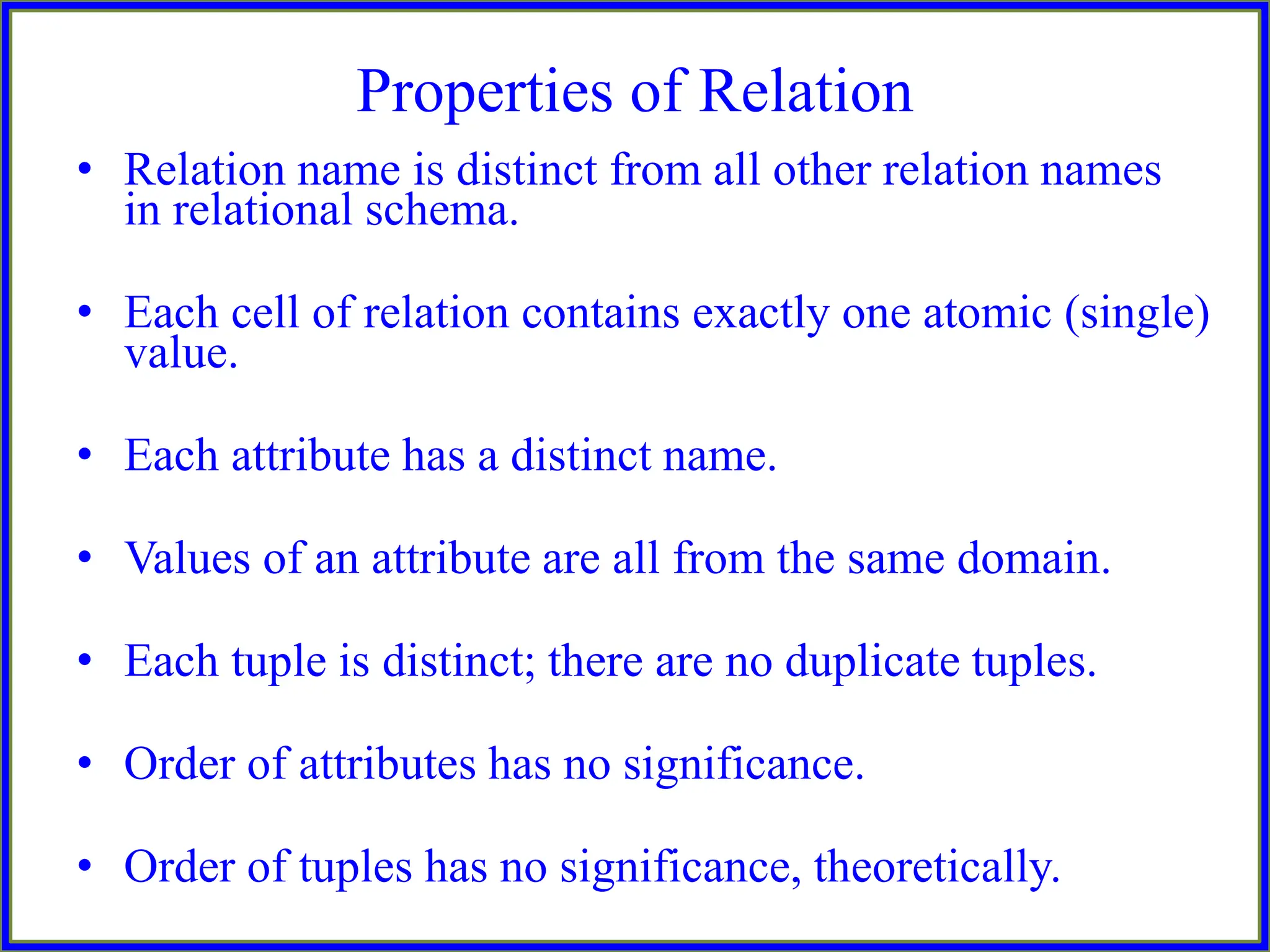
Properties of Relation
• Relation name is distinct from all other relation names
in relational schema.
• Each cell of relation contains exactly one atomic (single)
value.
• Each attribute has a distinct name.
• Values of an attribute are all from the same domain.
• Each tuple is distinct; there are no duplicate tuples.
• Order of attributes has no significance.
• Order of tuples has no significance, theoretically.
Relational Keys
• Super key
– An attribute, or a set of attributes, that uniquely identifies a
tuple within a relation.
• Candidate Key
– Super key (K) such that no proper subset is a super key within
the relation.
• Candidate key, K, for a relation R has two properties
– Uniqueness - in each tuple of R, values of K uniquely identify
that tuple.
– Irreducibility - no proper subset of K has the uniqueness
property
Relational Key
• Super key
– Uniquely identifies each entity
• STU_NUM
• STU_NUM, STU_LNAME
• STU_NUM, STU_LNAME, STU_INIT
• Candidate key
– Minimal super key
• STU_NUM
• STU_LNAME, STU_FNAME, STU_INIT, STU_PHONE
• When a key consists of more than one attribute, it is
called a composite key
Example
• Which attributes of this table can be used as a candidate
key?
• BranchNo and PostalCode can be used as candidate keys.
• City attribute cannot be used as a candidate key, because it
has duplicate values.
BranchNo Street City PostalCode
B005 22 Deer Rd London SW1 4EH
B007 16 Argyll St Aberdeen AB2 3SU
B003 163 Main St Glasgow G11 9QX
B004 32 Manse Rd Bristol BS99 1NZ
B003 56 Clover Dr London NW10 6EU
Relational Key
• Primary Key
– Candidate key selected to identify tuples uniquely within
relation.
• Alternate Keys
– Candidate keys that are not selected to be primary key.
• Foreign Key
– Attribute, or set of attributes, within one relation that matches
candidate key of some (possibly same) relation
Links to Refer
• https://youtu.be/EwEY_Y2Zz0s
• https://youtu.be/RRUeFwuJ39Q

lecture2-relationalmodelandterminology-240324190857-58c59e46.pptx

  • 1.
    UNIT 2 RELATIONAL ANDE-R MODELS[2.0- 2.2]
  • 2.
    Objectives • In thislecture, you will learn: – Some relational model terminologies – The difference between the relation schema and relational database schema – The properties of a relation – Relational keys – Views and purpose of views in relational database 2
  • 3.
    Relational Model Terminology •An entity is a person, place, event, or thing/Object for which we intend to collect data • Examples: – University -- Students, Faculty Members, Courses – Airline -- Pilots, Aircraft, Routes, Suppliers • A relation is a table with columns and rows. – Only applies to logical structure of the database, not the physical structure.
  • 4.
    Relational Model Terminology •Attribute is a named column of a relation. • Example: – Student -- Student Number, Name...etc • Domain is the set of allowable values for one or more attributes. Attribute Domain Name Meaning Domain Definition Stu_id StudentID ID of a student Character: Size 10
  • 5.
    Relational Model Terminology •Tuple is a row of a relation. • Degree is the number of attributes in a relation. • Cardinality is the number of tuples in a relation. • Relational Database – A collection of normalized relations with distinct relation names.
  • 6.
  • 7.
  • 8.
    Database Relations • Relationschema • Named relation defined by a set of attribute and domain name pairs. • Relational database schema • Set of relation schemas, each with a distinct name.
  • 9.
    Definition Summary Informal TermsFormal Terms Table Relation Column Header Attribute All possible Column Values Domain Row Tuple Table Definition Schema of a Relation Populated Table State of the Relation
  • 10.
    Relation and RelationalSchema • A relation schema is the name and the list of attributes of a relation • Example: – Grade (studentId, assignmentId, points, dateSubmitted) Relational Schema
  • 11.
    Properties of Relation •Relation name is distinct from all other relation names in relational schema. • Each cell of relation contains exactly one atomic (single) value. • Each attribute has a distinct name. • Values of an attribute are all from the same domain. • Each tuple is distinct; there are no duplicate tuples. • Order of attributes has no significance. • Order of tuples has no significance, theoretically.
  • 12.
    Relational Keys • Superkey – An attribute, or a set of attributes, that uniquely identifies a tuple within a relation. • Candidate Key – Super key (K) such that no proper subset is a super key within the relation. • Candidate key, K, for a relation R has two properties – Uniqueness - in each tuple of R, values of K uniquely identify that tuple. – Irreducibility - no proper subset of K has the uniqueness property
  • 13.
    Relational Key • Superkey – Uniquely identifies each entity • STU_NUM • STU_NUM, STU_LNAME • STU_NUM, STU_LNAME, STU_INIT • Candidate key – Minimal super key • STU_NUM • STU_LNAME, STU_FNAME, STU_INIT, STU_PHONE • When a key consists of more than one attribute, it is called a composite key
  • 14.
    Example • Which attributesof this table can be used as a candidate key? • BranchNo and PostalCode can be used as candidate keys. • City attribute cannot be used as a candidate key, because it has duplicate values. BranchNo Street City PostalCode B005 22 Deer Rd London SW1 4EH B007 16 Argyll St Aberdeen AB2 3SU B003 163 Main St Glasgow G11 9QX B004 32 Manse Rd Bristol BS99 1NZ B003 56 Clover Dr London NW10 6EU
  • 15.
    Relational Key • PrimaryKey – Candidate key selected to identify tuples uniquely within relation. • Alternate Keys – Candidate keys that are not selected to be primary key. • Foreign Key – Attribute, or set of attributes, within one relation that matches candidate key of some (possibly same) relation
  • 16.
    Links to Refer •https://youtu.be/EwEY_Y2Zz0s • https://youtu.be/RRUeFwuJ39Q

Editor's Notes

  • #4 LOGICAL STRUCTURE OF DATABASE Logical structure mainly consists of tablespace, segments, extents, and oracle data blocks TABLESPACE Each database is logically divided into one or more tablespaces. One or more datafiles are explicitly created for each tablespace to physically store the data of all logical structures in a tablespace. The combined size of the datafiles in a tablespace is the total storage capacity of the tablespace. SEGMENT A segment is a set of extents allocated for a certain logical structure. The segments can be of one of following type data segment,index segment,temporary segment,rollback segment. EXTENT The next level of logical database space is an extent. An extent is a specific number of contiguous data blocks, obtained in a single allocation, used to store a specific type of information. ORACLE DATABLOCKS At the finest level of granularity, Oracle database data is stored in data blocks. One data block corresponds to a specific number of bytes of physical database space on disk. The standard block size is specified by the DB_BLOCK_SIZE initialization parameter. In addition, you can specify up to five other block sizes.