DISTRIBUTED SYSTEMS
Principles andParadigms
Second Edition
ANDREW S. TANENBAUM
MAARTEN VAN STEEN
modified by A. Dobra and R. Newman 2012/2013
Chapter 1
Introduction
2.
What is anOperating System
An operating system is:
A collection of software components that
• Provides useful abstractions and
• Manages resources to
• Support application programs, and
• Provide an interface for users and programs
3.
Operating System Functions
Anoperating system’s main functions are to:
• Schedule processes & multiplex CPU
• Provide mechanisms for IPC and
synchronization
• Manage main memory
• Manage other resources
• Provide convenient persistent storage (files)
• Maintain system integrity, handle failures
• Enforce security policies (e.g., access control)
• Give users and processes an interface
4.
Definition of aDistributed System (1)
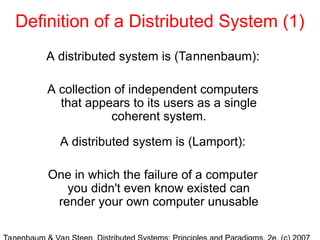
A distributed system is (Tannenbaum):
A collection of independent computers
that appears to its users as a single
coherent system.
A distributed system is (Lamport):
One in which the failure of a computer
you didn't even know existed can
render your own computer unusable
5.
Properties of DistributedSystems
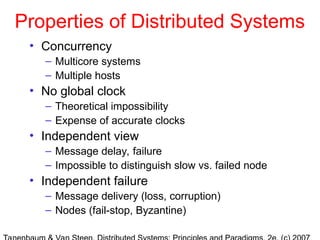
• Concurrency
– Multicore systems
– Multiple hosts
• No global clock
– Theoretical impossibility
– Expense of accurate clocks
• Independent view
– Message delay, failure
– Impossible to distinguish slow vs. failed node
• Independent failure
– Message delivery (loss, corruption)
– Nodes (fail-stop, Byzantine)
6.
Software Concepts
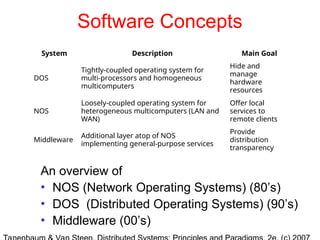
An overviewof
• NOS (Network Operating Systems) (80’s)
• DOS (Distributed Operating Systems) (90’s)
• Middleware (00’s)
System Description Main Goal
DOS
Tightly-coupled operating system for
multi-processors and homogeneous
multicomputers
Hide and
manage
hardware
resources
NOS
Loosely-coupled operating system for
heterogeneous multicomputers (LAN and
WAN)
Offer local
services to
remote clients
Middleware
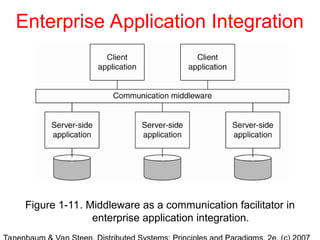
Additional layer atop of NOS
implementing general-purpose services
Provide
distribution
transparency
7.
Definition of aDistributed System (2)
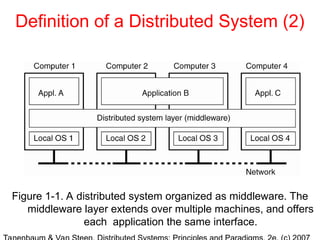
Figure 1-1. A distributed system organized as middleware. The
middleware layer extends over multiple machines, and offers
each application the same interface.
8.
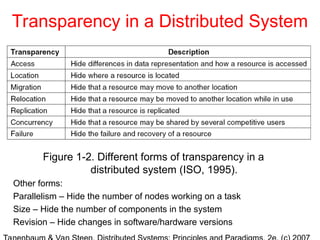
Transparency in aDistributed System
Figure 1-2. Different forms of transparency in a
distributed system (ISO, 1995).
Other forms:
Parallelism – Hide the number of nodes working on a task
Size – Hide the number of components in the system
Revision – Hide changes in software/hardware versions
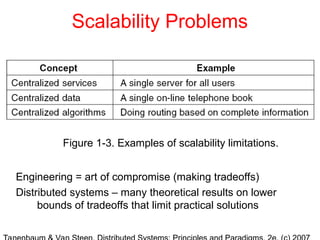
Scalability Problems
Figure 1-3.Examples of scalability limitations.
Engineering = art of compromise (making tradeoffs)
Distributed systems – many theoretical results on lower
bounds of tradeoffs that limit practical solutions
12.
Scalability Examples
Distributed systemsare ubiquitous and necessary:
• Web search
• Financial transactions
• Multiplayer games
• DNS
• Travel reservation systems
• Utility infrastructure (e.g., power grid)
• Embedded systems (e.g., cars)
• Sensor networks
Failure to scale is fatal
• Instagram – share cellphone pix
• Facebook IPO
13.
Web Search
• Googleuses thousands of machines to
– Provide search results
– Run Page-Rank algorithm
• Issues
– Connecting large number of machines
– Distributed file system (GFS)
– Indexing
– Programming model
– Scaling up when current system reaches limits
14.
Financial Transactions
Volume ishuge
• 4 million messages per second
• 50 million things you can trade
Requirements are stringent
• Low latency
• 24/7 operation (around the world)
• Failure “is not an option”
• Facebook NASDAQ Freeze
– Transaction system overwhelmed
– Hours to complete transactions in falling market
15.
Multiplayer Games
Very popular– huge market
Characteristics
• May have millions of players
• Players operate in same “world”
• Players interact with world, each other
Issues
• Number of users
• Latency, consistency
• Coordination of multiple servers
• Architecture???
16.
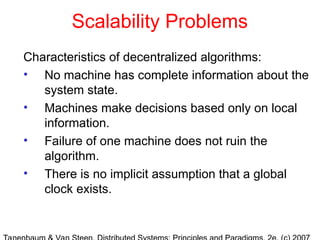
Scalability Problems
Characteristics ofdecentralized algorithms:
• No machine has complete information about the
system state.
• Machines make decisions based only on local
information.
• Failure of one machine does not ruin the
algorithm.
• There is no implicit assumption that a global
clock exists.
17.
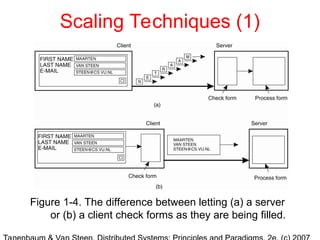
Scaling Techniques (1)
Figure1-4. The difference between letting (a) a server
or (b) a client check forms as they are being filled.
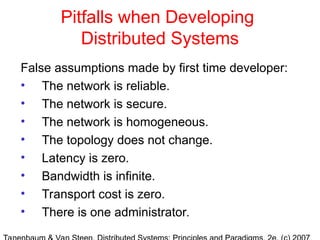
Pitfalls when Developing
DistributedSystems
False assumptions made by first time developer:
• The network is reliable.
• The network is secure.
• The network is homogeneous.
• The topology does not change.
• Latency is zero.
• Bandwidth is infinite.
• Transport cost is zero.
• There is one administrator.
20.
Multicore Systems
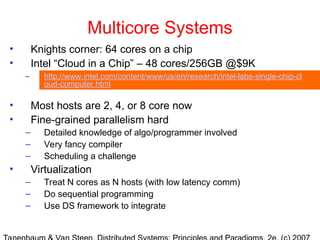
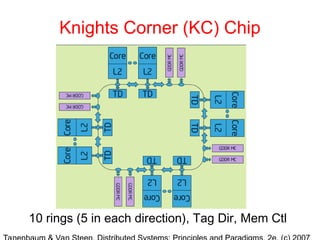
• Knightscorner: 64 cores on a chip
• Intel “Cloud in a Chip” – 48 cores/256GB @$9K
– http://www.intel.com/content/www/us/en/research/intel-labs-single-chip-cl
oud-computer.html
• Most hosts are 2, 4, or 8 core now
• Fine-grained parallelism hard
– Detailed knowledge of algo/programmer involved
– Very fancy compiler
– Scheduling a challenge
• Virtualization
– Treat N cores as N hosts (with low latency comm)
– Do sequential programming
– Use DS framework to integrate
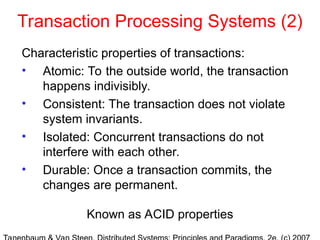
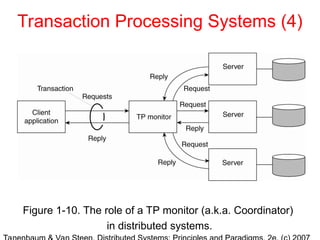
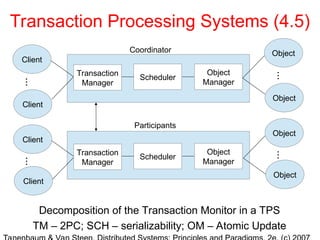
Transaction Processing Systems(2)
Characteristic properties of transactions:
• Atomic: To the outside world, the transaction
happens indivisibly.
• Consistent: The transaction does not violate
system invariants.
• Isolated: Concurrent transactions do not
interfere with each other.
• Durable: Once a transaction commits, the
changes are permanent.
Known as ACID properties
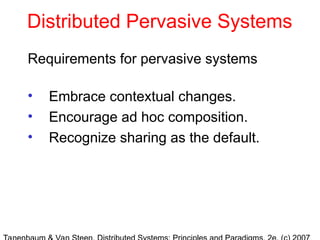
Electronic Health CareSystems (1)
Questions to be addressed for health care systems:
• Where and how should monitored data be
stored?
• How can we prevent loss of crucial data?
• What infrastructure is needed to generate and
propagate alerts?
• How can physicians provide online feedback?
• How can extreme robustness of the monitoring
system be realized?
• What are the security issues and how can the
proper policies be enforced?
33.
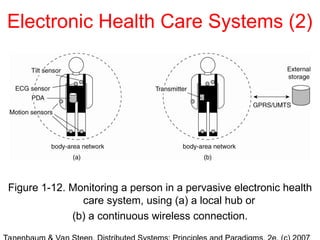
Electronic Health CareSystems (2)
Figure 1-12. Monitoring a person in a pervasive electronic health
care system, using (a) a local hub or
(b) a continuous wireless connection.
34.
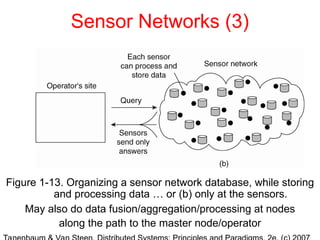
Sensor Networks (1)
Questionsconcerning sensor networks:
• How do we (dynamically) set up an
efficient tree in a sensor network?
• How does aggregation of results take
place? Can it be controlled?
• What happens when network links fail?
35.
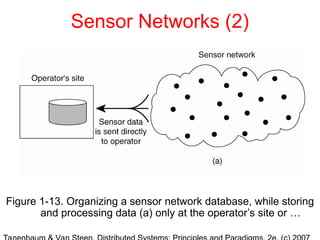
Sensor Networks (2)
Figure1-13. Organizing a sensor network database, while storing
and processing data (a) only at the operator’s site or …
36.
Sensor Networks (3)
Figure1-13. Organizing a sensor network database, while storing
and processing data … or (b) only at the sensors.
May also do data fusion/aggregation/processing at nodes
along the path to the master node/operator
37.
Some Fundamental Issues
•How do we decompose a complex
problem/task into logical/manageable
chunks?
• What is the physical architecture?
• How do we assign roles/responsibilities to
physical components?
• How do we find components (logical and
physical)?
• How do we define and maintain
consistency?