Compiled by Abdi A.
Dambi Dollo University
College Of Engineering and Technology Department of Software Engineering
Fundamental of Distributive Systems Individual Assignment
Name:Abdi Abera
ID:NSR/1951/20
Inistructor:Mr.Hachalu
Submission date:Dec:-7/12/2023
07/12/2023
Compiled by Abdi A.
1) What are the challenges in designing a distributed
system?
Distributed systems face many challenges like fault tolerance,
scalability, and availability. These challenges can be addressed by
providing a design that includes standby servers and replicating data
and services across multiple nodes.
 communication:In a distributed system,nodes need to communicate
with each other frequently.The communication needs to be reliable
and secure.Designing an effecient communication protocol that can
handle network failures and latency is a challenge.
 Consistency:maintaining consistency across all nodes in a distributed
system is a difficult task. Ensuring that all nodes have the same data at
all times requires careful design and implementation.
07/12/2023
Compiled by Abdi A.
cont...
Fault-tolerance:In a distrebuted system,nodes can fail or become
unavailable at any time.Designing a system that can tolerate such
failures and continue to function without data loss or corruption is
challenging.
Scalablity:A distributed system should be able to scale horizontally as
the number of nodes increases.Designing a system that can handle a
large number of nodes while maintaining performance is a challenge.
Security:Security is a critical concern in a distributed system.Nodes
need to authenticate each other and protect against attacks such as
denial-of-service,eavesdropping,and data tempering.
Data management:In a destributed system,data is spread across
multiple nodes.Designing a system that can efficiently manage data
storage, retrieval,and replication is challenging.
07/12/2023
Compiled by Abdi A.
2) What is a shared-nothing system?
• A shared-nothing architecture (SN) is a distributed computing
architecture in which each update request is satisfied by a single node
(processor/memory/storage unit) in a computer cluster.
• The intent is to eliminate contention among nodes. Nodes do not
share (independently access) the same memory or storage.
• Each node has its own memory,storage,and processing power,and
communicates with other nodes only through message passing.
• This archetecture is often used in large-scale web applications and
data processing systems, as it can provide high scalablity and fault
tolerance.
07/12/2023
Compiled by Abdi A.
3)What is a shared disk system?
• A shared-disk architecture (SD) is a distributed computing
architecture in which the nodes share same disk devices but each
node has its own private memory.
• The disks have active nodes which all share memory in case of any
failures.
• In this architecture the disks are accessible from all the cluster
nodes.
07/12/2023
Compiled by Abdi A.
4)What is an Autonomous system/
computing?
• More specifically, an autonomous system (AS) is a large network
or group of networks that has a unified routing policy. Every
computer or device that connects to the Internet is connected to
an AS.
• An autonomous/computing refers to a computing system or
network thet can opperate and make dicisions independently
without the need for human intervention.
• Authonomous systems are commonly used in vasious
industries,including manufacturing,transportation,healthcare,and
finance,to improve efficiency,reduce costs,and enhance safety.
07/12/2023
Compiled by Abdi A.
5)Why do we need to interconnect systems?
• Interconnection provides low latency, high availability connections
that enable companies to reliably transfer data between these assets.
Dedicated or direct interconnect provides a physical connection
between assets, maximising the security and performance of the
network while increasing cost.
• Interconnecting system is necessary to enable communication and
data exchange between different systems.
• Interconnected systems can share information,collaborate on
tasks,and streamline processes,reducing the need for manual
intervention and increasing productivity.
07/12/2023
Compiled by Abdi A.
6) Which component from the client/server architecture
provides local processing and interface to the network?
• In client-server architecture computer network in which many clients
(remote processors) request and receive service from a centralized
server (host computer).
• Client computers provide an interface to allow a computer user to
request services of the server and to display the results the server
returns.
07/12/2023
Compiled by Abdi A.
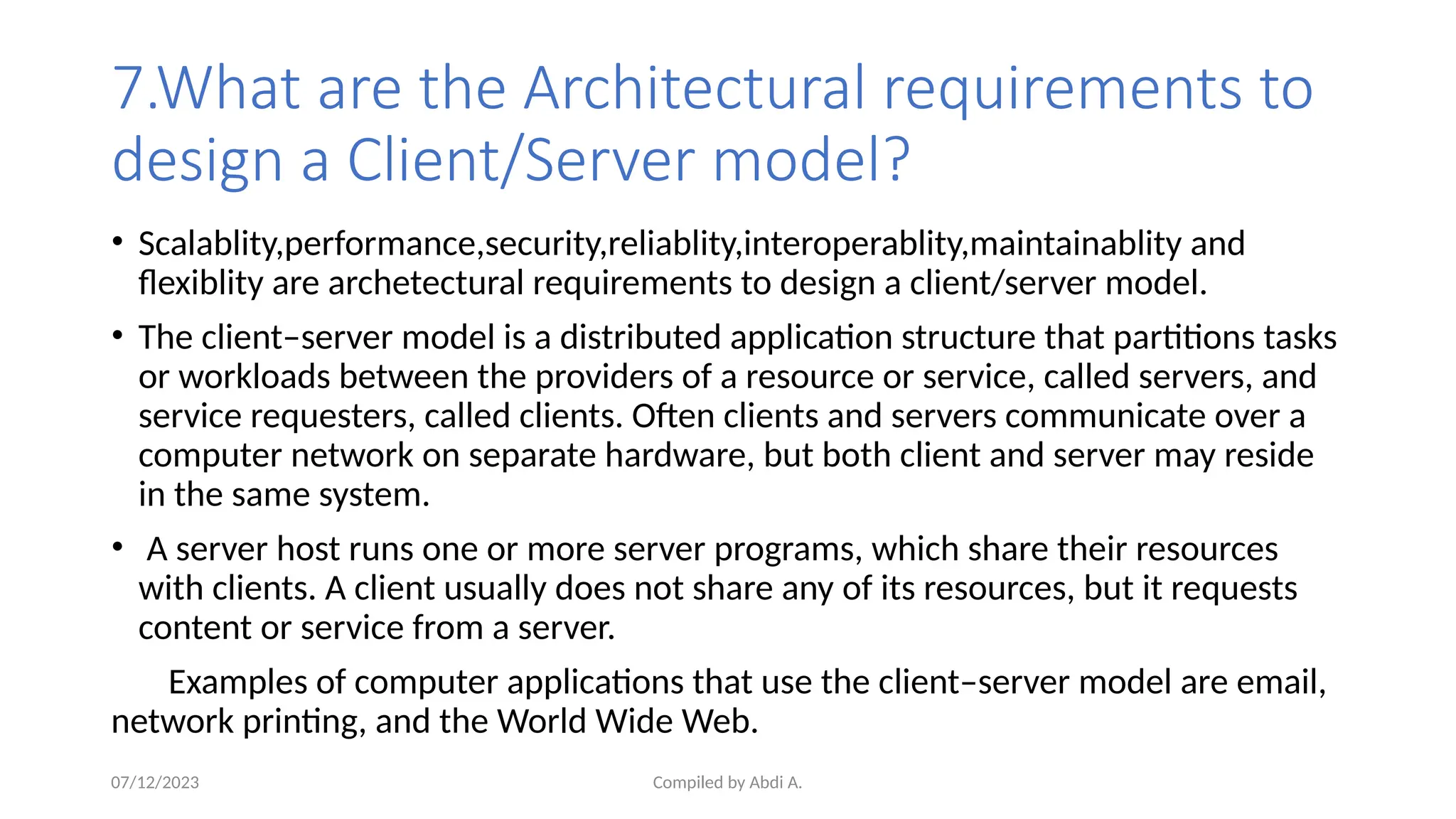
7.What are the Architectural requirements to
design a Client/Server model?
• Scalablity,performance,security,reliablity,interoperablity,maintainablity and
flexiblity are archetectural requirements to design a client/server model.
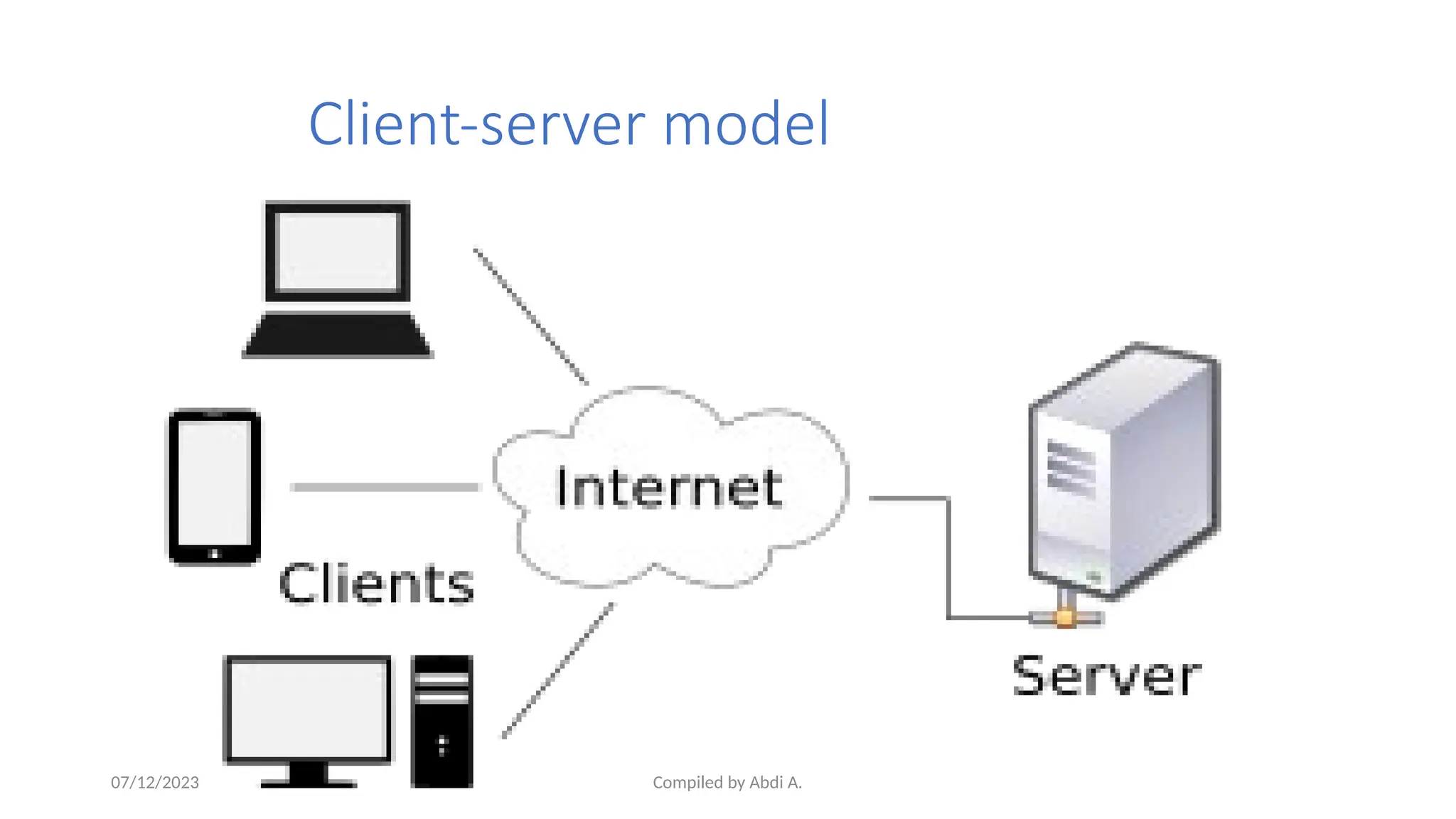
• The client–server model is a distributed application structure that partitions tasks
or workloads between the providers of a resource or service, called servers, and
service requesters, called clients. Often clients and servers communicate over a
computer network on separate hardware, but both client and server may reside
in the same system.
• A server host runs one or more server programs, which share their resources
with clients. A client usually does not share any of its resources, but it requests
content or service from a server.
Examples of computer applications that use the client–server model are email,
network printing, and the World Wide Web.
07/12/2023
Compiled by Abdi A.
Client-server model
07/12/2023
Compiled by Abdi A.
8. Define the four layers of Enterprise-IT I detail
The four leyers of Enterprice-IT are:
1.Infrastracture Layer: This layer includes the physical components of
the IT infrastracture,such as servers,storage devices,network
devices,,and data centers.
2.Platform Layer:This layer includes the software platforms and tools
used to develop,deploy and manage applications.
3.Application Layer: This layer includes the application that run on
top of the platform layer.
4.User Layer:This layer includes the end-users who interact whith
the applications and services provided by the IT infrastracture.It
includes desktops,laptops,mobile devices,and other endpoints used to
access enterprise applications and data.
07/12/2023
Compiled by Abdi A.
9. Explain Clock Synchronization in DS
• Clock synchronization in distributed systems aims to establish a
reference for time across nodes. Imagine a scenario where three
distinct systems are part of a distributed environment.
• In order for data exchange and coordinated operations to take place it
is essential that these systems have a shared understanding of time.
• Clock synchronization in distributed systems refers to the process of
ensuring that the clocks of different nodes in the system are
synchronized and accurate.
07/12/2023
Compiled by Abdi A.
10.Draw and explain client –server
architecture
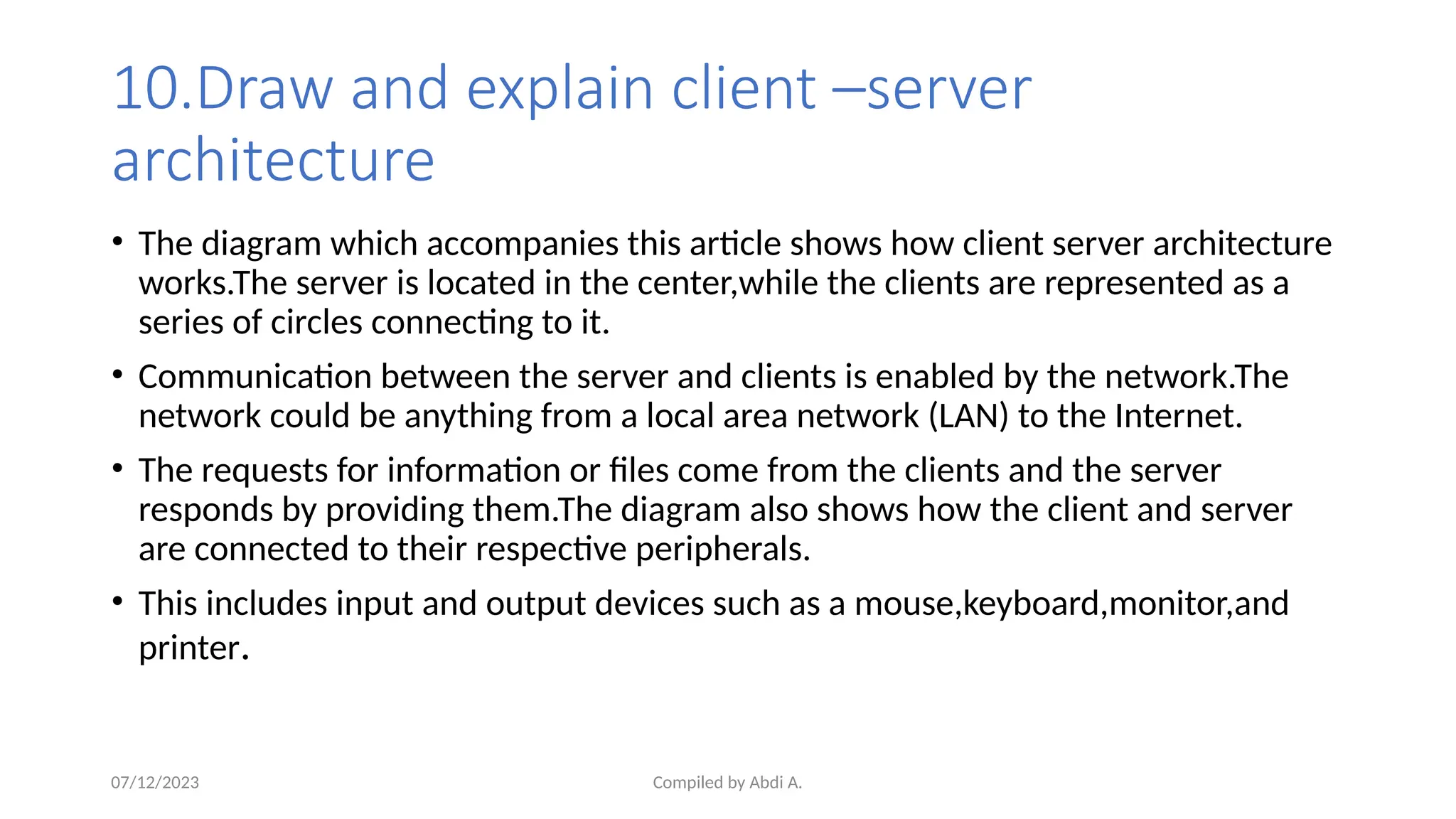
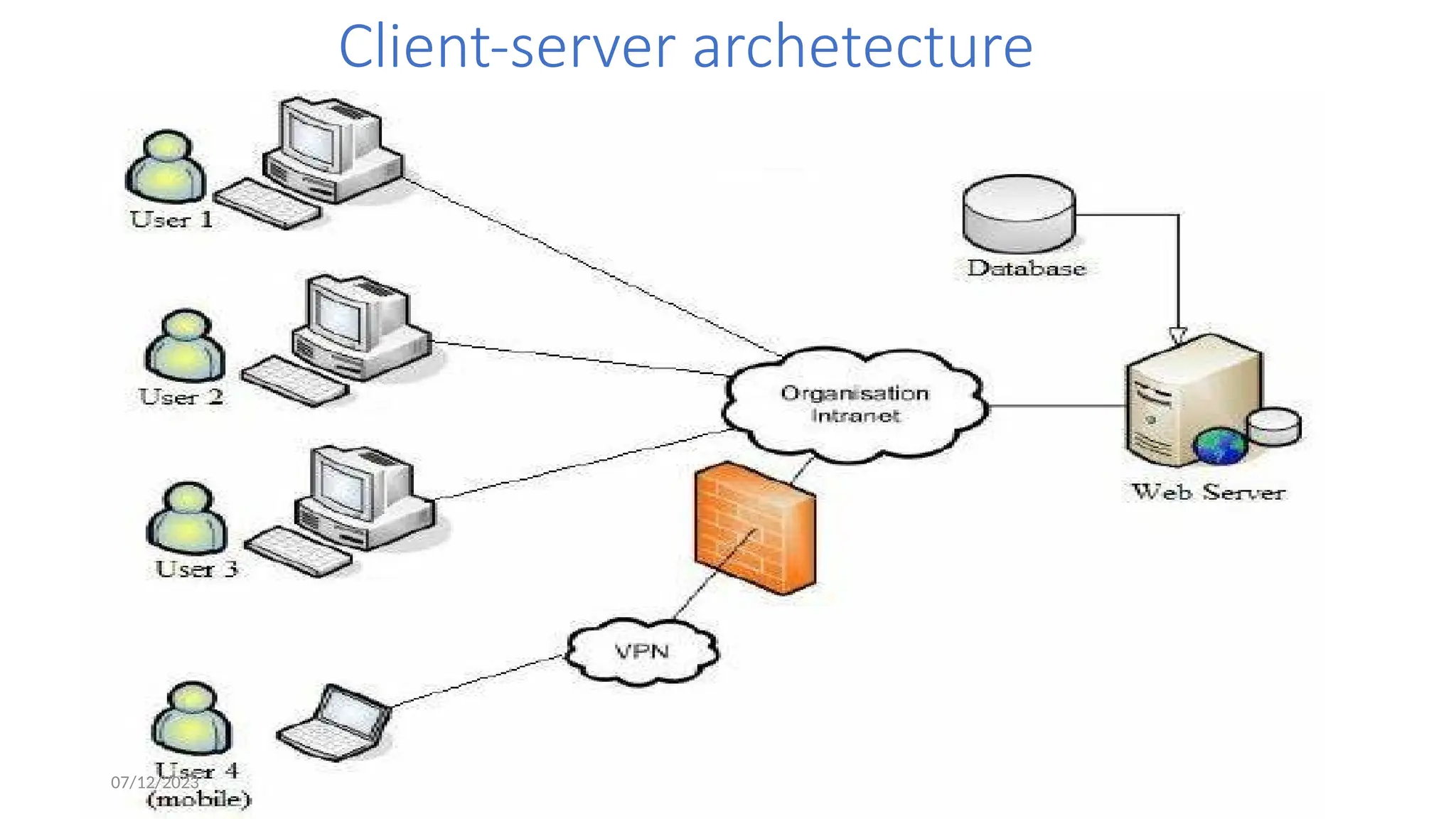
• The diagram which accompanies this article shows how client server architecture
works.The server is located in the center,while the clients are represented as a
series of circles connecting to it.
• Communication between the server and clients is enabled by the network.The
network could be anything from a local area network (LAN) to the Internet.
• The requests for information or files come from the clients and the server
responds by providing them.The diagram also shows how the client and server
are connected to their respective peripherals.
• This includes input and output devices such as a mouse,keyboard,monitor,and
printer.
07/12/2023
Compiled by Abdi A.
Client-server archetecture
07/12/2023
Compiled by Abdi A.
Thank you!!
The end!!
07/12/2023

distributed system from the real world.pptx

  • 1.
    Compiled by AbdiA. Dambi Dollo University College Of Engineering and Technology Department of Software Engineering Fundamental of Distributive Systems Individual Assignment Name:Abdi Abera ID:NSR/1951/20 Inistructor:Mr.Hachalu Submission date:Dec:-7/12/2023 07/12/2023
  • 2.
    Compiled by AbdiA. 1) What are the challenges in designing a distributed system? Distributed systems face many challenges like fault tolerance, scalability, and availability. These challenges can be addressed by providing a design that includes standby servers and replicating data and services across multiple nodes.  communication:In a distributed system,nodes need to communicate with each other frequently.The communication needs to be reliable and secure.Designing an effecient communication protocol that can handle network failures and latency is a challenge.  Consistency:maintaining consistency across all nodes in a distributed system is a difficult task. Ensuring that all nodes have the same data at all times requires careful design and implementation. 07/12/2023
  • 3.
    Compiled by AbdiA. cont... Fault-tolerance:In a distrebuted system,nodes can fail or become unavailable at any time.Designing a system that can tolerate such failures and continue to function without data loss or corruption is challenging. Scalablity:A distributed system should be able to scale horizontally as the number of nodes increases.Designing a system that can handle a large number of nodes while maintaining performance is a challenge. Security:Security is a critical concern in a distributed system.Nodes need to authenticate each other and protect against attacks such as denial-of-service,eavesdropping,and data tempering. Data management:In a destributed system,data is spread across multiple nodes.Designing a system that can efficiently manage data storage, retrieval,and replication is challenging. 07/12/2023
  • 4.
    Compiled by AbdiA. 2) What is a shared-nothing system? • A shared-nothing architecture (SN) is a distributed computing architecture in which each update request is satisfied by a single node (processor/memory/storage unit) in a computer cluster. • The intent is to eliminate contention among nodes. Nodes do not share (independently access) the same memory or storage. • Each node has its own memory,storage,and processing power,and communicates with other nodes only through message passing. • This archetecture is often used in large-scale web applications and data processing systems, as it can provide high scalablity and fault tolerance. 07/12/2023
  • 5.
    Compiled by AbdiA. 3)What is a shared disk system? • A shared-disk architecture (SD) is a distributed computing architecture in which the nodes share same disk devices but each node has its own private memory. • The disks have active nodes which all share memory in case of any failures. • In this architecture the disks are accessible from all the cluster nodes. 07/12/2023
  • 6.
    Compiled by AbdiA. 4)What is an Autonomous system/ computing? • More specifically, an autonomous system (AS) is a large network or group of networks that has a unified routing policy. Every computer or device that connects to the Internet is connected to an AS. • An autonomous/computing refers to a computing system or network thet can opperate and make dicisions independently without the need for human intervention. • Authonomous systems are commonly used in vasious industries,including manufacturing,transportation,healthcare,and finance,to improve efficiency,reduce costs,and enhance safety. 07/12/2023
  • 7.
    Compiled by AbdiA. 5)Why do we need to interconnect systems? • Interconnection provides low latency, high availability connections that enable companies to reliably transfer data between these assets. Dedicated or direct interconnect provides a physical connection between assets, maximising the security and performance of the network while increasing cost. • Interconnecting system is necessary to enable communication and data exchange between different systems. • Interconnected systems can share information,collaborate on tasks,and streamline processes,reducing the need for manual intervention and increasing productivity. 07/12/2023
  • 8.
    Compiled by AbdiA. 6) Which component from the client/server architecture provides local processing and interface to the network? • In client-server architecture computer network in which many clients (remote processors) request and receive service from a centralized server (host computer). • Client computers provide an interface to allow a computer user to request services of the server and to display the results the server returns. 07/12/2023
  • 9.
    Compiled by AbdiA. 7.What are the Architectural requirements to design a Client/Server model? • Scalablity,performance,security,reliablity,interoperablity,maintainablity and flexiblity are archetectural requirements to design a client/server model. • The client–server model is a distributed application structure that partitions tasks or workloads between the providers of a resource or service, called servers, and service requesters, called clients. Often clients and servers communicate over a computer network on separate hardware, but both client and server may reside in the same system. • A server host runs one or more server programs, which share their resources with clients. A client usually does not share any of its resources, but it requests content or service from a server. Examples of computer applications that use the client–server model are email, network printing, and the World Wide Web. 07/12/2023
  • 10.
    Compiled by AbdiA. Client-server model 07/12/2023
  • 11.
    Compiled by AbdiA. 8. Define the four layers of Enterprise-IT I detail The four leyers of Enterprice-IT are: 1.Infrastracture Layer: This layer includes the physical components of the IT infrastracture,such as servers,storage devices,network devices,,and data centers. 2.Platform Layer:This layer includes the software platforms and tools used to develop,deploy and manage applications. 3.Application Layer: This layer includes the application that run on top of the platform layer. 4.User Layer:This layer includes the end-users who interact whith the applications and services provided by the IT infrastracture.It includes desktops,laptops,mobile devices,and other endpoints used to access enterprise applications and data. 07/12/2023
  • 12.
    Compiled by AbdiA. 9. Explain Clock Synchronization in DS • Clock synchronization in distributed systems aims to establish a reference for time across nodes. Imagine a scenario where three distinct systems are part of a distributed environment. • In order for data exchange and coordinated operations to take place it is essential that these systems have a shared understanding of time. • Clock synchronization in distributed systems refers to the process of ensuring that the clocks of different nodes in the system are synchronized and accurate. 07/12/2023
  • 13.
    Compiled by AbdiA. 10.Draw and explain client –server architecture • The diagram which accompanies this article shows how client server architecture works.The server is located in the center,while the clients are represented as a series of circles connecting to it. • Communication between the server and clients is enabled by the network.The network could be anything from a local area network (LAN) to the Internet. • The requests for information or files come from the clients and the server responds by providing them.The diagram also shows how the client and server are connected to their respective peripherals. • This includes input and output devices such as a mouse,keyboard,monitor,and printer. 07/12/2023
  • 14.
    Compiled by AbdiA. Client-server archetecture 07/12/2023
  • 15.
    Compiled by AbdiA. Thank you!! The end!! 07/12/2023