CliClieenntt--sseerrvveerr ppaarraaddiigmgm
SSoocckketet PrProoggrarammmiminngg
Srinidhi Varadarajan
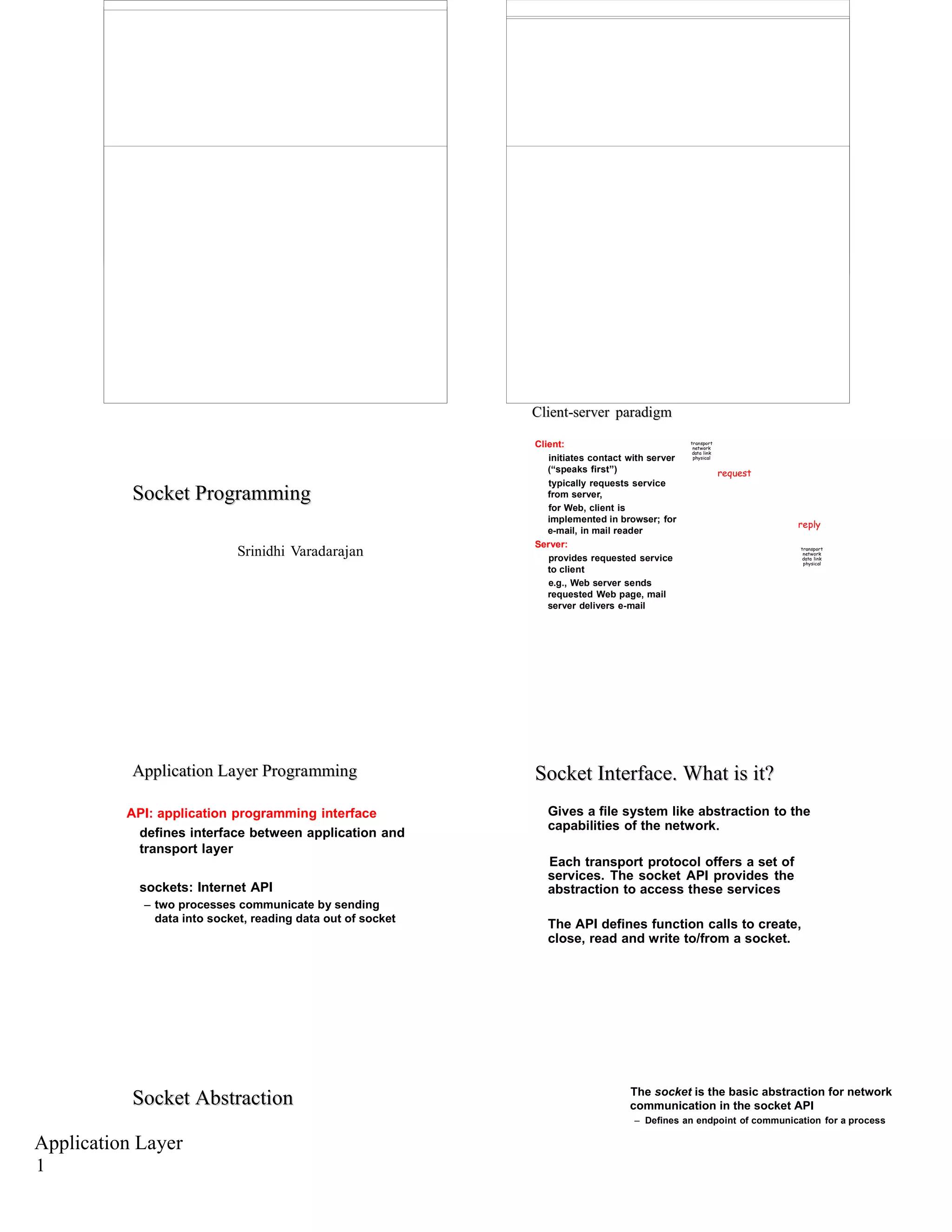
Client:
initiates contact with server
(“speaks first”)
typically requests service
from server,
for Web, client is
implemented in browser; for
e-mail, in mail reader
Server:
provides requested service
to client
e.g., Web server sends
requested Web page, mail
server delivers e-mail
application
transport
network
data link
physical
request
reply
application
transport
network
data link
physical
ApplicationApplication LLaayyerer PrProoggrarammmmiinngg
API: application programming interface
defines interface between application and
transport layer
sockets: Internet API
– two processes communicate by sending
data into socket, reading data out of socket
SSoocckketet IInnterface.terface. WWhhatat isis it?it?
Gives a file system like abstraction to the
capabilities of the network.
Each transport protocol offers a set of
services. The socket API provides the
abstraction to access these services
The API defines function calls to create,
close, read and write to/from a socket.
SSoocckketet AAbbstractistractioonn The socket is the basic abstraction for network
communication in the socket API
– Defines an endpoint of communication for a process
Application Layer
1
– Operating system maintains information about the
socket and its connection
– Application references the socket for sends, receives,
etc.
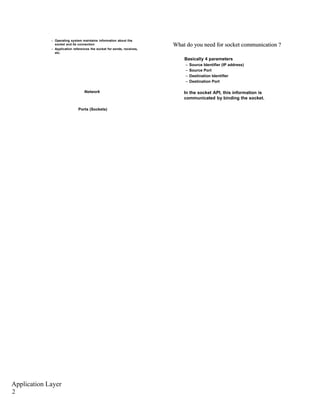
WhatWhat dodo youyou nneeeded forfor sosocckketet ccoommmmuunicationnication ??
Basically 4 parameters
– Source Identifier (IP address)
– Source Port
– Destination Identifier
– Destination Port
Process
A
Network Process
B
In the socket API, this information is
communicated by binding the socket.
Ports (Sockets)
Application Layer
2
CreatiCreatinngg aa ssoocckketet
int socket(int domain, int type, int protocol)
BiBindndiinngg aa sosocckketet
int bind (int socket, struct sockaddr *address, int addr_len)
Protocol Family:
PF_INET or
PF_UNIX
Usually
UNSPEC
This call is executed by:
– Server in TCP and UDP
Communication
semantics:
SOCK_STREAM or
SOCK_DGRAM
The call returns a integer identifier called a
handle
It binds the socket to the specified address. The
address parameter specifies the local component
of the address, e.g. IP address and UDP/TCP
port
SSoocckketet DescriDescrippttororssSSoocckketet DescriDescrippttororss
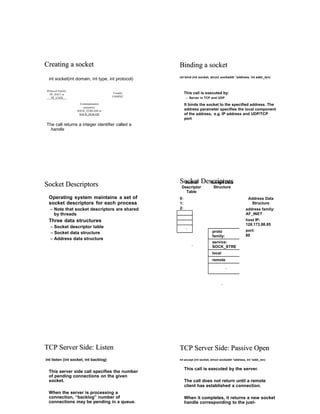
Operating system maintains a set of
socket descriptors for each process
– Note that socket descriptors are shared
by threads
Three data structures
– Socket descriptor table
– Socket data structure
– Address data structure
Socket
Descriptor
Table
0:
1:
2:
.
.
Socket Data
Structure
proto
family:
PF_INETservice:
SOCK_STRE
AMlocal
address:
remote
address:
.
.
Address Data
Structure
address family:
AF_INET
host IP:
128.173.88.85
port:
80
TCPTCP ServerServer Side:Side: LiLissttenen
int listen (int socket, int backlog)
This server side call specifies the number
of pending connections on the given
socket.
When the server is processing a
connection, “backlog” number of
connections may be pending in a queue.
TCPTCP ServerServer Side:Side: PasPasssiveive OpenOpen
int accept (int socket, struct sockaddr *address, int *addr_len)
This call is executed by the server.
The call does not return until a remote
client has established a connection.
When it completes, it returns a new socket
handle corresponding to the just-
established connection
TCTCPP CClielienntt SiSidde:e: AAccttivivee OpOpenen
int connect (int socket, struct sockaddr *address, int *addr_len)
This call is executed by the client.
*address contains the remote address.
The call attempts to connect the socket to a
server. It does not return until a connection
has been established.
When the call completes, the socket “socket”
is connected and ready for communication.
SSoocckkets:ets: SSuummmmaryary
Client:
int socket(int domain, int type, int protocol)
int connect (int socket, struct sockaddr *address, int addr_len)
Server:
int socket(int domain, int type, int protocol)
int bind (int socket, struct sockaddr *address, int addr_len)
int listen (int socket, int backlog)
int accept (int socket, struct sockaddr *address, int *addr_len)
MessageMessage PassingPassing
SSuummmmararyy ooff BasiBasicc SoSocckkeett CCaallslls
int send (int socket, char *message, int msg_len, int
flags) (TCP)
int sendto (int socket, void *msg, int len, int
CLIENT
connect()
Connect
(3-way handshake)
SERVER
new connection
accept()
int tolen ); (UDP)
int write(int socket, void *msg, int len); /* TCP */
write() read()
int recv (int socket, char *buffer, int buf_len, int
flags) (TCP)
int recvfrom(int socket, void *msg, int len, int
read() Data write()
flags, struct sockaddr *from, int
*fromlen); (UDP)
int read(int socket, void *msg, int len); (TCP)
close()
close()
NNeettwoworrkk BByyttee OrdOrderer
Network byte order is most-significant
byte first
Byte ordering at a host may differ
Utility functions
– htons(): Host-to-network byte order for a
short word (2 bytes)
– htonl(): Host-to-network byte order for a
long word (4 bytes)
– ntohs(): Network-to-host byte order for a
short word
– ntohl(): Network-to-host byte order for a
long word
SSoommee OOtthherer ““UUtitillitityy”” FFununcctitiononss
gethostname() -- get name of local host
getpeername() -- get address of remote
host
getsockname() -- get local address of
socket
getXbyY() -- get protocol, host, or service
number using known number, address, or
port, respectively
getsockopt() -- get current socket options
setsockopt() -- set socket options
ioctl() -- retrieve or set socket information
SSoommee OOtthherer ““UUtitillitityy”” FFununcctitiononss
inet_addr() -- convert “dotted”
character string form of IP address to
internal binary form
inet_ntoa() -- convert internal binary
form of IP address to “dotted”
character string form
AAdddressdress DataData StrStruuctctuurreses
struct sockaddr {
u_short sa_family; // type of address
char sa_data[14]; // value of address
}
sockaddr is a generic address structure
struct sockaddr_in {
u_short sa_family; // type of address (AF_INET)
u_short sa_port; // protocol port number
struct in_addr sin_addr; // IP address
char sin_zero[8]; // unused (set to zero)
}
sockaddr_in is specific instance for the Internet address
family

socket programming

  • 1.
    CliClieenntt--sseerrvveerr ppaarraaddiigmgm SSoocckketet PrProoggrarammmiminngg SrinidhiVaradarajan Client: initiates contact with server (“speaks first”) typically requests service from server, for Web, client is implemented in browser; for e-mail, in mail reader Server: provides requested service to client e.g., Web server sends requested Web page, mail server delivers e-mail application transport network data link physical request reply application transport network data link physical ApplicationApplication LLaayyerer PrProoggrarammmmiinngg API: application programming interface defines interface between application and transport layer sockets: Internet API – two processes communicate by sending data into socket, reading data out of socket SSoocckketet IInnterface.terface. WWhhatat isis it?it? Gives a file system like abstraction to the capabilities of the network. Each transport protocol offers a set of services. The socket API provides the abstraction to access these services The API defines function calls to create, close, read and write to/from a socket. SSoocckketet AAbbstractistractioonn The socket is the basic abstraction for network communication in the socket API – Defines an endpoint of communication for a process Application Layer 1
  • 2.
    – Operating systemmaintains information about the socket and its connection – Application references the socket for sends, receives, etc. WhatWhat dodo youyou nneeeded forfor sosocckketet ccoommmmuunicationnication ?? Basically 4 parameters – Source Identifier (IP address) – Source Port – Destination Identifier – Destination Port Process A Network Process B In the socket API, this information is communicated by binding the socket. Ports (Sockets) Application Layer 2
  • 3.
    CreatiCreatinngg aa ssoocckketet intsocket(int domain, int type, int protocol) BiBindndiinngg aa sosocckketet int bind (int socket, struct sockaddr *address, int addr_len) Protocol Family: PF_INET or PF_UNIX Usually UNSPEC This call is executed by: – Server in TCP and UDP Communication semantics: SOCK_STREAM or SOCK_DGRAM The call returns a integer identifier called a handle It binds the socket to the specified address. The address parameter specifies the local component of the address, e.g. IP address and UDP/TCP port SSoocckketet DescriDescrippttororssSSoocckketet DescriDescrippttororss Operating system maintains a set of socket descriptors for each process – Note that socket descriptors are shared by threads Three data structures – Socket descriptor table – Socket data structure – Address data structure Socket Descriptor Table 0: 1: 2: . . Socket Data Structure proto family: PF_INETservice: SOCK_STRE AMlocal address: remote address: . . Address Data Structure address family: AF_INET host IP: 128.173.88.85 port: 80 TCPTCP ServerServer Side:Side: LiLissttenen int listen (int socket, int backlog) This server side call specifies the number of pending connections on the given socket. When the server is processing a connection, “backlog” number of connections may be pending in a queue. TCPTCP ServerServer Side:Side: PasPasssiveive OpenOpen int accept (int socket, struct sockaddr *address, int *addr_len) This call is executed by the server. The call does not return until a remote client has established a connection. When it completes, it returns a new socket handle corresponding to the just-
  • 4.
  • 5.
    TCTCPP CClielienntt SiSidde:e:AAccttivivee OpOpenen int connect (int socket, struct sockaddr *address, int *addr_len) This call is executed by the client. *address contains the remote address. The call attempts to connect the socket to a server. It does not return until a connection has been established. When the call completes, the socket “socket” is connected and ready for communication. SSoocckkets:ets: SSuummmmaryary Client: int socket(int domain, int type, int protocol) int connect (int socket, struct sockaddr *address, int addr_len) Server: int socket(int domain, int type, int protocol) int bind (int socket, struct sockaddr *address, int addr_len) int listen (int socket, int backlog) int accept (int socket, struct sockaddr *address, int *addr_len) MessageMessage PassingPassing SSuummmmararyy ooff BasiBasicc SoSocckkeett CCaallslls int send (int socket, char *message, int msg_len, int flags) (TCP) int sendto (int socket, void *msg, int len, int CLIENT connect() Connect (3-way handshake) SERVER new connection accept() int tolen ); (UDP) int write(int socket, void *msg, int len); /* TCP */ write() read() int recv (int socket, char *buffer, int buf_len, int flags) (TCP) int recvfrom(int socket, void *msg, int len, int read() Data write() flags, struct sockaddr *from, int *fromlen); (UDP) int read(int socket, void *msg, int len); (TCP) close() close() NNeettwoworrkk BByyttee OrdOrderer Network byte order is most-significant byte first Byte ordering at a host may differ Utility functions – htons(): Host-to-network byte order for a short word (2 bytes) – htonl(): Host-to-network byte order for a long word (4 bytes) – ntohs(): Network-to-host byte order for a short word – ntohl(): Network-to-host byte order for a long word SSoommee OOtthherer ““UUtitillitityy”” FFununcctitiononss gethostname() -- get name of local host getpeername() -- get address of remote host getsockname() -- get local address of socket getXbyY() -- get protocol, host, or service number using known number, address, or port, respectively getsockopt() -- get current socket options setsockopt() -- set socket options ioctl() -- retrieve or set socket information
  • 6.
    SSoommee OOtthherer ““UUtitillitityy””FFununcctitiononss inet_addr() -- convert “dotted” character string form of IP address to internal binary form inet_ntoa() -- convert internal binary form of IP address to “dotted” character string form AAdddressdress DataData StrStruuctctuurreses struct sockaddr { u_short sa_family; // type of address char sa_data[14]; // value of address } sockaddr is a generic address structure struct sockaddr_in { u_short sa_family; // type of address (AF_INET) u_short sa_port; // protocol port number struct in_addr sin_addr; // IP address char sin_zero[8]; // unused (set to zero)
  • 7.
    } sockaddr_in is specificinstance for the Internet address family