Español I – Sr. Johnston
el quince de mayo del 2013
Copyright © 2008 Vista Higher Learning. All rights reserved.
4.3-
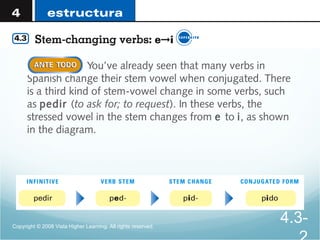
You’ve already seen that many verbs in
Spanish change their stem vowel when conjugated. There
is a third kind of stem-vowel change in some verbs, such
as pedir (to ask for; to request). In these verbs, the
stressed vowel in the stem changes from e to i, as shown
in the diagram.
Copyright © 2008 Vista Higher Learning. All rights reserved.
4.3-
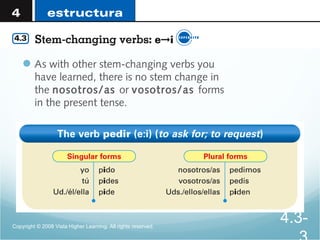
As with other stem-changing verbs you
have learned, there is no stem change in
the nosotros/as or vosotros/as forms
in the present tense.
Copyright © 2008 Vista Higher Learning. All rights reserved.
4.3-
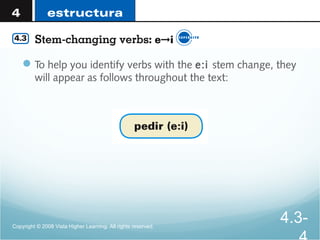
To help you identify verbs with the e:i stem change, they
will appear as follows throughout the text:
Copyright © 2008 Vista Higher Learning. All rights reserved.
4.3-
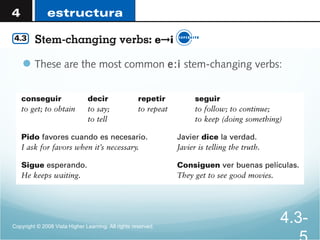
These are the most common e:i stem-changing verbs:
Copyright © 2008 Vista Higher Learning. All rights reserved.
4.3-
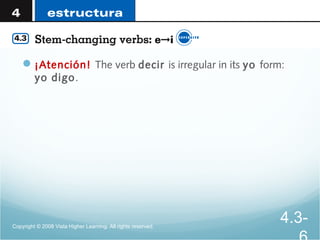
¡Atención! The verb decir is irregular in its yo form:
yo digo.
Copyright © 2008 Vista Higher Learning. All rights reserved.
4.3-
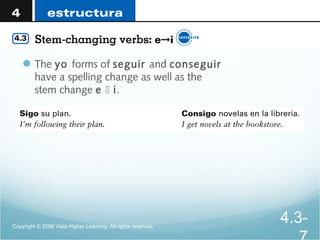
The yo forms of seguir and conseguir
have a spelling change as well as the
stem change e  i.
Copyright © 2008 Vista Higher Learning. All rights reserved.
4.3-
Copyright © 2008 Vista Higher Learning. All rights reserved.
4.3-
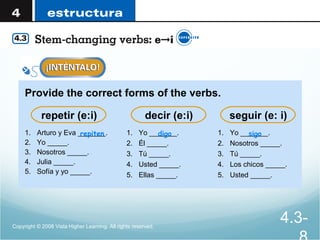
Provide the correct forms of the verbs.
1. Arturo y Eva _______.
2. Yo _____.
3. Nosotros _____.
4. Julia _____.
5. Sofía y yo _____.
1. Yo _______.
2. Él _____.
3. Tú _____.
4. Usted _____.
5. Ellas _____.
1. Yo _______.
2. Nosotros _____.
3. Tú _____.
4. Los chicos _____.
5. Usted _____.
repiten sigo
seguir (e: i)repetir (e:i) decir (e:i)
digo

5 15 13 leccion

  • 1.
    Español I –Sr. Johnston el quince de mayo del 2013 Copyright © 2008 Vista Higher Learning. All rights reserved. 4.3-
  • 2.
    You’ve already seenthat many verbs in Spanish change their stem vowel when conjugated. There is a third kind of stem-vowel change in some verbs, such as pedir (to ask for; to request). In these verbs, the stressed vowel in the stem changes from e to i, as shown in the diagram. Copyright © 2008 Vista Higher Learning. All rights reserved. 4.3-
  • 3.
    As with otherstem-changing verbs you have learned, there is no stem change in the nosotros/as or vosotros/as forms in the present tense. Copyright © 2008 Vista Higher Learning. All rights reserved. 4.3-
  • 4.
    To help youidentify verbs with the e:i stem change, they will appear as follows throughout the text: Copyright © 2008 Vista Higher Learning. All rights reserved. 4.3-
  • 5.
    These are themost common e:i stem-changing verbs: Copyright © 2008 Vista Higher Learning. All rights reserved. 4.3-
  • 6.
    ¡Atención! The verbdecir is irregular in its yo form: yo digo. Copyright © 2008 Vista Higher Learning. All rights reserved. 4.3-
  • 7.
    The yo formsof seguir and conseguir have a spelling change as well as the stem change e  i. Copyright © 2008 Vista Higher Learning. All rights reserved. 4.3-
  • 8.
    Copyright © 2008Vista Higher Learning. All rights reserved. 4.3- Provide the correct forms of the verbs. 1. Arturo y Eva _______. 2. Yo _____. 3. Nosotros _____. 4. Julia _____. 5. Sofía y yo _____. 1. Yo _______. 2. Él _____. 3. Tú _____. 4. Usted _____. 5. Ellas _____. 1. Yo _______. 2. Nosotros _____. 3. Tú _____. 4. Los chicos _____. 5. Usted _____. repiten sigo seguir (e: i)repetir (e:i) decir (e:i) digo