BCCC Tutoring Center
1
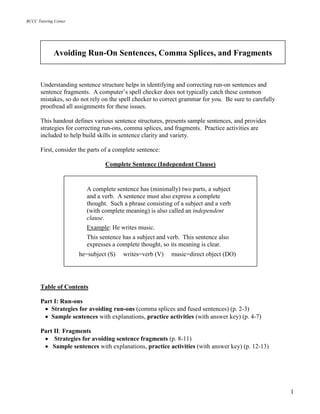
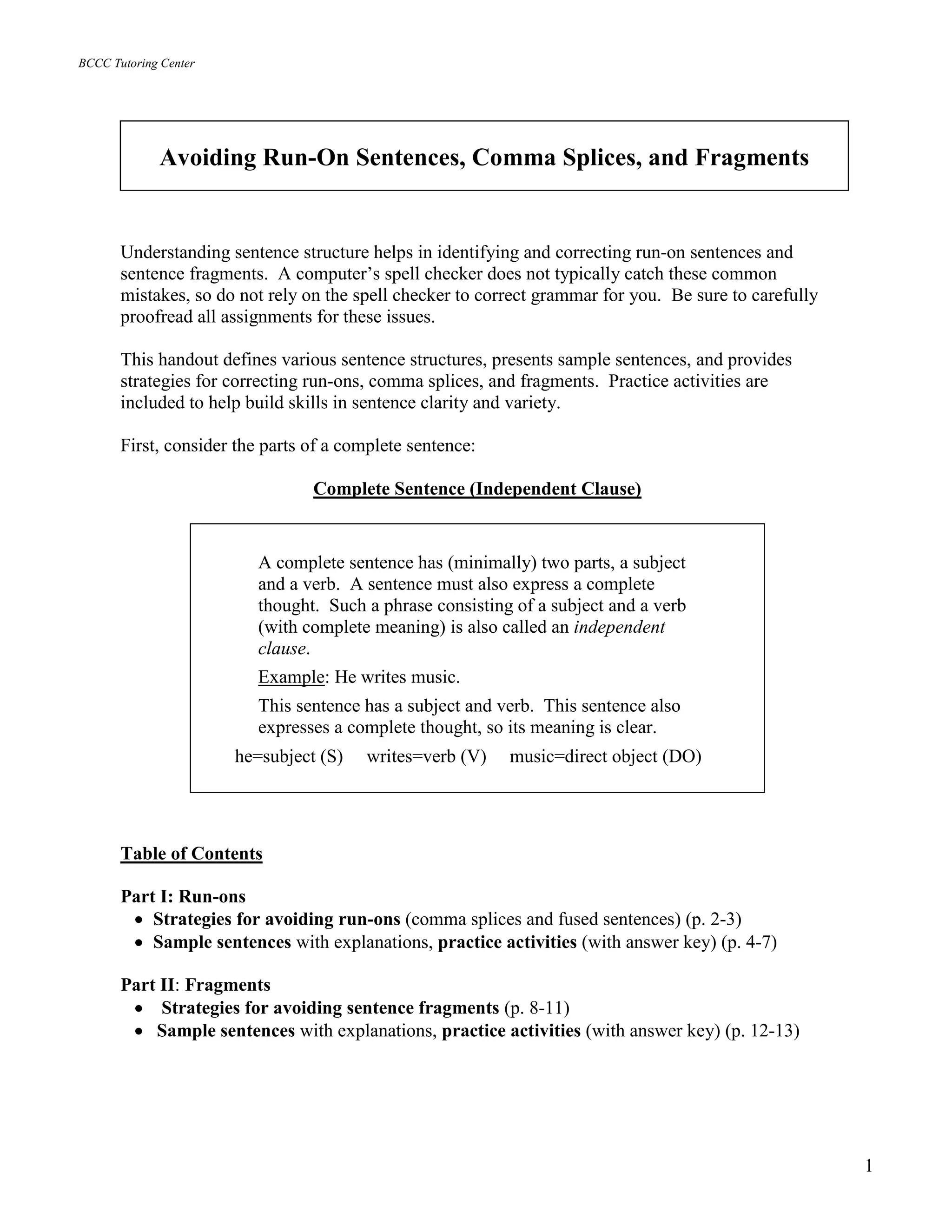
Understanding sentence structure helps in identifying and correcting run-on sentences and
sentence fragments. A computer’s spell checker does not typically catch these common
mistakes, so do not rely on the spell checker to correct grammar for you. Be sure to carefully
proofread all assignments for these issues.
This handout defines various sentence structures, presents sample sentences, and provides
strategies for correcting run-ons, comma splices, and fragments. Practice activities are
included to help build skills in sentence clarity and variety.
First, consider the parts of a complete sentence:
Complete Sentence (Independent Clause)
Table of Contents
Part I: Run-ons
Strategies for avoiding run-ons (comma splices and fused sentences) (p. 2-3)
Sample sentences with explanations, practice activities (with answer key) (p. 4-7)
Part II: Fragments
Strategies for avoiding sentence fragments (p. 8-11)
Sample sentences with explanations, practice activities (with answer key) (p. 12-13)
Avoiding Run-On Sentences, Comma Splices, and Fragments
A complete sentence has (minimally) two parts, a subject
and a verb. A sentence must also express a complete
thought. Such a phrase consisting of a subject and a verb
(with complete meaning) is also called an independent
clause.
Example: He writes music.
This sentence has a subject and verb. This sentence also
expresses a complete thought, so its meaning is clear.
he=subject (S) writes=verb (V) music=direct object (DO)
BCCC Tutoring Center
2
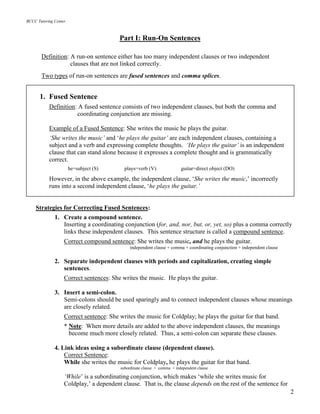
Part I: Run-On Sentences
Definition: A run-on sentence either has too many independent clauses or two independent
clauses that are not linked correctly.
Two types of run-on sentences are fused sentences and comma splices.
Strategies for Correcting Fused Sentences:
1. Create a compound sentence.
Inserting a coordinating conjunction (for, and, nor, but, or, yet, so) plus a comma correctly
links these independent clauses. This sentence structure is called a compound sentence.
Correct compound sentence: She writes the music, and he plays the guitar.
independent clause + comma + coordinating conjunction + independent clause
2. Separate independent clauses with periods and capitalization, creating simple
sentences.
Correct sentences: She writes the music. He plays the guitar.
3. Insert a semi-colon.
Semi-colons should be used sparingly and to connect independent clauses whose meanings
are closely related.
Correct sentence: She writes the music for Coldplay; he plays the guitar for that band.
* Note: When more details are added to the above independent clauses, the meanings
become much more closely related. Thus, a semi-colon can separate these clauses.
4. Link ideas using a subordinate clause (dependent clause).
Correct Sentence:
While she writes the music for Coldplay, he plays the guitar for that band.
subordinate clause + comma + independent clause
‘While’ is a subordinating conjunction, which makes ‘while she writes music for
Coldplay,’ a dependent clause. That is, the clause depends on the rest of the sentence for
1. Fused Sentence
Definition: A fused sentence consists of two independent clauses, but both the comma and
coordinating conjunction are missing.
Example of a Fused Sentence: She writes the music he plays the guitar.
‘She writes the music’ and ‘he plays the guitar’ are each independent clauses, containing a
subject and a verb and expressing complete thoughts. ‘He plays the guitar’ is an independent
clause that can stand alone because it expresses a complete thought and is grammatically
correct.
he=subject (S) plays=verb (V) guitar=direct object (DO)
However, in the above example, the independent clause, ‘She writes the music,’ incorrectly
runs into a second independent clause, ‘he plays the guitar.’
BCCC Tutoring Center
3
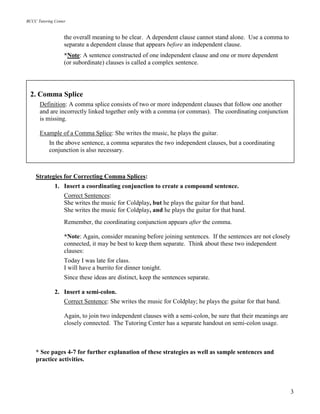
the overall meaning to be clear. A dependent clause cannot stand alone. Use a comma to
separate a dependent clause that appears before an independent clause.
*Note: A sentence constructed of one independent clause and one or more dependent
(or subordinate) clauses is called a complex sentence.
Strategies for Correcting Comma Splices:
1. Insert a coordinating conjunction to create a compound sentence.
Correct Sentences:
She writes the music for Coldplay, but he plays the guitar for that band.
She writes the music for Coldplay, and he plays the guitar for that band.
Remember, the coordinating conjunction appears after the comma.
*Note: Again, consider meaning before joining sentences. If the sentences are not closely
connected, it may be best to keep them separate. Think about these two independent
clauses:
Today I was late for class.
I will have a burrito for dinner tonight.
Since these ideas are distinct, keep the sentences separate.
2. Insert a semi-colon.
Correct Sentence: She writes the music for Coldplay; he plays the guitar for that band.
Again, to join two independent clauses with a semi-colon, be sure that their meanings are
closely connected. The Tutoring Center has a separate handout on semi-colon usage.
* See pages 4-7 for further explanation of these strategies as well as sample sentences and
practice activities.
2. Comma Splice
Definition: A comma splice consists of two or more independent clauses that follow one another
and are incorrectly linked together only with a comma (or commas). The coordinating conjunction
is missing.
Example of a Comma Splice: She writes the music, he plays the guitar.
In the above sentence, a comma separates the two independent clauses, but a coordinating
conjunction is also necessary.
BCCC Tutoring Center
4
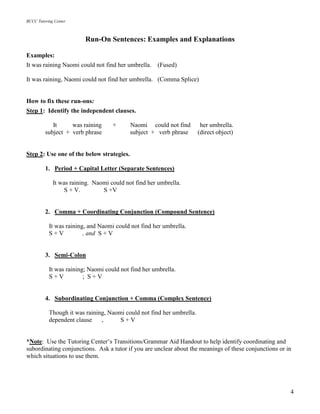
Run-On Sentences: Examples and Explanations
Examples:
It was raining Naomi could not find her umbrella. (Fused)
It was raining, Naomi could not find her umbrella. (Comma Splice)
How to fix these run-ons:
Step 1: Identify the independent clauses.
It was raining + Naomi could not find her umbrella.
subject + verb phrase subject + verb phrase (direct object)
Step 2: Use one of the below strategies.
1. Period + Capital Letter (Separate Sentences)
It was raining. Naomi could not find her umbrella.
S + V. S +V
2. Comma + Coordinating Conjunction (Compound Sentence)
It was raining, and Naomi could not find her umbrella.
S + V , and S + V
3. Semi-Colon
It was raining; Naomi could not find her umbrella.
S + V ; S + V
4. Subordinating Conjunction + Comma (Complex Sentence)
Though it was raining, Naomi could not find her umbrella.
dependent clause , S + V
*Note: Use the Tutoring Center’s Transitions/Grammar Aid Handout to help identify coordinating and
subordinating conjunctions. Ask a tutor if you are unclear about the meanings of these conjunctions or in
which situations to use them.
BCCC Tutoring Center
5
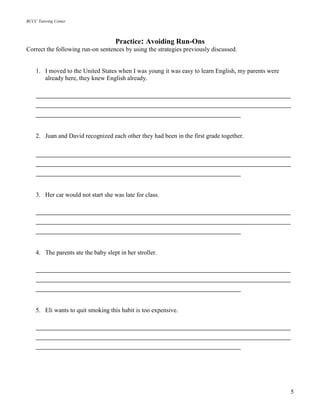
Practice: Avoiding Run-Ons
Correct the following run-on sentences by using the strategies previously discussed.
1. I moved to the United States when I was young it was easy to learn English, my parents were
already here, they knew English already.
_____________________________________________________________
_____________________________________________________________
_________________________________________________
2. Juan and David recognized each other they had been in the first grade together.
_____________________________________________________________
_____________________________________________________________
_________________________________________________
3. Her car would not start she was late for class.
_____________________________________________________________
_____________________________________________________________
_________________________________________________
4. The parents ate the baby slept in her stroller.
_____________________________________________________________
_____________________________________________________________
_________________________________________________
5. Eli wants to quit smoking this habit is too expensive.
_____________________________________________________________
_____________________________________________________________
_________________________________________________
BCCC Tutoring Center
6
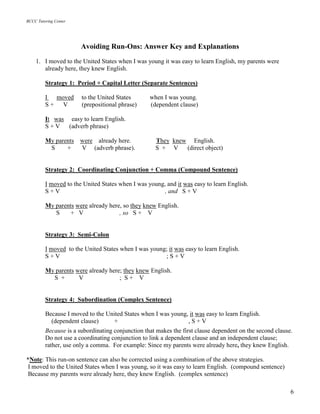
Avoiding Run-Ons: Answer Key and Explanations
1. I moved to the United States when I was young it was easy to learn English, my parents were
already here, they knew English.
Strategy 1: Period + Capital Letter (Separate Sentences)
I moved to the United States when I was young.
S + V (prepositional phrase) (dependent clause)
It was easy to learn English.
S + V (adverb phrase)
My parents were already here. They knew English.
S + V (adverb phrase). S + V (direct object)
Strategy 2: Coordinating Conjunction + Comma (Compound Sentence)
I moved to the United States when I was young, and it was easy to learn English.
S + V , and S + V
My parents were already here, so they knew English.
S + V , so S + V
Strategy 3: Semi-Colon
I moved to the United States when I was young; it was easy to learn English.
S + V ; S + V
My parents were already here; they knew English.
S + V ; S + V
Strategy 4: Subordination (Complex Sentence)
Because I moved to the United States when I was young, it was easy to learn English.
(dependent clause) + , S + V
Because is a subordinating conjunction that makes the first clause dependent on the second clause.
Do not use a coordinating conjunction to link a dependent clause and an independent clause;
rather, use only a comma. For example: Since my parents were already here, they knew English.
*Note: This run-on sentence can also be corrected using a combination of the above strategies.
I moved to the United States when I was young, so it was easy to learn English. (compound sentence)
Because my parents were already here, they knew English. (complex sentence)
BCCC Tutoring Center
7
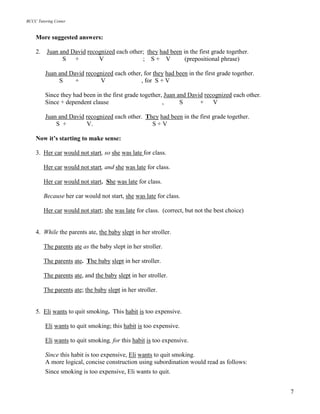
More suggested answers:
2. Juan and David recognized each other; they had been in the first grade together.
S + V ; S + V (prepositional phrase)
Juan and David recognized each other, for they had been in the first grade together.
S + V , for S + V
Since they had been in the first grade together, Juan and David recognized each other.
Since + dependent clause , S + V
Juan and David recognized each other. They had been in the first grade together.
S + V. S + V
Now it’s starting to make sense:
3. Her car would not start, so she was late for class.
Her car would not start, and she was late for class.
Her car would not start. She was late for class.
Because her car would not start, she was late for class.
Her car would not start; she was late for class. (correct, but not the best choice)
4. While the parents ate, the baby slept in her stroller.
The parents ate as the baby slept in her stroller.
The parents ate. The baby slept in her stroller.
The parents ate, and the baby slept in her stroller.
The parents ate; the baby slept in her stroller.
5. Eli wants to quit smoking. This habit is too expensive.
Eli wants to quit smoking; this habit is too expensive.
Eli wants to quit smoking, for this habit is too expensive.
Since this habit is too expensive, Eli wants to quit smoking.
A more logical, concise construction using subordination would read as follows:
Since smoking is too expensive, Eli wants to quit.
BCCC Tutoring Center
8
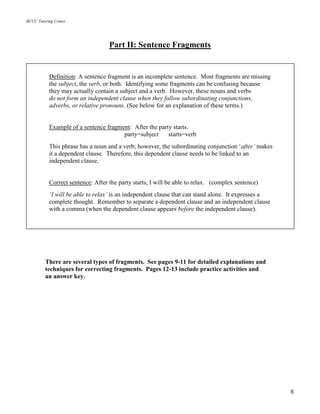
Part II: Sentence Fragments
There are several types of fragments. See pages 9-11 for detailed explanations and
techniques for correcting fragments. Pages 12-13 include practice activities and
an answer key.
Definition: A sentence fragment is an incomplete sentence. Most fragments are missing
the subject, the verb, or both. Identifying some fragments can be confusing because
they may actually contain a subject and a verb. However, these nouns and verbs
do not form an independent clause when they follow subordinating conjunctions,
adverbs, or relative pronouns. (See below for an explanation of these terms.)
Example of a sentence fragment: After the party starts.
party=subject starts=verb
This phrase has a noun and a verb; however, the subordinating conjunction ‘after’ makes
it a dependent clause. Therefore, this dependent clause needs to be linked to an
independent clause.
Correct sentence: After the party starts, I will be able to relax. (complex sentence)
‘I will be able to relax’ is an independent clause that can stand alone. It expresses a
complete thought. Remember to separate a dependent clause and an independent clause
with a comma (when the dependent clause appears before the independent clause).
BCCC Tutoring Center
9
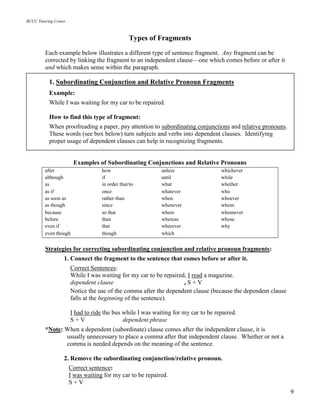
Types of Fragments
Each example below illustrates a different type of sentence fragment. Any fragment can be
corrected by linking the fragment to an independent clause—one which comes before or after it
and which makes sense within the paragraph.
Examples of Subordinating Conjunctions and Relative Pronouns
after how unless whichever
although if until while
as in order that/to what whether
as if once whatever who
as soon as rather than when whoever
as though since whenever whom
because so that where whomever
before than whereas whose
even if that wherever why
even though though which
Strategies for correcting subordinating conjunction and relative pronoun fragments:
1. Connect the fragment to the sentence that comes before or after it.
Correct Sentences:
While I was waiting for my car to be repaired, I read a magazine.
dependent clause , S + V
Notice the use of the comma after the dependent clause (because the dependent clause
falls at the beginning of the sentence).
I had to ride the bus while I was waiting for my car to be repaired.
S + V dependent phrase
*Note: When a dependent (subordinate) clause comes after the independent clause, it is
usually unnecessary to place a comma after that independent clause. Whether or not a
comma is needed depends on the meaning of the sentence.
2. Remove the subordinating conjunction/relative pronoun.
Correct sentence:
I was waiting for my car to be repaired.
S + V
1. Subordinating Conjunction and Relative Pronoun Fragments
Example:
While I was waiting for my car to be repaired.
How to find this type of fragment:
When proofreading a paper, pay attention to subordinating conjunctions and relative pronouns.
These words (see box below) turn subjects and verbs into dependent clauses. Identifying
proper usage of dependent clauses can help in recognizing fragments.
BCCC Tutoring Center
10
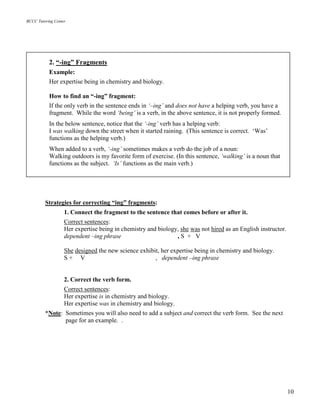
Strategies for correcting “ing” fragments:
1. Connect the fragment to the sentence that comes before or after it.
Correct sentences:
Her expertise being in chemistry and biology, she was not hired as an English instructor.
dependent –ing phrase , S + V
She designed the new science exhibit, her expertise being in chemistry and biology.
S + V , dependent –ing phrase
2. Correct the verb form.
Correct sentences:
Her expertise is in chemistry and biology.
Her expertise was in chemistry and biology.
*Note: Sometimes you will also need to add a subject and correct the verb form. See the next
page for an example. .
2. “-ing” Fragments
Example:
Her expertise being in chemistry and biology.
How to find an “-ing” fragment:
If the only verb in the sentence ends in ‘–ing’ and does not have a helping verb, you have a
fragment. While the word ‘being’ is a verb, in the above sentence, it is not properly formed.
In the below sentence, notice that the ‘-ing’ verb has a helping verb:
I was walking down the street when it started raining. (This sentence is correct. ‘Was’
functions as the helping verb.)
When added to a verb, ‘-ing’ sometimes makes a verb do the job of a noun:
Walking outdoors is my favorite form of exercise. (In this sentence, ‘walking’ is a noun that
functions as the subject. ‘Is’ functions as the main verb.)
BCCC Tutoring Center
11
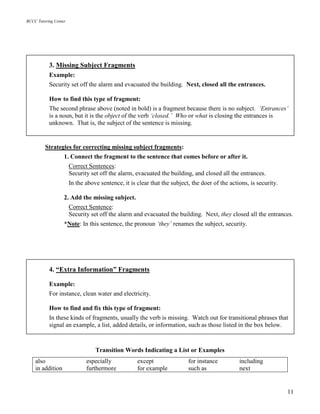
Strategies for correcting missing subject fragments:
1. Connect the fragment to the sentence that comes before or after it.
Correct Sentences:
Security set off the alarm, evacuated the building, and closed all the entrances.
In the above sentence, it is clear that the subject, the doer of the actions, is security.
2. Add the missing subject.
Correct Sentence:
Security set off the alarm and evacuated the building. Next, they closed all the entrances.
*Note: In this sentence, the pronoun ‘they’ renames the subject, security.
Transition Words Indicating a List or Examples
also especially except for instance including
in addition furthermore for example such as next
4. “Extra Information” Fragments
Example:
For instance, clean water and electricity.
How to find and fix this type of fragment:
In these kinds of fragments, usually the verb is missing. Watch out for transitional phrases that
signal an example, a list, added details, or information, such as those listed in the box below.
3. Missing Subject Fragments
Example:
Security set off the alarm and evacuated the building. Next, closed all the entrances.
How to find this type of fragment:
The second phrase above (noted in bold) is a fragment because there is no subject. ‘Entrances’
is a noun, but it is the object of the verb ‘closed.’ Who or what is closing the entrances is
unknown. That is, the subject of the sentence is missing.
BCCC Tutoring Center
12
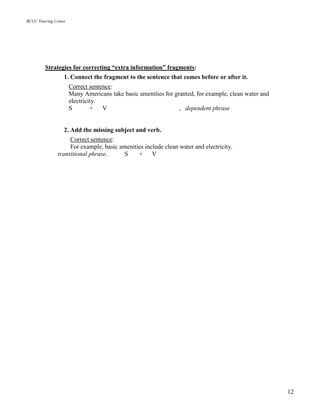
Strategies for correcting “extra information” fragments:
1. Connect the fragment to the sentence that comes before or after it.
Correct sentence:
Many Americans take basic amenities for granted, for example, clean water and
electricity.
S + V , dependent phrase
2. Add the missing subject and verb.
Correct sentence:
For example, basic amenities include clean water and electricity.
transitional phrase, S + V
BCCC Tutoring Center
13
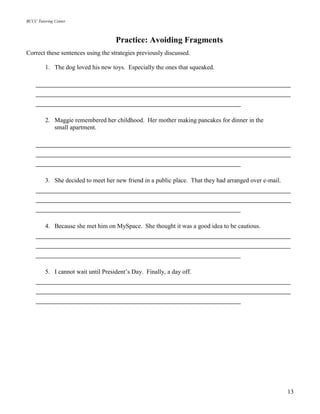
Practice: Avoiding Fragments
Correct these sentences using the strategies previously discussed.
1. The dog loved his new toys. Especially the ones that squeaked.
_____________________________________________________________
_____________________________________________________________
_________________________________________________
2. Maggie remembered her childhood. Her mother making pancakes for dinner in the
small apartment.
_____________________________________________________________
_____________________________________________________________
_________________________________________________
3. She decided to meet her new friend in a public place. That they had arranged over e-mail.
_____________________________________________________________
_____________________________________________________________
_________________________________________________
4. Because she met him on MySpace. She thought it was a good idea to be cautious.
_____________________________________________________________
_____________________________________________________________
_________________________________________________
5. I cannot wait until President’s Day. Finally, a day off.
_____________________________________________________________
_____________________________________________________________
_________________________________________________
BCCC Tutoring Center
14
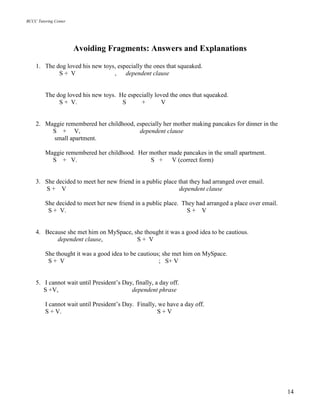
Avoiding Fragments: Answers and Explanations
1. The dog loved his new toys, especially the ones that squeaked.
S + V , dependent clause
The dog loved his new toys. He especially loved the ones that squeaked.
S + V. S + V
2. Maggie remembered her childhood, especially her mother making pancakes for dinner in the
S + V, dependent clause
small apartment.
Maggie remembered her childhood. Her mother made pancakes in the small apartment.
S + V. S + V (correct form)
3. She decided to meet her new friend in a public place that they had arranged over email.
S + V dependent clause
She decided to meet her new friend in a public place. They had arranged a place over email.
S + V. S + V
4. Because she met him on MySpace, she thought it was a good idea to be cautious.
dependent clause, S + V
She thought it was a good idea to be cautious; she met him on MySpace.
S + V ; S+ V
5. I cannot wait until President’s Day, finally, a day off.
S +V, dependent phrase
I cannot wait until President’s Day. Finally, we have a day off.
S + V. S + V

Avoiding run onscommasplicesfragmentsjuly08

  • 1.
    BCCC Tutoring Center 1 Understandingsentence structure helps in identifying and correcting run-on sentences and sentence fragments. A computer’s spell checker does not typically catch these common mistakes, so do not rely on the spell checker to correct grammar for you. Be sure to carefully proofread all assignments for these issues. This handout defines various sentence structures, presents sample sentences, and provides strategies for correcting run-ons, comma splices, and fragments. Practice activities are included to help build skills in sentence clarity and variety. First, consider the parts of a complete sentence: Complete Sentence (Independent Clause) Table of Contents Part I: Run-ons Strategies for avoiding run-ons (comma splices and fused sentences) (p. 2-3) Sample sentences with explanations, practice activities (with answer key) (p. 4-7) Part II: Fragments Strategies for avoiding sentence fragments (p. 8-11) Sample sentences with explanations, practice activities (with answer key) (p. 12-13) Avoiding Run-On Sentences, Comma Splices, and Fragments A complete sentence has (minimally) two parts, a subject and a verb. A sentence must also express a complete thought. Such a phrase consisting of a subject and a verb (with complete meaning) is also called an independent clause. Example: He writes music. This sentence has a subject and verb. This sentence also expresses a complete thought, so its meaning is clear. he=subject (S) writes=verb (V) music=direct object (DO)
  • 2.
    BCCC Tutoring Center 2 PartI: Run-On Sentences Definition: A run-on sentence either has too many independent clauses or two independent clauses that are not linked correctly. Two types of run-on sentences are fused sentences and comma splices. Strategies for Correcting Fused Sentences: 1. Create a compound sentence. Inserting a coordinating conjunction (for, and, nor, but, or, yet, so) plus a comma correctly links these independent clauses. This sentence structure is called a compound sentence. Correct compound sentence: She writes the music, and he plays the guitar. independent clause + comma + coordinating conjunction + independent clause 2. Separate independent clauses with periods and capitalization, creating simple sentences. Correct sentences: She writes the music. He plays the guitar. 3. Insert a semi-colon. Semi-colons should be used sparingly and to connect independent clauses whose meanings are closely related. Correct sentence: She writes the music for Coldplay; he plays the guitar for that band. * Note: When more details are added to the above independent clauses, the meanings become much more closely related. Thus, a semi-colon can separate these clauses. 4. Link ideas using a subordinate clause (dependent clause). Correct Sentence: While she writes the music for Coldplay, he plays the guitar for that band. subordinate clause + comma + independent clause ‘While’ is a subordinating conjunction, which makes ‘while she writes music for Coldplay,’ a dependent clause. That is, the clause depends on the rest of the sentence for 1. Fused Sentence Definition: A fused sentence consists of two independent clauses, but both the comma and coordinating conjunction are missing. Example of a Fused Sentence: She writes the music he plays the guitar. ‘She writes the music’ and ‘he plays the guitar’ are each independent clauses, containing a subject and a verb and expressing complete thoughts. ‘He plays the guitar’ is an independent clause that can stand alone because it expresses a complete thought and is grammatically correct. he=subject (S) plays=verb (V) guitar=direct object (DO) However, in the above example, the independent clause, ‘She writes the music,’ incorrectly runs into a second independent clause, ‘he plays the guitar.’
  • 3.
    BCCC Tutoring Center 3 theoverall meaning to be clear. A dependent clause cannot stand alone. Use a comma to separate a dependent clause that appears before an independent clause. *Note: A sentence constructed of one independent clause and one or more dependent (or subordinate) clauses is called a complex sentence. Strategies for Correcting Comma Splices: 1. Insert a coordinating conjunction to create a compound sentence. Correct Sentences: She writes the music for Coldplay, but he plays the guitar for that band. She writes the music for Coldplay, and he plays the guitar for that band. Remember, the coordinating conjunction appears after the comma. *Note: Again, consider meaning before joining sentences. If the sentences are not closely connected, it may be best to keep them separate. Think about these two independent clauses: Today I was late for class. I will have a burrito for dinner tonight. Since these ideas are distinct, keep the sentences separate. 2. Insert a semi-colon. Correct Sentence: She writes the music for Coldplay; he plays the guitar for that band. Again, to join two independent clauses with a semi-colon, be sure that their meanings are closely connected. The Tutoring Center has a separate handout on semi-colon usage. * See pages 4-7 for further explanation of these strategies as well as sample sentences and practice activities. 2. Comma Splice Definition: A comma splice consists of two or more independent clauses that follow one another and are incorrectly linked together only with a comma (or commas). The coordinating conjunction is missing. Example of a Comma Splice: She writes the music, he plays the guitar. In the above sentence, a comma separates the two independent clauses, but a coordinating conjunction is also necessary.
  • 4.
    BCCC Tutoring Center 4 Run-OnSentences: Examples and Explanations Examples: It was raining Naomi could not find her umbrella. (Fused) It was raining, Naomi could not find her umbrella. (Comma Splice) How to fix these run-ons: Step 1: Identify the independent clauses. It was raining + Naomi could not find her umbrella. subject + verb phrase subject + verb phrase (direct object) Step 2: Use one of the below strategies. 1. Period + Capital Letter (Separate Sentences) It was raining. Naomi could not find her umbrella. S + V. S +V 2. Comma + Coordinating Conjunction (Compound Sentence) It was raining, and Naomi could not find her umbrella. S + V , and S + V 3. Semi-Colon It was raining; Naomi could not find her umbrella. S + V ; S + V 4. Subordinating Conjunction + Comma (Complex Sentence) Though it was raining, Naomi could not find her umbrella. dependent clause , S + V *Note: Use the Tutoring Center’s Transitions/Grammar Aid Handout to help identify coordinating and subordinating conjunctions. Ask a tutor if you are unclear about the meanings of these conjunctions or in which situations to use them.
  • 5.
    BCCC Tutoring Center 5 Practice:Avoiding Run-Ons Correct the following run-on sentences by using the strategies previously discussed. 1. I moved to the United States when I was young it was easy to learn English, my parents were already here, they knew English already. _____________________________________________________________ _____________________________________________________________ _________________________________________________ 2. Juan and David recognized each other they had been in the first grade together. _____________________________________________________________ _____________________________________________________________ _________________________________________________ 3. Her car would not start she was late for class. _____________________________________________________________ _____________________________________________________________ _________________________________________________ 4. The parents ate the baby slept in her stroller. _____________________________________________________________ _____________________________________________________________ _________________________________________________ 5. Eli wants to quit smoking this habit is too expensive. _____________________________________________________________ _____________________________________________________________ _________________________________________________
  • 6.
    BCCC Tutoring Center 6 AvoidingRun-Ons: Answer Key and Explanations 1. I moved to the United States when I was young it was easy to learn English, my parents were already here, they knew English. Strategy 1: Period + Capital Letter (Separate Sentences) I moved to the United States when I was young. S + V (prepositional phrase) (dependent clause) It was easy to learn English. S + V (adverb phrase) My parents were already here. They knew English. S + V (adverb phrase). S + V (direct object) Strategy 2: Coordinating Conjunction + Comma (Compound Sentence) I moved to the United States when I was young, and it was easy to learn English. S + V , and S + V My parents were already here, so they knew English. S + V , so S + V Strategy 3: Semi-Colon I moved to the United States when I was young; it was easy to learn English. S + V ; S + V My parents were already here; they knew English. S + V ; S + V Strategy 4: Subordination (Complex Sentence) Because I moved to the United States when I was young, it was easy to learn English. (dependent clause) + , S + V Because is a subordinating conjunction that makes the first clause dependent on the second clause. Do not use a coordinating conjunction to link a dependent clause and an independent clause; rather, use only a comma. For example: Since my parents were already here, they knew English. *Note: This run-on sentence can also be corrected using a combination of the above strategies. I moved to the United States when I was young, so it was easy to learn English. (compound sentence) Because my parents were already here, they knew English. (complex sentence)
  • 7.
    BCCC Tutoring Center 7 Moresuggested answers: 2. Juan and David recognized each other; they had been in the first grade together. S + V ; S + V (prepositional phrase) Juan and David recognized each other, for they had been in the first grade together. S + V , for S + V Since they had been in the first grade together, Juan and David recognized each other. Since + dependent clause , S + V Juan and David recognized each other. They had been in the first grade together. S + V. S + V Now it’s starting to make sense: 3. Her car would not start, so she was late for class. Her car would not start, and she was late for class. Her car would not start. She was late for class. Because her car would not start, she was late for class. Her car would not start; she was late for class. (correct, but not the best choice) 4. While the parents ate, the baby slept in her stroller. The parents ate as the baby slept in her stroller. The parents ate. The baby slept in her stroller. The parents ate, and the baby slept in her stroller. The parents ate; the baby slept in her stroller. 5. Eli wants to quit smoking. This habit is too expensive. Eli wants to quit smoking; this habit is too expensive. Eli wants to quit smoking, for this habit is too expensive. Since this habit is too expensive, Eli wants to quit smoking. A more logical, concise construction using subordination would read as follows: Since smoking is too expensive, Eli wants to quit.
  • 8.
    BCCC Tutoring Center 8 PartII: Sentence Fragments There are several types of fragments. See pages 9-11 for detailed explanations and techniques for correcting fragments. Pages 12-13 include practice activities and an answer key. Definition: A sentence fragment is an incomplete sentence. Most fragments are missing the subject, the verb, or both. Identifying some fragments can be confusing because they may actually contain a subject and a verb. However, these nouns and verbs do not form an independent clause when they follow subordinating conjunctions, adverbs, or relative pronouns. (See below for an explanation of these terms.) Example of a sentence fragment: After the party starts. party=subject starts=verb This phrase has a noun and a verb; however, the subordinating conjunction ‘after’ makes it a dependent clause. Therefore, this dependent clause needs to be linked to an independent clause. Correct sentence: After the party starts, I will be able to relax. (complex sentence) ‘I will be able to relax’ is an independent clause that can stand alone. It expresses a complete thought. Remember to separate a dependent clause and an independent clause with a comma (when the dependent clause appears before the independent clause).
  • 9.
    BCCC Tutoring Center 9 Typesof Fragments Each example below illustrates a different type of sentence fragment. Any fragment can be corrected by linking the fragment to an independent clause—one which comes before or after it and which makes sense within the paragraph. Examples of Subordinating Conjunctions and Relative Pronouns after how unless whichever although if until while as in order that/to what whether as if once whatever who as soon as rather than when whoever as though since whenever whom because so that where whomever before than whereas whose even if that wherever why even though though which Strategies for correcting subordinating conjunction and relative pronoun fragments: 1. Connect the fragment to the sentence that comes before or after it. Correct Sentences: While I was waiting for my car to be repaired, I read a magazine. dependent clause , S + V Notice the use of the comma after the dependent clause (because the dependent clause falls at the beginning of the sentence). I had to ride the bus while I was waiting for my car to be repaired. S + V dependent phrase *Note: When a dependent (subordinate) clause comes after the independent clause, it is usually unnecessary to place a comma after that independent clause. Whether or not a comma is needed depends on the meaning of the sentence. 2. Remove the subordinating conjunction/relative pronoun. Correct sentence: I was waiting for my car to be repaired. S + V 1. Subordinating Conjunction and Relative Pronoun Fragments Example: While I was waiting for my car to be repaired. How to find this type of fragment: When proofreading a paper, pay attention to subordinating conjunctions and relative pronouns. These words (see box below) turn subjects and verbs into dependent clauses. Identifying proper usage of dependent clauses can help in recognizing fragments.
  • 10.
    BCCC Tutoring Center 10 Strategiesfor correcting “ing” fragments: 1. Connect the fragment to the sentence that comes before or after it. Correct sentences: Her expertise being in chemistry and biology, she was not hired as an English instructor. dependent –ing phrase , S + V She designed the new science exhibit, her expertise being in chemistry and biology. S + V , dependent –ing phrase 2. Correct the verb form. Correct sentences: Her expertise is in chemistry and biology. Her expertise was in chemistry and biology. *Note: Sometimes you will also need to add a subject and correct the verb form. See the next page for an example. . 2. “-ing” Fragments Example: Her expertise being in chemistry and biology. How to find an “-ing” fragment: If the only verb in the sentence ends in ‘–ing’ and does not have a helping verb, you have a fragment. While the word ‘being’ is a verb, in the above sentence, it is not properly formed. In the below sentence, notice that the ‘-ing’ verb has a helping verb: I was walking down the street when it started raining. (This sentence is correct. ‘Was’ functions as the helping verb.) When added to a verb, ‘-ing’ sometimes makes a verb do the job of a noun: Walking outdoors is my favorite form of exercise. (In this sentence, ‘walking’ is a noun that functions as the subject. ‘Is’ functions as the main verb.)
  • 11.
    BCCC Tutoring Center 11 Strategiesfor correcting missing subject fragments: 1. Connect the fragment to the sentence that comes before or after it. Correct Sentences: Security set off the alarm, evacuated the building, and closed all the entrances. In the above sentence, it is clear that the subject, the doer of the actions, is security. 2. Add the missing subject. Correct Sentence: Security set off the alarm and evacuated the building. Next, they closed all the entrances. *Note: In this sentence, the pronoun ‘they’ renames the subject, security. Transition Words Indicating a List or Examples also especially except for instance including in addition furthermore for example such as next 4. “Extra Information” Fragments Example: For instance, clean water and electricity. How to find and fix this type of fragment: In these kinds of fragments, usually the verb is missing. Watch out for transitional phrases that signal an example, a list, added details, or information, such as those listed in the box below. 3. Missing Subject Fragments Example: Security set off the alarm and evacuated the building. Next, closed all the entrances. How to find this type of fragment: The second phrase above (noted in bold) is a fragment because there is no subject. ‘Entrances’ is a noun, but it is the object of the verb ‘closed.’ Who or what is closing the entrances is unknown. That is, the subject of the sentence is missing.
  • 12.
    BCCC Tutoring Center 12 Strategiesfor correcting “extra information” fragments: 1. Connect the fragment to the sentence that comes before or after it. Correct sentence: Many Americans take basic amenities for granted, for example, clean water and electricity. S + V , dependent phrase 2. Add the missing subject and verb. Correct sentence: For example, basic amenities include clean water and electricity. transitional phrase, S + V
  • 13.
    BCCC Tutoring Center 13 Practice:Avoiding Fragments Correct these sentences using the strategies previously discussed. 1. The dog loved his new toys. Especially the ones that squeaked. _____________________________________________________________ _____________________________________________________________ _________________________________________________ 2. Maggie remembered her childhood. Her mother making pancakes for dinner in the small apartment. _____________________________________________________________ _____________________________________________________________ _________________________________________________ 3. She decided to meet her new friend in a public place. That they had arranged over e-mail. _____________________________________________________________ _____________________________________________________________ _________________________________________________ 4. Because she met him on MySpace. She thought it was a good idea to be cautious. _____________________________________________________________ _____________________________________________________________ _________________________________________________ 5. I cannot wait until President’s Day. Finally, a day off. _____________________________________________________________ _____________________________________________________________ _________________________________________________
  • 14.
    BCCC Tutoring Center 14 AvoidingFragments: Answers and Explanations 1. The dog loved his new toys, especially the ones that squeaked. S + V , dependent clause The dog loved his new toys. He especially loved the ones that squeaked. S + V. S + V 2. Maggie remembered her childhood, especially her mother making pancakes for dinner in the S + V, dependent clause small apartment. Maggie remembered her childhood. Her mother made pancakes in the small apartment. S + V. S + V (correct form) 3. She decided to meet her new friend in a public place that they had arranged over email. S + V dependent clause She decided to meet her new friend in a public place. They had arranged a place over email. S + V. S + V 4. Because she met him on MySpace, she thought it was a good idea to be cautious. dependent clause, S + V She thought it was a good idea to be cautious; she met him on MySpace. S + V ; S+ V 5. I cannot wait until President’s Day, finally, a day off. S +V, dependent phrase I cannot wait until President’s Day. Finally, we have a day off. S + V. S + V