Design and Analysis of Algorithms
National University of Computer and Emerging Sciences, Islamabad
Recurrence Relation
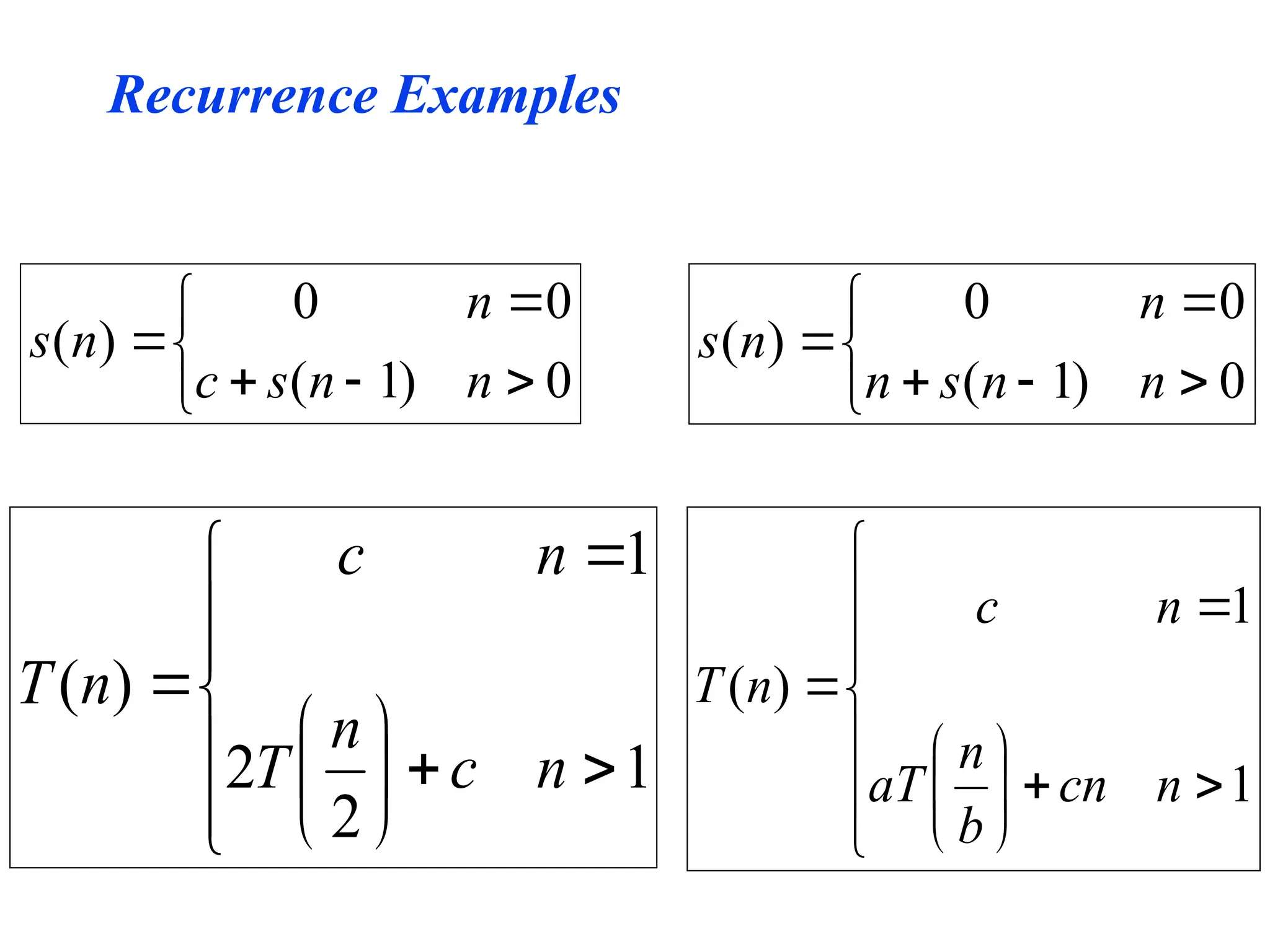
Recurrence Examples








0
0
)
1
(
0
)
(
n
n
n
s
c
n
s








0
)
1
(
0
0
)
(
n
n
s
n
n
n
s

















1
2
2
1
)
(
n
c
n
T
n
c
n
T

















1
1
)
(
n
cn
b
n
aT
n
c
n
T
Methods to solve recurrence
• Iteration method
• Substitution method
• Recursion tree method
• Master Theorem
Solving Recurrences
“iteration method”
• Work some algebra to express as a summation
• Evaluate the summation








0
)
1
(
0
0
)
(
n
n
s
c
n
n
s
s(n-1) = c + s(n-2)
s(n-2) = c + s(n-3)
Example 1
s(4)
c s(3)
c s(2)
c
s(0)
c
s(1)
=4c+s(0)
=4c+0
=4c
=nc = n
n=4
• s(4) =
c + s(4-1)
c + c + s(4-2)
2c + s(4-2)
2c + c + s(4-3)
3c + s(4-3)
4c + s(4-4)
= 4c + s(0)
=4c+0 [Stops here]
=nc








0
)
1
(
0
0
)
(
n
n
s
c
n
n
s
s(n-1) = c + s(n-2)
s(n-2) = c + s(n-3)
Example 1
• s(n) =
c + s(n-1)








0
)
1
(
0
0
)
(
n
n
s
c
n
n
s
s(n-1) = c + s(n-2)
Example 1
• s(n) =
c + s(n-1)
c + c + s(n-2)








0
)
1
(
0
0
)
(
n
n
s
c
n
n
s
s(n-1) = c + s(n-2)
Example 1
• s(n) =
c + s(n-1)
c + c + s(n-2)
2c + s(n-2)








0
)
1
(
0
0
)
(
n
n
s
c
n
n
s
s(n-1) = c + s(n-2)
s(n-2) = c + s(n-3)
Example 1
• s(n) =
c + s(n-1)
c + c + s(n-2)
2c + s(n-2)
2c + c + s(n-3)








0
)
1
(
0
0
)
(
n
n
s
c
n
n
s
s(n-1) = c + s(n-2)
s(n-2) = c + s(n-3)
Example 1
• s(n) =
c + s(n-1)
c + c + s(n-2)
2c + s(n-2)
2c + c + s(n-3)
3c + s(n-3)








0
)
1
(
0
0
)
(
n
n
s
c
n
n
s
s(n-1) = c + s(n-2)
s(n-2) = c + s(n-3)
Example 1
• s(n) =
c + s(n-1)
c + c + s(n-2)
2c + s(n-2)
2c + c + s(n-3)
3c + s(n-3)
…
kc + s(n-k) = ck + s(n-k)








0
)
1
(
0
0
)
(
n
n
s
c
n
n
s
s(n-1) = c + s(n-2)
s(n-2) = c + s(n-3)
Example 1
• s(n) =
c + s(n-1)
2c + s(n-2)
3c + s(n-3)
…
kc + s(n-k) = ck + s(n-k)








0
)
1
(
0
0
)
(
n
n
s
c
n
n
s
s(n-1) = c + s(n-2)
s(n-2) = c + s(n-3)
Example 1
• s(n) =
c + s(n-1)
2c + s(n-2)
3c + s(n-3)
4c + s(n-4)
…
kc + s(n-k) = ck + s(n-k)








0
)
1
(
0
0
)
(
n
n
s
c
n
n
s
s(n-1) = c + s(n-2)
s(n-2) = c + s(n-3)
Example 1
• So far for n >= k
n >= k we have
• s(n) = ck + s(n-k)
• What if k = n?
• s(n) = cn + s(0) = cn








0
)
1
(
0
0
)
(
n
n
s
c
n
n
s
Example 1
• So far for n >= k we have
• s(n) = ck + s(n-k)
• What if k = n?
• s(n) = cn + s(0) = cn
• So
• Thus in general
• s(n) = cn








0
)
1
(
0
0
)
(
n
n
s
c
n
n
s








0
)
1
(
0
0
)
(
n
n
s
c
n
n
s
Example 1
• s(n)








0
)
1
(
0
0
)
(
n
n
s
n
n
n
s
Example 2
• s(n)
= n + s(n-1)








0
)
1
(
0
0
)
(
n
n
s
n
n
n
s
Example 2
• s(n)
= n + s(n-1)
= n + n-1 + s(n-2)








0
)
1
(
0
0
)
(
n
n
s
n
n
n
s
Example 2
• s(n)
= n + s(n-1)
= n + n-1 + s(n-2)
= n + n-1 + n-2 + s(n-3)








0
)
1
(
0
0
)
(
n
n
s
n
n
n
s
Example 2
• s(n)
= n + s(n-1)
= n + n-1 + s(n-2)
= n + n-1 + n-2 + s(n-3)
= n + n-1 + n-2 + n-3 + s(n-4)








0
)
1
(
0
0
)
(
n
n
s
n
n
n
s
Example 2
• s(n)
= n + s(n-1)
= n + n-1 + s(n-2)
= n + n-1 + n-2 + s(n-3)
= n + n-1 + n-2 + n-3 + s(n-4)
= …
= n + n-1 + n-2 + n-3 + … + n-(k-1) + s(n-k)








0
)
1
(
0
0
)
(
n
n
s
n
n
n
s
Example 2
• s(5)
= 5 + s(5-1) =5+S(4)
= 5 + 4 + s(5-2) =5+4+S(3)
= 5 + 4 + 3 + s(5-3) = 5+4+3+S(2)
= 5 + 4 + 3 + 2 + s(5-4) =5+4+3+2+S(1)
= 5 + 4 + 3 + 2 +1+ s(5-5) =5+4+3+2+1+S(0)








0
)
1
(
0
0
)
(
n
n
s
n
n
n
s
Example 2
• s(n)
= n + s(n-1)
= n + n-1 + s(n-2)
= n + n-1 + n-2 + s(n-3)
= n + n-1 + n-2 + n-3 + s(n-4)
= …
= n + n-1 + n-2 + n-3 + … + n-(k-1) + s(n-k)








0
)
1
(
0
0
)
(
n
n
s
n
n
n
s
Example 2
• s(n)
= n + s(n-1)
= n + n-1 + s(n-2)
= n + n-1 + n-2 + s(n-3)
= n + n-1 + n-2 + n-3 + s(n-4)
= …
= n + n-1 + n-2 + n-3 + … + n-(k-1) + s(n-k)








0
)
1
(
0
0
)
(
n
n
s
n
n
n
s
)
(
1
k
n
s
i
n
k
n
i





Example 2
• So far for n >= k we have








0
)
1
(
0
0
)
(
n
n
s
n
n
n
s
)
(
1
k
n
s
i
n
k
n
i





Example 2
• So far for n >= k we have
• What if k = n?








0
)
1
(
0
0
)
(
n
n
s
n
n
n
s
)
(
1
k
n
s
i
n
k
n
i





S(5)=5 + 4 + 3 + 2 +1+ s(5-5)
=5+4+3+2+1+S(0)
Example 2
• So far for n >= k we have
• What if k = n?








0
)
1
(
0
0
)
(
n
n
s
n
n
n
s
)
(
1
k
n
s
i
n
k
n
i





2
1
0
)
0
(
1
1




 
 

n
n
i
s
i
n
i
n
i
Example 2
• So far for n >= k we have
• What if k = n?
• Thus in general








0
)
1
(
0
0
)
(
n
n
s
n
n
n
s
)
(
1
k
n
s
i
n
k
n
i





2
1
0
)
0
(
1
1




 
 

n
n
i
s
i
n
i
n
i
2
1
)
(


n
n
n
s
Example 2
Home Activity
• Solve the following Recurrence using iteration
Method
•T(1) = 1
T(n) = 2 T(n/2) + n
Note: Before looking at the solution, do it by yourself
Example 3
Home Activity
• T(n) = 2T(n/2) + n
= 2(2T(n/4) + n/2) + n
= 4T(n/4) + n + n
= 4(2T(n/8) + n/4) + n + n
= 8T(n/8) + n + n + n
= nT(n/n) + n + ... + n + n + n
= n + n + ... + n + n + n
Example 3
Reference: https://www.cs.cornell.edu/courses/cs3110/2014sp/recitations/21/solving-recurrences.html
Home Activity
• T(n) = 2T(n/2) + n
= 2(2T(n/4) + n/2) + n
= 4T(n/4) + n + n
= 4(2T(n/8) + n/4) + n + n
= 8T(n/8) + n + n + n
= nT(n/n) + n + ... + n + n + n
= n + n + ... + n + n + n
Counting the number of repetitions of n in the sum at the end,
we see that there are lg n + 1 of them. Thus the running time
is n(lg n + 1) = n lg n + n. We observe
that n lg n + n < n lg n + n lg n = 2n lg n for n>0, so the running time
is O(n lg n).
Example 3
Divide and Conquer
The divide-and-conquer paradigm
What is a paradigm? One that serves as a pattern or model.
• Divide the problem into a number of subproblems
• Conquer the subproblems by solving them
recursively. If small enough, just solve directly
without recursion
• Combine the solutions of the subproblems into the
solution for the original problem
Let T(n) be the running time on a problem of size n.
If problem is small enough, then solution takes constant
time (this is a boundary condition, which will be
assumed for all analyses)
It takes time to divide the problem into sub-problems at
the beginning. Denote this work by D(n).
Analyzing Divide-and-Conquer Algorithms
It takes time to combine the solutions at the end. Denote this
by C(n).
If we divide the problem into ‘a’ problems, each of which is
‘1/b’ times the original size (n), and since the time to solve
a problem with input size ‘n/b’ is T(n/b), and this is done ‘a’
times, the total time is:
T(n) = (1), n small (or n  c )
T(n) = aT(n/b) + D(n) + C(n)
Analyzing Divide-and-Conquer Algorithms
Reference
• Introduction to Algorithms
• Chapter # 4
• Thomas H. Cormen
• 3rd
Edition

Lec-4-2-Recurrence Relation-Iteration Method.ppt

  • 1.
    Design and Analysisof Algorithms National University of Computer and Emerging Sciences, Islamabad Recurrence Relation
  • 2.
  • 3.
    Methods to solverecurrence • Iteration method • Substitution method • Recursion tree method • Master Theorem
  • 4.
    Solving Recurrences “iteration method” •Work some algebra to express as a summation • Evaluate the summation
  • 5.
            0 ) 1 ( 0 0 ) ( n n s c n n s s(n-1) = c+ s(n-2) s(n-2) = c + s(n-3) Example 1 s(4) c s(3) c s(2) c s(0) c s(1) =4c+s(0) =4c+0 =4c =nc = n n=4
  • 6.
    • s(4) = c+ s(4-1) c + c + s(4-2) 2c + s(4-2) 2c + c + s(4-3) 3c + s(4-3) 4c + s(4-4) = 4c + s(0) =4c+0 [Stops here] =nc         0 ) 1 ( 0 0 ) ( n n s c n n s s(n-1) = c + s(n-2) s(n-2) = c + s(n-3) Example 1
  • 7.
    • s(n) = c+ s(n-1)         0 ) 1 ( 0 0 ) ( n n s c n n s s(n-1) = c + s(n-2) Example 1
  • 8.
    • s(n) = c+ s(n-1) c + c + s(n-2)         0 ) 1 ( 0 0 ) ( n n s c n n s s(n-1) = c + s(n-2) Example 1
  • 9.
    • s(n) = c+ s(n-1) c + c + s(n-2) 2c + s(n-2)         0 ) 1 ( 0 0 ) ( n n s c n n s s(n-1) = c + s(n-2) s(n-2) = c + s(n-3) Example 1
  • 10.
    • s(n) = c+ s(n-1) c + c + s(n-2) 2c + s(n-2) 2c + c + s(n-3)         0 ) 1 ( 0 0 ) ( n n s c n n s s(n-1) = c + s(n-2) s(n-2) = c + s(n-3) Example 1
  • 11.
    • s(n) = c+ s(n-1) c + c + s(n-2) 2c + s(n-2) 2c + c + s(n-3) 3c + s(n-3)         0 ) 1 ( 0 0 ) ( n n s c n n s s(n-1) = c + s(n-2) s(n-2) = c + s(n-3) Example 1
  • 12.
    • s(n) = c+ s(n-1) c + c + s(n-2) 2c + s(n-2) 2c + c + s(n-3) 3c + s(n-3) … kc + s(n-k) = ck + s(n-k)         0 ) 1 ( 0 0 ) ( n n s c n n s s(n-1) = c + s(n-2) s(n-2) = c + s(n-3) Example 1
  • 13.
    • s(n) = c+ s(n-1) 2c + s(n-2) 3c + s(n-3) … kc + s(n-k) = ck + s(n-k)         0 ) 1 ( 0 0 ) ( n n s c n n s s(n-1) = c + s(n-2) s(n-2) = c + s(n-3) Example 1
  • 14.
    • s(n) = c+ s(n-1) 2c + s(n-2) 3c + s(n-3) 4c + s(n-4) … kc + s(n-k) = ck + s(n-k)         0 ) 1 ( 0 0 ) ( n n s c n n s s(n-1) = c + s(n-2) s(n-2) = c + s(n-3) Example 1
  • 15.
    • So farfor n >= k n >= k we have • s(n) = ck + s(n-k) • What if k = n? • s(n) = cn + s(0) = cn         0 ) 1 ( 0 0 ) ( n n s c n n s Example 1
  • 16.
    • So farfor n >= k we have • s(n) = ck + s(n-k) • What if k = n? • s(n) = cn + s(0) = cn • So • Thus in general • s(n) = cn         0 ) 1 ( 0 0 ) ( n n s c n n s         0 ) 1 ( 0 0 ) ( n n s c n n s Example 1
  • 17.
  • 18.
    • s(n) = n+ s(n-1)         0 ) 1 ( 0 0 ) ( n n s n n n s Example 2
  • 19.
    • s(n) = n+ s(n-1) = n + n-1 + s(n-2)         0 ) 1 ( 0 0 ) ( n n s n n n s Example 2
  • 20.
    • s(n) = n+ s(n-1) = n + n-1 + s(n-2) = n + n-1 + n-2 + s(n-3)         0 ) 1 ( 0 0 ) ( n n s n n n s Example 2
  • 21.
    • s(n) = n+ s(n-1) = n + n-1 + s(n-2) = n + n-1 + n-2 + s(n-3) = n + n-1 + n-2 + n-3 + s(n-4)         0 ) 1 ( 0 0 ) ( n n s n n n s Example 2
  • 22.
    • s(n) = n+ s(n-1) = n + n-1 + s(n-2) = n + n-1 + n-2 + s(n-3) = n + n-1 + n-2 + n-3 + s(n-4) = … = n + n-1 + n-2 + n-3 + … + n-(k-1) + s(n-k)         0 ) 1 ( 0 0 ) ( n n s n n n s Example 2
  • 23.
    • s(5) = 5+ s(5-1) =5+S(4) = 5 + 4 + s(5-2) =5+4+S(3) = 5 + 4 + 3 + s(5-3) = 5+4+3+S(2) = 5 + 4 + 3 + 2 + s(5-4) =5+4+3+2+S(1) = 5 + 4 + 3 + 2 +1+ s(5-5) =5+4+3+2+1+S(0)         0 ) 1 ( 0 0 ) ( n n s n n n s Example 2
  • 24.
    • s(n) = n+ s(n-1) = n + n-1 + s(n-2) = n + n-1 + n-2 + s(n-3) = n + n-1 + n-2 + n-3 + s(n-4) = … = n + n-1 + n-2 + n-3 + … + n-(k-1) + s(n-k)         0 ) 1 ( 0 0 ) ( n n s n n n s Example 2
  • 25.
    • s(n) = n+ s(n-1) = n + n-1 + s(n-2) = n + n-1 + n-2 + s(n-3) = n + n-1 + n-2 + n-3 + s(n-4) = … = n + n-1 + n-2 + n-3 + … + n-(k-1) + s(n-k)         0 ) 1 ( 0 0 ) ( n n s n n n s ) ( 1 k n s i n k n i      Example 2
  • 26.
    • So farfor n >= k we have         0 ) 1 ( 0 0 ) ( n n s n n n s ) ( 1 k n s i n k n i      Example 2
  • 27.
    • So farfor n >= k we have • What if k = n?         0 ) 1 ( 0 0 ) ( n n s n n n s ) ( 1 k n s i n k n i      S(5)=5 + 4 + 3 + 2 +1+ s(5-5) =5+4+3+2+1+S(0) Example 2
  • 28.
    • So farfor n >= k we have • What if k = n?         0 ) 1 ( 0 0 ) ( n n s n n n s ) ( 1 k n s i n k n i      2 1 0 ) 0 ( 1 1          n n i s i n i n i Example 2
  • 29.
    • So farfor n >= k we have • What if k = n? • Thus in general         0 ) 1 ( 0 0 ) ( n n s n n n s ) ( 1 k n s i n k n i      2 1 0 ) 0 ( 1 1          n n i s i n i n i 2 1 ) (   n n n s Example 2
  • 30.
    Home Activity • Solvethe following Recurrence using iteration Method •T(1) = 1 T(n) = 2 T(n/2) + n Note: Before looking at the solution, do it by yourself Example 3
  • 31.
    Home Activity • T(n)= 2T(n/2) + n = 2(2T(n/4) + n/2) + n = 4T(n/4) + n + n = 4(2T(n/8) + n/4) + n + n = 8T(n/8) + n + n + n = nT(n/n) + n + ... + n + n + n = n + n + ... + n + n + n Example 3
  • 32.
    Reference: https://www.cs.cornell.edu/courses/cs3110/2014sp/recitations/21/solving-recurrences.html Home Activity •T(n) = 2T(n/2) + n = 2(2T(n/4) + n/2) + n = 4T(n/4) + n + n = 4(2T(n/8) + n/4) + n + n = 8T(n/8) + n + n + n = nT(n/n) + n + ... + n + n + n = n + n + ... + n + n + n Counting the number of repetitions of n in the sum at the end, we see that there are lg n + 1 of them. Thus the running time is n(lg n + 1) = n lg n + n. We observe that n lg n + n < n lg n + n lg n = 2n lg n for n>0, so the running time is O(n lg n). Example 3
  • 33.
    Divide and Conquer Thedivide-and-conquer paradigm What is a paradigm? One that serves as a pattern or model. • Divide the problem into a number of subproblems • Conquer the subproblems by solving them recursively. If small enough, just solve directly without recursion • Combine the solutions of the subproblems into the solution for the original problem
  • 34.
    Let T(n) bethe running time on a problem of size n. If problem is small enough, then solution takes constant time (this is a boundary condition, which will be assumed for all analyses) It takes time to divide the problem into sub-problems at the beginning. Denote this work by D(n). Analyzing Divide-and-Conquer Algorithms
  • 35.
    It takes timeto combine the solutions at the end. Denote this by C(n). If we divide the problem into ‘a’ problems, each of which is ‘1/b’ times the original size (n), and since the time to solve a problem with input size ‘n/b’ is T(n/b), and this is done ‘a’ times, the total time is: T(n) = (1), n small (or n  c ) T(n) = aT(n/b) + D(n) + C(n) Analyzing Divide-and-Conquer Algorithms
  • 36.
    Reference • Introduction toAlgorithms • Chapter # 4 • Thomas H. Cormen • 3rd Edition