Stacks and Queues
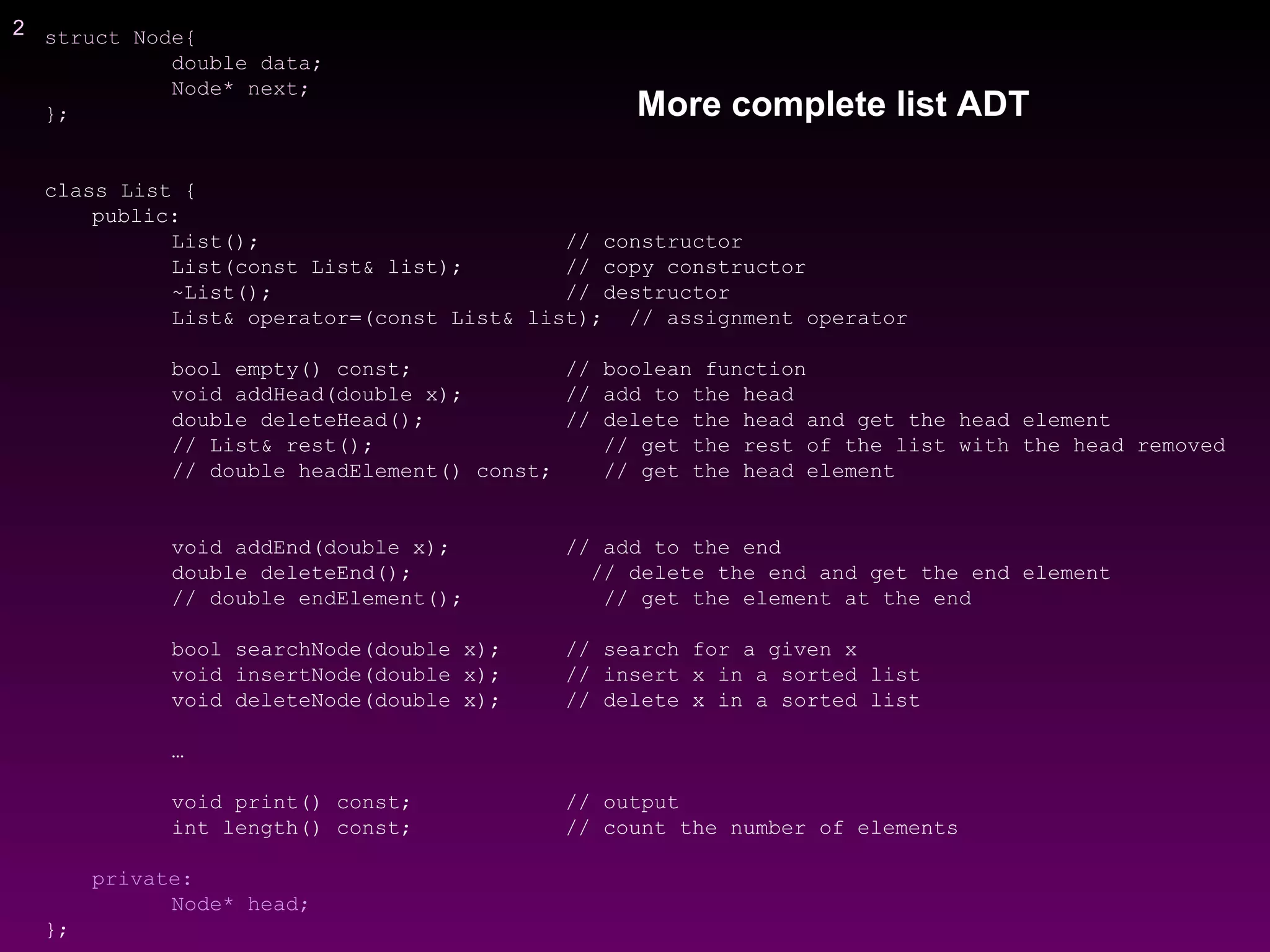
2 struct Node{
double data;
Node* next;
};
class List {
public:
List(); // constructor
List(const List& list); // copy constructor
~List(); // destructor
List& operator=(const List& list); // assignment operator
bool empty() const; // boolean function
void addHead(double x); // add to the head
double deleteHead(); // delete the head and get the head element
// List& rest(); // get the rest of the list with the head removed
// double headElement() const; // get the head element
void addEnd(double x); // add to the end
double deleteEnd(); // delete the end and get the end element
// double endElement(); // get the element at the end
bool searchNode(double x); // search for a given x
void insertNode(double x); // insert x in a sorted list
void deleteNode(double x); // delete x in a sorted list
…
void print() const; // output
int length() const; // count the number of elements
private:
Node* head;
};
More complete list ADT
3
Stack Overview
Stack ADT
Basic operations of stack
Pushing, popping etc.
Implementations of stacks using
array
linked list
4
Stack
A stack is a list in which insertion and deletion take
place at the same end
This end is called top
The other end is called bottom
Stacks are known as LIFO (Last In, First Out) lists.
The last element inserted will be the first to be retrieved
5
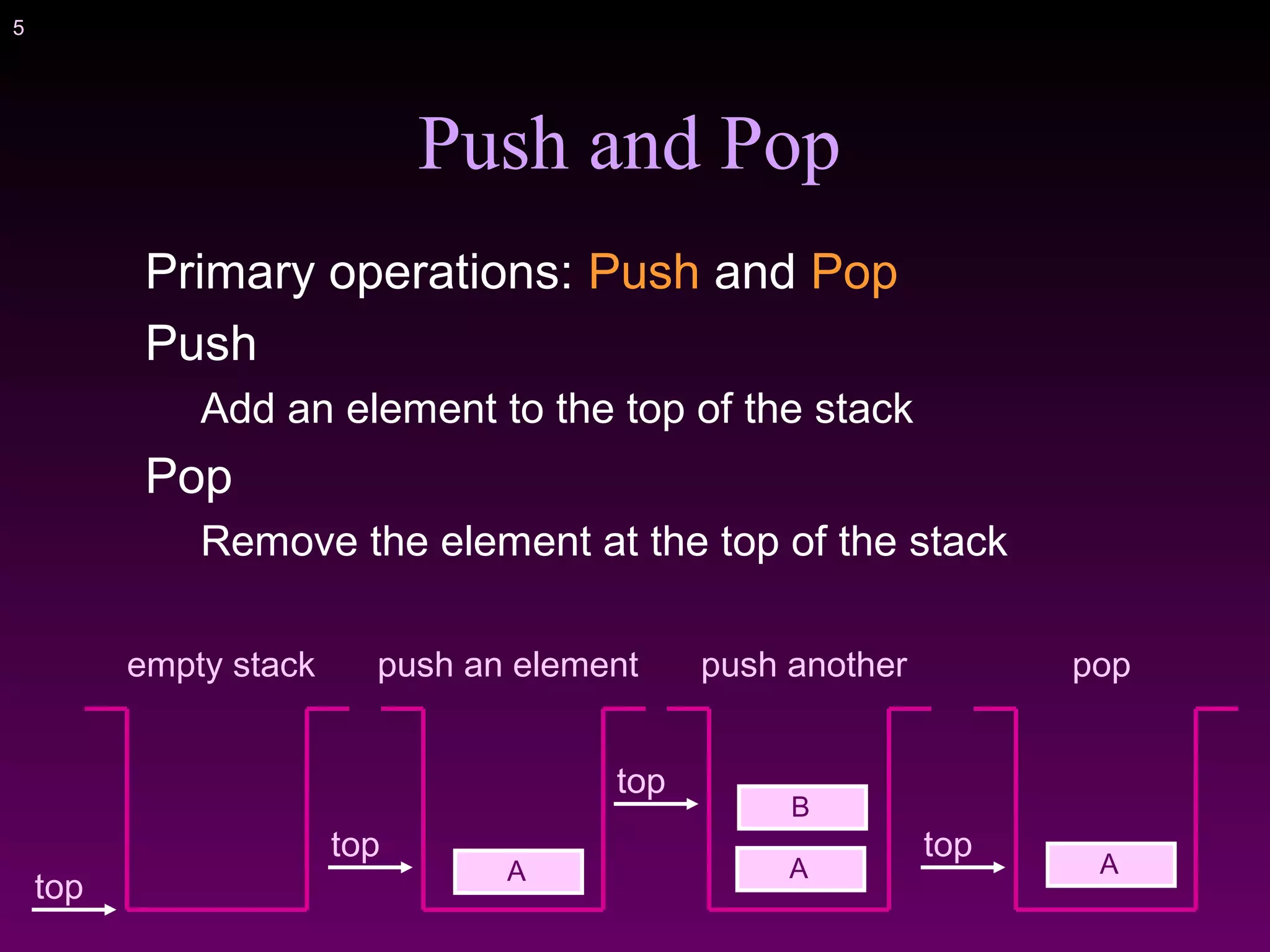
Push and Pop
Primary operations: Push and Pop
Push
Add an element to the top of the stack
Pop
Remove the element at the top of the stack
top
empty stack
A
top
push an element
top
push another
A
B
top
pop
A
6
Implementation of Stacks
Any list implementation could be used to
implement a stack
Arrays (static: the size of stack is given initially)
Linked lists (dynamic: never become full)
We will explore implementations based on
array and linked list
7
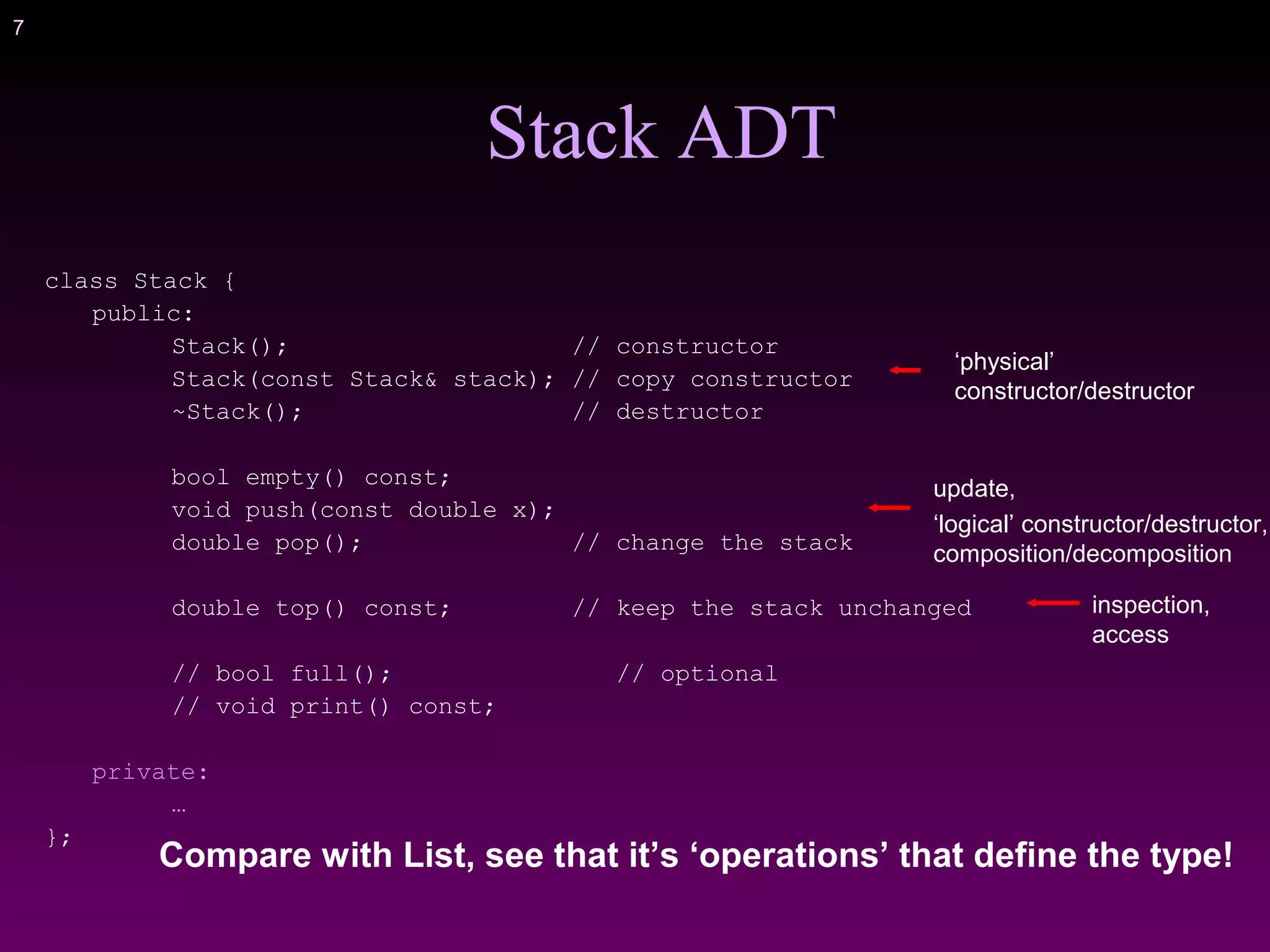
class Stack {
public:
Stack(); // constructor
Stack(const Stack& stack); // copy constructor
~Stack(); // destructor
bool empty() const;
void push(const double x);
double pop(); // change the stack
double top() const; // keep the stack unchanged
// bool full(); // optional
// void print() const;
private:
…
};
Stack ADT
update,
‘logical’ constructor/destructor,
composition/decomposition
‘physical’
constructor/destructor
Compare with List, see that it’s ‘operations’ that define the type!
inspection,
access
8
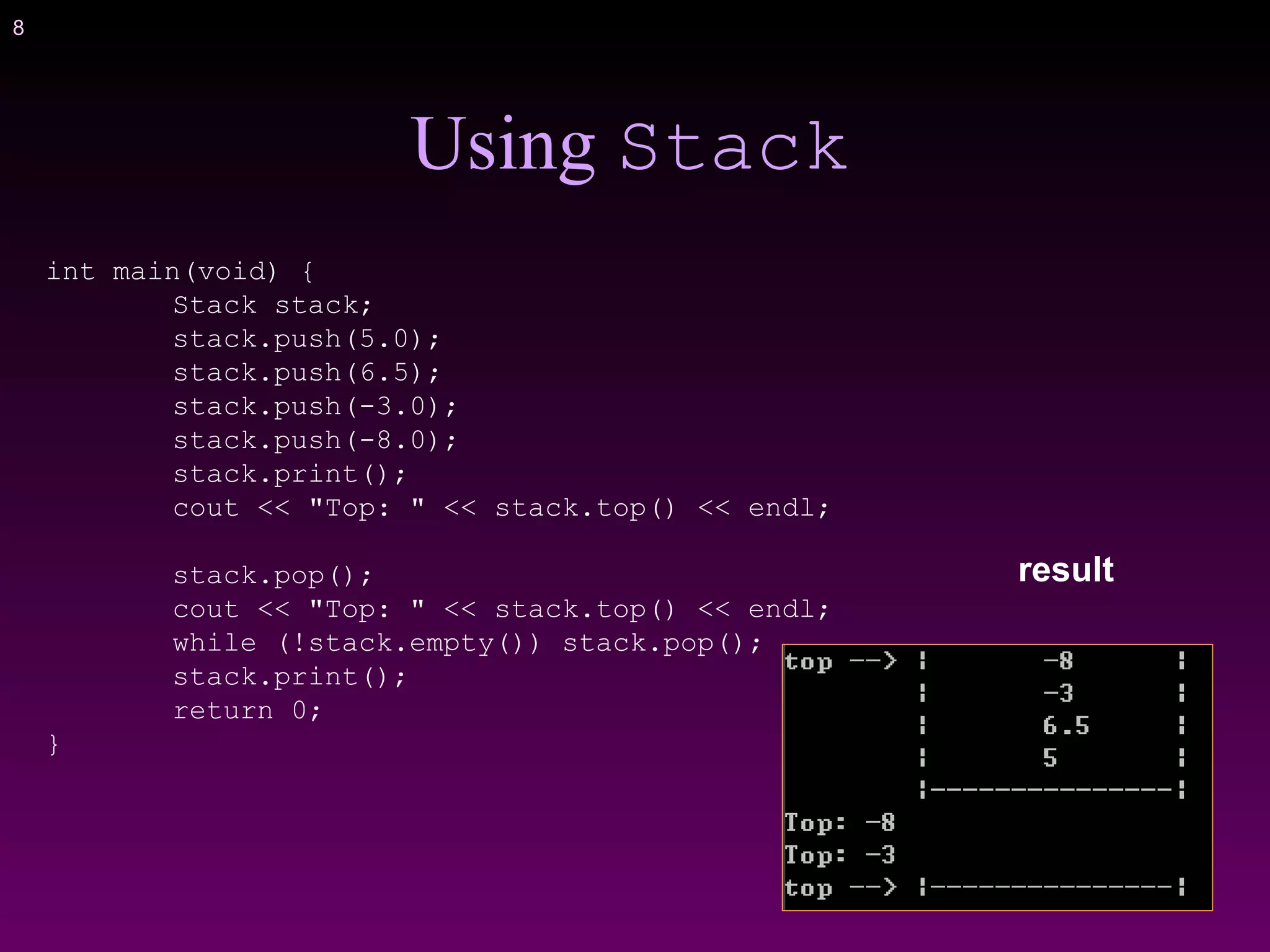
Using Stack
int main(void) {
Stack stack;
stack.push(5.0);
stack.push(6.5);
stack.push(-3.0);
stack.push(-8.0);
stack.print();
cout << "Top: " << stack.top() << endl;
stack.pop();
cout << "Top: " << stack.top() << endl;
while (!stack.empty()) stack.pop();
stack.print();
return 0;
}
result
9
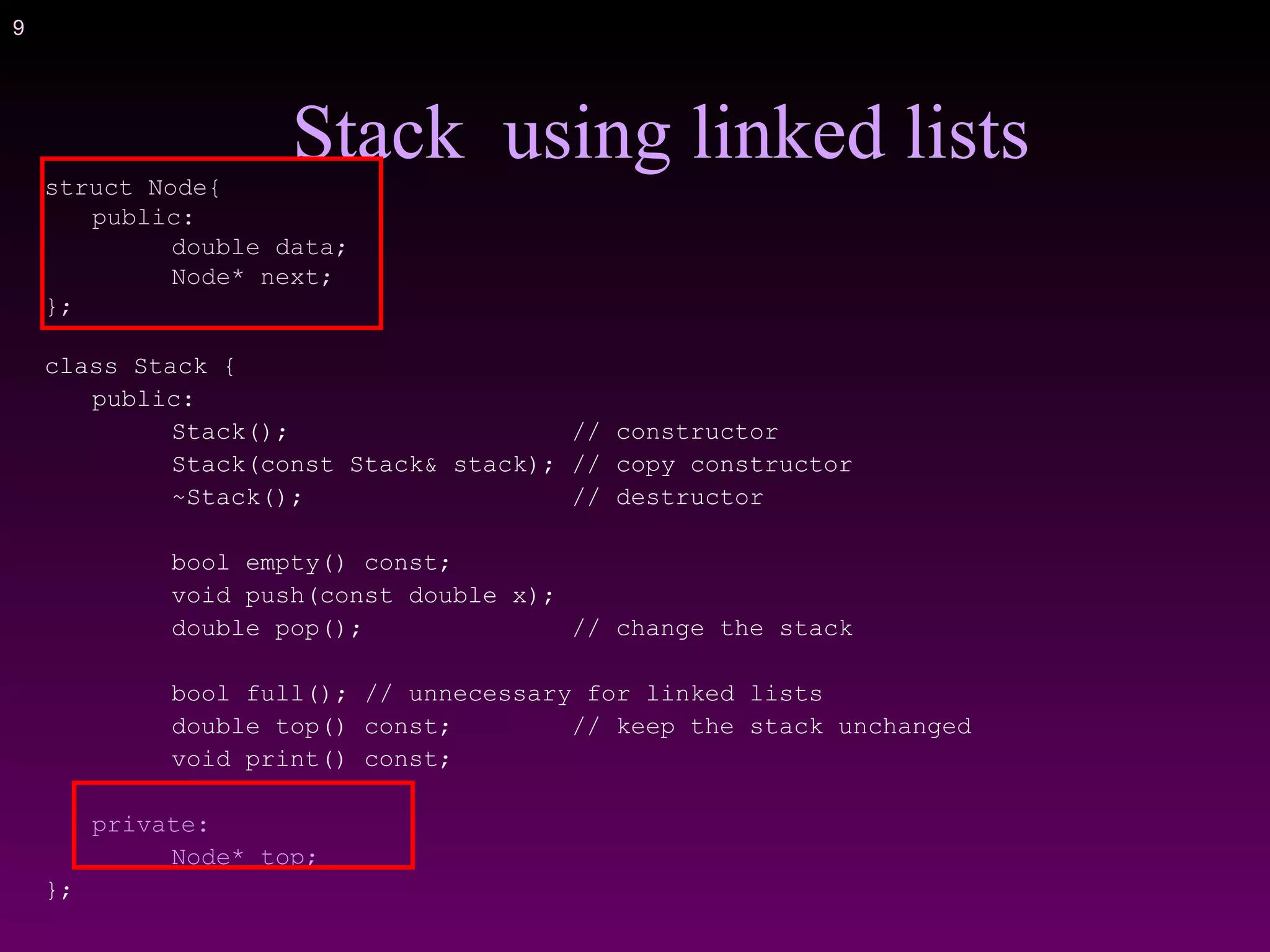
struct Node{
public:
double data;
Node* next;
};
class Stack {
public:
Stack(); // constructor
Stack(const Stack& stack); // copy constructor
~Stack(); // destructor
bool empty() const;
void push(const double x);
double pop(); // change the stack
bool full(); // unnecessary for linked lists
double top() const; // keep the stack unchanged
void print() const;
private:
Node* top;
};
Stack using linked lists
10
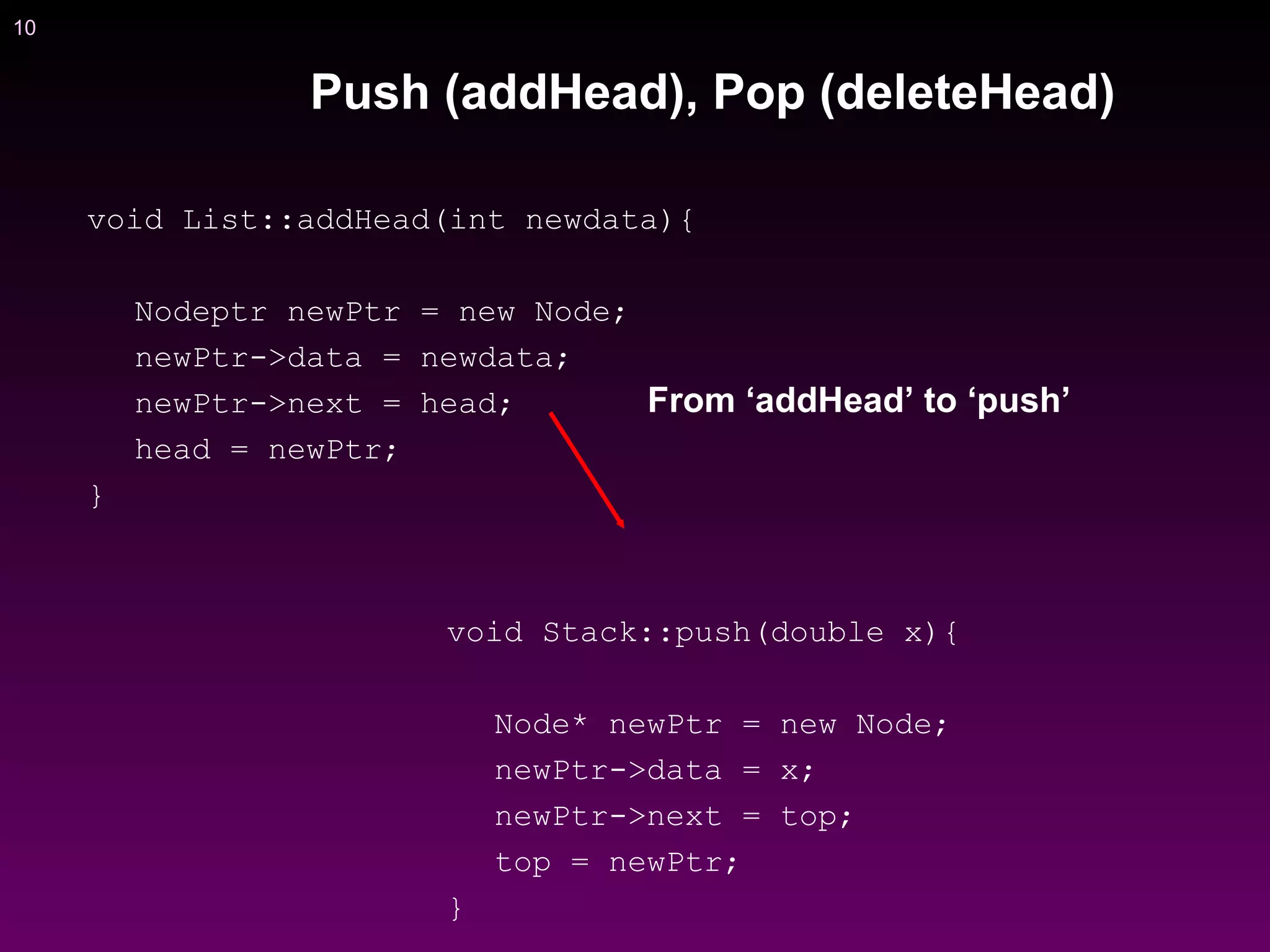
void List::addHead(int newdata){
Nodeptr newPtr = new Node;
newPtr->data = newdata;
newPtr->next = head;
head = newPtr;
}
void Stack::push(double x){
Node* newPtr = new Node;
newPtr->data = x;
newPtr->next = top;
top = newPtr;
}
From ‘addHead’ to ‘push’
Push (addHead), Pop (deleteHead)
11
Implementation based on ‘existing’
linked lists
Optional to learn 
Good to see that we may ‘re-use’ linked lists
12
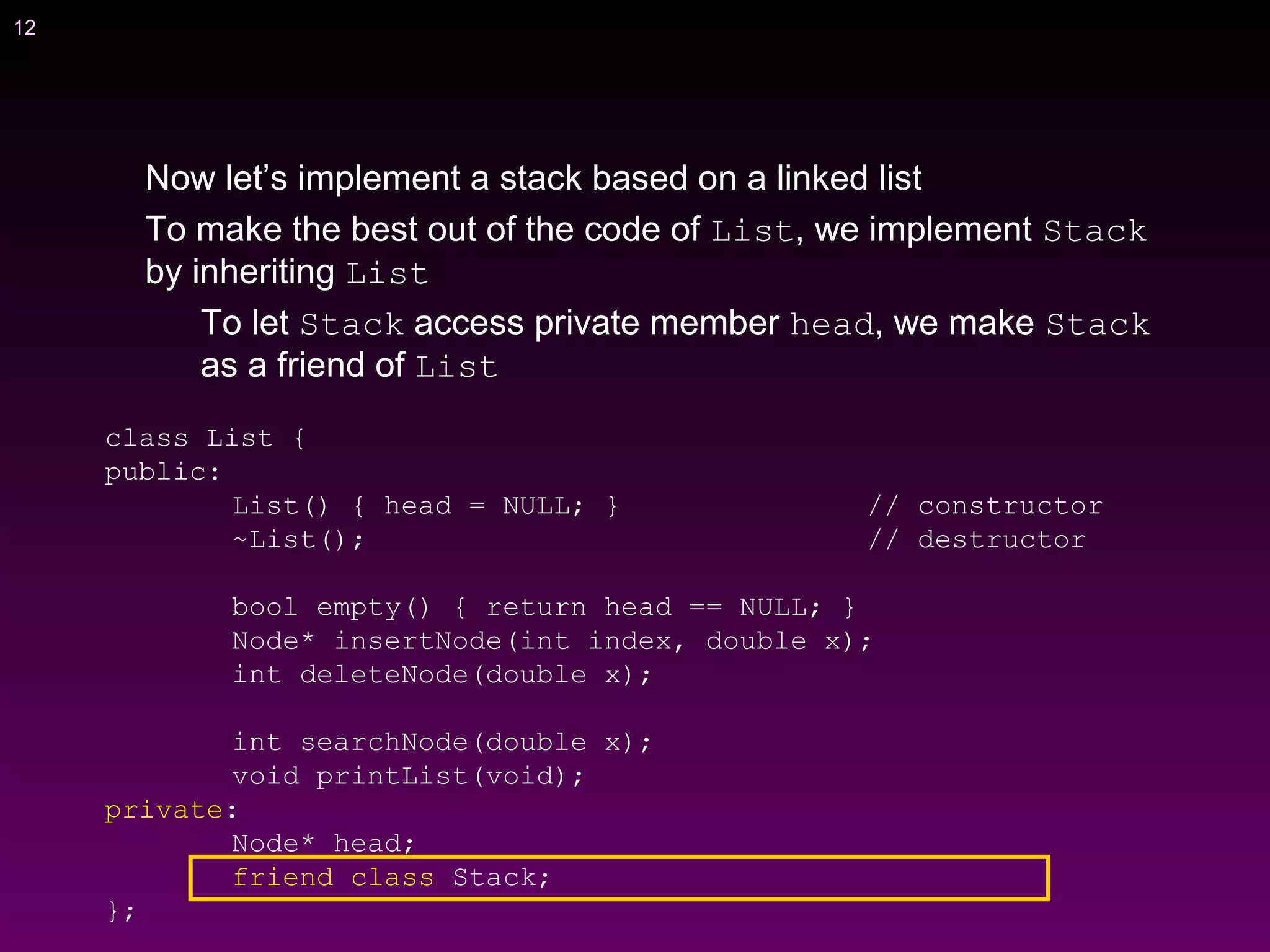
Now let’s implement a stack based on a linked list
To make the best out of the code of List, we implement Stack
by inheriting List
To let Stack access private member head, we make Stack
as a friend of List
class List {
public:
List() { head = NULL; } // constructor
~List(); // destructor
bool empty() { return head == NULL; }
Node* insertNode(int index, double x);
int deleteNode(double x);
int searchNode(double x);
void printList(void);
private:
Node* head;
friend class Stack;
};
13
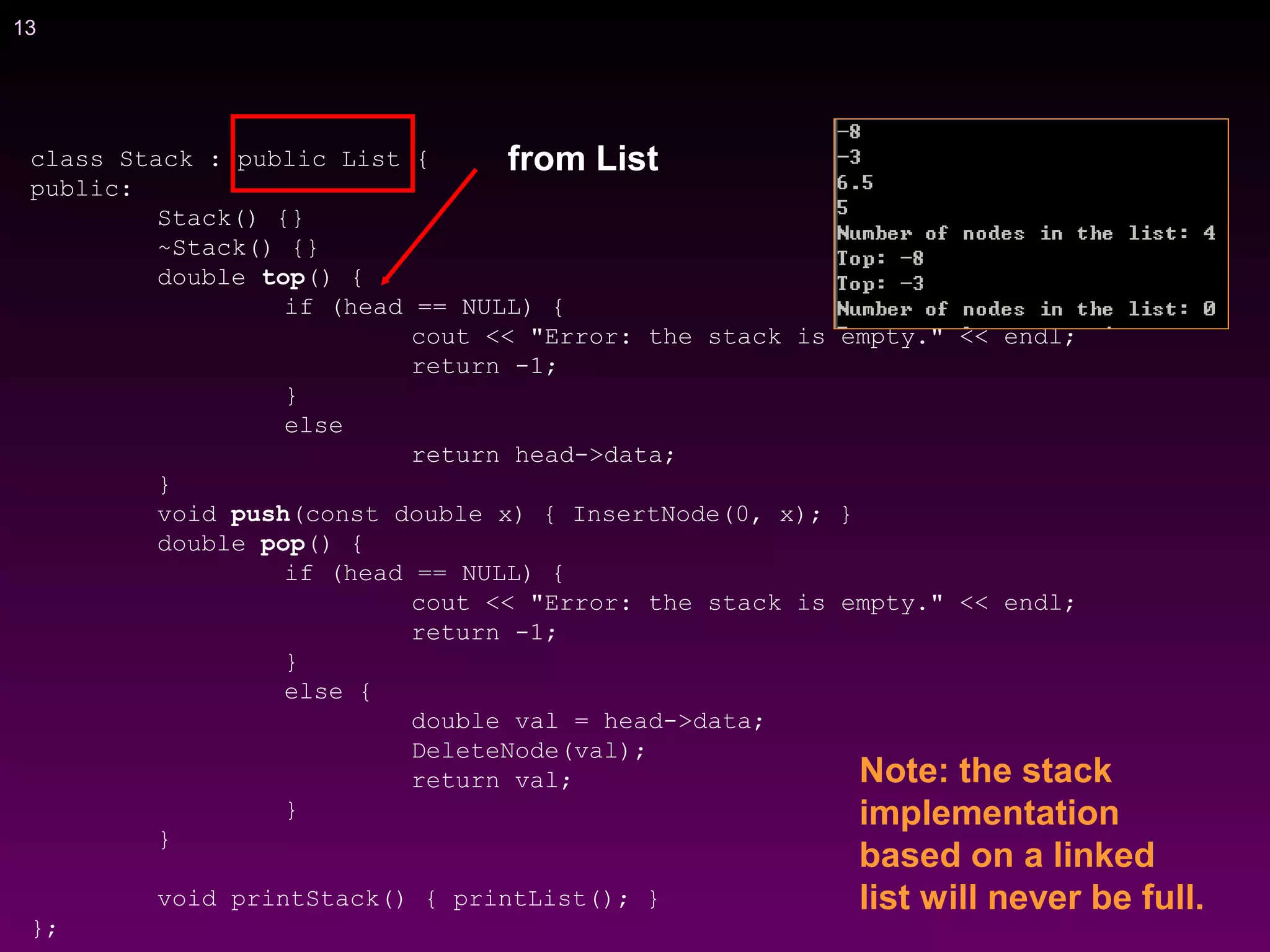
class Stack : public List {
public:
Stack() {}
~Stack() {}
double top() {
if (head == NULL) {
cout << "Error: the stack is empty." << endl;
return -1;
}
else
return head->data;
}
void push(const double x) { InsertNode(0, x); }
double pop() {
if (head == NULL) {
cout << "Error: the stack is empty." << endl;
return -1;
}
else {
double val = head->data;
DeleteNode(val);
return val;
}
}
void printStack() { printList(); }
};
Note: the stack
implementation
based on a linked
list will never be full.
from List
14
Stack using arrays
class Stack {
public:
Stack(int size = 10); // constructor
~Stack() { delete [] values; } // destructor
bool empty() { return top == -1; }
void push(const double x);
double pop();
bool full() { return top == maxTop; }
double top();
void print();
private:
int maxTop; // max stack size = size - 1
int top; // current top of stack
double* values; // element array
};
15
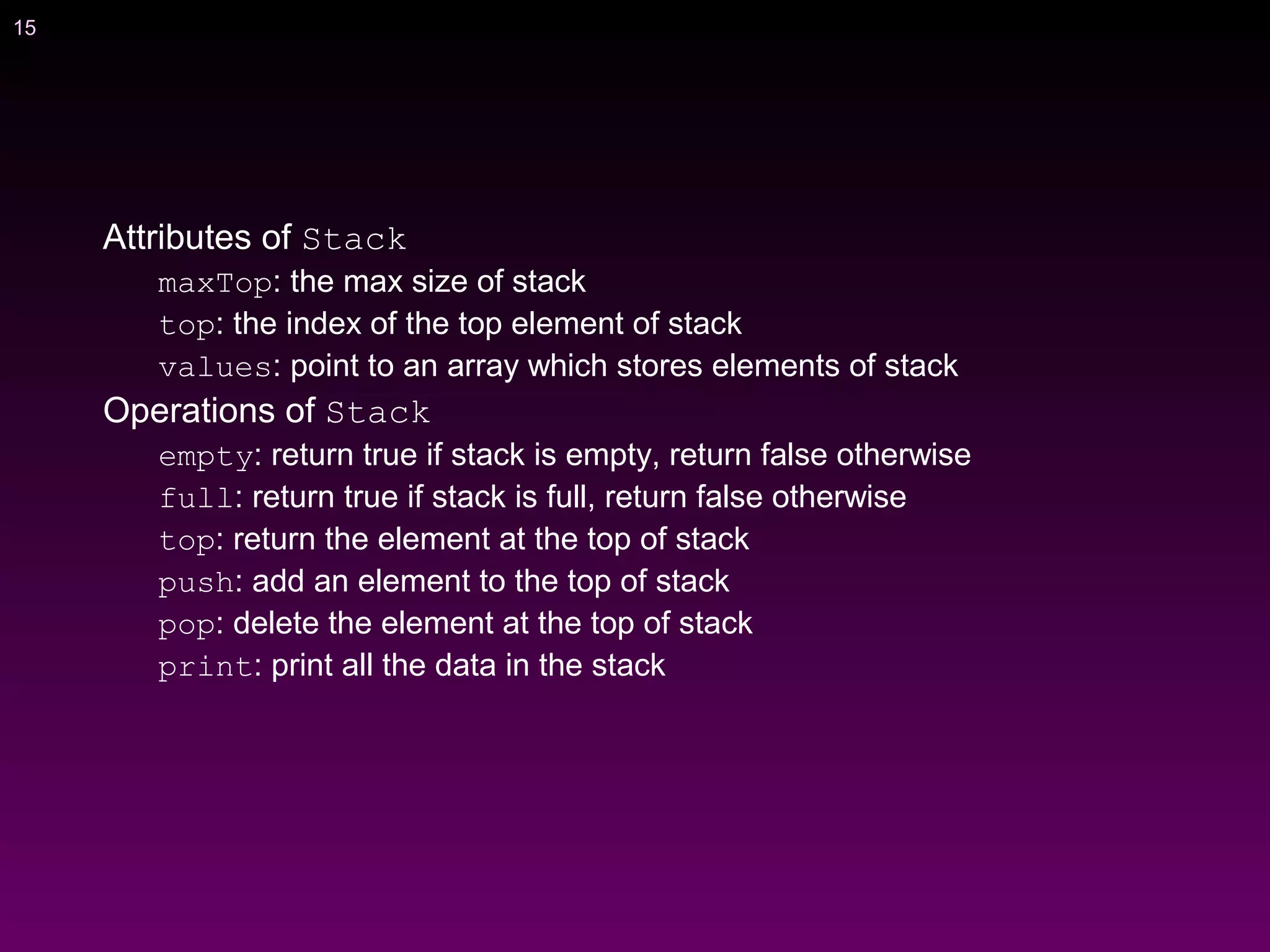
Attributes of Stack
maxTop: the max size of stack
top: the index of the top element of stack
values: point to an array which stores elements of stack
Operations of Stack
empty: return true if stack is empty, return false otherwise
full: return true if stack is full, return false otherwise
top: return the element at the top of stack
push: add an element to the top of stack
pop: delete the element at the top of stack
print: print all the data in the stack
16
Allocate a stack array of size. By default,
size = 10.
Initially top is set to -1. It means the stack is empty.
When the stack is full, top will have its maximum value, i.e.
size – 1.
Stack::Stack(int size /*= 10*/) {
values = new double[size];
top = -1;
maxTop = size - 1;
}
Although the constructor dynamically allocates the stack array,
the stack is still static. The size is fixed after the initialization.
Stack constructor
17
void push(const double x);
Push an element onto the stack
Note top always represents the index of the top
element. After pushing an element, increment top.
void Stack::push(const double x) {
if (full()) // if stack is full, print error
cout << "Error: the stack is full." << endl;
else
values[++top] = x;
}
18
double pop()
Pop and return the element at the top of the stack
Don’t forgot to decrement top
double Stack::pop() {
if (empty()) { //if stack is empty, print error
cout << "Error: the stack is empty." << endl;
return -1;
}
else {
return values[top--];
}
}
19
double top()
Return the top element of the stack
Unlike pop, this function does not remove the top
element
double Stack::top() {
if (empty()) {
cout << "Error: the stack is empty." << endl;
return -1;
}
else
return values[top];
}
20
void print()
Print all the elements
void Stack::print() {
cout << "top -->";
for (int i = top; i >= 0; i--)
cout << "t|t" << values[i] << "t|" << endl;
cout << "t|---------------|" << endl;
}
21
Stack Application:
Balancing Symbols
To check that every right brace, bracket, and
parentheses must correspond to its left counterpart
e.g. [( )] is legal, but [( ] ) is illegal
Algorithm
(1) Make an empty stack.
(2) Read characters until end of file
i. If the character is an opening symbol, push it onto the stack
ii. If it is a closing symbol, then if the stack is empty, report an error
iii. Otherwise, pop the stack. If the symbol popped is not the
corresponding opening symbol, then report an error
(3) At end of file, if the stack is not empty, report an error
22
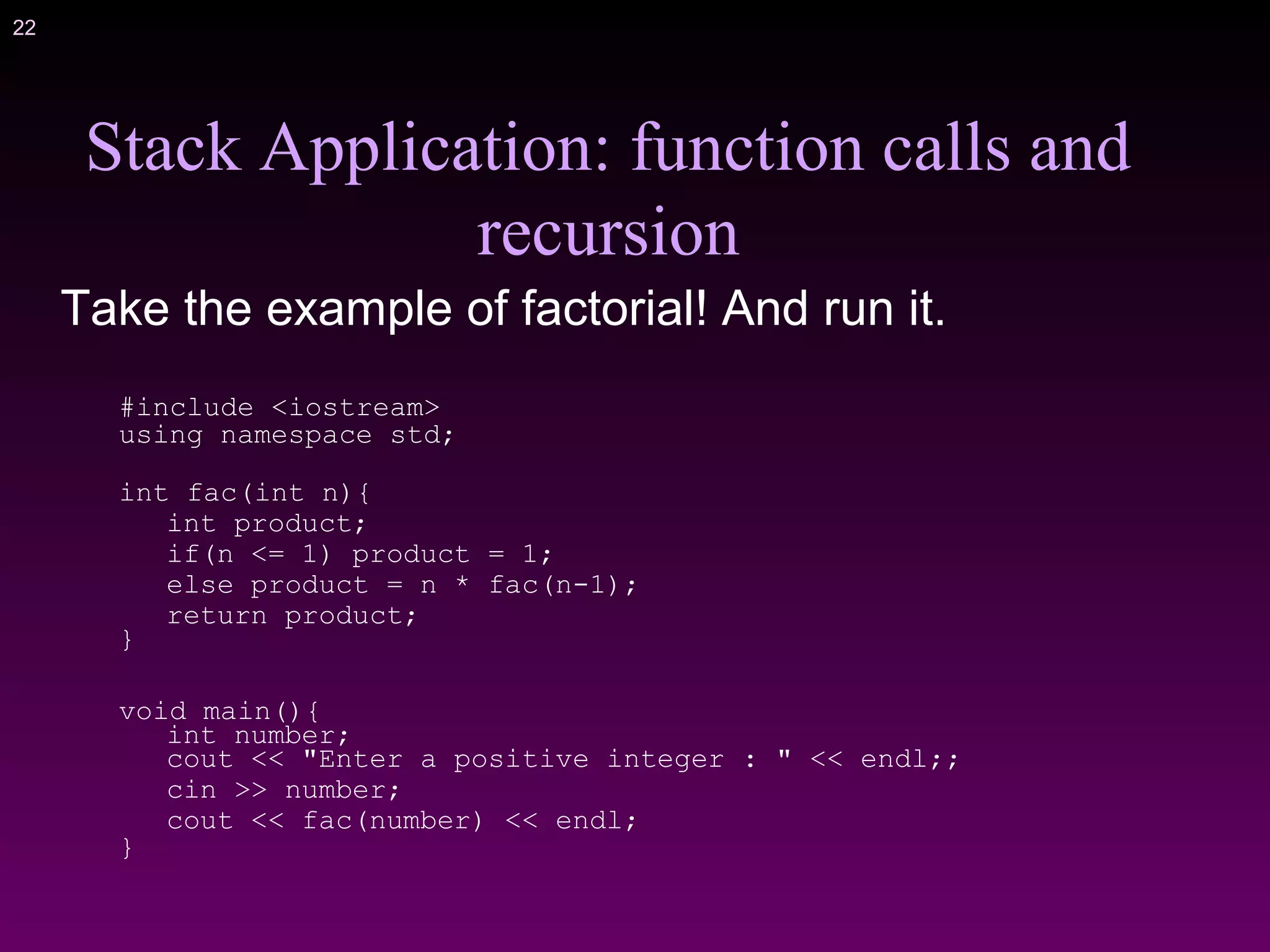
Stack Application: function calls and
recursion
Take the example of factorial! And run it.
#include <iostream>
using namespace std;
int fac(int n){
int product;
if(n <= 1) product = 1;
else product = n * fac(n-1);
return product;
}
void main(){
int number;
cout << "Enter a positive integer : " << endl;;
cin >> number;
cout << fac(number) << endl;
}
23
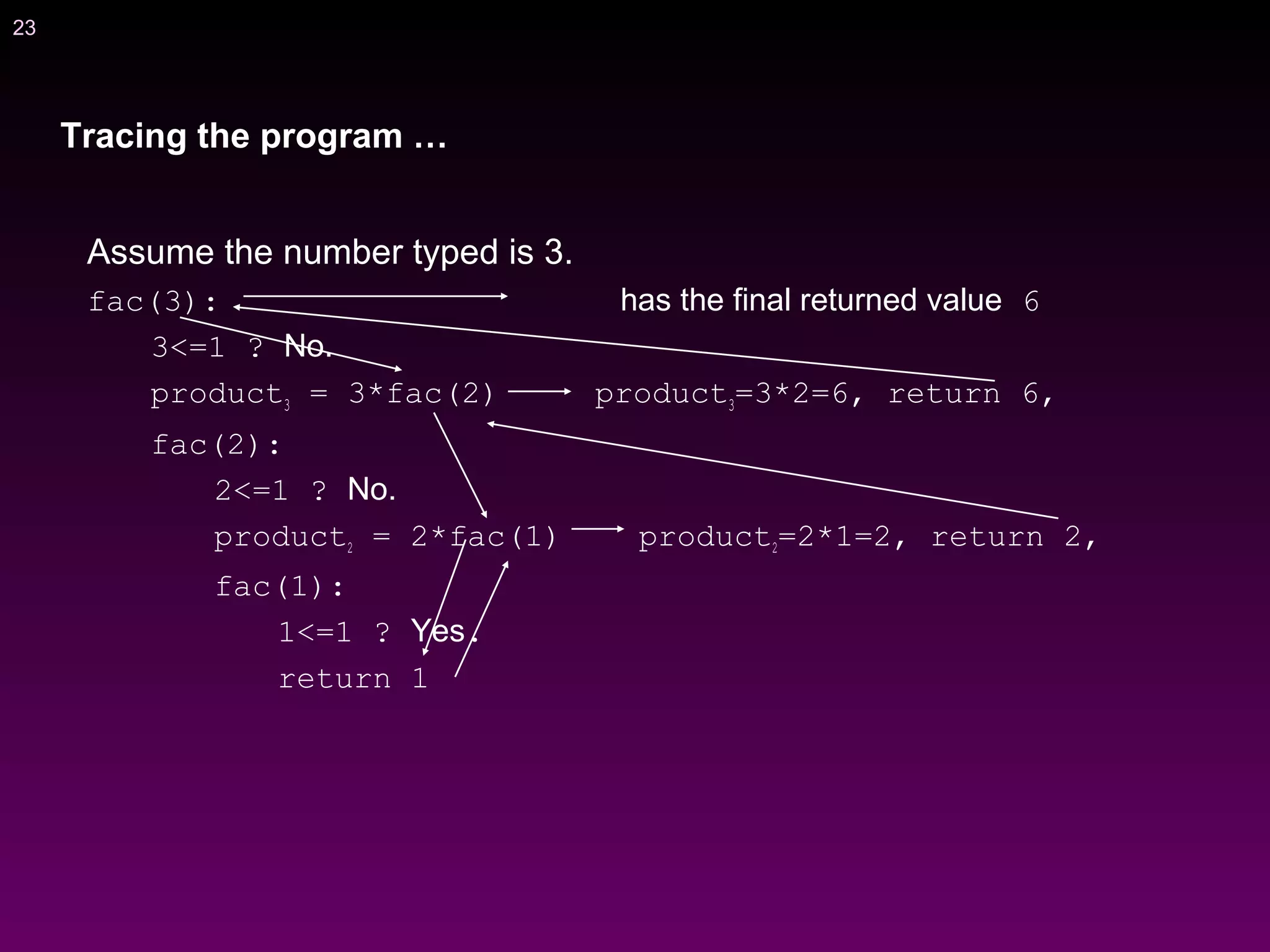
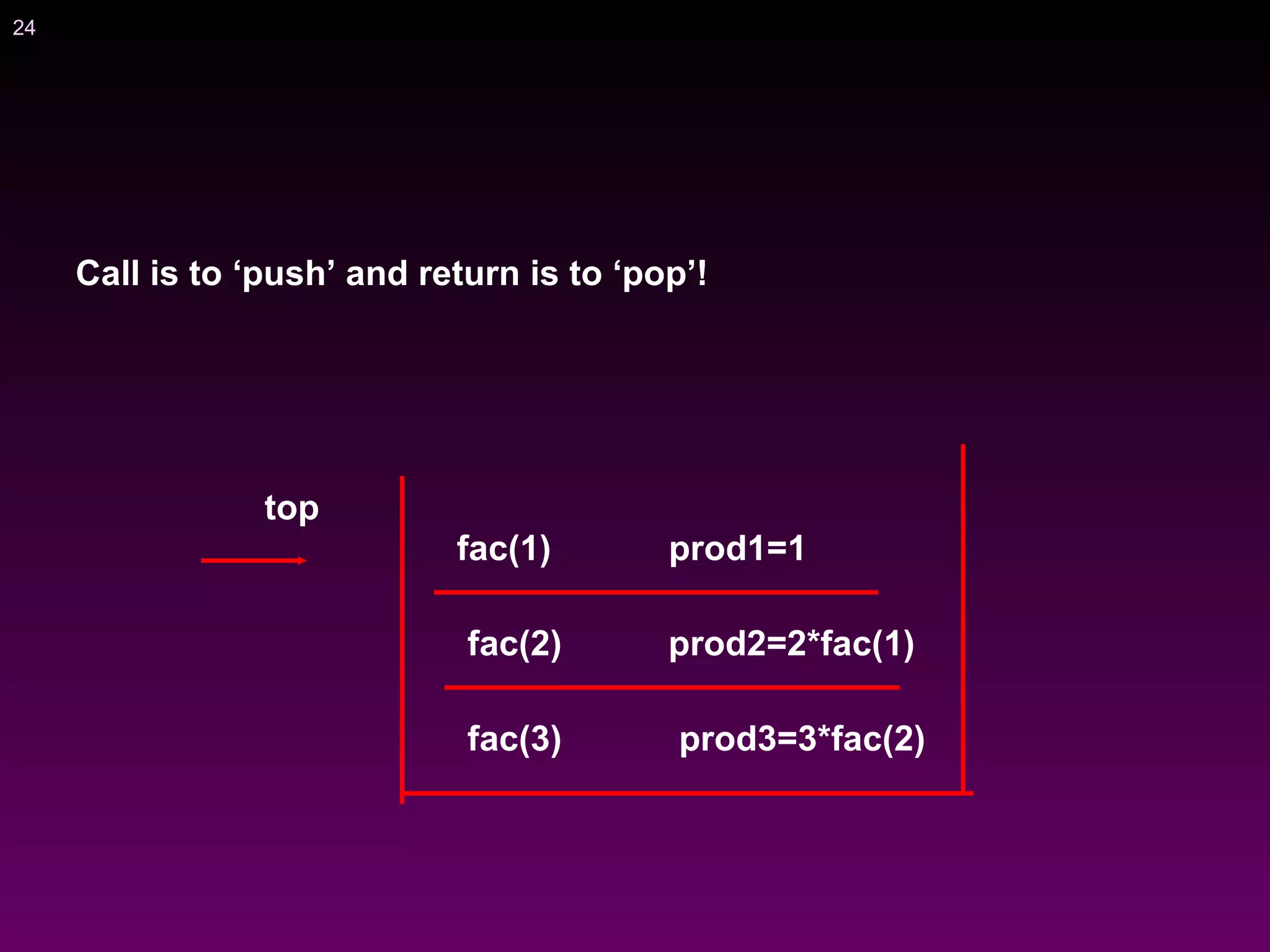
Assume the number typed is 3.
fac(3): has the final returned value 6
3<=1 ? No.
product3 = 3*fac(2) product3=3*2=6, return 6,
fac(2):
2<=1 ? No.
product2 = 2*fac(1) product2=2*1=2, return 2,
fac(1):
1<=1 ? Yes.
return 1
Tracing the program …
24
fac(3) prod3=3*fac(2)
prod2=2*fac(1)fac(2)
fac(1) prod1=1
Call is to ‘push’ and return is to ‘pop’!
top
25
Array versus
linked list implementations
push, pop, top are all constant-time
operations in both array and linked list
implementation
For array implementation, the operations are
performed in very fast constant time
26
Queue Overview
Queue ADT
Basic operations of queue
Enqueuing, dequeuing etc.
Implementation of queue
Linked list
Array
27
Queue
A queue is also a list. However, insertion is
done at one end, while deletion is performed
at the other end.
It is “First In, First Out (FIFO)” order.
Like customers standing in a check-out line in a
store, the first customer in is the first customer
served.
28
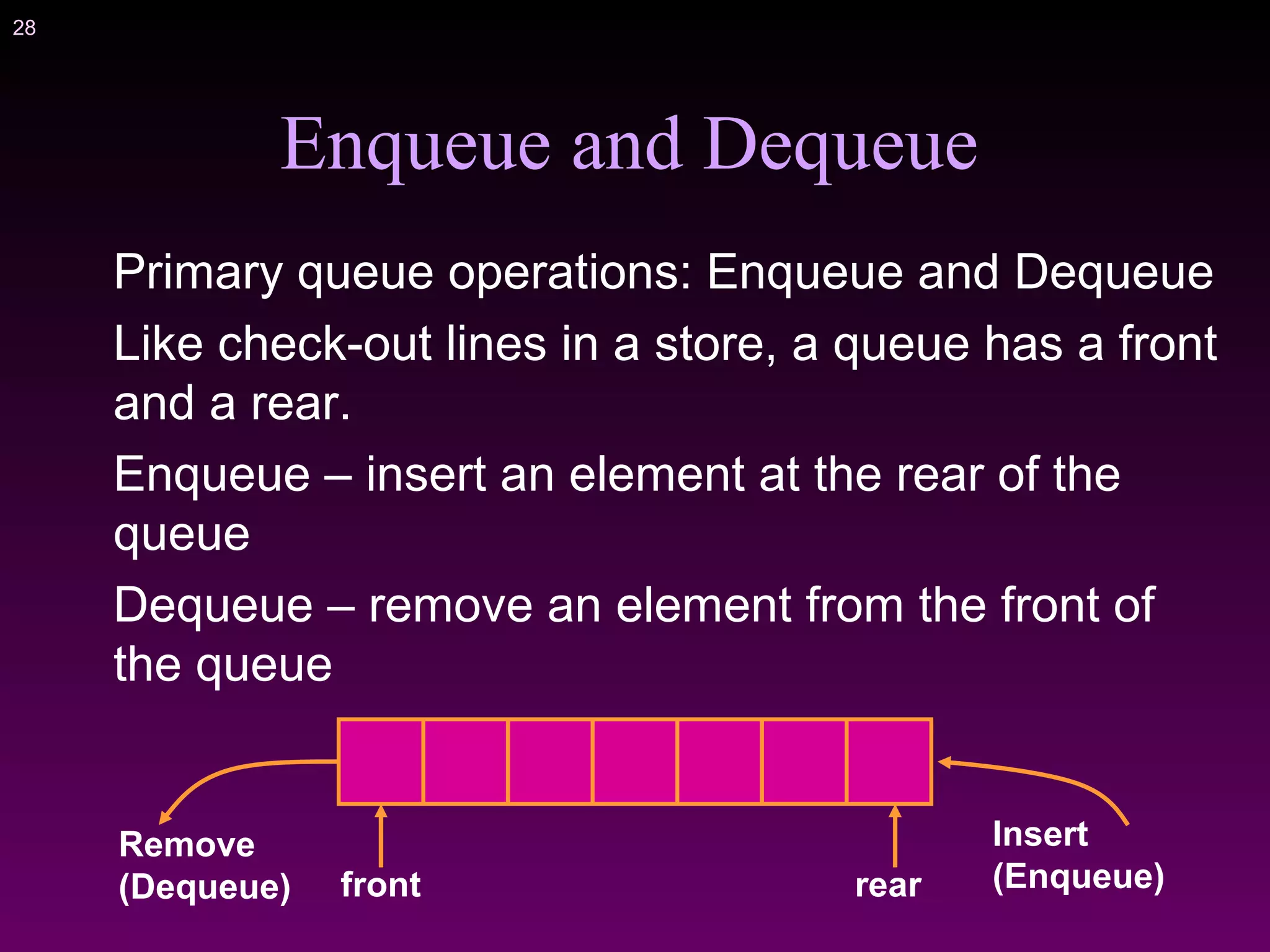
Enqueue and Dequeue
Primary queue operations: Enqueue and Dequeue
Like check-out lines in a store, a queue has a front
and a rear.
Enqueue – insert an element at the rear of the
queue
Dequeue – remove an element from the front of
the queue
Insert
(Enqueue)
Remove
(Dequeue) rearfront
29
Implementation of Queue
Just as stacks can be implemented as arrays
or linked lists, so with queues.
Dynamic queues have the same advantages
over static queues as dynamic stacks have
over static stacks
30
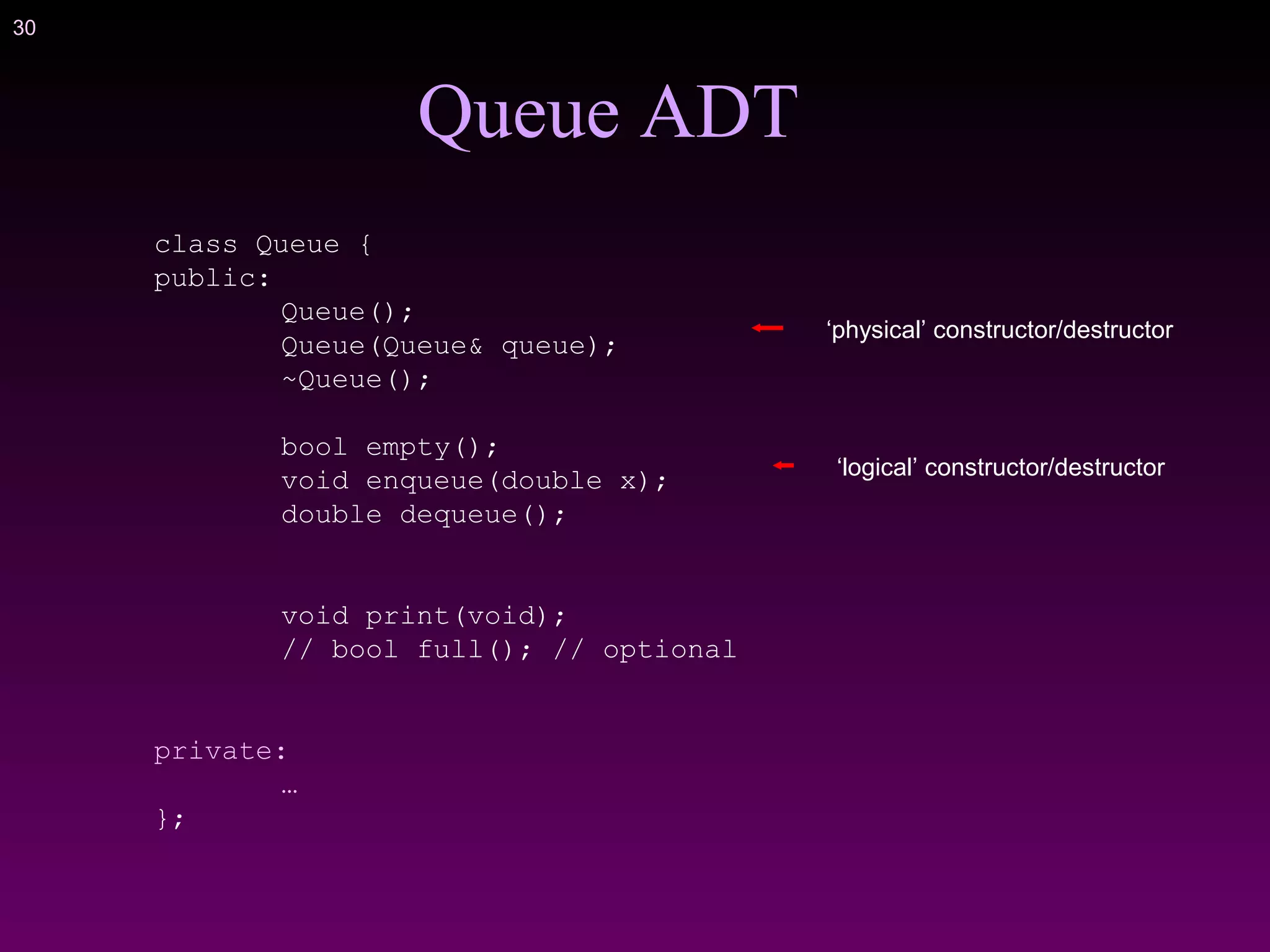
class Queue {
public:
Queue();
Queue(Queue& queue);
~Queue();
bool empty();
void enqueue(double x);
double dequeue();
void print(void);
// bool full(); // optional
private:
…
};
Queue ADT
‘physical’ constructor/destructor
‘logical’ constructor/destructor
31
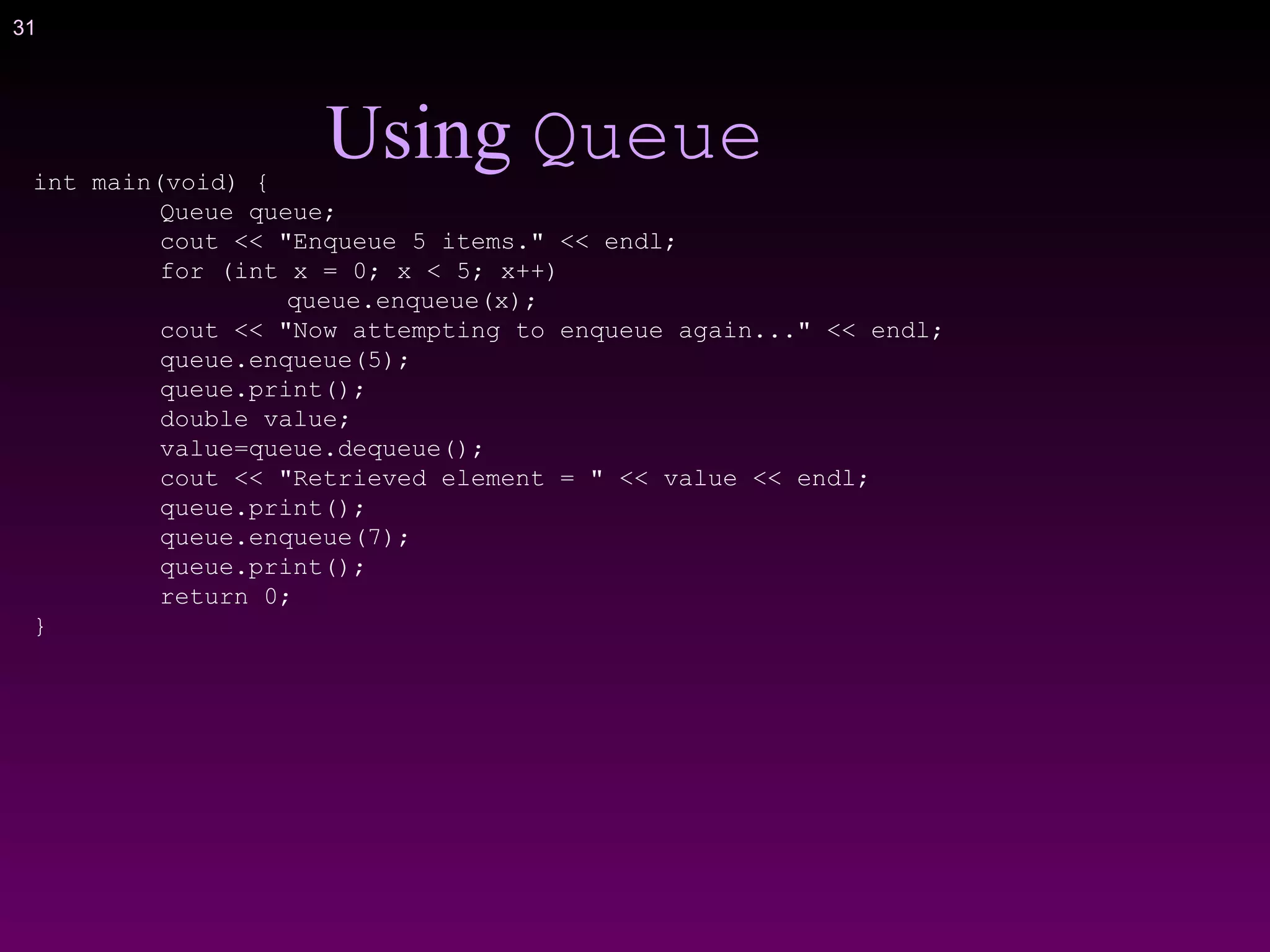
Using Queueint main(void) {
Queue queue;
cout << "Enqueue 5 items." << endl;
for (int x = 0; x < 5; x++)
queue.enqueue(x);
cout << "Now attempting to enqueue again..." << endl;
queue.enqueue(5);
queue.print();
double value;
value=queue.dequeue();
cout << "Retrieved element = " << value << endl;
queue.print();
queue.enqueue(7);
queue.print();
return 0;
}
32
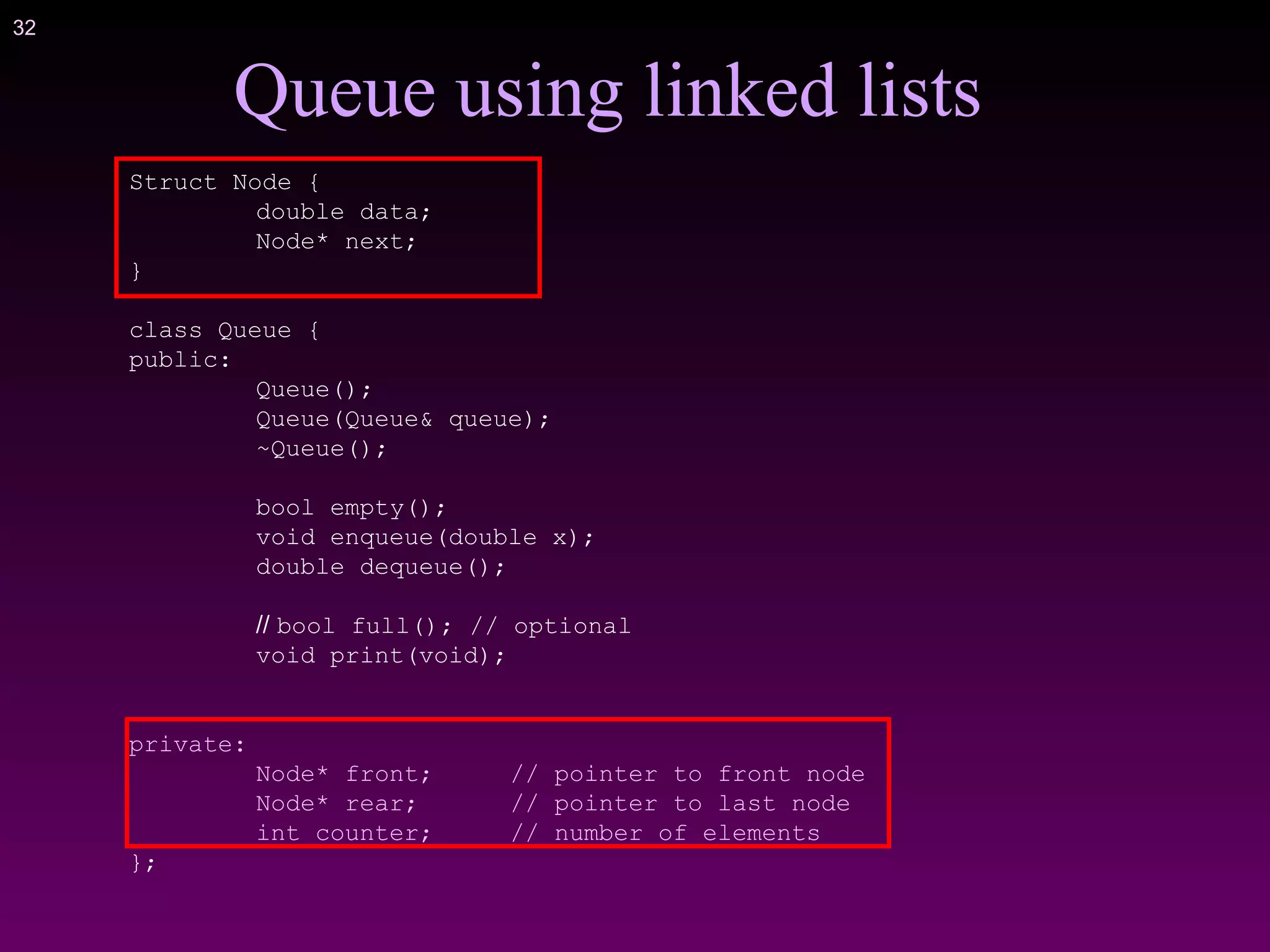
Struct Node {
double data;
Node* next;
}
class Queue {
public:
Queue();
Queue(Queue& queue);
~Queue();
bool empty();
void enqueue(double x);
double dequeue();
// bool full(); // optional
void print(void);
private:
Node* front; // pointer to front node
Node* rear; // pointer to last node
int counter; // number of elements
};
Queue using linked lists
33
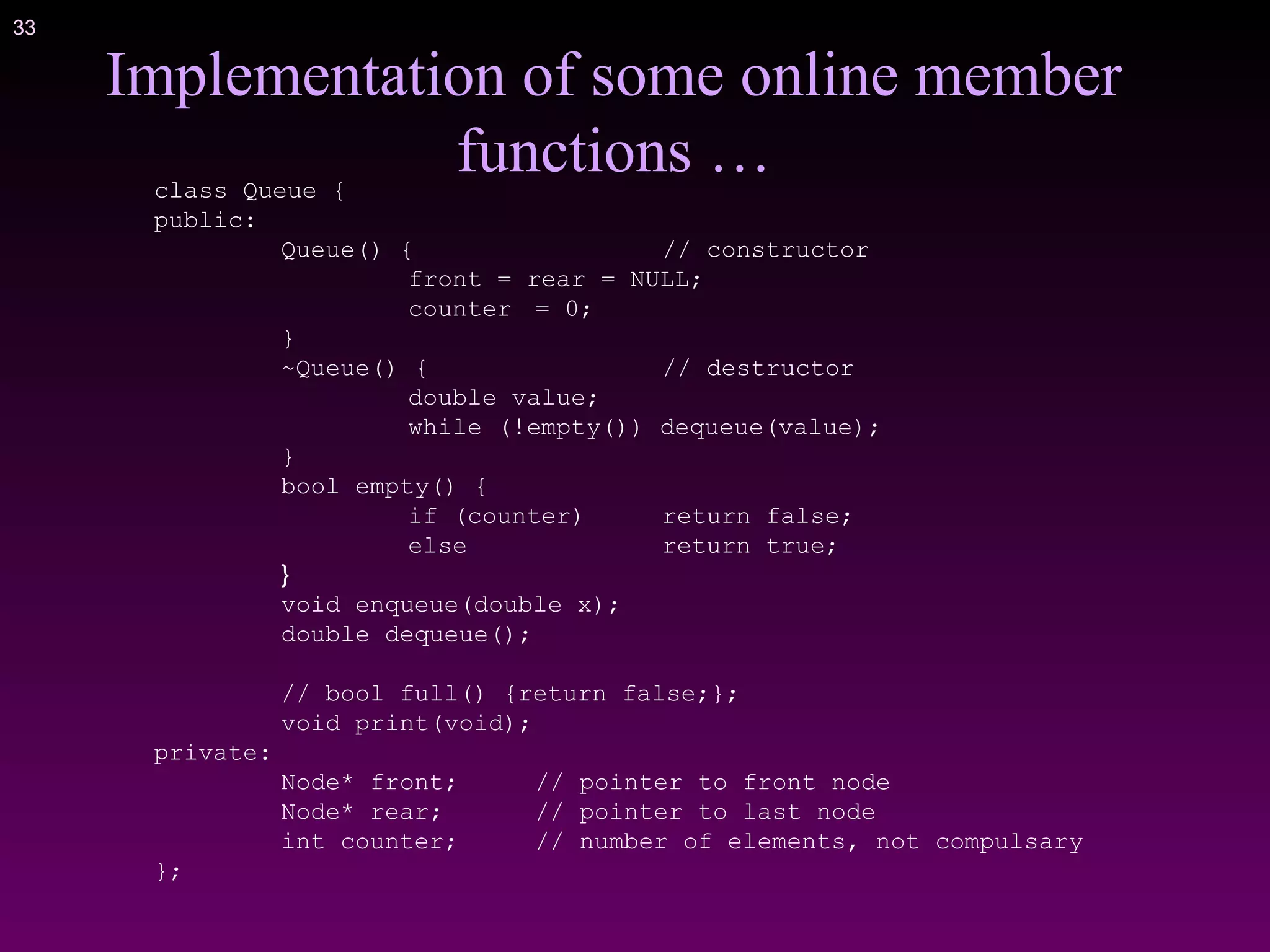
class Queue {
public:
Queue() { // constructor
front = rear = NULL;
counter = 0;
}
~Queue() { // destructor
double value;
while (!empty()) dequeue(value);
}
bool empty() {
if (counter) return false;
else return true;
}
void enqueue(double x);
double dequeue();
// bool full() {return false;};
void print(void);
private:
Node* front; // pointer to front node
Node* rear; // pointer to last node
int counter; // number of elements, not compulsary
};
Implementation of some online member
functions …
34
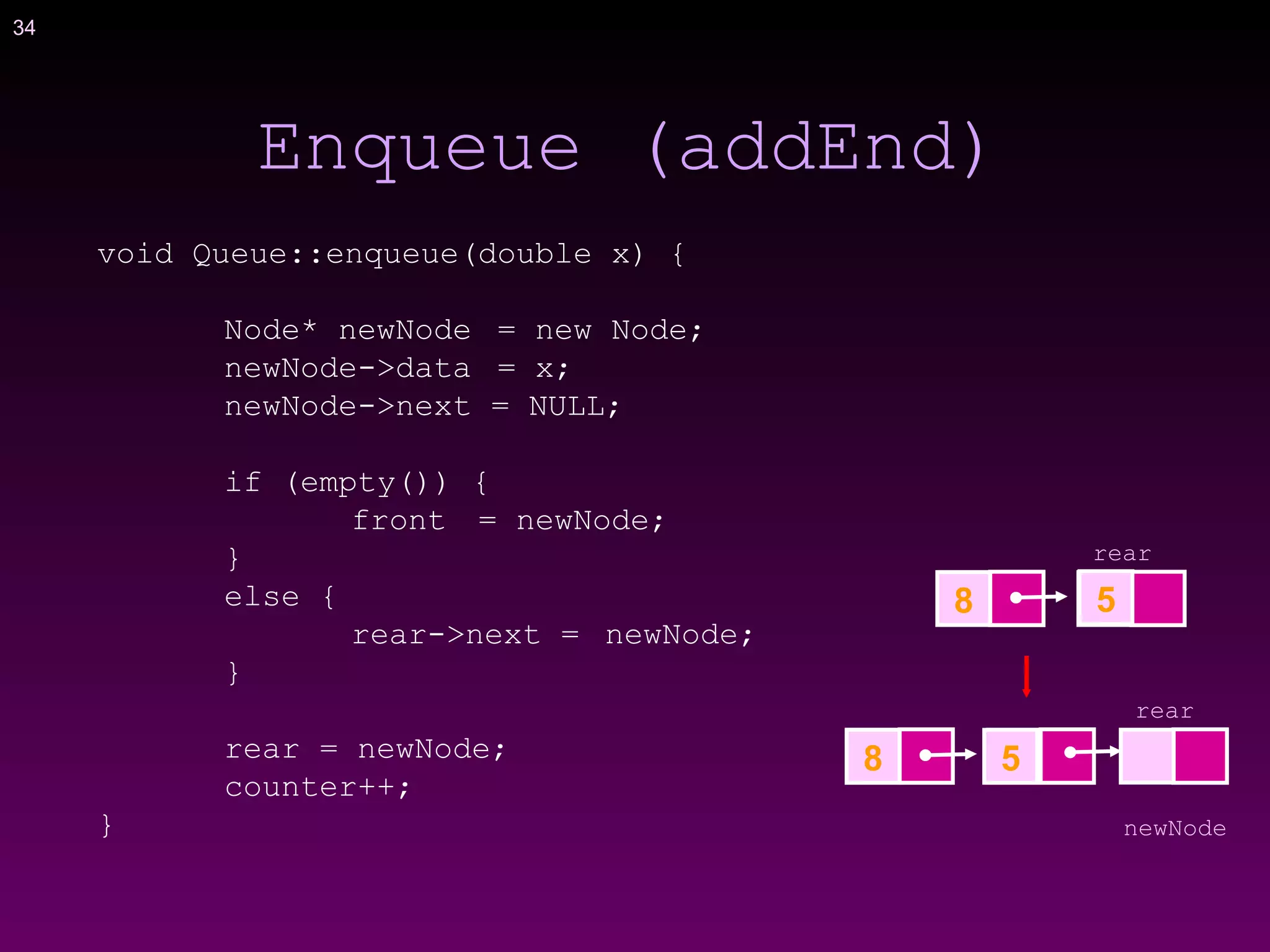
Enqueue (addEnd)
void Queue::enqueue(double x) {
Node* newNode = new Node;
newNode->data = x;
newNode->next = NULL;
if (empty()) {
front = newNode;
}
else {
rear->next = newNode;
}
rear = newNode;
counter++;
}
8
rear
rear
newNode
5
58
35
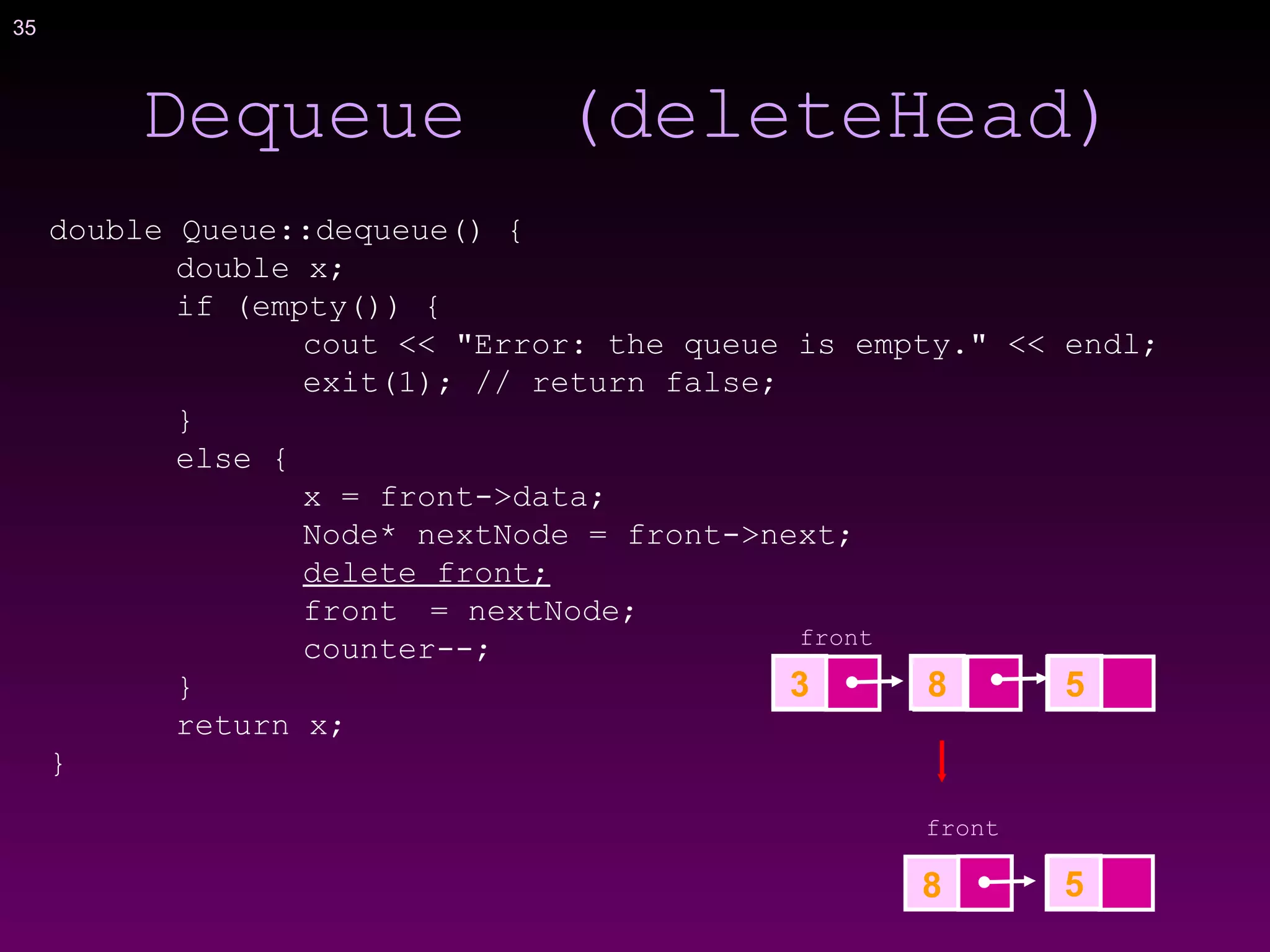
Dequeue (deleteHead)
double Queue::dequeue() {
double x;
if (empty()) {
cout << "Error: the queue is empty." << endl;
exit(1); // return false;
}
else {
x = front->data;
Node* nextNode = front->next;
delete front;
front = nextNode;
counter--;
}
return x;
}
front
583
8 5
front
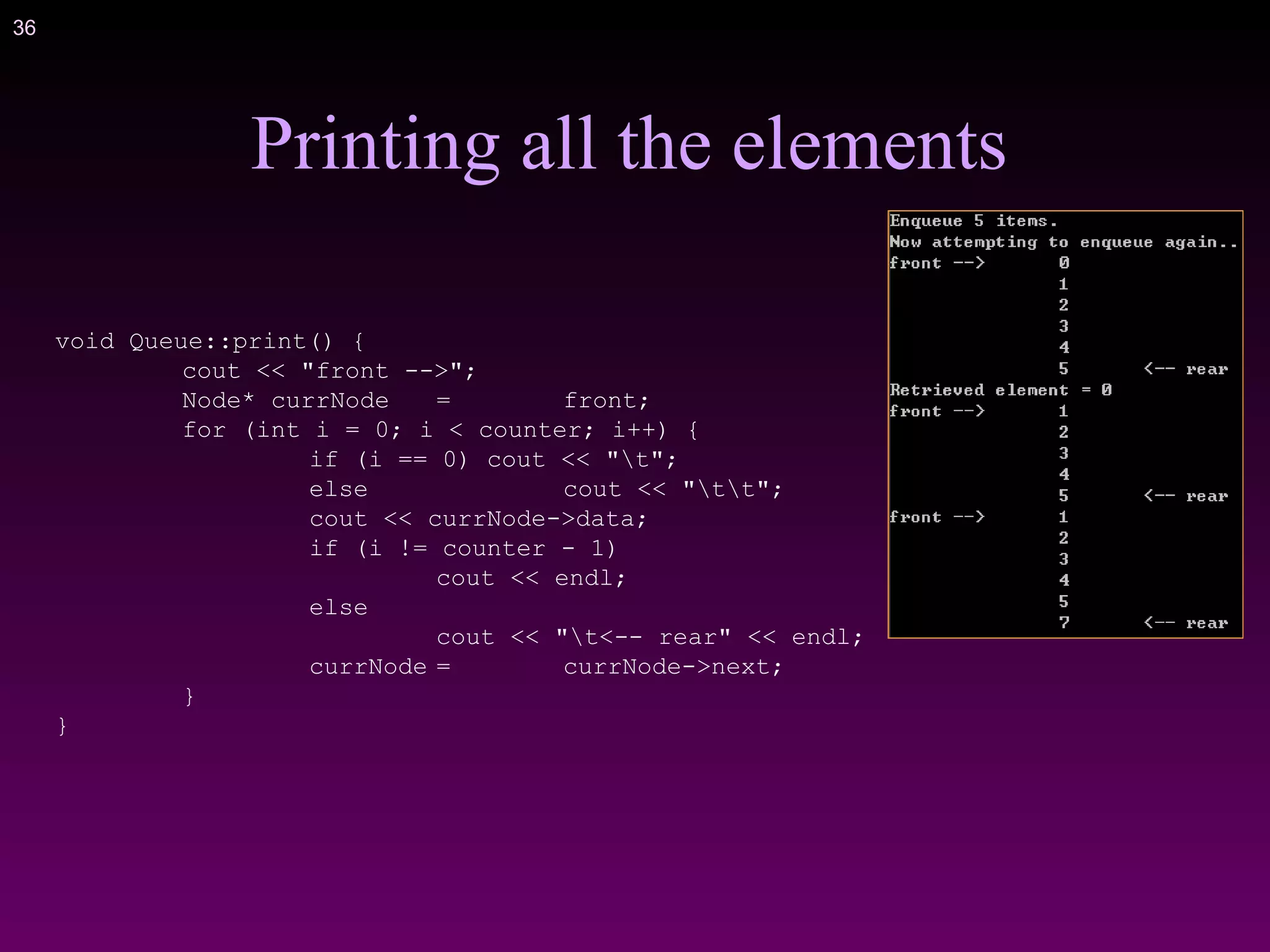
36
Printing all the elements
void Queue::print() {
cout << "front -->";
Node* currNode = front;
for (int i = 0; i < counter; i++) {
if (i == 0) cout << "t";
else cout << "tt";
cout << currNode->data;
if (i != counter - 1)
cout << endl;
else
cout << "t<-- rear" << endl;
currNode = currNode->next;
}
}
37
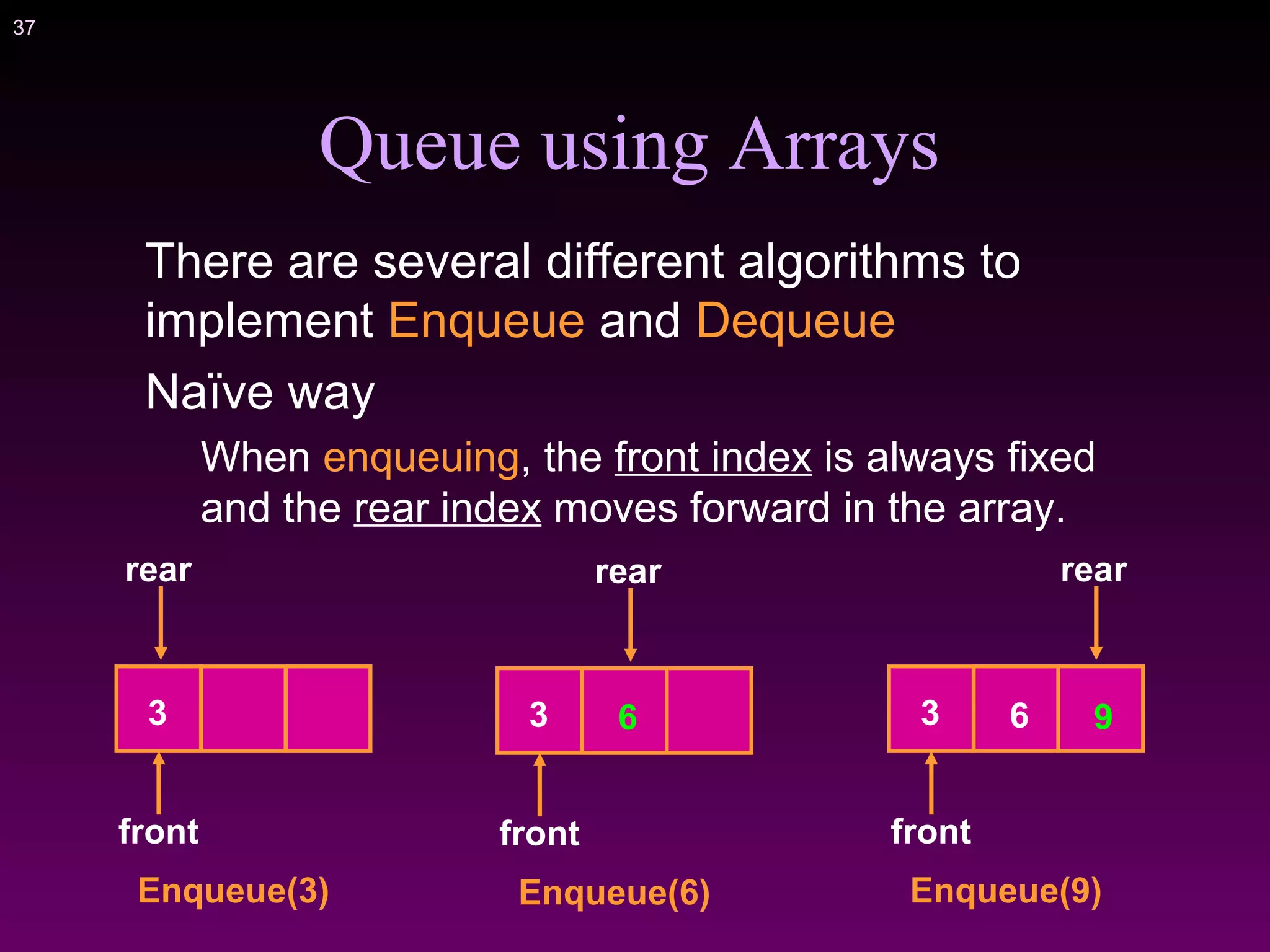
Queue using Arrays
There are several different algorithms to
implement Enqueue and Dequeue
Naïve way
When enqueuing, the front index is always fixed
and the rear index moves forward in the array.
front
rear
Enqueue(3)
3
front
rear
Enqueue(6)
3 6
front
rear
Enqueue(9)
3 6 9
38
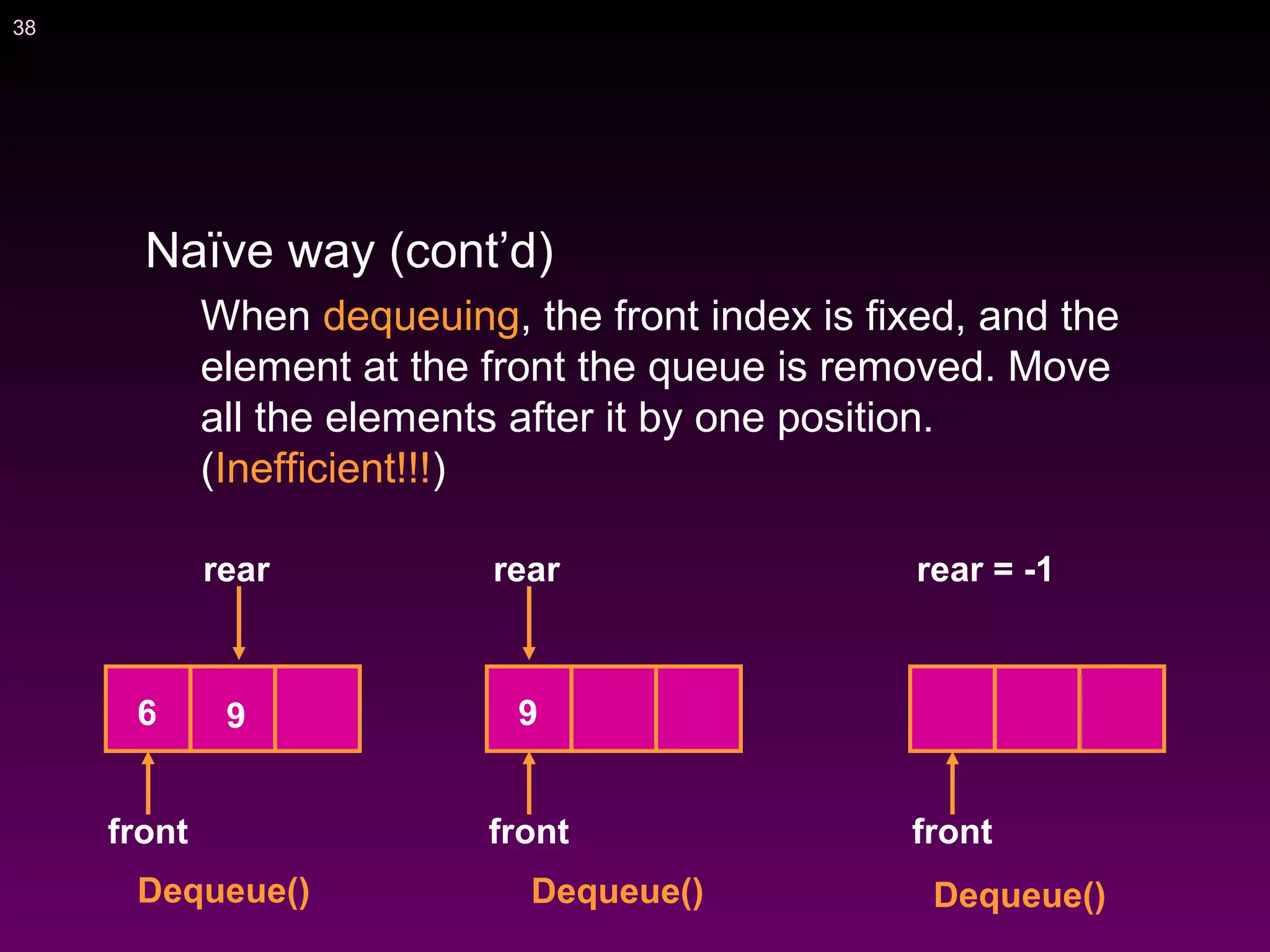
Naïve way (cont’d)
When dequeuing, the front index is fixed, and the
element at the front the queue is removed. Move
all the elements after it by one position.
(Inefficient!!!)
Dequeue()
front
rear
6 9
Dequeue() Dequeue()
front
rear
9
rear = -1
front
39
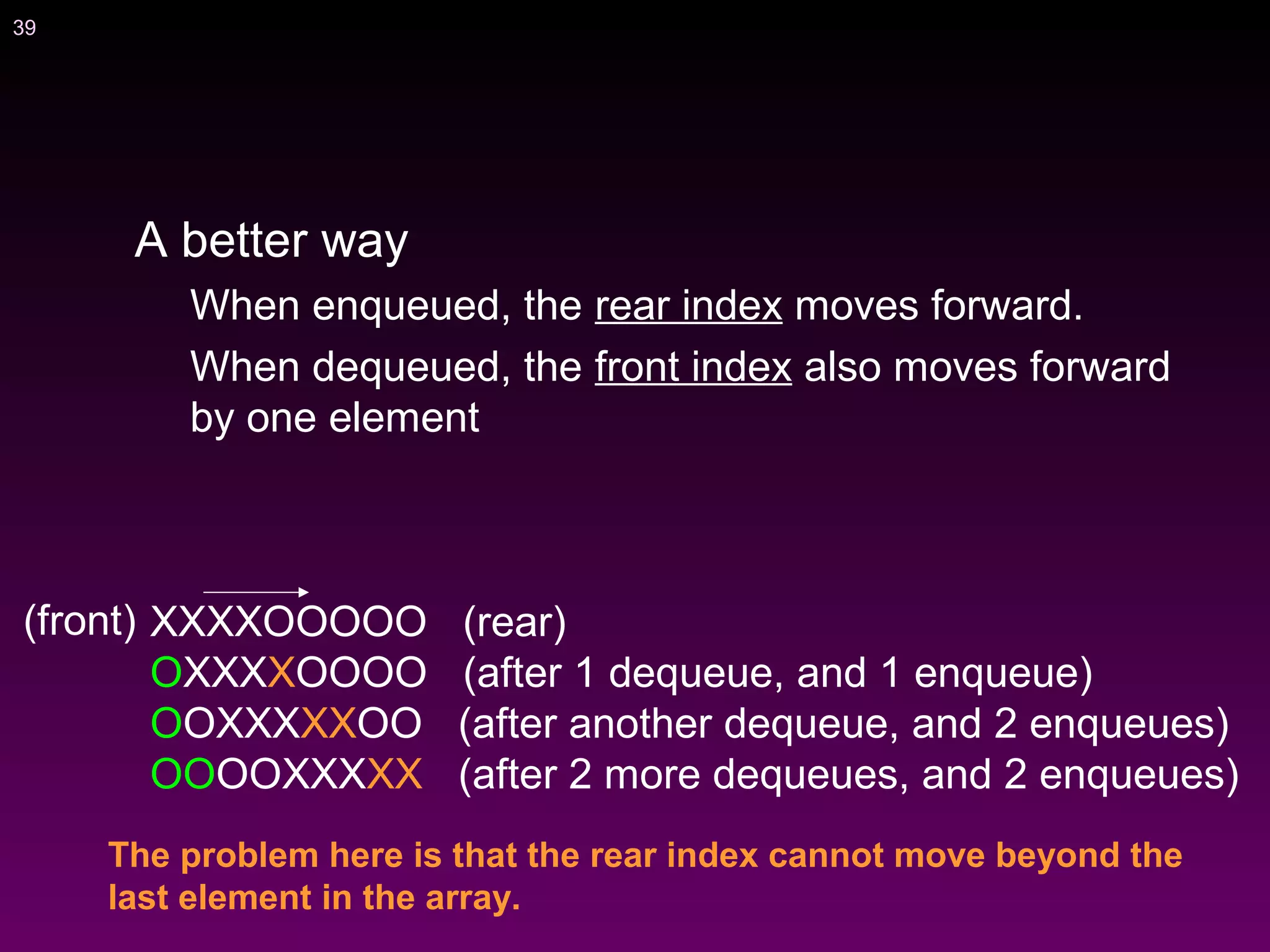
A better way
When enqueued, the rear index moves forward.
When dequeued, the front index also moves forward
by one element
XXXXOOOOO (rear)
OXXXXOOOO (after 1 dequeue, and 1 enqueue)
OOXXXXXOO (after another dequeue, and 2 enqueues)
OOOOXXXXX (after 2 more dequeues, and 2 enqueues)
(front)
The problem here is that the rear index cannot move beyond the
last element in the array.
40
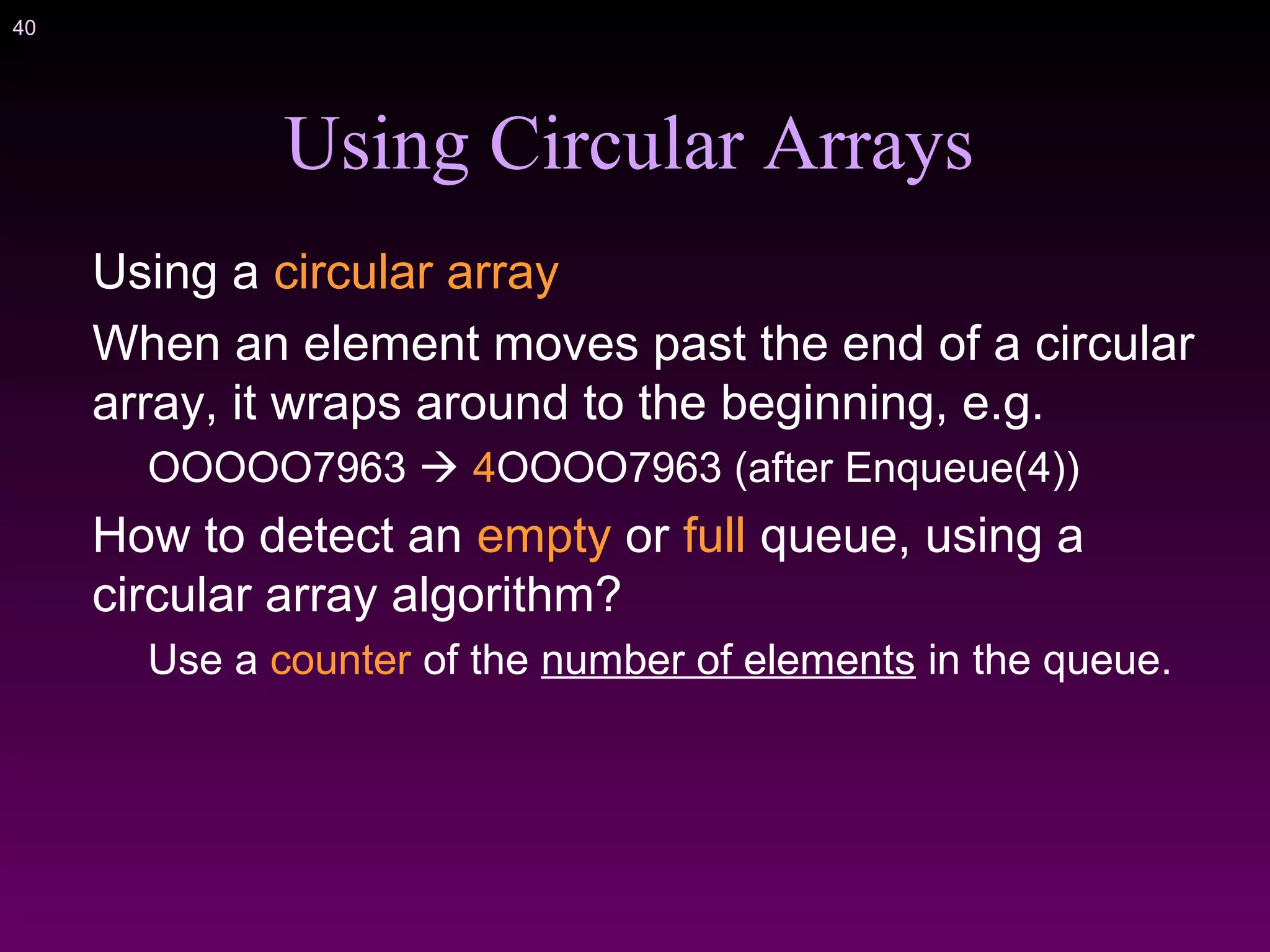
Using Circular Arrays
Using a circular array
When an element moves past the end of a circular
array, it wraps around to the beginning, e.g.
OOOOO7963  4OOOO7963 (after Enqueue(4))
How to detect an empty or full queue, using a
circular array algorithm?
Use a counter of the number of elements in the queue.
41
class Queue {
public:
Queue(int size = 10); // constructor
Queue(Queue& queue); // not necessary!
~Queue() { delete [] values; } // destructor
bool empty(void);
void enqueue(double x); // or bool enqueue();
double dequeue();
bool full();
void print(void);
private:
int front; // front index
int rear; // rear index
int counter; // number of elements
int maxSize; // size of array queue
double* values; // element array
};
full() is not essential, can be embedded
42
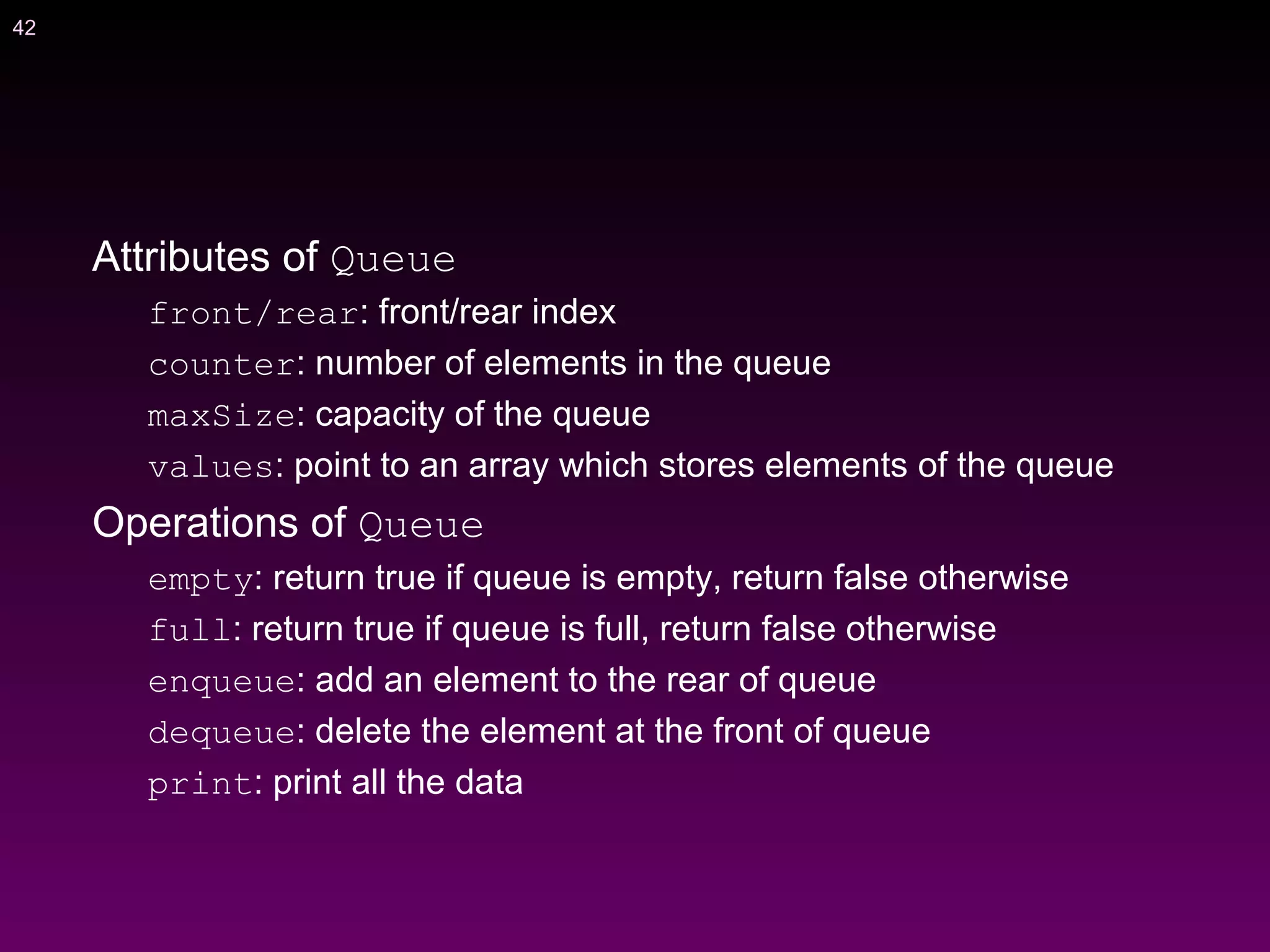
Attributes of Queue
front/rear: front/rear index
counter: number of elements in the queue
maxSize: capacity of the queue
values: point to an array which stores elements of the queue
Operations of Queue
empty: return true if queue is empty, return false otherwise
full: return true if queue is full, return false otherwise
enqueue: add an element to the rear of queue
dequeue: delete the element at the front of queue
print: print all the data
43
Queue constructor
Queue(int size = 10)
Allocate a queue array of size. By default, size = 10.
front is set to 0, pointing to the first element of the
array
rear is set to -1. The queue is empty initially.
Queue::Queue(int size /* = 10 */) {
values = new double[size];
maxSize = size;
front = 0;
rear = -1;
counter = 0;
}
44
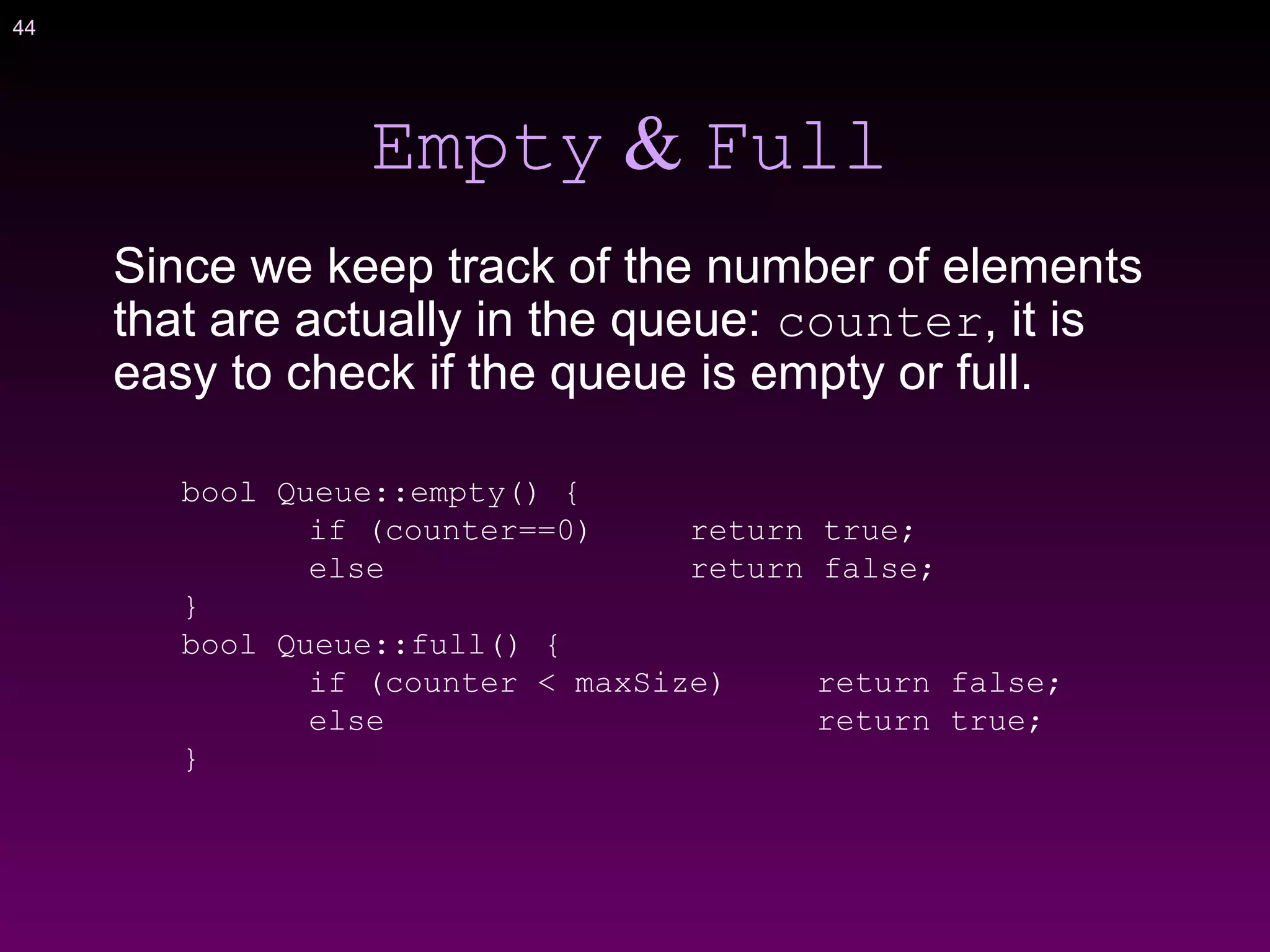
Empty & Full
Since we keep track of the number of elements
that are actually in the queue: counter, it is
easy to check if the queue is empty or full.
bool Queue::empty() {
if (counter==0) return true;
else return false;
}
bool Queue::full() {
if (counter < maxSize) return false;
else return true;
}
45
Enqueue
void Queue::enqueue(double x) {
if (full()) {
cout << "Error: the queue is full." << endl;
exit(1); // return false;
}
else {
// calculate the new rear position (circular)
rear = (rear + 1) % maxSize;
// insert new item
values[rear] = x;
// update counter
counter++;
// return true;
}
}
Or ‘bool’ if you want
46
Dequeue
double Queue::dequeue() {
double x;
if (empty()) {
cout << "Error: the queue is empty." << endl;
exit(1); // return false;
}
else {
// retrieve the front item
x = values[front];
// move front
front = (front + 1) % maxSize;
// update counter
counter--;
// return true;
}
return x;
}
47
Printing the elements
void Queue::print() {
cout << "front -->";
for (int i = 0; i < counter; i++) {
if (i == 0) cout << "t";
else cout << "tt";
cout << values[(front + i) % maxSize];
if (i != counter - 1)
cout << endl;
else
cout << "t<-- rear" << endl;
}
}
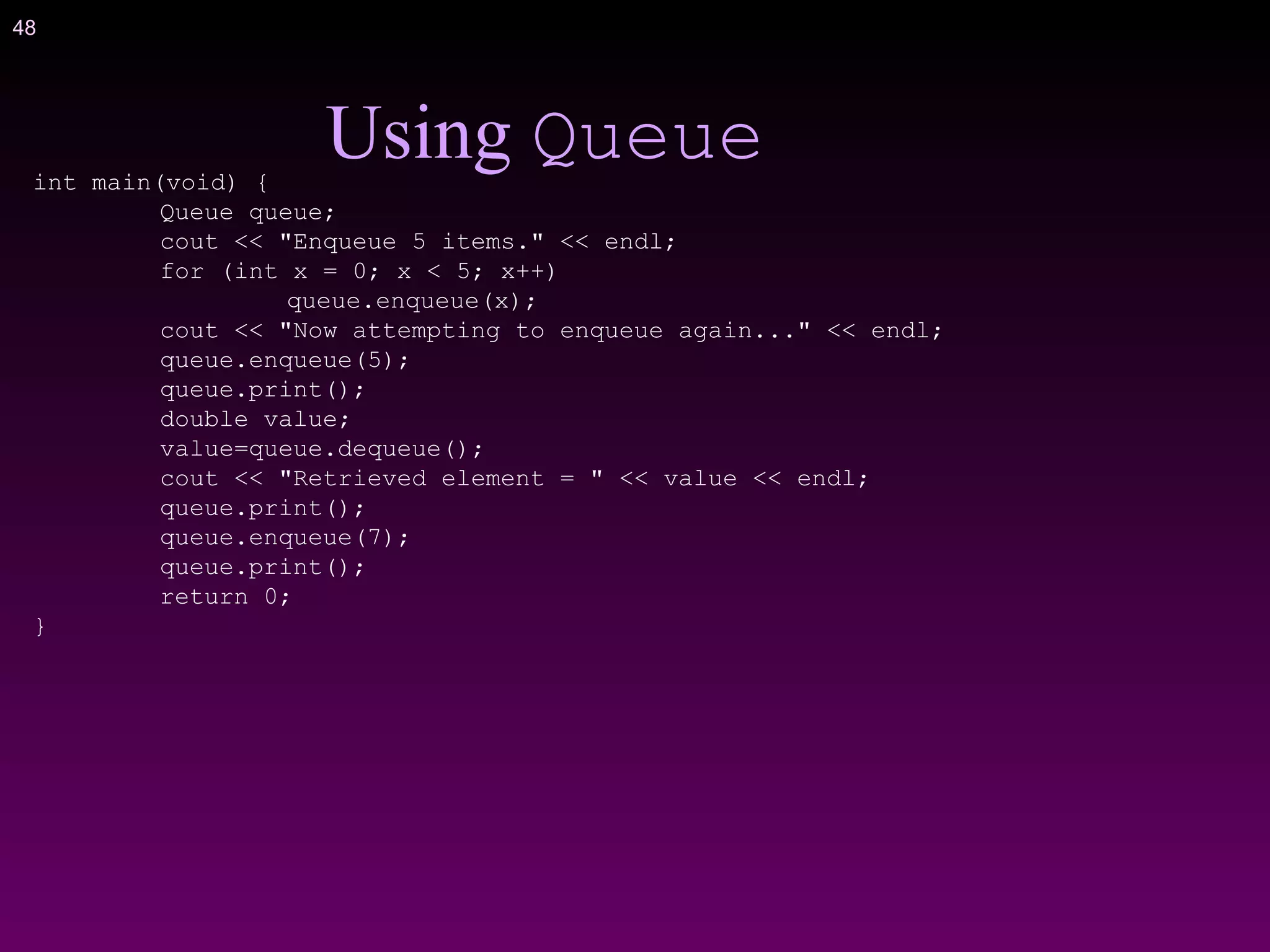
48
Using Queueint main(void) {
Queue queue;
cout << "Enqueue 5 items." << endl;
for (int x = 0; x < 5; x++)
queue.enqueue(x);
cout << "Now attempting to enqueue again..." << endl;
queue.enqueue(5);
queue.print();
double value;
value=queue.dequeue();
cout << "Retrieved element = " << value << endl;
queue.print();
queue.enqueue(7);
queue.print();
return 0;
}
49
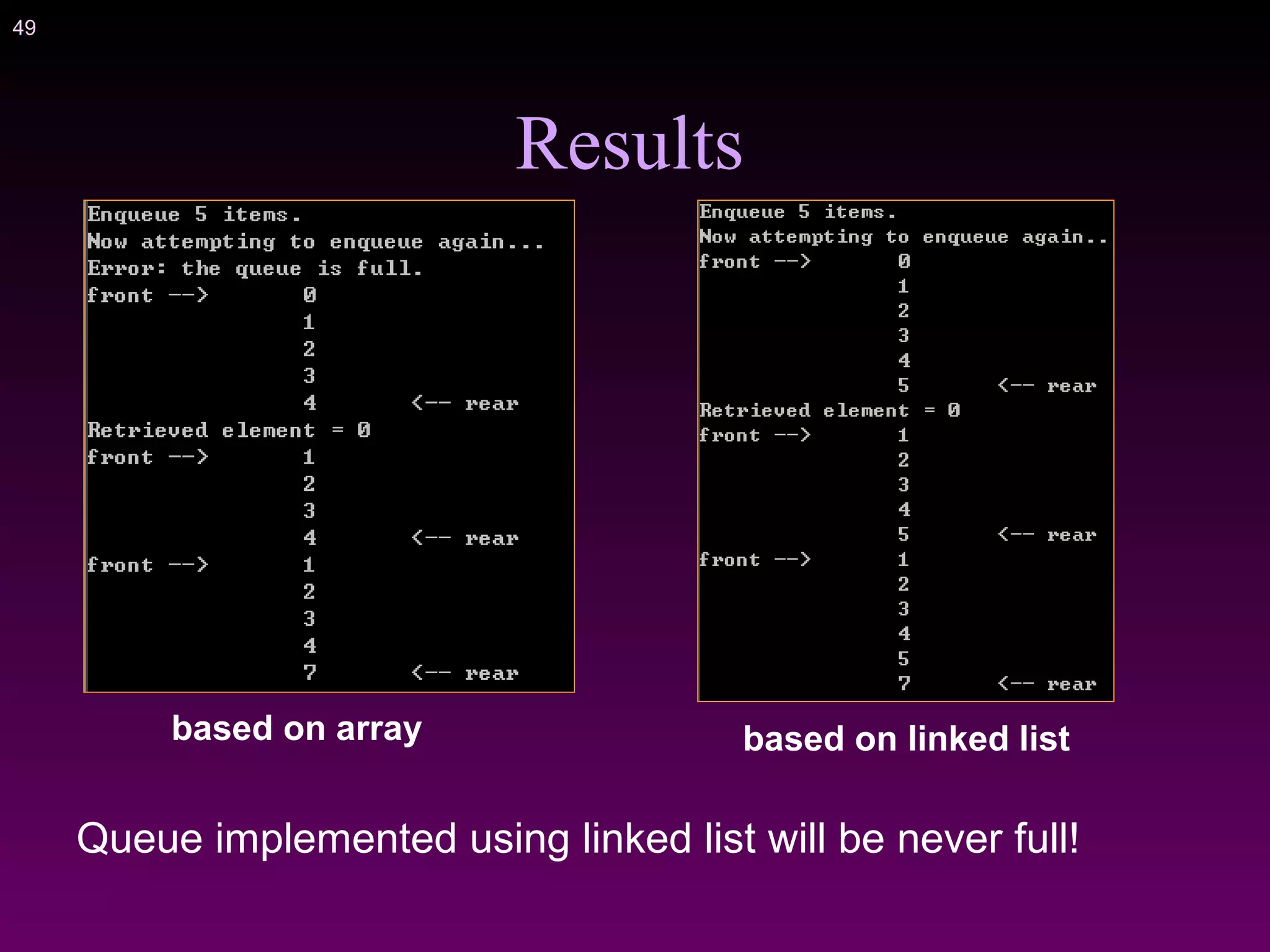
Results
Queue implemented using linked list will be never full!
based on array based on linked list
50
Queue applications
When jobs are sent to a printer, in order of
arrival, a queue.
Customers at ticket counters …

Stack queue

  • 1.
  • 2.
    2 struct Node{ doubledata; Node* next; }; class List { public: List(); // constructor List(const List& list); // copy constructor ~List(); // destructor List& operator=(const List& list); // assignment operator bool empty() const; // boolean function void addHead(double x); // add to the head double deleteHead(); // delete the head and get the head element // List& rest(); // get the rest of the list with the head removed // double headElement() const; // get the head element void addEnd(double x); // add to the end double deleteEnd(); // delete the end and get the end element // double endElement(); // get the element at the end bool searchNode(double x); // search for a given x void insertNode(double x); // insert x in a sorted list void deleteNode(double x); // delete x in a sorted list … void print() const; // output int length() const; // count the number of elements private: Node* head; }; More complete list ADT
  • 3.
    3 Stack Overview Stack ADT Basicoperations of stack Pushing, popping etc. Implementations of stacks using array linked list
  • 4.
    4 Stack A stack isa list in which insertion and deletion take place at the same end This end is called top The other end is called bottom Stacks are known as LIFO (Last In, First Out) lists. The last element inserted will be the first to be retrieved
  • 5.
    5 Push and Pop Primaryoperations: Push and Pop Push Add an element to the top of the stack Pop Remove the element at the top of the stack top empty stack A top push an element top push another A B top pop A
  • 6.
    6 Implementation of Stacks Anylist implementation could be used to implement a stack Arrays (static: the size of stack is given initially) Linked lists (dynamic: never become full) We will explore implementations based on array and linked list
  • 7.
    7 class Stack { public: Stack();// constructor Stack(const Stack& stack); // copy constructor ~Stack(); // destructor bool empty() const; void push(const double x); double pop(); // change the stack double top() const; // keep the stack unchanged // bool full(); // optional // void print() const; private: … }; Stack ADT update, ‘logical’ constructor/destructor, composition/decomposition ‘physical’ constructor/destructor Compare with List, see that it’s ‘operations’ that define the type! inspection, access
  • 8.
    8 Using Stack int main(void){ Stack stack; stack.push(5.0); stack.push(6.5); stack.push(-3.0); stack.push(-8.0); stack.print(); cout << "Top: " << stack.top() << endl; stack.pop(); cout << "Top: " << stack.top() << endl; while (!stack.empty()) stack.pop(); stack.print(); return 0; } result
  • 9.
    9 struct Node{ public: double data; Node*next; }; class Stack { public: Stack(); // constructor Stack(const Stack& stack); // copy constructor ~Stack(); // destructor bool empty() const; void push(const double x); double pop(); // change the stack bool full(); // unnecessary for linked lists double top() const; // keep the stack unchanged void print() const; private: Node* top; }; Stack using linked lists
  • 10.
    10 void List::addHead(int newdata){ NodeptrnewPtr = new Node; newPtr->data = newdata; newPtr->next = head; head = newPtr; } void Stack::push(double x){ Node* newPtr = new Node; newPtr->data = x; newPtr->next = top; top = newPtr; } From ‘addHead’ to ‘push’ Push (addHead), Pop (deleteHead)
  • 11.
    11 Implementation based on‘existing’ linked lists Optional to learn  Good to see that we may ‘re-use’ linked lists
  • 12.
    12 Now let’s implementa stack based on a linked list To make the best out of the code of List, we implement Stack by inheriting List To let Stack access private member head, we make Stack as a friend of List class List { public: List() { head = NULL; } // constructor ~List(); // destructor bool empty() { return head == NULL; } Node* insertNode(int index, double x); int deleteNode(double x); int searchNode(double x); void printList(void); private: Node* head; friend class Stack; };
  • 13.
    13 class Stack :public List { public: Stack() {} ~Stack() {} double top() { if (head == NULL) { cout << "Error: the stack is empty." << endl; return -1; } else return head->data; } void push(const double x) { InsertNode(0, x); } double pop() { if (head == NULL) { cout << "Error: the stack is empty." << endl; return -1; } else { double val = head->data; DeleteNode(val); return val; } } void printStack() { printList(); } }; Note: the stack implementation based on a linked list will never be full. from List
  • 14.
    14 Stack using arrays classStack { public: Stack(int size = 10); // constructor ~Stack() { delete [] values; } // destructor bool empty() { return top == -1; } void push(const double x); double pop(); bool full() { return top == maxTop; } double top(); void print(); private: int maxTop; // max stack size = size - 1 int top; // current top of stack double* values; // element array };
  • 15.
    15 Attributes of Stack maxTop:the max size of stack top: the index of the top element of stack values: point to an array which stores elements of stack Operations of Stack empty: return true if stack is empty, return false otherwise full: return true if stack is full, return false otherwise top: return the element at the top of stack push: add an element to the top of stack pop: delete the element at the top of stack print: print all the data in the stack
  • 16.
    16 Allocate a stackarray of size. By default, size = 10. Initially top is set to -1. It means the stack is empty. When the stack is full, top will have its maximum value, i.e. size – 1. Stack::Stack(int size /*= 10*/) { values = new double[size]; top = -1; maxTop = size - 1; } Although the constructor dynamically allocates the stack array, the stack is still static. The size is fixed after the initialization. Stack constructor
  • 17.
    17 void push(const doublex); Push an element onto the stack Note top always represents the index of the top element. After pushing an element, increment top. void Stack::push(const double x) { if (full()) // if stack is full, print error cout << "Error: the stack is full." << endl; else values[++top] = x; }
  • 18.
    18 double pop() Pop andreturn the element at the top of the stack Don’t forgot to decrement top double Stack::pop() { if (empty()) { //if stack is empty, print error cout << "Error: the stack is empty." << endl; return -1; } else { return values[top--]; } }
  • 19.
    19 double top() Return thetop element of the stack Unlike pop, this function does not remove the top element double Stack::top() { if (empty()) { cout << "Error: the stack is empty." << endl; return -1; } else return values[top]; }
  • 20.
    20 void print() Print allthe elements void Stack::print() { cout << "top -->"; for (int i = top; i >= 0; i--) cout << "t|t" << values[i] << "t|" << endl; cout << "t|---------------|" << endl; }
  • 21.
    21 Stack Application: Balancing Symbols Tocheck that every right brace, bracket, and parentheses must correspond to its left counterpart e.g. [( )] is legal, but [( ] ) is illegal Algorithm (1) Make an empty stack. (2) Read characters until end of file i. If the character is an opening symbol, push it onto the stack ii. If it is a closing symbol, then if the stack is empty, report an error iii. Otherwise, pop the stack. If the symbol popped is not the corresponding opening symbol, then report an error (3) At end of file, if the stack is not empty, report an error
  • 22.
    22 Stack Application: functioncalls and recursion Take the example of factorial! And run it. #include <iostream> using namespace std; int fac(int n){ int product; if(n <= 1) product = 1; else product = n * fac(n-1); return product; } void main(){ int number; cout << "Enter a positive integer : " << endl;; cin >> number; cout << fac(number) << endl; }
  • 23.
    23 Assume the numbertyped is 3. fac(3): has the final returned value 6 3<=1 ? No. product3 = 3*fac(2) product3=3*2=6, return 6, fac(2): 2<=1 ? No. product2 = 2*fac(1) product2=2*1=2, return 2, fac(1): 1<=1 ? Yes. return 1 Tracing the program …
  • 24.
    24 fac(3) prod3=3*fac(2) prod2=2*fac(1)fac(2) fac(1) prod1=1 Callis to ‘push’ and return is to ‘pop’! top
  • 25.
    25 Array versus linked listimplementations push, pop, top are all constant-time operations in both array and linked list implementation For array implementation, the operations are performed in very fast constant time
  • 26.
    26 Queue Overview Queue ADT Basicoperations of queue Enqueuing, dequeuing etc. Implementation of queue Linked list Array
  • 27.
    27 Queue A queue isalso a list. However, insertion is done at one end, while deletion is performed at the other end. It is “First In, First Out (FIFO)” order. Like customers standing in a check-out line in a store, the first customer in is the first customer served.
  • 28.
    28 Enqueue and Dequeue Primaryqueue operations: Enqueue and Dequeue Like check-out lines in a store, a queue has a front and a rear. Enqueue – insert an element at the rear of the queue Dequeue – remove an element from the front of the queue Insert (Enqueue) Remove (Dequeue) rearfront
  • 29.
    29 Implementation of Queue Justas stacks can be implemented as arrays or linked lists, so with queues. Dynamic queues have the same advantages over static queues as dynamic stacks have over static stacks
  • 30.
    30 class Queue { public: Queue(); Queue(Queue&queue); ~Queue(); bool empty(); void enqueue(double x); double dequeue(); void print(void); // bool full(); // optional private: … }; Queue ADT ‘physical’ constructor/destructor ‘logical’ constructor/destructor
  • 31.
    31 Using Queueint main(void){ Queue queue; cout << "Enqueue 5 items." << endl; for (int x = 0; x < 5; x++) queue.enqueue(x); cout << "Now attempting to enqueue again..." << endl; queue.enqueue(5); queue.print(); double value; value=queue.dequeue(); cout << "Retrieved element = " << value << endl; queue.print(); queue.enqueue(7); queue.print(); return 0; }
  • 32.
    32 Struct Node { doubledata; Node* next; } class Queue { public: Queue(); Queue(Queue& queue); ~Queue(); bool empty(); void enqueue(double x); double dequeue(); // bool full(); // optional void print(void); private: Node* front; // pointer to front node Node* rear; // pointer to last node int counter; // number of elements }; Queue using linked lists
  • 33.
    33 class Queue { public: Queue(){ // constructor front = rear = NULL; counter = 0; } ~Queue() { // destructor double value; while (!empty()) dequeue(value); } bool empty() { if (counter) return false; else return true; } void enqueue(double x); double dequeue(); // bool full() {return false;}; void print(void); private: Node* front; // pointer to front node Node* rear; // pointer to last node int counter; // number of elements, not compulsary }; Implementation of some online member functions …
  • 34.
    34 Enqueue (addEnd) void Queue::enqueue(doublex) { Node* newNode = new Node; newNode->data = x; newNode->next = NULL; if (empty()) { front = newNode; } else { rear->next = newNode; } rear = newNode; counter++; } 8 rear rear newNode 5 58
  • 35.
    35 Dequeue (deleteHead) double Queue::dequeue(){ double x; if (empty()) { cout << "Error: the queue is empty." << endl; exit(1); // return false; } else { x = front->data; Node* nextNode = front->next; delete front; front = nextNode; counter--; } return x; } front 583 8 5 front
  • 36.
    36 Printing all theelements void Queue::print() { cout << "front -->"; Node* currNode = front; for (int i = 0; i < counter; i++) { if (i == 0) cout << "t"; else cout << "tt"; cout << currNode->data; if (i != counter - 1) cout << endl; else cout << "t<-- rear" << endl; currNode = currNode->next; } }
  • 37.
    37 Queue using Arrays Thereare several different algorithms to implement Enqueue and Dequeue Naïve way When enqueuing, the front index is always fixed and the rear index moves forward in the array. front rear Enqueue(3) 3 front rear Enqueue(6) 3 6 front rear Enqueue(9) 3 6 9
  • 38.
    38 Naïve way (cont’d) Whendequeuing, the front index is fixed, and the element at the front the queue is removed. Move all the elements after it by one position. (Inefficient!!!) Dequeue() front rear 6 9 Dequeue() Dequeue() front rear 9 rear = -1 front
  • 39.
    39 A better way Whenenqueued, the rear index moves forward. When dequeued, the front index also moves forward by one element XXXXOOOOO (rear) OXXXXOOOO (after 1 dequeue, and 1 enqueue) OOXXXXXOO (after another dequeue, and 2 enqueues) OOOOXXXXX (after 2 more dequeues, and 2 enqueues) (front) The problem here is that the rear index cannot move beyond the last element in the array.
  • 40.
    40 Using Circular Arrays Usinga circular array When an element moves past the end of a circular array, it wraps around to the beginning, e.g. OOOOO7963  4OOOO7963 (after Enqueue(4)) How to detect an empty or full queue, using a circular array algorithm? Use a counter of the number of elements in the queue.
  • 41.
    41 class Queue { public: Queue(intsize = 10); // constructor Queue(Queue& queue); // not necessary! ~Queue() { delete [] values; } // destructor bool empty(void); void enqueue(double x); // or bool enqueue(); double dequeue(); bool full(); void print(void); private: int front; // front index int rear; // rear index int counter; // number of elements int maxSize; // size of array queue double* values; // element array }; full() is not essential, can be embedded
  • 42.
    42 Attributes of Queue front/rear:front/rear index counter: number of elements in the queue maxSize: capacity of the queue values: point to an array which stores elements of the queue Operations of Queue empty: return true if queue is empty, return false otherwise full: return true if queue is full, return false otherwise enqueue: add an element to the rear of queue dequeue: delete the element at the front of queue print: print all the data
  • 43.
    43 Queue constructor Queue(int size= 10) Allocate a queue array of size. By default, size = 10. front is set to 0, pointing to the first element of the array rear is set to -1. The queue is empty initially. Queue::Queue(int size /* = 10 */) { values = new double[size]; maxSize = size; front = 0; rear = -1; counter = 0; }
  • 44.
    44 Empty & Full Sincewe keep track of the number of elements that are actually in the queue: counter, it is easy to check if the queue is empty or full. bool Queue::empty() { if (counter==0) return true; else return false; } bool Queue::full() { if (counter < maxSize) return false; else return true; }
  • 45.
    45 Enqueue void Queue::enqueue(double x){ if (full()) { cout << "Error: the queue is full." << endl; exit(1); // return false; } else { // calculate the new rear position (circular) rear = (rear + 1) % maxSize; // insert new item values[rear] = x; // update counter counter++; // return true; } } Or ‘bool’ if you want
  • 46.
    46 Dequeue double Queue::dequeue() { doublex; if (empty()) { cout << "Error: the queue is empty." << endl; exit(1); // return false; } else { // retrieve the front item x = values[front]; // move front front = (front + 1) % maxSize; // update counter counter--; // return true; } return x; }
  • 47.
    47 Printing the elements voidQueue::print() { cout << "front -->"; for (int i = 0; i < counter; i++) { if (i == 0) cout << "t"; else cout << "tt"; cout << values[(front + i) % maxSize]; if (i != counter - 1) cout << endl; else cout << "t<-- rear" << endl; } }
  • 48.
    48 Using Queueint main(void){ Queue queue; cout << "Enqueue 5 items." << endl; for (int x = 0; x < 5; x++) queue.enqueue(x); cout << "Now attempting to enqueue again..." << endl; queue.enqueue(5); queue.print(); double value; value=queue.dequeue(); cout << "Retrieved element = " << value << endl; queue.print(); queue.enqueue(7); queue.print(); return 0; }
  • 49.
    49 Results Queue implemented usinglinked list will be never full! based on array based on linked list
  • 50.
    50 Queue applications When jobsare sent to a printer, in order of arrival, a queue. Customers at ticket counters …