Chapter 11 -
MME-292
Arman Hussain
Lecturer
DGCE, BUET
Metallic Materials Sessional
Lecture 05
Cast Iron
September 7, 2014
Chapter 11 - 2
Chapter 11: Applications and
Processing of Metal Alloys
ISSUES TO ADDRESS...
• How are Cast Iron classified and what are their
common applications?
• What are some of the common fabrication techniques
for metals?
• What heat treatment procedures are used to improve the
mechanical properties of Cast Irons?
Chapter 11 - 3
Adapted from Fig. 9.24, Callister &
Rethwisch 8e. (Fig. 9.24 adapted from
Binary Alloy Phase Diagrams, 2nd ed.,
Vol. 1, T.B. Massalski (Ed.-in-Chief),
ASM International, Materials Park, OH,
1990.)
Adapted from Fig.
11.1, Callister &
Rethwisch 8e.
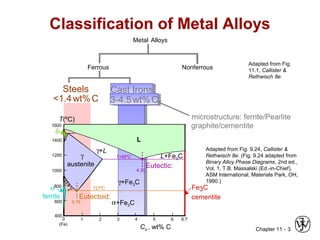
Classification of Metal Alloys
Metal Alloys
Steels
Ferrous Nonferrous
Cast Irons
<1.4wt%C 3-4.5wt%C
Steels
<1.4wt%C
Cast IronsCast Irons
3-4.5wt%C3-4.5wt%C
Fe3C
cementite
1600
1400
1200
1000
800
600
400
0 1 2 3 4 5 6 6.7
L
γ
austenite
γ+L
γ+Fe3C
α
ferrite
α+Fe3C
α+γ
L+Fe3C
δ
(Fe)
Co , wt% C
Eutectic:
Eutectoid:
0.76
4.30
727ºC
1148ºC
T(ºC) microstructure: ferrite/Pearlite
graphite/cementite
Chapter 11 - 4
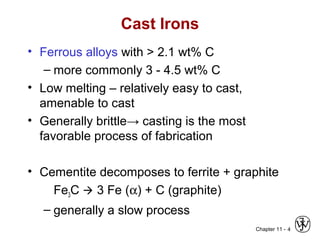
Cast Irons
• Ferrous alloys with > 2.1 wt% C
– more commonly 3 - 4.5 wt% C
• Low melting – relatively easy to cast,
amenable to cast
• Generally brittle→ casting is the most
favorable process of fabrication
• Cementite decomposes to ferrite + graphite
Fe3C  3 Fe (α) + C (graphite)
– generally a slow process
Chapter 11 - 5
Fe-C True Equilibrium Diagram
Graphite formation
promoted by
• Si > 1 wt%
• slow cooling
Adapted from Fig. 11.2,
Callister & Rethwisch 8e.
[Fig. 11.2 adapted from
Binary Alloy Phase
Diagrams, 2nd ed.,
Vol. 1, T.B. Massalski (Ed.-
in-Chief), ASM International,
Materials Park, OH, 1990.]
1600
1400
1200
1000
800
600
400
0 1 2 3 4 90
L
γ +L
α + Graphite
Liquid +
Graphite
(Fe) C, wt% C
0.65
740ºC
T(ºC)
γ + Graphite
100
1153ºCγ
Austenite 4.2 wt% C
α + γ
Chapter 11 -
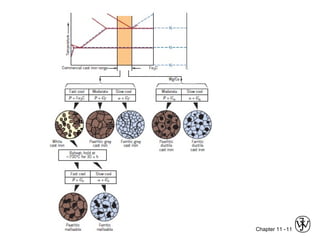
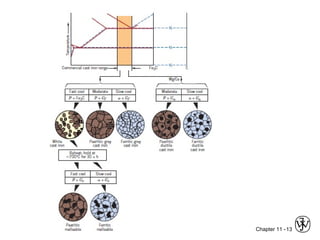
Types of Cast Iron
Gray iron
Ductile iron
White iron
Malleable iron (Heat treated white iron)
6
Chapter 11 - 7
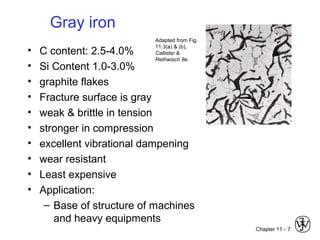
Gray iron
• C content: 2.5-4.0%
• Si Content 1.0-3.0%
• graphite flakes
• Fracture surface is gray
• weak & brittle in tension
• stronger in compression
• excellent vibrational dampening
• wear resistant
• Least expensive
• Application:
– Base of structure of machines
and heavy equipments
Adapted from Fig.
11.3(a) & (b),
Callister &
Rethwisch 8e.
Chapter 11 -
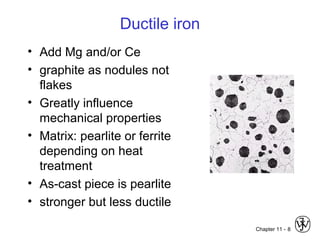
Ductile iron
• Add Mg and/or Ce
• graphite as nodules not
flakes
• Greatly influence
mechanical properties
• Matrix: pearlite or ferrite
depending on heat
treatment
• As-cast piece is pearlite
• stronger but less ductile
8
Chapter 11 -
Contd.
• Heat treatment for several hours at about
7000
C will yield a ferrite matrix
• Stronger and much more ductile
• Applications: valves, pump bodies, crank-
shaft, gears etc.
9
Chapter 11 -10
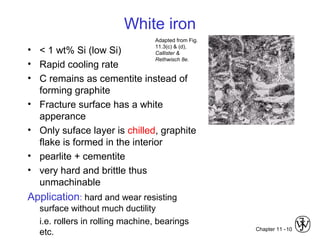
White iron
• < 1 wt% Si (low Si)
• Rapid cooling rate
• C remains as cementite instead of
forming graphite
• Fracture surface has a white
apperance
• Only suface layer is chilled, graphite
flake is formed in the interior
• pearlite + cementite
• very hard and brittle thus
unmachinable
Application: hard and wear resisting
surface without much ductility
i.e. rollers in rolling machine, bearings
etc.
Adapted from Fig.
11.3(c) & (d),
Callister &
Rethwisch 8e.
Chapter 11 -11
Chapter 11 -
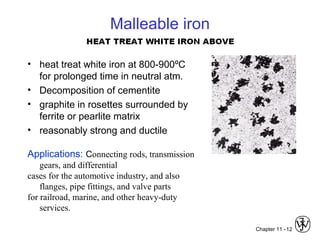
Malleable iron
12
• heat treat white iron at 800-900ºC
for prolonged time in neutral atm.
• Decomposition of cementite
• graphite in rosettes surrounded by
ferrite or pearlite matrix
• reasonably strong and ductile
Applications: Connecting rods, transmission
gears, and differential
cases for the automotive industry, and also
flanges, pipe fittings, and valve parts
for railroad, marine, and other heavy-duty
services.
Chapter 11 -13
Chapter 11 -
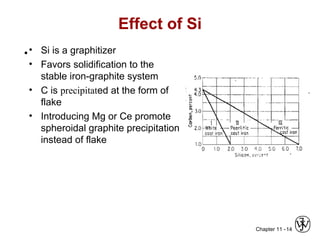
Effect of Si
14
•• Si is a graphitizer
• Favors solidification to the
stable iron-graphite system
• C is precipitated at the form of
flake
• Introducing Mg or Ce promote
spheroidal graphite precipitation
instead of flake
Chapter 11 -
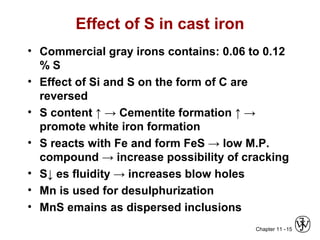
Effect of S in cast iron
• Commercial gray irons contains: 0.06 to 0.12
% S
• Effect of Si and S on the form of C are
reversed
• S content ↑ → Cementite formation ↑ →
promote white iron formation
• S reacts with Fe and form FeS → low M.P.
compound → increase possibility of cracking
• S↓ es fluidity → increases blow holes
• Mn is used for desulphurization
• MnS emains as dispersed inclusions
15
Chapter 11 -
Next Class
Structure properties
relationship
16

Lec 05

  • 1.
    Chapter 11 - MME-292 ArmanHussain Lecturer DGCE, BUET Metallic Materials Sessional Lecture 05 Cast Iron September 7, 2014
  • 2.
    Chapter 11 -2 Chapter 11: Applications and Processing of Metal Alloys ISSUES TO ADDRESS... • How are Cast Iron classified and what are their common applications? • What are some of the common fabrication techniques for metals? • What heat treatment procedures are used to improve the mechanical properties of Cast Irons?
  • 3.
    Chapter 11 -3 Adapted from Fig. 9.24, Callister & Rethwisch 8e. (Fig. 9.24 adapted from Binary Alloy Phase Diagrams, 2nd ed., Vol. 1, T.B. Massalski (Ed.-in-Chief), ASM International, Materials Park, OH, 1990.) Adapted from Fig. 11.1, Callister & Rethwisch 8e. Classification of Metal Alloys Metal Alloys Steels Ferrous Nonferrous Cast Irons <1.4wt%C 3-4.5wt%C Steels <1.4wt%C Cast IronsCast Irons 3-4.5wt%C3-4.5wt%C Fe3C cementite 1600 1400 1200 1000 800 600 400 0 1 2 3 4 5 6 6.7 L γ austenite γ+L γ+Fe3C α ferrite α+Fe3C α+γ L+Fe3C δ (Fe) Co , wt% C Eutectic: Eutectoid: 0.76 4.30 727ºC 1148ºC T(ºC) microstructure: ferrite/Pearlite graphite/cementite
  • 4.
    Chapter 11 -4 Cast Irons • Ferrous alloys with > 2.1 wt% C – more commonly 3 - 4.5 wt% C • Low melting – relatively easy to cast, amenable to cast • Generally brittle→ casting is the most favorable process of fabrication • Cementite decomposes to ferrite + graphite Fe3C  3 Fe (α) + C (graphite) – generally a slow process
  • 5.
    Chapter 11 -5 Fe-C True Equilibrium Diagram Graphite formation promoted by • Si > 1 wt% • slow cooling Adapted from Fig. 11.2, Callister & Rethwisch 8e. [Fig. 11.2 adapted from Binary Alloy Phase Diagrams, 2nd ed., Vol. 1, T.B. Massalski (Ed.- in-Chief), ASM International, Materials Park, OH, 1990.] 1600 1400 1200 1000 800 600 400 0 1 2 3 4 90 L γ +L α + Graphite Liquid + Graphite (Fe) C, wt% C 0.65 740ºC T(ºC) γ + Graphite 100 1153ºCγ Austenite 4.2 wt% C α + γ
  • 6.
    Chapter 11 - Typesof Cast Iron Gray iron Ductile iron White iron Malleable iron (Heat treated white iron) 6
  • 7.
    Chapter 11 -7 Gray iron • C content: 2.5-4.0% • Si Content 1.0-3.0% • graphite flakes • Fracture surface is gray • weak & brittle in tension • stronger in compression • excellent vibrational dampening • wear resistant • Least expensive • Application: – Base of structure of machines and heavy equipments Adapted from Fig. 11.3(a) & (b), Callister & Rethwisch 8e.
  • 8.
    Chapter 11 - Ductileiron • Add Mg and/or Ce • graphite as nodules not flakes • Greatly influence mechanical properties • Matrix: pearlite or ferrite depending on heat treatment • As-cast piece is pearlite • stronger but less ductile 8
  • 9.
    Chapter 11 - Contd. •Heat treatment for several hours at about 7000 C will yield a ferrite matrix • Stronger and much more ductile • Applications: valves, pump bodies, crank- shaft, gears etc. 9
  • 10.
    Chapter 11 -10 Whiteiron • < 1 wt% Si (low Si) • Rapid cooling rate • C remains as cementite instead of forming graphite • Fracture surface has a white apperance • Only suface layer is chilled, graphite flake is formed in the interior • pearlite + cementite • very hard and brittle thus unmachinable Application: hard and wear resisting surface without much ductility i.e. rollers in rolling machine, bearings etc. Adapted from Fig. 11.3(c) & (d), Callister & Rethwisch 8e.
  • 11.
  • 12.
    Chapter 11 - Malleableiron 12 • heat treat white iron at 800-900ºC for prolonged time in neutral atm. • Decomposition of cementite • graphite in rosettes surrounded by ferrite or pearlite matrix • reasonably strong and ductile Applications: Connecting rods, transmission gears, and differential cases for the automotive industry, and also flanges, pipe fittings, and valve parts for railroad, marine, and other heavy-duty services.
  • 13.
  • 14.
    Chapter 11 - Effectof Si 14 •• Si is a graphitizer • Favors solidification to the stable iron-graphite system • C is precipitated at the form of flake • Introducing Mg or Ce promote spheroidal graphite precipitation instead of flake
  • 15.
    Chapter 11 - Effectof S in cast iron • Commercial gray irons contains: 0.06 to 0.12 % S • Effect of Si and S on the form of C are reversed • S content ↑ → Cementite formation ↑ → promote white iron formation • S reacts with Fe and form FeS → low M.P. compound → increase possibility of cracking • S↓ es fluidity → increases blow holes • Mn is used for desulphurization • MnS emains as dispersed inclusions 15
  • 16.
    Chapter 11 - NextClass Structure properties relationship 16

Editor's Notes

  • #5 So phase diagram for this system is different (Fig 12.4)
  • #6 Cast irons have graphite