1
Cast irons
EF420 Lecture 9
Overview of cast iron
Iron with 1.7 to 4.5% carbon and 0.5 to 3% silicon
Lower melting point and more fluid than steel (better
castability)
Low cost material usually produced by sand casting
A wide range of properties, depending on composition &
cooling rate
 Strength
 Hardness
 Ductility
 Thermal conductivity
 Damping capacity
3
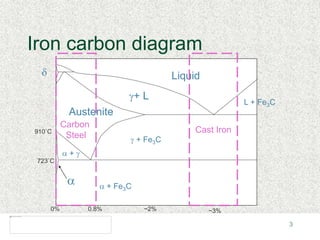
Iron carbon diagram
Liquid
Austenite
a + Fe3C
d
g+ L
a + g
L + Fe3C
723˚C
910˚C
0% 0.8% ~2% ~3%
a
g + Fe3C
Cast Iron
Carbon
Steel
4
Production of cast iron
Pig iron, scrap steel, limestone and carbon
(coke)
Cupola
Electric arc furnace
Electric induction furnace
Usually sand cast, but can be gravity die cast
in reusable graphite moulds
Not formed, finished by machining
5
Types of cast iron
Grey cast iron - carbon as graphite
White cast iron - carbides, often alloyed
Ductile cast iron
 nodular, spheroidal graphite
Malleable cast iron
Compacted graphite cast iron
 CG or Vermicular Iron
6
Effect of cooling rate
Slow cooling favours the formation of graphite & low
hardness
Rapid cooling promotes carbides with high hardness
Thick sections cool slowly, while thin sections cool
quickly
Sand moulds cool slowly, but metal chills can be
used to increase cooling rate & promote white iron
7
Effect of composition
A CE over 4.3 (hypereutectic) leads to carbide or
graphite solidifying first & promotes grey cast iron
A CE less than 4.3 (hypoeutectic) leads to austenite
solidifying first & promotes white iron
8
Grey cast iron
Flake graphite in a matrix of pearlite, ferrite or
martensite
Wide range of applications
Low ductility - elongation 0.6%
Grey cast iron forms when
 Cooling is slow, as in heavy sections
 High silicon or carbon
9
Typical properties
Depend strongly on casting shape & thickness
AS1830 & ASTM A48 specifies properties
Low strength, A48 Class 20, Rm 120 MPa
 High carbon, 3.6 to 3.8%
 Kish graphite (hypereutectic)
 High conductivity, high damping
High strength, A48 Class 60, Rm 410 MPa
 Low carbon, (eutectic composition)
10
Graphite form
Uniform
Rosette
Superimposed (Kish and
normal)
Interdendritic random
Interdendritic preferred
orientation
See AS5094 “designation
of microstructure of
graphite”
11
Matrix structure
Pearlite or ferrite
Transformation is to ferrite when
 Cooling rate is slow
 High silicon content
 High carbon equivalence
 Presence of fine undercooled graphite
12
Properties of grey cast iron
Machineability is excellent
Ductility is low (0.6%), impact resistance low
Damping capacity high
Thermal conductivity high
Dry and normal wear properties excellent
13
Applications
Engines
 Cylinder blocks, liners,
Brake drums, clutch plates
Pressure pipe fittings (AS2544)
Machinery beds
Furnace parts, ingot and glass moulds
14
Ductile iron
Inoculation with Ce or Mg or both causes
graphite to form as spherulites, rather than
flakes
Also known as spheroidal graphite (SG), and
nodular graphite iron
Far better ductility than grey cast iron
See AS1831
15
Microstructure
Graphite spheres
surrounded by ferrite
Usually some pearlite
May be some cementite
Can be hardened to
martensite by heat
treatment
16
Production
Composition similar to grey cast iron except
for higher purity.
Melt is added to inoculant in ladle.
Magnesium as wire, ingots or pellets is added
to ladle before adding hot iron.
Mg vapour rises through melt, removing
sulphur.
17
Verification
Testing is required to ensure nodularisation is
complete.
Microstructural examination
Mechanical testing on standard test bars
(ductility)
Ultrasonic testing
18
Properties
Strength higher than grey cast iron
Ductility up to 6% as cast or 20% annealed
Low cost
 Simple manufacturing process makes complex
shapes
Machineability better than steel
19
Applications
Automotive industry 55% of ductile iron in
USA
 Crankshafts, front wheel spindle supports,
steering knuckles, disc brake callipers
Pipe and pipe fittings (joined by welding) see
AS2280
20
Malleable iron
Graphite in nodular form
Produced by heat treatment of white cast iron
Graphite nodules are irregular clusters
Similar properties to ductile iron
See AS1832
21
Microstructure
Uniformly dispersed graphite
Ferrite, pearlite or tempered martensite matrix
Ferritic castings require 2 stage anneal.
Pearlitic castings - 1st stage only
22
Annealing treatments
Ferritic malleable iron
 Depends on C and Si
 1st stage 2 to 36 hours at 940˚C in a controlled atmosphere
 Cool rapidly to 750˚C & hold for 1 to 6 hours
For pearlitic malleable iron
 Similar 1st stage above (2 - 36 h at 940˚C)
 Cool to 870˚C slowly, then air cool & temper to specification
Harden and temper pearlitic iron for martensitic
castings
23
Properties
Similar to ductile iron
Good shock resistance
Good ductility
Good machineability
24
Applications
Similar applications to ductile iron
Malleable iron is better for thinner castings
Ductile iron better for thicker castings >40mm
Vehicle components
 Power trains, frames, suspensions and wheels
 Steering components, transmission and differential parts,
connecting rods
Railway components
Pipe fittings AS3673
25
Joining cast iron
Welding
Braze-welding
Brazing
Soldering
Mechanical connections
29
Weldability
White cast iron - not weldable
 Small attachments only
Grey cast iron - low weldability
 Welding largely restricted to salvage and repair
Ductile and malleable irons - good weldability
(inferior to structural steel)
 Welding increasingly used during manufacture
34
White cast iron
White fracture surface
No graphite, because carbon forms Fe3C or
more complex carbides
Abrasion resistant
Often alloyed
Australian Standard DR20394 “Wear
resistant white cast irons”
35
Effects of alloy elements
Promote graphite (Si, Ni)
Promote carbides (Cr)
Affect matrix microstructure
 Ferrite, pearlite, martensite or austenite
Corrosion resistance (Cr)
Specific effects
41
High chromium irons
12 to 28% chromium
Less effect on hardenability than in steels
Mo, Ni, Mn, and Cu also added for
hardenability to give martensite
43
Ni-hard irons
Grinding balls
1-2.2 Si, 5-7 Ni, 7-11 Cr
M7C3 eutectic carbides in martensite
48
Abrasion resistant irons
Pearlitic white irons
 Cheap but wear more quickly
Martensitic white irons
 More expensive but better wearing
ASTM A532-75A
49
Can be heat treated
Stress relief up to 700˚C
Tempering of martensite
Subzero treatment to remove retained
austenite
Annealing for machining followed by QT
50
Microstructures
Pearlite and ferrite in Fe3C matrix
Austenite / martensite in Fe3C matrix
M7C3 in a martensite matrix
51
Abrasion resistance
Depends on cast iron
Depends also on abrasive and environment
 Eg Silicon carbide wears martensitic and pearlite
equally
 Silica wears martensitic irons much less than
pearlitic ones

09castiron (1).ppt

  • 1.
  • 2.
    Overview of castiron Iron with 1.7 to 4.5% carbon and 0.5 to 3% silicon Lower melting point and more fluid than steel (better castability) Low cost material usually produced by sand casting A wide range of properties, depending on composition & cooling rate  Strength  Hardness  Ductility  Thermal conductivity  Damping capacity
  • 3.
    3 Iron carbon diagram Liquid Austenite a+ Fe3C d g+ L a + g L + Fe3C 723˚C 910˚C 0% 0.8% ~2% ~3% a g + Fe3C Cast Iron Carbon Steel
  • 4.
    4 Production of castiron Pig iron, scrap steel, limestone and carbon (coke) Cupola Electric arc furnace Electric induction furnace Usually sand cast, but can be gravity die cast in reusable graphite moulds Not formed, finished by machining
  • 5.
    5 Types of castiron Grey cast iron - carbon as graphite White cast iron - carbides, often alloyed Ductile cast iron  nodular, spheroidal graphite Malleable cast iron Compacted graphite cast iron  CG or Vermicular Iron
  • 6.
    6 Effect of coolingrate Slow cooling favours the formation of graphite & low hardness Rapid cooling promotes carbides with high hardness Thick sections cool slowly, while thin sections cool quickly Sand moulds cool slowly, but metal chills can be used to increase cooling rate & promote white iron
  • 7.
    7 Effect of composition ACE over 4.3 (hypereutectic) leads to carbide or graphite solidifying first & promotes grey cast iron A CE less than 4.3 (hypoeutectic) leads to austenite solidifying first & promotes white iron
  • 8.
    8 Grey cast iron Flakegraphite in a matrix of pearlite, ferrite or martensite Wide range of applications Low ductility - elongation 0.6% Grey cast iron forms when  Cooling is slow, as in heavy sections  High silicon or carbon
  • 9.
    9 Typical properties Depend stronglyon casting shape & thickness AS1830 & ASTM A48 specifies properties Low strength, A48 Class 20, Rm 120 MPa  High carbon, 3.6 to 3.8%  Kish graphite (hypereutectic)  High conductivity, high damping High strength, A48 Class 60, Rm 410 MPa  Low carbon, (eutectic composition)
  • 10.
    10 Graphite form Uniform Rosette Superimposed (Kishand normal) Interdendritic random Interdendritic preferred orientation See AS5094 “designation of microstructure of graphite”
  • 11.
    11 Matrix structure Pearlite orferrite Transformation is to ferrite when  Cooling rate is slow  High silicon content  High carbon equivalence  Presence of fine undercooled graphite
  • 12.
    12 Properties of greycast iron Machineability is excellent Ductility is low (0.6%), impact resistance low Damping capacity high Thermal conductivity high Dry and normal wear properties excellent
  • 13.
    13 Applications Engines  Cylinder blocks,liners, Brake drums, clutch plates Pressure pipe fittings (AS2544) Machinery beds Furnace parts, ingot and glass moulds
  • 14.
    14 Ductile iron Inoculation withCe or Mg or both causes graphite to form as spherulites, rather than flakes Also known as spheroidal graphite (SG), and nodular graphite iron Far better ductility than grey cast iron See AS1831
  • 15.
    15 Microstructure Graphite spheres surrounded byferrite Usually some pearlite May be some cementite Can be hardened to martensite by heat treatment
  • 16.
    16 Production Composition similar togrey cast iron except for higher purity. Melt is added to inoculant in ladle. Magnesium as wire, ingots or pellets is added to ladle before adding hot iron. Mg vapour rises through melt, removing sulphur.
  • 17.
    17 Verification Testing is requiredto ensure nodularisation is complete. Microstructural examination Mechanical testing on standard test bars (ductility) Ultrasonic testing
  • 18.
    18 Properties Strength higher thangrey cast iron Ductility up to 6% as cast or 20% annealed Low cost  Simple manufacturing process makes complex shapes Machineability better than steel
  • 19.
    19 Applications Automotive industry 55%of ductile iron in USA  Crankshafts, front wheel spindle supports, steering knuckles, disc brake callipers Pipe and pipe fittings (joined by welding) see AS2280
  • 20.
    20 Malleable iron Graphite innodular form Produced by heat treatment of white cast iron Graphite nodules are irregular clusters Similar properties to ductile iron See AS1832
  • 21.
    21 Microstructure Uniformly dispersed graphite Ferrite,pearlite or tempered martensite matrix Ferritic castings require 2 stage anneal. Pearlitic castings - 1st stage only
  • 22.
    22 Annealing treatments Ferritic malleableiron  Depends on C and Si  1st stage 2 to 36 hours at 940˚C in a controlled atmosphere  Cool rapidly to 750˚C & hold for 1 to 6 hours For pearlitic malleable iron  Similar 1st stage above (2 - 36 h at 940˚C)  Cool to 870˚C slowly, then air cool & temper to specification Harden and temper pearlitic iron for martensitic castings
  • 23.
    23 Properties Similar to ductileiron Good shock resistance Good ductility Good machineability
  • 24.
    24 Applications Similar applications toductile iron Malleable iron is better for thinner castings Ductile iron better for thicker castings >40mm Vehicle components  Power trains, frames, suspensions and wheels  Steering components, transmission and differential parts, connecting rods Railway components Pipe fittings AS3673
  • 25.
  • 26.
    29 Weldability White cast iron- not weldable  Small attachments only Grey cast iron - low weldability  Welding largely restricted to salvage and repair Ductile and malleable irons - good weldability (inferior to structural steel)  Welding increasingly used during manufacture
  • 27.
    34 White cast iron Whitefracture surface No graphite, because carbon forms Fe3C or more complex carbides Abrasion resistant Often alloyed Australian Standard DR20394 “Wear resistant white cast irons”
  • 28.
    35 Effects of alloyelements Promote graphite (Si, Ni) Promote carbides (Cr) Affect matrix microstructure  Ferrite, pearlite, martensite or austenite Corrosion resistance (Cr) Specific effects
  • 29.
    41 High chromium irons 12to 28% chromium Less effect on hardenability than in steels Mo, Ni, Mn, and Cu also added for hardenability to give martensite
  • 30.
    43 Ni-hard irons Grinding balls 1-2.2Si, 5-7 Ni, 7-11 Cr M7C3 eutectic carbides in martensite
  • 31.
    48 Abrasion resistant irons Pearliticwhite irons  Cheap but wear more quickly Martensitic white irons  More expensive but better wearing ASTM A532-75A
  • 32.
    49 Can be heattreated Stress relief up to 700˚C Tempering of martensite Subzero treatment to remove retained austenite Annealing for machining followed by QT
  • 33.
    50 Microstructures Pearlite and ferritein Fe3C matrix Austenite / martensite in Fe3C matrix M7C3 in a martensite matrix
  • 34.
    51 Abrasion resistance Depends oncast iron Depends also on abrasive and environment  Eg Silicon carbide wears martensitic and pearlite equally  Silica wears martensitic irons much less than pearlitic ones