CHAPTER 2:
CUSTOMER-BASED BRAND EQUITY
Becamex Business School
Eastern International University
Presented by: Phong Nguyen
2016
TOC
1. What is brand equity?
2. Key drivers of brand equity
3. Brand building principle
4. Summary
1. WHAT IS BRAND EQUITY?
Brand equity
Brand Equity: a measure of the total value of a brand.
1.5
Customer-Based Brand Equity
“The differential effect that brand knowledge has on consumer
response to the marketing of that brand.”
Keller, 1993
2.6
Customer-Based Brand Equity
2.7
“The differential effect that brand knowledge has on consumer
response to the marketing of that brand.”
Customer-Based Brand Equity
Differential effect
Differences in consumer response
Brand knowledge
A result of consumers’ knowledge about the brand
Consumer response to marketing
Choice of a brand
Recall of copy points from an ad
Response to a sales promotion
Evaluations of a proposed brand extension
2.8
Brand Equity as a “Bridge”
Reflection of past investments in the marketing of a brand
Direction for future marketing actions or programs
2.9
Making a Brand Strong:
Brand Knowledge
Brand knowledge is the key to creating brand equity.
Brand knowledge consists of a brand node in memory with a
variety of associations linked to it.
Brand knowledge has two components: brand awareness and
brand image.
2.10
A reputable shampoo brand
Iconic masculine blue
Premium price
Anti dandruff
Make me confident and
charismatic
Masculine, modern, youthful,
Sporty, trendy, dynamic
International and reputable brand.
Charming, charismatic, masculine user
image.
Effective in anti dandruff
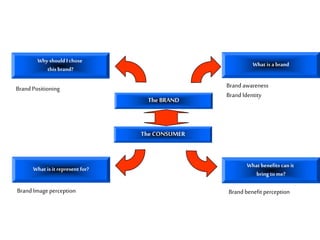
What isCLEARMEN?
What isitrepresentfor?
WhyshouldI chose
thisbrand?
What benefitscanit
bringto me?
The BRAND
The CONSUMER
Brand awareness
Brand Identity
Brand benefit perceptionBrand Imageperception
Brand Positioning
What is a brand
What is itrepresent for?
What benefits can it
bring to me?
Why should I chose
this brand?
Sources of Brand Equity
Brand awareness
Brand recognition
Brand recall
Brand image
Strong, favorable, and unique brand associations
2.13
Brand Awareness Advantages
Learning advantages
Register the brand in the minds of consumers
Consideration advantages
Likelihood that the brand will be a member of the
consideration set
Choice advantages
Affect choices among brands in the consideration set
2.14
Establishing Brand Awareness
Increasing the familiarity of the brand through repeated
exposure (for brand recognition)
forging strong associations with the appropriate product
category or other relevant purchase or consumption cues (for
brand recall)
2.15
Creating a Positive Brand Image
Brand Associations
Does not matter which source of brand association
Need to be favorable, strong, and unique
Marketers should recognize the influence of these other
sources of information by both managing them as well as
possible and by adequately accounting for them in
designing communication strategies.
2.16
2. KEY DRIVERS OF BRAND
EQUITY
Four Questions Customers ask of Brands
Who are you? (brand identity)
What are you? (brand meaning)
What about you? What do I think or feel about you? (brand
responses)
What about you and me? What kind of association and how
much of a connection would I like to have with you? (brand
relationships)
2.18
2.19
Customer-Based Brand Equity Pyramid
RESONANCE
SALIENCE
JUDGMENTS FEELINGS
PERFORMANCE IMAGERY
4. RELATIONSHIPS =
What about you and me?
3. RESPONSE =
What about you?
2. MEANING =
What are you?
1. IDENTITY =
Who are you?
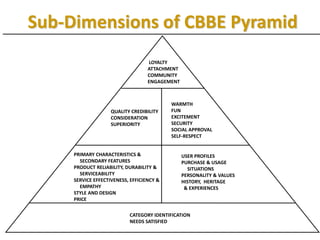
Sub-Dimensions of CBBE Pyramid
LOYALTY
ATTACHMENT
COMMUNITY
ENGAGEMENT
QUALITY CREDIBILITY
CONSIDERATION
SUPERIORITY
WARMTH
FUN
EXCITEMENT
SECURITY
SOCIAL APPROVAL
SELF-RESPECT
CATEGORY IDENTIFICATION
NEEDS SATISFIED
PRIMARY CHARACTERISTICS &
SECONDARY FEATURES
PRODUCT RELIABILITY, DURABILITY &
SERVICEABILITY
SERVICE EFFECTIVENESS, EFFICIENCY &
EMPATHY
STYLE AND DESIGN
PRICE
USER PROFILES
PURCHASE & USAGE
SITUATIONS
PERSONALITY & VALUES
HISTORY, HERITAGE
& EXPERIENCES
Salience Dimensions
Depth of brand awareness
Ease of recognition and recall
Strength and clarity of category membership
Breadth of brand awareness
Purchase consideration
Consumption consideration
2.21
Depth and Breadth Importance
The product category hierarchy shows us not only the depth of
awareness matters but also the breadth.
The brand must not only be top-of-mind and have sufficient
“mind share,” but it must also do so at the right times and places.
2.22
Product Category Structure
To fully understand brand recall, we need to appreciate product
category structure, or how product categories are organized in
memory.
2.23
Performance Dimensions
Primary characteristics and supplementary features
Product reliability, durability, and serviceability
Service effectiveness, efficiency, and empathy
Style and design
Price
2.24
Imagery Dimensions
User profiles
Demographic and psychographic characteristics
Actual or aspirational
Group perceptions—popularity
Purchase and usage situations
Type of channel, specific stores, ease of purchase
Time (day, week, month, year, etc.), location, and context of usage
Personality and values
Sincerity, excitement, competence, sophistication, and roughness
History, heritage, and experiences
Nostalgia
Memories
2.25
Judgment Dimensions
Brand quality
• Value
• Satisfaction
Brand credibility
• Expertise
• Trustworthiness
• Likeability
Brand consideration
• Relevance
Brand superiority
• Differentiation
2.26
Feelings Dimensions
Warmth
Fun
Excitement
Security
Social Approval
Self-respect
2.27
Resonance Dimensions
Behavioral loyalty
Frequency and amount of repeat purchases
Attitudinal attachment
Love brand (favorite possessions; “a little pleasure”)
Proud of brand
Sense of community
Kinship
Affiliation
Active engagement
Seek information
Join club
Visit website, chat rooms
2.28
Customer-Based Brand Equity Model
Consumer-
Brand
Resonance
Brand Salience
Consumer
Judgments
Consumer
Feelings
Brand
Performance
Brand
Imagery
INTENSE, ACTIVE
LOYALTY
RATIONAL &
EMOTIONAL
REACTIONS
POINTS-OF-
PARITY &
POINTS-OF-
DIFFERENCE
DEEP, BROAD
BRAND
AWARENESS
Application:
Identify the Key Drivers of Brand Equity
0.17 0.66
0.24
0.65
Performance
Imagery Feelings
Judgment
Resonance
0.58
0.49
3. BRAND BUILDING
PRINCIPLE
2.31
The Four Steps of Brand Building
Ensure identification of the brand with customers and an
association of the brand in customers’ minds
Establish the totality of brand meaning in the minds of
consumers
Elicit the proper customer responses to the brand identification
and brand meaning
Convert brand response to create an intense, active loyalty
relationship between customers and the brand
2.32
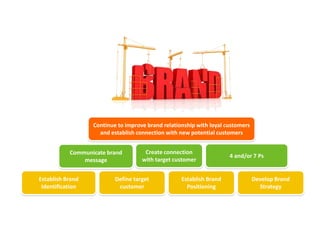
Establish Brand
Identification
Establish Brand
Positioning
Develop Brand
Strategy
Communicate brand
message
Create connection
with target customer
Define target
customer
4 and/or 7 Ps
Continue to improve brand relationship with loyal customers
and establish connection with new potential customers
Brand Building Implications
Customers own brands.
Don’t take shortcuts with brands.
Brands should have a duality.
Brands should have richness.
Brand resonance provides important focus.
2.34
Creating Customer Value
Customer-brand relationships are the foundation of brand
resonance and building a strong brand.
The customer-based brand equity model certainly puts that
notion front and center.
2.35
Is a company consumer-centric?
Is the company looking for ways to take care of you?
Does the company know its customers well enough to
differentiate between them?
Is someone accountable for customers?
Is the company managed for shareholder value?
Is the company testing new customer offers and learning
from the results?
2.36Sources: Larry Selden and Geoffrey Colvin, 2004.
Customer Relationship Management
(CRM)
Uses a company’s data systems and applications to track
consumer activity and manage customer interactions with the
company
2.37
Relationship of Customer Equity to
Brand Equity
Customers drive the success of brands but brands are the
necessary touchpoint that firms have to connect with their
customers.
Customer-based brand equity maintains that brands create value
by eliciting differential customer response to marketing activities.
The higher price premiums and increased levels of loyalty
engendered by brands generate incremental cash flows.
2.40
4. SUMMARY
Brand Equity
1. Brand Equity: a measure of the total value of a brand.
2. There are Four Questions Customers ask of Brands
• Who are you? (brand identity)
• What are you? (brand meaning)
• What about you? What do I think or feel about you? (brand
responses)
• What about you and me? What kind of association and how much of
a connection would I like to have with you? (brand relationships)
2.42
Brand Building
Ensure identification of the brand with customers and an
association of the brand in customers’ minds
Establish the totality of brand meaning in the minds of
consumers
Elicit the proper customer responses to the brand identification
and brand meaning
Convert brand response to create an intense, active loyalty
relationship between customers and the brand
2.43

Customer-based Brand Equity

  • 1.
    CHAPTER 2: CUSTOMER-BASED BRANDEQUITY Becamex Business School Eastern International University Presented by: Phong Nguyen 2016
  • 2.
    TOC 1. What isbrand equity? 2. Key drivers of brand equity 3. Brand building principle 4. Summary
  • 3.
    1. WHAT ISBRAND EQUITY?
  • 4.
    Brand equity Brand Equity:a measure of the total value of a brand.
  • 5.
  • 6.
    Customer-Based Brand Equity “Thedifferential effect that brand knowledge has on consumer response to the marketing of that brand.” Keller, 1993 2.6
  • 7.
    Customer-Based Brand Equity 2.7 “Thedifferential effect that brand knowledge has on consumer response to the marketing of that brand.”
  • 8.
    Customer-Based Brand Equity Differentialeffect Differences in consumer response Brand knowledge A result of consumers’ knowledge about the brand Consumer response to marketing Choice of a brand Recall of copy points from an ad Response to a sales promotion Evaluations of a proposed brand extension 2.8
  • 9.
    Brand Equity asa “Bridge” Reflection of past investments in the marketing of a brand Direction for future marketing actions or programs 2.9
  • 10.
    Making a BrandStrong: Brand Knowledge Brand knowledge is the key to creating brand equity. Brand knowledge consists of a brand node in memory with a variety of associations linked to it. Brand knowledge has two components: brand awareness and brand image. 2.10
  • 11.
    A reputable shampoobrand Iconic masculine blue Premium price Anti dandruff Make me confident and charismatic Masculine, modern, youthful, Sporty, trendy, dynamic International and reputable brand. Charming, charismatic, masculine user image. Effective in anti dandruff What isCLEARMEN? What isitrepresentfor? WhyshouldI chose thisbrand? What benefitscanit bringto me?
  • 12.
    The BRAND The CONSUMER Brandawareness Brand Identity Brand benefit perceptionBrand Imageperception Brand Positioning What is a brand What is itrepresent for? What benefits can it bring to me? Why should I chose this brand?
  • 13.
    Sources of BrandEquity Brand awareness Brand recognition Brand recall Brand image Strong, favorable, and unique brand associations 2.13
  • 14.
    Brand Awareness Advantages Learningadvantages Register the brand in the minds of consumers Consideration advantages Likelihood that the brand will be a member of the consideration set Choice advantages Affect choices among brands in the consideration set 2.14
  • 15.
    Establishing Brand Awareness Increasingthe familiarity of the brand through repeated exposure (for brand recognition) forging strong associations with the appropriate product category or other relevant purchase or consumption cues (for brand recall) 2.15
  • 16.
    Creating a PositiveBrand Image Brand Associations Does not matter which source of brand association Need to be favorable, strong, and unique Marketers should recognize the influence of these other sources of information by both managing them as well as possible and by adequately accounting for them in designing communication strategies. 2.16
  • 17.
    2. KEY DRIVERSOF BRAND EQUITY
  • 18.
    Four Questions Customersask of Brands Who are you? (brand identity) What are you? (brand meaning) What about you? What do I think or feel about you? (brand responses) What about you and me? What kind of association and how much of a connection would I like to have with you? (brand relationships) 2.18
  • 19.
    2.19 Customer-Based Brand EquityPyramid RESONANCE SALIENCE JUDGMENTS FEELINGS PERFORMANCE IMAGERY 4. RELATIONSHIPS = What about you and me? 3. RESPONSE = What about you? 2. MEANING = What are you? 1. IDENTITY = Who are you?
  • 20.
    Sub-Dimensions of CBBEPyramid LOYALTY ATTACHMENT COMMUNITY ENGAGEMENT QUALITY CREDIBILITY CONSIDERATION SUPERIORITY WARMTH FUN EXCITEMENT SECURITY SOCIAL APPROVAL SELF-RESPECT CATEGORY IDENTIFICATION NEEDS SATISFIED PRIMARY CHARACTERISTICS & SECONDARY FEATURES PRODUCT RELIABILITY, DURABILITY & SERVICEABILITY SERVICE EFFECTIVENESS, EFFICIENCY & EMPATHY STYLE AND DESIGN PRICE USER PROFILES PURCHASE & USAGE SITUATIONS PERSONALITY & VALUES HISTORY, HERITAGE & EXPERIENCES
  • 21.
    Salience Dimensions Depth ofbrand awareness Ease of recognition and recall Strength and clarity of category membership Breadth of brand awareness Purchase consideration Consumption consideration 2.21
  • 22.
    Depth and BreadthImportance The product category hierarchy shows us not only the depth of awareness matters but also the breadth. The brand must not only be top-of-mind and have sufficient “mind share,” but it must also do so at the right times and places. 2.22
  • 23.
    Product Category Structure Tofully understand brand recall, we need to appreciate product category structure, or how product categories are organized in memory. 2.23
  • 24.
    Performance Dimensions Primary characteristicsand supplementary features Product reliability, durability, and serviceability Service effectiveness, efficiency, and empathy Style and design Price 2.24
  • 25.
    Imagery Dimensions User profiles Demographicand psychographic characteristics Actual or aspirational Group perceptions—popularity Purchase and usage situations Type of channel, specific stores, ease of purchase Time (day, week, month, year, etc.), location, and context of usage Personality and values Sincerity, excitement, competence, sophistication, and roughness History, heritage, and experiences Nostalgia Memories 2.25
  • 26.
    Judgment Dimensions Brand quality •Value • Satisfaction Brand credibility • Expertise • Trustworthiness • Likeability Brand consideration • Relevance Brand superiority • Differentiation 2.26
  • 27.
  • 28.
    Resonance Dimensions Behavioral loyalty Frequencyand amount of repeat purchases Attitudinal attachment Love brand (favorite possessions; “a little pleasure”) Proud of brand Sense of community Kinship Affiliation Active engagement Seek information Join club Visit website, chat rooms 2.28
  • 29.
    Customer-Based Brand EquityModel Consumer- Brand Resonance Brand Salience Consumer Judgments Consumer Feelings Brand Performance Brand Imagery INTENSE, ACTIVE LOYALTY RATIONAL & EMOTIONAL REACTIONS POINTS-OF- PARITY & POINTS-OF- DIFFERENCE DEEP, BROAD BRAND AWARENESS
  • 30.
    Application: Identify the KeyDrivers of Brand Equity 0.17 0.66 0.24 0.65 Performance Imagery Feelings Judgment Resonance 0.58 0.49
  • 31.
  • 32.
    The Four Stepsof Brand Building Ensure identification of the brand with customers and an association of the brand in customers’ minds Establish the totality of brand meaning in the minds of consumers Elicit the proper customer responses to the brand identification and brand meaning Convert brand response to create an intense, active loyalty relationship between customers and the brand 2.32
  • 33.
    Establish Brand Identification Establish Brand Positioning DevelopBrand Strategy Communicate brand message Create connection with target customer Define target customer 4 and/or 7 Ps Continue to improve brand relationship with loyal customers and establish connection with new potential customers
  • 34.
    Brand Building Implications Customersown brands. Don’t take shortcuts with brands. Brands should have a duality. Brands should have richness. Brand resonance provides important focus. 2.34
  • 35.
    Creating Customer Value Customer-brandrelationships are the foundation of brand resonance and building a strong brand. The customer-based brand equity model certainly puts that notion front and center. 2.35
  • 36.
    Is a companyconsumer-centric? Is the company looking for ways to take care of you? Does the company know its customers well enough to differentiate between them? Is someone accountable for customers? Is the company managed for shareholder value? Is the company testing new customer offers and learning from the results? 2.36Sources: Larry Selden and Geoffrey Colvin, 2004.
  • 37.
    Customer Relationship Management (CRM) Usesa company’s data systems and applications to track consumer activity and manage customer interactions with the company 2.37
  • 38.
    Relationship of CustomerEquity to Brand Equity Customers drive the success of brands but brands are the necessary touchpoint that firms have to connect with their customers. Customer-based brand equity maintains that brands create value by eliciting differential customer response to marketing activities. The higher price premiums and increased levels of loyalty engendered by brands generate incremental cash flows. 2.40
  • 39.
  • 40.
    Brand Equity 1. BrandEquity: a measure of the total value of a brand. 2. There are Four Questions Customers ask of Brands • Who are you? (brand identity) • What are you? (brand meaning) • What about you? What do I think or feel about you? (brand responses) • What about you and me? What kind of association and how much of a connection would I like to have with you? (brand relationships) 2.42
  • 41.
    Brand Building Ensure identificationof the brand with customers and an association of the brand in customers’ minds Establish the totality of brand meaning in the minds of consumers Elicit the proper customer responses to the brand identification and brand meaning Convert brand response to create an intense, active loyalty relationship between customers and the brand 2.43

Editor's Notes