
USING  CARTOONS AS A LEARNING STRATEGY Teresa Plana Vidal
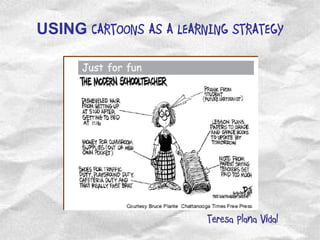
Humour is just another defense against the universe. Mel Brooks  Humour is also a way of saying something serious. T. S. Eliot  Um… I think I ’ ll go home now because the kids will be bathed and ready for bed. I think I ’ ll stay until 10, because if I go home earlier I ’ ll have to take the dog for a walk
OBJECTIVES Help to understand  abstract contents
OBJECTIVES Facilate the comprehension of graphic messages in newspapers.
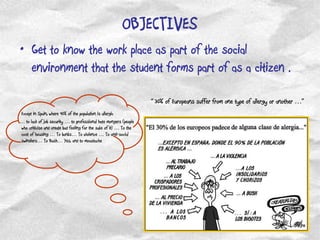
OBJECTIVES Get to know the work place as part of the social environment that the student forms part of as a citizen   . Except in Spain, where 90% of the population is allergic …   to lack of job security  …  to professional hate mongers (people who criticise and create bad feeling for the sake of it)  …  To the cost of housing  …  To banks …  To violence  …  To anti-social swindlers …  To Bush …  Yes, and to moustache “ 30% of Europeans suffer from one type of allergy or another  … ”
They raise curricular contents.   CHARACTERISTICS
They make use of legal and economic concepts.   CHARACTERISTICS
They use subjects such as law, economy, business or taxes as some of their main arguments.  CHARACTERISTICS
They suggest legal and/or socioeconomic questions  CHARACTERISTICS
CHARACTERISTICS   They help us to deduce concepts or induce us to apply concepts explained in class
They use rigorous arguments CHARACTERISTICS
They suggest didactic reasoning   CHARACTERISTICS
They discuss them in an educational context.   CHARACTERISTICS
A) They help us to: explain, search and relate.   ¿Can you explain what a mayor, may and may not do? Relate: vote, democracy, people, power and mayor ACTIVITIES
¿ The public are members of a ... society ? ¿ Why does the man hate this situation? ¿ What kind of assembly is this ?
B) The students must find the logical inconsistency.   40 years of cursing the income tax I pay and I end up with no pension!
C) They discover new concepts and meanings. I   don ’ t believe in ” No ”  or in abstaining, so the only option is “ well, I suppose so ” 1 ) What does the cartoon refer to? 2) What is the issue? 3) What other possibilities are there?
Conclusions 1. These jokes are not funny. Newspaper cartoons often reflect social realities that we don ’ t like.
Conclusions 2. Many of these jokes are difficult to understand, they presuppose certain knowledge or attitudes .
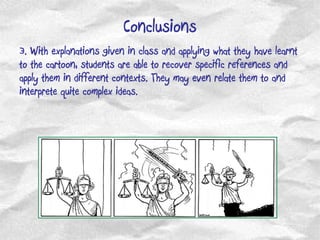
Conclusions 3. With explanations given in class and applying what they have learnt to the cartoon, students are able to recover specific references and apply them in different contexts. They may even relate them to and interprete quite complex ideas.
Thanks! Teresa Plana Vidal

Learning with cartoons

  • 1.
  • 2.
    USING CARTOONSAS A LEARNING STRATEGY Teresa Plana Vidal
  • 3.
    Humour is justanother defense against the universe. Mel Brooks Humour is also a way of saying something serious. T. S. Eliot Um… I think I ’ ll go home now because the kids will be bathed and ready for bed. I think I ’ ll stay until 10, because if I go home earlier I ’ ll have to take the dog for a walk
  • 4.
    OBJECTIVES Help tounderstand abstract contents
  • 5.
    OBJECTIVES Facilate thecomprehension of graphic messages in newspapers.
  • 6.
    OBJECTIVES Get toknow the work place as part of the social environment that the student forms part of as a citizen . Except in Spain, where 90% of the population is allergic … to lack of job security … to professional hate mongers (people who criticise and create bad feeling for the sake of it) … To the cost of housing … To banks … To violence … To anti-social swindlers … To Bush … Yes, and to moustache “ 30% of Europeans suffer from one type of allergy or another … ”
  • 7.
    They raise curricularcontents. CHARACTERISTICS
  • 8.
    They make useof legal and economic concepts. CHARACTERISTICS
  • 9.
    They use subjectssuch as law, economy, business or taxes as some of their main arguments. CHARACTERISTICS
  • 10.
    They suggest legaland/or socioeconomic questions CHARACTERISTICS
  • 11.
    CHARACTERISTICS They help us to deduce concepts or induce us to apply concepts explained in class
  • 12.
    They use rigorousarguments CHARACTERISTICS
  • 13.
    They suggest didacticreasoning CHARACTERISTICS
  • 14.
    They discuss themin an educational context. CHARACTERISTICS
  • 15.
    A) They helpus to: explain, search and relate. ¿Can you explain what a mayor, may and may not do? Relate: vote, democracy, people, power and mayor ACTIVITIES
  • 16.
    ¿ The publicare members of a ... society ? ¿ Why does the man hate this situation? ¿ What kind of assembly is this ?
  • 17.
    B) The studentsmust find the logical inconsistency. 40 years of cursing the income tax I pay and I end up with no pension!
  • 18.
    C) They discovernew concepts and meanings. I don ’ t believe in ” No ” or in abstaining, so the only option is “ well, I suppose so ” 1 ) What does the cartoon refer to? 2) What is the issue? 3) What other possibilities are there?
  • 19.
    Conclusions 1. Thesejokes are not funny. Newspaper cartoons often reflect social realities that we don ’ t like.
  • 20.
    Conclusions 2. Manyof these jokes are difficult to understand, they presuppose certain knowledge or attitudes .
  • 21.
    Conclusions 3. Withexplanations given in class and applying what they have learnt to the cartoon, students are able to recover specific references and apply them in different contexts. They may even relate them to and interprete quite complex ideas.
  • 22.