Why do financial institutions
exist?
Basic facts about financial structure
throughout the world
• Financial system is complex in both structure
and function throughout the world.
• Includes many different types of institutions:
banks, insurance companies, mutual funds,
stock and bond markets, and so on.
• Eight basic facts about financial structure
throughout the world.
Basic facts about financial structure
throughout the world
• 1. Stocks are not the most important source of
external financing for businesses.
• 2. Issuing marketable debt and equity
securities is not the primary way in which
businesses finance their operations.
Basic facts about financial structure
throughout the world
3. Indirect finance, which involves the
activities of financial intermediaries, is
many times more important than direct
finance, in which businesses raise funds
directly from lenders in financial markets.
4. Financial intermediaries, particularly
banks, are the most important source of
external funds used to finance businesses
Basic facts about financial structure
throughout the world
5. The financial system is among the most
heavily regulated sectors of economy.
6. Only large, well-established corporations
have easy access to securities markets to
finance their activities.
Basic facts about financial structure
throughout the world
7. Collateral is a prevalent feature of debt
contracts for both households
and businesses.
8. Debt contracts are typically extremely
complicated legal documents that place
substantial restrictions on the behavior of
the borrowers.
Transaction costs
• Transaction costs influence financial structure
• Financial intermediaries reduce transaction
costs
Transaction costs influence financial
structure
─ E.g., a $5,000 investment only allows you to
purchase 100 shares @ $50 / share (equity)
─ No diversification
─ Bonds even worse—most have a $1,000 size
 In sum, transactions costs can hinder
flow of funds to people with productive
investment opportunities
Transaction costs
• You have only a small amount available, you
can make only a restricted number of
investments because a large number of small
transactions would result in very high
transaction costs
How financial intermediaries reduce
transaction costs
• Financial intermediaries reduce transaction
costs
• Allow small savers and borrowers from the
existence of financial markets
Economies of scale
• Bundle the funds of many investors together
• Take advantage of ‘economies of scale’
• Reduce in transaction costs per dollar of
investment as the size of transactions
increases
• Reduces transaction costs for each individual
investor
Economies of scale
• Economies of scale possible because the total
cost of carrying out a transaction in financial
markets increases only a little as the size of
the transaction grows
• Mutual fund
• Sells shares to individuals
• Invests the proceeds in bonds or stocks
Economies of scale
• Lower transaction costs because of economies
of scale
• Cost savings are passed on to individual
investors after management fees
• Funds are large enough to buy a widely
diversified portfolio of securities
• Reduces risk
Expertise
• FI develop expertise to lower transaction costs
• For example, computer technology
• Provide customers liquidity services,
customers find easy to conduct transactions
• Also provides investors with liquidity, which
explains Fact # 3
Asymmetric Information: Adverse
Selection and Moral Hazard
 In your introductory finance course, you
probably assumed a world of symmetric
information—the case where all parties to a
transaction or contract have the same
information, be that little or a lot
 In many situations, this is not the case. We
refer to this as asymmetric information.
Asymmetric information
• Arises when one party’s insufficient knowledge
about the other party involved in a transaction
• Makes it impossible to make accurate decisions
when conducting the transaction
• For example, managers of a corporation know
whether they are honest or have better
information about how well their business is
doing than the stockholders do
Asymmetric information
• Take two forms:
• 1. Adverse selection
• 2. Moral hazard
Adverse selection
1. Occurs when one party in a transaction has
better information than the other party
2. Before transaction occurs
3. Potential borrowers most likely to produce
adverse outcome are ones most likely to
seek loan and be selected
Adverse selection
• For example, big risk takers or outright crooks
might be the most eager to take out a loan
because they know they are unlikely to pay it
back
• Lenders might decide not to make any loans,
even though there are good credit risks in the
marketplace
Moral hazard
1. Occurs when one party has an incentive to
behave differently once an agreement is
made between parties
2. After transaction occurs
3. Hazard that borrower has incentives to
engage in undesirable (immoral) activities
making it more likely that won't pay
loan back
Moral hazard
• For example, after the loan borrowers may
take big risks which have high possible returns
but increases default risk
Asymmetric Information: Adverse
Selection and Moral Hazard
 The analysis of how asymmetric
information problems affect behavior is
known as agency theory.
 We will now use these ideas of adverse
selection and moral hazard to explain how
they influence financial structure.
The Lemons Problem: How Adverse
Selection Influences Financial Structure
 Lemons Problem in Used Cars
1. If we can't distinguish between “good” and
“bad” (lemons) used cars, we are willing pay
only an average of good and bad car values
2. Result: Good cars won’t be sold, and the
used car market will function inefficiently.
 What helps us avoid this problem with
used cars?
The Lemons Problem: How Adverse
Selection Influences Financial Structure
 Lemons Problem in Securities Markets
─ If we can't distinguish between good and bad
securities, willing pay only average of good
and bad securities’ value
─ Result: Good securities undervalued and
firms won't issue them; bad securities
overvalued so too many issued
The Lemons Problem: How Adverse
Selection Influences Financial Structure
 Lemons Problem in Securities Markets
3. Investors won't want buy bad securities, so
market won't function well
─ Explains Fact # 1 and # 2
─ Also explains Fact # 6 : Less asymmetric info
for well known firms, so smaller lemons
problem
Tools to Help Solve Adverse Selection
(Lemons) Problems
• In the absence of asymmetric information, the
lemons problem goes away
• 1. Productive production and sale of
information
• For example, credit rating agencies,
investment advisory services
• Free-rider problem
Tools to Help Solve Adverse Selection
(Lemons) Problems
• 2. Government regulation to increase
information
• For example, annual audits of public
corporations
• Asymmetric information problem of adverse
selection helps explain why financial markets
are among the most heavily regulated sectors
in the economy. Fact #5
Tools to Help Solve Adverse Selection
(Lemons) Problems
3. Financial Intermediation
─ Analogy to solution to lemons problem
provided by used car dealers
─ Avoid free-rider problem by making private
loans (explains Fact # 3 and # 4)
─ Also explains fact #6—large firms are more
likely to use direct instead of indirect
financing
Tools to Help Solve Adverse Selection
(Lemons) Problems
4. Collateral and Net Worth
─ Explains Fact # 7
How Moral Hazard Affects the Choice
Between Debt and Equity Contracts
 Moral Hazard in Equity Contracts:
the Principal-Agent Problem
1. Result of separation of ownership by
stockholders (principals) from control by
managers (agents)
2. Managers act in own rather than
stockholders' interest
How Moral Hazard Affects the Choice
Between Debt and Equity Contracts
An example of this problem is useful.
Suppose you become a silent partner in an
ice cream store, providing 90% of the equity
capital ($9,000). The other owner, Steve,
provides the remaining $1,000 and will act
as the manager. If Steve works hard, the
store will make $50,000 after expenses, and
you are entitled to $45,000 of it.
How Moral Hazard Affects the Choice
Between Debt and Equity Contracts
However, Steve doesn’t really value the
$5,000 (his part), so he goes to the beach,
relaxes, and even spends some of the
“profit” on art for his office. How do you, as a
90% owner, give Steve the proper incentives
to work hard?
How Moral Hazard Affects the Choice
Between Debt and Equity Contracts
 Tolls to Help Solve the Principal-Agent
Problem
1. Production of Information: Monitoring
2. Government Regulation to Increase Information
3. Financial Intermediation (e.g, venture capital)
4. Debt Contracts
 Explains Fact # 1, Why debt is used more
than equity
How Moral Hazard Influences Financial
Structure in Debt Markets
 Even with the advantages just described,
debt is still subject to moral hazard. In fact,
debt may create an incentive to take on
very risky projects. This is important to
understand. Let’s looks at a simple
example.
How Moral Hazard Influences Financial
Structure in Debt Markets
 Most debt contracts require the borrower
to pay a fixed amount (interest) and keep
any cash flow above this amount.
 For example, what if a firm owes $100 in
interest, but only has $90? It is essentially
bankrupt. The firm “has nothing to lose” by
looking for “risky” projects to raise the
needed cash.
How Moral Hazard Influences Financial
Structure in Debt Markets
 Tools to Help Solve Moral Hazard in
Debt Contracts
1. Net Worth and Collateral
2. Monitoring and Enforcement of Restrictive
Covenants. Examples are covenants that …
• discourage undesirable behavior
• encourage desirable behavior
• keep collateral valuable
• provide information
How Moral Hazard Influences Financial
Structure in Debt Markets
 Tools to Help Solve Moral Hazard in
Debt Contracts
3. Financial Intermediation—banks and other
intermediaries have special advantages
in monitoring
 Explains Facts # 1–4
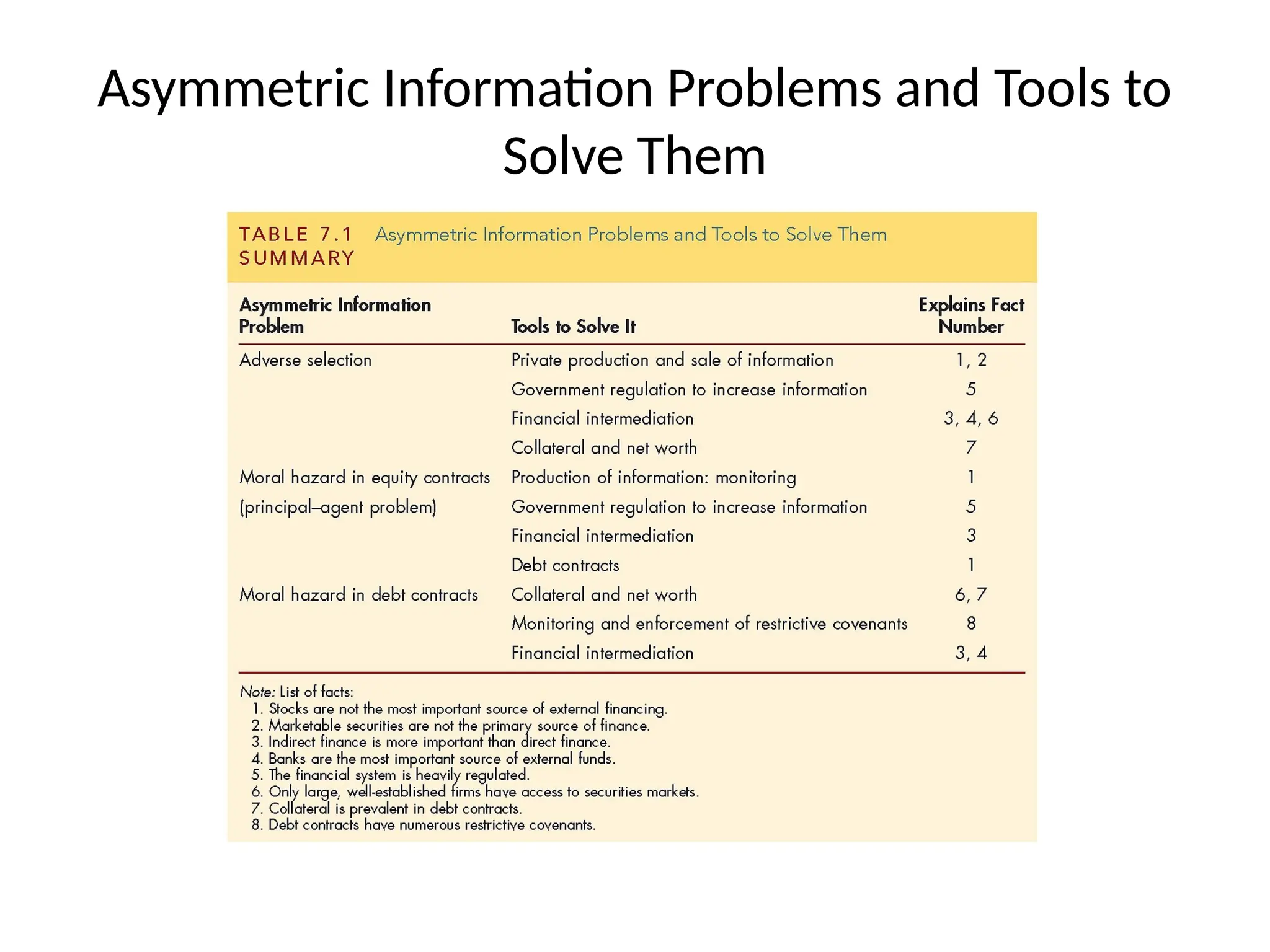
Asymmetric Information Problems and Tools to
Solve Them
Conflicts of Interest
 Conflicts of interest are a type of moral
hazard that occurs when a person or
institution has multiple interests, and serving
one interest is detrimental to the other.
 Three classic conflicts developed in
financial institutions. Looking at these
closely offers insight in avoiding these
conflicts in the future.
Conflicts of Interest: Underwriting and
Research in Investment Banking
 Investment banks may both research companies
with public securities, as well as underwrite
securities for companies for sale to the public.
 Research is expected to be unbiased and
accurate, reflecting the facts about the firm. It is
used by the public to form investment choices.
 Underwriters will have an easier time if research
is positive. Underwriters can better serve the firm
going public if the firm’s outlook is optimistic.
Conflicts of Interest: Underwriting and
Research in Investment Banking
 Research is expected to be unbiased and
accurate, reflecting facts about the firm. It is used
by the public to form investment choices.
 Underwriters can command a better price for
securities issued by a firm if the firm’s outlook is
optimistic.
 An investment bank acting as both a researcher
and underwriter of securities for companies clearly
has a conflict—serve the interest of the issuing
firm or the public?
Conflicts of Interest: Underwriting and
Research in Investment Banking
 During the tech boom, research reports
were clearly distorted to please issuers.
Firms with no hope of ever earning a profit
received favorable research.
 This also lead to spinning, where
underpriced equity was allocated to
executives who would promise future
business to the investment bank.
Conflicts of Interest: Auditing and
Consulting in Accounting Firms
• Auditors check the assets and books of a firm for the
quality and accuracy of the information. The
objective in an unbiased opinion of the firm’s
financial health.
• Consultants, for a fee, help firms with variety of
managerial, strategic, and operational projects.
• An auditor acting as both an auditor and consultant
for a firm clearly is not objective, especially if the
consulting fees exceed the auditing fees.
Conflicts of Interest: Credit Assessment
and Consulting in Rating Agencies
• Rating agencies assign a credit rating to a security
issuance of a firm based on projected cash flow,
assets pledged, etc. The rating helps determine the
riskiness of a security.
• Consultants, for a fee, help firms with variety of
managerial, strategic, and operational projects.
• An rating agency acting as both an rater and
consultant for a firm clearly is not objective, especially
if the consulting fees exceed the rating fees.
Conflicts of Interest: Credit Assessment and
Consulting in Rating Agencies
 Rating agencies, such as Moody’s and Standard
and Poor, were caught in this game during the
housing bubble. Firms asked the rater to help
structure debt offering to attain the highest rating
possible. When the debt subsequently defaulted,
it was difficult for the agency to justify the original
high rating. Perhaps it was just error. But few
believe that—most see the rating agencies as
being blinded by high consulting fees.

chapter_7.pptx finance and the following

  • 1.
    Why do financialinstitutions exist?
  • 2.
    Basic facts aboutfinancial structure throughout the world • Financial system is complex in both structure and function throughout the world. • Includes many different types of institutions: banks, insurance companies, mutual funds, stock and bond markets, and so on. • Eight basic facts about financial structure throughout the world.
  • 3.
    Basic facts aboutfinancial structure throughout the world • 1. Stocks are not the most important source of external financing for businesses. • 2. Issuing marketable debt and equity securities is not the primary way in which businesses finance their operations.
  • 4.
    Basic facts aboutfinancial structure throughout the world 3. Indirect finance, which involves the activities of financial intermediaries, is many times more important than direct finance, in which businesses raise funds directly from lenders in financial markets. 4. Financial intermediaries, particularly banks, are the most important source of external funds used to finance businesses
  • 5.
    Basic facts aboutfinancial structure throughout the world 5. The financial system is among the most heavily regulated sectors of economy. 6. Only large, well-established corporations have easy access to securities markets to finance their activities.
  • 6.
    Basic facts aboutfinancial structure throughout the world 7. Collateral is a prevalent feature of debt contracts for both households and businesses. 8. Debt contracts are typically extremely complicated legal documents that place substantial restrictions on the behavior of the borrowers.
  • 7.
    Transaction costs • Transactioncosts influence financial structure • Financial intermediaries reduce transaction costs
  • 8.
    Transaction costs influencefinancial structure ─ E.g., a $5,000 investment only allows you to purchase 100 shares @ $50 / share (equity) ─ No diversification ─ Bonds even worse—most have a $1,000 size  In sum, transactions costs can hinder flow of funds to people with productive investment opportunities
  • 9.
    Transaction costs • Youhave only a small amount available, you can make only a restricted number of investments because a large number of small transactions would result in very high transaction costs
  • 10.
    How financial intermediariesreduce transaction costs • Financial intermediaries reduce transaction costs • Allow small savers and borrowers from the existence of financial markets
  • 11.
    Economies of scale •Bundle the funds of many investors together • Take advantage of ‘economies of scale’ • Reduce in transaction costs per dollar of investment as the size of transactions increases • Reduces transaction costs for each individual investor
  • 12.
    Economies of scale •Economies of scale possible because the total cost of carrying out a transaction in financial markets increases only a little as the size of the transaction grows • Mutual fund • Sells shares to individuals • Invests the proceeds in bonds or stocks
  • 13.
    Economies of scale •Lower transaction costs because of economies of scale • Cost savings are passed on to individual investors after management fees • Funds are large enough to buy a widely diversified portfolio of securities • Reduces risk
  • 14.
    Expertise • FI developexpertise to lower transaction costs • For example, computer technology • Provide customers liquidity services, customers find easy to conduct transactions • Also provides investors with liquidity, which explains Fact # 3
  • 15.
    Asymmetric Information: Adverse Selectionand Moral Hazard  In your introductory finance course, you probably assumed a world of symmetric information—the case where all parties to a transaction or contract have the same information, be that little or a lot  In many situations, this is not the case. We refer to this as asymmetric information.
  • 16.
    Asymmetric information • Ariseswhen one party’s insufficient knowledge about the other party involved in a transaction • Makes it impossible to make accurate decisions when conducting the transaction • For example, managers of a corporation know whether they are honest or have better information about how well their business is doing than the stockholders do
  • 17.
    Asymmetric information • Taketwo forms: • 1. Adverse selection • 2. Moral hazard
  • 18.
    Adverse selection 1. Occurswhen one party in a transaction has better information than the other party 2. Before transaction occurs 3. Potential borrowers most likely to produce adverse outcome are ones most likely to seek loan and be selected
  • 19.
    Adverse selection • Forexample, big risk takers or outright crooks might be the most eager to take out a loan because they know they are unlikely to pay it back • Lenders might decide not to make any loans, even though there are good credit risks in the marketplace
  • 20.
    Moral hazard 1. Occurswhen one party has an incentive to behave differently once an agreement is made between parties 2. After transaction occurs 3. Hazard that borrower has incentives to engage in undesirable (immoral) activities making it more likely that won't pay loan back
  • 21.
    Moral hazard • Forexample, after the loan borrowers may take big risks which have high possible returns but increases default risk
  • 22.
    Asymmetric Information: Adverse Selectionand Moral Hazard  The analysis of how asymmetric information problems affect behavior is known as agency theory.  We will now use these ideas of adverse selection and moral hazard to explain how they influence financial structure.
  • 23.
    The Lemons Problem:How Adverse Selection Influences Financial Structure  Lemons Problem in Used Cars 1. If we can't distinguish between “good” and “bad” (lemons) used cars, we are willing pay only an average of good and bad car values 2. Result: Good cars won’t be sold, and the used car market will function inefficiently.  What helps us avoid this problem with used cars?
  • 24.
    The Lemons Problem:How Adverse Selection Influences Financial Structure  Lemons Problem in Securities Markets ─ If we can't distinguish between good and bad securities, willing pay only average of good and bad securities’ value ─ Result: Good securities undervalued and firms won't issue them; bad securities overvalued so too many issued
  • 25.
    The Lemons Problem:How Adverse Selection Influences Financial Structure  Lemons Problem in Securities Markets 3. Investors won't want buy bad securities, so market won't function well ─ Explains Fact # 1 and # 2 ─ Also explains Fact # 6 : Less asymmetric info for well known firms, so smaller lemons problem
  • 26.
    Tools to HelpSolve Adverse Selection (Lemons) Problems • In the absence of asymmetric information, the lemons problem goes away • 1. Productive production and sale of information • For example, credit rating agencies, investment advisory services • Free-rider problem
  • 27.
    Tools to HelpSolve Adverse Selection (Lemons) Problems • 2. Government regulation to increase information • For example, annual audits of public corporations • Asymmetric information problem of adverse selection helps explain why financial markets are among the most heavily regulated sectors in the economy. Fact #5
  • 28.
    Tools to HelpSolve Adverse Selection (Lemons) Problems 3. Financial Intermediation ─ Analogy to solution to lemons problem provided by used car dealers ─ Avoid free-rider problem by making private loans (explains Fact # 3 and # 4) ─ Also explains fact #6—large firms are more likely to use direct instead of indirect financing
  • 29.
    Tools to HelpSolve Adverse Selection (Lemons) Problems 4. Collateral and Net Worth ─ Explains Fact # 7
  • 30.
    How Moral HazardAffects the Choice Between Debt and Equity Contracts  Moral Hazard in Equity Contracts: the Principal-Agent Problem 1. Result of separation of ownership by stockholders (principals) from control by managers (agents) 2. Managers act in own rather than stockholders' interest
  • 31.
    How Moral HazardAffects the Choice Between Debt and Equity Contracts An example of this problem is useful. Suppose you become a silent partner in an ice cream store, providing 90% of the equity capital ($9,000). The other owner, Steve, provides the remaining $1,000 and will act as the manager. If Steve works hard, the store will make $50,000 after expenses, and you are entitled to $45,000 of it.
  • 32.
    How Moral HazardAffects the Choice Between Debt and Equity Contracts However, Steve doesn’t really value the $5,000 (his part), so he goes to the beach, relaxes, and even spends some of the “profit” on art for his office. How do you, as a 90% owner, give Steve the proper incentives to work hard?
  • 33.
    How Moral HazardAffects the Choice Between Debt and Equity Contracts  Tolls to Help Solve the Principal-Agent Problem 1. Production of Information: Monitoring 2. Government Regulation to Increase Information 3. Financial Intermediation (e.g, venture capital) 4. Debt Contracts  Explains Fact # 1, Why debt is used more than equity
  • 34.
    How Moral HazardInfluences Financial Structure in Debt Markets  Even with the advantages just described, debt is still subject to moral hazard. In fact, debt may create an incentive to take on very risky projects. This is important to understand. Let’s looks at a simple example.
  • 35.
    How Moral HazardInfluences Financial Structure in Debt Markets  Most debt contracts require the borrower to pay a fixed amount (interest) and keep any cash flow above this amount.  For example, what if a firm owes $100 in interest, but only has $90? It is essentially bankrupt. The firm “has nothing to lose” by looking for “risky” projects to raise the needed cash.
  • 36.
    How Moral HazardInfluences Financial Structure in Debt Markets  Tools to Help Solve Moral Hazard in Debt Contracts 1. Net Worth and Collateral 2. Monitoring and Enforcement of Restrictive Covenants. Examples are covenants that … • discourage undesirable behavior • encourage desirable behavior • keep collateral valuable • provide information
  • 37.
    How Moral HazardInfluences Financial Structure in Debt Markets  Tools to Help Solve Moral Hazard in Debt Contracts 3. Financial Intermediation—banks and other intermediaries have special advantages in monitoring  Explains Facts # 1–4
  • 38.
    Asymmetric Information Problemsand Tools to Solve Them
  • 39.
    Conflicts of Interest Conflicts of interest are a type of moral hazard that occurs when a person or institution has multiple interests, and serving one interest is detrimental to the other.  Three classic conflicts developed in financial institutions. Looking at these closely offers insight in avoiding these conflicts in the future.
  • 40.
    Conflicts of Interest:Underwriting and Research in Investment Banking  Investment banks may both research companies with public securities, as well as underwrite securities for companies for sale to the public.  Research is expected to be unbiased and accurate, reflecting the facts about the firm. It is used by the public to form investment choices.  Underwriters will have an easier time if research is positive. Underwriters can better serve the firm going public if the firm’s outlook is optimistic.
  • 41.
    Conflicts of Interest:Underwriting and Research in Investment Banking  Research is expected to be unbiased and accurate, reflecting facts about the firm. It is used by the public to form investment choices.  Underwriters can command a better price for securities issued by a firm if the firm’s outlook is optimistic.  An investment bank acting as both a researcher and underwriter of securities for companies clearly has a conflict—serve the interest of the issuing firm or the public?
  • 42.
    Conflicts of Interest:Underwriting and Research in Investment Banking  During the tech boom, research reports were clearly distorted to please issuers. Firms with no hope of ever earning a profit received favorable research.  This also lead to spinning, where underpriced equity was allocated to executives who would promise future business to the investment bank.
  • 43.
    Conflicts of Interest:Auditing and Consulting in Accounting Firms • Auditors check the assets and books of a firm for the quality and accuracy of the information. The objective in an unbiased opinion of the firm’s financial health. • Consultants, for a fee, help firms with variety of managerial, strategic, and operational projects. • An auditor acting as both an auditor and consultant for a firm clearly is not objective, especially if the consulting fees exceed the auditing fees.
  • 44.
    Conflicts of Interest:Credit Assessment and Consulting in Rating Agencies • Rating agencies assign a credit rating to a security issuance of a firm based on projected cash flow, assets pledged, etc. The rating helps determine the riskiness of a security. • Consultants, for a fee, help firms with variety of managerial, strategic, and operational projects. • An rating agency acting as both an rater and consultant for a firm clearly is not objective, especially if the consulting fees exceed the rating fees.
  • 45.
    Conflicts of Interest:Credit Assessment and Consulting in Rating Agencies  Rating agencies, such as Moody’s and Standard and Poor, were caught in this game during the housing bubble. Firms asked the rater to help structure debt offering to attain the highest rating possible. When the debt subsequently defaulted, it was difficult for the agency to justify the original high rating. Perhaps it was just error. But few believe that—most see the rating agencies as being blinded by high consulting fees.