Downloaded 30 times
![IJRET: International Journal of Research in Engineering and Technology eISSN: 2319-1163 | pISSN: 2321-7308
_______________________________________________________________________________________
Volume: 03 Issue: 06 | Jun-2014, Available @ http://www.ijret.org 11
LEARNING TO DETECT PHISHING URLs
Ram B. Basnet1
, Andrew H. Sung2
, Quingzhong Liu3
1
Colorado Mesa University, 1100 North Ave. Grand Jct. CO 81501, USA
2
New Mexico Tech, 801 Leroy Pl. Socorro NM 87801, USA
3
Sam Houston State University, Huntsville, TX 77341, USA
Abstract
Phishing attacks have been on the rise and performing certain actions such as mouse hovering, clicking, etc. on malicious URLs
may cause unsuspecting Internet users to fall victims of identity theft or other scams. In this paper, we study the anatomy of
phishing URLs that are created with the specific intent of impersonating a trusted third party to trick users into divulging personal
data. Unlike previous work in this area, we only use a number of publicly available features on URL alone; in addition, we
compare performance of different machine learning techniques and evaluate the efficacy of real-time application of our method.
Applying it on real-world data sets, we demonstrate that the proposed approach is highly effective in detecting phishing URLs
with an error rate of 0.3%, false positive rate of 0.2% and false negative rate of about 0.5%, thereby improving previous results
on the important problem of phishing detection.
Keywords— Phishing URL, phishing websites, machine learning, web mining, phishing attack, URL classification
---------------------------------------------------------------------***--------------------------------------------------------------------
1. INTRODUCTION
Phishing, according to AntiPhishing Working Group [1], is
a criminal mechanism employing both social engineering
and technical subterfuge to steal consumers‟ personal
identity data and financial account credentials. For example,
a “phisher” sends out emails masquerading as a trustworthy
person or a reputable institution, such as a bank, to a large
number of random Internet users. The phishers trick users
by employing social engineering tactics inducing them to
click on a link to a forged site where the user is then asked
to provide private information, e.g., password, bank account
information, credit card number, social security number, etc.
Once the Internet users are lured into a fraudulent website,
even the experienced users are often fooled to fulfill the
website‟s primary goal [11].
The means of distribution of phishing URLs include, among
others, spam or phishing messages with links to the phishing
site, Blackhat search engine optimization (SEO) techniques,
Internet downloads, peer-to-peer (P2P) file sharing
networks, social networking sites, visiting vulnerable web
sites such as blogs, forums, comment accepting news
portals, instant messaging (IM), Internet Relay Chat (IRC),
etc.
Blacklisting is the most common anti-phishing technique
used by modern web browsers. However, study shows that
centralized, blacklist-based protection alone is not adequate
enough to protect end users from new and emerging zero-
day phishing webpages that appear in the thousands and
quickly disappear every day. The study also shows that
heuristics based phishing techniques outperform centralized
blacklisting techniques used by most web browsers [27].
What are needed to address the shortcomings of blacklisting
are methods that are discovery-oriented, dynamic, and semi-
automated. This approach should not replace, but
compliment the blacklist to provide defense-in-depth
mechanism to effectively combat the phishing attacks.
To that end, we present a heuristic-based methodology for
automatically classifying URLs as being potentially
phishing in nature. This methodology could then be used to
thwart a phishing attack by either masking the potentially
phishing URL, or by alerting the user about the potential
threat. Because of the focus on the URL itself, this approach
can be applied anywhere that a URL can be embedded, such
as in email, web pages, chat sessions, to name a few. We
evaluate our approach on real-world data sets with more
than 16,000 phishing and 31,000 non-phishing URLs. We
experimentally demonstrate that our approach can obtain an
error rate of less than 0.3% while maintaining about 0.2%
false positive and 0.5% false negative rates. Featured with
high accuracy rate, we believe that our light-weight
approach can be used by individual users in their system for
near real-time phishing URL detection.
The contributions of this paper are: 1) A demonstration that
a phishing URL can be detected by using the information on
the URL alone without looking at the actual web page
contents and regardless of the context or medium the URL is
distributed. 2) An examination of the importance of publicly
available information on a URL in the evaluation of whether
that URL is phishing. 3) A comparison of a number of
publicly available machine learning classifiers to determine
the best for classification of phishing URLs. 4) A
demonstration that the proposed methodology can be used
for near real-time application in detecting phishing URLs. 5)
A demonstration that the properties of phishing URLs
change over time and how the data drift can affect
classifiers‟ performances.](https://image.slidesharecdn.com/learningtodetectphishingurls-140820042141-phpapp02/85/Learning-to-detect-phishing-ur-ls-1-320.jpg)
![IJRET: International Journal of Research in Engineering and Technology eISSN: 2319-1163 | pISSN: 2321-7308
_______________________________________________________________________________________
Volume: 03 Issue: 06 | Jun-2014, Available @ http://www.ijret.org 12
2. BACKGROUND
In this section, we provide a definition of phishing URL and
review some related works.
2.1 Definition of Phishing URL
Whittaker et al. [33] define a phishing web page as “any
web page that, without permission, alleges to act on behalf
of a third party with the intention of confusing viewers into
performing an action with which the viewers would only
trust a true agent of a the third party.” This definition, which
is similar to the definition of “web forgery”, covers a wide
range of phishing pages from typical ones – displaying
graphics relating to a financial company and requesting a
viewer‟s personal credentials – to sites which claim to be
able to perform actions through a third party once provided
with the viewer‟s login credentials. Thus, a phishing URL is
a URL that leads user to a phishing web page. Our study, by
this definition, is therefore independent of the attack vector
by which a phishing URL is distributed.
2.2 Related Work
This section provides related work in phishing attack
detection and classification using machine learning and non-
machine learning approaches.
2.2.1 Machine Learning Approaches
The work by Garera et al. [13] is the most closely related to
our work. They use logistic regression over 18 hand-selected
features to classify phishing URLs. The features include the
presence of certain red flag key words in the URL, some
proprietary features based on Google‟s PageRank and
webpage quality guidelines. Even though they do not
analyze the page contents to use as features, they use the
pre-computed page based features from Google‟s
proprietary infrastructure that they call Crawl Database.
They achieve a classification accuracy of 97.3% over a set
of 2,500 URLs. Direct comparison with our approach,
however, is difficult without access to the same datasets or
features. Though similar in goal, our approach differs
significantly in both methodology (considering new publicly
available features based on URLs alone and comparing
several different machine learning algorithms) and scale
(considering more features and an order-of-magnitude more
samples).
Ma et al. propose a method to classify malicious URLs
using variable number of lexical and host-based properties
of the URLs. Using these features, they compare the
accuracy of batch and online learning algorithms [18] and
[19]. Among 4 batch algorithms, they determine that
Logistic Regression performs the best for their problem. For
large-scale application in detecting malicious URLs, they
determine that Confidence-Weighted algorithm performs the
best among 4 online algorithms. Though we use some
similar features and classification models, our approach is
different in a number of ways. First, the scope of our work is
limited to detecting phishing URLs as opposed to detecting
wide range of malicious URLs. Our techniques can certainly
be extended to detecting and classifying wider range of
malicious URLs. Secondly, we have a fixed set of smaller
number of features. Thirdly, we do not use host-based
properties of web pages such as WHOIS entries, connection
speed, etc. Though WHOIS information can be very useful
in determining the reputation of hosts and registrars and the
reputation of the domains overall, it makes the repetition of
the experiments difficult.
Whittaker et al. [33] describe the design and performance
characteristics of a scalable machine learning classifier that
has been used in maintaining Google‟s phishing blacklist
automatically. Their proprietary classifier analyzes millions
of pages a day, examining the URL and the contents of a
page to determine whether or not a page is phishing. Their
system classifies web pages submitted by end users and
URLs collected from Gmail‟s spam filters. Though some
URL based features are similar, we propose several new
features and evaluate our approach with publicly available
machine learning algorithms and public data sets. Unlike
their approach, we do not use any proprietary and page
content based features.
Zhang et al. [34] present CANTINA, content-based
approach to detect phishing websites, based on the TF-IDF
information retrieval algorithm and the Robust Hyperlinks
algorithm. By using a weighted sum of 8 features (4 content-
related, 3 lexical, and 1 WHOIS-related) they show that
CANTINA can correctly detect approximately 95% of
phishing sites. The goal of our approach is to avoid
downloading the actual web pages and thus reduce the
potential risk of analyzing the malicious content on user‟s
system. In order to achieve this goal, we evaluate only the
features related to URLs.
A number of machine learning-based studies can be found in
related contexts such as in detecting phishing emails. Fette
et al. [12] use a set of 10 features extracted from email
headers, WHOIS information on sender‟s domain, email
contents, URL structures, etc. and apply Support Vector
Machines (SVMs) to classify phishing emails from
legitimate ham emails. We further improve the accuracy of
Fette et al. by introducing groups of keyword based features
from the email contents [3]. Using different classification
models we achieve classification accuracy of 98%, while
maintaining low false positive and negative rates. Fette et al.
[12] hypothesized that phishing email classification appears
to be simple text classification problem but, the
classification is confounded by the fact that the class of
“phishing” emails is nearly identical to the class of real
emails. Motivated by the hypothesis, we base the phishing
email classification problem as the text classification
problem in our previous work [5]. Using Confidence-
Weighted linear classifier, an online algorithm, and using
only the email text contents as “bag-of-words”
representation, we achieve a classification accuracy of 99%,
maintaining false positive and false negative rates of less
than 1% on public benchmark data sets.](https://image.slidesharecdn.com/learningtodetectphishingurls-140820042141-phpapp02/85/Learning-to-detect-phishing-ur-ls-2-320.jpg)
![IJRET: International Journal of Research in Engineering and Technology eISSN: 2319-1163 | pISSN: 2321-7308
_______________________________________________________________________________________
Volume: 03 Issue: 06 | Jun-2014, Available @ http://www.ijret.org 13
2.2.2 Non-Machine Learning Approaches
Besides machine learning (ML) based techniques, there
exist many other approaches in phishing detection. Perhaps,
the most widely used anti-phishing technology is the URL
blacklist technique that most modern browsers are equipped
with [14] and [28]. Other popular methods are browser-
based plug-in or add-in toolbars. SpoofGuard [9] uses
domain name, URL, link, and images to evaluate the spoof
probability on a webpage. The plug-in applies a series of
tests, each resulting in a number in the range from 0 to 1.
The total score is a weighted average of the individual test
results. There has been an attempt to detect phishing attack
using user generated rules [6]. Other anti-phishing tools
include SpoofStick [30], SiteAdvisor [20], Netcraft anti-
phishing toolbar [23], AVG Security Toolbar [2], etc.
3. OUR METHOD
In this section, we describe in detail our approach to
detecting phishing URLs. We begin with an overview of the
classification problem, followed by a discussion of the
generation of our data sets, features we extract, and finally
the set of machine learning classifiers we use to evaluate our
methodology.
3.1 Method Overview
We propose a heuristic-based approach to classify phishing
URLs by using the information available only on URLs. We
treat the problem of detecting phishing URLs as a binary
classification problem with phishing URLs belong to the
positive class and benign URLs belong to the negative class.
We first run a number of scripts to collect our phishing and
benign URLs and create our data sets. Our next batch of
scripts then extracts a number of features by employing
various publicly available resources in order to classify the
instances into their corresponding classes. We then apply
various machine learning algorithms to build models from
training data, which is comprised of pairs of feature values
and class labels. Separate set of test data are then supplied to
the models, and the predicted class of the data instance is
compared to the actual class of the data to compute the
accuracy of the classification models. Figure 1 provides the
overview of graphical representation of phishing URL
detection framework.
Fig. 1 Overview of phishing URL detection framework
3.2 Data Sets
For experiments, we collected our data from various
credible sources that are also used by Ma et al. [18], Zhang
et al. [34], and many others. For phishing URLs, we wrote
Python scripts to automatically download confirmed
phishing websites‟ URLs from PhishTank. PhishTank is a
collaborative clearing house for data and information about
phishing on the Internet [25]. After signing up, developers
and researchers can download confirmed phishing URL lists
in various file formats with an API key provided for free. A
potential phishing URL once submitted is verified by a
number of registered users to confirm it as phishing. We
collected first set of 11,361 phishing URLs from June 1 to
October 31 of 2010 and call it OldPhishTank data set.
Phishing tactics used by scammers evolve over time. In
order to follow these evolving URL features and to closely
mimic the real-world scenario, we collected second batch of
5,456 confirmed phishing URLs that were submitted for
verification from January 1 to May 3, 2011. We call it
NewPhishTank data set.
In order to address URLs that were produced using
shortening services such as bit.ly, goo.gl, etc., we developed
a Python library [4] to utilize the web service API provided
by longurl.org to automatically detect and expand shortened
URLs. The service currently supports about 333 popular
shortening services. However, some short URLs – either
from some new and unsupported shortening services or
because the shortening services do not expand as the target
URL has been reported as phishing or malicious – do exist
in our data sets.
We collected the non-phishing URLs from two public data
sources: Yahoo! directory and DMOZ Open Directory
Project. We used Yahoo‟s server redirection service,
http://random.yahoo.com/bin/ryl, which randomly selects a
web link from Yahoo directory and redirects browser to that
page. In order to cover wider URL structures, we also made
a list of URLs of most commonly phished targets (using
statistics of top targets from PhishTank). We then crawled
those URLs, parsed the retrieved HTML contents, and
harvested the hyperlinks therein to also use as non-phishing
URLs. Those additional hyperlinks are assumed to be
benign since they were extracted from a legitimate source.
We use 22,213 legitimate URLs using these sources and call
it Yahoo data set. These URLs were collected between
September 15, 2010 and October 31, 2010. The other source
of legitimate URLs, DMOZ, is a directory whose entries are
vetted manually by editors. We use 9,636 randomly chosen
non-phishing URLs from this source and call it DMOZ data
set.
We then paired OldPhishTank and NewPhishTank data sets
with non-phishing URLs from a benign source (either
Yahoo or DMOZ). We refer to these data sets as the
OldPhishTank-Yahoo (OY), OldPhishTank-DMOZ (OD),
NewPhishTank-Yahoo (NY), and NewPhishTank-DMOZ
(ND).](https://image.slidesharecdn.com/learningtodetectphishingurls-140820042141-phpapp02/85/Learning-to-detect-phishing-ur-ls-3-320.jpg)
![IJRET: International Journal of Research in Engineering and Technology eISSN: 2319-1163 | pISSN: 2321-7308
_______________________________________________________________________________________
Volume: 03 Issue: 06 | Jun-2014, Available @ http://www.ijret.org 14
Table 1: Feature Categories and Number of Features in
Each Category
Feature Category Feature Count
Lexical based 24
Keyword based 101
Search Engine based 6
Reputation based 7
Anywhere from a handful to tens of thousands of features
have been proposed and used in detecting phishing URLs.
We developed our set of 138 features based on related
works, drawing primarily from [3], [12], [13], [33], and
[34]. Some of these features are modified to fit our needs,
while others are newly proposed. The use of relatively small
number of fixed set of features makes the decision
boundaries less complex, and therefore less prone to over-
fitting as well as faster to evaluate for most batch
algorithms.
We group features that we gather into 4 broad categories.
Table 1 summarizes each category and the number of
features from that category that we use in our data sets for
classifying phishing URLs. We briefly describe each feature
category with their statistics from a randomly selected 80%
of OldPhishTank-Yahoo training data set (we call it
“Random Set”) in the following sub sections.
3.2.1 Lexical-based Features
Lexical features, the textual properties of the URL itself,
have been widely used in literatures [3], [12], [18], [19],
[33], and [34] in detecting phishing attacks.
We examine various obfuscation techniques phishers may
employ and derive a number of phishing like features to use
in our classifiers. For instance, we check if there‟s a port
number in a URL and check if the port belongs to the list of
standard HTTP ports: 80, 8080, 21, 443, 70, and 1080. If the
port number doesn‟t belong to the standard list, we flag it as
a potentially phishing URL.
There are 24 features in this category. We summarize the
real-valued and binary features separately in Table 2 and 3,
respectively. The decimal numbers are rounded to 2 digits
after the decimal point.
Table 2: Feature Categories and Number of Features in
Each Category
Feature
Description
URL Type Max Mi
n
Mean Med
-ian
Length of
Host
Phishing 240 4 21.38 19
Non-
phishing
70 5 18.77 18
Number of
„.‟ in Host
Phishing 30 0 2.13 2
Non-
phishing
5 1 2.14 2
Number
of„.‟ in Path
Phishing 18 0 0.86 1
Non-
phishing
13 0 0.25 1
Number of
„.‟ in URL
Phishing 30 0 3.00 3
Non-
phishing
15 1 2.38 2
Length of
Path
Phishing 380 0 24.55 15
Non-
phishing
360 0 10.74 1
Length of
URL
Phishing 999 13 66.09 18
Non-
phishing
383 15 41.22 33
Table 3: Summary of Lexical-based Binary Valued Features
and their Statistics
Feature Description % Phishing % Non-
phishing
„-„ in Host 2.02% 9.03%
Digit [0-9] in Host 30.06% 3.11%
IP Based Host 4.15% 0.00%
Hex Based Host 0.18% 0.00%
„-„ in Path 15.82% 6.64%
„/‟ in Path 98.39% 96.18%
„=‟ in Path 4.58% 0.16%
„;‟ in Path 0.07% 0.00%
„,‟ in Path 0.15% 0.28%
Has Parameter Part 0.18% 0.77%
Has Query Part 0.07% 0.01%
„=‟ in Query Part 13.45% 10.43%
Has Fragment Part 0.18% 0.77%
„@‟ in URL 0.33% 0.08%
„Username‟ in URL 0.33% 0.08%
„Password‟ in URL 0.02% 0.00%
Has Non-Standard
Port
0.01% 0.00%
„_‟ in Path 11.16% 8.41%
3.2.2 Keyword-based Features
Many phishing URLs are found to contain eye-catching
word tokens (e.g., login, signin, confirm, verify, etc.) to
attract users‟ attention. Garera et al. [13] selected 8 red flag
keywords to use as features. Whittaker et al. [33] use every
string token separated by non-alphanumeric characters out
of the URL to use as features. However, they rely on the
feature selection methods built into their machine-learning
framework to incorporate only the most useful of these
features into their classification models. Though our word
based feature extraction technique is somewhat similar to
theirs, the selection technique significantly differs as we
employ a formal feature selection technique which we
describe next.
Using the Random Set (Section III-B), we tokenize each
phishing URL by splitting it using non-alphanumeric
characters. After applying Porter stemmer [22], we obtain
12,012 unique root tokens and their frequencies. While we
could use every word token appearing on phishing URLs as
a feature an approach taken by Ma et al. [18] and [19] to
detect malicious URLs this many keyword based features
plus other features per URL can burden our batch learning](https://image.slidesharecdn.com/learningtodetectphishingurls-140820042141-phpapp02/85/Learning-to-detect-phishing-ur-ls-4-320.jpg)
![IJRET: International Journal of Research in Engineering and Technology eISSN: 2319-1163 | pISSN: 2321-7308
_______________________________________________________________________________________
Volume: 03 Issue: 06 | Jun-2014, Available @ http://www.ijret.org 15
algorithms without yielding any performance benefit.
Instead, we discard all tokens with length < 3 such as d, c, e,
br, fr, it, etc. Some single-character tokens have high
frequencies, but offer no meaning. Two-character tokens are
mostly the country code top-level domains (ccTLD). We
also discard several common URL parts such as http, www,
com, etc. and webpage file extensions such as htm, html,
asp, php, etc. Since top target organizations such as paypal,
ebay, bankofamerica, wamu, etc. are covered by top target
list under reputation-based features, we discard them as
well.A large number of tokens have frequency one,
suggesting that they are not frequently used in phishing
URLs. Most of these words either do not make sense as a
whole or they have random characters such as ykokejox,
riversid, sxkretyvwufatnrmomgpqjdw, njghlfi, etc. We
discard these tokens as well. With this preliminary selection,
we are left with 1,127 tokens.
We then apply feature selection technique commonly used
in text classification. Feature selection serves two main
purposes. First, it makes the process of training and applying
a classifier more efficient by decreasing the size of the
discriminative features. This is of particular importance for
classifiers that, unlike Naïve Bayes, are expensive to train.
Second, feature selection often increases classification
accuracy by eliminating noise features. We compute mutual
information (MI) of each term in phishing class. MI
measures how much information the presence or absence of
a term contributes to making the correct classification
decision on a class [24]. MI is computed using the following
equation:
𝑀𝐼 𝑈; 𝐶 =
𝑁11
𝑁
𝑙𝑜𝑔2
𝑁𝑁11
𝑁1. 𝑁.1
+
𝑁01
𝑁
𝑙𝑜𝑔2
𝑁𝑁01
𝑁0. 𝑁.1
+
𝑁10
𝑁
𝑙𝑜𝑔2
𝑁𝑁10
𝑁1. 𝑁.0
+
𝑁00
𝑁
𝑙𝑜𝑔2
𝑁𝑁00
𝑁0. 𝑁.0
(1)
where U is a random variable that takes values et = 1 (the
URL contains term t) and et = 0 (the URL does not contain
term t), C is a random variable that takes values ec = 1 (the
URL is in class c) and ec = 0 (the URL is not in class c), N s
are counts of URLs that have the values of et and ec that are
indicated by the two subscripts. For example, N10 is the
number of URLs that contain t (et = 1) and are not in c (ec =
0). N1. = N10 + N11 is the number of URLs that contain t (et =
1) and we count URLs independent of class membership (ec
ϵ {0, 1}). N = N00 + N01 + N10 + N11 is the total number of
URLs in the training set.
Terms with high MI values indicate that they are more
relevant to the class and are good discriminative features,
whereas terms with lower MI values indicate that they are
less relevant. For brevity, Table IV shows only the top 10
terms based on MI along with the percentage of each term
appearing in phishing and non-phishing URLs in the
Random Set.
Table 4: Top 10 root Terms (Based on Mutual Information)
and Their Statistics
Root
Term
MI
% Phishing
URLs
% Non-
phishing URLs
log 0.1740 21.77% 1.71%
pay 0.1027 13.26% 0.50%
web 0.0778 14.90% 1.62%
cmd 0.6840 10.08% 0.37%
account 0.0559 7.86% 0.34%
dispatch 0.0390 5.69% 0.01%
free 0.0362 7.20% 0.48%
run 0.0331 4.89% 0.16%
net 0.0320 13.05% 5.05%
confirm 0.0292 3.42% 0.00%
Note that the statistical values of each feature among
phishing and non-phishing URLs are rounded to 2 and MI
values are rounded to 4 decimal digits. Because some
keywords are so sparsely present among non-phishing URLs
in the training dataset, their statistical values are rounded to
0.00% (for instance, term confirm in Table 4). The only
feature term that is entirely absent among non-phishing
URLs from all data sets is config.
By ordering the terms based on MI values from high to low,
we then use these terms as binary features on data set OY.
Using forward feature selection method, we train and test
Naïve Bayes 1,127 times for each feature set size from 1 to
1,127 and record its error rate for each run. We choose
Naïve Bayes because of its speed and its effectiveness in
spam filtering application [29] a problem similar to ours
that uses “spammy” word tokens. Figure 2 shows the error
rates on feature size from 1 to 1,127.
Fig 2 Effects of keyword feature set size on error rate using
Naïve Bayes on OY dataset.
Initially, the error rate decreases significantly from ~29% to
~24% as the number of features increases. But after 100
features, the change in error rate is statistically insignificant
(< 0.1%) until all the features are added. Thus, we decide to
use the top 101 terms based on their MI as keyword based
features.
3.2.3 Reputation-based Features
PhishTank produces various top 10 statistical reports on
phishing websites every month. We downloaded 3 types of
statistics: Top 10 Domains, Top 10 IPs, and Top 10 Popular
Targets from the first batch of statistics published in October
2006 to October 2010. The idea behind this is to make use](https://image.slidesharecdn.com/learningtodetectphishingurls-140820042141-phpapp02/85/Learning-to-detect-phishing-ur-ls-5-320.jpg)
![IJRET: International Journal of Research in Engineering and Technology eISSN: 2319-1163 | pISSN: 2321-7308
_______________________________________________________________________________________
Volume: 03 Issue: 06 | Jun-2014, Available @ http://www.ijret.org 16
of the historical data on top IPs and domains that host
phishing websites. If a URL has many other phishing related
heuristics and also its host belongs to top IP and/or top
domain that has historic reputation of hosting phishing web
pages, then we can increase our confidence level to classify
the URL in question as phishing. There are 311 unique
domains, 354 unique IPs, and 43 unique targets in the top 10
statistics during 4 years of period.
Features from PhishTank statistics may appear little biased
to use against detecting phishing URLs from the same
source. The idea, however, is to use features based on many
statistical reports similar to these on phishing web pages.
For instance, we include statistics from StopBadware.org,
which we explain next. We plan to find more public
statistics to use in our future work, and we hypothesize that
these features help in detecting phishing URLs if included
with many other discriminative features.
StopBadware.org works with its network of partner
organizations such as Google, Sunbelt Software, etc. and
individuals to fight back against viruses, spyware, etc. [31].
It produces top 50 IP address report from number of
reported URLs. We check if the IP address of a URL
belongs to this top 50 report and flag it as potentially
phishing if it does.
To the best of our knowledge, this is the first work to use
such publicly available historical statistics to detect phishing
URLs.
Several blacklists have been used by Ma et al. [18] and [19].
We use Safe Browsing API [14] to check URLs against
Google‟s constantly updated blacklists of suspected
phishing and malware pages and use 3 binary features for
membership in those blacklists. Essentially, these blacklists
are also used by Google Chrome and Mozilla Firefox to
warn users of potentially malicious websites.
Table 5 summarizes the distribution of reputation-based
features in phishing and non-phishing URLs.
Table: 5 Reputation-based Features and Their Statistics
Feature Description
% Phishing
URLs
% Non-
phishing
URLs
PhishTank Top 10
Domain in URL
20.98% 4.87%
PhishTank Top 10
Target in URL
32.65% 14.21%
IP in PhishTank Top 10
IPs
17.30% 0.87%
IP in StopBadware Top
50 IPs
2.31% 1.37%
URL in Phishing
Blacklist
42.41% 0.00%
URL in Malware
Blacklist
0.45% 0.05%
URL in RegTest
Blacklist
0.16% 0.00%
3.2.4 Search Engine-based Features
Google search engine has been used by Garera et al. [13],
Whittaker et al. [33], and Zhang et al. [34]. Whittaker et al.
use PageRank from Google proprietary infrastructure.
Garera et al. use Google‟s proprietary technologies such as
PageRank, page index, and page quality scores. These are
pre-computed during Google‟s crawl phase and are stored in
a table, which they call Crawl Database. Though the features
generated from the Google proprietary infrastructure seem
plausible, it makes the repetition and validation of
experiments extremely difficult if not impossible. On the
other hand, our search engine based feature gathering
technique uses either publicly available APIs or mimics
users using search engines to gather information on a URL.
Zhang et al. select the top 5 words with highest TF-IDF
value to generate lexical signature of a page. They feed each
lexical signature to Google search engine and check if the
domain name of the current web page matches the domain
name of the top 30 results. If yes, they consider it to be a
legitimate website. Though the goal is similar, we utilize
search engines in different ways. Instead of using the query
terms, we use the URL and its domain part.
We check if the URL exists in the search engines‟ index in
the following manner. First, we search for the whole URL
and retrieve the top 30 results. Our preliminary experiments
showed that retrieving top 10 results was enough to check if
a URL has been indexed. We use the top 30 results, even so,
to be on the safe side as the work by Zhang et al. show that
retrieving more than 30 results doesn‟t yield any
performance improvements. If the results contain the URL,
we consider it as a potentially benign URL, phishing
otherwise. We also check if the domain part of the URL
matches the domain part of any links in the results.
Similarly, if there is a match, we flag the URL as a
potentially legitimate URL. Otherwise, we query the search
engine again with just the domain part of a URL. If none of
the returned links matches the query URL, we flag the URL
as potentially phishing. If both the URL and the domain do
not exist in search engines index, it is a high indication that
the domain is a newly created one and the URL in question
is more likely to be phishing. Hence, we believe that these
features also compliment the „age of domain‟ feature based
on WHOIS used by most of the related works.
Our heuristic, however, makes certain assumptions that the
leading top 3 search engines index the vast majority of
legitimate websites and that legitimate sites usually live
longer and hence, the search engine crawlers will index
them sooner or later. On the other hand, the average time a
phishing site stays online is 4.5 days or even less [27], [34].
Moreover, there won‟t be that many links pointing to the
phishing web site. Because of the low life span and lack of
links pointing to the phishing web site, we assume that
search engines crawlers may not get to the site before they
are taken down. We employ 3 major search engines with the
strong reason that at least one of them may have indexed
legitimate website if not all. Furthermore, search engines
may try to filter out known malicious links from the search](https://image.slidesharecdn.com/learningtodetectphishingurls-140820042141-phpapp02/85/Learning-to-detect-phishing-ur-ls-6-320.jpg)
![IJRET: International Journal of Research in Engineering and Technology eISSN: 2319-1163 | pISSN: 2321-7308
_______________________________________________________________________________________
Volume: 03 Issue: 06 | Jun-2014, Available @ http://www.ijret.org 17
results using their proprietary technologies. Thus, the
heuristic effectively leverages on top search engines
crawling resources and proprietary filtering techniques.
To the best of our knowledge, this is the first work to utilize
search engines in this manner to detect phishing URLs.
Search engine based features and their statistics are
summarized in Table 6.
Table: 6 Search Engine-based Features and Their Statistics
Feature Description
% Phishing
URLs
% Non-
phishing
URLs
URL NOT in Google
Top Results
98.71% 4.85%
Domain NOT in Google
Top Results
98.27% 2.64%
URL NOT in Bing Top
Results
96.95% 34.63%
Domain NOT in Bing
Top Results
96.34% 12.77%
URL NOT in Yahoo
Top Results
98.93% 17.74%
Domain NOT in Yahoo
Top Results
98.71% 13.95%
3.3 Classification Models
Since no single classifier is perfect, we evaluate several
supervised batch-learning classifiers. As researchers, we
have no vested interest in any particular classifier. These
classifiers are chosen mostly because they have been applied
to problems similar to ours, such as in detecting: spam and
phishing emails, phishing and malicious URLs, phishing
webpages, etc. We simply want to empirically compare a
number of classifiers based on their availability in
implementation and determine the one that yields the best
performance in terms of both training and testing time and
accuracy to the problem of detecting phishing URLs.
We evaluate the following 7 classifiers implemented in
WEKA (Waikato Environment for Knowledge Analysis)
library [15] with their default parameter values:
1) Support Vector Machines (SVMs with rbf kernel) [32]
2) SVMs with linear kernel
3) Multilayer Perceptron (MLP) [16]
4) Random Forest (RF) [8]
5) Naïve Bayes (NB) [17]
6) Logistic Regression (LR) [7]
7) C4.5 [26] – which is implemented as J48 in WEKA.
4. EMPIRICAL EVALUATIONS
Using the features described in Section III-C, we encode
each individual URL into a feature vector with 138
dimensions. We scale the real-valued features, available
mostly in lexical based features, to lie between 0 and 1.
Scaling equalizes the range of the features in real-valued and
binary features further emphasizing that we are treating each
feature as equally informative and important.
In order to evaluate our methodology, we perform 5 major
experiments. We use 10 times 10-fold cross-validation
(unless otherwise stated) to evaluate the classifiers. The
experiments are run on a machine with 2 dual-core 2 GHz
Intel processors and 4 GB memory.
4.1 Experiment 1- Classifier Evaluation
In this experiment, we evaluate classification performance
of 7 classifiers on all data sets using the whole feature set.
Figure 3, 4, and 5 compare the overall error rates, false
positive rates (FPR), and false negative rates (FNR)
respectively.
Fig. 3 Overall error rates of all classifiers on each of four
data sets using all features.
Fig. 4 False positive rates of all classifiers on each of four
data sets using all features
Note NB has 2.24% and 3.62% false positive rates on
OldPhishTank-Yahoo and NewPhishTank-Yahoo data sets
respectively.
Fig. 5 False negative rates of all classifiers on each of four
data sets using all features](https://image.slidesharecdn.com/learningtodetectphishingurls-140820042141-phpapp02/85/Learning-to-detect-phishing-ur-ls-7-320.jpg)
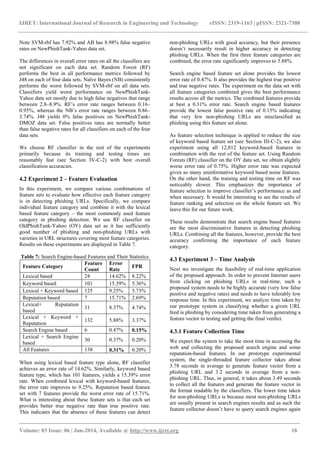
![IJRET: International Journal of Research in Engineering and Technology eISSN: 2319-1163 | pISSN: 2321-7308
_______________________________________________________________________________________
Volume: 03 Issue: 06 | Jun-2014, Available @ http://www.ijret.org 19
for just the domain part of the URLs. We believe that we
can significantly lower the time to collect features by
employing parallel processing and local caching techniques
that can access the web and gather various features
simultaneously. We leave this as our future work when we
build a robust, scalable system to test in the real world.
4.3.2 Training and Testing Times
To provide better comparisons of time taken by the
classifiers to train and test the models and to find out the
time taken to classify an instance of URL, we use 80/20
percentage split on the OldPhishTank-Yahoo data set with
all features for training and testing purposes respectively.
We summarize the average results in Table 8 after running
the experiments for 5 times. The cross-validation time is the
time taken by classifiers in Experiment 1 on
NewPhishTank-Yahoo data set.
Table 8: Training and Testing Time Taken by all Classifiers on OY Data Set Using all Features
Average
Time
Total
Samples
RF J48 MLP LR
SMV-
lin
SVM-
rbf
NB
Train 26860 1.05 m 2.28 m 1.69 h 0.56 m 1.65 m 1.56 m 0.15 m
Test 6714 0.03 s 0.003 s 88.08 s 0.03 s 2.0 s 2.24 s 0.20 s
Test 1
0.021
ms
0.003
ms
13.12
ms
0.03
ms
1.33 ms 2.01 ms
0.19
ms
Cross-validation 27669 14.6 m 36.2 m 20.9 h 6.3 m 14.1 m 12.7 m 1.7 m
Naïve Bayes is widely used in spam filters partly because
the training and testing times are fast. We see similar result
with NB taking the fastest 0.15 minutes to build the model.
However, it also performs the worst in terms of error rate.
MLP has the worst training time (in hours) and also worst
testing time. We can observe that Random Forests (RF) has
one of the best tradeoff between train and test time and
overall accuracy. RF‟s training time is second best and
comparatively very close to that of NB‟s, and its overall
performance results are the best among all the classifiers
(see Experiment 1).
Though training time is generally higher compared to testing
time, training may be done offline and less frequently. It‟s
the test time that is crucial in providing the real-time service
of detecting phishing URLs.Time taken to test a URL, once
the model is trained, by most of the classifiers is in very low
milliseconds and negligible compared to time taken to
collect features. Overall, our single-threaded experimental
system can classify a URL in less than 3.5 seconds in
average. We understand that this time may not be acceptable
in real-time classification system. Nonetheless, we believe
that there‟s a lot of room for improvements during the
design and implementation of the system for large-scale
deployment to effectively provide near real-time service.
Furthermore, users may likely tradeoff some speed for its
high accuracy when it comes to detecting potentially
dangerous phishing URLs.
4.4 Experiment 4
In these experiments, we demonstrate how a classifier‟s
performance varies when using mismatched data sources
and temporal-based data sets.
4.4.1 Mismatched Data Sets
Features extracted by observing a particular data set can
yield impressive low classification error rates when trained
and tested on disjoint sets of the same data source using the
right classifier. However, experiment results from study by
Ma et al. [18] show that when training and testing sources
are completely mismatched, a classifier‟s performance
decreases significantly. To investigate if this phenomenon
holds in our case, we experiment with training and testing
on various combinations of phishing and non-phishing
sources of URLs. There‟s one caveat, however, in our
phishing URLs data sources. As we couldn‟t find the second
credible source for phishing URLs, we generate two
phishing data sets (separated by two whole months of
collection time) from the same source PhishTank as
described in Section III-B. Even though it may not make a
strong case for different sources, we argue that it does make
a very strong case for investigating data drift (evolving
features in phishing URLs, see Section IV-D-2).We use the
abbreviations defined in Section III-B to refer to each
combination of data sets, e.g., OY for Old PhishTank-
Yahoo.
Table 9: Training and Testing Time Taken by all Classifiers
on OY Data Set Using all Features
Training
Testing (Error Rate)
OY OD NY ND
OY 0.31% 0.08% 2.69% 4.96%
OD 10.92% 0.09% 13.39% 0.33%
NY 0.47% 0.79% 0.87% 0.21%
ND 10.45% 0.27% 12.54% 0.33%
All data sets
(OYND)
0.33% 0.06% 0.10% 0.16%
Table 9 shows classification results of training and testing
on mismatched data sets using Random Forest classifier.
As expected, when trained and tested RF classifier with the
same data set, the overall error rates are normally better
compared to when trained and tested with mismatched –
possibly different sources – data sets (see the diagonal
values in Table IX). When new phishing URLs are tested](https://image.slidesharecdn.com/learningtodetectphishingurls-140820042141-phpapp02/85/Learning-to-detect-phishing-ur-ls-9-320.jpg)
![IJRET: International Journal of Research in Engineering and Technology eISSN: 2319-1163 | pISSN: 2321-7308
_______________________________________________________________________________________
Volume: 03 Issue: 06 | Jun-2014, Available @ http://www.ijret.org 20
against the model trained from old phishing URLs, the error
rate is 2.69% contributed mostly by false negatives.When
only the non-phishing URL source is mismatched (e.g., OD
and OY), error rate increases due to higher false positives.
This observation is similar to the one observed by Ma et al.
[18]. However, when only the phishing URL data sets are
mismatched (e.g., OD, ND), we do not see a big increase in
error rates. The worst error rate in this category is 2.69%
(OY and NY). This small increase in error rate may be due
to the fact that the source of phishing URLs are not
technically different but they differ by the time when
phishing URLs were submitted for verification. We look
more into this in the next section. When classifier is trained
with combination of any phishing data sets plus DMOZ
(OD, ND), and tested with combinations of phishing data
sets and Yahoo data set (OY, NY), the error ranges between
10–13%, contributed mostly by high false positives. When
trained with URLs from all the data sets, the model
generalizes well and yields good performance results across
all test data sets (last row). This experiment concludes that
the classifiers trained using URL data from one data source
may not generalize well while testing data from different
data source. Furthermore, it shows that training data set
needs to be selected properly that represent the actual test
environment in the real world in order to achieve the best
performance from a classifier in the important problem of
detecting phishing URLs.
Though instances in data sets may be different, we can
compare these results with those in Ma et al. [18] in cases
where the data sources are similar. Their data sets include
5,500 phishing URLs from PhishTank and all of their
benign URLs come from Yahoo and DMOZ.When trained
and tested with the various combinations of Yahoo, DMOZ,
and PhishTank data sources, our method achieves errors in
the range 0.06–13.39%, while their approach report errors in
the range 1.24–33.54% on the same data sources. They
achieve at best 0.90% on the split of the Yahoo-Spamscatter
data source showing that their approach is better at detecting
spam URLs than at detecting phishing URLs. We argue that
our approach achieves superior performance in detecting
phishing URLs.
4.4.2 Concept Drift
Phishing tactics and URL structures keep changing
continuously over time as attackers come up with novel
ways to circumvent the existing filters. As phishing URLs
evolve over time, so must the classifier‟s trained model to
improve its performance. Ma et al. [19] conclude that
retraining algorithms continuously with new features is
crucial for adapting successfully to the ever evolving
malicious URLs and their features. An interesting future
direction would be to find the effect of variable number of
features using online algorithms in detecting phishing
URLs.
We use OldPhishTank data set and 22,722 (twice the
number of phishing URLs) randomly selected non-phishing
URLs from Yahoo and DMOZ data sets as our “base”
training set. Figure 6 shows the classification error rates for
classifiers after training them only once using the “base”
training set. The x-axis shows number of weeks in the
experiment with the phishing URLs collected from January
1st
week to May 1st
week of 2011, and the y-axis shows the
error rates on testing the classifier with phishing URLs
collected each week. For non-phishing URLs, to generate
each week‟s test data, twice the number of phishing URLs is
randomly selected from Yahoo and DMOZ data sets.
Fig 6 Error rates for all classifiers after training them once
and testing them on weekly data.
While most classifiers perform poorly in this experiment,
J48 performs the worst for most of the weeks with error rate
reaching as high as 28% when testing with data from 3rd
week of March (33). Random Forests (RF) and Logistic
Regression (LR), in general, perform better with error
ranging from 0–13%. For all the classifiers, the high error
rate is due to high false negatives, which get as high as 60–
80% for some weeks. For week 31 data, most classifiers
yield a 0% error rate, as there are only 2 phishing URLs and
4 non-phishing URLs for the week‟s test data. These high
error rates due to high false negative rates suggest that the
model must be retrained on fresh data to account for new
combinations of features on phishing and non-phishing
URLs over time in order to keep the model fresh and
achieve better performance.
To address this issue, we retrain classifiers every week with
training data collected up to that week and test on the data
from the following week. We show these results in Figure 7.
To test the models for data collected on January 1st
week
(11), for example, we train classifiers using “base” training
set. To test data collected on week 12, we retrain all the
classifiers with “base” training set plus all data collected up
to the previous week (11 in this case). As a result, the error
rates decrease over time due to significant improvement in
false negative rates week after week. For RF classifier, error
rate decreases from 9% on the first week to 0.4% for the last
week. Interestingly, we see the most improvement in
performance of J48. Its error rate starts with the highest 20%
for the first week and it gradually improves to 0.6% on the
last week. Although fresh data eventually helps most
classifiers improve over previous experiment where the
classifiers are trained only once, we feel that a week‟s
training data is still insufficient. By looking at the trends in
our experiments and as observed by Ma et al. [19], training
on daily data or perhaps using incremental training with
individual instance using online algorithms may improve the
results on classification of continuously changing phishing](https://image.slidesharecdn.com/learningtodetectphishingurls-140820042141-phpapp02/85/Learning-to-detect-phishing-ur-ls-10-320.jpg)
![IJRET: International Journal of Research in Engineering and Technology eISSN: 2319-1163 | pISSN: 2321-7308
_______________________________________________________________________________________
Volume: 03 Issue: 06 | Jun-2014, Available @ http://www.ijret.org 21
URLs. But due to lack of enough data for a lot of individual
days in our data sets, we leave these experiments for future
work when we‟ll collect phishing URLs from several feeds
on a large scale.
Fig. 7 - Error rates for all classifiers after training them
every week.
4.5 Experiment 5 - Top Targets
In our OldPhishTank-Yahoo (OY) data set (see Section III-
B), we include legitimate URLs of top online brands that are
frequently targeted by phishers. Since our goal is to detect
phishing URLs that forge legitimate URLs, we try to
investigate how our proposed method performs against the
URLs from legitimate top targets. To that end, we combine
all the data sets (OYND) except the top targets‟ URLs and
use the combined 46,992 instances as a training data set. We
use the rest 1,674 instances as a test data set. When trained
and tested Random Forest (RF) with these data sets, it yields
a 19.35% error rate, meaning only 80.65% of legitimate
URLs related to the top targets are correctly classified as
non-phishing URLs and the rest are all misclassified as
phishing URLs. This large error rate is due to the fact that
these target URLs look very similar to the forged phishing
URLs, and the model, perhaps, is not trained with the types
of URLs that are seen during testing.
In order to address this, we randomly select 75% of
legitimate URLs from top targets and include them in the
training set and retrain the model. We test the newly trained
model with the remaining 418 instances of top target URLs.
As expected, the results improve significantly, yielding a
1.67% error rate, misclassifying only 7 non-phishing URLs
as phishing. This experiment further emphasizes the
importance of judicious selection of training data set with
proper representation of all the possible phishing and non-
phishing URLs the system will be actually tested against.
Unlike related works ([13], [18], [19], [33]), we explicitly
test the validity of our method on the actual phishing targets
and show that our method yields good accuracy results in
detecting not only the phishing URLs but also in detecting
the legitimate URLs of the actual targets.
5. DISCUSSIONS
5.1 Limitations
Despite offering low error rates, there are some limitations
to our study. First, all of our phishing URLs came from a
single source PhishTank; therefore the URLs received may
not be representative of all phishing URLs. However,
PhishTank not only automatically collects potential phishing
URLs from users‟ email applications, it also allows
registered users to manually submit a URL (perhaps
received from various attack vectors besides email) for
verification.
Search engine based features contribute to a major
performance bottleneck due to the time lag involved in
querying search engines. Also the service providers may
either permanently block our system citing potential of
service (DoS) attack originating from our system or
temporarily limit the access to their services to manage
throttle. Using local caching, our system must manage not to
flood search engines with requests.
As our reputation based features rely on blacklists and other
historical statistics provided by third parties, we have no
control over the quality and reliability of the services and
data provided by them. Though absence of these features
may not significantly hurt the performance of our approach,
we certainly can look for alternative sources.
PyLongURL script [4] couldn‟t automatically expand some
shortened phishing URLs mostly because the legitimate
shortening services blocked and removed them after
receiving reports of phishing attacks. Even though these
short URLs lack all the lexical and keyword based features,
most of them are correctly classified because of the search
engines and reputation-based features. This is very less
likely to happen on legitimate URLs shortened using
legitimate shortening services as the script will be able to
expand them to their final URLs. Nevertheless, we
experimented on OldPhishTank-Yahoo data set after
removing the shortened URLs that couldn‟t be automatically
expanded. The differences in classifiers‟ performance
results, however, were statistically insignificant.
5.2 Error Analysis
We examine URLs that contributed to false positives and
false negatives. This can further reveal limitations of the
approach and possibly provide potential improvements to
the current approach. We examine the test results on the
whole data set (ONYD) with all features using Random
Forest classifier with 80/20 percentage split test option.
Some internal links that we harvested from legitimate highly
targeted web sites have properties similar to phishing URLs,
for examples:
http://www.standardbankbd.com/pages_details.php?id=35
&phpsessid=39327de0de6269760dc6a1f3fb630,
http://moneysense.natwest.com/natwest/adults/makingbanki
ngsimple/loans.asp?page=MONEYSENSE/ADULTS/MAKI
NG_BANKING_SIMPLE/LOANS, etc. Perhaps newly
generated links or due to the way search engines index
URLs, the search engines didn‟t have these links indexed.
Because some target names and some keywords such as
login, signoff, etc. are present in them and they are usually
lengthy as seen in examples, these non-phishing URLs
resemble more like phishing URLs. However, this is as
much an issue with the selection of training data as it is with](https://image.slidesharecdn.com/learningtodetectphishingurls-140820042141-phpapp02/85/Learning-to-detect-phishing-ur-ls-11-320.jpg)
![IJRET: International Journal of Research in Engineering and Technology eISSN: 2319-1163 | pISSN: 2321-7308
_______________________________________________________________________________________
Volume: 03 Issue: 06 | Jun-2014, Available @ http://www.ijret.org 22
the methodology. Perhaps a second and much shorter work
could mitigate these false positives using enhanced benign
URL harvesting methods. Similarly, our method may flag
new legitimate web pages as phishing in particularly those
that have not yet been crawled and indexed by search
engines.
Some URLs such as http://whoblocksyou.net,
http://www.checkmessenger3.net/en/, http://you-
areblocked.com, http://www.yahooblockchecker.info/, etc.
and their variants are classified as non-phishing. This group
of web pages promises users to find if any contacts in MSN,
Yahoo or any common instant messenger have blocked you
once you provide your email and password. These websites
seem to be around for a while, some from as far back as
2007. Even though they have been confirmed as phishing
sites by the PhishTank community long back, interestingly,
the sites still exist. Moreover, Chrome, Firefox, and Internet
Explorer didn‟t block these web sites (as of August 10,
2011) implying that these links were not in their blacklists.
Other group of web pages such as
http://home.comcast.net/~mikeskipper/,
http://habbomatanza.galeon.com/, etc. hosted on free
legitimate hosting services contributed to more false
negatives. These URLs do not have any red flag keywords
and their domain and in some instances even the whole
URLs were in search results and were not in browsers
blacklists.
We believe that by looking into the page contents of URLs,
some of these false negatives can be mitigated.
5.3 Tuning False Positives and Negatives
In case of detecting phishing URLs, false positives may be
tolerated more than false negatives or vice versa. With false
positive URLs, users have to be extra vigilant while loading
the URL and manually confirm if the webpage is legitimate
before submitting any sensitive personal information. False
negatives, on the other hand, may provide false sense of
security and users may end up giving up their personal
information to a forged webpage. Instead of minimizing the
overall error rate, for policy reasons or personal security
preferences, users may want to tune the decision threshold
to minimize the false negatives at the expense of more false
positives or vice versa.
Figure 8 shows the tradeoff between false negative and false
positive rates as an ROC graph for Random Forest over an
instance of whole data set (ONYD) using all the features.
The highlight on the figure shows that if the false positives
are tuned to 0.15%, the model achieves a false negative rate
of 3.16%. If we can tolerate a little higher false positive rate
to 0.4%, however, we can achieve a lower false negative
rate of 1.05%.
Fig. 8 ROC graph showing tradeoff between false negatives
and false positives. Note that the x-axis ranges between 0-
1%
5.4 Potential Adversarial Attacks
As search engine based features are highly discriminative,
attackers may try to launch distributed denial of service
(DDoS) attack on search engines. It is not very likely to
happen on all three of them simultaneously, however.
Though quality and index size of a search engine plays a big
role in our approach to correctly classify phishing and
legitimate URLs, we can look for an alternative as there are
plenty to choose from. Using Blackhat SEO techniques,
adversaries can get their phishing websites crawled in a
short period of time. Though page ranking is not an issue,
our technique may provide a large number of false negatives
if phishing links are simply found in search engines‟
indexes. Adversaries may buy established domain names or
establish a new web site hosting benign contents for a while.
Once the major search engines index the web site, they may
exploit this fact and start hosting phishing web pages
effectively avoiding search engine based features.
Consequently, buying a domain name, hosting a website for
a long time, employing Blackhat SEO to alter the PageRank
of a phishing page require significant investment, which
reduces the potential profit from the phishing campaign.
Phishers may try to evade our heuristic-based approach by
using new URL shortening services that we are either not
aware of or do not know how to utilize the service
automatically. Study shows that scammers are now
establishing their own fake URL-shortening services [21].
Under this scheme, shortened links created on these fake
URL-shortening services are further shortened by legitimate
URL-shortening sites. These links are then distributed via
phishing emails, blogs, micro-blogs, and social networking
websites. Though we didn‟t observe it in our data sets, we
anticipate this tactic to be used against our proposed system
and see a need to address it in our future work. We can
always enhance the capabilities of our URL expanding
script by actively looking out for new shortening services
and incorporating them into our script. Moreover, in order to
successfully evade our approach, phishers not only have to
use a rare shortening service, but also have to work hard to
get those short links indexed by search engines.
Adversaries may try to reduce the information content in the
lexical and keyword based features of URLs thus effectively
reducing the phishing like features and making their links](https://image.slidesharecdn.com/learningtodetectphishingurls-140820042141-phpapp02/85/Learning-to-detect-phishing-ur-ls-12-320.jpg)
![IJRET: International Journal of Research in Engineering and Technology eISSN: 2319-1163 | pISSN: 2321-7308
_______________________________________________________________________________________
Volume: 03 Issue: 06 | Jun-2014, Available @ http://www.ijret.org 23
more legitimate. Another approach is to leverage well-
known infrastructure such as hosting phishing page on a
legitimate popular domain such as free webhosting services
or by breaking into legitimate web sites or by exploiting
common Cross-site Scripting (XSS) vulnerabilities [10]. We
can overcome this drawback by looking into the contents of
the web pages. This drawback, however, is not particular to
our approach, but to all the approaches that rely only the
URL metadata and structures to detect potential
maliciousness.
To make reputation based features less suspicious, phishers
may try to host their contents in domains and IPs that do not
have historically bad reputation of hosting malicious
websites. Sites with good reputation, however, are either too
difficult to exploit or their administrators typically remove
malicious pages under their control promptly, thus limiting
the potential audience and profitability of phishing
campaign hosted in their web servers.
Furthermore, since we provide equal weight to all the
features, phishers do not have an opportunity to target
higher weight features in order to invade our classifiers.
6. CONCLUSIONS AND FUTURE WORK
In this paper, we proposed new search engines, reputation,
and statistically mined keyword based features for
classifying phishing URLs. We empirically demonstrated
that the proposed features are highly relevant to the
automatic discovery and classification of phishing URLs.
We evaluated our approach on real-world public data sets by
comparing performance results of several popular
supervised learning methods. Experimental results showed
that the proposed anti-phishing solution was able to detect
phishing URLs with an accuracy of more than 99.4% while
maintaining false positive and false negative rates of less
than 0.5%. We showed that our experimental prototype,
once trained, could classify a given URL as phishing or non-
phishing with a turnaround time of about 3 seconds.
Most classifiers except Naïve Bayes showed statistically
similar performance metrics. For our problem, Random
Forest (RF) classifier, however, provided the best tradeoff
between the classification performance and the training and
testing time. RF consistently outperformed all other
classifiers in most experiments. We have shown that the
steps of selecting representative training set and retraining
algorithms continuously with fresh data are crucial aspects
in adapting successfully to the ever-evolving stream of
URLs and their features.
As our future work, we plan to develop a framework using
this approach and deploy it for a large-scale real-world test.
We hope to improve the feature collection time by
employing parallel processing and local caching. We will
also investigate the effectiveness of online algorithms as
they have been found to outperform traditional batch
algorithms in problem similar to ours [19]. We believe that
by looking into the contents of web pages, we can further
improve false positives and negatives. We‟re currently
investigating this matter as well.
ACKNOWLEDGMENTS
The authors would like to acknowledge the generous
support received from ICASA (the Institute for Complex
Additive Systems Analysis), a division of New Mexico
Tech. Thanks go to Max Planck, Darryl Ackley, and Tenzin
Doleck for providing helpful feedbacks on the paper.
REFERENCES
[1] APWG. 2010 1st Quarter Report,
http://www.antiphishing.org/reports/apwg_report_Q1
_2010.pdf, accessed on January 17, 2011.
[2] AVG Security Toolbar,
http://www.avg.com/product-avg-toolbar-tlbrc#tba2,
accessed on July 10, 2011.
[3] R.B. Basnet, S. Mukkamala, A.H. Sung, Detection of
phishing attacks: a machine learning approach, In:
Bhanu Prasad (Ed.), Studies in Fuzziness and Soft
Computing, Springer, 2008, pp. 373-383.
[4] R.B. Basnet, PyLongURL - Python library for
longurl.org, software available at:
http://code.google.com/p/pylongurl/, 2010.
[5] R.B. Basnet, A.H. Sung, Classifying phishing emails
using confidence-weighted linear classifiers, In: Proc.
Int. Conf. Information Security and Artificial
Intelligence, ISAI„10, Chengdu, China, 2010, pp.
108-112.
[6] R.B. Basnet, A.H. Sung, Q. Liu, Rule-based phishing
attack detection, In: Proc. Int. Conf. Security and
Management , SAM‟11, Las Vegas, NV, USA, 2011.
[7] M.T. Brannick, Logistic regression,
http://luna.cas.usf.edu/~mbrannic/files/regression/Lo
gistic.html, accessed on February 27, 2011.
[8] L. Breiman, Random forests,
http://oz.berkeley.edu/users/breiman/randomforest20
01.pdf, 2001, accessed on February 20, 2011.
[9] N. Chou, R. Ledesma, Y. Teraguchi, D. Boneh, J.
Mitchell, Client-side defense against web-based
identity theft, In: Proc. 11th
Network and Distributed
System Security Symposium, NDSS‟04, San Diego,
CA, USA, 2004.
[10] Cross-site Scripting (XSS),
http://www.owasp.org/index.php/Cross-
site_Scripting_(XSS), accessed on March 12, 2011.
[11] R. Dhamija, J.D. Tygar, Hearst M, Why phishing
works, In: Proc. Int. Conf. Human-Computer
Interaction, CHI‟06, Montreal, Quebec, Canada,
2006, pp. 581-590.
[12] I. Fette, N. Sadeh, A. Tomasic, Learning to detect
phishing emails, In: Proc. Int. Conf. World Wide
Web, WWW‟07, Banff, Alberta, Canada, 2007, pp.
649-656.
[13] S. Garera, N. Provos, M. Chew, A.D. Rubin, A
framework for detection and measurement of
phishing attacks. In: Proc. 5th
ACM Workshop on
Recurring Malcode, WORM‟07, ACM, New York,
NY, USA, 2007, pp. 1-8.](https://image.slidesharecdn.com/learningtodetectphishingurls-140820042141-phpapp02/85/Learning-to-detect-phishing-ur-ls-13-320.jpg)
![IJRET: International Journal of Research in Engineering and Technology eISSN: 2319-1163 | pISSN: 2321-7308
_______________________________________________________________________________________
Volume: 03 Issue: 06 | Jun-2014, Available @ http://www.ijret.org 24
[14] Google Safe Browsing API - Google Code,
http://code.google.com/apis/safebrowsing/, accessed
on June 12, 2010.
[15] M. Hall, E. Frank, G. Holmes, B. Pfahringer, P.
Reutemann, I.H. Witten, The WEKA data mining
software: an update, SIGKDD Explorations, 11
(2009) 10-18.
[16] K. Hornik, Multilayer feedforward networks are
universal approximators, Neural Networks 2 (1989)
359-366.
[17] G.H. John, P. Langley, Estimating continuous
distributions in Bayesian classifiers, In: Proc. 11th
Conf. Uncertainty in Artificial Intelligence, San
Mateo, CA, USA, 1995, pp. 338-345.
[18] J. Ma, L.K. Saul, S. Savage, G.M. Voelker, Beyond
blacklists: Learning to detect malicious web sites
from suspicious URLs, In: Proc. 15th
ACM SIGKDD
Int. Conf. Knowledge Discovery and Data Mining,
Paris, France, 2009, pp. 1245-1254.
[19] J. Ma, L.K. Saul, S. Savage, G.M. Voelker,
Identifying suspicious URLs: an application of large-
scale online learning, In: Proc. 26th
Annual Int. Conf.
Machine Learning, ICML‟09, Montreal, Quebec,
Canada, 2009, pp. 681-688.
[20] McAfee SiteAdvisor Software – Website Safety
Ratings and Secure Search,
http://www.siteadvisor.com, accessed on July 15,
2011.
[21] Microsoft Security Intelligence Report, Vol.10, 2011,
http://www.microsoft.com/security/sir/default.aspx,
accessed on June 5, 2011.
[22] Natural Language Toolkit (NLTK),
http://www.nltk.org, accessed on July 15, 2011.
[23] Netcraft Anti-Phishing Toolbar,
http://toolbar.netcraft.com, accessed on June 23,
2011.
[24] H. Peng, F. Long, C. Ding, Feature selection based
on mutual information: criteria of max-dependency,
max-relevance, and min-redundancy, IEEE
Transaction on Pattern Analysis and Machine
Intelligence 27 (2005) 1226-1238.
[25] PhishTank. Out of the net, into the tank,
http://www.phishtank.com, accessed on June 18,
2010.
[26] J. R. Quinlan, C4.5 programs for machine learning,
Morgan Kaufmann Publishers, San Mateo, CA, USA,
1993.
[27] S. Sheng, B. Wardman, G. Warner, L.F. Cranor, J.
Hong, C. Zhang, An empirical analysis of phishing
blacklists, In: Proc. 6th Int. Conf. Email and Anti-
Spam, CEAS‟09, Mountain View, California, USA,
2009.
[28] SmartScreen Filter – Microsoft Windows,
http://windows.microsoft.com/en-US/internet-
explorer/products/ie-9/features/smartscreen-filter,
2011.
[29] SpamBayes: Bayesian anti-spam classifier written in
Python, http://spambayes.sourceforge.net, accessed
on July 27, 2011.
[30] SpoofStick Home, http://www.spoofstick.com,
accessed on July 25, 2011.
[31] StopBadware, IP Address Report – Top 50 by
number of reported URLs,
http://stopbadware.org/reports/ip, accessed on June
12, 2010.
[32] V.N. Vapnik, The nature of statistical learning
theory, Springer, 1995.
[33] C. Whittaker, B. Ryner, M. Nazif, Large-scale
automatic classification of phishing pages, In: Proc.
17th
Annual Network and Distributed System
Security Symposium, NDSS‟10, San Diego, CA,
USA, 2010.
[34] Y. Zhang, J. Hong, L. Cranor, CANTINA: a content-
based approach to detecting phishing web sites, In:
Proc. 16th
Int. Conf. World Wide Web, WWW‟07,
Banff, Alberta, Canada, 2007, pp. 639-648.](https://image.slidesharecdn.com/learningtodetectphishingurls-140820042141-phpapp02/85/Learning-to-detect-phishing-ur-ls-14-320.jpg)

The paper studies phishing URLs, particularly their anatomy and how they imitate trusted third parties, leading to identity theft. It proposes a heuristic-based methodology for detecting phishing URLs, achieving a remarkable accuracy with a 0.3% error rate and low false positive and negative rates by using publicly available features on URLs alone. The study emphasizes the method's potential for real-time application and the need for dynamic approaches to complement existing blacklist techniques in combating phishing attacks.


![[IJET V2I5P15] Authors: V.Preethi, G.Velmayil](https://cdn.slidesharecdn.com/ss_thumbnails/ijet-v2i5p15-161107143444-thumbnail.jpg?width=640&height=640&fit=bounds)


