Introduction to URL
Phishing Detection
This introductory section provides an overview of the growing threat
of URL phishing attacks and the importance of developing robust
detection methods. Phishing scams that leverage malicious URLs are
a major cybersecurity concern, putting user data and organizational
security at risk.
by Nidhi Bisht
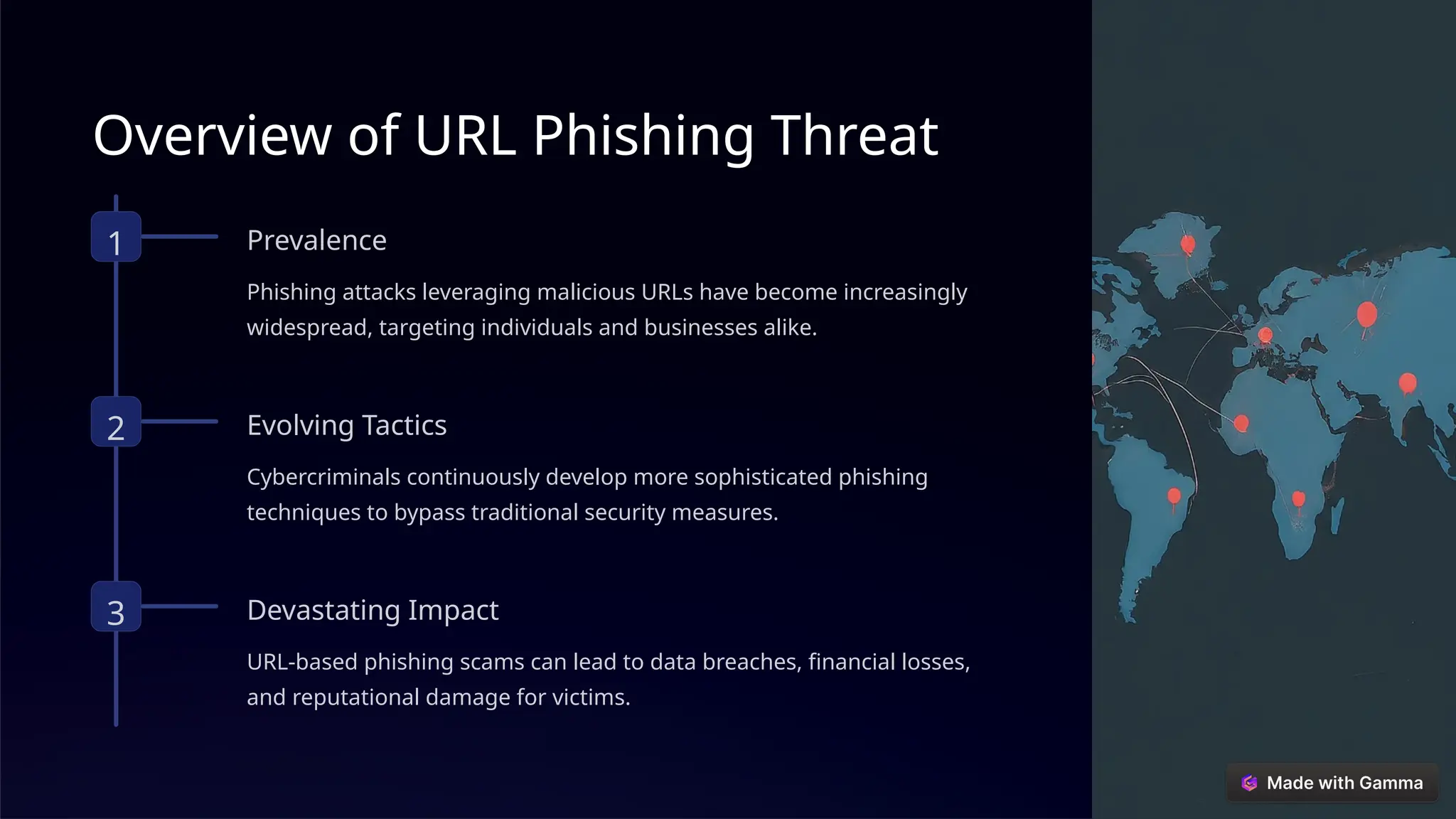
Overview of URL Phishing Threat
1 Prevalence
Phishing attacks leveraging malicious URLs have become increasingly
widespread, targeting individuals and businesses alike.
2 Evolving Tactics
Cybercriminals continuously develop more sophisticated phishing
techniques to bypass traditional security measures.
3 Devastating Impact
URL-based phishing scams can lead to data breaches, financial losses,
and reputational damage for victims.
Techniques for URL Phishing Detection
1 URL Analysis
Examining the structure, content, and
behavior of URLs to identify potential
phishing indicators.
2 Domain Reputation
Leveraging blacklists, whitelists, and
reputation databases to assess the
trustworthiness of a domain.
3 Behavioral Heuristics
Detecting anomalous user interactions
and page behavior that may signal a
phishing attempt.
4 Machine Learning
Applying advanced algorithms to classify
URLs as legitimate or phishing based on
various features.
Feature Engineering for URL Phishing
Detection
URL-based Features
Extracting features such as
URL length, character
composition, and presence
of suspicious keywords.
Domain-based Features
Analyzing domain age,
registration details, and
hosting information to
identify suspicious patterns.
Webpage-based
Features
Evaluating the content,
structure, and behavior of
the webpage associated
with the URL.
Machine Learning Models for URL
Phishing Detection
Logistic Regression
A classic machine learning model that can
effectively classify URLs as phishing or
legitimate.
Random Forest
An ensemble learning method that
combines multiple decision trees to
improve accuracy and robustness.
Support Vector Machines
A powerful algorithm that can handle
complex, high-dimensional URL feature
spaces.
Deep Learning
Advanced neural network architectures
that can learn complex patterns in URL
data for accurate prediction.
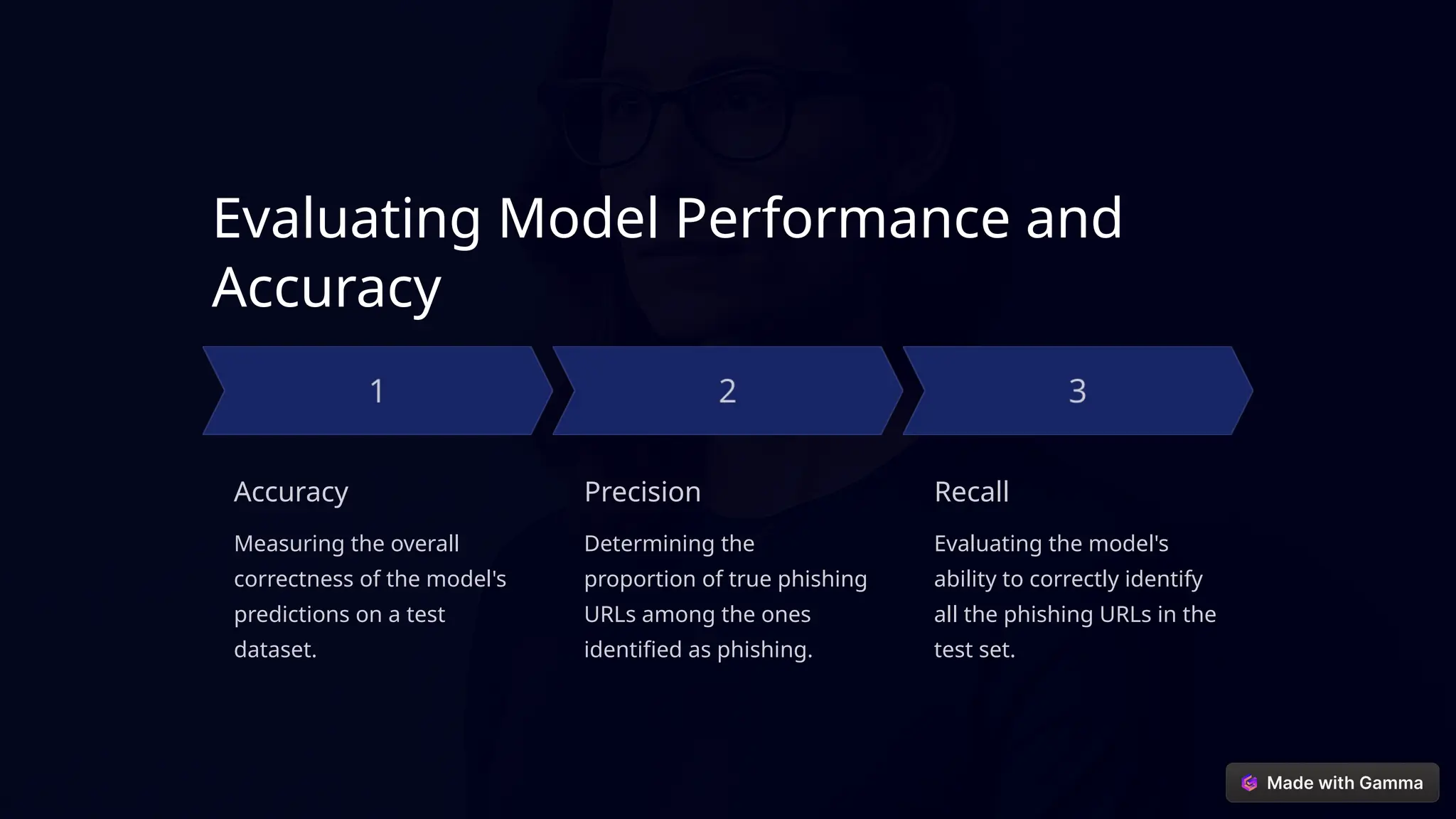
Evaluating Model Performance and
Accuracy
Accuracy
Measuring the overall
correctness of the model's
predictions on a test
dataset.
Precision
Determining the
proportion of true phishing
URLs among the ones
identified as phishing.
Recall
Evaluating the model's
ability to correctly identify
all the phishing URLs in the
test set.
Implementing URL Phishing Detection
in Python
Python
Leveraging Python's
robust ecosystem of
machine learning
libraries to develop
and deploy URL
phishing detection
models.
Scikit-learn
Utilizing this popular
machine learning
library for feature
engineering, model
training, and
performance
evaluation.
Pandas
Handling and
preprocessing URL
data using the
powerful data
manipulation
capabilities of the
Pandas library.
TensorFlow
Employing this
flexible deep
learning framework
to build and deploy
advanced neural
network models for
URL phishing
detection.
Conclusion and Future
Considerations
Effective URL phishing detection is a crucial component of a
comprehensive cybersecurity strategy. As phishing tactics continue to
evolve, ongoing research and development in advanced machine
learning techniques will be essential to stay ahead of the curve and
protect individuals and organizations from these threats.

phishing attack specifically URL detection

  • 1.
    Introduction to URL PhishingDetection This introductory section provides an overview of the growing threat of URL phishing attacks and the importance of developing robust detection methods. Phishing scams that leverage malicious URLs are a major cybersecurity concern, putting user data and organizational security at risk. by Nidhi Bisht
  • 2.
    Overview of URLPhishing Threat 1 Prevalence Phishing attacks leveraging malicious URLs have become increasingly widespread, targeting individuals and businesses alike. 2 Evolving Tactics Cybercriminals continuously develop more sophisticated phishing techniques to bypass traditional security measures. 3 Devastating Impact URL-based phishing scams can lead to data breaches, financial losses, and reputational damage for victims.
  • 3.
    Techniques for URLPhishing Detection 1 URL Analysis Examining the structure, content, and behavior of URLs to identify potential phishing indicators. 2 Domain Reputation Leveraging blacklists, whitelists, and reputation databases to assess the trustworthiness of a domain. 3 Behavioral Heuristics Detecting anomalous user interactions and page behavior that may signal a phishing attempt. 4 Machine Learning Applying advanced algorithms to classify URLs as legitimate or phishing based on various features.
  • 4.
    Feature Engineering forURL Phishing Detection URL-based Features Extracting features such as URL length, character composition, and presence of suspicious keywords. Domain-based Features Analyzing domain age, registration details, and hosting information to identify suspicious patterns. Webpage-based Features Evaluating the content, structure, and behavior of the webpage associated with the URL.
  • 5.
    Machine Learning Modelsfor URL Phishing Detection Logistic Regression A classic machine learning model that can effectively classify URLs as phishing or legitimate. Random Forest An ensemble learning method that combines multiple decision trees to improve accuracy and robustness. Support Vector Machines A powerful algorithm that can handle complex, high-dimensional URL feature spaces. Deep Learning Advanced neural network architectures that can learn complex patterns in URL data for accurate prediction.
  • 6.
    Evaluating Model Performanceand Accuracy Accuracy Measuring the overall correctness of the model's predictions on a test dataset. Precision Determining the proportion of true phishing URLs among the ones identified as phishing. Recall Evaluating the model's ability to correctly identify all the phishing URLs in the test set.
  • 7.
    Implementing URL PhishingDetection in Python Python Leveraging Python's robust ecosystem of machine learning libraries to develop and deploy URL phishing detection models. Scikit-learn Utilizing this popular machine learning library for feature engineering, model training, and performance evaluation. Pandas Handling and preprocessing URL data using the powerful data manipulation capabilities of the Pandas library. TensorFlow Employing this flexible deep learning framework to build and deploy advanced neural network models for URL phishing detection.
  • 8.
    Conclusion and Future Considerations EffectiveURL phishing detection is a crucial component of a comprehensive cybersecurity strategy. As phishing tactics continue to evolve, ongoing research and development in advanced machine learning techniques will be essential to stay ahead of the curve and protect individuals and organizations from these threats.