



How we create bespoke e-learning
IntroductionsLindsey ReesContent Creation ManagerJulian StubbsInstructional Designer
What is Content Creation ?
Have you considered instructional design?
Have you used the Authoring Tool?
Have you created your own graphics?
Action Mappinghttp://blog.cathy-moore.com/
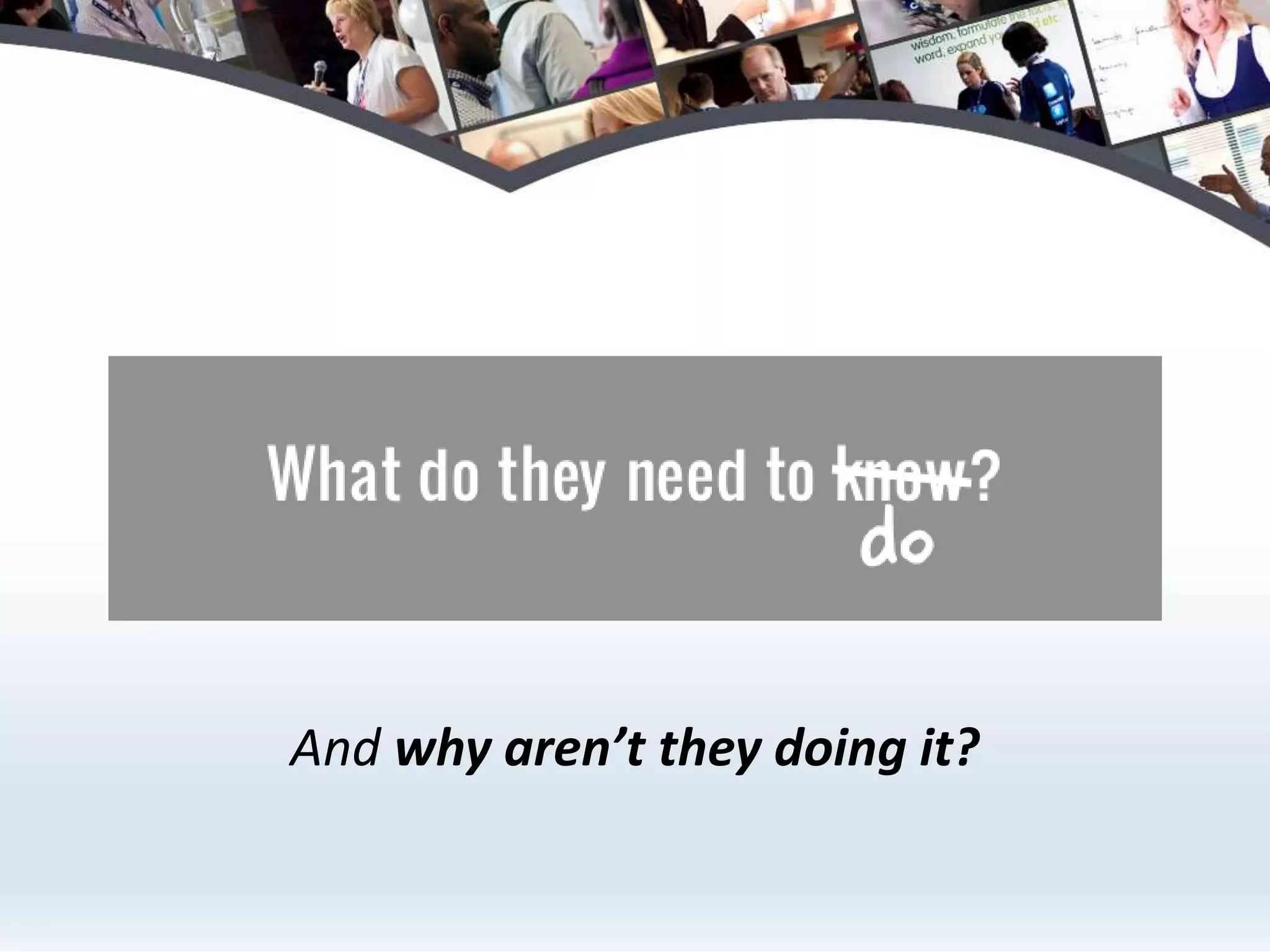
And why aren’t they doing it?
Action Mapping ExampleSTEP 1: Identify the business goalGood: Increase widget sales 8% by Q4Avoid: Salespeople should know all the widget features
Action Mapping StepsSTEP 2: Identify what people need to do to reach that goal To increase sales, our salespeople must:Ask questions that uncover a customer’s needs.Identify the best widget for the customer.Emphasize the benefits that will matter most tothe customer.These statements describe actions, not knowledge
Action Mapping StepsSTEP 3: Design activities that help people practise each behaviourA fictional customer appears. The learner chooses questions that will reveal the customer’s needs.A customer wants to reduce their electricity use. The learner identifies the best widget and explains their choice.Avoid fact checks and trivia games. These don’t happen in the real world.
Action Mapping StepsSTEP 4: Identify what people (really, really) need to knowIdentify the information that the learners must have to complete each practice activity.We should cover thehistory of widgets!We should describethe supply chain forwidget parts.
Task: Apply action mapping principles to the following…Content: Dealing with subject access requests involving other people’s information Target audience: Contact centre staff at Wickstafford Council
What will you do differently?
Any questions?
DemosHomes for Islington: Mental Health Awarenesshttp://www.learningpool.com/hfi/mod/scorm/player.php?a=296&scoid=931Powys: People Managerhttp://www.learningpool.com/powys/mod/scorm/player.php?a=237&scoid=629Blaenau Gwent/Home Office: Community Safety Partnerships http://www.learningpool.com/communitysafety/mod/scorm/player.php?a=251&scoid=841Social Media Blog VideoLeadership Videos
Subject Access Request ExampleSTEP 1: Identify the business goalCall centre staff to be able to correctly decide when to disclose information following a subject access request
Subject Access Request ExampleSTEP 2: Identify what people need to do to reach that goal Identify if the information requested relates to other individuals as well as the individual making the request Identify if it is possible to comply with the request without revealing information which relates to and identifies a third party individualIf possible, obtain consent from third partyIf not possible, decide whether it would it be reasonable to disclose without consent
Subject Access Request ExampleSTEP 3: Design activities that help people practise each behaviourIdentify if the information requested relates to other individuals as well as the individual making the request Show a number of different potential scenarios including the request and the associated requested information. Ask the learner to make a judgement on whether disclosure would affect a third party. This could be extended to an online resource with a variety of scenarios that are available as a reference for learners whilst doing their daily role. These could be used if they are unsure, to help them compare the current decsion to some model answers.
Subject Access Request ExampleSTEP 4: Identify what people (really, really) need to knowIn this instance, really very little. If you are concerned about launching straight in you could give a couple of example scenarios with appropriate responses before getting them to decide.

Learning Pool's Lindsey Rees on 'How to create bespoke e-learning'.

  • 1.
    How we createbespoke e-learning
  • 2.
    IntroductionsLindsey ReesContent CreationManagerJulian StubbsInstructional Designer
  • 3.
    What is ContentCreation ?
  • 4.
    Have you consideredinstructional design?
  • 5.
    Have you usedthe Authoring Tool?
  • 6.
    Have you createdyour own graphics?
  • 7.
  • 8.
    And why aren’tthey doing it?
  • 9.
    Action Mapping ExampleSTEP1: Identify the business goalGood: Increase widget sales 8% by Q4Avoid: Salespeople should know all the widget features
  • 10.
    Action Mapping StepsSTEP2: Identify what people need to do to reach that goal To increase sales, our salespeople must:Ask questions that uncover a customer’s needs.Identify the best widget for the customer.Emphasize the benefits that will matter most tothe customer.These statements describe actions, not knowledge
  • 11.
    Action Mapping StepsSTEP3: Design activities that help people practise each behaviourA fictional customer appears. The learner chooses questions that will reveal the customer’s needs.A customer wants to reduce their electricity use. The learner identifies the best widget and explains their choice.Avoid fact checks and trivia games. These don’t happen in the real world.
  • 12.
    Action Mapping StepsSTEP4: Identify what people (really, really) need to knowIdentify the information that the learners must have to complete each practice activity.We should cover thehistory of widgets!We should describethe supply chain forwidget parts.
  • 13.
    Task: Apply actionmapping principles to the following…Content: Dealing with subject access requests involving other people’s information Target audience: Contact centre staff at Wickstafford Council
  • 14.
    What will youdo differently?
  • 15.
  • 16.
    DemosHomes for Islington:Mental Health Awarenesshttp://www.learningpool.com/hfi/mod/scorm/player.php?a=296&scoid=931Powys: People Managerhttp://www.learningpool.com/powys/mod/scorm/player.php?a=237&scoid=629Blaenau Gwent/Home Office: Community Safety Partnerships http://www.learningpool.com/communitysafety/mod/scorm/player.php?a=251&scoid=841Social Media Blog VideoLeadership Videos
  • 17.
    Subject Access RequestExampleSTEP 1: Identify the business goalCall centre staff to be able to correctly decide when to disclose information following a subject access request
  • 18.
    Subject Access RequestExampleSTEP 2: Identify what people need to do to reach that goal Identify if the information requested relates to other individuals as well as the individual making the request Identify if it is possible to comply with the request without revealing information which relates to and identifies a third party individualIf possible, obtain consent from third partyIf not possible, decide whether it would it be reasonable to disclose without consent
  • 19.
    Subject Access RequestExampleSTEP 3: Design activities that help people practise each behaviourIdentify if the information requested relates to other individuals as well as the individual making the request Show a number of different potential scenarios including the request and the associated requested information. Ask the learner to make a judgement on whether disclosure would affect a third party. This could be extended to an online resource with a variety of scenarios that are available as a reference for learners whilst doing their daily role. These could be used if they are unsure, to help them compare the current decsion to some model answers.
  • 20.
    Subject Access RequestExampleSTEP 4: Identify what people (really, really) need to knowIn this instance, really very little. If you are concerned about launching straight in you could give a couple of example scenarios with appropriate responses before getting them to decide.