Learning Language Through
Tasks and Activities
OUTLINE
• The Task as an Environment for Learning
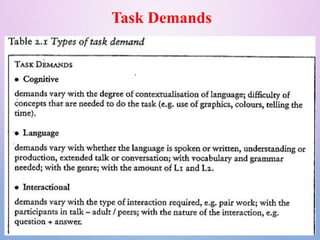
• Task Demands
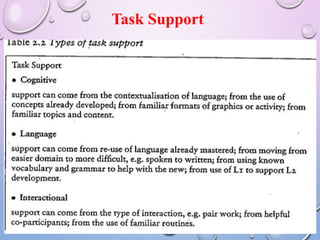
• Task Support
• Balancing Demands and Support
The Task as an Environment for Learning
• We often present activities to children without any respect to
their understanding the purpose of the task.
• Pupils should know the meaning and purpose of the activities
they are supposed to do.
• The activity should make sense to them.
• Sometimes they are anxious to please, they just want to
fulfil the task and they act as if they understand (e.g. gap
filling exercises and matching).
• The importance of a learning perspective which is beyond the
evaluation of classroom activities.
• Providing teachers the tools for really checking on how much
pupils are understanding and learning.
2.2 Analyzing the environment created by an activity in terms of
demands on learners.
2.3 Supports for learning
2.4 How learning opportunities can be constructed by adjusting
the balance between demands and supports.
• Coursebook written for 11 years olds in the Sultanate of Oman.
• The activity is intended as practice material in pupils’ book.
• The structure, demands and the support provided to meet those
demands are going to be analyzed.
• The basis for this speaking activity is a grid with 2 rows and 3
columns.
• Pupils are required to make up sentences with vocabulary and
grammar they have already learnt with the past tense.
• Our focus on the demands placed on pupils when they try to
produce accurate sentences in English.
• The grid must read in a particular way.
• In each picture Hani s doing sth, so that a further demand on
the pupil is to recognize the action from the picture and find
the English word for that.
• The sentences are to be spoken aloud, so that a further demand
beyond finding vocabulary and grammar is to pronounce
words.
Task Demands
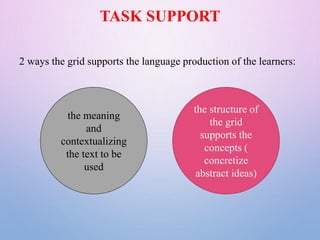
TASK SUPPORT
2 ways the grid supports the language production of the learners:
the meaning
and
contextualizing
the text to be
used
the structure of
the grid
supports the
concepts (
concretize
abstract ideas)
Task Support
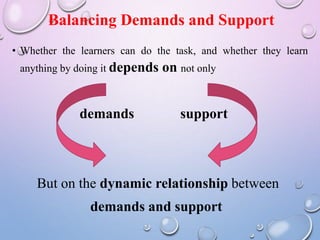
Balancing Demands and Support
• Whether the learners can do the task, and whether they learn
anything by doing it depends on not only
demands support
But on the dynamic relationship between
demands and support
Balancing Demands and Support
• If the demands are too high, learners will find the task too difficult
‘switch off’
• If a task provides too much support, then learners will not be
‘stretched’
• ‘The Goldilocks Principle’: a task that is going to help the learner
to learn more language is that demanding but not too much
demanding, but provides but not too much support.
• The difference between demands and support creates the space for
growth and produces opportunities for language learning.

Learning language through tasks and activities

  • 1.
  • 2.
    OUTLINE • The Taskas an Environment for Learning • Task Demands • Task Support • Balancing Demands and Support
  • 3.
    The Task asan Environment for Learning • We often present activities to children without any respect to their understanding the purpose of the task. • Pupils should know the meaning and purpose of the activities they are supposed to do. • The activity should make sense to them. • Sometimes they are anxious to please, they just want to fulfil the task and they act as if they understand (e.g. gap filling exercises and matching).
  • 4.
    • The importanceof a learning perspective which is beyond the evaluation of classroom activities. • Providing teachers the tools for really checking on how much pupils are understanding and learning. 2.2 Analyzing the environment created by an activity in terms of demands on learners. 2.3 Supports for learning 2.4 How learning opportunities can be constructed by adjusting the balance between demands and supports.
  • 6.
    • Coursebook writtenfor 11 years olds in the Sultanate of Oman. • The activity is intended as practice material in pupils’ book. • The structure, demands and the support provided to meet those demands are going to be analyzed. • The basis for this speaking activity is a grid with 2 rows and 3 columns. • Pupils are required to make up sentences with vocabulary and grammar they have already learnt with the past tense.
  • 7.
    • Our focuson the demands placed on pupils when they try to produce accurate sentences in English. • The grid must read in a particular way. • In each picture Hani s doing sth, so that a further demand on the pupil is to recognize the action from the picture and find the English word for that. • The sentences are to be spoken aloud, so that a further demand beyond finding vocabulary and grammar is to pronounce words.
  • 8.
  • 10.
    TASK SUPPORT 2 waysthe grid supports the language production of the learners: the meaning and contextualizing the text to be used the structure of the grid supports the concepts ( concretize abstract ideas)
  • 11.
  • 13.
    Balancing Demands andSupport • Whether the learners can do the task, and whether they learn anything by doing it depends on not only demands support But on the dynamic relationship between demands and support
  • 14.
    Balancing Demands andSupport • If the demands are too high, learners will find the task too difficult ‘switch off’ • If a task provides too much support, then learners will not be ‘stretched’ • ‘The Goldilocks Principle’: a task that is going to help the learner to learn more language is that demanding but not too much demanding, but provides but not too much support. • The difference between demands and support creates the space for growth and produces opportunities for language learning.