Module : Teaching language skills
Presented by: Professor :
Moudden Mina Ayad CHRAA
Bouras Redouan
• Definition of grammar
• Teaching Grammar : Considerations
• Key Differences : Fluency vs Accuracy
• Approaches to Teaching Grammar :DEDUCTIVE VS. INDUCTIVE
• Controlled vs Free Activities
• Frameworks: PPP/ PPU
• Teaching Grammar using games
• Micro-teaching : Presentation stage
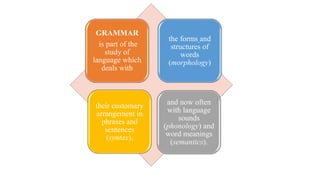
GRAMMAR
is part of the
study of
language which
deals with
and now often
with language
sounds
(phonology) and
word meanings
(semantics).
their customary
arrangement in
phrases and
sentences
(syntax),
the forms and
structures of
words
(morphology)
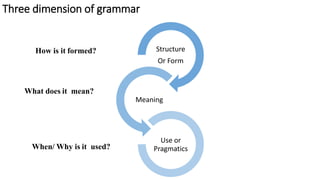
Three dimension of grammar
Structure
Or Form
Meaning
Use or
Pragmatics
How is it formed?
What does it mean?
When/ Why is it used?
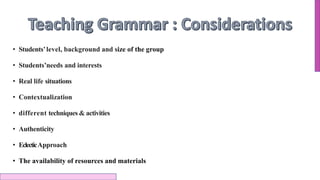
• Students’level, background and size of the group
• Students’needs and interests
• Real life situations
• Contextualization
• different techniques & activities
• Authenticity
• EclecticApproach
• The availability of resources and materials
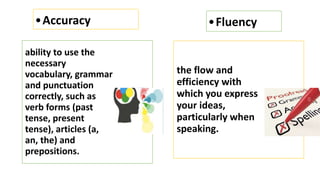
•Accuracy
ability to use the
necessary
vocabulary, grammar
and punctuation
correctly, such as
verb forms (past
tense, present
tense), articles (a,
an, the) and
prepositions.
•Fluency
the flow and
efficiency with
which you express
your ideas,
particularly when
speaking.
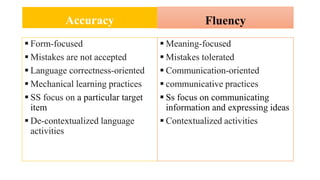
Accuracy
 Form-focused
 Mistakes are not accepted
 Language correctness-oriented
 Mechanical learning practices
 SS focus on a particular target
item
 De-contextualized language
activities
Fluency
 Meaning-focused
 Mistakes tolerated
 Communication-oriented
 communicative practices
 Ss focus on communicating
information and expressing ideas
 Contextualized activities
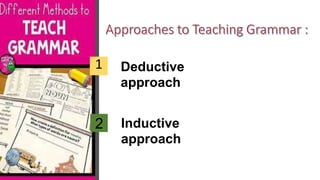
1
2
Deductive
approach
Inductive
approach
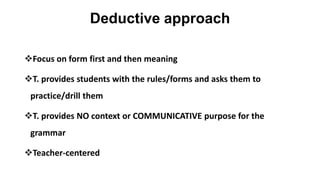
Deductive approach
Focus on form first and then meaning
T. provides students with the rules/forms and asks them to
practice/drill them
T. provides NO context or COMMUNICATIVE purpose for the
grammar
Teacher-centered
Concrete illustration
Teacher explains the form and use of “Past Continuous”
Form : Subject +was/were + verb [ing] + obj
Use: to indicate that a longer action in the past was interrupted
Teacher asks Ss to practice the past continuous through completing certain tasks like
Inductive approach
• Focus on meaning first and form second
• learners discover the rule through meaningful communication
• T. provides a CONTEXT and PURPOSE for use
• Learner- centered approach
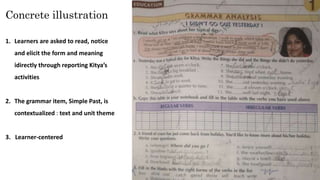
Concrete illustration
1. Learners are asked to read, notice
and elicit the form and meaning
idirectly through reporting Kitya’s
activities
2. The grammar item, Simple Past, is
contextualized : text and unit theme
3. Learner-centered
• Guided Practice Activities
• Focus on developing accuracy rather than fluency
• Students practice the target grammar rule they have learnt
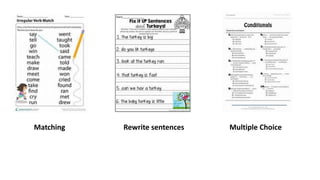
Matching Multiple Choice
Rewrite sentences
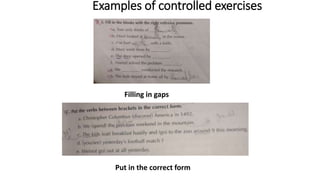
Examples of controlled exercises
Put in the correct form
Filling in gaps
• Free Language Production
• Students use language in a free context based on their choices
Deliver a short presentation using the target grammar item
Discussion
Write a reports or essay
Write a reply to a letter or email
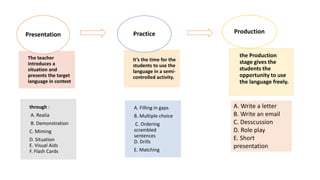
PPP Framework
• This framework is widely used throughout the world by many EFL and ESL teachers.
• It can be used to teach grammar items, vocabulary and functions
• The acronym stands for Presentation, Practice and Production. Each letter means a stage
of the learning process.
The teacher
introduces a
situation and
presents the target
language in context
through :
A. Realia
B. Demonstration
C. Miming
D. Situation
E. Visual Aids
F. Flash Cards
Presentation
It’s the time for the
students to use the
language in a semi-
controlled activity.
A. Filling in gaps
B. Multiple choice
C. Ordering
scrambled
sentences
D. Drills
E. Matching
Practice
the Production
stage gives the
students the
opportunity to use
the language freely.
Production
A. Write a letter
B. Write an email
C. Desscussion
D. Role play
E. Short
presentation
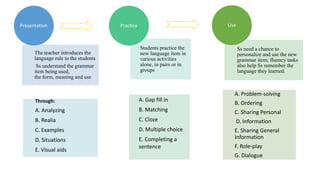
PPU Framework
• We often use this framework to plan lessons teaching speaking, grammar, functions and
vocabulary.
• The PPU stands for Presentation, Practice and USE. Each letter REPRESENTS a stage of the
learning process.
• PPU represents an accuracy to-fluency model of instruction.
The teacher introduces the
language rule to the students
Ss understand the grammar
item being used,
the form, meaning and use
Through:
A. Analyzing
B. Realia
C. Examples
D. Situations
E. Visual aids
Presentation
Students practice the
new language item in
various activities
alone, in pairs or in
groups
A. Gap fill in
B. Matching
C. Cloze
D. Multiple choice
E. Completing a
sentence
Practice
Ss need a chance to
personalize and use the new
grammar item; fluency tasks
also help Ss remember the
language they learned.
A. Problem-solving
B. Ordering
C. Sharing Personal
D. Information
E. Sharing General
Information
F. Role-play
G. Dialogue
Use
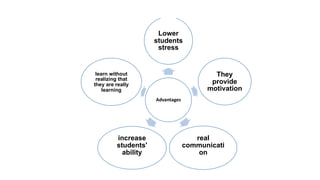
Practicing grammar using Games:
Jill Hadfield (1990) defined
games as “an activity with rules, a
goal and an element of fun”.
Advantages
Lower
students
stress
They
provide
motivation
real
communicati
on
increase
students'
ability
learn without
realizing that
they are really
learning
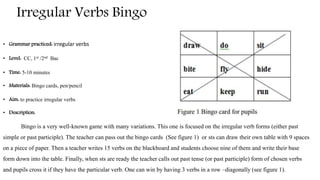
Irregular Verbs Bingo
• Grammar practiced: irregular verbs
• Level: CC, 1st /2nd Bac
• Time: 5-10 minutes
• Materials: Bingo cards, pen/pencil
• Aim: to practice irregular verbs
• Description:
Bingo is a very well-known game with many variations. This one is focused on the irregular verb forms (either past
simple or past participle). The teacher can pass out the bingo cards (See figure 1) or sts can draw their own table with 9 spaces
on a piece of paper. Then a teacher writes 15 verbs on the blackboard and students choose nine of them and write their base
form down into the table. Finally, when sts are ready the teacher calls out past tense (or past participle) form of chosen verbs
and pupils cross it if they have the particular verb. One can win by having 3 verbs in a row –diagonally (see figure 1).
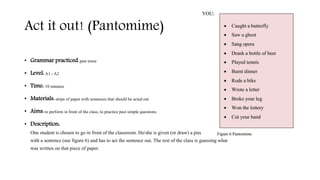
Act it out! (Pantomime)
• Grammar practiced: past tense
• Level: A1 - A2
• Time: 10 minutes
• Materials: strips of paper with sentences that should be acted out
• Aims: to perform in front of the class, to practice past simple questions.
• Description:
One student is chosen to go in front of the classroom. He/she is given (or draw) a piece of paper
with a sentence (see figure 6) and has to act the sentence out. The rest of the class is guessing what
was written on that piece of paper.
References
• Ait Hajji, K & Youngkeun, K (2019) Teaching and Learning Grammar by Games In EFL
Classrooms in Moroccan High Schools. Inje University.
• Harmer, J. (1998). The Practice of English Language Teaching.(2nd ed). Harlow:
Longman.
• Scrivener, J. (2005). Learning teaching: A guidebook for English language teachers
(2nd ed.). Oxford: Macmillan.
• Thornbury , S. (1999)‘’How to teach grammar’’
• https://fr.slideshare.net/akopali/how-to-teach-grammar
• https://sites.google.com/a/algeriatesol.org/algeriatesol/frameworks/ppu-
presentation-practice-use-/ppu-framework
• https://www.teachingenglish.org.uk/article/planning-a-grammar-
lesson#:~:text=their%20existing%20knowledge.-
,Presentation%2C%20practice%20and%20production%20(PPP),it%20through%20very
%20controlled%20activities.
Micro teaching
Level : Intermediate Unit: Education Date :
Skill: Grammar Lesson: Simple Past Time: 15min – Presentation stage
I sream, you scream, we all scream for ice cream.
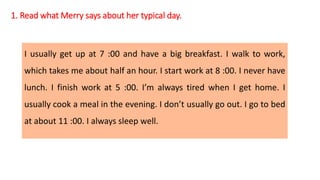
1. Read what Merry says about her typical day.
I usually get up at 7 :00 and have a big breakfast. I walk to work,
which takes me about half an hour. I start work at 8 :00. I never have
lunch. I finish work at 5 :00. I’m always tired when I get home. I
usually cook a meal in the evening. I don’t usually go out. I go to bed
at about 11 :00. I always sleep well.
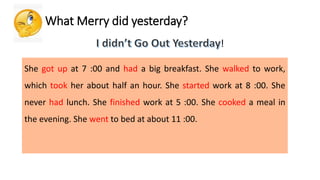
What Merry did yesterday?
!
She got up at 7 :00 and had a big breakfast. She walked to work,
which took her about half an hour. She started work at 8 :00. She
never had lunch. She finished work at 5 :00. She cooked a meal in
the evening. She went to bed at about 11 :00.
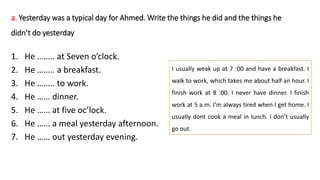
a. Yesterday was a typical day for Ahmed. Write the things he did and the things he
didn’t do yesterday
1. He …….. at Seven o’clock.
2. He …….. a breakfast.
3. He …….. to work.
4. He …… dinner.
5. He …… at five oc’lock.
6. He …… a meal yesterday afternoon.
7. He …… out yesterday evening.
I usually weak up at 7 :00 and have a breakfast. I
walk to work, which takes me about half an hour. I
finish work at 8 :00. I never have dinner. I finish
work at 5 a.m. I’m always tired when I get home. I
usually dont cook a meal in lunch. I don’t usually
go out.
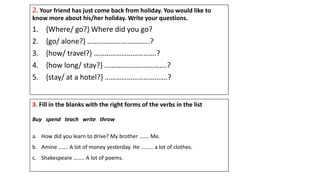
2. Your friend has just come back from holiday. You would like to
know more about his/her holiday. Write your questions.
1. {Where/ go?} Where did you go?
2. {go/ alone?} …………………………….?
3. {how/ travel?} …………………………….?
4. {how long/ stay?} …………………………….?
5. {stay/ at a hotel?} …………………………….?
3. Fill in the blanks with the right forms of the verbs in the list
Buy spend teach write throw
a. How did you learn to drive? My brother ……. Me.
b. Amine ……. A lot of money yesterday. He ……… a lot of clothes.
c. Shakespeare …….. A lot of poems.
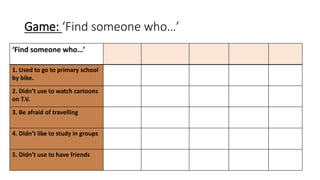
Game: ‘Find someone who…’
‘Find someone who…’
1. Used to go to primary school
by bike.
2. Didn’t use to watch cartoons
on T.V.
3. Be afraid of travelling
4. Didn’t like to study in groups
5. Didn’t use to have friends

Teaching Grammar. CRMEF_SM 2021

  • 1.
    Module : Teachinglanguage skills Presented by: Professor : Moudden Mina Ayad CHRAA Bouras Redouan
  • 2.
    • Definition ofgrammar • Teaching Grammar : Considerations • Key Differences : Fluency vs Accuracy • Approaches to Teaching Grammar :DEDUCTIVE VS. INDUCTIVE • Controlled vs Free Activities • Frameworks: PPP/ PPU • Teaching Grammar using games • Micro-teaching : Presentation stage
  • 3.
    GRAMMAR is part ofthe study of language which deals with and now often with language sounds (phonology) and word meanings (semantics). their customary arrangement in phrases and sentences (syntax), the forms and structures of words (morphology)
  • 4.
    Three dimension ofgrammar Structure Or Form Meaning Use or Pragmatics How is it formed? What does it mean? When/ Why is it used?
  • 6.
    • Students’level, backgroundand size of the group • Students’needs and interests • Real life situations • Contextualization • different techniques & activities • Authenticity • EclecticApproach • The availability of resources and materials
  • 8.
    •Accuracy ability to usethe necessary vocabulary, grammar and punctuation correctly, such as verb forms (past tense, present tense), articles (a, an, the) and prepositions. •Fluency the flow and efficiency with which you express your ideas, particularly when speaking.
  • 9.
    Accuracy  Form-focused  Mistakesare not accepted  Language correctness-oriented  Mechanical learning practices  SS focus on a particular target item  De-contextualized language activities Fluency  Meaning-focused  Mistakes tolerated  Communication-oriented  communicative practices  Ss focus on communicating information and expressing ideas  Contextualized activities
  • 11.
  • 12.
    Deductive approach Focus onform first and then meaning T. provides students with the rules/forms and asks them to practice/drill them T. provides NO context or COMMUNICATIVE purpose for the grammar Teacher-centered
  • 13.
    Concrete illustration Teacher explainsthe form and use of “Past Continuous” Form : Subject +was/were + verb [ing] + obj Use: to indicate that a longer action in the past was interrupted Teacher asks Ss to practice the past continuous through completing certain tasks like
  • 14.
    Inductive approach • Focuson meaning first and form second • learners discover the rule through meaningful communication • T. provides a CONTEXT and PURPOSE for use • Learner- centered approach
  • 15.
    Concrete illustration 1. Learnersare asked to read, notice and elicit the form and meaning idirectly through reporting Kitya’s activities 2. The grammar item, Simple Past, is contextualized : text and unit theme 3. Learner-centered
  • 17.
    • Guided PracticeActivities • Focus on developing accuracy rather than fluency • Students practice the target grammar rule they have learnt
  • 18.
  • 19.
    Examples of controlledexercises Put in the correct form Filling in gaps
  • 20.
    • Free LanguageProduction • Students use language in a free context based on their choices Deliver a short presentation using the target grammar item Discussion Write a reports or essay Write a reply to a letter or email
  • 21.
    PPP Framework • Thisframework is widely used throughout the world by many EFL and ESL teachers. • It can be used to teach grammar items, vocabulary and functions • The acronym stands for Presentation, Practice and Production. Each letter means a stage of the learning process.
  • 22.
    The teacher introduces a situationand presents the target language in context through : A. Realia B. Demonstration C. Miming D. Situation E. Visual Aids F. Flash Cards Presentation It’s the time for the students to use the language in a semi- controlled activity. A. Filling in gaps B. Multiple choice C. Ordering scrambled sentences D. Drills E. Matching Practice the Production stage gives the students the opportunity to use the language freely. Production A. Write a letter B. Write an email C. Desscussion D. Role play E. Short presentation
  • 23.
    PPU Framework • Weoften use this framework to plan lessons teaching speaking, grammar, functions and vocabulary. • The PPU stands for Presentation, Practice and USE. Each letter REPRESENTS a stage of the learning process. • PPU represents an accuracy to-fluency model of instruction.
  • 24.
    The teacher introducesthe language rule to the students Ss understand the grammar item being used, the form, meaning and use Through: A. Analyzing B. Realia C. Examples D. Situations E. Visual aids Presentation Students practice the new language item in various activities alone, in pairs or in groups A. Gap fill in B. Matching C. Cloze D. Multiple choice E. Completing a sentence Practice Ss need a chance to personalize and use the new grammar item; fluency tasks also help Ss remember the language they learned. A. Problem-solving B. Ordering C. Sharing Personal D. Information E. Sharing General Information F. Role-play G. Dialogue Use
  • 25.
    Practicing grammar usingGames: Jill Hadfield (1990) defined games as “an activity with rules, a goal and an element of fun”.
  • 26.
  • 27.
    Irregular Verbs Bingo •Grammar practiced: irregular verbs • Level: CC, 1st /2nd Bac • Time: 5-10 minutes • Materials: Bingo cards, pen/pencil • Aim: to practice irregular verbs • Description: Bingo is a very well-known game with many variations. This one is focused on the irregular verb forms (either past simple or past participle). The teacher can pass out the bingo cards (See figure 1) or sts can draw their own table with 9 spaces on a piece of paper. Then a teacher writes 15 verbs on the blackboard and students choose nine of them and write their base form down into the table. Finally, when sts are ready the teacher calls out past tense (or past participle) form of chosen verbs and pupils cross it if they have the particular verb. One can win by having 3 verbs in a row –diagonally (see figure 1).
  • 28.
    Act it out!(Pantomime) • Grammar practiced: past tense • Level: A1 - A2 • Time: 10 minutes • Materials: strips of paper with sentences that should be acted out • Aims: to perform in front of the class, to practice past simple questions. • Description: One student is chosen to go in front of the classroom. He/she is given (or draw) a piece of paper with a sentence (see figure 6) and has to act the sentence out. The rest of the class is guessing what was written on that piece of paper.
  • 29.
    References • Ait Hajji,K & Youngkeun, K (2019) Teaching and Learning Grammar by Games In EFL Classrooms in Moroccan High Schools. Inje University. • Harmer, J. (1998). The Practice of English Language Teaching.(2nd ed). Harlow: Longman. • Scrivener, J. (2005). Learning teaching: A guidebook for English language teachers (2nd ed.). Oxford: Macmillan. • Thornbury , S. (1999)‘’How to teach grammar’’ • https://fr.slideshare.net/akopali/how-to-teach-grammar • https://sites.google.com/a/algeriatesol.org/algeriatesol/frameworks/ppu- presentation-practice-use-/ppu-framework • https://www.teachingenglish.org.uk/article/planning-a-grammar- lesson#:~:text=their%20existing%20knowledge.- ,Presentation%2C%20practice%20and%20production%20(PPP),it%20through%20very %20controlled%20activities.
  • 30.
    Micro teaching Level :Intermediate Unit: Education Date : Skill: Grammar Lesson: Simple Past Time: 15min – Presentation stage
  • 31.
    I sream, youscream, we all scream for ice cream.
  • 32.
    1. Read whatMerry says about her typical day. I usually get up at 7 :00 and have a big breakfast. I walk to work, which takes me about half an hour. I start work at 8 :00. I never have lunch. I finish work at 5 :00. I’m always tired when I get home. I usually cook a meal in the evening. I don’t usually go out. I go to bed at about 11 :00. I always sleep well.
  • 33.
    What Merry didyesterday? ! She got up at 7 :00 and had a big breakfast. She walked to work, which took her about half an hour. She started work at 8 :00. She never had lunch. She finished work at 5 :00. She cooked a meal in the evening. She went to bed at about 11 :00.
  • 34.
    a. Yesterday wasa typical day for Ahmed. Write the things he did and the things he didn’t do yesterday 1. He …….. at Seven o’clock. 2. He …….. a breakfast. 3. He …….. to work. 4. He …… dinner. 5. He …… at five oc’lock. 6. He …… a meal yesterday afternoon. 7. He …… out yesterday evening. I usually weak up at 7 :00 and have a breakfast. I walk to work, which takes me about half an hour. I finish work at 8 :00. I never have dinner. I finish work at 5 a.m. I’m always tired when I get home. I usually dont cook a meal in lunch. I don’t usually go out.
  • 35.
    2. Your friendhas just come back from holiday. You would like to know more about his/her holiday. Write your questions. 1. {Where/ go?} Where did you go? 2. {go/ alone?} …………………………….? 3. {how/ travel?} …………………………….? 4. {how long/ stay?} …………………………….? 5. {stay/ at a hotel?} …………………………….? 3. Fill in the blanks with the right forms of the verbs in the list Buy spend teach write throw a. How did you learn to drive? My brother ……. Me. b. Amine ……. A lot of money yesterday. He ……… a lot of clothes. c. Shakespeare …….. A lot of poems.
  • 36.
    Game: ‘Find someonewho…’ ‘Find someone who…’ 1. Used to go to primary school by bike. 2. Didn’t use to watch cartoons on T.V. 3. Be afraid of travelling 4. Didn’t like to study in groups 5. Didn’t use to have friends