Ch.3  How to Teach  Grammar from Rules Jean 9622604 Riona 9622614 Date: Oct. 08,2008
Content A deductive approach Rules and explanations Sample lesson 1: Using a  rule explanation  to teach question formation Sample lesson 2:Teaching used to using  translation Sample lesson 3: Teaching articles using  grammar worksheets Sample lesson 4: Teaching word order using a  self-study grammar
A deductive approach A  deductive  approach starts with the presentation of a rule and is followed by examples in which the rule is applied. A  inductive  approach starts with some examples from which a rule is inferred. In place of the terms  deductive  and  inductive , it may be easier to use the terms  rule-driven  learning and  discovery  learning respectively
A deductive approach The deductive (rule-driven) approach to language teaching is traditionally associated with Grammar-Translation. It is important to stress that the deductive method is not necessarily dependent on translation

The drawbacks of the deductive approach Grammar presentation may not interest the younger Ss who are lack of meta-language. Grammar explanation encourages a teacher-fronted and transmission-style classroom. Explanation is seldom as memorable as other forms of presentation, such as demonstration. Such an approach encourages the belief that learning a language is simply a case of knowing the rules.
The advantages of the deductive approach It gets straight to the point, and can therefore be time-saving. It acknowledges the role of cognitive processes in language acquisition, especially adult. The learners, who have an analytical learning style, can meet their learning expectation. It allows the teacher to deal with language points as they come up.
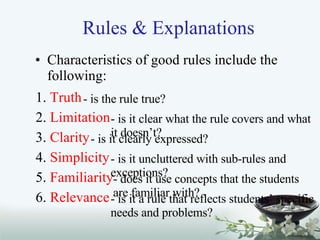
Rules & Explanations Characteristics of good rules include the following: 1.  Truth   2.  Limitation 3.  Clarity 4.  Simplicity 5.  Familiarity 6.  Relevance - is the rule true? - is it clear what the rule covers and what it doesn’t? - is it clearly expressed? - is it uncluttered with sub-rules and exceptions? - does it use concepts that the students are familiar with? - is it a rule that reflects students’ specific needs and problems?
Ex. Giving a grammar explanation HRIGHT THE  Right. The past perfect. (cueing) The past perfect is formed from the past of the auxiliary “have” plus the past participle. (rule of form) For example, “everyone had left”, “the film had stared.” (examples) So, what’s the past perfect of “they go”? (check) “ They had gone.” GOOD!! It is used when you are talking about the past, and you want to refer to an earlier point in the past. (rule of use) For example, “We were late. When we got to the cinema, the film had already started.” (example) Did the film start after we arriverd, at the same time as we arrived, or before we arrived? (check) “ Before.” Right !! b a (illustration)
Sample Lesson Lesson1: Using a  rule explanation  to teach question formation (Pre-intermediate) The president phoned the Queen. Someone Verb Subject Object Subject- verb- object pattern (SVO)

Someone phoned the Queen. 1. Who phoned the Queen? -The president. The president phoned the Queen. someone. 2. Who did the president phone? -The Queen.
S  V  O Someone  phoned  the Queen. Who  phoned  the Queen?
S  V  O The president  phoned  someone. The president  did phone  someone. O  V  S  V Who  did  the President  phone?
The Pope Madonna Martina Hingis Michael Jackson
Who phoned you yesterday/this morning/last weekend? Who did you phone  yesterday/this morning/last weekend?
Discussion Step 1: establishing necessary  terminology . Step 2: establishing a contrast between  subject Qs  and  object Qs . Step 3: explaining the  language point . Step4:  testing  learners’ grasp of the rule. Step5: offering Ss a chance to  practice  the language point.
Evaluation The E-factor  (efficiency): If the rule is a simple one then this approach can be very economic in terms of  time . Grammar explanation involves few if any materials and requires little or no preparation.
Evaluation The A-factor  (appropriate): It is appropriate for  adults learner  whose learning expectation tend them to more  analytical  and  reflective  way to learn. Students will tire of  too many  “chalk-and-talk”  presentations.
Sample lesson 2:Teaching used to using translation The teacher use translation to present  used to do  to a group of Spanish-speakers.  Soler (present  suele , past  solia )= to be accustomed to .
Sample lesson 2:Teaching used to using translation Step one 1.Tony solia fumar, pero lo dejo hace dos anos. Tony used to smoke but he stopped two years ago. Eng translations for Spanish sentences Ex. I used to drink red wine Yo solia beber vino tinto.
Sample lesson 2:Teaching used to using translation Step 2 Ask for a translation Andy suele fumar un paguete entero cada dia.  (present tense) Ss will assume that Eng verb  used to  works in the present the same way that the Spanish verb  soler  does. T explain (in Spanish) that  used to  has only past meaning. Ss provide Eng translations for sentences in either the past or the present.
Sample lesson 2:Teaching used to using translation Step 3 T writes: I used to ski when I was young, but I stopped because it was too expensive. I used to ____ when I was ____, but I stopped because _______. T asks Ss to write their own sentences and compare them in groups of three.
Discussion T attempts to involve the learners at each stage, thereby reducing the danger of ‘chalk-and-talkiness’. Moreover, explanations are kept short. In step 2,  this trap-setting technique  has been shown to be an effective teaching strategy—more effective than  structuring the presentation  so that Ss are prevented from making the error.
Evaluation Efficiency :  Translation is probably the most  economical  means of conveying meaning. Efficacy :  Unless the learner has invested some mental effort in the process, the gains will be short-lived. Over-use of translation may also reduce the amount of exposure Ss get to the target language. Appropriate :  In these cases it often seems appropriate to use translation, given its speed and efficiency, and especially at elementary level where explanations in the target lg.
Sample lesson 3: Teaching articles using grammar worksheets Focus the teaching-learning process more on the Ss. Giving them more responsibility for their learning Providing more opportunities for real communication. T divides the class into groups and giving each group a different set of rules relating to article use.
Sample lesson 3: Teaching articles using grammar worksheets Step one To divide Ss into 3 groups To distribute the exercise sheet (a/an, the, and 0) and Ss fill in the gap. G1:Summary A (definite) G2: B (indefinite) G3:C (0)
Sample lesson 3: Teaching articles using grammar worksheets Step 2 T re-groups Ss in order to make Ss help others to do the exercise. 1 2 3  1 2 3  1 2 3  Then   1 1 1  2 2 2  3 3 3 Ss compare their ans to the exercise, and to share any information from their grammar summaries.
Sample lesson 3: Teaching articles using grammar worksheets Step 3 T checks the exercise in open class, asking learners to justify their ans by reference to the rules on their worksheets.
Discussion To achieve this, it adopts the principle of the classic  jigsaw  activity thru collaboration and the exchange of information to complete  information gap. Learners will need to share the information and involve speaking Eng. ( communicate  about grammar) The  teacher’s role  is  limited  to that of monitor the activity and help sort out problems in interpreting the grammar.
Evaluation Efficiency :  It’s only  economical  in terms of the time spent on it if the Ss are communicating in Eng. Efficacy :  The mental work involved in explaining a grammar point to someone else is likely to have a more enduring  effect on memory  than simply reading the rules and doing the exercise. Appropriate :  Ss are happy to take some responsibility for their own learning, so this approach is particularly  appropriate .
Sample Lesson Lesson 4: teaching word order using a  self-study grammar  (intermediate) Self-study grammar: grammar reference books which include  exercise  and an  answer key . (Check page 44.45 of the textbook.)
Sample Lesson Step 1 :  Identifying a common problem--put adv. between subject and object. Ex. I like  very much  techno music. T asks Ss to study the grammar rules as homework. Also, asking Ss to design their own exercise by writing 12 original sentences.
Sample Lesson Step 2: T puts Ss in pairs and they exchange the exercise they have prepared.  Ss read and correct their partner's sentences. T is available for consulting and resolving any problems.
Sample Lesson Step 3: T rounds off this part of rule by eliciting the word order rules form the classroom.
Discussion “ Helping the learners to help themselves .” It is useful for dealing with the problems that arise in the class, but not dealt with  in the Ss’ current syllabus.  By  personalizing the exercise , it is made more memorable and more interesting for Ss.
Evaluation The E-factor  (efficiency): Saving the class time. Engaging Ss with the rules in a  deeper level of exercise .  Pair work provides the chance of  peer-teaching .
Evaluation The A-factor  (appropriate): Needing to be introduced to Ss gradually, with the exercise-writing activities taking place initially in class, and under the supervision of T.
THANK YOU  FOR  LISTENING!!

Unit 3(1)

  • 1.
    Ch.3 Howto Teach Grammar from Rules Jean 9622604 Riona 9622614 Date: Oct. 08,2008
  • 2.
    Content A deductiveapproach Rules and explanations Sample lesson 1: Using a rule explanation to teach question formation Sample lesson 2:Teaching used to using translation Sample lesson 3: Teaching articles using grammar worksheets Sample lesson 4: Teaching word order using a self-study grammar
  • 3.
    A deductive approachA deductive approach starts with the presentation of a rule and is followed by examples in which the rule is applied. A inductive approach starts with some examples from which a rule is inferred. In place of the terms deductive and inductive , it may be easier to use the terms rule-driven learning and discovery learning respectively
  • 4.
    A deductive approachThe deductive (rule-driven) approach to language teaching is traditionally associated with Grammar-Translation. It is important to stress that the deductive method is not necessarily dependent on translation
  • 5.
    The drawbacks ofthe deductive approach Grammar presentation may not interest the younger Ss who are lack of meta-language. Grammar explanation encourages a teacher-fronted and transmission-style classroom. Explanation is seldom as memorable as other forms of presentation, such as demonstration. Such an approach encourages the belief that learning a language is simply a case of knowing the rules.
  • 6.
    The advantages ofthe deductive approach It gets straight to the point, and can therefore be time-saving. It acknowledges the role of cognitive processes in language acquisition, especially adult. The learners, who have an analytical learning style, can meet their learning expectation. It allows the teacher to deal with language points as they come up.
  • 7.
    Rules & ExplanationsCharacteristics of good rules include the following: 1. Truth 2. Limitation 3. Clarity 4. Simplicity 5. Familiarity 6. Relevance - is the rule true? - is it clear what the rule covers and what it doesn’t? - is it clearly expressed? - is it uncluttered with sub-rules and exceptions? - does it use concepts that the students are familiar with? - is it a rule that reflects students’ specific needs and problems?
  • 8.
    Ex. Giving agrammar explanation HRIGHT THE Right. The past perfect. (cueing) The past perfect is formed from the past of the auxiliary “have” plus the past participle. (rule of form) For example, “everyone had left”, “the film had stared.” (examples) So, what’s the past perfect of “they go”? (check) “ They had gone.” GOOD!! It is used when you are talking about the past, and you want to refer to an earlier point in the past. (rule of use) For example, “We were late. When we got to the cinema, the film had already started.” (example) Did the film start after we arriverd, at the same time as we arrived, or before we arrived? (check) “ Before.” Right !! b a (illustration)
  • 9.
    Sample Lesson Lesson1:Using a rule explanation to teach question formation (Pre-intermediate) The president phoned the Queen. Someone Verb Subject Object Subject- verb- object pattern (SVO)
  • 10.
    Someone phoned theQueen. 1. Who phoned the Queen? -The president. The president phoned the Queen. someone. 2. Who did the president phone? -The Queen.
  • 11.
    S V O Someone phoned the Queen. Who phoned the Queen?
  • 12.
    S V O The president phoned someone. The president did phone someone. O V S V Who did the President phone?
  • 13.
    The Pope MadonnaMartina Hingis Michael Jackson
  • 14.
    Who phoned youyesterday/this morning/last weekend? Who did you phone yesterday/this morning/last weekend?
  • 15.
    Discussion Step 1:establishing necessary terminology . Step 2: establishing a contrast between subject Qs and object Qs . Step 3: explaining the language point . Step4: testing learners’ grasp of the rule. Step5: offering Ss a chance to practice the language point.
  • 16.
    Evaluation The E-factor (efficiency): If the rule is a simple one then this approach can be very economic in terms of time . Grammar explanation involves few if any materials and requires little or no preparation.
  • 17.
    Evaluation The A-factor (appropriate): It is appropriate for adults learner whose learning expectation tend them to more analytical and reflective way to learn. Students will tire of too many “chalk-and-talk” presentations.
  • 18.
    Sample lesson 2:Teachingused to using translation The teacher use translation to present used to do to a group of Spanish-speakers. Soler (present suele , past solia )= to be accustomed to .
  • 19.
    Sample lesson 2:Teachingused to using translation Step one 1.Tony solia fumar, pero lo dejo hace dos anos. Tony used to smoke but he stopped two years ago. Eng translations for Spanish sentences Ex. I used to drink red wine Yo solia beber vino tinto.
  • 20.
    Sample lesson 2:Teachingused to using translation Step 2 Ask for a translation Andy suele fumar un paguete entero cada dia. (present tense) Ss will assume that Eng verb used to works in the present the same way that the Spanish verb soler does. T explain (in Spanish) that used to has only past meaning. Ss provide Eng translations for sentences in either the past or the present.
  • 21.
    Sample lesson 2:Teachingused to using translation Step 3 T writes: I used to ski when I was young, but I stopped because it was too expensive. I used to ____ when I was ____, but I stopped because _______. T asks Ss to write their own sentences and compare them in groups of three.
  • 22.
    Discussion T attemptsto involve the learners at each stage, thereby reducing the danger of ‘chalk-and-talkiness’. Moreover, explanations are kept short. In step 2, this trap-setting technique has been shown to be an effective teaching strategy—more effective than structuring the presentation so that Ss are prevented from making the error.
  • 23.
    Evaluation Efficiency : Translation is probably the most economical means of conveying meaning. Efficacy : Unless the learner has invested some mental effort in the process, the gains will be short-lived. Over-use of translation may also reduce the amount of exposure Ss get to the target language. Appropriate : In these cases it often seems appropriate to use translation, given its speed and efficiency, and especially at elementary level where explanations in the target lg.
  • 24.
    Sample lesson 3:Teaching articles using grammar worksheets Focus the teaching-learning process more on the Ss. Giving them more responsibility for their learning Providing more opportunities for real communication. T divides the class into groups and giving each group a different set of rules relating to article use.
  • 25.
    Sample lesson 3:Teaching articles using grammar worksheets Step one To divide Ss into 3 groups To distribute the exercise sheet (a/an, the, and 0) and Ss fill in the gap. G1:Summary A (definite) G2: B (indefinite) G3:C (0)
  • 26.
    Sample lesson 3:Teaching articles using grammar worksheets Step 2 T re-groups Ss in order to make Ss help others to do the exercise. 1 2 3 1 2 3 1 2 3 Then 1 1 1 2 2 2 3 3 3 Ss compare their ans to the exercise, and to share any information from their grammar summaries.
  • 27.
    Sample lesson 3:Teaching articles using grammar worksheets Step 3 T checks the exercise in open class, asking learners to justify their ans by reference to the rules on their worksheets.
  • 28.
    Discussion To achievethis, it adopts the principle of the classic jigsaw activity thru collaboration and the exchange of information to complete information gap. Learners will need to share the information and involve speaking Eng. ( communicate about grammar) The teacher’s role is limited to that of monitor the activity and help sort out problems in interpreting the grammar.
  • 29.
    Evaluation Efficiency : It’s only economical in terms of the time spent on it if the Ss are communicating in Eng. Efficacy : The mental work involved in explaining a grammar point to someone else is likely to have a more enduring effect on memory than simply reading the rules and doing the exercise. Appropriate : Ss are happy to take some responsibility for their own learning, so this approach is particularly appropriate .
  • 30.
    Sample Lesson Lesson4: teaching word order using a self-study grammar (intermediate) Self-study grammar: grammar reference books which include exercise and an answer key . (Check page 44.45 of the textbook.)
  • 31.
    Sample Lesson Step1 : Identifying a common problem--put adv. between subject and object. Ex. I like very much techno music. T asks Ss to study the grammar rules as homework. Also, asking Ss to design their own exercise by writing 12 original sentences.
  • 32.
    Sample Lesson Step2: T puts Ss in pairs and they exchange the exercise they have prepared. Ss read and correct their partner's sentences. T is available for consulting and resolving any problems.
  • 33.
    Sample Lesson Step3: T rounds off this part of rule by eliciting the word order rules form the classroom.
  • 34.
    Discussion “ Helpingthe learners to help themselves .” It is useful for dealing with the problems that arise in the class, but not dealt with in the Ss’ current syllabus. By personalizing the exercise , it is made more memorable and more interesting for Ss.
  • 35.
    Evaluation The E-factor (efficiency): Saving the class time. Engaging Ss with the rules in a deeper level of exercise . Pair work provides the chance of peer-teaching .
  • 36.
    Evaluation The A-factor (appropriate): Needing to be introduced to Ss gradually, with the exercise-writing activities taking place initially in class, and under the supervision of T.
  • 37.
    THANK YOU FOR LISTENING!!