A learning disability is a neurological condition
that affects a persons ability to receive , store ,
process , store or retrieve information . It causes
difficulty for a student to learn as quickly as a non
– learning disabled child does .
 Trouble in learning alphabet and connecting letters to their
sounds.
 Making many mistakes when reading aloud
 Inability to understand what one reads
 Trouble with spelling
Poor handwriting
 Late language learning
 Trouble remembering the letters and their sounds
 Wrong pronunciation of words
 Low self – esteem
 Inability to retell a story in order
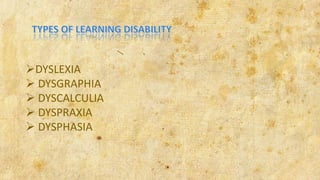
DYSLEXIA
 DYSGRAPHIA
 DYSCALCULIA
 DYSPRAXIA
 DYSPHASIA
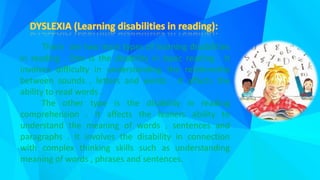
There are two main types of learning disabilities
in reading . One is the disability in basic reading . It
involves difficulty in understanding the relationship
between sounds , letters and words . It affects the
ability to read words .
The other type is the disability in reading
comprehension . It affects the leaners ability to
understand the meaning of words , sentences and
paragraphs . It involves the disability in connection
with complex thinking skills such as understanding
meaning of words , phrases and sentences.
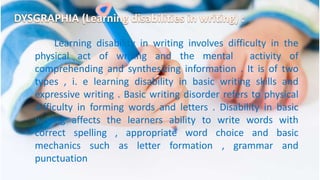
Learning disability in writing involves difficulty in the
physical act of writing and the mental activity of
comprehending and synthesizing information . It is of two
types , i. e learning disability in basic writing skills and
expressive writing . Basic writing disorder refers to physical
difficulty in forming words and letters . Disability in basic
writing affects the learners ability to write words with
correct spelling , appropriate word choice and basic
mechanics such as letter formation , grammar and
punctuation
DYSCALCULIA (Learning disability in mathematics) :
This learning disability involves difficulty in
memorization and organization of numbers ,
operation signs and numbers . A child's ability to do
mathematics will be affected differently by a language
learning disability , a visual disorder or difficulty with
sequencing , memory and organization . He may also
have trouble with counting principles or have
difficulty in telling time .
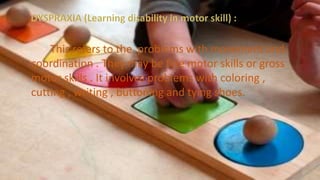
This refers to the problems with movement and
coordination . They may be fine motor skills or gross
motor skills . It involves problems with coloring ,
cutting , writing , buttoning and tying shoes.
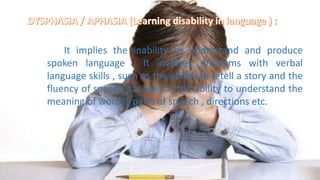
It implies the inability to understand and produce
spoken language . It involves problems with verbal
language skills , such as the ability to retell a story and the
fluency of speech , as well as the ability to understand the
meaning of words , parts of speech , directions etc.
Learning disabilities result from impairments in one or more process related to
perceiving , thinking , remembering or learning which changes the brains
functioning and processing of information . Children with learning disabilities
are not “dumb” intellectually deficient or “lazy” . The most probable casual
factors are the following .
organic Factors
 Heredity
 Environment Factors
Children with learning disabilities
generally suffer from some type of brain
injury dysfunction of the central nervous
system . Anomalies in the developing
brain , illness or injury , fetal exposure to
alcohol , low birth weight , oxygen
deprivation , premature birth ,
malnutrition and exposure to toxic
chemicals cause learning disability .
Children of persons with reading
disabilities have a slightly greater
than normal possibility of having
the same problems . There is
growing evidence that genetics
may account for at least some
family links with dyslexia .
Environmental factors are
very severe in causing
learning disability .
Environmental factors
consist of poor living
conditions and poor quality
of teaching .
There is no absolute cure for learning disabilities . They are life – long . Special
education programmes can help people cope with and compensate for these
disorders , but learning disabilities will last life time . Some useful measures
are given below .
 Give the student positive feedback .
 Give lost opportunities for practice .
 Review the students evaluation records to identify learning disability
area .
 Consult with specialists .
 provide proper instruction to address the students special needs .
 Teach organizational skills , study skills , and learning strategies .
 Work with the students parents to create an educational plan suitable
to meet the students needs .
 Establish a positive working relationship with the students parents .
Attention deficit hyperactivity disorder (ADHD) is a condition of the
brain that affects a persons ability to pay attention , sit still and
control behavior . It is a neurobiological disorder . It is one of the
most common childhood brain disorders and can continue through
adolescence and adulthood .
ADHD consist three types of disorders , each with its own
pattern of behaviors . They are Inattentive type , Hyperactive-
Impulsive type and Combined type . The combined type involves the
symptoms of both the inattentive and Hyper- Impulsive types .
 Distractibility
 Frequent switching of attention from one activity to another
 poor concentration
 Become bored with a task after only a few minutes .
 Difficulty in organizing thing properly
 Difficulty in completing assignments in time
 day dreaming
 Struggling to follow instructions
 Tendency to lose things like toys , bag , note books , pen etc.
 Difficulty remaining seated
 Excessive running , climbing etc.
 Excessive talking
 Dash around , touching or playing with everything in
sight
 Be constantly in motion
 Difficulty playing quietly
 Difficulty doing quiet activities .
 Very impatient
 pass inappropriate comments
 Blurting out answers before hearing the question
fully
 Express emotions without control
 Act without regard for consequences
 Often interrupt others conversations and
activities .
The child must show the symptoms of any type of ADHD.
 The symptoms must be more severe than in other
children of the same age .
 The symptoms must last for at least six months .
 The disorders must adversely affect at least two areas of
a child's life such as school , home , daycare settings ,
and friendships .
 The disorders should not be due to stress , depression
and anxiety .
 keen observation
 Create a routine
 Organize well
 Avoid distractions
 Limit choices
 Give clear cut directions
Discipline effectively
 Set realistic goals
 Identify the child's talent
 Lessen seating distractions
 Break down assignments
 Give positive reinforcement
Teach good study skills
Learning disability

Learning disability

  • 3.
    A learning disabilityis a neurological condition that affects a persons ability to receive , store , process , store or retrieve information . It causes difficulty for a student to learn as quickly as a non – learning disabled child does .
  • 4.
     Trouble inlearning alphabet and connecting letters to their sounds.  Making many mistakes when reading aloud  Inability to understand what one reads  Trouble with spelling Poor handwriting  Late language learning  Trouble remembering the letters and their sounds  Wrong pronunciation of words  Low self – esteem  Inability to retell a story in order
  • 5.
  • 6.
    There are twomain types of learning disabilities in reading . One is the disability in basic reading . It involves difficulty in understanding the relationship between sounds , letters and words . It affects the ability to read words . The other type is the disability in reading comprehension . It affects the leaners ability to understand the meaning of words , sentences and paragraphs . It involves the disability in connection with complex thinking skills such as understanding meaning of words , phrases and sentences.
  • 7.
    Learning disability inwriting involves difficulty in the physical act of writing and the mental activity of comprehending and synthesizing information . It is of two types , i. e learning disability in basic writing skills and expressive writing . Basic writing disorder refers to physical difficulty in forming words and letters . Disability in basic writing affects the learners ability to write words with correct spelling , appropriate word choice and basic mechanics such as letter formation , grammar and punctuation
  • 8.
    DYSCALCULIA (Learning disabilityin mathematics) : This learning disability involves difficulty in memorization and organization of numbers , operation signs and numbers . A child's ability to do mathematics will be affected differently by a language learning disability , a visual disorder or difficulty with sequencing , memory and organization . He may also have trouble with counting principles or have difficulty in telling time .
  • 9.
    This refers tothe problems with movement and coordination . They may be fine motor skills or gross motor skills . It involves problems with coloring , cutting , writing , buttoning and tying shoes.
  • 10.
    It implies theinability to understand and produce spoken language . It involves problems with verbal language skills , such as the ability to retell a story and the fluency of speech , as well as the ability to understand the meaning of words , parts of speech , directions etc.
  • 11.
    Learning disabilities resultfrom impairments in one or more process related to perceiving , thinking , remembering or learning which changes the brains functioning and processing of information . Children with learning disabilities are not “dumb” intellectually deficient or “lazy” . The most probable casual factors are the following . organic Factors  Heredity  Environment Factors
  • 12.
    Children with learningdisabilities generally suffer from some type of brain injury dysfunction of the central nervous system . Anomalies in the developing brain , illness or injury , fetal exposure to alcohol , low birth weight , oxygen deprivation , premature birth , malnutrition and exposure to toxic chemicals cause learning disability .
  • 13.
    Children of personswith reading disabilities have a slightly greater than normal possibility of having the same problems . There is growing evidence that genetics may account for at least some family links with dyslexia .
  • 14.
    Environmental factors are verysevere in causing learning disability . Environmental factors consist of poor living conditions and poor quality of teaching .
  • 15.
    There is noabsolute cure for learning disabilities . They are life – long . Special education programmes can help people cope with and compensate for these disorders , but learning disabilities will last life time . Some useful measures are given below .  Give the student positive feedback .  Give lost opportunities for practice .  Review the students evaluation records to identify learning disability area .  Consult with specialists .  provide proper instruction to address the students special needs .  Teach organizational skills , study skills , and learning strategies .  Work with the students parents to create an educational plan suitable to meet the students needs .  Establish a positive working relationship with the students parents .
  • 16.
    Attention deficit hyperactivitydisorder (ADHD) is a condition of the brain that affects a persons ability to pay attention , sit still and control behavior . It is a neurobiological disorder . It is one of the most common childhood brain disorders and can continue through adolescence and adulthood . ADHD consist three types of disorders , each with its own pattern of behaviors . They are Inattentive type , Hyperactive- Impulsive type and Combined type . The combined type involves the symptoms of both the inattentive and Hyper- Impulsive types .
  • 17.
     Distractibility  Frequentswitching of attention from one activity to another  poor concentration  Become bored with a task after only a few minutes .  Difficulty in organizing thing properly  Difficulty in completing assignments in time  day dreaming  Struggling to follow instructions  Tendency to lose things like toys , bag , note books , pen etc.
  • 18.
     Difficulty remainingseated  Excessive running , climbing etc.  Excessive talking  Dash around , touching or playing with everything in sight  Be constantly in motion  Difficulty playing quietly  Difficulty doing quiet activities .
  • 19.
     Very impatient pass inappropriate comments  Blurting out answers before hearing the question fully  Express emotions without control  Act without regard for consequences  Often interrupt others conversations and activities .
  • 20.
    The child mustshow the symptoms of any type of ADHD.  The symptoms must be more severe than in other children of the same age .  The symptoms must last for at least six months .  The disorders must adversely affect at least two areas of a child's life such as school , home , daycare settings , and friendships .  The disorders should not be due to stress , depression and anxiety .
  • 21.
     keen observation Create a routine  Organize well  Avoid distractions  Limit choices  Give clear cut directions Discipline effectively  Set realistic goals  Identify the child's talent  Lessen seating distractions  Break down assignments  Give positive reinforcement Teach good study skills