Learning disability
Learning disability 
Disorder in one or more basic 
psychological process involved in 
understanding or in using language 
spoken or written. 
Imperfect ability to listen, think, 
read, write, spell or to do 
mathematical calculations.
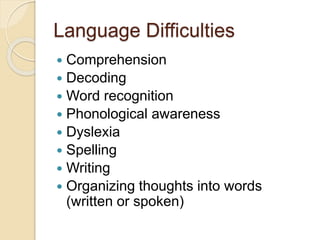
Language Difficulties 
 Comprehension 
 Decoding 
 Word recognition 
 Phonological awareness 
 Dyslexia 
 Spelling 
 Writing 
 Organizing thoughts into words 
(written or spoken)
Mathematics Difficulties 
 Computational skills 
 Word problems 
 Spatial relationships 
 Writing numbers 
 Copying shapes 
 Understanding mathematical concepts
causes 
Perceptual handicaps, brain 
injury, minimal brain 
dysfunction, dyslexia and 
developmental aphasia.
Learning disabled 
Disorders are intrinsic to 
the individual and 
presumed to be due to 
central nervous system 
dysfunction.
Criteria for determining the existence 
of a specific learning disability 
 Child does not achieve commensurate with his 
or her age and ability levels in one or more 
areas, when provided with learning experiences 
appropriate for the Childs age and ability level. 
 The child has a severe discrepancy between 
achievement & intellectual ability in one or more 
areas.
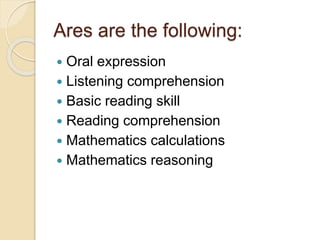
Ares are the following: 
 Oral expression 
 Listening comprehension 
 Basic reading skill 
 Reading comprehension 
 Mathematics calculations 
 Mathematics reasoning
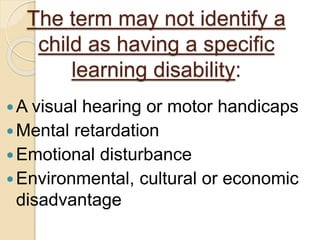
The term may not identify a 
child as having a specific 
learning disability: 
A visual hearing or motor handicaps 
Mental retardation 
Emotional disturbance 
Environmental, cultural or economic 
disadvantage
Characteristics of Individuals 
with Learning Disabilities 
 Delayed spoken language development 
 Poor spatial orientation 
 Inadequate time concepts 
 Difficulty in judging relationships 
 Direction related confusion 
 Poor general motor coordination 
 Poor mutual dexterity 
 Social imperceptions 
 Inattention 
 Hyperactivity 
 Perceptual disorders 
 Memory disorders
Causes of learning disability 
 organic and biological factors 
 genetic factors 
 environmental factors
How you identify learning 
disabled children 
 Assessment - Two types 
1. Informal assessment 
2. Formal assessment
Educational programmes 
for learning disabled 
children 
Behavioural interventions 
Cognitive behavioural interventions 
Medically based interventions 
Multisensory approach 
Direct instruction

Learning disability

  • 1.
  • 2.
    Learning disability Disorderin one or more basic psychological process involved in understanding or in using language spoken or written. Imperfect ability to listen, think, read, write, spell or to do mathematical calculations.
  • 3.
    Language Difficulties Comprehension  Decoding  Word recognition  Phonological awareness  Dyslexia  Spelling  Writing  Organizing thoughts into words (written or spoken)
  • 4.
    Mathematics Difficulties Computational skills  Word problems  Spatial relationships  Writing numbers  Copying shapes  Understanding mathematical concepts
  • 5.
    causes Perceptual handicaps,brain injury, minimal brain dysfunction, dyslexia and developmental aphasia.
  • 6.
    Learning disabled Disordersare intrinsic to the individual and presumed to be due to central nervous system dysfunction.
  • 7.
    Criteria for determiningthe existence of a specific learning disability  Child does not achieve commensurate with his or her age and ability levels in one or more areas, when provided with learning experiences appropriate for the Childs age and ability level.  The child has a severe discrepancy between achievement & intellectual ability in one or more areas.
  • 8.
    Ares are thefollowing:  Oral expression  Listening comprehension  Basic reading skill  Reading comprehension  Mathematics calculations  Mathematics reasoning
  • 9.
    The term maynot identify a child as having a specific learning disability: A visual hearing or motor handicaps Mental retardation Emotional disturbance Environmental, cultural or economic disadvantage
  • 10.
    Characteristics of Individuals with Learning Disabilities  Delayed spoken language development  Poor spatial orientation  Inadequate time concepts  Difficulty in judging relationships  Direction related confusion  Poor general motor coordination  Poor mutual dexterity  Social imperceptions  Inattention  Hyperactivity  Perceptual disorders  Memory disorders
  • 11.
    Causes of learningdisability  organic and biological factors  genetic factors  environmental factors
  • 12.
    How you identifylearning disabled children  Assessment - Two types 1. Informal assessment 2. Formal assessment
  • 13.
    Educational programmes forlearning disabled children Behavioural interventions Cognitive behavioural interventions Medically based interventions Multisensory approach Direct instruction